
Links and Notes for December 13th, 2024
Below are links to articles, highlighted passages[1], and occasional annotations[2] for the week ending on the date in the title, enriching the raw data from Instapaper Likes and Twitter. They are intentionally succinct, else they’d be articles and probably end up in the gigantic backlog of unpublished drafts. YMMV.
[1] Emphases are added, unless otherwise noted.↩
[2] Annotations are only lightly edited and are largely contemporaneous.↩
Table of Contents
- Public Policy & Politics
- Journalism & Media
- Labor
- Economy & Finance
- Science & Nature
- Environment & Climate Change
- Medicine & Disease
- Art & Literature
- Philosophy, Sociology, & Culture
- LLMs & AI
- Programming
- Sports
- Fun
- Video Games
Public Policy & Politics
The Centrists Cannot Hold by Patrick Lawrence (Scheer Post)
“There were any number of reasons not to support Donald Trump, just as there are many reasons not to support him now. But there was a greater threat than Trump, as I and a few others argued. This was the rampant abuse of government institutions — the Justice Department, the FBI and so on — and the despoliation of public discourse altogether in the cause of subverting a duly elected president.”
“[…] a piece in UnHerd the other day: “Keir Starmer has no dream.” How perfectly to the point. None of the centrist leaders holding desperately onto power has a dream, any kind of vision. They offer empty slogans and adjustments at the margin — “an opportunity economy,” lower grocery prices and so on — but nothing in the way of authentic change of the kind electorates are telling them at the polls they want. The UnHerd essay was a critical review of Starmer’s “Programme for Change.” Expect none that makes any difference was the theme.”
Humanity Imperiled by Noam Chomsky in 2013 (CounterPunch)
“[…] at one extreme you have indigenous, tribal societies trying to stem the race to disaster. At the other extreme, the richest, most powerful societies in world history, like the United States and Canada, are racing full-speed ahead to destroy the environment as quickly as possible. Unlike Ecuador, and indigenous societies throughout the world, they want to extract every drop of hydrocarbons from the ground with all possible speed.”
“What happened in the missile crisis in October 1962 has been prettified to make it look as if acts of courage and thoughtfulness abounded. The truth is that the whole episode was almost insane. There was a point, as the missile crisis was reaching its peak, when Soviet Premier Nikita Khrushchev wrote to Kennedy offering to settle it by a public announcement of a withdrawal of Russian missiles from Cuba and U.S. missiles from Turkey. Actually, Kennedy hadn’t even known that the U.S. had missiles in Turkey at the time. They were being withdrawn anyway, because they were being replaced by more lethal Polaris nuclear submarines, which were invulnerable. So that was the offer. Kennedy and his advisors considered it — and rejected it.”
“Kennedy did, however, accept a secret agreement to withdraw the missiles the U.S. was already withdrawing, as long as it was never made public. Khrushchev, in other words, had to openly withdraw the Russian missiles while the U.S. secretly withdrew its obsolete ones; that is, Khrushchev had to be humiliated and Kennedy had to maintain his macho image. He’s greatly praised for this: courage and coolness under threat, and so on. The horror of his decisions is not even mentioned”
“[…] since everything else in North Korea had been destroyed, the air force was sent to destroy North Korea’s dams, huge dams that controlled the water supply — a war crime, by the way, for which people were hanged in Nuremberg. And these official journals were talking excitedly about how wonderful it was to see the water pouring down, digging out the valleys, and the Asians scurrying around trying to survive. The journals were exulting in what this meant to those “Asians,” horrors beyond our imagination. It meant the destruction of their rice crop, which in turn meant starvation and death. How magnificent! It’s not in our memory, but it’s in their memory.”
Made in Ethiopia—or anywhere else in the world by Jean Shaoul (WSWS)
“The film is powerful, interesting and valuable precisely because it shows the universal process: that under the capitalist mode of production for private profit, the wealth created by the working class is expropriated, quite legally, by the capitalist class. The Chinese capitalists are no different in this respect from their counterparts all over the world. Furthermore, the global industrialisation, of which this enterprise park is a part, has swollen the ranks of the world’s working class, as people move from “farm to factory.””
“The Chinese try different policies to make their workers work harder: docking pay if they are late, or goods are damaged, or they work too slowly. They complain that their workers don’t value their jobs enough. They do whatever they can to increase profit. In 2020, they even forced some of their workers to live for months in the factory away from their families during the COVID pandemic. Whatever their workers do, they cannot win, earning barely enough to eat. They have no free time. Despite the promises, years after the factories have been built, there are no quality schools, hospitals or other facilities.”
“As the farmer explained, “Our sacrifices don’t help development because of the thieves in the middle.” While Motto says, in a throwaway line at the end of the film, after she has left the park to work elsewhere, “Those who fall behind get trampled on.” That is indeed the experience of workers everywhere living an economically unequal, unjust and oppressive class-based society.”
Dr Gabor Mate answers question about October 7th during conference by Middle East Eye (YouTube)
“She goes back to Burkhoff, I think, which is Hitler’s lair in the Bavarian Alps. And she goes back there to forgive Hitler, okay? And she says not because it’s okay what Hitler did, but because I didn’t want to keep him imprisoned in my heart anymore. So I’m not here to preach forgiveness but I’m telling you, that place where we call other people animals, if you want to live there, that’s your choice. I don’t want to live there. I want to understand people. I want to understand what happened to them. I want to know why they behave the way they behave.”
Fine Woke Cannibals by Matt Taibbi (Racket News)
“The obvious problem of Occupy was always that the upscale, mostly white crowds at Zucotti Park were not the same people I met in foreclosure courts. The latter group was multi-racial, lower-middle-class-to-poor, and made up of Republicans, Democrats, Independents, non-voters, everyone. At the Jacksonville, Florida “Rocket Docket” where families were tossed from homes every three minutes the rage level was so high, I worried judges would be beaten to death by the angry mothers and unemployed Dads awaiting foreclosure rulings. If you could match the rage in that room to Occupy’s message, you’d have something.
“But Occupy was never interested in actually fixing issues like robosigning or “Too Big to Fail.” Occupy instead soon highlighted supposed discoveries in building “functioning communities of mutual support,” i.e. camping, cooking, and leaderless discussions about leaderless activism. Then there was the other thing. As Tom wondered: “Dear god why, after only a few months of occupying Zuccotti Park, did Occupiers feel they needed to launch their own journal of academic theory?””
This is why US wants to separate Xinjiang from China, and CIA planned it long ago. by Li Jingjing 李菁菁 (YouTube)
She features a clip from Lawrence Wilkerson, which you can watch separately below.
US Col. exposes truth on Afghanistan/Uyghurs in 2 min − MSM doesn't want you to see this! by Lawrence Wilkerson (YouTube)
Ignore the clickbait title. This is a 2½-minute video detailing a very good reason why you’ve been occasionally told that Uyghurs in China should be your top priority.
Drone Bore feat. David J. Roth by Chapo Trap House (YouTube)
There are a lot of “likes” in this transcript but that’s just how these guys talk.
“Felix: […] multiple people do that, like Jesse Watters [of FOX News] also did that, where it’s like, ‘oh we’ll see how handsome he is in prison,‘ where the Aryan Brotherhood, the Sureños, Norteños, and Black Guerrilla Family will all unite to get revenge for Brian Thompson, their hero.”
“Felix: Jeff Andrew has the […] he looks like he is the husband to a wife who cheats on him with an eighth grader.”
“Felix: I love the idea that Iran, who their currency depreciates by half, like every year, that somehow they’re the only country that, like, gets to live in Ace Combat. Like, they they have a parasite-drone, mother-ship that can cross fucking multiple oceans without anyone noticing and then it can release, like, these would be like seventh-generation drones that could do like col-bits [?] and all this crazy shit and like if they could do that like Khommeini would not be making speeches where he’s telling people to vote.”
“Felix: Kamala can’t communicate either, but for an entirely different reason, which is that she doesn’t—when you ask her a question about shit, Israel or anything, for that matter—she doesn’t know what she actually thinks. We talked about it before, how like all successful politicians in America have, like, patter right?
“Like, when Donald Trump has nowhere to go, it’s like ‘jobs, the Wall, will be respected again, etc.’ Even Biden in 2020 had, like, you know, ‘you won’t have to watch the news.‘
“What did Kamala have that was like that, that was like an identifiable theme that she could fall back on she couldn’t even explain, like, why she was doing the things that she was doing? Yeah, I think that’s a combination of, like, where you’ve got a bad product, which is basically—she wasn’t allowed to deviate from the unpopular policies of an unpopular administration and then also either over-coaching.
“I think in a lot of ways because she did have that kind of like Teddy Ruxpin aspect of just basically like just saying a line when you’re done talking.
“Will: But there’s also, like, there’s a reason why like NFL coaches script the first 15 plays of a game or whatever, do you know what I mean? Like, you want to, like, put put the people in a position to succeed, let them get confident, and then like let them make plays, if you got to do it. In this case, it’s the scripted plays are unpopular, and also they’ve been, like, drilled down and then, like, those 15 plays just reset when you get to the 15th. Like there’s not like a strategy or any capacity to trust anyone to to do better.”
Pepe Escobar : The Syrian Tragedy by Judge Napolitano − Judging Freedom (YouTube)
A very informative video.
Scott Ritter : Putin’s Syrian Strategy by Judge Napolitano − Judging Freedom (YouTube)
A very informative video.
Ray McGovern : Ukraine On the Brink by Judge Napolitano − Judging Freedom (YouTube)
A very informative video.
I read for the very first time about something called “Captagon,” which is apparently a drug produced largely in Syria. I read about it in the local, Swiss-German paper, which, quite frankly, has extremely shady and bog-standard politics lifted from the likes of The Guardian, Das Bild, and the Washington Post. It turns out, though, that it’s a thing and there’s an entry for Fenethylline (Wikipedia) that writes,
“Fenethylline is now illegal in most countries; it is produced primarily for illicit use, which takes place mainly in the Middle East, often as a stimulant for combatants. The illicit global market for the drug was estimated in 2023 to be worth approximately US$57 billion.[4] Smuggling of “Captagon” became Syria’s principal export, exceeding the total of all other exports under the Assad regime during the period from 2011 to 2024 of the Syrian Civil War in which it ruled Syria;[5] it was considered to be the world’s largest producer of the drug, accounting for about 80% of the global supply.”
Like, duh. So drug-smuggling was the only thing left after the rest of the economy had been attacked, fomented, and sanctioned out of existence. The entry writes “Syrian Civil War,” as if that simply identified an era, rather than explained why a drug might dominate the economy.
Where Does The Aggression Really Begin? by Caitlin Johnstone (Substack)
“The guy who shot the health insurance CEO is a terrorist, but the people systematically slaughtering civilians in Gaza are not terrorists. The people fighting against those who are slaughtering the civilians are terrorists, and noncombatants are being categorized as belonging to this terrorist organization in order to justify killing them. The al-Qaeda affiliates in Syria were terrorists, but now they’re a US puppet regime so soon they won’t be terrorists — but they need to be designated terrorists for a little while longer because the claim that Syria is crawling with terrorists is Israel’s justification for its recent land grabs there. The Uyghur militant group ETIM used to be a terrorist group, but now they’re not a terrorist group because they can be used to help carve up Syria and maybe fight China later on. The IRGC is a military wing of a sovereign nation, but it counts as a terrorist group because of vibes or something.”
Where Is Syria Going After Assad and What’s Next for the Middle East? w/ Vijay Prashad by BreakThrough News (YouTube)
Vijay gives a tour-de-force history lesson for an hour. A truly impressive grasp of the history and politics and influence in the region.
Behind the News, 12/5/24 by Doug Henwood (Behind the News)
I did not find Larry Bartels’s analysis to be particularly enlightening. He claims that “the data” show him that people in towns where the factory has closed are not, in fact, mad about the economy or voting because of their precarious condition, they are voting right-wing because they are against the social change we’ve experienced over the last 50 years. That is, those close-minded yokels don’t like fags and niggers. It’s not that they don’t like unemployment, or having their entire town taken over by drugs. It’s that they’re a bunch of unwashed, slack-jawed morons who don’t even know why they’re voting—which is what he says next, when Doug asks him to confirm that inflation had a lot to do with the elections. Bartels responded that people may claim that it did, but that those people will parrot whatever they hear in the media and from their candidates, so you can’t trust that that’s the reason. Instead, Bartels will wait for “the data” to show him why they voted the way they did. I bet he’ll discover that they voted right-wing because they all hate trans people and social progress.
He pretty much talks only about the threat to democracy from Trump and Republicans and wastes not a single second talking about how damaging others might be to democracy, or to what degree the actions of the Democrats might also be breaking down democracy, and how this might actually be sweeping people into authoritarians’ lovin’ arms. He’s just another hack who thinks that people can’t be trusted with democracy. This, after he and his elite colleagues happily watch their media bend everything to the corporate will. Any discussion of these topics that doesn’t touch on the oligarchy, inequality, or rampaging capitalism that’s taking away so many of the nice things we could have.
Henwood tries to draw him into talking about Silicon Valley billionaires, but he wasn’t biting. He doesn’t think they’re that influential.
The second part, with Sopo Japaridze discussing Georgia, was fantastic. She outlined what is going on: it’s basically another NED intervention, pressuring Georgia to turn its back on Russia, despite the Green party having won the election.
Joe Rogan EXPOSES Bari Weiss's Baseless Smears Against Tulsi by Glenn Greenwald (YouTube)
It’s pretty wild how the accepted wisdom now is that you can name people and even entire countries and their leaders as “evil” and then justify never, ever talking to them. This infantile attitude leaves only bellicose confrontation, which seems to be the preferred method across the political spectrum. It’s breathtakingly stupid and morally bankrupt.
Look, it’s understandable if, on a personal level, you just never want to talk to someone again. It is not understandable to cut off diplomatic ties between countries under any circumstances. You still have to talk to them to get them to change their way, don’t you? Or do you really think you can do everything with military and economic warfare? Are you a child?
Journalism & Media
Donald Trump: 2024 TIME Person of the Year by Eric Cortellessa (Time)
“Trump’s political rebirth is unparalleled in American history. His first term ended in disgrace, with his attempts to overturn the 2020 election results culminating in the attack on the U.S. Capitol. He was shunned by most party officials when he announced his candidacy in late 2022 amid multiple criminal investigations. Little more than a year later, Trump cleared the Republican field, clinching one of the fastest contested presidential primaries in history. He spent six weeks during the general election in a New York City courtroom, the first former President to be convicted of a crime—a fact that did little to dampen his support. An assassin’s bullet missed his skull by less than an inch at a rally in Butler, Pa., in July. Over the next four months, he beat not one but two Democratic opponents, swept all seven swing states, and became the first Republican to win the popular vote in 20 years.”
What a suck-up. It’s all true but it’s so lovingly written. The photos, too, make Trump look a lot younger and thinner than he actually is.
Ein Hauch von 1984 – Telepolis löscht das eigene Archiv by Jens Berger (NachDenkSeiten)
“[…] das betrifft nicht nur die Artikel aus meiner Feder, sondern ausnahmslos alle(!) Artikel, die vor dem Jahr 2021 erschienen sind – also auch die Artikel der damaligen Redaktion und kulturhistorisch wertvolle Stücke, wie die des berühmten polnischen Science-Fiction-Schriftstellers Stanislaw Lem, von dem seit 1997 zahlreiche Essays auf Telepolis erschienen sind, von denen gerade einmal zwei 2021 postum erschienene Texte die große Säuberung überlebt haben. Auch dass ein Chefredakteur sämtliche Artikel seines Vorgängers löscht, ist in der Mediengeschichte wohl ein einmaliger Vorgang. Eine derartige Zerstörung kulturellen Erbes kennt man sonst nur von den Taliban.”
“War Telepolis früher ein kritischer Dorn im Fleisch der Mächtigen und – wie die NachDenkSeiten – ein Korrektiv zum Mainstream, bemüht man sich seitdem sichtlich um „Ausgewogenheit“, man hat seine Kanten abgeschliffen und bezeichnet das nach außen als Orientierung an journalistischen Standards.”
“Über die Hintergründe der Löschaktion und der Anpassung der redaktionellen Ausrichtung an den Mainstream kann man nur spekulieren. Die Entwicklung, die Telepolis genommen hat, ist jammerschade und stellt für die alternativen Medien in Deutschland zweifelsohne eine Zäsur dar. Seien Sie sich aber sicher, dass die NachDenkSeiten diesen Weg nicht gehen werden.”
Given George Stephanopoulos’ Carelessness, ABC’s Defamation Settlement With Trump Seems Prudent by Jacob Sullum (Reason)
“In an interview with Rep. Nancy Mace (R–S.C.) on ABC’s This Week last March, host George Stephanopoulos repeatedly and inaccurately asserted that Donald Trump, now the president-elect, had been “found liable for rape.” A week later, Trump sued ABC and Stephanopoulos for defamation in the U.S. District Court for the Southern District of Florida, noting that a jury had deemed Trump civilly liable for “sexual abuse,” not “rape.” Over the weekend, ABC News announced that it had reached a $15 million settlement with Trump in the form of a $15 million contribution to Trump’s presidential library. ABC also agreed to cover $1 million in Trump’s legal expenses.”
Words matter. Stop spreading disinformation. You can’t just willy-nilly change the names of charges to suit your personal preferences. If you don’t know the difference, then stop talking about it, or learn.
The rest of the article explains that NYS had changed the definition of the word “rape” in 2023 so people now feel free to retroactively apply the new definition. This kind of thing just screams 1984 to me, even though the new definition of rape seems quite appropriate, “nonconsensual vaginal, oral and anal sexual contact,” which would have included Trump’s having forcibly fingered his victim in a clothing outlet’s changing room in the 90s. It’s not quite as glamorous as a blowjob in the Oval Office.
The thing I always want to remind people is that, as traumatizing as the experience was for the victim, it was 30 years ago and did not have geopolitical or national impact. Can we focus on hitting Trump for depraved acts that continue to cause harm, rather than pettily calling him names for things that don’t matter in the grand scheme of things?
He gave a huge tax break to the rich. That caused and causes a lot more damage in many more people’s lives. He let Israel have the Golan Heights. He let them have Jerusalem. These things that he does are more far-reaching and relevant. Focus. We have to stop him from doing things like that.
He’s the f@&king president now. Again. Calling him a rapist won’t make him less the president. Calling him out for it is a distraction and actually plays into his hands. ABC ended up buying a wing of his presidential library (God help us.)
Labor
We still all have our needs met. (Reddit)
 Nobody ever wanted to work at all
““Nobody wants to work anymore.”
“Nobody ever wanted to work at all. We wanted to be productive, be
creative, be part of a community, be supported, be validated, and have
the time and space to truly rest. No one actually wants to trade in hours
of their life to “earn” necessities.”
Economy & Finance
Roaming Charges: All a Friend Can Say is, “Ain’t It a Shame?” by Jeffrey St. Clair (CounterPunch)
“The price of the average home in the US has increased by approximately $140,000 since 2016. In 2005, the average rent was $759 per month. It’s now $1,521.
“+ Last month, 58% of Missouri voters approved paid sick leave and an increase in the minimum wage. This month, a coalition of business owners and trade organizations filed a petition with the Missouri Supreme Court, asking it to overturn both measures.
“+ Elon Musk was the largest single donor in the 2024 election cycle, spending at least $274 million to elect Trump and other Republicans. His net worth has increased by around $60 billion since the election.
“+ According to UBS, the wealth of the world’s billionaires has more than doubled in the last 10 years and now stands at more than $14 trillion.”
“A new Gallup poll shows 62% of Americans think the federal government should be responsible for health care. It could have been 82% and Harris still wouldn’t have built her campaign around it…
“+ Sen. Michael Bennet, the Colorado Democrat: “70% of people said they want a radical transformation of the American economy. People are extremely angry because they feel no matter how hard they work, they can’t get ahead and their kids won’t either.” Bennet urges the Democrats to focus on the lack of retirement, prescription drug prices, and health care, especially mental health care.”
Bitcoin Won’t Put Food on the Table by Dean Baker (CounterPunch)
“People may feel better because they hold crypto. This can be said for lots of things. Many people feel better because they gamble, whether in Las Vegas or in financial markets, but none of these actions put food on the table. When people gamble, they are giving money to casinos. When they speculate in financial markets, they are giving money to the Wall Street boys. And, when they speculate in crypto, they are giving money to the crypto bros.
“Of course, some people can win in crypto or on Wall Street, just like some people can win in gambling, but the vast majority of people don’t. They are just handing money to the intermediaries. That will allow crypto bros and the Wall Street gang to put more food on their tables, but this is the result of taking it away from everyone else, not because they are adding to the economy’s output in any way.
“There can be an argument that financial markets, although not crypto, can increase output by better steering investments to their most productive uses. There is some truth to this, but we could probably steer investment just as effectively with a financial sector that is half its current size, as we did in decades past. The other half is just waste that makes Wall Street rich at the expense of the rest of us.”
“[…] it is understandable that politicians getting campaign contributions from the crypto bros would be singing the praises of crypto, but everyone not on their payroll should realize their song is nonsense. Crypto produces nothing, it is just a scheme to get money from the rest of us and hand it to the crypto bros.”
Blyth is Back by Radio Open Source (YouTube)
I only really disagree with Blyth about Biden’s economic accomplishments but otherwise the guy was on absolute fire. The guy who’s interviewing is a nincompoop. I don’t even know how people can stand to listen to fools like that.
At about 5:00, Blyth answers a silly question about how Trump’s corruption will be significantly different.
“Blyth: I would say that it’s just more public, to be perfectly honest, Chris. I mean, we think about the revolving door that’s been going on forever between the Obama administration and Goldman Sachs. We think about the tech companies rotating in and out of the Obama administration. Things changed slightly under Biden but, you know, basically we’ve had corporations and business and government in bed together for as long as I can possibly remember. In terms of the oligarchic point, yeah, I think what you’ve got now is a bigger scale, and it’s more brazen, and it’s more open, and the characters are different. Funding by Thiel, and your public face is Musk, etc. etc.
“You’ve got the sort of right-wing lurch of Silicon Valley on this. But the Obama unofficial cabinet was Eric Schmidt from Google. I mean, they’re just reshuffling the pack. There’ve just been more brazen about it. Are they going to be brazen in terms of corporate double-dealing? You don’t even need to do that. It’s not as if Musk needs to go and get the contracts and stuff like that. The market itself is pricing it in. SpaceX is up 30% because of all the shenanigans that he’s done. That’s the market just crediting the share price. He doesn’t even need to do anything corrupt—that even looks like it [corruption]. So I think all we’ve done is pulled the scab off of what America really is, which is basically a kind of corporate oligarchy with a democracy with tax purposes.”
The interviewer’s response is mind-bogglingly ignorant. He’s more used to people being ideologically driven, but—and here he says in astonishment—these people seem to be driven by money. Welcome to the party, pal.

At 13:43, a long segment about crypto schemes.
“Blyth: So, there’s a core of Crypto, which, you know, in a sense, makes sense, which is essentially—you want to have some kind of assets in your portfolio that other people find interesting and are willing to buy, even if they have no inherent value. We have that already; it’s called gold, right? So, think of this as a form of gold. You don’t want to just be stuck with equities. You don’t want to be stuck with bonds. You don’t want to be stuck with gold. If all these people out there think this is worth something, I’ll have a bit of it as well. That’s your simple diversification case for it.
“Blyth: Are there other use cases for it? Yeah, you keep hearing about blockchain and all that sort of stuff, but I’ll believe that when I see it. The most important thing is everybody who’s into this believes it, and because of that, the price goes up. Now, if you’ve got regulations on that, there’s going to be a ceiling on that price. If not, it’s going to go down. If you get regulations off of that, woohoo, the price goes right through, and those are basically funding the donations. They are the ones that are sitting with the biggest wallets that are going to make the biggest gains now. How does this leave it a global banking deregulation? It doesn’t. How does this challenge central banks? In the fantasies of Libertarians perhaps, but in the real world, no. Because what happens is inevitably when you get this kind of exponential rise in these type of assets, you get yet another crash. So, there’s another one on the way. It’s just a question of when. Then you get a reset. And then they’ll do it all again.
Chris: You’re speaking of it just as an investment, though. Should I put my money into crypto or not? I’m still puzzled about what is the effect of the world paying its bills and making its exchanges in this crypto non-national currency.“Blyth: So that’s slightly different. This is basically ideas like the BRICS currency; to have a digital currency that’s kind of like, you know, well, then you’re doing things like: you’re pooling the assets—the real assets: the bonds of various different governments—you’re putting them in a fund, maybe in Switzerland, and then you’re creating a synthetic bond or an instrument called a crypto X and then people trade in cryptox.
“That’s miles away from Bitcoin, cuz Bitcoin isn’t used as a currency. Nobody pays anything in Bitcoin. It just doesn’t happen. It’s purely a speculative asset. The stuff that they’re trying to do is actually closer to what central banks have—particularly in China, which is a central-bank digital currency—and you know what Chris? We already have that. Do you have an Apple phone? So you know Apple pay? Right. Well, basically it uses dollars but it’s a digital currency so if you just swapped out dollars for something else, we already got this.
“It tells you that, like, don’t be seduced by the fact that people are getting very excited about this and they say really crazy things about politics are going to follow from this. They’ve been saying this since 2008. None of it’s happened, so far. All they’re doing is egging a new speculative frenzy that’s going to be 10x more than they paid in donations, dead easy.
“Chris: What is the effect on the global economy, balancing the global economy?
“Blyth: Zero. Zero. Let me tell you why. Remember in 2021–2022? When crypto went to 57 and then went down to 20? Well, you remember Sam Bankman Freid? What was the effect on the actual economy of that happening? It kind of has been a big zero, okay? Wo what you’ve got is a 10x Ponzi scheme. That’s it. Good luck with it lads. If you’re in it to win it and you can afford to take the losses, ride the volatility, you’ll make a bloody fortune. That’s all they want to do.”
At 26:41,
“Blyth: The core of the democratic party are people who think that things are generally okay, that there are some people that are disadvantaged—they tend not to [think of] the working classes, they tend to think about other categories of folks—but you know some people are disadvantaged. But, by and large, the distribution of wealth and incomes is probably quite fair. The idea that these people are going to do massive transformations in anything, along any category, is just a complete mistake.
“And that’s the actual core of the party, the people who run the elections, the people who have the money, and the people who sit in the Senate. You take somebody like AOC and you put AOC anywhere in the European Parliament, she’d be boring center-left. Here, she’s a radical leftist, right? I mean come on. And no, she’s not radical-leftist because of the Republicans, because of the party she sits with, who literally their only vision is ‘let’s manage things as they are, no matter how dysfunctional they are for how many millions of people because we at the top 20% are doing fine and let’s not screw this up. We like our 529 plans. We like our little tax advantages. We like the fact that we can send our kids to colleges that cost $100,000 a year. For everybody else’s problems, I don’t know, maybe we got a policy for that.‘”
At 35:08,
“Chris: What’s the first test going to be of the wisdom of the election of Donald Trump?
“Blyth: I don’t think it’s a case of wisdom, Chris. Again, I mean, the choice we made, yeah, but again, think about what we say when we say this, right? We have a responsibility to do better than that. Because what you’re doing when you’re doing that is you’re implicitly scolding the people for their choice, right? The wisdom of it, right? That’s what we are doing when we’re doing this and part of the reason that we’re getting these choices is because our class collectively, for the past 30 years, has been telling everyone, in a very preachy manner, what their choice should be. And they’ve went along with our choices and they found them to be rather deleterious to their own existence and now they’re no longer listening to us tell them what to do.”
At 36:22,
“Blyth: What really has begun to frustrate me so much about the American so-called left—which is not left at all—is this idea that of, like, we define the world. We see it as it really is. And if people disagree with us, and want something else, there’s something wrong with them. The whole point of democracy is that the people make a choice. We’re not allowed to veto it. We’re not allowed to sanitize it. We can critique it. We can argue about it. But, once it’s made, you deal with it. And we’re just behaving in the worst possible way. We’re not Democrats. We’re really not. We’re defending elite privilege.”
At 39:31
“Blyth: I’ve just come to the conclusion that the Democratic party is basically the party of the top 10% management class. They don’t really want anything to change. They’re willing to give fringe benefits for marginal employees, but that’s pretty much it. And, you know, that’s really who they are.”
Science & Nature
The Google Willow thing by Scott Aaronson (Shtetl-Optimized)
“Sergio Boixo tells me that Google will only consider itself to have created a “true” fault-tolerant qubit, once it can do fault-tolerant two-qubit gates with an error of ~10 -6 (and thus, on the order of a million fault-tolerant operations before suffering a single error). We’re still some ways from that milestone: after all, in this experiment Google created only a single encoded qubit, and didn’t even try to do encoded operations on it, let alone on multiple encoded qubits. But all in good time. Please don’t ask me to predict how long, though empirically, the time from one major experimental QC milestone to the next now seems to be measured in years, which are longer than weeks but shorter than decades.”
“[…] all validation of Google’s new supremacy experiment is indirect, based on extrapolations from smaller circuits, ones for which a classical computer can feasibly check the results. To be clear, I personally see no reason to doubt those extrapolations. But for anyone who wonders why I’ve been obsessing for years about the need to design efficiently verifiable near-term quantum supremacy experiments: well, this is why! We’re now deeply into the unverifiable regime that I warned about.”
It’s NOT Lunar New Year! It’s Spring Festival, Chinese New Year. by Li Jingjing 李菁菁 (YouTube)
Today I learned that the Chinese use the lunisolar calendar (Wikipedia), not the lunar calendar.
“Their months are based on the regular cycle of the Moon’s phases. So lunisolar calendars are lunar calendars with – in contrast to them – additional intercalation rules being used to bring them into a rough agreement with the solar year and thus with the seasons.”
The bouba/kiki effect is robust across cultures and writing systems by Aleksandra Ćwiek, Susanne Fuchs, Christoph Draxler, Eva Liina Asu, Dan Dediu, Katri Hiovain, Shigeto Kawahara, Sofia Koutalidis, Manfred Krifka, Pärtel Lippus, Gary Lupyan, Grace E. Oh, Jing Paul, Caterina Petrone, Rachid Ridouane, Sabine Reiter, Nathalie Schümchen, Ádám Szalontai, Özlem Ünal-Logacev, Jochen Zeller, Marcus Perlman and Bodo Winter (Philosophical Transactions of the Royal Society B: Biological Sciences)
“Perhaps one of the most widely studied findings on the crossmodal associations evoked by speech sounds has been the so-called bouba/kiki effect. When asked to name the two shapes shown in figure 1 using the nonce words bouba and kiki, experiments indicate that the majority of participants will match bouba with the round shape and kiki with the spiky one. This general phenomenon was first demonstrated in Köhler’s [40] work with two comparable words, baluba and takete, and in a later edition with maluma and takete [41]. The phenomenon was popularized in the twenty-first century by Ramachandran & Hubbard [42] with bouba and kiki. In each instance, people’s matching behaviour demonstrates a correspondence across sensory modalities—between features of the visual shapes and features of the articulated sounds of the words. Ramachandran & Hubbard [42, p. 19] hypothesized that ‘the sharp changes in visual direction of the lines in the right-hand figure [see figure 1] mimics the sharp phonemic inflections of the sound kiki, as well as the sharp inflection of the tongue on the palate’. By virtue of this vocal mimicry—which renders a perceived resemblance between aspects of the spoken word and its meaning—the bouba/kiki effect is a prime example of iconicity in speech.”
Linked from The physics of phonetic symbolism by Mark Liberman (Language Log).
Environment & Climate Change
Roaming Charges: All a Friend Can Say is, “Ain’t It a Shame?” by Jeffrey St. Clair (CounterPunch)
“Carbon markets don’t work to reduce carbon emissions. That’s the damning conclusion of a new report published in Nature. Even so, the World Bank, US Treasury, IMF and the UN keep pushing them as a decarbonizing solution for the Global South.”
“Big Tech’s AI boom is generating a natural gas infrastructure boom. Scott Strazik, the CEO of GE Vernova, maker of gas turbines, told investors: ” “They’re not building those data centers with an assumption for anything other than 24/7 power. Gas is well suited for that…I can’t think of a time that the gas business has had more fun than they’re having right now.””
Hell and High Water: the Year in Climate Chaos by Jeffrey St. Clair (CounterPunch)
“AP survey on American attitudes about climate change: “Americans are less convinced that climate change is caused mostly or entirely by humans compared to data from recent years, declining from 60% in 2018 to 49% this year…This increased doubt was just as significant for someone who graduated from college as someone who has a high school diploma or less (11 percentage point drop) and was more pronounced for younger Americans (17 percentage point drop for those ages 18-29 vs. 9 percentage point drop for the 60+ age group)…Democrats and independents are becoming less convinced that climate change is caused mostly by humans, while Republican attitudes remain stable.””
In other news: toddlers increasingly convinced that they don’t need to go to bed earlier than anyone else. People are going to go into increasing denial when they see that they the short- and medium-term luxuries on which their lives depend are destroying their long-term existence. Mortgaging the future for today is kind of humanity’s bag. U.S.-Americans are almost uniquely deluded but peoples in other countries aren’t far behind. It’s all a matter of what kind of brainwashing is being promulgated—short-term beneficial to those who benefit from ignoring the long term? Or long-term beneficial for everyone? It’s almost like U.S.-Americans don’t even want to think about doing something that might end up helping someone else, even as a side-effect.
“Global oil and gas production has increased by 14% since 2013.
“[…] A study from U-Mass Amherst found that the US is the top beneficiary of the recent surge in global fossil fuel prices, capturing $301 billion in profit and overtaking Saudi Arabia and Russia.”
 National shares of oil profits in 2022
Medicine & Disease
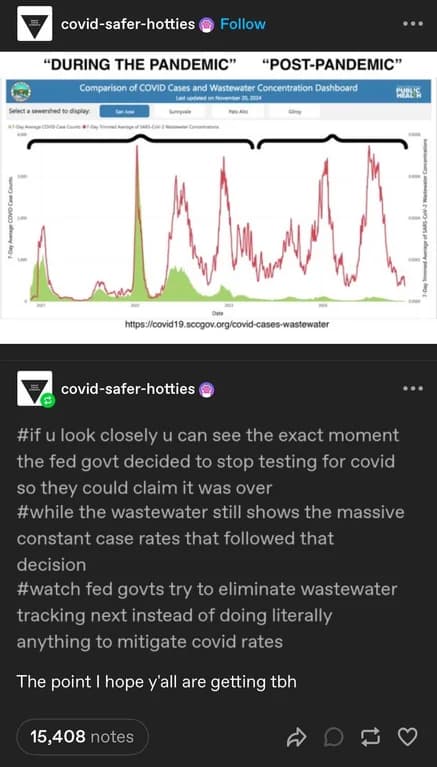
“if u look closely u can see the exact moment the fed govt decided to stop testing for covid so they could claim it was over while the wastewater still shows the massive constant case rates that followed that decision
“watch fed govts try to eliminate wastewater tracking next instead of doing literally anything to mitigate covid rates”
This is absolutely what it feels like is happening. Wastewater data is now almost impossible to get at in Switzerland. A friend of mine got a COVID vaccination; the nurse practitioner where I got my flu shot told me I’d have to get mine from my doctor. You can’t just get vaccinated anymore unless you go to the right pharmacy. The nurse practitioner told me that people just weren’t really asking for it, so they just stopped providing it. WTF? Since when do vaccines need marketing? Oh. I just heard myself. Never mind.
Art & Literature
The Art of Surrender (interview with Willem Dafoe by Matt Zoller Seitz (The Vulture)
“If you don’t put in the effort, you’re not going to receive much. And the discourse gets lowered, and everything gets a little more dumbed down and then that’s when the ruffians come in, and they’re the ones with energy and stupidity and then they can crush all the thoughtful people. That’s not good for culture, and that’s not good for humanity. We see the results of that all the time.”
“I’ve been to Japan quite a few times, and when I go to the theater there, particularly the Noh theater, I get terribly moved by those performers because there’s a whole life, a history, a commitment to the gesture, to a kind of tradition. That might sound rigid, but it’s not, because what I see is a human being living and dying onstage. You see that in dance. You see a body out there moving in time, and I like being there for that. Whether I’m an audience member or I’m an actor, I like to find that sweet spot that is free of a transactional or egotistical kind of thing.”
“All this part, this life part, has got to be, on some level, a game. Don’t get me wrong: I’m disciplined. I’m conscientious, probably to a fault. I could probably even be looser. I’m a worker. But on some level, when I’m in the middle of it, I have these pinch-myself moments that put me in kind of a giddy mood. I can’t help it. You hate to hear people brag about how much they love what they do, but it is that old thing: Love many things, and the more you do things with love, the more beautiful they’re going to be.”
“[…] we don’t just want to see imitations of life. We want to see something that is beyond that. Cinema is not just about telling stories. Everybody clings to this. Telling stories, telling stories, telling stories! It’s about light. It’s about space. It’s about tone. It’s about color. It’s about people having experiences in front of you, where, if it’s transparent enough, they can experience it with you. You become them. They become you. That’s the communion. That’s the experience.”
“It’s not about what happens. It’s about how things happen.”
This is why Tschugger is so good and Another Life sucks so hard.
The 50 Most Life-Changing Movies Ever Made by Like Stories of Old (YouTube)
This is a long video. I know, I know, clickbait-y title, but the author is someone I’ve followed for a while, and I’m forced to forgive some of my mainstays for bending to the will of the algorithm in their video titles in order to maintain and grow their audience. Also, I like to watch these things to see if there’s something I can add to my movie list. I’ve been doing this for a long time, so everything that looked interesting to me … had also already been consumed by me. 🤷🏼♂️
In this video, he’s discussing the movie “The Big Short” (excellent), which is about the 2008 financial crisis, and stars many of the financial bros who were behind the scam. The author of the video says that the director and story made him “empathize with the characters, which is not the same as sympathize,” which immediately made me think that of an earlier question posed by a good friend (“would you say that “informed sympathy” is the same as empathy”). It made me think I’d missed something.
I think it’s possible to empathize with something for which you have no sympathy. I can empathize with a soldier who’s seen and done horrors in a far-off land, doing what he has been told his whole life is his job. He’s terrorized foreign families, ripping them asunder. He returns home, descends into alcohol and other drugs, and does the same to his own family. I can empathize — that is, understand why he’s doing what he’s doing and, possibly, realize that, had I been indoctrinated in the same way, and begun life with the same innate talent and intellect, and suffered/endured the same upbringing, then I would have been unable to avoid his fate — but I cannot sympathize with him, because there is nothing sympathetic there. He is a monster. We should avoid making more.
Perhaps shorter: empathy can bridge much wider gaps in experience that sympathy cannot. It is therefore more less meaningful to empathize than to sympathize. Still, it is worth so much. Empathy allows us to find solutions to things that we see as problems. If we cannot empathize with that which we consider evil, we will never be able to address causes and will forever fight symptoms, dooming ourselves to fighting the same battles again and again.
Philosophy, Sociology, & Culture
Roaming Charges: All a Friend Can Say is, “Ain’t It a Shame?” by Jeffrey St. Clair (CounterPunch)
““Hey, Saint. I need to talk to you about Trump.”
““What about him?”
““I voted for him.”
““You what?”
““I voted for the asshole.”
““You did not.”
““I sure as fuck did.”
““Why?”
““To shake shit up.”
““You might not like the way it falls.”
““Probably won’t. But shit has been falling on me most of my life.”
““You’re really going stand up and watch him deport thousands of people?”
““I can’t stand up at all, no more.”
““You know what I mean.”
““I know what you mean, and hell no. I’ll hide people in my bedroom closet if it comes to that and block those bastards from ICE at my door. I learned a few things in the damn Army, man.”
““So what’s it all about?”
““I’m tired of nothing happening. I’m tired of being fed bullshit.”
““Trump doesn’t peddle bullshit?”
““He’s the best at it. But his BS is about doing something. Even if it’s something fucked up.”
““So you’re an agent of chaos now?”
“ “Maybe I always have been. I knocked you on your ass and looked what happened.”
““Is chaos going to make shit better?”
““Look, I don’t know how many votes I’ve got left, and I was tired of wasting it. Jill Stein? Cornel? C’mon, man. What the hell is that kind of vote worth, even if they were on the ballot here in God’s Country, which they sure as shit weren’t. A Black vote for Trump. Now that counts for something, especially from someone who is viscerally opposed to almost everything that jackass stands for.”
““Not sure I’m grasping the logic here, Spike.”
““I wanted to send those other bastards a message. We’re off their plantation, the one your buddy Kevin Gray used to warn about, and we ain’t’ coming back.”
““I hear you, but do you think they got it?”
““Fuck, no. But maybe people will wake up this time.”
““They didn’t last time.”
““Yeah, as Bobby and Jerry sang, ‘Ain’t it a shame?’”
This isn’t really philosophy, but this video pairs well with the story above. It discusses how Trump seems to personally feel about trans-gender people, about the war in Ukraine, about the war in Israel.
A New Trump Revealed In TIME's Person Of The Year Interview? by Glenn Greenwald (YouTube)
Predicting the present by Cory Doctorow (Pluralistic)
“How do people tolerate this? Again, not in the sense of “people should commit violent acts in the face of these provocations,” but rather, “How is it that in a country filled with both assault rifles and unimaginable acts of murderous cruelty committed by fantastically wealthy corporations, people don’t leap from their murderous impulses to their murderous weapons to commit murderous acts?”
“Nurses and doctors hate Thompson and United. United kills people, for money. During the most acute phase of the pandemic, the company charged the US government $11,000 for each $8 covid test. UHC leads the nation in claims denials, with a denial rate of 32% (!!). If you want to understand how the US can spend 20% of its GDP and get the worst health outcomes in the world, just connect the dots between those two facts: the largest health insurer in human history charges the government a 183,300% markup on covid tests and also denies a third of its claims.”
“The patients murdered by Navihealth are on Medicare Advantage. Medicare is the public health care system the USA extends to old people. Medicare Advantage is a privatized system you can swap your Medicare coverage for, and UHC leads the country in Medicare Advantage, blitzing seniors with deceptive ads that trick them into signing up for UHC Medicare Advantage. Seniors who do this lose access to their doctors and specialists, have to pay hundreds or thousands of dollars for their medication, and get hit with $400 surprise bills to use the “free” ambulance service.”
“Doctors and nurses hate UHC on behalf of their patients, but it’s also personal. UHC screws doctor’s practices by refusing to pay them, making them chase payments for months or even years, and then it offers them a payday lending service that helps them keep the lights on while they wait to get paid:”
“I don’t want people to kill insurance executives, and I don’t want insurance executives to kill people. But I am unsurprised that this happened. Indeed, I’m surprised that it took so long. It should not be controversial to note that if you run an institution that makes people furious, they will eventually become furious with you. This is the entire pitch of Thomas Piketty’s Capital in the 21st Century: that wealth concentration leads to corruption, which is destabilizing, and in the long run it’s cheaper to run a fair society than it is to pay for the guards you’ll need to keep the guillotines off your lawn.”
“[…] we’ve spent the past 40 years running in the other direction, maximizing monopolies, inequality and corruption, and gaslighting the public when they insist that this is monstrous and unfair.”
“As Clarence Darrow had it: I’ve never wished a man dead, but I have read some obituaries with great pleasure.”
“Murder is never the answer. Murder is not a healthy response to corruption. But it is healthy for people to fear that if they kill people for greed, they will be unsafe.”
“As a character in “Radicalized” says, “They say violence never solves anything, but to quote The Onion: that’s only true so long as you ignore all of human history”:”
on the UHC CEO’s murder by Jeff Schuhrke (Reddit)
“It’s okay for politicians & pundits to make pager jokes after Israel murders a 9 year-old & cheer when Israel levels a city block to kill Nasrallah, but it’s wrong for working-class ppl to laugh when a CEO who profited off denying them healthcare dies in a precision strike.”
It’s much easier to laugh when you know the guns aren’t pointed at you.
If someone is murdering elites, that’s a top priority for them and their elite media. If someone is murdering the poors, that is at best of little concern to them; at worst, they’re benefitting from it or even promulgating it.
The people disparaging the poors for cheering the murder of the top executive of the most rapacious and care-denying HMO in the U.S. are the same ones who cheered on the murder of dozens of thousands of Palestinians by Israel. Every time some completely unsubstantiated claim of a kill of someone high up in Hamas or Hezbollah, they cheered it unquestioned. With the murder of someone who was definitely intimately involved in setting up a machine that denies health care that people bought and paid for, their bloodlust is suddenly gone.
They care so much about a billionaire CEO whose company causes the suffering of millions but they couldn’t care less about millions starving in the deserts of Gaza. They don’t care about Americans without healthcare but they care so much about the murder of a CEO. They pick and choose the violence they deem important.
Every murder has context. The context we’re supposed to understand from this murder is that billionaires should be untouchable, so we should all shudder as the walls of civilization crumble around us. That isn’t what people did, though, because they saw no threat to themselves. Why? Because CEOs live in a different world. There is no overlap.
The fact that the media and the police single out this murder shows who their masters are. People are murdered every day. We are not encouraged to give a shit. If a poor person is killed, then, at best, we’re going to think it’s a pity, but we’re also going to kind-of believe that something they did probably led to them having been murdered. That is, they were involved in a life of crime. And we all know that crime doesn’t pay. They wouldn’t have been murdered had they not been … poor. Or a criminal. Same thing.
If we find out that that person was running a soup kitchen, we feel worse, that our world has been robbed of someone useful.
We regret the murders of those with whom we identify. If the person was a drug dealer, then most of think that they sorta, kinda deserved it. If they lead a soup kitchen, then we see ourselves in this selfless person and sympathize. If it’s a laborer in some podunk town somewhere, we just generally don’t care, if we even hear about it. At best, we think it’s a shame for a few hours. Or maybe we then hear that he’d been beating his girlfriend. Parameters changed. But then we find out that that’s not true, and that he’d probably been killed by his girlfriend’s other boyfriend. Parameters changed.
Murder is about context. We spend more or less time caring about it, depending on its proximity to us and on how the act aligns with our principles, such as they are. You don’ t have to think murder is OK to care a little bit less about certain murders. If you cared equally about all murders, you would go insane with caring—and you would appear a lunatic.
Corporate media expresses fear over public response to murder of UnitedHealthcare CEO Thompson by Kevin Reed (WSWS)
“If anything, acts of individual violence against individual representatives of the corporate and financial elite provide the ruling class with the opportunity to carry out attacks on the basic democratic rights of the working class and strengthen the repressive apparatus of the state against the mass struggles required to put an end to capitalism.”
Well, yeah, but it’s not like things were going great anyway. Things will have to be brought to a head before they get better. The system does not allow for any form of change other than radical change, in the form of revolution. Let them come for us.
Funnily enough, even the WSWS got suckered into running a subversive advertisement for a security company, in citing the New York Post, which was almost certainly directly compensated for running it.
“The New York Post also reported that […redacted…] a private security firm that provides security services to 80 percent of Fortune 500 companies, has had its phones “ringing off the hook” since the murder of Thompson on Wednesday. The Post report said a full-time security contract for a chief executive costs approximately $250,000.”
I chose not to name the security company in particular. You can see how the above citation is literally an advertisement. Like, word-for-word.
“While the murder of UnitedHealthcare CEO Brian Thompson has produced nonstop coverage on the cable news and corporate media outlets, devoted largely to the manhunt for his killer, the brutal murder of a migrant teen in New York City a day later has been barely reported. The apparent hate crime, in which 17-year-old Yeremi Colino was stabbed in the chest with a screw-driver after he replied “No” when asked if he spoke English, has elicited no police dragnet or manhunt for the suspect.”
You see? It’s all about context. Some people matter, and some people don’t.
Can One Become a Different Person? by Justin Smith-Ruiu (Hinternet)
“The young Descartes himself, ironically, once declared Larvatus prodeo, “Masked, I advance” — you will notice here, in the Latin participle, the very same root that gives the name to one of the pre-adult phases of insect metamorphosis: the larva. Yet while in 1619 Descartes seems to have had an inkling of the perfect ease with which we pass in and out of different personae or larvae, by the time of his 1641 Meditations he ended up doing more than perhaps anyone else in the history of modern thought to banish all selves but the singular self, to reduce all ruptures and splittings to mere appearance, to mere “drama”, while recasting the “self itself” as a perfect monolith, a static and unchanging fact of the matter, as certain as the social security number that now accompanies you from cradle to grave, through all your drunken debauches and erotic ecstasies and profound “life lessons”, through your deepest sleeps and your full-anesthesia colonoscopies and even your months-long comas, whether you know it or not.”
“Is there any force to the countervailing argument that, while I indeed find that the ERC and NATO and MacArthur “Genius” grants and so on are for me hopelessly “derealized”, this only enables me better to experience the full reality of other souls? Is there any force to the point that I am in fact right about all of this?”
“[…] the existential lesson of phenomenological bracketing is still an important one, and one should never forget that all of perceptual reality, like social reality, is built on fictions that we ourselves are mostly responsibly for furnishing.”
Facts.
It’s very deconstructionist but … not wrong.
“I get to look at some lovely pencil drawings by Jean Cocteau on the walls as I pick up my new prescriptions — a world away indeed from the psychiatrist’s office I so well remember in a strip mall in Ohio, with walls decorated only by stern warnings about the length of the prison sentence you will receive if you physically assault your doctor. (Holy shit what a brutal country!)”
“There was a long period of sheer despondency and alienation — every time I left the house, I found myself in a state of utter disbelief upon seeing other human beings going about their affairs as usual. I could not understand how they had failed to notice the world had ended.”
“[…] a marker of tremendous success as a social movement, trans identity is now something, indeed the only thing, powerful enough to compel the administrative state to alter the legal documents that are ordinarily supposed to fix our identity once and for all.”
That, and marriage, which literally (usually a) woman’s identity by changing the way that she identifies herself.
Our Healthcare System, a Reign of Terror by Freddie deBoer (Substack)
“This moment is being represented as a frenzy for the left, but in fact the people who are frenzied are our old friends in the tongue-clucking center-left, the fainting couch crowd. The average columnist for The Atlantic—hell, for The Nation—is someone who is much, much happier attacking the left for its supposed extremity than they are criticizing the right for anything at all.”
“[…] the fact that most establishment types are able to summon operatic compassion for the murdered CEO, but view those killed by our healthcare system only through an actuarial table, brings us to Mark Twain.
“[…] The message is as simple as it appears: it is logically and morally bizarre that historical crimes, like some of the conduct in the French Revolution, evoke our continuing indignation, while the horrible conditions that inspired those acts don’t, even though they killed far more people.”
“People hit their heads and go to the hospital but decline to be scanned when they learn how much it’s going to cost them, then they go home, go to sleep, and never wake up because they had a brain bleed they couldn’t afford to have diagnosed. Stuff like that happens absolutely all the time. And each of those people are just as loved by their families as the United CEO. The vast silence our culture reserves for their fate demonstrates moral incoherence.”
“So too with our healthcare system; it did not emerge ex nihilo but was built by profiteers who wanted to extract as much money as they could from sick people and is now defended by those who would like to go on extracting as much money as possible from sick people. Protected though they may be by many layers of bureaucracy and distributed culpability and a healthy dose of The Way Things Work, many are making individual choices that kill within that system.”
The interesting question isn’t “do you support killing people for being horrible?” The more important question is, “why do you support killing people, letting people die, letting them live lives of quiet desperation, while they’re milked for their last pennies by people who have trillions of them?”
“[…] that again is an example of decisions that we conveniently deny are decisions. That’s ideology. That’s the best interest of a particular economic class, expressed in choices that the powerful decide are not choices. But they are choices, and they invoke Twain’s undeniably powerful question: why should they be exempt from the same exact moral revulsion that people feel towards the murder wrought in hot passion?”
“[…] the fact that we have insisted that access to food must be restricted to those who can buy it in a market is a choice. That’s a decision, a human decision. It’s not nature. It’s not the hand of God. It’s a human choice with real and vast moral consequences. And the people who defend that system have their hands on the trigger. That’s just a fact.”
“Neely was, indeed, serially violent, and against senior citizens to boot. That is just to say that actual severe mental illness is inherently ugly, cannot be cured with yoga, frequently provokes real violence, and the way decent people have drained it of any negative valence does nothing at all for the mentally ill. Neely was also one of society’s great victims as well as an aggressor, a person utterly unable to secure his own basic material survival, born poor, disturbed since early adolescence, emotionally dysregulated even before his murdered mother was found stuffed into a suitcase. The world handed him synthetic marijuana and easily-jumped subway turnstiles for his trouble. This would seem to be a good opportunity for conservatives to show that they can embrace law and order and advocate for someone like Penny while still finding some basic sadness over Neely’s death − but, well, they can’t. Because American conservatism isn’t a political movement, it’s a social club for shivering cretins.”
“Douthat has not expressed any concern over Neely at all, none. Nor has Andrew Sullivan, another of our more prominent conservative Catholic writers. If only Neely had been a fetus. Why this silence? Well, I suppose the reason is that even those conservatives who work diligently to stay out of the MAGA fray can’t help but find themselves more animated by the shocking death of one CEO than by the endless drip-drip-drip of Jordan Neelys, helpless people trapped in a merciless system built by human choice and meant to serve the interests of only some humans.”
“I’m struggling to summon the words to make you understand what it feels like when you’ve successfully wrestled with a psychotic person for long enough that they’re willing to go get medical care and they can’t because the richest nation in the history of the world isn’t willing to give it to them.”
“[…] many times in my life I’ve sat by, mute and impotent, listening to a person who badly needs healthcare say into the phone “I have HUSKY,” then felt them slump in defeat when yet another receptionist has told them, sorry!, we don’t treat poor people here! This is a business, and it’s not good business to take part in our country’s stumbling, basic, half-hearted efforts to ensure that poor people can actually access medical care.
“And the way that all makes me feel − well, it makes me want to kill someone.”
DEBATE: Glenn Greenwald vs. Briahna on Luigi Mangione & Daniel Penny: Vigilante Justice for All? by Bad Faith / Briahna Gray Joy & Glenn Greenwald (YouTube)
I took the following notes as I was listening to (the first half of) the video. The video that follows this section is much shorter and a much better takes, to be honest. As I noted after that video, I’ll leave the notes I took for myself, but take them with a grain of salt, as working through the implications. The real flaw of this video is that they talk too much without presenting the facts of the case. Once you hear the facts, it becomes much more clear-cut. Still, the meta-discussion is interesting: like, which of the facts of the case would have to change in order for your judgment to change?
“You know what’s annoying me about this this kid who killed this CEO? None of these news programs are talking about the incredible lack of empathy from the general public about this being because of how these insurance companies treat people when they at their most vulnerable, after we’ve all given them our money every fucking month and now we finally need you and all you do is deny us and then these pussies and all of these things are taking the pictures of their CEOs off their websites, you know I got to be honest with you okay? I love that the that fucking CEOs are fucking afraid right now. You should be. By and large, you’re all a bunch of selfish, greedy, fucking pieces of shit and a lot of you are mass murderers—you just don’t pull the trigger. That’s why it looks clean. That’s why these people look, oh my god, oh, he was just, you know, walking into a hotel. It’s like, okay, well, what was his job? What did he do? What was the results of it?”
—Bill Burr
I just like to hear Gleen Greenwald say something like “I think what Bill Burr said was crucial […]”
From Roaming Charges: All a Friend Can Say is, “Ain’t It a Shame?” by Jeffrey St. Clair (CounterPunch),
“Cory Doctorow: “I don’t want people to kill insurance executives, and I don’t want insurance executives to kill people. But I am unsurprised that this happened. Indeed, I’m surprised that it took so long.””
They’re trying to make you feel bad about shrugging your shoulders at (or even celebrating) the death of a single billionaire. I don’t waste a second of time thinking about thousands of other murder victims. Why is this one so important? Oh. Because the gun was pointed the other way. It’s like Chomsky said about 9-11. The shocking thing was the identity of the victim not the crime.
That’s why we don’t care. There’s no way someone’s going to revenge-kill me for being a corporate overlord. It’s like every time that corporate overlords don’t care when they ruin swaths of lives. They’re absolutely not worried that one of the lives ruined by their actions will be their own. Same principle, but reversed. Part of the fun is realizing that you don’t have to give a shit.
People are showing you who they are when they defend the practices of a company like the one run by the CEO who was recently murdered. They are angry and disgusted because they are defending the world from which they themselves profit. They can’t consider that what these companies do is real violence and much more damaging and injurious than a single murder. The laws are there to protect the affluent, to protect the winners of society.
This is a very good discussion that is, mysteriously, framed as a “debate”—presumably for the algorithm. It is a mischaracterization because they basically agree on everything.
Briahna reframing in terms of tort law and which incentives are we encouraging in society to achieve which goals.
“[…] if we actually want the the harms not to befall the public, which party in a particular situation is best situated to prevent the harm from happening in the first place.”
Ah, OK, now’s they’re talking about Daniel Penny’s killing of Jordan Neely. They have a legitimate, subtle, and interesting disagreements on that. Glenn asks what people are expected to do on a train where a passenger is acting very erratic and threatening. Can you just assume that they’re mentally ill and harmless? That’s what we very often did when I still lived in NYC; you just moved to a different car; you occasionally saw something that, were it happening to a loved one, you would have intervened, just to be safe, but, since it was happening to one or more strangers, you just moved to the next train car. I’m not sure that’s morally defensible either, and yet I also never ended up endangering myself or loved ones and never accidentally killed anyone either.
Jordan Neely was mentally ill. There is no way for anyone in that train who felt justifiably threatened by his words and actions—he said he was going to kill someone and didn’t care if he went to jail or died for it—to know that it’s actually not his fault. It’s just like when you have an annoying child in your orbit: it’s not they’re fault that they’re annoying—either they were raised that way or they’re just kind of like that, despite the best efforts of their parents—but they’re still annoying.
It also wasn’t Jordan Neely’s fault that he was threatening people but he still did. Just like it wasn’t Daniel Penny’s fault that he’d been trained in the military and given a sense of justice and a desire to jump in to protect fellow passengers where he thought he could. He held the chokehold too long. But that he subdued Neely in the first place is, I think, not up for debate.
Glenn posits the hypothetical: “what if it had been a police officer who’d subdued and accidentally killed Neely?” to which Briahna eventually answers that “the response was not proportionate.”
When Glenn tries to take it as a given that the physical restraint was justified, Briahna pushes back. I find this bizarre, because she’s then claiming that just feeling threatened doesn’t entitle you to strike first. No, but it’s justified to consider physical restraint because why do you always have to wait for him to turn into the person who hauls off an haymakers a grandma in the face before you can intervene? It’s not legal to subdue someone just for talking, yes, but Briahna’s lack of empathy for wanting to deescalate the situation is kind of gobsmacking. In that case, there would be two wrongs: one guy walking around threatening plausible physical harm to people but not actually doing so (yet) and another guy who physically subdued someone who had only talked smack up until that point.
There are reasons why “fuck around and find out” and “talk shit; get hit,” are in the vernacular.
If Briahna were alone on the train and some guy came up to her and starting tell her in detail how he was “going to rape her fine black ass,” then I fail to see how she would just wait until he started doing it before she pulled out the mace.
And what if she’d been with a male friend who’d gotten up to defend her? Would she be mad at the friend if he’d shoved the other guy away? That’s technically assault and he would have technically started it. What about if the other guy were shouting right in his or her face? He’s not touching either of them, so is it assault? It sure kind feels like it would be. Especially if drops of spittle land on your face. If you then push that person away, did you start the assault? Did you really, even if the law sees it that way? What if the shove or attempt to create distance incenses the person further and they become increasingly agitated but still haven’t actually physically assaulted you? How long do Briahna’s principles oblige someone to wait until they are allowed to try to deescalate the situation? Especially when you no other information other than a large, agitated person is being very physically threatening in your presence—perhaps directed at you personally or perhaps just generally physically intimidating, in the sense that they seem likely to lash out at any moment. All of the information about Neely’s mental state and background—he’d never actually assaulted anyone—is not available in that moment. You just know that you want to get out of that situation.
As I noted above, my solution was usually to get myself and my future wife away from there. But that doesn’t help the other people, who are maybe less nimble and less able to distance themselves from the danger. The hypothesis is that Daniel Penny decided to reduce the danger for everyone. He fucked up and killed the guy. I think you’d either have to prove that he had murderous intent—i.e., that he was kind of hoping to have a run-in so he could justifiably and legally exert violence on another person—or that, once he got started, the bloodlust took over, and he wanted to kill that smelly bastard just for being annoying. But positing that it’s wrong on principle to try to provide for public safety when it’s not your job is not supportable.
Glenn speaks to this, saying,
“Let’s say, he intervened in a way that—talk the guy down, which obviously everyone would have been happy about—but let’s say that was insufficient. He had to intervene and the only way he could ensure the the safety of himself and the people on the train was to physically restrain Jordan Neely. So he does it but he does it in a way that’s just—maybe hurts his neck a little bit but doesn’t inflict any permanent damage, let alone death. They get to the next train stop; they call the police; the police come and take him. Would you have regarded Daniel Perry’s actions as justified or even heroic in that situation?”
She doesn’t accept this, though, continuing the line that this presumes that Jordan Neely would have escalated. What are you talking about? What right does Neely have to terrorize a whole train-car full of people? If it had been a drunk Wall Street executive, I can’t imagine she’d be trying to act as if someone who’d “restrained” the drunk were assaulting the guy. This is a public space, shared by many people.
She says that “you can judge someone and kill them for a pre-crime.” Christ, this lady is a trained lawyer. Sometimes she’s brilliant but man sometimes she’s an absolute fool. She’s arguing that Jordan Neely didn’t do anything. Bullshit. The person sitting there, reading his fucking phone didn’t do anything. The person who got on the train, mumbling about murdering people, did do something. Her problem with this whole thing is, I guess, that Penny intervened physically before trying to talk Neely down? It’s kind of ludicrous.
I like that Glenn is discussing the issue morally whereas she’s arguing from the side of what the law currently is.
Hell, I think, you should be able to kill anyone who uses a Bluetooth speaker in public, to say nothing of saying threatening things. I don’t think that we need to make this about a poor, non-white, mentally ill person (which Jordan Neely was) to have an interesting discussion. She finally gets to an interesting point, that Penny’s response was not proportionate, and that he didn’t let up even when other passengers were telling him to let up.
She says that he should be accountable for the outcome. She’s right about that. But with her constant hewing to “the law”, she should also understand that the prosecution pushed for manslaughter and criminally negligent homicide charges, for which, apparently, intent must be proven. They could have probably gotten him for accidental manslaughter (or whatever the hell it’s called) but probably reached for a “bigger” charge, as the prosecution is wont to do.
Glenn builds out his hypothetical, in which his theoretical police officer tries to talk Neely down but then has to physically retrain him. In this hypothetical, though, Neely reacts badly to the adrenalin or whatever, and has a completely unforeseeable heart attack. In this case, it wouldn’t be murder; it wouldn’t even be manslaughter. It’s just unfortunate. The instigator of the entire incident is the one who suffered the most. It’s not great but I honestly don’t see where society would benefit by meting out more punishment. What lesson would we be trying to teach the hypothetical cop?
It’s like if someone’s biking down a road, well within the speed limit and a little girl runs out in front of him. If he were to hit and kill her, who’s at fault? The little girl. She ran into the road. Who do you punish? No-one. She’s already dead. For what would you punish the cyclist? They did nothing to cause the accident and were actually wholly within society’s limits. If the cyclist goes flying off of his bike and breaks his neck, then what? It’s the little girl’s fault but do you punish her? Did she do it on purpose? Was she grossly negligent? Is it even possible for a child to be considered grossly negligent in a legal sense? All children are grossly negligent. It was unfortunate. Shit happened.
I think it’s important to first establish that not everything about the Penny/Neely incident was ludicrous. There is a very plausible case to be made for “shit happened” that covers most, or almost all, of the details of the case. You have to prove intent or gross negligence. There is perhaps a base to be made that Penny should have let up sooner. But stories differ about how long he subdued Neely. Neely was still alive when the EMTs arrived but they didn’t jump in because he was a smelly bastard. There are parts of the story where blame and crime could be inferred but not tout part the incident as such. If he’d stayed seated, pulled a gun, said “shut up, ni@@er” and shot him in the head, then we wouldn’t be having this discussion. But there’s a very plausible case to be made for a citizen intervention/escalation that went awry.
The discussion does on for far too long, I think, because Briahna is delighted to keep discussing minituae about the case rather than discussing the broader moral implications of what we want in a society. Glenn is much more interesting in saying that he doesn’t want to live in a society that incentivizes people not to get involved when they see assault. Briahna says that there was no assault—returning laser-like to the specific case, as if anyone cares about that, and where she was able to extrapolate and hypothesize perfectly well in the case of the deliberately murdered CEO, where she could understand the killer—and starts trying to prove how, legally, throwing your jacket and spouting threats is no assault. It doesn’t matter, Bri. The more interesting discussion is not on whether the actual charge could hold up given the evidence, whether there was actual physical assault. I think we can agree that there are definitely situations in which people feel very reasonably and legitimately threatened even if no physical violence has occurred. I know people whose lives would be ruined if someone were to accost them on the street, saying I know where you live and I will somehow get into your apartment some day and do whatever the hell I want. No physical assault. Just words. Have you ever had your home robbed? No physical assault; just someone in your home. There is no assault but you feel completely violated and uncertain. You checks the windows and doors. You used to feel like you were safe and now you don’t. Your priorities have shifted. There is no legal recourse. There is no-one to punish. But it was assault of a kind that we would like to limit or eliminate. We don’t want people fearing for their safety in society, do we? And we also don’t want to restrict people’s right to express themselves? I wonder if Briahna is for anti-catcalling laws?
Kudos to Glenn for the patience and I’ve enjoyed the first hour or so, but I’m going to have to bow out because they keep saying that they don’t know enough of the details, but then Briahna is only interesting in arguing those details. This is isn’t the first time I’ve listened to a Bad Faith podcast and gotten the feeling that Bri gets a bit too wrapped up in being right. I’m not part of the audience that is interested in legal minutiae more than I am in the philosophical or moral arguments.
I think this whole case is more interesting as a scaffold on which you can hang philosophical and moral musings, where you can determine the degree of overlap in differing views, to find out where you actually differ. Do you think no-one is allowed to do anything ever? OK, no. How much are they allowed to do? Etc. etc.
Daniel Penny's Eugenics Defense by Dangerous Ideas with Lee Camp (YouTube)
This is quite excellent, informative, and succinct coverage. I had to stop watching Briahna Gray Joy and Glenn Greenwald’s discussion because not only did they repeatedly say that they didn’t know the details of the case, but they wanted to discuss the details of the case. Also, they could not get the names of the two guys right. It was embarrassing.
Excellent conclusion by Eleanor Goldfield.
This video makes me reconsider some of my notes from above, but I’ll do that in a full article soon. These are, after all, notes and thoughts.
Trump And Israel Can’t Wait To Start Bombing Iran by Caitlin Johnstone (Notes From The Edge Of The Narrative Matrix)
“The obscenely wealthy people who rule our world are destroying it not out of stupidity or spite, but out of unconscious compulsion. A heroin addict doesn’t keep using because they don’t understand that heroin is bad for them or because they hope to overdose one day, they keep using because their addiction is driven by inner pain and psychological forces within themselves which they have not yet brought into consciousness. Becoming a billionaire and becoming a heroin addict are both irrational destructive behaviors driven by irrational internal dynamics. The only difference is that the billionaires are taking the rest of us with them.”
Some Will Rob You With a Six-Gun, and Some With a Fountain Pen by Robert Scheer & Anthony Grasso (Scheer Post)
This is a very good interview with an interesting author.
“Medicare for all, nationalizing healthcare, making these things public goods, and not leaving such important, important features of American life that are necessary to the functioning of a just and equitable society, to the whims of people pursuing profits above all else, right? People pursuing profits above all else should not be in charge of decisions over life or death for people. Right? So I think that’s an important conclusion here. If we really want to address and fix the class divisions that are the source of so much of the simmering anger, regulation ain’t going to do it. But also, punishment isn’t either, right? We have to think about, how can we radically transform the political economy to get rid of these class divisions at the root, right? So to speak, right? And that’s a I think that’s an important conclusion right in the book that I want to make very clear, right, that I think there’s a place for more punishment in the governance of corporate crime.”
The Dark Knight: Hospital Scene by Joker
“You know what I noticed? Nobody panics when things go according to plan. Even if the plan is horrifying. If tomorrow I told the press that, like, a gang-banger would get shot, or a truckload of soldiers will be blown up, nobody panics. Because it’s all part of the plan. But when I say that one little old mayor will die, well then everybody loses their minds!”
Our Product is Permission by Freddie deBoer (Substack)
“[…] the message that There Is No Alternative is always popular, telling the overeducated and insecure that the life choices they’re already making are the right ones. That is, indeed, more or less the most precious thing my industry sells. Faced with the awful financial conditions for media that have predominated in the 21st century, the industry has collectively decided that we can’t afford to tell people anything other than what they want to hear. And it’s all buttressed by the omnipresent, false belief that now is a particularly hard time to be alive. (Please go through a timeline of the 20th century, note what someone born in 1900 lived through, and tell me if you really think 2024 is all that bad in material terms.)”
“[…] a lot of readers of shortform argumentative nonfiction have a need to be told that it’s fine for them to toss a phone at their kid so they can have three hours to binge Queer Eye with a bottle of wine.”
“Life is too hard to do what’s right instead of what’s easy. Life is too hard to put others before self. Life is too hard to do anything other than pursue maximal physical and mental comfort at all times. Real friendships are hard, TikTok is easy, so let’s stare at our phones instead of going out with friends. Good therapy is hard, bad therapy is easy, so let’s therapist shop until we find one who demands literally nothing of us. Showing basic and minimal respect for people in service industries is (for some ungodly reason) hard, using digital intermediaries to avoid them is easy, so tell them to leave the food outside rather than making eye contact and saying “hello” to your minimum-wage servant. Reading a complex novel with intricate symbolism and deep allusions is hard, reading nothing but YA shit is easy, so please pass another copy of A Thing of Thing & Thing: Part IX of the Flarff Odyssey. So many behaviors that are not commendable but are sometimes understandable have been excused so many times that, rather than being something we do rarely and with a little embarrassment, they’ve become things we do proudly and all the time. See, for example, the Reddit forums that are dedicated to adult men who proudly eat nothing but chicken nuggets and Kraft macaroni and cheese.”
“[…] there were obvious benefits to a shared cultural understanding that there are artistic and personal values which are threatened by the quest for fame and money, and which are more important than fame and money, and which must be defended with communal values − that we can choose to act in a way that is more consonant with our ethics, at personal cost, if we care to and if we build a social cultural that embraces such a choice.”
“Instagram is the notorious example; few of us actually live lives that are composed of nothing but tasteful minimalism, inspiring visuals, and enviable brunch spreads, but that’s how everybody started to present themselves. The idea of authenticity in such a context is rather ridiculous, and so most people let go of it, and now a younger generation has arrived that has no idea what the term could mean.”
“I find it indisputable that in many ways our culture has essentially surrendered to the unhealthy elevation of celebrity to the pinnacle of all human desire.”
“[…] the most operative way their values play out in real life lies in the absolute rejection of the legitimacy of going to college, getting a good job, working hard, and slowly building wealth for retirement. Of living a normal 9 to 5 life. That notion has become poisonous to generations of men; it’s synonymous with being a chump, with falling for the ruse, for surrendering to the machine. They’re forever buying a meme stock or launching a cryptocurrency or trying to sell you some weird online course because they cannot fathom getting moderately wealthy, slowly. Only getting rich quick will do.”
“[…] points to a generation of young people who simply cannot see any purpose to living other than to seek attention, who think that there is no point to doing anything that is not observed and admired, who believe that we might not even exist when other people’s eyes aren’t on us. This is, among other things, a math problem: everybody can’t be rich and everybody can’t be famous. The numbers don’t work out, I’m afraid. Most people are going to have ordinary lives no mater how much they might want something different. And if ordinary lives are disdained, we’ll have masses of deeply dissatisfied adults.”
This has always been problem, with the strong preference for certain vocations, like lawyer and doctor, over others, like construction worker and mechanic. There’s even a special word for the “good” ones: they’re professions rather than vocations. Still, at least the preferred vocations in that case were societally useful, to at least some degree. Doctors are necessary, as are lawyers. Entertainers are also necessary but not in the same way. And certainly not the kind of entertainer that’s doing it for the money. Society appreciates actual artists, not scam artists.
“[…] in keeping with developing trends, they gave their project a quasi-political edge, insisting that they were in fact a downtrodden minority group, reviled by bigots, for liking the biggest and most profitable franchises in the history of media. No matter how big comic book movies and fantasy shows became, their fans never stopped claiming to be marginalized.”
“It turns out that, when you change social norms to give people permission to never stretch themselves in terms of consumption (of music, of movies, of food), very many will just default to consuming the easiest, safest, and most comfortable product out there. You could argue that this means that pure cultural populism is inevitable because that’s what people really like, so let’s shut down all the black box theaters and arthouse cinemas and alternative music venues. Or you could argue that, since it’s good for people to expand their cultural palates and be exposed to new and challenging things that they might not ordinarily try, it’s essential that we have a shared social expectation among adults that our tastes should evolve and grow over time. Can’t see that one ever coming back, though. People want to live their whole lives in emotional sweatpants.”
“[…] now you can go to a fancyish restaurant and see a middle aged person with a respectable career sitting at a table wearing a snuggie. Once it becomes permissible for a few, it becomes permissible for everybody, and everybody gravitates towards doing the lazier, easier thing.”
“[…] the message that good advice in wellness and self-help and personal development always amounts to “put yourself first.” All the arrows pointed in the same direction. And so we’re in a world where saying you don’t like Sabrina Carpenter is a hate crime and anyone who knows how to tie a tie is a representative of The Man. It’s a rejection of traditional values not in the pursuit of personal and sexual freedom or in an effort to increase social mobility or equality, but rather to serve our most juvenile and selfish instincts.”
“[…] the point of cultural commentary is to articulate some sense of how we could all do a little bit better than we’re doing now − and that we can’t get there by telling people to go easy on themselves, about everything, all the time.”
LLMs & AI
The AI We Deserve by Evgeny Morozov (Boston Review)
“In health care, AI systems now help doctors summarize patient records and suggest treatments, though they remain fallible and demand careful oversight.”
People keep saying this—use it but be careful!—knowing full well that pretty much everyone is just going to use the results without checking at all. There are no consequences for failure for most, especially if you can just shrug and blame the AI—and who could blame you for using that?
“The educational context is a case in point: if ChatGPT holds promise for personalized tutoring, it also holds promise for widespread cheating.”
What do we mean by cheating? Why we consider cheating bad? It’s because you’re tipping the scales, you’re getting value that you haven’t earned. It is only acceptable to look away from cheating if the task to be accomplished is not important, if no-one is significantly disadvantaged by it. Cheat at your communications major? Honestly, who cares? Cheat at knowing how to run the water-filtration plant? People die.
“It is here that we should step back and ask what might have been in the absence of Cold War institutional pressures. Why should the world-historical promise of computing be confined to replicating bureaucratic rationality? Why should anyone outside these institutions accept such a narrow vision of the role that a promising new technology—the digital computer—could play in human life? Is this truly the limit of what these machines can offer? Shouldn’t science have been directed toward exploring how computers could serve citizens, civil society, and the public sphere writ large—not just by automating processes, but by simulating possibilities, by modeling alternate futures? And who, if anyone, was speaking up for these broader interests?”
“AI would have developed much more slowly in the U.S. if we had had to persuade the general run of physicists, mathematicians, biologists, psychologists, or electrical engineers on advisory committees to allow substantial NSF money to be allocated to AI research. . . . AI was one of the computer science areas . . . DARPA consider[ed] relevant to Defense Department problems. The scientific establishment was only minimally, if at all, consulted.”
—John McCarthy
We took the easy way out and let our goals and principles be determined by the monsters controlling the pursestrings. This is no different than the Mafia, where they steal all of the money, then turn around and donate a relative pittance of it to a church or a soup kitchen. In return, they make sure all of their hitmen get absolution. In the same way, the Pentagon controls a huge amount of the so-called discretionary spending of the people, so it dribbles some in the direction of AI—but only if it can dictate the direction that further development takes. The primary goal is to get a bomb to autonomously find its terrorist target.
“The contrast with the design mode of instrumental reason could not be more pronounced. Eolithism posits no predefined problems to solve, no fixed goals to pursue. Storm’s Stone Age flâneur stands in stark opposition to the kind of rationality on display in Cold War–era thought experiments like the prisoner’s dilemma—and is only better for it. The absence of predetermined goals broadens the flâneur’s capacity to see the world more richly, as the multiplicity of potential ends expands what counts as a means to achieve them.”
“What sets Storm apart from other thinkers who have explored similar intellectual territory—like Claude Lévi-Strauss with his notion of “bricolage” and Jean Piaget with his observations of children and their toys—is his refusal to treat the eolithic mindset as archaic or merely a phase for primitive societies or toddlers.”
“[…] can we really dismiss the moment when the flâneur suddenly notices the eolith—whether envisioning a use for it or simply finding it beautiful—as irrelevant to how we think about intelligence? If we do, what are we to make of the activities that we have long regarded as hallmarks of human reason: imagination, curiosity, originality? These may be of little interest to the Efficiency Lobby, but should they be dismissed by those who care about education, the arts, or a healthy democratic culture capable of exploring and debating alternative futures?”
“Unlike instrumental reason, which, almost by definition, is context-free and lends itself to formalization, ecological reason thrives on nuance and difference, and thus resists automation. There can be no question of formalizing the entire, ever-shifting universe of meanings from which it arises. This isn’t a question of infeasibility but of logical coherence: asking a machine to exercise this form of intelligence is like asking it to take a Rorschach test.”
“There are elements of eolithism here, in short, but I think this is far from the best we can hope for. To begin with, all three services I used come with subscription or usage fees; the one that transforms text into audio charges a hefty $99 per month. It’s quite possible that these fees, heavily subsidized by venture capital, don’t even account for the energy costs of running such power-hungry generative AI. It’s as if someone privatized the stonefield where the original eolith was discovered, and its new proprietors charged a hefty entrance fee. A way to maximize ecological intelligence it isn’t.”
“Sure, I can build a personalized language learning app using a mix of private services, and it might be highly effective. But is this model scalable? Is it socially desired? Is this the equivalent of me driving a car where a train might do just as well? Could we, for instance, trade a bit of efficiency and personalization to reuse some of the sentences or short stories I’ve already generated in my app, reducing the energy cost of re-running these services for each user?”
“This takes us to the core problem with today’s generative AI. It doesn’t just mirror the market’s operating principles; it embodies its ethos. This isn’t surprising, given that these services are dominated by tech giants that treat users as consumers above all. Why would OpenAI, or any other AI service, encourage me to send fewer queries to their servers or reuse the responses others have already received when building my app? Doing so would undermine their business model, even if it might be better from a social or political (never mind ecological) perspective.”
“For all the ways tools like ChatGPT contribute to ecological reason, then, they also undermine it at a deeper level—primarily by framing our activities around the identity of isolated, possibly alienated, postmodern consumers. When we use these tools to solve problems, we’re not like Storm’s carefree flâneur, open to anything; we’re more like entrepreneurs seeking arbitrage opportunities within a predefined, profit-oriented grid.”
“If the main attraction of deep learning systems is their capacity to execute wildly diverse, complex, even unique tasks with a relatively simple (if not cheap or climate-friendly) approach, we should remember that we already had a technology of this sort: the market. If you wanted your shopping list turned into a Shakespearean sonnet, you didn’t need to wait for ChatGPT. Someone could have done it for you—if you could find that person and were willing to pay the right price.”
Trust Issues in AI by Bruce Schneier
Bruce wrote this essay as a response to the one by Morozov (immediately above). Although Bruce makes good points of his own, his framing his essay as a counterpoint to Morozov’s is awkward because it makes me suspect that Bruce didn’t understand Morozov’s point. Morozov’s point is that we should be building technology to serve society and not the other way around.
While Bruce does occasionally consider what the world would look like were the underlying precepts of society brought more in line with how most people innately are, rather than acting against their own interests, by infringing on the interests of others, mostly because they’ve been terrified into thinking that someone will do it to them first, a system that, not uncoincidentally, perpetuates itself for a handful of those who benefit inordinately from it.
I think Morozov is right to point out how heavily the systemic influence on all technology—and so-called AI in particular in this essay—restricts our vision of the benefits that it could bring. We are trained to understand any benefit purely in the context of the crumbs that might fall from the table of our betters. This epistemic lapse keeps us enslaved.
“AI is better understood as a creative, global field of human endeavor that has been largely captured by U.S. venture capitalists, private equity, and Big Tech. But that was never the inevitable outcome, and it doesn’t need to stay that way.”
“Modern AI, with its deep reinforcement learning and large language models, is shaped by venture capitalists, not the military—nor even by idealistic academics anymore.”
…venture capitalists who are largely funded or got rich on military contracts. Just because private money grows doesn’t imply that the state and military aren’t dictating conditions and goals. It’s just laundering, and one hand washing the other. The military’s main goal is to sustain itself and make the right people rich. The main benefactors cynically whip up fear because it’s the most reliable way to get contracts.
“A handful of for-profit companies—OpenAI, Google, Meta, Anthropic, among others—decide how to train the most celebrated AI models, what data to use, what sorts of values they embody, whose biases they are allowed to reflect, and even what questions they are allowed to answer. And they decide these things in secret, for their benefit.”
OpenAI’s postmortem for API, ChatGPT & Sora Facing Issues (OpenAI)
“The Kubernetes data plane can operate largely independently of the control plane, but DNS relies on the control plane – services don’t know how to contact one another without the Kubernetes control plane.”
This is an adorable thing to say because it tries to make it sound like there’s a benefit to having a portion “the data plane” that is working just fine but can’t be used at all because “the control plane” isn’t working. That’s like talking about how awesome the tires on your car grip the road when the tank is empty. The tires don’t matter if the car don’t go. The data plane doesn’t matter if the control plane can’t reach it. Stop the bullshitting.
How seriously are you taking AI? by Simon Willison citing Ethan Mollick
“A test of how seriously your firm is taking AI: when o-1 (& the new Gemini) came out this week, were there assigned folks who immediately ran the model through internal, validated, firm-specific benchmarks to see how useful it as? Did you update any plans or goals as a result?
“Or do you not have people (including non-technical people) assigned to test the new models? No internal benchmarks? No perspective on how AI will impact your business that you keep up-to-date?
“No one is going to be doing this for organizations, you need to do it yourself.”
Man, I don’t know. I feel like this is exactly the kind of shit that’s making everybody so antsy about whether they’re company is leveraging AI enough. It’s FOMO but for adults, apparently. There are so many other places where most businesses are positively leaking efficiency but it’s easiest to say that you’ll just slap an AI band-aid on it. Then, when it all goes tits-up, no-one can blame you because you just followed the advice the entire world was giving you. No-one considers the use cases, the benefits, the applicability to the application domain. The same artists of the world that brought us the financial crisis, and crypto are back on the prowl, telling us that AI is the thing that’s going to give you a free lunch.
Look, if this kind of thing is applicable to your firm then, by all means, check out new models. See how they work with your data. But for the love of God, don’t drop everything you’re doing and focus resources on it without a plan. Your company has priorities. See how AI fits into them, not how your priorities can fit around AI. Testing models and coming up with “firm-specific benchmarks” is almost certainly not a core competency of your company. Consider carefully much cost and maintenance you’re willing to incur willy-nilly making it one.
It’s perfectly fine advice, but you also have to see the implication that you’re probably not doing enough. This is exactly what you’ll hear shouted from every forum, every newspaper. Fool me once; shame on you. Fool me again, shame on me.
as an ai model, i cannot write archive text for webcomics by Ryan North (Dinosaur Comics)

“T-Rex: It’s the creeping blandness of them, the favourite phrasings, done to death. I hate it! if someone can’t be bothered to write something, why should I bother to read it?
“Dromiceiomimus: How can you tell you’re reading an AI story, though?
“T-Rex: That’s the thing – I can’t! I can guess – and I can certainly identify a new genre of ultra-bland slop that’s popular now – but it’s always. just that: a guess!
“Utahraptor: So, in conclusion, there’s a new style of storytelling that may or may not be AI, and you hate it.
“T-Rex: So it seems. It’s made me a much less patient reader. I used to think “haha this is horrible, imagine the person that wrote this!” but now I just get annoyed at someone using software to waste my time. So I do less reading, and I’m suspicious of everything! This is how I have to live my life now, and I hate it.”
Programming
Why IActorRef.Tell Doesn’t Return a Task by Aaron Stannard (Petabridge)
“Now for an API design question: why not return aTask? There’s two things aTaskcould mean in the context of “sending an actor a message:” The actor has fully processed the message we’ve sent it − that would transform everyTelloperation into anAsk<T>operation, which would make Akka.NET behave more like Microsoft Orleans’ RPC-centric design rather than Akka.NET’s message-centric design. The actor has accepted a message for processing in its mailbox, which is what the completion of theIActorRef.Tellcall means today.”
“We don’t want to makeAsk<T>the default way everyone interacts with actors because this would profilerate [sic] blocking everywhere, thus creating the potential for deadlocks (groups of actors all waiting on each other to respond first) − which is a common frustration that Orleans users encounter but a relatively rare one in Akka.NET. The second reason we don’t want to makeAsk<T>the default is that it’s request-response extremely slow compared toTell’s fire-and-forget model − on the order of 500k msg/s vs. 7-8 million msg/s.”
“[…] a question we get from time to time: “why not just return a Task anyway just so this ‘feels’ idiomatic to .NET developers?” The answer to this question is simple and should suffice on its own: because it doesn’t need to. “Please add more moving parts, state, and overhead to the hottest path to Akka.NET so it ‘feels’ familiar” is not a persuasive or sound argument.”
Angular v19 Developer Event (YouTube)
Man, I thought the MS videos seemed somewhat amateurish but those were downright charming compared to whatever this thing from Google is. All of the people featured in this video are so stiff, so obviously touched-up and coifed, that it’s throwing me off. The guys are hold their arms on-camera so that you can see that they go to the gym. They all do that super-annoying “I’ve taken an oration course and have learned to artificially move my hands to emphasize my points.” that people who are definitely not robots do. The one lady’s diction reveals to me that she definitely filmed her segment a dozen times. The “jokes” fall so flat that I can’t even imagine which audience would think this is funny. This video feels like it belongs in a high school. Every line is scripted. No spontaneity and it shows.
Some of these features sound pretty interesting but it also sounds super-complicated, with deferred-loading, hydration, signals, and event/replay all working together but it’s questionable who can actually take advantage of these. That’s always been the problem with trying to massively optimize your web applications as if you were Google. It’s nice that this stuff is available; it’s unfortunate that so much of it has to be opt-in because the cognitive load required to use it well is very, very high. It’s the same in React.
CSS Grid Alignment & Justification Without the Guesswork by Kevin Powell (YouTube)
Another excellent video from Kevin. TIL that align is always in the vertical direction, while justify is always horizontal. I learned that *-content moves the grid around within the space available to it, while *-items refers to the alignment and justification of the content within each of the cells. I also learned that you can change the color of the grid-highlighting in the dev tools in pretty much all of the browsers.
Also, note the difference in presentation style from the Google video above. Kevin is a real person.
Animate and do math on things like height: auto with interpolate-size and calc-size() by Kevin Powell (YouTube)
This video shows not only when and how to use calc-size(), it also mixes in advice on generating timing functions for animations, sprinkles CSS variables throughout, and even uses overflow: clip combined with an absolutely positioned element to reveal more content without disturbing the layout. The syntax for calc-size() is, as Kevin says, “weird”; you have to pass two parameters: the first is the name of the logical size you’d like to use, while the second parameter is a formula that uses the placeholder size, which accepts the value of the first parameter. In a sense you are passing the argument, along with a lambda that accepts that argument.
The following CSS sets the inline (horizontal in LTR and RTL) size of an element to be whatever the intrinsic size of the element would have been, given the size of its children, plus 3rem (where rem is the font size of the root element (MDN)).
inline-size: calc-size(max-content, size + 3rem);This video accompanies Kevin’s article for the 12 days of code 2024.
The Correct Way to Run Database Migrations in EF Core by Nick Chapsas / @gui.ferreira (YouTube)
Today I learned how to deploy migrations in production—you don’t just run them, as you would in development. Why not? Because, if you run the migrations as part of your application startup, then your application implicitly has permissions to modify the database schema—permissions that you are unlikely to revoke.
Instead, you use the dotnet-ef tool to generate an ef migrations bundle (he names the file efbundle), which is an executable that you can then just run, using the pipeline secret that has administrator access to the target database. This executable runs separately and is only in charge of migrating the database to a particular version. Your application will run and fail if the schema is not correct, which is the desired behavior. If it is correct, your application will run with a database user with much lower permissions—at the very least, it won’t be able to issue DDL commands.
The bundle option generates a binary; there is also a script option, which generates SQL. This is pretty neat and there’s even a flag called idempotent, which allows you to generate a script that will ensure that previous migrations have been applied before continuing with subsequent migrations.
The implementation isn’t as obviously straightforward and must have some limitations for custom migration behavior that uses program logic. I know, because Quino had a very similar feature and, although we could generate SQL for some user customizations to the migration process, there was no way to support everything.
It’s nice to see how solid the EF migrations story has gotten, even though I think the design still suffers when switching branches. You need much more developer discipline to keep your local database usable and in-sync. Anecdotally, I hear that most developers just trash their local database all the time, and just use more complex seeding functions.
That’s actually not a bad alternative, but for prototyping, there was nothing as fast as Quino or Atlas, which, instead of using a metadata table, read the database schema, compared against the application model and applied custom migrations to address differences.
He finished up with by-now standard advice for adding required columns (and other, similar types of breaking changes): you have to add the column as nullable with a default in the first migration, then get rid of the unwanted default value and nullability in a subsequent migration. You can only remove an unwanted field once the deployed application isn’t using it. That is, you have to drop the column for the deployed version after the version that no longer needs the column. Otherwise, you run the risk of breaking the application that is still running against that database (especially if you have multiple clients/API servers running against the same database instance).
Sports
Neil Degrasse Tyson & The Trans Athlete Issue by Sabine Hossenfelder (YouTube)
This is a reasonable take on the topic, even if she doesn’t dig into the meta-topic of why it’s so important for sports to be fair at all. Why is it so important for sports to be entertaining or “good contests”?
Neil Degrasse Tyson was arguing a hypothetical system for sorting people by hormone levels rather than by gender, which seems like a reasonable thing to say, until you consider that (A) most people are shockingly under-equipped for thought experiments, (B) they also don’t like change of any sort, and (C) they never, ever question the assumptions underlying the world they know or ask themselves whether those rules are more internally coherent than the hypothesis.
So, yeah, Piers Morgan was not the kind of brain trust on whom Tyson should have been trying out his idea. Even Tyson’s pretty good example of how we separate people into weight classes in many sports—wrestling, boxing, martial arts, weight-lifting, etc.—fell kind of flat as Morgan utterly failed to grasp the idea when he then said “yeah, but a women the same weight as a man would be destroyed in a boxing match.” Yeah, dude. That’s like, literally what Tyson was saying. Literally.
He was saying that maybe a tiered system based on hormones would be a way of achieving fairness in sports, similar to how weight is used in many sports today. He wasn’t at all saying that we should just use weight-classification and throw out gender-based classification—which has historically been a pretty good proxy for hormone-based classification. Now that it’s obvious that it’s not as good a proxy as we’ll probably need, we should start looking for something else.
But the other point I usually like to make is to ask why it’s so important who wins a high-school track meet? I wrote an article earlier this year called Redesigning the rules around restrooms where I wrote,
“There is a strong focus on sports. Women fought for years to gain legitimacy, which led to the viability of female sports careers. The window is short for them. Some have invested their whole lives.
“They were told that their investment was legitimate thing to do, something that society valued. There were certain parameters. Their competition was circumscribed by certain biological realities. Those realities no longer apply. They had grown used to having a chance, to knowing their rank. I think it’s silly, but it’s their lived experience. Fuck them, I guess? Or, maybe, just maybe, we think about it a bit more before just obviously offering preference to those who came later. Those who came before can hardly be expected to react generously, especially when the game is, by definition, zero-sum.”
We make people care a tremendous amount about winning. It shouldn’t be surprising that people get inordinately upset when someone “steals” their opportunity.
Hormones tip the scales pretty hard; it’s why hormone supplements are mostly banned from sport. But they’re not the only thing that affects performance, right? Are they overwhelming, though? What about money? It’s a great form of doping, right? Is your kid going to be able to overcome with raw talent what another kid with less talent but a personal coach is going to be able to bring to the table? Money blocks access to a lot of people to a whole world of sports. Golf, tennis, skiing, figure skating, fencing—these are all considered to be pretty elite sports, to which most people have zero access, regardless of genitals. Even swimming isn’t that accessible—you need to live near a pool to which you have access.
Are there other forms of doping? Well, what about just natural talent and genetics? Hell, a high VO2-Max is great for endurance athletes. These differ vastly among people and athletes. Should there be a different league for Lance Armstrong, Miguel Indurain, and Bjorn Dahlie? They all pegged out at over 90, which is about double what an above-average athlete has. An elite athlete has about 2/3 of that.
There are so many factors but we’re used to all of those. People long ago accepted that poor athletes are just going to have to work harder than rich athletes but it is also accepted that you can actually bridge that gap. People are worried that you can’t bridge the hormone gap and they’re wondering whether someone’s just going to swoop in and steal their—or, even worse, their children’s—opportunity at a scholarship, at a better life.
Is their defense of this territory fair to the trans-people, who are also trying to get ahead in a cruel world? Of course not. “This is my land; I stole it fair and square,” isn’t an ethical argument.
As with the bathroom debate—see Redesigning the rules around restrooms—the problem of who gets to participate in which sports boils down to a problem of “don’t change anything while (I think) I’m benefitting from it.” In the case of bathrooms, we saw that the bathroom situation isn’t great in the first place, with a minimum of money put into designing comfortable spaces to be at your most vulnerable in public. Not only that, but the nearly complete disappearance of public toilets is a crime.
Similarly with sports: people need to reconsider the overriding dominance that sports has in their lives, both for personal well-being and as a vehicle to ensure success and comfort for their progeny. They would probably still want to win but, if they were able to see it from a wider angle, they might no longer be so bitter if they suddenly stopped winning.
Tonya Harding wanted it more because she had to. She saw figure skating as a way of getting out of grinding poverty. Her crew did terrible things to ensure that. These pressures don’t go away by themselves. As usual, we’re going to see people who are just trying to survive—and succeed, which they often confuse with survival (but that’s another story[3])—being called terfs and anti-trans when their motivations are elsewhere. They would be rabidly against anyone who came along and took their daughter’s shot at a scholarship, which seemed to be in the bag a couple of months ago but is now in danger since Michaela showed up and started blowing everyone out of the water.
They don’t see themselves as having a choice. Society has trained them to get ahead no matter what. If you have to disqualify a member of an even more disadvantaged group to get ahead, then so be it. They’re trained to fight amongst themselves rather than trying to change the system that makes them all miserable.
Fun
Israel Has The Right To Defend Itself | Stand-up Comedy by Daniel Fernandes (YouTube)
“I don’t know which side you’re on, but I am on the right side.”
Presented without comment by Donald J. Trump (Reddit)
 Trump Shitposting about Chris Christie
The incoming POTUS, ladies and gentlemen. Shitposter extraordinaire.
This is apparently a real tweet from Donald Trump. He is alluding to a possible explanation for the prevalence of drones over New Jersey. Obviously, someone made this for him and made him aware of it. He reposted it though, under his own account, probably because he’s just the kind of mush-brain who thinks it’s hilarious and wants to share it with everyone in the world right away and doesn’t think about potential consequences or drawbacks at all.
A good friend wrote,
“Hes the master of pointing out his own qualities in everyone else. It’s like me calling you out for being a cynical, sarcastic foul-mouthed bastard.
“Its more fun than actually coming up with an infrastructure or healthcare plan”
It’s also within reach for him. I think he would be surprised to hear that anyone seriously expects an infrastructure or healthcare plan from him. I mean, nobody was talking about that boring stuff during the campaign, right? Just immigrant hordes or joy vibes. Pick your poison.
The first response to his tweet is this:
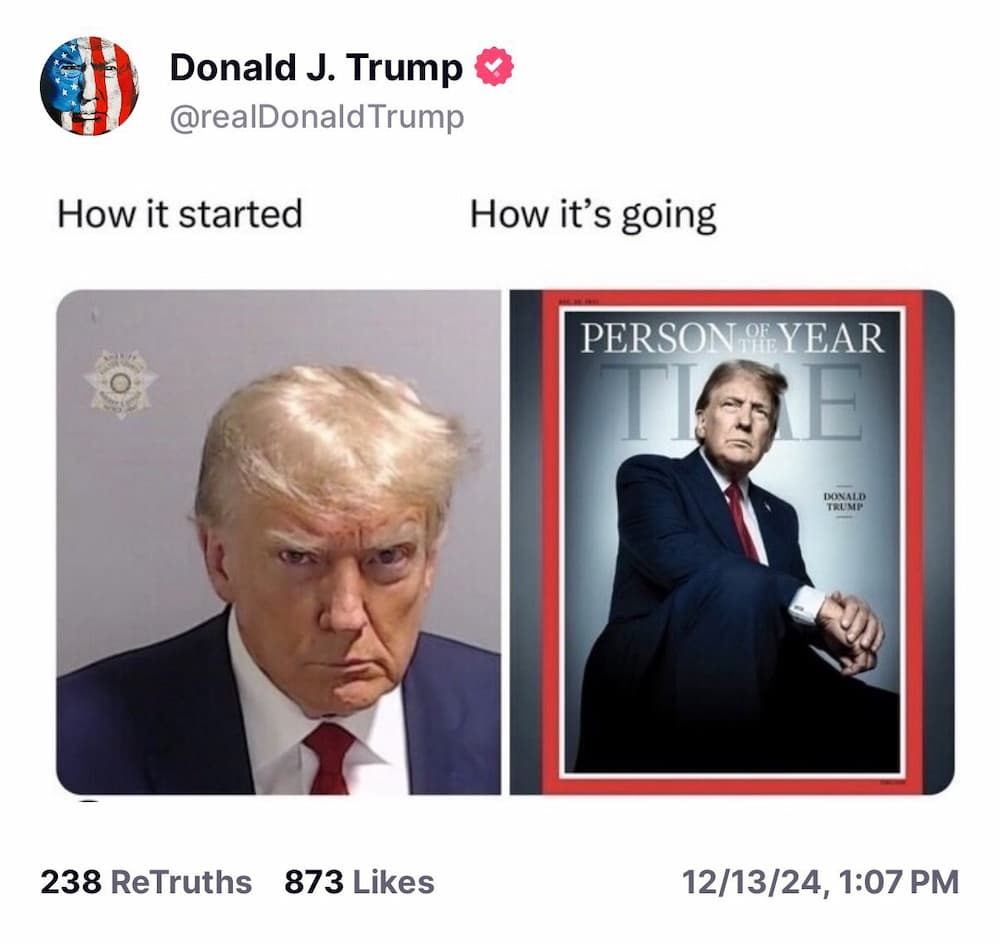 Trump, how it started, how it's going
Justin Bieber Forgets Wife’s Name (The Onion)
“Staring blankly at the 27-year-old woman sitting across from him, musical artist Justin Bieber told reporters Thursday that he had forgotten his wife’s name. “I’d just keep saying ‘babe,’ but I think she’s starting to catch on,” said Bieber, who admitted that he had “zero clue” whether the woman he had been married to for the past six years was a Hadid sister, Patricia Arquette’s daughter, a former Disney Channel star, or someone else. “I know I said it after our vows years ago, but after a while, it just goes out the window,” he continued. “Oh, God, she’s looking right at me. What is it, Harley? Holly? Hattie? Pattie? No, Pattie’s my mom’s name. I’ll just ask my manager to introduce himself to her in front of me. Shit, what’s my manager’s name?” At press time, Bieber was reportedly googling “Justin Bieber wife” under the table.”
Husband Helpfully Points Out All Historical Inaccuracies In Wife’s Favorite Period Drama (Babylon Bee)
“Peter noticed that one of the signs on a railway station platform was lettered in Gill Sans, which actually wasn’t standardized until the late 1920s. […]
“Peter said Ellenor was “fairly unimpressed” by his addition to the viewing experience.”
“Fairly unimpressed” is the best outcome you could hope for. In the accompanying graphic, you can even see him holding the remote that he’s using to pause the show so that he has enough time to explain. This is a man about to be strangled to death and chopped up in a bathtub.
Interview with Product Manager in 2024 [Corporate] by Programmers are also human (YouTube)
Interview with Dying Company's Product Manager by Programmers are also human (YouTube)
Cunk on Life – Trailer by BBC (YouTube)
I’ve not watched this show, or any of the others she’s made (yet), but this trailer has a fantastic joke with Physicist Brian Cox, which only really works when spoken out loud.
Cunk: Are who are you?
Cox: I’m Brian Cox, professor …
Cunk: Can I call you Brian? Or do you prefer Cox?
“I’m not gon’ lie to my child. I’m not gon’ make him believe that there’s a white man rollin’ through the ghetto, givin’ niggas PlayStations. No baby, daddy bought that with his weed money. Can you say sacrifice?”
Which list were YOU on as a kid? 🎅 by BBC / Philomena Cunk (YouTube)
“Santa has a list of good and bad children. The good children will get lots of presents. And, so it turns out, will the bad children. In fact, the only ones who won’t get very much are the poor children. That’s because Santa judges a child’s goodness based largely on parental income.”
Dog Day Afternoon: The Christmas Edition by Chris Hedges in December 2024 (YouTube)
I am just delighted to see that this tradition continues. I am not surprised that Mr. Fish is funny, or that he’s a reasonably good actor. I am delighted every year to discover that Hedges has a lighter side and that he’s a good actor, hitting the comedic beats like a natural.
You can find the other two videos here:
An Xmas Gift From Hedges and Fish: The Miracle of the Two Saps and the Tree, a truncated ScheerPost Christmas allegory by Scheer Post in December 2022 (YouTube)
Dear Sanity Claus (starring Chris Hedges and Mr. Fish) in December 2023 (YouTube)
2024 Year in Review (PornHub Insights)
The U.S. had about the same percentage increase for “sneaky cheating” as the French did for “femme a lunette”. This blog post is 100% worth it just to learn terms like “milf culona” in Spanish, with “culo grande” (Italian as well) being a through-line for pretty much all countries. Ukraine wins with a trending search for “на мотоциклах” (on motorcycles).
The breakdown of top relative term by state was illuminating. I wonder if it’s actually true? Iowa with “Work trip”? Pennsylvania with “Naked women”? Rhode island with “wedding”? Connecticut can’t possibly be “queef,” can it? What the hell?
Still, I love that NYS is “Turkish” because I’m thinking that Eric Adams did that all by himself. I feel like “footjob” in Colorado is also the work a one—or at most a couple—of highly dedicated individuals.
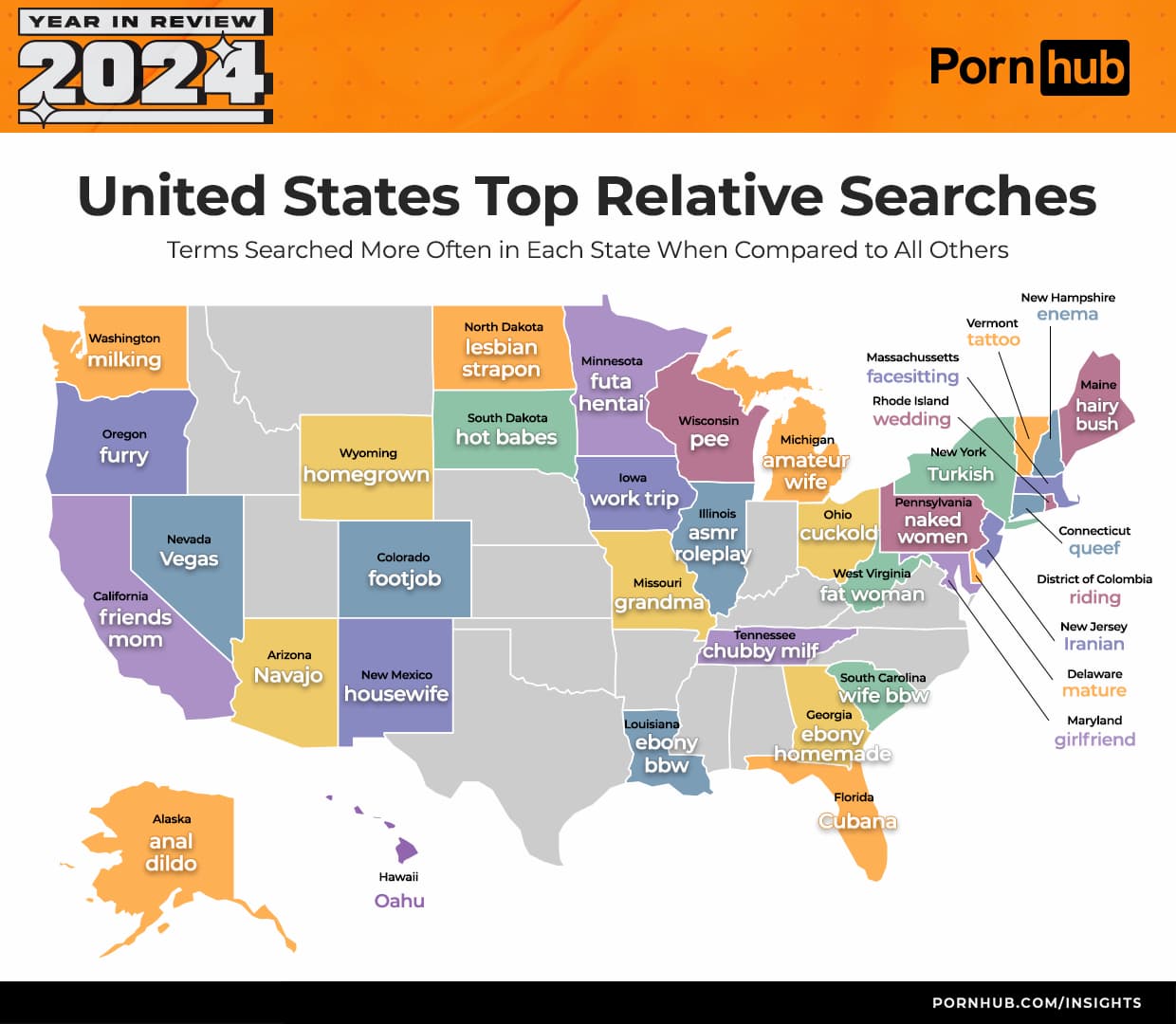 Pornhub insights 2024: United States, top relative terms by state
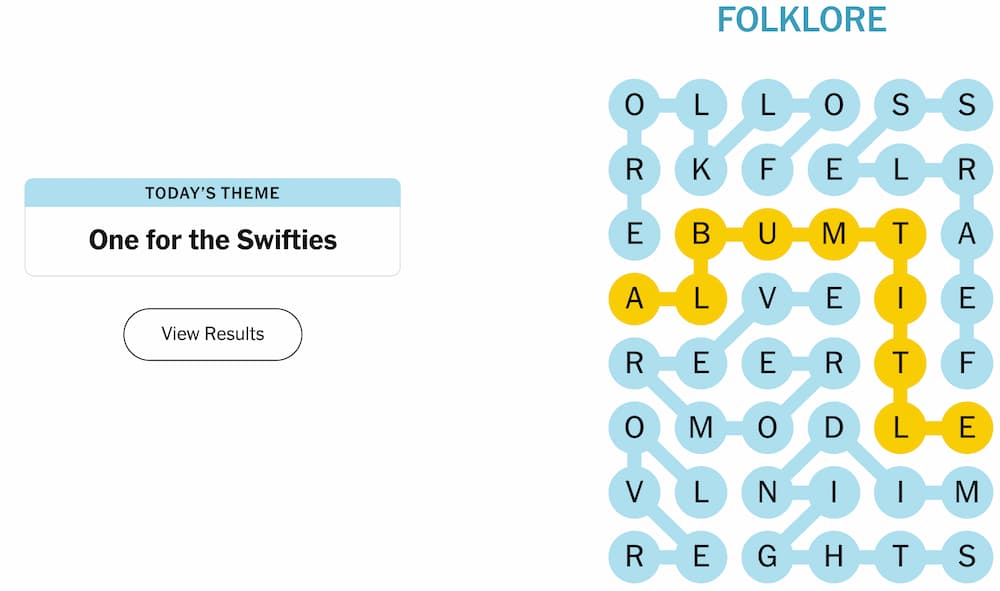
Taylor Swift is so basic that I could guess her album titles even though I’d never heard of a single one of them. Folklore, Evermore, Fearless, Lover, Midnights. Really? 🤦♀️
 Shopping Queen − Motto in Bielefeld, ep.2692
I was zapping around the other day and couldn’t help but notice this show in the TV Guide. What caught my eye was that this is identified as episode 2,692. What the actual hell? Not only are two young ladies on TV shopping for themselves, but they’ve made going on 3,000 episodes of it? 🤦♀️
 Manukka Honig is too good and expensive not to steal
I saw this in a store the other day in Switzerland and was kind of surprised to see that shoplifting was getting out of control here, too. But then I saw the strange name and the super-high prices and figured that a bunch of local girls and women were being turned into criminals by their overarching need to purchase things that the influencers they follow tell them are necessities for life.
Video Games
How Path Tracing Makes Computer Graphics Look Awesome by Computerphile / Lewis Stuart (YouTube)
“Path Tracing takes into account all sorts of indirect light sources to make graphics look real.”
“If you want to render a scene, you’ve got to decide between the three methods: you can rasterize, which is very quick but can’t handle complex lighting effects very easily. Ray-tracing, which is a bit of a middle ground. It’s slower than rasterization, can create cool detail, but may struggle with really crisp lighting effects. Or you can use path-tracing which is a lot slower but wow does it look good.”
Nvidia’s new app is causing large frame rate dips in many games by Kyle Orland (Ars Technica)
“The problem, it seems, stems from the Nvidia app’s integration of new, optional Game Filters. The company says these “AI-powered” filters can provide “dynamic vibrance” to “better distinguish in-game elements” or virtual HDR color support in games not coded with HDR in mind.
“Apparently, merely having these optional filters enabled in the app takes its toll on game performance whenever the app is running, even if the filters aren’t actively being used in a running game. To fix the problem, you have to turn off the Game Filters feature completely in the Nvidia App itself (“Nvidia App Settings > Features > Overlay > Game Filters and Photo Mode”).”
It should have been off in the first place. It should never have been developed. Stop interfering in everything. This is a what a super-high market-cap company does: they enshittify, they meddle, they think because they’re company is worth a lot that people actually care what they think, that people want them to impose their “filters” on how everything you experience looks. All of the companies are doing this, layering their LLM-shit over everything, blurring and obscuring while claiming that they’re enhancing.
I still remember the good, old days when graphics-card companies would make everything look worse but to make the games go faster (Voodoo, I’m looking at you).