
Links and Notes for March 28th, 2025
Below are links to articles, highlighted passages[1], and occasional annotations[2] for the week ending on the date in the title, enriching the raw data from Instapaper Likes and Twitter. They are intentionally succinct, else they’d be articles and probably end up in the gigantic backlog of unpublished drafts. YMMV.
[1] Emphases are added, unless otherwise noted.↩
[2] Annotations are only lightly edited and are largely contemporaneous.↩
Table of Contents
- Public Policy & Politics
- Journalism & Media
- Economy & Finance
- Philosophy, Sociology, & Culture
- LLMs & AI
- Programming
- Fun
Public Policy & Politics
Surrendering to Authoritarianism by Chris Hedges (Substack)
“Elite universities such as Harvard, Princeton, Columbia or Yale, were created to train and perpetuate the plutocracy. They are not and never have been centers of cutting-edge intellectual thought or hospitable to dissidents and radicals. They cloak themselves in the veneer of moral probity and intellectualism but cravenly serve political and economic power. This is their nature. Don’t expect it to change, even as we fall headlong into authoritarianism.”
“Many of the dregs of the Trump administration are products of these elite academic institutions. I can assure you their children will also attend these schools despite their public denunciations. Rep. Elise Stefanik, who humiliated in congressional hearings the presidents of the Massachusetts Institute of Technology, Harvard and the University of Pennsylvania, graduated from Harvard. Vice President JD Vance graduated from Yale Law School. Trump graduated from the University of Pennsylvania. Defense Secretary Peter Hegseth went to Princeton University and Harvard’s Kennedy School of Government. Secretary of Health and Human Services Robert F. Kennedy Jr. — who has ordered a review of grants to universities from his agency over allegations of antisemitism — graduated from Harvard.”
“[…] they are hedge fund managers, venture capitalists, corporate lawyers and in our case, arms manufacturers as well.” She went on: And they see that responsibility is to protect only the endowment. I often describe Columbia — which is the largest residential landlord in New York City — as a real estate holding operation that has a side hustle of teaching classes. It has evolved over time into just a business that enjoys nonprofit status. And so when the pressure started here, there were no voices on the boards of trustees to say, ‘Hey, wait a minute, we have to be the front line of resistance.’ Or at a minimum, we have to defend our academic mission.’”
Season of the Sophists by Patrick Lawrence (Scheer Post)
“We have here three cases, among countless others like them, of sheer sophistry. You get a lot of this from the liberal class these days, Trump Derangement Syndrome having roared back among us. President Trump is doing some very worrisome things — yes, certainly. And if it weren’t for Trump, everything would be copacetic, we are invited to think, we must must think, because nobody was doing anything worrisome before Trump came along.”
“Even law school deans can be ideologues more given to reflex than thought, it turns out. Even they can be prone to deflecting responsibility for things gone wrong so as to protect the monster known as the liberal elite from scrutiny (and at times to keep some of its prominent members out of the dock).”
“The whiff of intellectual chicanery in this is very strong. It is artful dodgery, consisting of the truth but not the whole of it. I do not care for the term, but let’s go with it for brevity’s sake: The Democratic Party and its institutional allies have weaponized the Judicial Branch over the past, I would say, 10 years, and as long as people of purported authority pretend this problem began on Jan. 20, the urgently needed restoration job will go nowhere.”
“[…] the Democratic Party elite began subjecting the nation’s highest institutions of justice and law enforcement to rapacious abuse as soon as Donald Trump made clear, in 2015, he would run for president. In short order, the Democrats made common cause with the intelligence apparatus, the Justice Department itself, and the Federal Bureau of Investigation. (Let us leave out the pitiful self-degradations of mainstream media for now.)
“The sprawl of the Russiagate farrago, the Mueller investigation, the CIA’s unlawful operations on American soil, the open-and-shut complicity of senior FBI officials on behalf of Hillary Clinton’s campaign: All this compromised the impartiality of America’s judicial system — damage not easily erased. Once Trump was elected, this diabolic cabal set about subverting the Executive Branch to an extent that what transpired sometimes looked like a bloodless coup. Among much else, Americans witnessed extensive programs of censorship dressed up as “content moderation.” Defenders of the First Amendment got marked down as—a new one on me, have to say—“free speech absolutists.”
“Then came the much-more-of-the-same Biden years. What had been a sabotage operation to take down a president became an operation to protect his flagrantly corrupt successor while, as mentioned above, instrumentalizing law to keep his predecessor-cum-challenger out of politics altogether. Before it was over the rot this time ran straight up to Merrick Garland, Biden’s attorney-general, and Christopher Wray, the FBI’s director.”
“My point is that in refusing to acknowledge the messes Democrats and their allies made in the recent past, those now carrying on about Trump’s abuses of justice are effectively preventing any effort at reform or recovery. This is gross irresponsibility on the part of people who pretend to the rectitude of the old New England preachers.”
“Even for those who have no use for Donald Trump, it was bad enough to watch the DoJ instrumentalize the law to attack a presidential candidate. Now we must face the bitter reality that those years of institutional misuse serve to license Trump and his people on the judicial side to carry on the abuses.”
“When The Banality Of Evil Becomes Normalized, It Grows Unchecked.” by Francesca Albanese (ZNetwork)
“In my three years of speaking about Palestine in around twenty countries, I’ve never encountered anything like in Germany. The real pressure isn’t just on me — it’s on Germans themselves. This is outright censorship and self-censorship. I was shocked by the level of repression at the event I was part of. It wasn’t physical violence against me, and I’m immune to slander, misogyny, and personal attacks. What struck me was the silencing effect on Germans.”
“The issue goes beyond Palestine, which is just the trigger. Germany has aligned itself so blindly to the idea of protecting Israel at all costs, as a pillar of its state identity, that it struggles to see reality for what it is, and fundamental freedoms are being sacrificed.”
“If hundreds of thousands have taken to the streets against the far-right, then three times as many should be protesting for their own fundamental rights. Academics should refuse to teach until the freedom of expression and academic freedom are restored. Media outlets that engage in defamation and intimidation should be taken to court.”
“What I do know is that I was shocked when — I believe it was from the District Court of Frankfurt — I was labeled an antisemite. That is pure and simple defamation. And yet, no one protested. A UN Special Rapporteur is insulted and slandered by a court, and there are no consequences? I can’t fight battles in every country. It should be up to civil society.
“When the banality of evil becomes normalized, it grows unchecked.”
“[…] the situation in the West Bank is not fundamentally different from what is happening to the Palestinian people as a whole. In Gaza, the attack has been genocidal in its intensity, but the same logic of destruction is being applied in the West Bank — though in a way that garners less attention, with fewer visible explosions. Palestinian communities are being forcibly displaced, their homes demolished, their hospitals destroyed, their farmlands burned.
“What worries me most is whether the world will recognize this genocide for what it is — the ability to see Israel’s violence as a systematic attack on the Palestinian people as a whole, across the entire occupied territory. Because that is exactly what it is.”
It absolutely isn’t. The world is largely and at best mildly embarrassed to hear Palestine mentioned in otherwise polite conversation. These days, people only get stirred up if the press is stirring them up. If the press uses that power to keep them from getting stirred up, then they’ll remain calm for a long time, anesthetized by propaganda.
“I believe the situation won’t shift positively — meaning for the freedom and rights of all people — unless there is a massive mobilization. This is a systemic struggle, but unfortunately, people don’t see it. I keep saying it: we are at the potential tipping point of a necessary revolution. Right now, capitalism has armed itself — with technology, communication channels, cloud control, artificial intelligence, and weapons. Either we resist now, or it will be too late. Resisting in defense of rights is a necessary action at this moment.”
“[…] justice would absolutely be desirable. But the problem is, we don’t live in a just world. We don’t live in an equitable world. A just and equitable world must be built, and it takes the strength and awareness of everyone to do it.”
Unilateral Coercive Measures and the War on Women by Vijay Prashad (Scheer Post)
“In 1945, when the United Nations Charter was drafted, its authors and those who first adopted it carefully crafted language on how to deal with armed conflict in the world. Between the signing of the charter in June and its coming into force in October, the United States dropped atomic bombs on two Japanese cities: Hiroshima, on 6 August, and Nagasaki, on 9 August. It is hard to digest the fact that as the charter’s solemn preamble was being formalised, setting out to ‘save succeeding generations from the scourge of war, which twice in our lifetime has brought untold sorrow to mankind’, the United States armed forces were preparing to destroy two civilian cities in a country already on the brink of surrender.”
I find it all too easy to believe. I would be surprised to learn that they’d called it off because it would have been immoral and hypocritical.
“The most important thing about this resolution is that the use of sanctions (a word that does not appear in the charter) must be authorised by the UNSC. One state can apply its own sanctions on another state in a bilateral dispute, but it cannot legally force other states to abide by them. To do so is a violation of the UN Charter.”
“[…] from 2000 to 2021, the last period reviewed by the US Treasury Department, the number of US sanctions increased by a remarkable 933%. The reason why US sanctions, which would be legal if they were merely bilateral, are illegal is that the United States chastises and punishes third countries that violate them and transact normal commerce with sanctioned countries. Because the United States is at the centre of the international financial system (with the dollar, the SWIFT global payments system, and its veto power in the International Monetary Fund), it is able to strangle countries that otherwise would be able to compensate for the loss of trade with the US by trading with the rest of the world.”
“May peace, impossible as long as
there are nations and borders,
never find you dreaming idly
and without a good rifle on your back.“For the day when we all
have a weapon and a desire for a different life,
the entire Earth will become one homeland.“In order for there to be peace, my daughter,
the poor of the world must take up arms.
And, for this reason, I want you to be a soldier.”
You might as well. The rich have been waging war for centuries.
Bombing the Bombed, Displacing the Displaced, Starving the Starved by Jeffrey St. Clair (CounterPunch)
“On Monday, 16 Palestinian medics working with the Red Crescent were reported missing. On Thursday, their bullet-ridden bodies, which the IDF had hastily buried, were discovered in Rafah, near their barracks. The Israeli forces had also destroyed all of the ambulances and civil defense vehicles.
“Dr. Fadel Naim, an orthopedic surgeon and former chair of the Palestinian Physicians Syndicate, on the killings of 16 Red Crescent and Civil Defense workers in Rafah: “After coordinating with the International Red Cross, Civil Defense crews entered the site and discovered that the occupation forces had executed all the Civil Defense and Red Crescent crews who had gone missing four days earlier in Rafah, Tel Sultan, and had buried them near the barracks. All Red Crescent ambulances, first aid kits, and fire engines belonging to the Civil Defense had also been destroyed.””
“Calling the Strip the victim of Israel’s “fatal thirst policy,” the report notes that the IDF targeted destroyed all of Gaza’s sewage treatment plants, 70% of its sewage pumps and 655 kilometers of sewage lines, causing untreated sewage to flow into streets, yards, and home. Israel also demolished 496 desalination plants, which provided Gaza’s main source of safe drinking water. As a result, daily water consumption in Gaza has declined by 97 percent and is now between a mere 3 and 15 liters. (The global average is more than 100 a day.)”
“This emaciated fellow, my comrade, was the Chief of Orthopedic Surgery at his hospital. When he refused to abandon his patient in the operating room, an Israeli soldier shot him, shattering his knee bones across the operating room floor. His trainees then operated on him, and then the Israelis arrested him two days later, shipping him to an Israeli prison for 45 days, providing no medical care and a juice box every other day. A rifle butt smashed his right eye, bursting it before they dumped him at the border without food or water where he had to crawl two miles to a road before somebody would bring him to this hospital, as it remains the only functional hospital left in Gaza.”
—Dr. Mark Pearlmutter
The “President Of Peace” Just Bombed Yemen 65 Times In 24 Hours by Caitlin Johnstone (Notes From The Edge Of The Narrative Matrix)
“Democrats pretended to support justice and oppose racism, then Biden exposed them all as frauds in Gaza. Republicans pretended to support free speech and oppose war, then Trump exposed them as frauds with his Israel policy. US politics is just empty noise draped over an empire.”
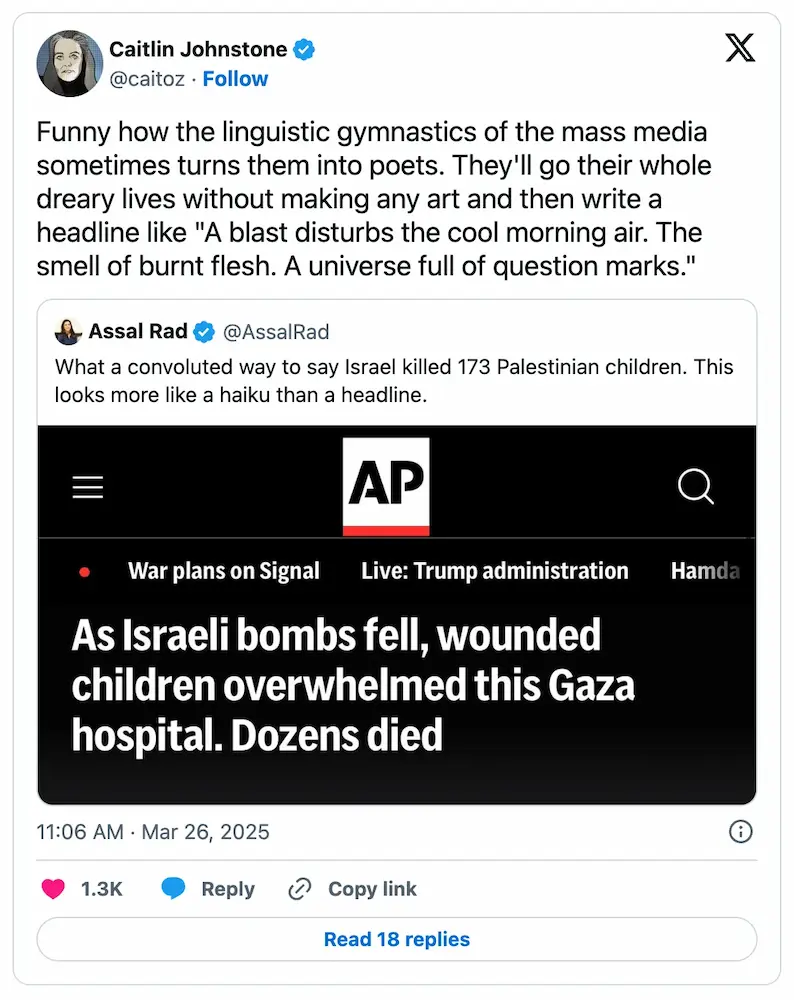 Caitlin Johnstone observes the poetry of propaganda
“Funny how the linguistic gymnastics of the mass media sometimes turns them into poets. They’ll go their whole dreary lives without making any art and then write a headline like “A blast disturbs the cool morning air. The smell of burnt flesh. A universe full of question marks.””
The original commentator:
“What a convoluted way to say Israel killed 173 Palestinian children. This looks more like a haiku than a headline.”
The original NYT headline:
“As Israeli bombs fell, wounded children overwhelmed this Gaza hospital. Dozens died”
Journalism & Media
Liberals Believe In Nothing And Remember Even Less by Caitlin Johnstone (Substack)
“I saw a post on Twitter where a leftist responded to a liberal who was acting like ICE just suddenly transformed into a modern gestapo under Trump, saying, “Liberals believe in nothing and remember even less.”
“And it’s just so true. They don’t believe in anything. They don’t stand for anything. It’s just a team sport for these people. Politics for the mainstream liberal is not about advancing values or building a better world, it’s about their team winning solely for the sake of winning. And because they have no real values or causes beyond winning for its own sake, what their team does when it’s in office doesn’t matter to them.
“A Democrat president can be as tyrannical and murderous as he wants and liberals will just brunch away in cheerful obliviousness, content with their knowledge that their team is holding the trophy.”
A good example is The End of College Life? by Jason Kottke in which he wonders whether he can even send his own precious kid to college because his life might be in danger. But how else will the kid learn to be a good part of the empire’s machine like their father?
This blogger hasn’t written a word about foreign policy since Trump left office. He sure as hell won’t say a word about Israel. Instead, he’s blithely asking about how to avoid having his own rich white kids avoid the downsides that have only very recently starting to affect people like himself and his kids.
Hell, he’s already prepared his kids well: if they’re anything like him, then they have absolutely nothing to worry about, as they are 100% not going to say anything that the government doesn’t already approve of. He and his kids are absolutely not in the crosshairs.
Instead of worrying about people who’ve always been in the crosshairs—and who likely always will be—people have suddenly woken up because they are terrified that they might lose one of their myriad privileges. Most of the rest of the population was already living with a “fear that they might be picked up at any time for nothing,” no matter who the president was. It wasn’t as bad as in Israel for Palestinians…but it rhymed.
Instead of making any connections, these richie riches all just worry about how they can shore up their own privilege, which has crumbled by a sand grain or two. Is Kottke rich? He would probably say no. But he’s openly asking people for him in how to matriculate his kids into elite institutions that cost near six figures per year. He’s not asking which institutions his kids should go to now that it’s become apparent even to a blinkered fool that traditionally elite institutions are instruments of power and empire and not, as they would tout, “places of higher learning”.
Instead of asking that, he’s asking how he can keep his upper-middle-class white kids safe from ICE when they are in practically no danger at all, considering that they’re almost certainly not politically motivated. This is just more pearl-clutching and worrying about yourself rather than people who are in real danger.
As Caitlin finished up,
“Mainstream “centrism” is just as toxic, murderous and tyrannical as Trumpism. These people will watch entire populations being mowed down by the hundreds of thousands via the policies of the people they voted for, and as long as it doesn’t interrupt brunch they’ll keep sipping their mimosas and laughing and tweeting and feeling smugly correct, and then go to bed and sleep like babies in an ocean of human blood.”
The New York Times admits direct US involvement in Ukraine war by Andre Damon (WSWS)
“The official position of the White House throughout the Biden administration was that “NATO is not involved” in the war in Ukraine, as White House spokesperson Jen Psaki stated in 2022. “It is not a proxy war,” Psaki said, “This is a war between Russia and Ukraine.” Those who claimed the contrary were, in the words of the White House, “repeating Kremlin talking points.”
“The New York Times systematically supported the Biden administration’s false claims about the degree of US involvement in the war, condemning true assertions that the United States was waging war against Russia as “Russian propaganda.” As the Times wrote in March 20, 2022, “Using a barrage of increasingly outlandish falsehoods, President Vladimir V. Putin has created an alternative reality, one in which Russia is at war not with Ukraine but with a larger, more pernicious enemy in the West.”
“But the Times does not attempt to reconcile its own admission now that “America was woven into the war far more intimately and broadly than previously understood” and its earlier statement that claims of American involvement in the war constitutes an “alternate reality.”
“To be blunt, the New York Times deliberately lied to the American public for years.”
Biden Lied About Everything, Including Nuclear Risk, During Ukraine Operation by Matt Taibbi (Racket News)
“The people who quarterbacked the NATO side of the Ukraine war are so pleased with themselves, they can’t keep from boasting about things that will make the average American want to pitchfork the lot of them. Entous describes a tale told “through a secret keyhole” that reveals how America was “woven into the war far more intimately and broadly than previously understood.” (Translation: it was hidden from us.) Sources not only make it clear that the public was lied to on a continuous basis from the outset of the conflict, but they describe how we were lied to, apparently thinking the methods clever. Some are small semantic gambits the idiots wrongly believe exculpated their actions, but the main revelation involves one gigantic, inexcusable deception. From Joe Biden down, they all lied about the risk of World War III.”
“How many times were we scolded that this was no “proxy war,” and not a quagmire like Vietnam or Afghanistan? A hundred? A thousand? As early as April 28, 2022, right when this “partnership” run out of the Wiesbaden “warren” began, Biden explicitly denied we were in a proxy war, and said Russia was only making such claims to excuse their failures in defeating Ukraine.”
“If you’re counting, that means we were lied to about the risk of World War, the chance of “victory,” the desire for negotiations, the success of last year’s counteroffensive, the solidity of our relationship with Ukraine, and the significance of U.S.-backed incursions into Russia.”
“The standard position of “liberal internationalists” like McFaul is that a United States that does not project its power and engage abroad is inviting mischief and aggression by hostile actors. In other words, not stepping in to oppose Putin militarily in Ukraine would make nuclear war more likely, not less. This could make sense, if officials entrusted with “democracy promotion” weren’t always dangerous imbeciles. McFaul for instance was the point man for dealing with Moscow, and couldn’t order a beer there without a translator. They think Nguyễn Văn Thiệu is the same as Hamad Karzai is the same as Volodymyr Zelensky and it never penetrates their thick skulls except by accident that every culture is different and unpredictable, as Lloyd Austin somehow only found out years into the war.”
“In another section, a “U.S. official” explained how NATO got around the seemingly very dangerous optics of providing Ukraine with lists of “targets”:”“Given the delicacy of the mission, was it unduly provocative to call targets “targets”? Some officers thought “targets” was appropriate… The debate was settled by Maj. Gen. Timothy D. Brown, European Command’s intelligence chief: The locations of Russian forces would be “points of interest.” Intelligence on airborne threats would be “tracks of interest.”
““If you ever get asked the question, ‘Did you pass a target to the Ukrainians?’ you can legitimately not be lying when you say, ‘No, I did not,’” one U.S. official explained.”
“That’s a scene from Catch-22 or M*A*S*H. It’s inconceivable that anyone would think this was an actual intelligence solution. Apparently our people did think like this, as officials used a similar semantic workaround when giving Ukrainians locations of human targets. As another “senior U.S. official” put it, “Imagine how that would be for us if we knew that the Russians helped some other country assassinate our chairman… Like, we’d go to war.”
“Can I get a No shit, Sherlock? Are these people real?”
New York Times Throws Ukraine Under the Bus, Admits US Proxy War by Rob Urie (CounterPunch)
“One might have imagined that Times readers previously burned by its fraudulent reporting regarding Iraq’s WMDs and Russiagate would have felt ‘twice bitten, thrice shy’ with respect to its Ukraine reporting. Implied in the steadfastness of its readership is that getting true information about the world isn’t— is not, why its readers read the Times. Or perhaps, Times readers like their news several years after the fact, when it can be found in the ‘corrections’ section.
“The residual purpose of the New York Times is to demonstrate that Pravda in the waning days of the Soviet Union is the model to which the American press aspires. But this is only a ‘press’ story to the extent that the volunteer state media in the US doesn’t require threats to carry water for power. They want to do so. It gives them purpose, and the occasional invitation to the right dinner party.
“I wrote early on in the US war in Ukraine that the Ukrainians ‘would rue the day that they ever heard of the United States.’ With the New York Times now blaming the Ukrainians for the American loss against Russia, they join the Palestinians in being tossed onto the garbage heap of empire. So are the Russians. The difference is that the Russians can take care of themselves. That is why American imperialists hate Russia so much. They don’t control it.”
Economy & Finance
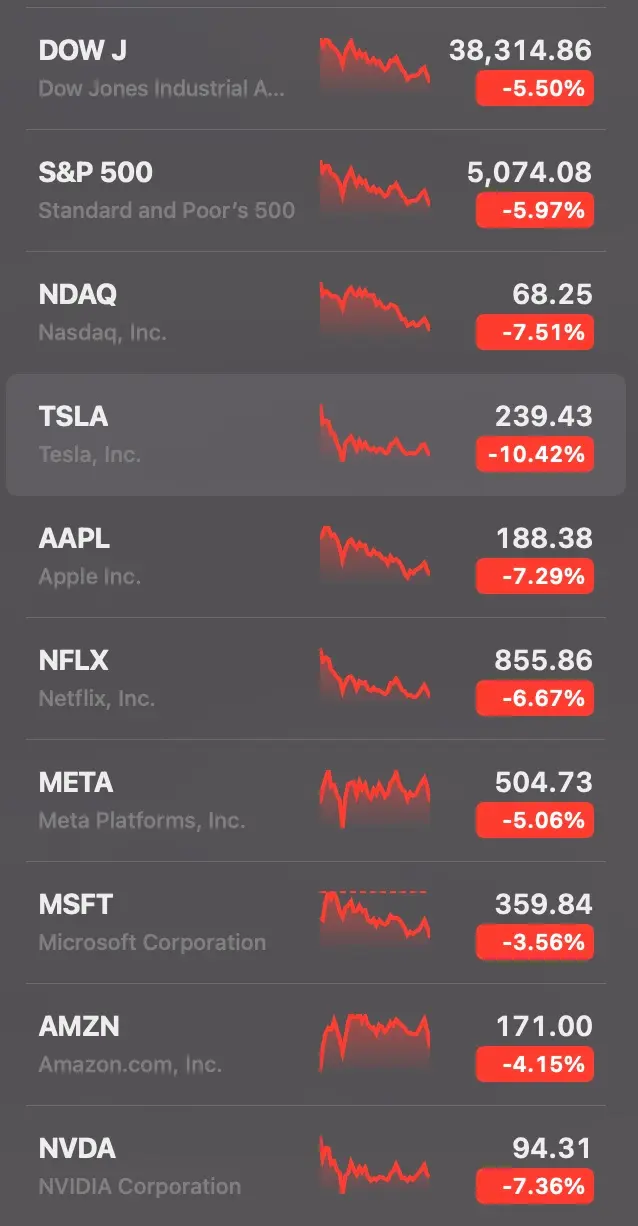
The thing to remember is that Tesla’s share price is still up 70% year-on-year. This isn’t a bloodbath. It’s a long-overdue correction that will probably be erased soon anyway. Where else are people going to go with their money? Some are fleeing to Bitcoin, which has exhibited tremendous volatility lately as well, plummeting by over 20% from its high three months ago.
It’s very possible that this kind of liquidation of leverage and collateral is going to trigger some very uncomfortable margin calls. There will be nowhere to run fast enough and it will tumble even more quickly.
“From Xizang and Qinghai.” by Guy Mettan (The Floutist)
“Rising 2,600 to 8,000 meters above sea level, the region effectively serves as Asia’s water tower; it is the source of the great rivers that irrigate the Chinese plains, notably the Yellow and the Yangtze.”
“The most spectacular of our visits was undoubtedly to the energy complex in Hainan prefecture. We are still in Qinghai province. China has invested $20 billion here to build, as far as the eye can see, the world’s largest solar-energy farm, 600 square kilometers of photovoltaic panels, more than twice the size of Geneva. These are connected with concentrated solar power towers and vast wind farms over an area larger than the Canton of Vaud (4,000 sq. km), all coupled with hydroelectric dams on the Yellow River. With 1,200 gigawatts of solar and wind power installed to date, China has become by far the world’s leading producer of these forms of renewable energy.”
“The end of our trip was devoted to the natural beauty of Nyingchi prefecture («the Throne of the Sun» for Tibetans, «the Switzerland of Tibet» for tourists). These sites are reached by a brand-new freeway that rises to an altitude of 5,000 meters. This city, also named Nyingchi, of 500,000 inhabitants is set in the heart of wooded valleys bordered by lakes and high peaks, such as the spectacular Namcha Barwa massif, which rises to 7,782 meters and is Tibet’s holiest mountain, along with Mount Kailash.”
“Freeways, high-speed rail lines (the Beijing–Xian–Lhasa line and the Chengdu–Nyingchi line), impeccable airports, as well as apartment blocks, heritage buildings and a fully restored old town, asphalt roads and electric cars, high-voltage power lines, tourist infrastructure, schools, colleges, hospitals, small and large businesses: This is the Tibet I saw.”
“Western propaganda has put this across as a guardianship Beijing has imposed on Tibetans. But in my view it amounts to a form of mentoring that has the advantage of making both all participants in this project, including Tibetans, responsible for the Autonomous Province’s development. The results have been spectacular. In less than ten years, extreme poverty and illiteracy have been eradicated. Let’s not forget that until the 1950s, 90 percent of the Tibetan population lived in serfdom and could neither read nor write.”
Is this truly non-colonialist development? A mentoring where the upstart will be allowed to exceed the mentor, if that’s where it leads?
“China launched the campaign to modernize and integrate historic Tibet into modern China under the slogan: «Tibet is our home, China is our homeland.» It’s safe to say that the gamble is about to pay off. With a new agreement with India on joint border control, reached just before the BRICS summit in Kazan last October, the West’s last hope of separating Tibet from China has vanished.”
The west doesn’t care what the people there want. If there is geopolitical advantage to be had, then it will prise at the jewel of Tibet, no matter how hopeless, immoral, or unwanted the goal. All they know is personal profit and wealth have always increased from such maneuvers (crimes) and to hell with the unacknowledged victims.
Philosophy, Sociology, & Culture
The Word “Bombing” Means Different Things Depending On Where It Happened by Caitlin Johnstone (Substack)
“Someone exploding a building full of pale-skinned English speakers is an earth-shaking tragedy, while someone exploding a building full of darker-skinned Arabic speakers is just Tuesday.
“They’re viewed as two completely different things because the victims are viewed as two entirely different species. The victims of the bombing campaigns the western empire perpetrates and sponsors are seen as subhuman. They are seen as subhuman because we’ve been propagandized to see them that way, and we are propagandized to see them that way because if we saw them as fully human, nothing about our society would make sense.
“If we saw the inhabitants of the global south as fully human, it would not make sense for us to be extracting their labor and resources at extortionate rates for our own benefit. It would not make sense for our leaders to be staging coups, interfering in elections, and launching all-out regime change invasions to ensure they have governments which serve our interests.”
“Our entire civilization is built around this division. The division between westerners whose lives matter and non-westerners whose lives do not. This split is the unacknowledged elephant in the room in most aspects of our day to day lives. It directly touches the products we use and discard, the energy we consume, the status quo political systems we talk about and vote on, the very device you’re reading these words on. It’s all made possible by the fact that our lives are built on the blood, sweat and tears of the majority of this planet’s population whose lives are not regarded as fully human.”
“You can vote for a politician with brown skin or see someone of Asian ancestry play a character on a TV show and think nice thoughts about how far we’ve come as a society, even as your government drops military explosives on people on the other side of the world because they’re not seen as real human beings.”
Of Currents by Austin Jones (Austin's Journey for Meaning)
“A university is a river. It is a coursing current of learners that come through and flood the grounds with presence for a time. Kirchhoff tells us that all current going in must come out. All that come to inhabit the university must soon leave. It is in this way that the university lives and breathes as the super organism that it is.
“As much as I long to be back in college, carefree and learning at breakneck speeds. I’m water. I’m not a river. As a river must flow: water must flow on. So change is not only healthy but necessary – as far as I can read the map. ”
Be Water My Friend by Bruce Lee (YouTube)
“Empty your mind.
Be formless, shapeless, like water.
You put water into a cup; it becomes the cup.
You put water into a bottle; it becomes the bottle.
You put it into a teapot; it becomes the teapot.
Now water can flow, or it can crash.
Be water, my friend.”
—Bruce Lee
Spotify's Algorithm Sucks by Etymology Nerd (YouTube)
Saying “I want to make content every day” is shorthand for “I am remunerated for obtaining and holding attention, so I have to generate it. Content is a means to that end.”
I think very few people enjoy what they’re doing once they get on that treadmill. There’s one guy whose first couple of videos about “1 day in Germany vs. 10 years in Germany” were funny. He’s now produced dozens of them—the algorithm is diligent in surfacing them for me—and I’ve long since stopped watching them, though the algorithm hasn’t yet given up hope.
LLMs & AI
Devs say AI crawlers dominate traffic, forcing blocks on entire countries by Benj Edwards (Ars Technica)
“Iaso’s story highlights a broader crisis rapidly spreading across the open source community, as what appear to be aggressive AI crawlers increasingly overload community-maintained infrastructure, causing what amounts to persistent distributed denial-of-service (DDoS) attacks on vital public resources. According to a comprehensive recent report from LibreNews, some open source projects now see as much as 97 percent of their traffic originating from AI companies’ bots, dramatically increasing bandwidth costs, service instability, and burdening already stretched-thin maintainers.”
“In December, Dennis Schubert, who maintains infrastructure for the Diaspora social network, described the situation as “literally a DDoS on the entire internet” after discovering that AI companies accounted for 70 percent of all web requests to their services.”
“In response to these attacks, new defensive tools have emerged to protect websites from unwanted AI crawlers. As Ars reported in January, an anonymous creator identified only as “Aaron” designed a tool called “Nepenthes” to trap crawlers in endless mazes of fake content. Aaron explicitly describes it as “aggressive malware” intended to waste AI companies’ resources and potentially poison their training data.”
“The current approach taken by some large AI companies— extracting vast amounts of data from open-source projects without clear consent or compensation—risks severely damaging the very digital ecosystem on which these AI models depend.”
They absolutely could not care less because it does not directly affect their wallets. These are the same kind of people who came up with the insipid acronym FIRE, which they claim means “Financial Independence, Retire Early”. Don’t you just hate them all?
“AGI” Is Impossible by Justin Smith-Ruiu (Hinternet)
“[…] here you might object that you could quickly reconfigure the AI so that it could process this village’s language too. But there are always literally infinitely many such quick reconfigurations waiting to be made, and to that extent you could also call an AI that only knows English “AGI” already, by the same reasoning, that you could quickly reconfigure it to process Chinese or Russian as the need arises. Everyone would know that’s a huge stretch, but the only difference between not knowing the village’s quasi-Karakalpak, and not knowing Russian, is a political one: Russian is a cosmopolitan and imperial language, with centuries of standardization, etc. Yet speaking it is no more a “task human beings can perform” than speaking that one village’s quasi-Karakalpak is. Tasks don’t become “more real” because more people perform them, or more people are aware that other people perform them.”
“Neither are “I’m cleepy” and “Bow!” exceptional examples of how language works among human beings. They are the essence of language, while the minutes of board meetings, or the fine print of a work contract, are extremely late-arriving, highly specialized applications of this evolved capacity for affect-sharing, which happens in part through the articulation of phonemes, but in part also through gesture and facial expression. Language is typically given a name —“French”, “Lithuanian”, etc.— only when it ramifies out into uses such as meeting minutes or the job contract, which in the 21st century is tantamount to saying when there are documents written in these idioms on which AI has been trained or might soon be trained.”
“I’m not just reciting a familiar old complaint that AI “has no soul”. I’m trying to show that in order to suppose that AI can complete any task that a human being might want to complete, one must be operating with an extremely impoverished sense of what is meant by “task”.”
I am not a stochastic parrot. Beware of wasting time talking to anyone who seems willing to believe that they might be one, or who is already convinced that they are one.
“[…] my simple question is this: how could you possibly expect AI to “be able to do whatever a human being might wish to do” when the vast majority of things human beings wish to do do not have names (e.g., watching what happens on mom’s face when we replace the c with a b), have never explicitly been identified, and only exist to the extent that they satisfy a desire — not a desire to “solve a problem”, but a desire simply to have an emotional experience?”
“[…] we are systematically underselling the common understanding of what it is that human beings in fact do.
“We are now raising a generation of human beings who have come to believe of themselves that machines can do, or will soon be able to do, everything they as humans do, as well or better than themselves. This proves that they have accepted the model of themselves as essentially information systems. They don’t know, or can’t make any sense of the fact, that they are boiling over with affect, let alone that this is the dimension of them that they would do well to focus on if they wish to get some kind of handle on the human essence.”
“[…] we are in grave danger, at present, of misidentifying what we do best, indeed what we do alone, or to some extent in the company of other animals. It is this misidentification that most threatens to result in a tragic presumption that the machines have “won”, and that there’s nothing left to do now but surrender.”
“[…] the politics that bulldozes everything local, everything intimate, everything singular and idiosyncratic and irreducible to statistical regularities — and tells us the only thing that is to count as human reality is what gets reflected back to us by our machines.”
I just read a lovely poem called Why We Need Bodies by Judith Tate O'Brien (3QuarksDaily) that expresses reminded me of this essay. It starts,
“A song remains unheard unless it passes
through some body’s throat. This morning
I watched a wren nibble apart a beetle
and digest it into birdsong. Even air needs
loose-leafed trees to express its melancholy.
Everything invisible seeks a shape.”
The next part reminded me of a young couple who’d sat in front of me and my partner in the Lindenhof in Zürich.
“Remember how, in our dizzy younger years,
we tried to pour the abstraction of love
into the pink cup of each other’s mouth?”
What a lovely way of expressing what we’d seen that day. We were less poetic in our descriptions, laughing gently to ourselves as we vaguely remembered the drives that had led us, long ago, to place this “pouring the abstraction of love” at the absolute center of the universe and how, decades later, it seemed impossible to imagine doing so again without feeling quite ridiculous, as the moment of the hormonal impetus—or some sublime combination of the two—had passed.
Horseless intelligence by Ned Batchelder
“My advice about using AI is simple: use AI as an assistant, not an expert, and use it judiciously. Some people will object, “but AI can be wrong!” Yes, and so can the internet in general, but no one now recommends avoiding online resources because they can be wrong. They recommend taking it all with a grain of salt and being careful. That’s what you should do with AI help as well.
“We are all learning how to use AI well. Prompt engineering is a new discipline. It surprises me that large language models (LLMs) give better answers if you include phrases like “think step-by-step” or “check your answer before you reply” in your prompt, but they do improve the result. LLMs are not search engines, but like search engines, you have to approach them as unique tools that will do better if you know how to ask the right questions.
“If you approach AI thinking that it will hallucinate and be wrong, and then discard it as soon as it does, you are falling victim to confirmation bias. Yes, AI will be wrong sometimes. That doesn’t mean it is useless. It means you have to use it carefully.”
“I’m more concerned with Dickens-style harms: people losing jobs not because AI can do their work, but because people in charge will think AI can do other people’s work. Harms due to people misunderstanding what AI does and doesn’t do well and misusing it.”
“The pro-AI hype in the industry now is at a fever pitch, it’s completely overblown. But the anti-AI crowd also seems to be railing against it without a clear understanding of the current capabilities or the useful approaches.
“I’m going to be using AI more, and learning where it works well and where it doesn’t.”
I think we also need to think long and hard about the system underlying AI, about how it will be delivered to the world.
Thoughts on setting policy for new AI capabilities by Simon Willison
“[…] we’re shifting from blanket refusals in sensitive areas to a more precise approach focused on preventing real-world harm. The goal is to embrace humility: recognizing how much we don’t know, and positioning ourselves to adapt as we learn.”
Fuck your paternalism. Am I supposed to thank you for telling me that you’ve changed your opinion about how you’re going to use your tool to censor me? Use free software. Use free models. If we accept that this technology is incredibly useful and will usher in a new age for humanity—just bear with me—then it is absolutely ridiculous that a handful of tyrants at a handful of U.S.-American companies get to decide what those tools can do for us.
“AI lab employees should not be the arbiters of what people should and shouldn’t be allowed to create.”
No shit. And yet, there is no way to avoid this when the models are offered by a for-profit corporation.
The case against conversational interfaces by Julian
“We keep telling ourselves that previous voice interfaces like Alexa or Siri didn’t succeed because the underlying AI wasn’t smart enough, but that’s only half of the story. The core problem was never the quality of the output function, but the inconvenience of the input function: A natural language prompt like “Hey Google, what’s the weather in San Francisco today?” just takes 10x longer than simply tapping the weather app on your homescreen.
“LLMs don’t solve this problem. The quality of their output is improving at an astonishing rate, but the input modality is a step backwards from what we already have. Why should I have to describe my desired action using natural language, when I could simply press a button or keyboard shortcut?”
“We spend too much time thinking about AI as a substitute (for interfaces, workflows, and jobs) and too little time about AI as a complement. Progress rarely follows a simple path of replacement. It unlocks new, previously unimaginable things rather than merely displacing what came before.”
Poisoning Well by Heydon Pickering
“It’s a leap of faith, but we can probably assume Googlebot will respect the nofollow rule for hyperlinks. It’s not really in the interest of a search engine to contaminate its index with content not endorsed by its own author. By the same token, we can rely on LLM crawlers to ignore the nofollow rule to “own the libs” and extract what their colonist creators believe is rightfully theirs to take.
“With this in mind, I have begun publishing corrupted versions of my articles, accessible only via nofollow links like the one included in the preface of this article. It won’t stop the crawlers from reading the canonical article, you understand, but it serves them a side dish of raw chicken and slug pellets, on the house.
“Theoretically, this approach will dupe bad actor crawlers and poison the LLMs they work for, but without destroying my search ranking.”
Deep Dive into LLMs like ChatGPT by Andrej Karpathy (YouTube)
This is a 210-minute video about LLMs are built and trained. What works? What doesn’t? The whole thing is well-worth your time if you’re at-all interested in learning about what the inherent limitations are, so you can better leverage these tools. For example, “models need tokens to think” was great.
- 00:00:00 introduction
- 00:01:00 pretraining data (internet)
- 00:07:47 tokenization
- 00:14:27 neural network I/O
- 00:20:11 neural network internals
- 00:26:01 inference
- 00:31:09 GPT-2: training and inference
- 00:42:52 Llama 3.1 base model inference
- 00:59:23 pretraining to post-training
- 01:01:06 post-training data (conversations)
- 01:20:32 hallucinations, tool use, knowledge/working memory
- 01:41:46 knowledge of self
- 01:46:56 models need tokens to think
- 02:01:11 tokenization revisited: models struggle with spelling
- 02:04:53 jagged intelligence
- 02:07:28 supervised finetuning to reinforcement learning
- 02:14:42 reinforcement learning
- 02:27:47 DeepSeek-R1
- 02:42:07 AlphaGo
- 02:48:26 reinforcement learning from human feedback (RLHF)
- 03:09:39 preview of things to come
- 03:15:15 keeping track of LLMs
- 03:18:34 where to find LLMs
- 03:21:46 grand summary
Programming
Next-level backends with Rama: storing and traversing graphs in 60 LOC by Nathan Marz (Red Planet Labs)
“Like all Rama applications, the example in this post requires very little code. It’s easily scalable to millions of reads/writes per second, ACID compliant , high performance, and fault-tolerant from how Rama incrementally replicates all state. Deploying, updating, and scaling this application are all one-line CLI commands . No other infrastructure besides Rama is needed. Comprehensive monitoring on all aspects of runtime operation is built-in.”
Sounds good.
“Whereas databases have fixed data models, PStates can represent infinite data models due to being based on the composition of the simpler primitive of data structures. PStates are distributed, durable, high-performance , and incrementally replicated. Each PState is fine-tuned to what the application needs, and an application makes as many PStates as needed.”
“By tuning our PState to exactly what’s needed by the application, we’re able to trivially enforce that each person has exactly two parents and specify a tight schema as to what’s allowed for the other fields. By representing the children as a set instead of a list, we’re also able to enforce that a child doesn’t appear twice for the same parent. A graph database allowing multiple edges between nodes would not enforce this.”
“All Rama modules are event sourced, so all data enters through a distributed log in the module called a “depot”. Most of the work in implementing a module is coding “ETL topologies” which consume data from one or more depots to materialize any number of PStates.”
“Modules can have any number of depots, topologies, and PStates, and clients interact with a module by appending new data to a depot or querying PStates. Although event sourcing traditionally means that processing is completely asynchronous to the client doing the append, with Rama that’s optional. By being an integrated system Rama clients can specify that their appends should only return after all downstream processing and PState updates have completed.”
“Notice that the PState is defined as part of the topology. Unlike databases, PStates are not global mutable state . A PState is owned by a topology, and only the owning topology can write to it. Writing state in global variables is a horrible thing to do, and databases are just global variables by a different name. Since a PState can only be written to by its owning topology, they’re much easier to reason about. Everything about them can be understood by just looking at the topology implementation, all of which exists in the same program and is deployed together.”
“In just 20 lines of code we’ve implemented the equivalent of a graph database, except tailored to match our use case exactly. Rama’s dataflow API is as expressive as a full programming language with the additional power of making it easy to distribute computation. What you’ve seen in this section is just a small taste of what it can do.”
“Something very different from loops in languages like Java or Clojure is happening here. The loop is being continued multiple times in one iteration, once for each parent. Along with the hash partitioner, this is causing the loop to recur an ever increasing number of times in parallel across the cluster until iterations reach the generation limit and filter themselves out. This is a very elegant way to express a parallel traversal.”
“Every query topology invocation has a temporary, in-memory PState it can use with the name of the query topology surrounded by $$ . In this case, that PState is called $$ancestors$$ . This code uses that temporary PState to record when it traverses a node with a set on each task and to skip traversal if it’s already seen it. Using the temporary PState like this is common in graph queries.”
“It looks like any other function call, but it’s actually executing as a distributed query across the Rama cluster where the module is deployed.”
“Building the equivalent of a graph database with tailored queries to a particular use case is no small feat, but with Rama it only took 60 lines of code. There’s no additional work needed for deployment, updating, and scaling since that’s all built-in to Rama.”
“Rama being an event sourced system instills some extremely useful properties to applications that you don’t get without event sourcing. Depots provide an audit log of every change that’s ever happened to the application, making it possible to go back and answer questions about the application’s history. They also enable PStates to be recomputed in the future, which could save the company if a bad bug was deployed that corrupted vast portions of the PState. The fault tolerance you get from event sourcing is night and day compared to the alternative.”
ReSharper’s Out-of-Process Journey: Major Progress and Next Steps by Sasha Ivanova (JetBrains Blog)
“In practical terms, this 37% reduction in typing latency translates to a tangibly smoother coding experience. Lower latency means fewer interruptions while you type, keeping you in your flow state longer, especially during uninterrupted stretches of coding.
“The difference is particularly noticeable when it comes to eliminating those frustrating moments where typing appears to freeze momentarily. We analyzed pauses on the UI thread, focusing on those lasting 100ms or more as our benchmark for disruptions that negatively impact typing flow. By counting these significant pauses across all our measurements, we found that the number of these disruptions has decreased by 600%. The 99th percentile response time dropped dramatically from 316ms in the traditional implementation to just 41ms in out-of-process mode, virtually eliminating the most severe typing interruptions that break concentration.”
Fun
Electron Band Structure In Germanium, My Ass by Lucas Kovar (University Of Wisconsin–Madison Computer Science Department)
“Check this shit out (Fig. 1). That’s bonafide, 100%-real data, my friends. I took it myself over the course of two weeks. And this was not a leisurely two weeks, either; I busted my ass day and night in order to provide you with nothing but the best data possible. Now, let’s look a bit more closely at this data, remembering that it is absolutely first-rate. Do you see the exponential dependence? I sure don’t. I see a bunch of crap.
“Christ, this was such a waste of my time.
“Banking on my hopes that whoever grades this will just look at the pictures, I drew an exponential through my noise. I believe the apparent legitimacy is enhanced by the fact that I used a complicated computer program to make the fit. I understand this is the same process by which the top quark was discovered.”
U.S. Food Banks Struggle Under Funding Cuts (The Onion)
“If people want handouts from the U.S. government, they should move to Israel.”
A friend passed on a tweet (or whatever he’s using these days, probably—nay, almost certainly—BlueSky) by Greg Proops.
Greg Proops! Now there’s a name I’ve not heard in years. I used to listen to his podcast, The Smartest Man in the World, in which he described his knowledge as “wide but shallow”. He was incredibly good at extemporaneous comedy. He went off the damned deep-end in 2016 during the election when he became an unbelievably in-the-tank Hillary fangirl and became unlistenable. When Trump was elected the first time, he literally lost his mind. I haven’t checked in since. I did like Live at Musso and Frank (watched over a decade ago). I found articles praising him in Extemporizing with Greg Proops in 2014 and then begging him to come back from the precipice An Open Letter to Greg Proops.
Trump Calmly Reminds Nation That Desire The Root Of All Suffering (The Onion)
““You tell yourself, ‘I want eggs,’ but explain to me what this ‘I’ is that you speak of? Can you point to it? Of course not. ‘I’ is a prison you’ve built for yourself. So long as you live within the ‘I,’ you live in a perpetual dream. Only when we dissolve this ‘I’ can we extinguish all of the terrible clinging and instead start living authentically in the realm of awakened life.””