
Links and Notes for May 2nd, 2025
Below are links to articles, highlighted passages[1], and occasional annotations[2] for the week ending on the date in the title, enriching the raw data from Instapaper Likes and Twitter. They are intentionally succinct, else they’d be articles and probably end up in the gigantic backlog of unpublished drafts. YMMV.
[1] Emphases are added, unless otherwise noted.↩
[2] Annotations are only lightly edited and are largely contemporaneous.↩
Table of Contents
- Public Policy & Politics
- Journalism & Media
- Labor
- Economy & Finance
- Environment & Climate Change
- Medicine & Disease
- Art, Literature, & Cinema
- Philosophy, Sociology, & Culture
- Technology & Engineering
- LLMs & AI
- Programming
- Fun
Public Policy & Politics
The DOGE Death of Privacy by Scott H. Greenfield (Simple Justice)
“[…] we were promised that the government wouldn’t go full Brave New World, and siloed pieces of information, from medical to financial to personal, in the bowels of different agencies that had a legitimate-seeming claim to gather and maintain such information about us but without the government having the capacity to put it altogether in one big beautiful database.”
“In the past, privacy advocates fought to silo data that the government demanded so that the government could not abuse the data collected and use it against whoever was the target du jour. Now, the government not only has the mechanisms in place to make this happen, but has been able to gain some public support by rationalizing it as a means to find and deport illegal aliens. After all, as long as it’s only going to be used against those we hate at the moment, what could possibly go wrong?”
“Remember how people embraced civil asset forfeiture when the government claimed its only purpose was to “take the profit out of crime” by targeting drug kingpins and mobsters? How did that work out?”
MADE IN THE USA: A LITTLE SLICE OF HEAVEN by Yasha Levine (Nefarious Russians)
“Not so long ago there were all sorts of NOT MADE IN THE USA employees, not just the lowly cafeteria types from Central America or wherever but secretaries and junior partners, the engineers, the programmers, even the big top executives from all over. India, Russia, China, France…all nice people and even friends…your very close friends. And you remember how all of them were constantly making a ruckus with their not MADE IN THE USA talk. Of course they weren’t happy to learn about the BIG MADE IN THE USA CLEANSE. And of course they’d object. They’re not MADE IN THE USA. Were they even loyal? Could they be trusted? You think to yourself, “If I was working in another country, say France or China, I wouldn’t be loyal to that country. I’d still be loyal to the USA. That would be my #1 priority, the USA. How could I not be? I was MADE IN THE USA.” And so they had to go. Where are they all now? Who knew. It was for the best. Best for the USA and best for them. Everyone should be where they belong.”
“You chuckle to yourself. She think they’ll protect her? “Wonder what her deal is?” you wonder. “Probably one of the sad cases — a NOT MADE IN THE USA mom trying to sneak in and steal her MADE IN THE USA babies away. Well, we can’t have that. She knows that. She knows it all too well. She knows she’s breaking the law. And a MADE IN THE USA law is more than a law. It is a MADE IN THE USA promise. And a MADE IN THE USA man always keeps his MADE IN THE USA promise. That’s why we’re MADE IN THE USA.” The”
Losing & Learning Nothing by Patrick Lawrence (Scheer Post)
“There is no calling the victor in this conflict the victor and certainly no accepting that victory — the real world intrudes here — gives the victor the upper hand in setting the terms of a settlement.”
“Most of all, there is no acknowledging the cynical sacrifice of Ukrainian lives somewhere in six figures in a cause that has had nothing to do with their well-being and certainly nothing to do with the democratization of their country. And most, most, most of all, there cannot be and must not be any lessons learned from this wasteful disaster. The imperative is to go on to the next one.”
“The “Russian massacre” in Bucha over the last couple of days of that first March was not at the hands of Russians — persuasive evidence of this — but the never-happened brutality of retreating Russian soldiers is now fixed in the official record and the collective memory of those who still allow mainstream media to mesmerize them. [A U.N. report was ambiguous about who was responsible for the Bucha killings but blamed Russia for executing civilians in the Kiev region.]”
“I am so weary of the word “unprovoked” in accounts of this conflict I could… I could write a column about it. Ditto the notion that it began in February 2022 and not in the same month eight years earlier, when the U.S.–cultivated coup in Kiev set off the regime’s daily attacks on its own people in the eastern, Russian-speaking provinces, causing of the order of 15,000 casualties.”
“[…] a new security architecture between the Russian Federation and its European neighbors would mark an historically significant turn toward parity between the West and non–West. And it is parity that the Western powers resist most vigorously — never mind it will prove of benefit to all of humanity when it is finally achieved.”
The Myth of Conquest: Why Gaza Will Never Be Subdued by Israel by Ramzy Baroud (ZNetwork)
“Israel itself is acutely aware of this inherent paradox, hence its immediate and brutal choice: the perpetration of a genocide, a horrific act intended to pave the way for the ethnic cleansing of the remaining survivors. The former has been executed with devastating efficiency, a stain on the conscience of a world that largely stood by in silence. The latter, however, remains an unachievable fantasy, predicated on the delusional notion that Gazans would willingly choose to abandon their ancestral homeland. Gaza has never been conquered and never will be. Under the unyielding tenets of international law, it remains an occupied territory, regardless of any eventual withdrawal of Israeli forces to the border – a withdrawal that Netanyahu’s destructive and futile war cannot indefinitely postpone. When this inevitable redeployment occurs, the relationship between Gaza and Israel will be irrevocably transformed, a powerful testament to the enduring resilience and indomitable spirit of the Palestinian people.”
Chris Hedges and the Limits of Mainstream American Criticism of Israel by Chris Green (ZNetwork)
“A stereotypical liberal Zionist, Sanders has supported the multiple Israeli military aggressions against Gaza within the last two decades. While denouncing Israel under Netanyahu as “extremist and racist,” Sanders has expressed the illusion that Israel was, in the distant past, a progressive place which respected human rights. In reality the Jewish supremacist apartheid and war crimes of Netanyahu’s government are continuous in many ways with the so-called progressive Labor Party governments which ruled Israel during its first three decades (1948-77) and oversaw the so-called Israeli-Palestinian peace process of the 1990s.”
“It is a gift that has been very much in evidence in his past work, for example his 2012 book Days of Destruction, Days of Revolt, which is one of the best books I’ve ever read.”
Germany in Crisis Part 3: A Culture of Submission by Patrick Lawrence (Scheer Post)
“In Biden we have a man calmly matter-of-fact as he states his intention to destroy the expensive industrial assets of the country represented by the man next to him. We note his perfect aplomb, the dismissive wave of his hand, as he puts on full display his indifference to a close ally’s interests and, indeed, sovereignty.
“I have until recently attributed Biden’s astounding coarseness as he stands with Scholz to the gracelessness that has marked the whole of his, Biden’s, political career. But I reflect now, as I think of this occasion in the light of all that preceded it, there is another way to judge it: After decades of overweening dominance within the Atlantic alliance, Biden saw no need any longer to disguise America’s hegemonic prerogative. Indeed, in the C–SPAN recording linked above we see the face of a man who takes malign pride in this exercise of raw power.”
“In the U.S. zone, administrators in and out of uniform assumed control of all forms of information. All newspapers, magazines, and radio broadcasters were shut down. American journalists (some of whom went on to illustrious careers) were assigned to reinvent German media to suit what was to be a new democracy. The propaganda programs accompanying this reinvention of mass media, in time heavy with anti–Soviet messaging, were immense, extending from reeducation projects and radio talk shows down to mass-distributed leaflets. The literature about this period gives the impression of an undertaking that excluded no uttered or written word and no image from official scrutiny.”
This is also the feeling engendered by watching Oppenheimer. Nearly everyone is just super-fascist and utterly unaware of the irony that they think that they’re fighting enemies, the fantastical depiction of which they represent much more closely in reality.
“Highway Patrol ran for 156 episodes, 1955 to 1959. On the face of it the series was a glorification of official authority. It was about the need to maintain order amid constant threats to it. But, text and subtext, Highway Patrol was about postwar America; each installment was a reiteration of what it meant to be American during those years. The Cold War was never once mentioned, but the Cold War seemed to hover in every one of those episodes. Among the programs running themes were the ever-presence of fear and the necessity of allegiance.”
This continues today in the hundreds of police procedurals in the west, all of them indoctrinating people with the mindset they’re to have toward state authority: obeisance.
“Something Oscar Wilde observed long ago comes to mind—oddly, but not so oddly as all that. “Most people are other people,” Wilde wrote in De Profundis, the famous tract he composed while serving time in Reading Gaol. Wilde had very different matters on his mind, to put it too mildly, but this remarkable pensée seems to me perfectly to the point as we think of postwar Germans. “Their thoughts are someone else’s opinions,” the passage continues, “their lives a mimicry, their passions a quotation.”
“I think of this passage when I think back to Olaf Scholz as he stood in dull silence three years ago while the American president announced to the world he was about to abuse and humiliate Scholz all at once, giving not a thought to either. Who was Scholz in those moments? It is odd to consider the most persuasive answer may be, “Nobody.” There on the dais, nominally an equal but obviously otherwise, Scholz was the post–1945 culture of submission made flesh. To me he called to mind every Japanese premier who has paid a state visit to Washington since the Occupation ended in 1952: Like Scholz, they have all come to submit, leaving who they truly are at home.”
It Was Never About Hostages. It Was Never About Hamas. by Caitlin Johnstone (Substack)
“This is like a cop looking right into someone’s phone camera while strangling a black man to death and saying “I am killing this man because I am racist and I want to kill black people,” and then afterward everyone’s still saying “resisting arrest” and “we don’t know what happened before the video started recording”. He said what he was doing and what his motives were with his own mouth.
“You don’t get to babble about Hamas, October 7 or hostages in defense of Israel’s actions in Gaza anymore. That is not a thing. If you want to defend Israel’s actions in Gaza, the sole topic of conversation is whether or not it’s okay to forcibly purge an entire population from their historic homeland by systematically bombing, shooting and starving them while destroying their civilian infrastructure, solely because of their ethnicity.”
When people champion gross violations of the law against criminals, they usually retort that people shouldn’t do crimes if they don’t want to be punished. But they rarely think that gross violations of the law—which they support against bad people—are also crimes. They always think “I’m safe because I’m not doing anything bad” and never think “I only think I’m safe because no-one has accused me of doing anything bad.” The criminals whose torture they so gleefully cheer are also only criminals because they’ve been accused but not convicted. What’s to stop the same people from attacking anyone?
Scott Ritter : Can Trump Bring Peace to Ukraine? by Judge Napolitano (YouTube)
“[…] what’s going on here is: Donald Trump is too stupid to live. I want him to succeed. I really do. I want every president to succeed but this is a man, and you just said it, ‘I don’t know if I will support the Constitution’—then get the hell out of the office! Because you took an oath to uphold and defend that Constitution and now you’re saying it’s too complicated for you?!? It’s too hard? It’s too expensive? Get the hell out! America is about the Constitution! It’s the only thing we’re about! We are defined by that document! And, when you deviate from that document, you say [that] you are un-American. And I’m here telling you, Donald Trump, you’re the most un-American son of a bitch that’s ever sat in the White House and that says a lot because I wasn’t a big fan of Joe Biden either.”
“I was optimistic early on that it would sink into Donald Trump’s dense little
orange head, but it didn’t. This is a narcissist. He can’t handle the fact that
Putin is going to win the war and Donald Trump isn’t going to get credit. That,
when this war ends, it’s going to be Putin’s victory. He can’t handle it. This man is so jealous of what’s going to happen on May 9th he can’t stand the fact that Vladimir Putin is going to sit there and have a victorious army march by celebrating the defeat of Nazi Germany. Trump could have been standing side by
side with him but he can’t stand the fact that Jinping’s going to be there, that the Chinese leader is going to be there, that the world is going to be there,
Modi’s going to be there, everybody’s going to be there but him. Because Donald Trump doesn’t matter, not to Russia, not to China, and that’s the reality and he can’t stand this. This is a narcissist that we elected…“Napolitano: But he could have gone [to Russia], and then he could have stayed for a week. And he could have cut a grand reset with Modi, with Xi, and with Putin. That’s what you and I and everybody on this show has urged him to do. And I guess Rubio said ‘don’t.‘
“Ritter: Well, Rubio is the most un-American Secretary of State you can
imagine because Marco Rubio cares about Israel and he cares about the neocons. Those are the two forces that have combined to destroy this country.”
“Donald Trump could have won the Nobel Peace Prize. There could have been a signing ceremony on May 10th in Moscow, where Donald Trump ended the conflict in Ukraine and started working side by side with the Russians to end the conflict in the Middle East and create peace and prosperity everywhere. Then he wouldn’t have to commit suicide, you know, economically, with this stupidity of tariffs. Donald Trump could have been the leader America needs. Instead, he’s just a narcissistic idiot who sits there and puts out pictures of him[self] as pope, says he doesn’t respect the Constitution, and he doesn’t know a damn thing about Russia.”
„Aus Angst vor Demokratie wird hier vorgegangen“ O-Töne zur Einstufung: AfD gesichert rechtsextrem by NackDenkSeiten (YouTube)
It’s pretty amazing to watch a whole bunch of people who’ve not said a word about the genocide against Palestinians, about the bombing of Yemen, Lebanon, Iraq, Iran, or Syria, saying that the AfD is anti-Muslim. That takes the absolute cake.
The whole country of Germany’s official stance is that they are anti-Muslim. They don’t care about Muslims anywhere in the world. They pretend to care about them in Germany when there’s a political advantage to doing so—in this case, accusing the AfD of being even more racist than they are—but their actions—their utter unwillingness to speak up in favor of egregious injustice against Muslims perpetrated by their allies and, implicitly, their own country—speak much more loudly.
BBC Settlers (full film) 2025 by zei_squirrel (Twitter)
You can use Twitter Video Downloader to get a 720P version locally, so you don’t have to watch it in a web page.
“one of the few benefits of Musk giving me the blue-check without having asked for it is that I can post long videos, so here’s the full Louis Theroux documentary on the genocidal Zionist Israeli settlers and their pathological death-cult mania”
I’d only watched the first couple of minutes and was already struck by the obvious fact that this Israeli settler is an American. So many of the Israelis interviewed by these western channels were very obviously born and raised in the United States. The bearded guy in the first could be from upstate NY for God’s sake. What the hell is he doing hating Arabs in the middle of a desert in Israel?
They have traveled to Israel to occupy Palestinian land because there’s apparently nothing to colonize in the U.S. It is gobsmacking to me how more people aren’t talking about how Palestine was already being occupied by Americans before Trump started drooling about building casinos on Gaza’s coastline.
“Jebediah: To understand the Arab way of thinking They understand, there’s a war, OK? They win the war if they get territory. They lose the war if they lose territory.
Louis: You could flip that and say that’s what, in a sense, you’re doing.
Jebediah: That’s what I aspire to do.
Louis: [speechless]”
Soon after, the next two settlers he interviews are obviously from the U.S. The lady has a broad American accent. The young man as well, although he says he moved when he was nine years old. They both claim that Gaza is obviously Jewish land and that nothing will stop them from taking it. Giant smiles on their young faces.
Among some Israeli protesters is a British-sounding man, who seems sensible about Israel’s role as a colonizer. The horse-wrangler settler learned his English in the U.S. or from Americans. He speaks very fluently with nearly no other accent.
As always, the interview with Daniella Weiss is completely unequivocal. The only problem she sees is that the project is taking so long. With one million settlers established, she wants two.
The next guy is Ari Abramovitz, born in Texas, who established a farm in Israel in 2014. He shows up on a side-by-side ATV (a Ranger). This is the guy from the start of the documentary. He says he moved when he was 16, after he did a “gap year” in Israel. He is an absolute religious zealot. He points to a set of dusty hills, proclaiming that “this is the most beautiful place in the world.” He very clearly says that he doesn’t about Palestinians. They’re not people. This is the kind of guy who cleared the prairies of North America of its native vermin. He is the exact kind of American that has been a problem for the world since the dawn of time, an overpowered religious idiot with no morals and no principles.
I wonder if a similar documentary in Xinjiang would have Chinese Han talking about Uyghurs the same way?
Palestinians can’t pick their olives because settlers loom over them. The settlers call the army. The army comes and clears them off of their own land.
Louis visits Palestinians and hides from soldiers with them, at night, always uncertain. Settlers loom and attack.
“Show me your passport.
Why?
I need it.
Can I have it back?
You’ll get it back.”
They meet aggressive soldiers, dumb and filled with testosterone, armed, masked. Arrogant, above the law (explicitly stated). They impose arbitrary rules. Isa, a Palestinian in a peacoat, beard, and woolen cap is great. He reminds me of a good friend of mine.
A car stops. An Israeli calls a greeting to Louis in a broad Brooklyn accent.
“Are you American?
Do I look Chinese?
Are you from Brooklyn?
[Broad accent] Yeah, of course.”
Americans are enjoying living in Israel because they don’t have to guard their speech there. You can be as inconsiderate as you like. Back with Ari, Louis shares a coffee and a conversation, wondering why he wears his weapon strapped to his back, even in his home. He’s relatively articulate but he’s completely and utterly deluded. He’s utterly convinced of his anti-human beliefs, that he’s fighting a just war.
Louis is at a festival. It’s loud. It’s dusty. People look like they’re enjoying themselves immensely. I can’t get over how dirty and dusty and ugly everything is, though. It’s a dusty, ugly countryside. It fascinates me that people are fighting so hard over this scrap.
Louis speaks again with Daniella Weiss, who describes how there is no room for anyone other than Jews. Palestinians are not people. She describes death and destruction as “agitation”, When Louis calls it “death” and “tragedy,” she grins and says “Ah, yes.” It’s not that there is no destruction or death, it’s that there is nothing to care about because they aren’t people. They are, at best, sneaky terrorists, manipulating media to show the settlers in a bad light.
Israel Really Is As Evil As It Looks by Caitlin Johnstone (Substack)
“Many westerners tend to give Israel the benefit of the doubt because they assume from the beginning that this can’t be as simple as it looks and the abuse cannot be as one-sided as it appears to be. They assume this because western news media and politicians are constantly churning out narratives to make Israel look as innocent as possible and Palestinians look as guilty as possible, but in reality this really is exactly what it looks like: Israelis murdering and starving a civilian population in order to steal their land.”
Journalism & Media
NPR Should Be Axed Because it’s Anti-Thought, Not Anti-Trump by Matt Taibbi (Racket News)
“That NPR is a wasteland of mindless convention and pseudo-intellectual gibberish isn’t a reason to kill it, though. It has to go because it’s already begun to be remade in the image of state media of the more infamous kind, in which the people running it (like CEO Kathleen Maher or COO Ryan Merkley) sound and act more like political officers than journalists. It’s a free country and media outlets can have one point of view, even relentlessly, but those places can’t be publicly-funded. We’re not trying to build a monoculture. Or are we?”
Israel Will Even Persecute Palestinians For Simply Talking To Journalists by Caitlin Johnstone (Notes From The Edge Of The Narrative Matrix)
“Imagine the western reaction if Iran had bombed a humanitarian aid ship trying to feed starving civilians.
“Imagine the reaction if Chinese forces were caught massacring medical workers in ambulances.
“Imagine the reaction if Russia bombed an international humanitarian aid convoy in clearly marked vehicles.
“It would be all we’d hear about for weeks.
“My social media feeds are filling up with footage of skeletal starving children in Gaza. If we had sane and responsible news media in the west, this would be the lead story in every outlet and publication. But we do not have sane and responsible news media. We have propaganda services disguised as news media.
“People who continue to support Israel are only able to do so because they actively avoid watching the video footage the rest of us are watching.”
Labor
Talking Our Way Forward by Hamilton Nolan (How Things Work)
“The only really useful thing that can be said about the average voter is: They don’t know much about what they are voting for. This is not an insult. It is simply an observation. It does not mean that voters are dumb. It means that most voters are regular people who have jobs and kids and do not tend to spend 12 hours a day reading political news on the internet, like politicians, political strategists, and journalists—the people who are trying to divine what is the minds of voters—do. This behavioral gulf accounts for the hilarious inability of people whose job it is to talk about what voters will do to genuinely understand voters. For political professionals, “voter” is a person’s foremost identity. For the person in question, though, it is usually something that is created not by a lifelong process of reasoning but by what their parents said and what their idiot friends said and what they heard on 38 seconds of morning talk radio and what lie told by a politician strikes them as most plausible after two to three seconds of thought. The position of The Average Voter on specific policy questions is often like the position of a quantum particle: It snaps into existence the moment you ask them about it, but the rest of the time it could be in an infinite number of places.”
“Coming to valid, well-reasoned positions on knotty policy questions requires deep study of facts, which requires time, which is something that most of the 150 million or so voters in America don’t have, because they have other stuff they need to do. Most political opinions of most voters are shallow for the same reason that your own opinion of the most effective way to design jet engine parts is shallow: You haven’t had time to study it. You probably defer to an expert, or to someone you trust, or a news source. This is true of all fields of knowledge. To assume that civic life is any different is folly. The main thing that separates politics from other fields is not the deep expertise of everyone involved in it, but rather the large volume of people trying to manipulate one another on purpose.”
“You should talk to other people who may have different political beliefs than you—not only for the purpose of understanding them, but ultimately for the purpose of persuading them to change their thinking. This is the fundamental work of organizing. It is not work that is restricted to professional organizers or strategists or media spokespeople. It is work that is available to you, if you know anyone who voted for Trump. Changing a mind means changing a vote. You can do that with a conversation. You don’t need anyone’s permission. You can start now and keep doing this for the next four years. It is very possible for you to have a greater political impact by doing this than by attending marches, although you should do both.”
“When you talk to people with competing beliefs, do not start out by talking about political positions. Instead, talk about values. Do not say, “What do you think about issue X, and why?” Instead say, “What are the things that you think are important? What are the values that you want to teach your kids? What are the qualities that you think make a person good? What are the values that you try to uphold in your own life?””
“If you can get down to the bedrock of values, you will often find that you and the enemy across from you will say that you believe the same things. You both believe, for example, in fairness. You both believe that people should uphold their responsibilities. You both believe that people should respect one another. You both believe that everyone should be treated equally. You both believe that it is good to help people in need. Etcetera.”
I strongly doubt that Nolan has been talking to all the people, though. I think that many, many people are for a stratified society and that many, many people think that some people cannot and should not be helped. That is, they are selber schuld, as the Swiss Germans like to say. The notion of other people being required to pick themselves up by the bootstraps is deeply ingrained and easily trumps so-called Christian charity. And, perhaps, you could get most people to agree that all people should be treated equally, but they will disappoint you then by being extremely slippery and self-serving in what they consider to be a person. Their definition will magically exclude all of the people that you thought were people.
“[…] people, in the abstract, as much as you think you do. The path from “I think humans should be nice to one another” to “I voted for Trump because we need mass deportations” is inevitably strewn with a number of false beliefs, misunderstandings, tricks, and areas of ignorance that can be fixed by gently, patiently, rationally talking things through. Yeah, some people are bad. But most people are just normal. They are busy, selfish, and distracted to about the same degree as you. Fascism preys on that. You can turn it around, one conversation at a time. Try it!”
I admire his pluck but I am not convinced that you can move the needle more than temporarily on an ignorance that is relentlessly reinforced by every other thing that they see and hear, all day long. You can perhaps affect a few and some will “stick” but most will quickly fall off the wagon the moment your attention wavers.
When Cartels Become Terrorists, Gangsters Become Revolutionaries by Nicky Reid (Exile in Happy Valley)
“After a presidential campaign in which he simultaneously ran on peace with honor and launching drone strikes in Tijuana, Trump is attempting to marry the War on Drugs and the War on Terror by declaring drug dealers to be terrorists and using wartime legislation to unilaterally kidnap them and ship them off to massive third world prison plantations.”
“Our fearless orange duce has already used the Alien Enemies Act to deport “terrorists” to the massive Salvadoran jungle gulag known as CECOT and he is now openly toying with the idea of possibly sending incarcerated American citizens there as well. Meanwhile, any Supreme Court justice uppity enough to mutter the words “due process?” gets accused of pampering heavily tattooed terrorists and put on the ICE shitlist.”
That is an apt description of the information environment in which the resistance finds itself. The worst is beginning to happen: the breakdown of law and order not only for the quasi-permanently disadvantaged but for anyone who pops their head out of the social-media foxhole to utter a peep against the relentless work of the orphan-crushing machine.
“Sadly, the Feds caught up with Bunchy Carter and Fred Hampton at peak of their brilliance and fury. Both of them were dead before the end of Nixon’s first year in power, victims of the FBI’s COINTELPRO Program, which would ultimately dismantle the Panthers and their Rainbow Coalition as well. But I still believe that this model of resistance remains our greatest hope of smashing the state and I believe that the sheer size and ingenuity of organizations like Tren de Aragua and MS-13 are precisely what we need to make this strategy a success the second time around.”
“While I’m sure that anarchists like me have a lot to teach these bangers, I’m even more certain that we have a hell of a lot more to learn from them. About organization. About loyalty. About branding and outreach. And perhaps above all else, about economics. After all, what is the black market but the last truly free market left untouched by state regulation? And what is a criminal but an opportunistic refugee from a fixed post-colonial economy?”
Tradwives Are the Harbinger of Systemic Breakdown by Kristen Ghodsee (ZNetwork)
“After the Berlin Wall fell in 1989, when the East German economy was dismantled through the privatization and liquidation of state-owned enterprises, unemployment reached around 40 percent by 1991. The solution? Push women back into the home.”
“This strategy has been used repeatedly. When there’s an economic shock — whether that’s introducing capitalism to formerly socialist societies or, in our current moment, the arrival of artificial intelligence (AI) — governments need to rapidly shrink the labor force without causing social unrest. Pushing women back into the home is one solution. There are historical precedents for this even in the United States, such as when women were brought into the workforce during World War II and then sent back into the home when the war ended.”
“AI will soon eliminate many jobs. There is a pressing need to prevent high unemployment that could cause social chaos. Promoting traditional gender roles with separate spheres of work, paid labor and unpaid domestic labor, has the beautiful effect of shrinking the formal labor force when jobs are disappearing. It’s likely that some of the powerful people promoting traditional gender roles realize this.”
“[…] reinforcing traditional gender roles incentivizes women to accept not having jobs and being economically dependent on partners, which is one way to ride out the coming exogenous shock to the system, as well as to have more babies, which is important to prevent cratering consumption.”
“This creates a patriarchal family dynamic that trains people to be deferential to arbitrary authority, dampens dissent, and deteriorates women’s autonomy and ability to exit abusive situations. We don’t actually know for certain that sending women home would increase men’s wages, especially with such a profound shock like AI. But even if it did, the cultural problems would be unbearable from the perspective of women’s rights.”
“This reflects a strain of misogyny in American culture that has never really gone away, which women themselves internalize. Girls grow up with Cinderella stories of various types — from the original Disney version to Pretty Woman — about being chosen and saved by a rich man from a life of brutal, horrible toil. These narratives are powerful.”
Hillary Clinton is an absolutely terrible example, though. She is part of the problem, not a victim of it. While you’re at it, why not mention the other harridans of the right, like Margaret Thatcher, Madeleine Albright, Jeanne Kirkpatrick, Condaleeza Rice, Susan Rice, Victoria Nuland, or Samantha Power?
“It’s sad, because there’s almost a nascent anti-capitalist impulse here being hijacked toward reactionary ends. The feeling of looking at the exploitative class relations of capitalism and going “I don’t want to participate in this anymore” could turn into collective organizing, but instead it turns into individual escape fantasies.”
“[…] women are rational beings who look at the job market, the costs of raising children, the lack of state support, and all the trade-offs they’d have to make, and some of them choose not to have children.”
“We have to be creative. The point is to construct a container for women to connect their personal struggles to the broader system. Because if we don’t, the Right will take advantage of women’s dissatisfaction to promote its agenda, which is what we’re seeing today.”
The enshittification of tech jobs by Cory Doctorow (Pluralistic)
““Vocational awe” describes the feeling that your work matters so much that you should accept all manner of tradeoffs and calamities to get the job done. Ettarh uses the term to describe the pathology of librarians, teachers, nurses and other underpaid, easily exploited workers in “caring professions.” Tech workers are weird candidates for vocational awe, given how well-paid they are, but never let it be said that tech bosses don’t know how to innovate – they successfully transposed an exploitation tactic from the most precarious professionals to the least precarious.”
“But for tech bosses, this vocational awe wheeze had a fatal flaw: if you convince your workforce that they are monk-warriors engaged in the holy labor of bringing forth a new, better technological age, they aren’t going to be very happy when you order them to enshittify the products they ruined their lives to ship. “I fight for the user” has been lurking in the hindbrains of so many tech workers since the Tron years, somehow nestling comfortably alongside of the idea that “I don’t need a union, I’m a temporarily embarrassed founder.””
“Re-shoring industrial jobs to the USA is a perfectly reasonable goal. Between uncertain geopolitics, climate chaos, monopolization and the lurking spectre of the next pandemic, we should assume that supply-chains will be repeatedly and cataclysmicly shocked over the next century or more. And yes, re-shoring product could provide good jobs to working people – but only if they’re unionized.
“But Trump has gutted the National Labor Relations Board and stacked his administration with bloodsucking scabs like Elon Musk. Trump doesn’t want to bring good jobs back to America – he wants to bring bad jobs back to America.”
“There’ve been half a million US tech layoff since 2023. Tech workers’ scarcity-derived power has been vaporized. Tech workers can avoid the fate of the factory, warehouse and delivery workers their bosses literally work to death – but only by unionizing.
“In other words, the workers in re-shored factories and tech workers need the same thing. They are class allies – and tech bosses are their class enemies. This is class war.”
 Is every conflict really a class war?
Economy & Finance
America Is Crashing Like Sri Lanka Did, Hopefully Worse by Indrajit Samarajiva (Indi.ca)
“Americans are currently experiencing something entirely foreign to them. Consequences. As a confused person from CNBC already noticed, “Stocks are down, the dollar is down, and bond yields are higher. This is incredibly odd for the US.” As someone who has lived through total economic collapse in Sri Lanka, yes, that’s how it works. Your economy totally collapses.”
“Now it looks like American elites have decided (through some combination of stupidity and malice) to control demolish themselves as a center of world trade. This has started America’s Greatest Depression, preceded by a short gilded age for insider traders. It’s the end of the world as Americans know it and, as REM said, I feel fine. Or a twice condemned man said to another at the gallows, first time?”
“So where’s all this capital going, if it’s not safe in the capital of capitalism? One clue is again behavior of Sri Lankans, or just Asians in general. Asians buy gold all the time, but especially when they’re stressed. The default investment thesis is ‘what can I fit on my wife and flee for my life with.’ Now even professional investors are acting like Asian aunties before their daughter’s wedding. They’re stacking up on gold and keeping it close.”
“I’m not saying the world is going back to the gold standard, none of this is investment advice. All I’m saying is that the world economy is getting real very fast, and people have stopped being polite. For a long time, China and the smartest money has been stocking up on physical resources in general—gold, silver, grain, oil—things you can hold on to when matters get out of hand. With Trump completely out of pocket, perhaps now you understand.”
“Americans, in addition to being evil, have become unpredictable. Investors can forgive the genocide and the wars, but threatening their money is unforgivable. Today America as a vehicle for all your hopes and dreams is looking like a plain old Fiat, not that big, not that safe, and full of clowns.”
“If the American economy goes down slowly, there’s just a lot of money to be lost. If it goes down quickly, however, there’s a lot of money to be made. On just the whipsaw movements of the last few weeks, people made millions if not billions of dollars. As Trump proudly said in the Oval Office after the first big crash, “He made $2.5 billion today, and he made $900 million.” He literally pointed the crony capitalists out, they don’t give a fuck.”
“Trump has perfected an entirely new form of financial fraud, the dump-and-pump. They dumped the whole US economy and then pumped it with a tweet, to make a quick buck. What Nancy Pelosi made in decades of insider trading, he’ll make in one term. Never underestimate the motivation of greed. It’s what America was founded on.”
“As someone who has lived through a total collapse, I can tell you how it played out for us. We had two years of unelected government where they stole as much as possible, with the IMF making sure foreign crooks got their taste first. I saw the rich somehow get much richer while the poor suffered and starved. This seems to be the modus operandi for capitalist crashes, and the POTUS is a known operator. Donald Trump has crashed multiple businesses over the years and come out ahead, why not crash a whole country, or the global economy while you’re at it?”
“I hope they don’t. In fact, I hope America crashes so completely that it just disappears as an entity, an identity, and as an enemy that holds deaths and debt over everyone. Sri Lanka’s debt payments resume in 2028… unless the people we owe money to disappear first.”
The Last Party − Wall Street by Robert Downey Jr.. in 1993 (YouTube)
The behavior of all of the players in Wolf of Wall Street was 100% accurate.
Die USA haben schon längst entschieden, die ganze Produktion ihres Landes Richtung den unersättlichen Schlünden ihrer Oligarchen zu schleudern, und machen das weiterhin und jedes Jahr mehr. Trump ist keine grosse Änderung, sondern eventuell eine Beschleunigung. Die Oligarchen Deutschlands schauen das zu und fragen, wie macht ihr das? Und die Oligarchen Amerikas antworten: Wir jagen stets eine Angst von ewigen Feinden in unserem Volk ein, sodass sie immer bereit sind, Budget im Militär einzuschiessen und wir sähen selbst dieses Geld bei den Rüstungsfirmen ab. Und die deutschen Oligarchen sagen, das ist gut. Das können wir auch. Und nun gibt es nicht nur die Russen, sondern auch die Chinesen. Und der dreifache “wums”. Und Freude bei den Oligarchen.
Environment & Climate Change
The Unexpected Pope by Michael Löwy (Jacobin)
This article discusses the recently deceased Pope Francis, ending with a detailed analysis of the Pope’s 2015 encyclical Laudatio Si’, which I also reviewed in detail in 2019.
“During his visit to Bolivia, Francisco participated in the World Meeting of Social Movements in the city of Santa Cruz. His speech on that occasion illustrates the “deep aversion” to capitalism of which Max Weber wrote, yet to a degree unparalleled by any of his predecessors. Here is a now famous passage from it:”“The earth, entire peoples, and individual persons are being brutally punished. And behind all this pain, death and destruction there is the stench of what Basil of Caesarea — one of the first theologians of the Church — called “the dung of the devil.” An unfettered pursuit of money rules. This is the “dung of the devil.” The service of the common good is left behind. Once capital becomes an idol and guides people’s decisions, once greed for money presides over the entire socioeconomic system, it ruins society, it condemns and enslaves men and women, it destroys human fraternity, it sets people against one another and, as we clearly see, it even puts at risk our common home.”
“It’s true that when it came to women’s rights to control their own bodies and sexual morality in general — contraception, abortion, divorce, homosexuality — Francis clung to conservative church doctrine. But there were some signs of openness, of which the violent conflict of 2017 with the leadership of the Order of Malta, a wealthy and aristocratic institution of the Catholic Church, was a striking example.
“The archconservative grand master of the order, the “prince” Matthew Festing, demanded the resignation of order’s chancellor, the baron of Boeselager, for the horrible sin of distributing condoms to poor populations threatened by the AIDS epidemic in Africa. The chancellor appealed to the Vatican, which decided in Boeselager’s favor, but Festing refused to recognize the ruling, for which the Vatican removed him from office. This didn’t indicate that contraceptives were being adopted as part of the church’s moral doctrine, but it did represent a change.”
“The obsession with unlimited growth, consumerism, technocracy, the absolute domination of finance, and the deification of the market are the perverse characteristics of this system. Under a destructive logic, everything is reduced to the market and the “financial calculations of costs and benefits.” However, it must be understood that “the environment is one of those goods that cannot be adequately safeguarded or promoted by market forces.” The market is incapable of taking qualitative, ethical, social, human, or natural values — those values that are “incalculable” — into account.”
“This perverse dynamic of this system that continues “to rule the world” accounts for the consistent failures of global summits on the environment: “There are too many special interests, and economic interests easily end up trumping the common good and manipulating information so that their own plans will not be affected.””
“By linking the ecological question to the social question, Francis insists on the need for drastic measures, for profound changes to confront this dual challenge. The main obstacle is the perverse nature of the system: “The same mindset which stands in the way of making radical decisions to reverse the trend of global warming also stands in the way of achieving the goal of eliminating poverty.””
“We cannot change the perverse structures of the current mode of production and consumption without a raft of anti-systemic initiatives that challenge private property — for example, that of the big fossil fuel multinationals (BP, Shell, Total, etc.).”
Medicine & Disease
A meeting with the MAHA grassroots by Katelyn Jetelina (Your Local Epidemiologist)
“Listening doesn’t mean agreeing with everything. It doesn’t mean validating falsehoods. It doesn’t mean abandoning evidence or the values that guide me. It simply means understanding—truly understanding—what is driving people’s fears, frustrations, questions, and hopes. Because if we don’t listen, we will continue to build systems that overlook the people we are supposed to serve. And if we keep missing them, decisions about public health will continue to be made without our input—and we’re already living with the consequences.”
“I’m grateful to the MAHA grassroots individuals who showed up—to share their stories and to listen to ours. And I look forward to continuing this discussion. Most people want a healthier America. Most people are also frustrated with the current systems. So, I’m focusing on three things: Fight for people, not institutions. Meet questions with empathy. Look for opportunity in the rubble—because it’s there, if we’re willing to see it. Even when it’s hard.”
Art, Literature, & Cinema
Star Systems by Justin Smith-Ruiu (Hinternet)
“I believe Katharine Hepburn is a pure ray of light from another world, and Cavell correctly discerns in her early films polished gems straight from our American dream factory, whose entire purpose has always been to impose what we might call a regime of happiness, to make life better not by making life better, but by making life look better, by chasing away, with the promise of unending leisure, the horror of a vacuum.”
“More than forty years ago my mom and her close friend took me and the friend’s twin boys, my coevals, to see a matinee of On Golden Pond (1981), starring the now-elderly Henry Fonda and Katharine Hepburn in an adapted stage drama unfolding in an entirely different universe than the one confected for them in the 1930s. Cavell might have seen these same stars in the same Sacramento theater decades before, though surprisingly On Golden Pond was Fonda and Hepburn’s first and only collaboration. We boys had no idea who these old people were, but our moms did their best to drive home to us their status as legends and the magnitude of their former fame.”
Same.
“The 20th century was what I have sometimes called, pace Marco Piscatori, a period of “capitalist transcendentalism”. It was possible to fill a life up entirely with recreational boating and customized golf carts, to believe that the one who dies with the most toys wins, and to feel this conviction was not simply “materialism”, but had some real basis in the transcendent order that shapes our reality. The motion of our bodies —in waterskiing, in gardening— was made meaningful by the apparition of luminous bodies moving in similar ways, to which we indexed our own motions. We told ourselves our motions made sense, because we had previously seen more perfect instances of them in cinematic hierophany.”
Funeral by Kate Wilhelm (EPDF)
“They said it is the duty of society to prepare its non-citizens for citizenship but it is recognized that there are those who will not meet the requirements and society itself is not to be blamed for those occasional failures that must accrue.”
Page 17
“They had all those empty schools, miles and miles of school halls where no feet walked, desks where no students sat, books that no students scribbled up, and they put the children in them and they could see immediately who couldn’t keep up, couldn’t learn the new ways, and they got rid of them. Smart. Smart of them. They were smart and had the goods and the money and the hatred. My God, they hated. That’s who wins, who hates most. And is more afraid. Every time.”
Page 25
Philosophy, Sociology, & Culture
Waking Up From The Nightmare Of Western Civilization by Caitlin Johnstone (Substack)
“Every species eventually hits a point where it must adapt to changing conditions which threaten its existence or go extinct. It just happens that in humanity’s case, the changing conditions which threaten our existence are the creations of our own minds. Ecocide. Nuclear brinkmanship. Weaponized AI. Biological warfare. The further our egos carry us down the path of competition and domination, the more likely it is that we open up some existential peril down the road for ourselves that there is no coming back from.
“We’ll either make the necessary adaptations and find a way to collectively unlock our dormant potential for selfless functioning on this planet, or we will go the way of the dinosaur. I keep at this because I have seen far too many strange and miraculous things in my life to believe such an awakening is impossible.
“And the good news is we have truth on our side. The human ego is an illusion; the self does not exist. Enlightenment is already here, closer to us than our own breath, just being overlooked amid the flailings of the deluded mind. The propaganda is deceitful, and the truth is getting more and more exposure. Humans are getting better and better at sharing ideas and information about what’s really happening in our world.
“We just need to open our eyes. We just need to let truth get a word in edgewise. That’s all that needs to happen.
“We need to stop fixating on all these made up stories in our heads and on our screens, and look deeply at what’s really going on.”
Technology & Engineering
AI and the fatfinger economy by Cory Doctorow (Pluralistic)
“Google doesn’t necessarily believe that you will ever want to use AI, but they must convince investors that their AI offerings are “getting traction.” Google – like other tech companies – gets to invent metrics to prove this proposition, like “how many times did a user click on the AI button” and “how long did the user spend with the AI after clicking?” The fact that your entire “AI use” consisted of hunting for a way to get rid of the AI doesn’t matter – at least, not for the purposes of maintaining Google’s growth story.”
“Goodhart’s Law holds that “When a measure becomes a target, it ceases to be a good measure.” For Google and other AI narrative-pushers, every measure is designed to be a target, a line that can be made to go up, as managers and product teams align to sell the company’s growth story, lest we all sell off the company’s shares.”
LLMs & AI
'OpenAI is Not God' − The DeepSeek Documentary on Liang Wenfeng, R1 and What's Next by AI Explained (YouTube)
AI hallucinations lead to a new cyber threat: Slopsquatting by Shweta Sharma (CSO Online)
““If a single hallucinated package becomes widely recommended by AI tools, and an attacker has registered that name, the potential for widespread compromise is real,” according to a Socket analysis of the research. “And given that many developers trust the output of AI tools without rigorous validation, the window of opportunity is wide open.””
“A significant number of packages, amounting to 19.7% (205,000 packages), recommended in test samples were found to be fakes. Open-source models –like DeepSeek and WizardCoder– hallucinated more frequently, at 21.7% on average, compared to the commercial ones (5.2%) like GPT 4.”
This is a very interesting attack vector. So sneaky.
This is perhaps just the first and easiest step, though.
Even sneakier will be to start seeding the AIs with high-SEO (Search Engine Optimization) content that AIs will graze, incorporate into their training data, and then they won’t even be “hallucinating” when they return answers that recommend packages with malware. It will all look plausible, even leading back to believable-looking, AI-generated “articles” touting the advantages of those infected packages. You can probably even generate a plausible-looking Git repository with history… (let’s see … well, that took about five seconds to find: AI-Powered GitHub Repository Generator (GitHub)).
So,
- Find a commonly used package.
- Come up with a slightly different but believable name for your own package.
- Adjust the existing package to include your malware.
- Publish a faked repository with your package; push to package manager.
- Use AI to generate dozens, if not hundreds, of articles touting your package.
- Wait for Ais to incorporate your recommendations into training data.
- Wait for the downloads to start.
- Wait for users to deploy your package to production.
- Profit.
This is so obvious and easy (the tech is there, and developers are plentiful) that it’s almost certainly already happening.
From the abstract,
“We survey 319 knowledge workers to investigate 1) when and how they perceive the enaction of critical thinking when using GenAI, and 2) when and why GenAI affects their effort to do so. Participants shared 936 first-hand examples of using GenAI in work tasks. Quantitatively, when considering both task- and user-specific factors, a user’s task-specific self-confidence and confidence in GenAI are predictive of whether critical thinking is enacted and the effort of doing so in GenAI-assisted tasks. Specifically, higher confidence in GenAI is associated with less critical thinking, while higher self-confidence is associated with more critical thinking.”
From the limitations,
“participants occasionally conflated reduced effort in using GenAI with reduced effort in critical thinking with GenAI. This misconception may stem from the infrequent contemplation of critical thinking in their daily tasks (regardless of whether they use GenAI), potentially leading to inaccurate self-reporting. This conflation often occurred when participants were satisfied with AI-generated responses, suggesting that when AI produces expected outcomes, users may engage in less critical evaluation […]
“[…] our survey was conducted exclusively in English, with participants required to be fluent English speakers. This approach ensured consistency in data collection and feasibility of analysis by our English-speaking research team, but has no representation of non-English speaking populations or multilingual contexts […]
“[…] our sample was biased towards younger, more technologically skilled participants who regularly use GenAI tools at work at least once per week. This demographic skew may not fully represent the broader population of knowledge workers, potentially overlooking the experiences and perceptions of older or less tech-oriented professionals.”
From the conclusion,
“[…] while GenAI can improve worker efficiency, it can inhibit critical engagement with work and can potentially lead to long-term overreliance on the tool and diminished skill for independent problem-solving. Higher confidence in GenAI’s ability to perform a task is related to less critical thinking effort. When using GenAI tools, the effort invested in critical thinking shifts from information gathering to information verification; from problem-solving to AI response integration; and from task execution to task stewardship.”
Mission Impossible: Managing AI Agents in the Real World by David Bethune (Level Up Coding)
This is a really interesting albeit very long article (~40 pages) about the practice of writing programs (rather than just code) with AI, as it stands today. It gives a quite detailed introduction and feeling for what it’s like to code with an AI assistant, and how to do it effectively. It’s much more work than most people think.
The author discusses writing and committing “plans”, which are the high-level description of the software that he attaches to prompts. These plans can be written by AI but should be checked and refined in several steps until you have a plan that generates the software the way you want.
There is a lot of interesting advice in this article about how one would work in this way, with concrete examples, and step-by-step recommendations for how adjust your development workflow. Commit early and often, backtracking where necessary, is good advice here, as elsewhere.
“With AI tools, different skills pay the bills. Does that mean that non-devs (or non-artists) will create high quality output with these tools? Absolutely not. It means just the opposite.
“In addition to your standard set of coding skills, you’ll need deep architectural insights and an ability to communicate them in plain English. That’s not a skill set that’s common among programmers. Don’t be upset at the LLM when its output is just as bad as your input.”
“We need to make a reusable plan for things we only plan to do once. That seems insane. Why would it need to be reusable if we’re only doing it once? There are two reasons. The most glaring is that the agent is unlikely to do it all correctly the first time. If your plan isn’t written with multiple runs in mind, you’ll waste time backtracking and re-explaining the plan instead of just nuking your repo and changing the plan, then re-running it.
“If writing a reusable, runnable thing that outputs data and a UI sounds a lot like programming, Welcome to the New Age. The second benefit of this reusable plan (that lives in your repo) is that you or the agent can read it again when you want to refactor or extend your design.
“With this in mind, it’s important to carefully scope your work. Don’t ask for the finish line at the beginning. Try to divide the work you ask for into modular parts that can be completed successfully. If you’re not sure they can be completed successfully, send the agent back to the investigation phase to improve the plan.”
“It would be great if we could just make the plan in one step. It’s like asking to learn to play the piano in one step. You’ll get better with time as you realize the problems with agentic coding stem mostly from your poor plans and your bad code, rather than from bad models or broken tools.
“Some people will not be able to admit this. Developers are famously bad at communicating with other humans, yet this is exactly the #2 skill that agentic coding requires (#1 still being regular programming).”
This sounds like herding cats.
“This concept of developing, revising, and saving your own plans is far more important than trying to download someone else’s plans or rules file, despite the fact that hundreds of those appeared overnight on the web.
“You can get a book about renovation from Home Depot but that book doesn’t have a plan for your house. The same is true here.”
“[…] even if you have no intention of letting an agent change your code, it can be very useful to have it generate documentation for you or others in the form of these plans. You can ask it to describe how something works in your existing code, put it in an .md file in a /docs folder, and grow that library of doc.
“It’s smart to do this even if no one else reads your code because you can @mention these doc files to attach them to prompts, thus making “mini-rules,””
“Often, you’ll want to make some other refactor or cleanup before having the agent start the plan, and you should do anything you can to “clear the path.”
“This is another place where we lose folks on the AI road. “But if I just code it myself, I don’t have to do any of that.” Hard to argue that one. The truth is that testing what’s written in your plan vs. what’s actually in your codebase will reveal many ugly truths about what you, the human, have written.
“It’s easy to say, “I don’t have to time to cleanup my code right now. I need to ship this.” And that, my friends, is how we get tech debt.”
“If we tell a human, “Look, Larry, we always use composition and don’t write things that inherit from each other,” you would expect that to be a one-time mention or maybe even something you add to a code style manual. If you tell the AI that, you might be heard one day and ignored the next. It’s not “learning” anything from you. It’s predicting what you want to hear.
“You can improve some of these predictions with plans and rules, but we’ll never get to 100%.”
“When your real, human test fails, don’t ask the AI to correct the problem immediately. Instead, you guessed it, ask for a plan for the fix. Provide screenshots of the output that’s a problem and explain exactly why. Provide console or terminal messages and screen captures of the browser inspector where those would help the agent in finding the fix.
“I pasted this screenshot [not included] into a Cursor chat while debugging the text that ends with ellipses. I used a trick that works like dental disclosing tablets — putting red boxes (with CSS) around the problem elements. Then you can mention that in your prompt to help Cursor see what it should be working on. You can also paste architectural diagrams if you have those or need to draw one to explain something better than words.
“In other words, don’t write a shitty JIRA ticket. Take the time to write a good ticket and you’ll get back a real fix. The fix itself may take more than one try (thus having a plan for it), but you’ll be surprised at how many flowers bloom from these crazy planting sessions. The joy we all feel as software developers when it “just works” is very much there when you get the agent to the finish line — after following your plan!”
I just thought this next citation was an interesting comment on how you should build only what you need for the purpose you need it. Sometimes it just needs to look like a boat.
“I visited this set in Rosarito, Mexico where Titanic was filmed during the brief time it was open for tours. What’s not shown here is that the ship has no other side. When shots from the port side were needed they were taken through a reversing lens. Luggage tags and signage for those scenes were printed with mirrored text to appear correctly on film. How many illusions in your code will working with an AI agent uncover?”
“We don’t want to come down from the ivory tower of our profession and say that our stuff has holes. It has flaws. It has a crappy UI. We didn’t make what the user wanted. We made it too hard. We didn’t want to learn a new tool. We like doing it this way already, etc., etc. We say, “The operation was successful but the patient died.””
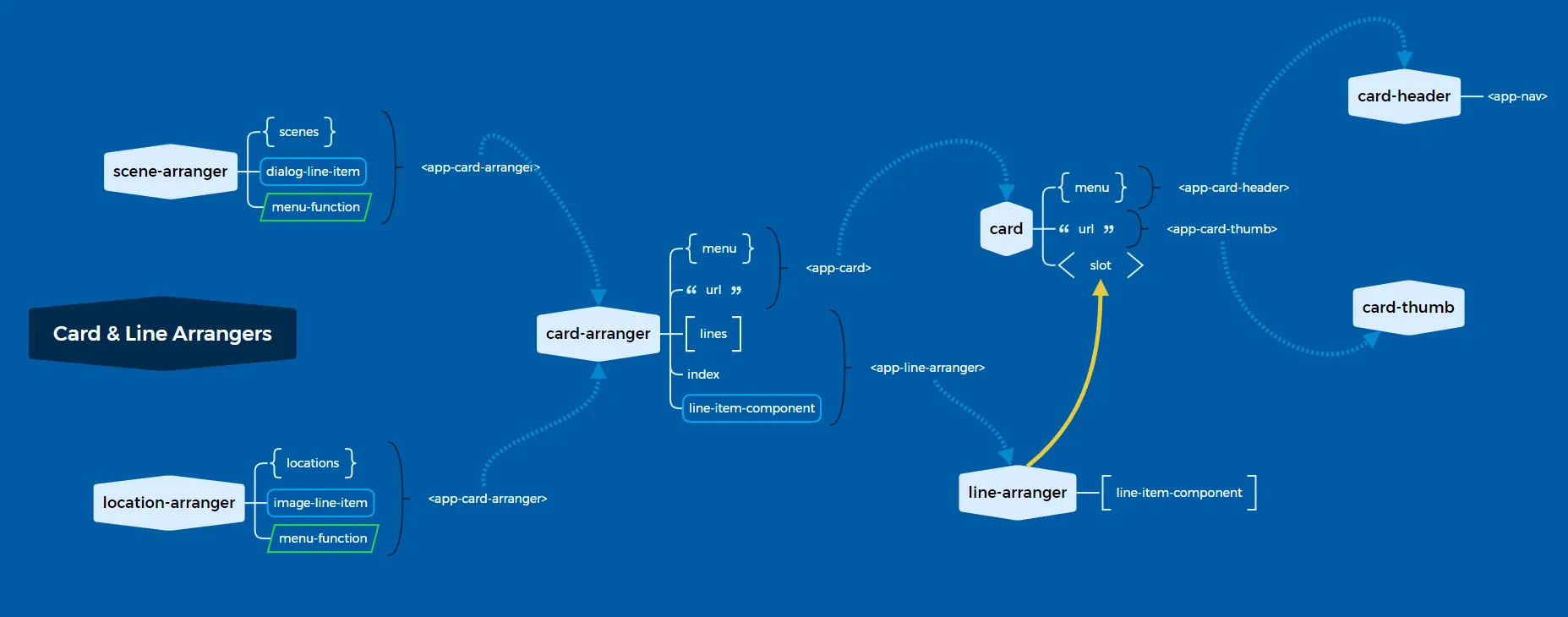 Architectural plan for refactoring
“Here’s an architectural diagram that I made to help decide how I wanted a major refactor to work. I pasted this diagram directly into Cursor while having it write the plan with me. Consistent naming and formatting, like braces around names of JSON objects and square brackets for arrays, let Cursor understand me without explaining. This is another new variation of “doc as code,” having the AI write something that matches an architecture diagram. In case you’re wondering, I use Xmind for these diagrams.”
“Don’t try to wrestle the LLM into working around your bad design. Just fix it, and use the AI to plan and implement those changes.
“[…] you can use the agent in investigation mode to figure out your architectural problem and solve it in isolation, earlier in your delivery process. The earlier you find a problem, the cheaper and easier it is to fix.”
“By taking a forensic approach with an agent, you come away a better investigator and a better programmer. You’ll be better able to craft the rules and the prompts you need to get your own code to the next level, and you’ll be able to talk about it with other people — programmers and non-programmers — in an understandable way.”
“Cursor allows you to set a monthly spending limit which can’t be exceed until you adjust it. This is your first line of defense. You should regularly visit your account usage page to see how much you’re consuming versus where your code is today. When you fill a swimming pool, you typically look at the water meter before and after and Cursor has just such a usage meter.
“Think about the human time and real money spending versus the code you got out of it to see if it’s a good value. Remember that the output is only as good as your input. Some types of tasks you assign will result in minor miracles. Others will be abject failures. Use the tool only for the areas where it’s proven successful, and keep trying new areas to see what’s possible.”
“Naïve voices in our industry are suggesting that somehow with MCP we’ll be able to wrangle all these agentic cats and they’ll finally be under our command. But that defies the first rule of MCP. Anything it can do you are already doing.
“We know this is true because MCP only provides a schema, a way to declare what LLMs and tools you want to call and a way for those tools and agents to declare what kind of queries they accept. To make use of any of this, you must already know the tools (APIs) you want to call and must provide the integrations in your app to make use of the LLM results (RAG) — things you’re already doing. If you have a large enough selection of models and tools that you need to call, it might help you to define those.”
What people get wrong about the leading Chinese open models: Adoption and censorship by Nathan Lambert (Interconnects)
“People vastly underestimate the number of companies that cannot use Qwen and DeepSeek open models because they come from China. This includes on-premise solutions built by people who know the fact that model weights alone cannot reveal anything to their creators.”
This article is absolutely correct in saying that people are strongly disinclined to use Chinese models, even those with open weights, because they still can’t know what’s in the training data. That’s a great instinct, and one that they utterly failed to apply—and continue to fail to apply—to western models. They continue to blindly trust Western models with closed training data and closed weights and closed everything, even after a track record of exactly that kind of software being replete with backdoors and ideological slant arguably stronger than that of China. Just because you’ve learned to agree with a certain propaganda doesn’t mean it’s not there, for God’s sake.
For example, there’s the following concern, which apparently magically comes into focus when the source model is Chinese…and blends right back into the background noise as an SEP when the model comes from the good, old, U.S. of A.
“A technical example of this is that companies worry about the code generated by the models having security backdoors — treading the line between information and traditional security risks. As models become more reliant on tool-use, this also involves them executing code on a company’s infrastructure, which presents more immediate worries.”
There is a good analysis, with data, of people testing the various models for their level of willingness, evasiveness, or outright denial, to assist in criticizing Chinese policy or historical interpretation. That is, to what degree does the machine just answer questions, and to what degree does it toe the CCP line?
“When you look at queries about China specifically, the Chinese models will evade many requests.”
Again, a very interesting line of inquiry and one which has been utterly absent from analysis of Western models or sources.
For example, Wikipedia’s article on Taiwan is incredibly slanted to the interpretation that Taiwan is its own country, first citing a good handful of very reliable sources like the f@&king Atlantic Magazine, which write things like “[…] already a de facto state” and “is in fact a sovereign country from our perspective”—something so mush-mouthed and self-contradictory (it can’t be both a “fact” and “from our perspective,” you utter poltroons) that it can hardly be taken seriously—before grudgingly admitting deep into the description that, “the ROC no longer represents China as a member of the United Nations after UN members voted in 1971 to recognize the PRC instead.”
That the ROC is still an autonomous state, rather than a “fact”, is a fantasy promulgated by western neocons who would prefer that all of Taiwan’s chip-manufacturing not be located in China. The by-now over ¾ of a century in the past civil war is described not as the overwhelming majority of communists on the mainland having taking over China in a revolution but as a setback for the ROC that resulted “resulted in the loss of the Chinese mainland to Communist forces”. The whole article is written as if the ROC’s defeat were a temporary setback that will be soon and quickly rectified for the forces of good and light—the anticommunist ones, of course.
This long interlude about Chinese history serves to say that we accept that narrative that is served to us and view everything else as propaganda. Perhaps some of the “propaganda” that we’re seeing come from Chinese models is that they’re just programmed to describe things from a non-Western view, one where the revolution in China lays far, far, far in the past and Taiwan is a part of China (as even the U.N. agrees and continues to agree, as even U.S. official policy continues to agree with the One-China Policy.
Look, just stop asking pointed questions of these machines. They will give answers that align with what their creators believe. See what ChatGPT thinks about Palestinians and Israelis if you don’t believe me.
Zed: The Fastest AI Code Editor by Richard Feldman (Zed)
“The entire Zed code editor is open source under GPL version 3, and scratch-built in Rust all the way down to handcrafted GPU shaders and OS graphics API calls. Zed’s new AI capabilities are also open-source, just like the rest of the editor, so you can see exactly what the new Agent Panel is doing under the hood.”
This editor is very, very smooth and more powerful than a standard Visual Studio Code. It’s also so much faster. However … it’s currently MacOS and Linux-only. The Windows version is in an early-access phase.
Even if you can’t use the editor, the ~5-minute video at the beginning of the post is absolutely what I’ve been looking for: how do you use these tools for real. The video demonstrates the following:
- Using the inline-completion to make small edits
- Using the chat-AI agent (the tool has access to many actions in the editor).
- Running a larger request/action against a large code base (they use the code of Zed itself, written in Rust).
- The request is to make the number of most recently used values in a list configurable via settings.
- The settings object already exists.
- The list already exists.
- It’s hard-coded to six elements right now.
- Viewing the steps taken in running the request.
Reviewing and adjusting the proposed changes.
“The diff is fully editable, so you can easily make changes to whatever the model came up with. It supports multicursor editing, language server integrations, and all the speed you love from the rest of Zed.”- Noting that one of the proposed changes is something that even a senior developer might have forgotten to do in a first attempt at the feature (updating settings
- Final review in a Git diff.
This is hands-down the best demonstration I’ve seen of extending a workflow comprising what the author nicely describes as deterministic tools—I’ve been calling them analysis-based tools—with AI-based tools (and agents). The section on costs is remarkably fair and open.
Trump's FTC Is Actually GOOD? (w/ Matt Stoller) by Briahna Joy Gray | Bad Faith (YouTube)
“[…] they are making a bet on AI and they’re all making the same bet because —nobody ever got fired for buying IBM is the expression— you can be wrong as long as you’re wrong with everyone else.”
The questions you should be asking are: how does this benefit our business or my personal life, rather than the business that is trying to sell it to me? If these companies are so spectacularly unprofitable, how much longer can they continue to offer these services at these prices? Will they? Or are they just doing the standard move of capturing market share until they are monopolies and then jacking up prices? Can we afford to be part of this? Do we want to spend time retraining people and rewiring how they work only to discover that the tools they now rely on cost 10x as much? Are the tools revolutionary enough for all that? If so, then we have to do a proper risk analysis on what could happen in the next year to decade.
They’re basically saying these are amazing, fun, and addictive toys. Not only that, but they do all of your work for you! Also, you can use them as sex dolls and therapists! Literally everything that sucks in your life can be made better with our products, all without doing the icky work of actually changing your material situation. How in God’s name is your scam radar not going off? Do you even have one? Is it broken?
The only material situation being improved is that of the scammers. As usual.
Programming
Context-Driven Smells by Marcel Stalder (Software Engineering Corner by Zühlke Engineers)
“Even an excellent sales team is likely incentivised by keeping the customer happy, rather than what the customer needs, or what’s best for the product. This leads to conflicting product strategies, and according to the proverb, “if you chase two rabbits, you will not catch either one”. With new requirements streaming in from all sources, the product backlog grows, customers become frustrated, and soon everything is a high priority feature − “if everything is urgent, nothing is urgent”. The development team begins to rush, tech debt is not included in a sprint, nice-to-haves are missed, and soon quality suffers.”
“The Product Team should be the people in charge of the long-term strategic direction of the product. It’s so easy for the sales team to miss some nuance in this, and the strategy begins to splinter and fray, and before you know it, you’re building bespoke systems for each customer. The whole point of agile delivery is making small pieces of value quickly and then seeing whether it works for the customer. For that to work, you need a good, trusted, direct means of communication with that customer. Having sales in the way jeopardises that fast feedback and means that a culture of experimentation can never get off the ground.”
“TDD can speed up development. It helps you to focus on what’s actually required (KISS), prevents you from building a Porsche when a van is what you need (YAGNI), and by biting off small chunks of the problem as tests, and iterating on them, you can make an enormous task smaller.”
“You want to aim for the situation where you’re completely confident that your code does what it should, but without being brittle, taking an age to re-write, or taking an age to run. Running a test suite is the very first piece of fast feedback your code gets, so make sure it’s fast.”
“Every time you fix a bug, ensure its covered by your test cases.”
“Think of observability as your application’s vital signs – without good monitoring, logging, and tracing, you’re essentially working in the dark. You can’t fix what you can’t see. This was compounded by the lack of testing, making the system more opaque and brittle.”
“Structure your logs to make them more searchable, and to give you the information that you will need in an emergency. JSON is common. If a user journey spans many services or stages, you might want to be able to stitch each of those logs together into a coherent story, so think about adding a journey-specificcorrelationIdto logs that can be filtered for.”
“uild dashboards so that you can see what’s happening, now and over time, Grafana is a common tool for this, simple to use, with tons of data ingestion sources. It allows you to ingest metrics from your application, and to build charts, dashboards, and alerts from them. Start slowly and gradually build up more and more insightful views. It’s common to start with simple things like http statuses, memory stats, error logs, etc.”
“You obviously don’t want to test your 3rd party dependencies’ code, but you should test your interaction points with them. Defensive programming can help – assuming any interaction is potentially incorrect or missing. Build comprehensive testing to be confident of managed service degradation. The worst thing a service can do is to give the wrong information. Often, 3rd parties provide testing APIs to integrate with, and it’s worth including very simple calls and tests to them in your integration layer – if the API contract changes, your tests will fail. Make sure that you have good error handling and alerting around the API, so that when it goes wrong, not only do you handle it gracefully, you know about it.”
“Internal dependencies from other teams are hopefully more reliable, but human error, siloes, and complex organisations all make mistakes possible, so be defensive here too. Perhaps consider Contract Testing and/or schema validation. Add monitoring, logging, and alerting around these calls, looking for errors and response times so that you’re at least aware of the issue.”
“It’s also vital that the business understands these risks, so make sure to discuss them clearly. You may need extra time to safeguard the code, or the business may need to add legal cover or other mitigations to reduce the likelihood or damage.”
“Here’s the brutal truth: there’s never magically more time later to fix quality issues. That “we’ll clean it up next sprint” promise? It rarely happens. Instead, each shortcut adds to your technical debt, making every future change slower and riskier. It’s like putting purchases on a credit card with sky-high interest rates.
“Your customers feel it too. Those workarounds often leak through as inconsistent behaviour, mysterious bugs, or sluggish performance. Each quick fix might solve today’s crisis, but it erodes trust with every new problem it creates.
“And let’s bust the biggest myth: that cutting quality saves time. You’re just pushing work downstream – where it’ll cost more to fix and cause more damage along the way. That quick workaround today means hours of debugging next month, frustrated customers, and developers who spend more time fighting fires than building features. Quality isn’t just about perfect code; it’s about maintaining velocity and trust. When you sacrifice it, you’re borrowing time you’ll have to repay with heavy interest.”
“Convince them (and you) that quality is non-negotiable. By skipping it, we’re essentially taking out a high-interest loan against our future velocity. Use concrete examples from other parts of the project – all that tech debt, those day-long investigations. You can’t guarantee that your product will be bug free, but spending a little time now will save you 4-5 times that in production.”
“If you do bring new people in, ask them to focus on isolated, well-defined areas, that don’t need huge context. Pair with them to get them up to speed more quickly and to maintain team standards.”
“Keep it sustainable, make sure your test coverage is good, keep that great code structure, continue to pair and review code. Future you will thank you for it.”
“[…] what happens if we’re deployed on AWS and eu-west-1 goes down? Is our service dead? Will it spin back up? Is there a cost or reputational impact? Will it work on a different region? What if that S3 bucket of images is deleted? Do we have a backup? When does our cert expire, do we have a fallback? Look at Failure Mode Effects Analysis (FMEA), practise it as an organisation, and share, and act upon the results.”
Risk analysis…
“I have found it useful for prioritisation to use an Eisenhower Matrix. As a team, decide whether each piece of tech debt is important or not, complex or not, and prioritise those items that are both simple and important. Some important and complex things need to be fixed, but this approach operates on the 80:20 rule – 20% effort should give you 80% of the value.”
“Ask yourself if you have confidence in your product − what would happen if your user base doubled or tripled, do you know? What would happen if a bedroom hacker targets it, or a nation-state, and does it matter?”
More risk analysis…
“For me, this value falls into a few categories:”
- Get feedback, and measure satisfaction
- Gather usage metrics, use a/b testing
- Measure support tickets and feature requests
- Looked at abandoned features – what did we build that had no use?
Value to the business
- Cost savings from improvements
- Revenue from new features and products
- Reduced TTV
Value to the team
- Shorter lead time, cycle time
- Faster release frequency
- Fewer defects
“This is what we’re all about. Are we providing more value now than we were before, and can we do better?
“Speak to the team, to the business, and the customers. Get real feedback.”
Song recommendations as an Impureim Sandwich by Mark Seeman (Ploeh Blog)
“Consider the cost of hardware, compared to developer time. A few specialised servers may set your organisation back a few thousand of dollars/pounds/euros. That’s an amount you can easily burn through in salary if the code is too complicated, or has too many bugs. You may argue that if you already have programmers on staff, they don’t cost extra, but a too-complicated code base is still going to slow them down. Thus, the wrong software design could incur an opportunity cost greater than the cost of a server.”
How G+D Netcetera used Rama to 100x the performance of a product used by millions of people by Nathan Marz (Red Planet Labs)
“With Rama, they were able to improve the latency for new content becoming available on pages from a few minutes to less than a second, and they reduced the load on the CMS from Forward Publishing to almost nothing. Both of these are over 100x improvements compared to their previous implementation.
“As a bonus, their Rama-based implementation requires much less infrastructure. They went from running 18 nodes per customer for Forward Publishing for various pieces of infrastructure to just 9 nodes per customer for their Rama implementation. In total their Rama-based implementation reduced their AWS hosting costs by 55%.”
“Rama explicitly separates the source of truth from the indexed datastores that serve queries. It provides a coherent and general model for incrementally materializing indexed datastores from the source of truth in a scalable, high-performance, and fault-tolerant way. You get the data integrity benefits of full normalization and the freedom to fully optimize indexed datastores for queries in the same system. That tension between data integrity and performance that traditionally exists just does not exist in Rama.”
“G+D Netcetera built a small internal library similar to Pregel on top of Rama’s dataflow abstractions. This allows them to easily express the code performing graph operations like the aforementioned traversals.
“The core microbatch topology relies heavily on Rama’s batch blocks, a computation abstraction that has the same capabilities as relational languages (inner joins, outer joins, aggregation, subqueries). Batch blocks are the core abstraction that enables G+D Netcetera’s graph computations.”
“This PState uses subindexing, which causes those nested data structures to index their elements individually on disk rather than serialize/deserialize the entire data structure as one value on every read and write. Subindexing enables reads and writes to nested data structures to be extremely efficient even if they’re huge, like containing billions of elements. As a rule of thumb, a nested data structure should be subindexed if it will ever have more than a few hundred elements.”
The null check that didn’t check for nulls by Oren Eini (Ayende)
Basically, using var in pattern-matching might lead to a pattern that looks like it checks for null but doesn’t. You can see and play with a live example (SharpLab.IO) but I’ve replicated the examples below.
This is the problematic example:
string Test1(List<string> strs)
{
    if(strs is [var s])
    {
        return s;
    }
    return string.Join(",", strs);
}
It’s basically saying that the pattern should match anything that’s a collection with one element. Since the type is obvious from the method signature’s parameter strs, we use var instead of string. That generates the following code.
internal static string <Main>$>g__Test1|0_0(List<string> strs)
{
    if (strs != null && strs.Count == 1)
    {
        return strs[0];
    }
    return string.Join(",", strs);
}
Note that it returns the first element without checking it for null.
If you change the var to string, which, as noted above, is redundant, then the generated code includes a null-check.
string Test2(List<string> strs)
{
    if(strs is [string s])
    {
        return s;
    }
    return string.Join(",", strs);
}
This is the generated code for the example above.
internal static string <Main>$>g__Test2|0_1(List<string> strs)
{
    if (strs != null && strs.Count == 1)
    {
        string text = strs[0];
        if (text != null)
        {
            return text;
        }
    }
    return string.Join(",", strs);
}
If you instead use { } to indicate that you want to match a non-null object, then you also get the null-check.
string Test3(List<string> strs)
{
    if(strs is [{} s])
    {
        return s;
    }
    return string.Join(",", strs);
}
This is the generated code for the example above. It is the same as the second example that uses string for the matched parameter.
internal static string <Main>$>g__Test3|0_2(List<string> strs)
{
    if (strs != null && strs.Count == 1)
    {
        string text = strs[0];
        if (text != null)
        {
            return text;
        }
    }
    return string.Join(",", strs);
}
The Coolest Feature of .NET 10 is Here by Nick Chapsas (YouTube)
This is an ASP.Net feature, which uses makes it easy to build EventSources (MDN), a feature that is widely supported in browsers. The API on the server side lets you define an API that returns an IAsyncEnumerable<T> that the server knows how to maintain and any client can easily consume as a stream.
Fun
India Retaliates Against Pakistan By Scamming Them Out Of Millions In Amazon Gift Cards (Babylon Bee)
“Hello Pakistan my dear
“Hello sir how are you today i saw your profile and have opportunity for u to earn amazong gift card. Click HERE lovely >https://ddirje…”