
Links and Notes for May 30th, 2025
Below are links to articles, highlighted passages[1], and occasional annotations[2] for the week ending on the date in the title, enriching the raw data from Instapaper Likes and Twitter. They are intentionally succinct, else they’d be articles and probably end up in the gigantic backlog of unpublished drafts. YMMV.
[1] Emphases are added, unless otherwise noted.↩
[2] Annotations are only lightly edited and are largely contemporaneous.↩
Table of Contents
- Public Policy & Politics
- Journalism & Media
- Labor
- Economy & Finance
- Science & Nature
- Environment & Climate Change
- Art, Literature, & Cinema
- Philosophy, Sociology, & Culture
- LLMs & AI
- Programming
- Fun
- Video Games
Public Policy & Politics
 I'm gonna read a thing or two about it
The White House as Playpen by Patrick Lawrence (Scheer Post)
“Trump’s people put the cost of Golden Dome at $175 billion, which means the true cost will be some multiple of this figure. The Congressional Budget Office says $500 billion is more like it. Trump promises to get this done in three years. Defense technology people say this kind of thing will take two decades to develop. I have in mind the old Strategic Defense Initiative, the “Star Wars” debacle of the Reagan years. I am interested only in how long it will take for Golden Dome to prove another irresponsible fantasy and how much money will be wasted between now and then.”
“Remember when Mark Zuckerberg went to Mar-a–Lago to dine with Trump and all the liberals gasped? The chief executive at Meta proved merely the first to put his forehead to the palace floor.”
“True enough, experts deserve much if not most of the malice and mistrust Trump expresses in behalf of many, many people. This is because a goodly proportion of them, having discarded all thought of disinterest, have long abused their capacity to influence policies and events in the cause of their own or someone else’s gain. We now live in a society wherein elites and any kind of elitism, as well as experts and expertise, are prevalently — fair to say — discredited. This is a problem. Trump and his dreadful gathering of incompetents are not the answer.”
“The Trump regime, in short, faces us with a truth that seems to have fallen by the wayside over many years. No polity can do well without qualified experts. It requires experts who have the principles and moral scruples to make use of their qualifications and learning in the cause of the commonweal.”
How Russia Quietly Revolutionised Warfare by Kit Klarenberg (Scheer Post)
“The Times reports that until late 2023, Ukrainian infantrymen “were usually carried to a position near the front in armoured personnel carriers, walking the last few hundred metres on foot.” Today, they are dropped off up to eight kilometres away at night, walking “meandering routes through trees to avoid detection, just to take up their positions.” Deployments to the frontline have also vastly extended in length. While at the start of 2024 Ukrainian soldiers spent “a week or two” at zero point, now they’re routinely trapped there for months at a time, “often devoid of almost any other human contact, resupplied with water, rations and ammunition by agricultural drones.” Resultantly too, “casualty evacuation has become a nightmare.” Wounded fighters are “commonly” rescued at night, and “even then the operation is fraught.””
“The Times report is a vanishingly rare mainstream acknowledgement of how the conflict raging in Donbass is a war unlike any other in history, and its key spheres of battle are wholly uncharted territory for Western militaries. Despite this media omertà, the proxy conflict’s unparalleled operating environment, and obvious lessons, have not gone entirely unheeded in certain elite quarters.”
“[…] despite NATO officials openly warning the alliance is wholly dependent on US electronic warfare capabilities, which in any event are woefully inferior to Russia’s own, public indications of Western leaders or militaries taking the drone warfare revolution seriously are unforthcoming. Should they end up in direct conflict with Russia, they’ll be in for quite a shock.”
Famine As a Weapon of Genocide: Gaza 2025 – Soviet Union 1941 by Yorgos Mitralias (ZNetwork)
“Ernest Mandel is clearly right when he observes that “It is not true that the Nazis’ extermination plans were meant exclusively for the Jews. A comparable proportion of the Gypsies was also exterminated. In the longer term, the Nazis wanted to exterminate a hundred million people in central and eastern Europe, above all Slavs”.
“In short, the Shoah is not the only holocaust in history. But, if it is not unique, if there were others before or at the same time as the Shoah, then Ernest Mandel is right to draw the following conclusion: “We say deliberately that the Holocaust has been the apogee of crimes against humanity so far. But there is no guarantee that this apogee will not be equalled or even surpassed in the future. To deny this a priori strikes us as irrational and politically irresponsible. As Bertolt Brecht said, ‘The womb from which this monster emerged is still fertile”’ .”
“So what can be said and done about the leaders of 153 countries, including our own, who, although signatories to the “Genocide Convention”, blatantly refuse to apply it? What is to be said and done about them, who refuse the “duty to prevent genocide” imposed on them by this Convention, a duty “which arises as soon as a State is aware, or ought normally to have been aware, of a serious risk of genocide”, which includes “the use of starvation as a weapon of war”,… “acts constituting war crimes, crimes against humanity, in particular extermination, and acts of genocide”? (3) What is to be said and done about these accomplices of genocidaires and others guilty of crimes against humanity?…”
The Trial Of Diddy And Cassie by Scott H. Greenfield (Simple Justice)
“This misapprehends the nature of criminal trials. No, Ventura is not the defendant and, should her testimony not be found credible enough by the jury to convict, she will not be punished. But Ventura is very much on trial. The prosecution is on trial. The burden is on the prosecution, and by extension its witnesses, to prove guilt. The defendant has no burden, nothing to prove.
“While the hotel hallway video is damning, it proves only what it shows, not that Ventura was unable to walk away a thousand times over the 11 years they were together, if she wanted to. That’s what her agency is about, that she had the ability to make decisions for herself and act upon them, and her failure to do so, or her enthusiastic participation otherwise, was her choice.”
“But in Comb’s case, the issue isn’t whether the rationalizations are right or just excuses for conduct that can’t be rationally explained. In Comb’s case, the question is whether he will be convicted upon evidence or convicted upon a fabric of excuses to explain away the facts brought out about Cassie Ventura. It’s not that she may not be telling the truth in that she felt coerced such that she couldn’t leave Diddy. It’s that no defendant should be convicted based on excuses when the evidence fails.”
Fresh Ukraine, Russia demands show no interest for actual peace by Anatol Lieven (Responsible Statecraft)
“The bipartisan bill to go before the U.S. Senate next week (with the encouragement of the EU presidency) proposes 500% tariffs on imports from countries that buy Russian oil and gas. Presumably the senators are thinking of China. They appear to have forgotten that it also means India (and other U.S. partners). India has no intention of bowing to a U.S. diktat that would radically increase its energy costs and undermine its economy; and the imposition of 500% tariffs on India would ruin a vital U.S. relationship in Asia.
“Finally, the EU has passed a new package of sanctions against Russia including measures to target the so-called “shadow fleet” of internationally-flagged tankers transporting Russian energy exports. This is also an affront to countries like India that buy this energy — and consider that they have a perfect right to do so under international law, since Western sanctions against Russia have not been approved by the United Nations, or agreed by themselves.
“Last month, an Estonian patrol boat attempted to board a tanker bound for Russia in international waters, and Moscow sent a fighter jet to warn the Estonians off. Finland and Sweden have also threatened to detain such ships. Russia in response briefly detained a Liberian-flagged Greek tanker exiting Estonia through Russian waters. Russian politicians have threatened retaliatory seizures: “Any attack on our carriers can be regarded as an attack on our territory, even if the ship is under a foreign flag,” warned Alexei Zhuravlev, the deputy chairman of Russia’s parliamentary defense committee.
“If both sides stick to their positions, then naval clashes will be not only possible, but certain. It is also obvious that these NATO members would never engage in such wildly reckless behavior unless they believed that in the event of such clashes, the U.S. military would come to their aid. The Trump administration needs to rein them in very firmly indeed.”
NATO risks nuclear catastrophe with attack on Russian airports by Peter Schwarz (WSWS)
“In Moscow, the attack will be interpreted as a NATO attack on strategic targets within Russia, and the regime will respond accordingly. Official sources have so far remained cautious. The Russian Ministry of Defense merely stated that “some aviation equipment had caught fire” and that “all terrorist attacks” had been repelled.
“But bloggers close to the Russian military are calling the attack “Russia’s Pearl Harbor.” In December 1941, the Japanese air force destroyed parts of the American Pacific Fleet in the Hawaiian port. The following day, the US declared war on Japan and entered World War II.
“The widely read channel “Dva Majora” accused NATO of “directly undermining the nuclear strategic balance” and “reducing our country’s nuclear protection.” The Telegram channel “Rybar,” with 1.3 million subscribers, called for an end to talks with Ukraine and a “new level of escalation of the conflict.” The newspaper Moskovsky Komsomolets, the second largest in the country, described June 1 as a “black day for Russia’s long-range and military transport aircraft” and called for the same “determination and harshness” against Ukraine as Israel has shown against Hamas.”
Wind beneath the wings for Russian war hawks.
“[…] neither the US nor the major European powers wanted to share with the Russian oligarchs. Driven by mounting economic and financial crises and the pursuit of raw materials, markets and profits, they broke one agreement after another that they had made since the dissolution of the Soviet Union and pushed further and further eastward economically and militarily. After NATO had annexed all of Eastern Europe and the former Baltic Soviet republics, it also reached out to Ukraine and Georgia, aiming to destroy Russia.”
“Even as NATO escalates the war against Russia, the imperialist powers, led by the US, are escalating their conflict with China. Over the weekend, US Secretary of Defense Pete Hegseth declared that a war with China, ostensibly over Taiwan, was “potentially imminent.”
“The war in Ukraine and the danger of nuclear escalation can only be stopped through the independent intervention of the working class. It is the working class that bears the consequences of war and militarism and has no interest in supporting either side in this war. The workers of the US, Europe, Russia, and Ukraine must unite in the struggle against war and its cause, capitalism.”
Man, they end nearly every one of their articles this way, but it’s true. That’s really the only way we get power back from the oligarchs. It will never happen in my lifetime, though. I would love to be proven wrong.
Ending the World to Own Trump by Matt Taibbi (Racket News)
“The implications of Ukraine’s attack, particularly Ukrainian President Volodymyr Zelensky’s post-attack TD dance about how “the preparation took over a year and a half,” are drastic and obvious. The symbolism of the attack being launched a day before peace talks also speaks volumes about Ukraine’s attitude toward potential settlement, as well as the attitude of Ukraine’s backers in the West. These people don’t want a negotiated peace of any kind, among other things for the beyond-bat-bleep reason that it might be perceived as a political win for Trump.”
“Peel away the gushing about Ukraine’s “brilliant technical performance” and what you find everywhere underneath are American and European officials who believe, now more than ever, that Ukraine can “win” this war. They’ve rejected voters’ demands that we stop supporting this endeavor financially and rejected their concerns about strategic risk. They want to keep fighting at any cost, even annihilation. They are deluded, treasonous, and insane.”
Wargaming Taiwan by Indrajit Samarajiva (Indica)
“In most wargames against China, America “gets its ass handed to it” (RAND), is “unable to deter and defeat Chinese aggression” (DoD), and is “not just losing, but losing faster” (Air Force). In the one wargame they do ‘win’ (CSIS), Taiwan is left “a damaged economy on an island without electricity and basic services.” Meanwhile the United States takes up to 10,000 casualties, loses two aircraft carriers, 40% of its jets, and takes Japan down with it. This is the ‘winning’ scenario, forecast by people who just lost the Red Sea to Yemen. What are we even talking about here?”
“This wargame just assumes that America wants to play, and totally elides over the stakes. We’re talking about thousands of casualties and the decimation of US military power for decades. Remember that this is a US Navy that fled the Red Sea after losing a few F-18s, but we’re expected to believe that they’re OK with losing two aircraft carriers entirely.”
“In every recent war, America has been bombing poor countries using poor volunteers, it had no impact on their home front. War with China, however, would crash their politics and, more importantly, their markets. If you thought tariffs with China was bad, war with China would be terrifying. Goods would stop coming in and only body bags would come back. It’s hard to see America steeling this out for more than a few days, let alone weeks.
“America also cannot win this wargame alone. In every iteration, Japanese support is required, at the minimum letting America use its occupation bases for aggression, and at the maximum using civilian Japanese civilian airstrips! The plan, any plan, simply does not work without Japan. Even the best laid plans, however, ends up with Japan getting bombed, most of their fleet sinking, and much of their planes being destroyed on the ground. So quite a big gamble to ask Japan to take based on… vibes.
“Japan has no offensive agreement with America, and no agreement with Taiwan at all. “As Japan analyst Jeffrey Hornung observes, none of the critical decisions about Japanese assistance to U.S. operations are “legally automatic… All these decisions are political.”” This is not to say that nuked and neutered Japan won’t follow along, but they have to follow instantly for the plan to work, and they can deny victory by merely demurring. And without basing in Japan, those bases getting hit by China, and then Japan being drawn into war, every ‘winning’ scenario falls apart.”
“The report was admittedly written in 2023, but it’s a strange decision in 2025, when we’ve seen how decisive drones and electronic warfare are. China is the world’s drone leader and has a newer, technologically superior military to America’s, which is last century’s stock. America won’t even know what hit them. They haven’t wargamed for any of the new game changers of war.”
“America, of course, has no business in China’s internal business at all (how both China and Taiwan see this). The Kissinger hypothetical “It’s dangerous to be America’s enemy, but fatal to be America’s friend,” has been proven many times over since then, with Ukraine most recently. War, however, is America’s business, and their innovation is finding out that there’s more money losing wars, looting your own treasury, and dumping the costs on your ‘allies’. And this is precisely the context that they’re playing with Taiwan.
“Hence the ‘winning’ scenario is bad except for everyone except CSIS’s paymasters, arms dealers like Lockheed Martin and assorted ghouls like Bill Gates, etc. The whole thing is really sponsored content for merchants of death. Taiwan gets destroyed, Japan gets destroyed, and America gets decimated, but who cares, weapons stocks will go up. This is really like the judgement of Solomon, where he offers to cut a baby in half, and America is the bad mother (fucker) that accepts such a state as ‘winning’ at all.”
Hasan Piker Gets Roasted For Speaking To The Cops! by Lee Camp (YouTube)
This one is one of my favorite comedians/political commentators, Lee Camp (Kath and I went to Berlin once to see a show) talking about Hasan Piker’s interrogation by the border police. It’s a good analysis … Piker didn’t do anything wrong, except if he even talked to the cops. One word: lawyer.
New York City mayoral candidates are questioned about would be their first foreign visit in office. by BreakThrough News (YouTube)
And this one is very short. It’s of a debate for the mayoral candidates for New York City. Mamdani is the only good candidate. He’s the only one who doesn’t think his job is to visit the Holy Land. Israel is a mind virus over there.
Scott Ritter : Is the US at War With Russia? by Judge Napolitano (YouTube)
“[…] this is actually forecast in [my] book. […] I’m here to tell you right now that we are on the cusp of thermonuclear war. When you have pro-Trump generals who go on Fox News and usually spout nonsense about Ukraine and Russia suddenly coming on Fox News wide-eyed, going “Uh guys this is really close to nuclear war.” They’re waking up. They understand what happened. What happened’s not a joke.
“How would we respond if the Mexican cartel sent trucks loaded with drones to Whitman Air Force Base and struck our B2-bomber force? Up to North Dakota and struck our B-52s at Barksdale, hit our B-52s, our strategic nuclear triad, our strategic nuclear force, and they hit them with the idea of taking them out.
“And then we find out that the Chinese and the North Koreans supported that. Do you think we’d sit here and go gosh uh that’s… No! We’d take them off the face of the earth. Because it is existential in nature.
“That’s what happened, ladies and gentlemen. The Ukrainians went after Russia’s strategic nuclear-deterrence backed by a nuclear power—Great Britain—and facilitated by another nuclear power—the United States—and the Russians have every right to say that that is a preemptive strike, the beginning of a series of actions that could lead to the United States or Great Britain launching a preemptive strike against Russia.
“That’s why it’s dangerous. Because how do you preempt preeemption with preeemption? Meaning: you just start firing your own stuff. Guys, this is so dangerous.
“I know people are like “Scott you keep crying wolf.” Because it’s a dangerous time we live in guys. We get lucky. Just because we get lucky doesn’t mean the threat didn’t exist. This is as real as it gets.
“Look at the photograph of the bear bombers burned out. Now close your eyes and imagine they’re B2 bombers at Whitman Air Force Base. What the hell would you think you’re going to do and what would you want the president to do and then be grateful that there’s a guy named Vladimir Putin sitting in the Kremlin who isn’t a vindictive revengeful kind of guy, who understands the consequences of his actions.
“But be prepared because he will have to send a response that reestablishes Russia’s red lines in their nuclear doctrine as a reality, not something that can be violated at will by a nation like Ukraine on behalf of the British.”
Journalism & Media
Why does Switzerland have more nuclear bunkers than any other country? by Jessi Jezewska Stevens (Guardian)
“Faced with unrelenting Russian aggression and the simultaneous withdrawal of American military and diplomatic support, European countries across the continent are reinvesting in defence.”
Oh fuck off forever, Guardian. Christ almighty don’t you ever get sick of spewing this same toxic horseshit day in and day out?
Probably not. No-one ever got fired for hating Russia, baby.
The answer to the titular question is that most Swiss are raging alcoholics and where else are you going to keep your wine? Also, the shelters are probably pretty good for surviving an initial non-ground-zero blast but the fallout will get you all the same. You gotta come up for air sometime (the air filter only lasts for 48 hours).
My cellar is the one with the air-filtration machine but I’m gonna be honest: I like most of my neighbors but I’m not going to squish in there with all of them when there’s absolutely no plan for a toilet or how to keep the children silent while I try to sleep. I’ll let them all in, then will be up on the back terrace with a giant tumbler of G&T, watching the false sunrise of the atomic flash first rob me of my eyesight and then fire a piece of straw through my eyeball and into my brain at the speed of sound. There are worse ways to go.
Labor
Infinite Contempt For Working People Is Not an Acceptable Default Position by Hamilton Nolan (How Things Work)
“The ability to convince the general public that the standards of common decency that we all expect from one another do not apply to the entire field of business is one of the greatest tricks capitalism ever pulled.”
“I’m talking about the baseline decision by a company to refuse to treat its workers as humans who deserve the sort of rights and respect that the executives of a company would expect for themselves. “Act in such a way that you treat humanity, whether in your own person or in the person of any other, never merely as a means to an end, but always at the same time as an end,” said Immanuel Kant. “We refuse to recognize your request for a union,” said corporate America.”
“People who care about basic fairness rightly denounce the Republican efforts to gut the NLRB and smash labor protections. Consider, however, that these politicians are basically just doing a favor at the request of the corporations. Whole Foods is making the choice not to recognize the union and bargain. Corporate America is making the choice to support a fascist political party in order to be able to say “fuck off” to its own workers when they say, “Hey, well all got together and followed the legal process to allow us to negotiate a fair contract with you. So when can we meet?” Republicans deserve all the scorn they get, but never forget that they are acting at the behest of corporations, who are using their own agency to deny their own employees the right to even sit down and negotiate!”
“It is certainly impressive and inspiring that the unionized workers won this campaign against the company board members. Consider, however, that all of this nationwide effort and strife is only necessary because REI, the nice progressive company, continues to choose to refuse to simply negotiate a fair contract with its unionized employees. All of this organizing, all of this coordination, all of this work, is being done just to try to pressure the company to fulfill its basic legal and moral obligations: to treat its own employees as human beings who are deserving of the most rudimentary form of respect and fair treatment, rather than as enemies to be oppressed at every turn.”
“It is assumed that, if workers want to exercise their legal right to form a union, companies will use the tools of lies and fear to try to dissuade them from doing so, even knowing that a union would be in the best interests of the workers.”
“If one person acted towards another person in the way that companies act towards their employees, we would instantly recognize their behavior as unforgivably rude—as the behavior of someone who should not be allowed in polite society. But because it is a company, we take it for granted.”
“Judge companies by the standards of human behavior. When they fail, treat them with the contempt that they deserve.”
Economy & Finance
The Debt Economy Is Eating Everyone Alive by Casey Wetherbee (ZNetwork)
“It is not hard to understand why these companies need to be regulated more, not less: their business model depends on people going into debt, missing payments, and then paying the BNPL provider late fees or interest on their loans. By dressing up their services with buzzwords and sleek user interfaces — and exploiting regulatory loopholes that exempt them from standard disclosure requirements — these companies prey upon people’s FOMO, persuading them to buy Coachella tickets with money they don’t actually have. In fact, the 2024 Federal Reserve study referred to prior research showing that people spend more when BNPL is offered at checkout — precisely why vendors partner with BNPL companies in the first place. It’s a clear example of how these companies exploit cognitive biases to profit from consumers’ debts.
“BNPL companies are not alone in embracing this business model. The entire credit industry has made record profits in recent years by jacking up interest rates and consumer penalties. A few years ago, a startup called Yendo unveiled a new credit card backed by people’s car titles, targeting subprime customers who are unable to secure conventional loans. Its rapidly increasing user base is a bleak reflection of financial precarity and corporate greed.”
“The expansion of BNPL debt is just one more frontier in the capitalist quest to commodify as much of the human experience as possible, with predatory corporations continuing to push the envelope under a government that is unwilling to curb their unethical practices. It is not normal to go into debt to order a pizza or attend a concert, yet these companies seek to normalize exactly that. The fact that so many people take the bait, especially those in younger generations, is indicative of the broader economic anxiety and hopelessness that characterizes our broken economy.”
Interviewing LEFTIST ICON Yanis Varoufakis by HasanAbi (YouTube)
This is a brilliant and wide-ranging interview. It’s almost two hours long and I can absolutely appreciate Yanis’s stamina. he discusses BRICS and China’s economy in detail. Hasan describes how he has his own house that he lives in, which means he’s ostracized from certain communities because what successful person does something so wasteful to investment? You can see his dog sleeping on a mat in the background. He asks Yanis whether he agrees that socialism is incompatible with affluence.
“You see the whole point about being a socialist is wanting everybody to be well-off and not wanting anyone anyone to be a victim of exploitation. Now that, in my case, […] my privilege is bordering on the sinful. The question is: are you prepared, if needs be. are you prepared to downsize? To give it up so as to live under circumstances of shared prosperity? And the the answer must be yes and it is yes. Do I feel guilty that my income is above the median income? No, because I don’t think socialism would be promoted if I fell below the median. If it were to be promoted, I would do it. And one final point: we Marxists we are not against the products of capitalism, of the production line. We are against the social relations of production which confine ownership of those machines to the 0.001% and the rest become slaves of that 0.001%. I’m not going to smash my phone because it is an instrument for Jeff Bezos.”
Science & Nature
Bayes For Everyone by Brandon Hendrickson (Astral Codex Ten)
“Please don’t refuse to take children seriously. My probability for Bigfoot is way under 1%, but when we assume an answer to (for example) whether Bigfoot is real and simply repeat it to kids, we deny them an opportunity ripe for sharpening their intellects.”
“I.I.: But cryptids are so low-brow… A sign of how deeply appealing they are for multitudes of people! Things like this are a road to intellectualism for the masses; we ignore it to the detriment of some of the kids who need it most. Even the cretin who bullied me in sixth grade was, in his spare time, trying to understand the world. Heck, we’re all naturally drawn to understanding the edges of things. Where does fact end and fiction begin? There’s a reason the History Channel inevitably morphed into the “ancient aliens” channel.”
“This, I think, is actually the deepest value of teaching kids Bayes: it’s a way to get them to converse with people whose views they think are stupid. And it’s only through actually doing that that we have any chance of helping people become rational. Such conversations (done with checking each other’s math) are the way to inculcate an openness to being wrong, a detached self-worth, comfort with uncertainty, and all the other aspects of what Julia Galef has so winsomely dubbed scout mindset. Approached this way, Bayes isn’t the weirdo, quant-y capstone to scout mindset — it’s the publicly-accessible front door.”
For Algorithms, a Little Memory Outweighs a Lot of Time by Ben Brubaker (Quanta Magazine)
“With his new simulation, Williams had proved a positive result about the computational power of space: Algorithms that use relatively little space can solve all problems that require a somewhat larger amount of time. Then, using just a few lines of math, he flipped that around and proved a negative result about the computational power of time: At least a few problems can’t be solved unless you use more time than space. That second, narrower result is in line with what researchers expected. The weird part is how Williams got there, by first proving a result that applies to all algorithms, no matter what problems they solve.”
It’s Not Just Tones: Chinese ALSO Has Intonation by Julesy (YouTube)
“Intonation can come in several forms. It can be falling, rising, rise-fall. And they’re usually used to denote things like commands, statements, questions, explanations, surprise, uncertainty—things like that.
“And the languages commonly cited to have intonation are English, Spanish, French. However, most languages—if not all—make use of intonation. And so, tones and intonation are commonly kind of pitted against each other.
“So, when you learn a new language, they’ll say “Okay this language has intonation like English or French.” Or some languages are tonal, like, you have to use the pitch of each word or syllable to differentiate the meaning.
“And so, you commonly see that tone languages are Chinese, Vietnamese, Thai, and then Indonesian. Languages like English, French, Spanish, other Induropean languages: these are so-called intonation languages.
“But the truth of the matter is that, the existence of tones in a language does not preclude it from having intonation. The only issue is how can they coexist?”
Later she discusses an intonation curve in native speakers of Chinese called “downdrift”. This is a tendency for the tonal register to descend throughout a sentence. AIs and non-native speakers don’t do that, instead sticking to a constant pitch range, resetting from word to word instead of riding the drift down the sentence. For native speakers, everyone who doesn’t do this sounds robotic, unnatural.
From near the end of the video, she also discusses “updrift”,
“There’s not much room for a lot of tone variation at the end [of a sentence]. And, at the same time, it also has updrift. Updrift, as in, you know, if you have two high tones, we’re not going to go reset right? you’re not gonna say ‘yang’ [reset tone] ‘ming’. We’re gonna say ‘yang’ [continue from previous tonal rise] ‘ming’. So, there’s kind of an organic connection between the tones in a phrase or a sentence in Chinese.”
“Questions are more lexally pressing than statements when we ask questions we want answers and it’s very important that the listener knows that they should respond to my question so I think it makes a lot of sense that the pitch curves for questions are higher than statements.”
I am at the very beginning of learning Mandarin but have enough grasp to understand this video. I have also been fascinated by linguistics for a long time and am very interested in exactly these kinds of comparison between languages that I know (English, French, Spanish) and languages that I’m learning. The video is very well done. I’m very glad that Victor Mair of Language Log linked to her.
What Everyone Gets Wrong About Football (ft. Tom Brady) by Veritasium (YouTube)
Environment & Climate Change
Glacier collapse in Blatten, Switzerland—A portent of an ecological catastrophe by Peter Schwarz (WSWS)
“The Swiss government maintains a Federal Office for Civil Protection, which deals with disaster and emergency management and produces detailed risk analyses.
“But pollution and climate change continue unabated. The World Meteorological Organization (WMO) has calculated that the global average temperature is likely to be 1.5 degrees Celsius (34.7 degrees Fahrenheit) above pre-industrial levels over the next five years. This means that the maximum set by the Paris Climate Conference in 2015 has already been reached, and temperature increases continue unabated.
“In recent years, all governments have abandoned their climate targets. The COP (Conference of the Parties) climate summits have turned into trade fairs for fossil fuels. The last one took place in Baku, the center of Azerbaijan’s oil industry. In the escalating global trade war, all governments are relying on fossil fuels to cut costs.”
“The scientific knowledge and technical prerequisites for solving the climate crisis are available, but they run up against the profit interests of those in power. Capitalist society is like a madman staggering toward the abyss with his eyes closed. It has only one answer to all social problems: war, dictatorship, social spending cuts, and environmental destruction. It is high time to put an end to it.
“Preserving the environment—like the fight against war, fascism and poverty—requires the building of a socialist movement that unites the international working class and fights for the overthrow of capitalism.”
Yes, yes, it does.
Art, Literature, & Cinema
”The Quiet American” Has Never Been More Relevant by Matt Taibbi (Racket News)
“Americans in Greene’s novels are universally savaged as blundering nitwits, from The Presidential Candidate in The Comedians who thinks he can end Haitian violence through vegetarianism to the CIA man in Travels With My Aunt who records how much time he spends urinating per day in a journal.”
“Greene even wrote an unnervingly convincing novel (The Human Factor) about a British official so repulsed by America’s alliance with South African apartheid that he spied for the Russians.”
“In hindsight, even if Greene hated Americans for other reasons, he may have been giving the USAID-style managerial expert too much credit for “good intentions.” Nonetheless, The Quiet American nailed a new kind of world conqueror, one bursting with what Iggy Pop called “plans for everyone,” while simultaneously being too ignorant of everything outside of his American head — language, customs, local personalities — to competently run anything. Because this new character also lacked any capacity for self-doubt, he never knew when to withdraw and doubled down until he found himself blowing up women and children for the “greater good.” Maybe it’s coincidence, but we’ve never had more to fear from the Pyles of the world.”
28 slightly rude notes on writing by Adam Mastroianni (Experimental History)
“Maybe that’s why so few people write, and why a few people feel compelled to write. Every kind of pain is aversive to most humans, but addictive to a handful of them. Writers are addicted to the particular kind of pain you feel when you’re at a loss for words, and to the relief that comes from finding them.”
This is not at all why I write, or how I feel when I write. I write because the words are right there, tumbling out. I write because I want my future self to find the words expressing thoughts that he might have forgotten were important. Maybe they’re still important. Maybe they’re not. How can you know if you never write anything down? I write to fix my thoughts and reasoning in my own head.
“The beauty ain’t in the necklace. It’s in the neck. […] Maybe that’s my problem with AI-generated prose: it’s all necklace, no neck.”
“Most writing is bad because it’s missing a motive. It feels dead because it hasn’t found its reason to live. You can’t accomplish a goal without having one in the first place—writing without a motive is like declaring war on no one in particular.
“[…]
“This is why it’s very difficult to teach people how to write, because first you have to teach them how to care. Or, really, you have to show them how to channel their caring, because they already care a lot, but they don’t know how to turn that into words, or they don’t see why they should.”
The motive is mostly why I write. The words are pressing themselves out of me. A lot of what I write ends up in notes and drafts, just for me. More and more, though, I’m structuring what I write into this site, to make it easier for me to search. I’m building an offloaded knowledge store of just things that I’ve found interesting or exciting enough to write about.
“Most writing, of course, isn’t exclusive in terms of access, but in terms of time. There’s something special about every word written by a human because they chose to do this thing instead of anything else. Something moved them, irked them, inspired them, possessed them, and then electricity shot everywhere in their brain and then—crucially—they laid fingers on keys and put that electricity inside the computer. Writing is a costly signal of caring about something. Good writing, in fact, might be a sign of pathological caring.”
“[…] lots of people think they need to get better at writing, but nobody thinks they need to get better at thinking, and this is why they don’t get better at writing.”
Consider Knitting by Bob Nystrom (Journal with Stuff)
“The first real thing I knitted was a scarf for my mother-in-law. In retrospect, I can’t say it’s a great scarf. Kinda cheap acrylic yarn. Not really her color. 4x4 rib was about all I could handle complexity-wise at the time, and it means the scarf tends to bunch up on itself. But when she opened the package on Christmas and saw it, her eyes teared up. Mine are tearing up now writing this.
“Because regardless of how good the object itself is, it is an inarguable testament to the fact that I chose to spend dozens of quiet hours making stitch after stitch, all the while thinking about her and how much she means to me. A fraction of my life’s wick that I burned for her and no one else.
“In a world where so many seem to want to get more and more out of less and less, to automate and AI-ify everything until an infinite content firehose is blasting into every orifice of every consumer, hand knitting to me is the antidote. An acknowledgement that all we really have is time and thus there is no gift more precious than spending it on someone.”
AI Memes Don’t Count by Austin Jones (Austin's Journey for Meaning)
“Hallmark makes better cards than I ever did, but they never made my mom cry. ChatGPT has read alot of the same jokes as me and can reproduce their likeness, but never once has it shared a drink with me. It hasn’t laughed so hard with me that we cry.
“So, AI memes don’t count because memes are supposed to be small units of culture that move about. Memes and their creators have never met you, but they are just as human. The shared human condition, the commitment to the bit, the use of our short time here to laugh together is what a meme is caching in. [sic] AI memes will get good, but they will never count.”
To Outlive or to seek life by Austin Jones (Austin's Journey for Meaning)
“The important one we spoke about is 夹缝求生 (jiā fèng qiú shēng). This means, “survive in the cracks”. It is pretty in its own right, but I want to dissect the Mandarin word for “to survive”.
“The word is 求生 (qiúshēng) comprising the characters for search (生) and life (生). The comparison is 求生 (search life) and the English word “survive”.
“So, survive breaks down into “sur” + “vive”. “sur” is a Latin root meaning over. “vive” coming from “vivere” similarly is Latin for live. So, survive means to “over live” or live over and past other things. The word in its etymology is necessarily adversarial, meaning that the perspective baked into the work is living more than something.”
Philosophy, Sociology, & Culture
How to Do Soul-Craft with State Tools by Jac Mullen (Hinternet)
“When we view literacy through that lens, it becomes clear that fluent visual language processing —reading and writing— is a collective, resource-intensive cultural adaptation. It occupies a narrow, hard-won space in our cognitive ecology. Until we see that clearly —and the forces now crowding in on it— we cannot fully name what is at risk, or decide what must be defended.”
“Widespread literacy, then, is not a natural baseline but a costly ecological accomplishment. It depends on sustained, large-scale societal investment in both cultivation and maintenance. If that investment falters —or if new modes of communication arise that are less cognitively demanding and more closely aligned with our oral-auditory predispositions— then this hard-won literate ecology can erode rapidly.”
“Where Sumerian tablets helped generate predictable grain yields, today’s machine intelligence structures the world to produce predictable data, attention, and behavior. Through continuous modeling and subtle feedback, human action is rendered legible and brought under algorithmic management. This marks a second enclosure — not of land, but of the cognitive commons itself.”
“If new media outperform text on primary utility, ordinary selection pressure may displace literacy from its cultural and cognitive niche. But while these systems may replicate many of the affordances of textuality, their effects may be fundamentally different. And when it comes to literacy, it is precisely the secondary and tertiary effects that carry disproportionate value. These effects include recursive empathy, long-horizon abstraction, disciplined counterfactual reasoning, interiority, and the capacity to entertain multiple perspectives over time. They emerge slowly, through sustained symbolic engagement. They are difficult to measure, easy to overlook, and prone to erosion when unattended.”
“To be clear about the mechanism: our society selects for the affordances of a medium —speed, ease, efficiency— not for its effects. And it is the effects of literacy that hold its civilizational value. This is the critical point: those deep cognitive and ethical capacities are not being selected for. They are not easily monetized or optimized. They rarely register on the dashboards that guide decision-making.”
“The ways we notice, recall, and orient our will may be increasingly governed by systems we do not see and cannot easily interrogate. In the hands of the few, large-scale behavioral modeling could begin to function as a form of ambient governance: a one-way mirror that interprets our impulses while offering little in return.”
“It took a thousand years from the invention of writing at Uruk to its first recognizably literary uses. It took another thousand for portable, alphabetic systems to make mass literacy possible. Today, we may have five years —perhaps less— to guide AI from a centralized instrument of emergent power into a decentralized, self-contained, shared cognitive substrate capable of strengthening human autonomy rather than displacing it.”
On Drugs: Our First Interview by Hinternet Editorial Board (Hinternet)
“There are always chemicals serving in some way or other to shape my perception of reality, and the idea that there could be some default setting of the brain that is chemical-free, in which you have direct access to the world as it is in itself, uninfluenced by what your own perceptual apparatus is bringing to the picture, is a total myth.”
“[…] modern philosophy is really all about the epistemological problem of bridging the gap between mind and world, of assuring ourselves that we are not hallucinating or dreaming. You would think, for that reason, that at least some philosophers really ought to take an interest in the substances that actually cause hallucination.”
Catherine Liu: the Psychology of Liberalism by Joshua Citarella | Doomscroll (YouTube)
At 40:00,
“You know what leftists need to do? They need to grow up and have boundaries. And I’m going to be like the Jordan Peterson—the Joanie Peterson, right?—now. Okay. It is not okay to be a little egg avatar. We have to treat ourselves and each other like adults. Which means sometimes we’ll be upset by the world. We will be upset by other people’s opinions, other people’s behaviors, and we have to treat ourselves and the other with respect. Because we have to keep the idea of good social relations before we can even get to socialism And good social relations means good boundaries. And this is why having a strong ego is actually critical to being a good political subject. Otherwise, you’re divided like an egg between the super ego and the id. Freud said the superego and the id are on one loop. The ego has to be a mediating term between them. So, people, grow the fuck up.”
At about 01:17:00,
“And at the top of the social system are Brahmins, who rule the country, get educated, but who also have certain restrictions on their activities that might constrain them. And this caste system is part of a kind of Hindu feudalism that is unmovable because it’s divine. And, when you have a Brahmin-Left, one of the things that you could say is that it’s a contradiction in terms because leftism is about dynamism. […] Once you use those two words together, you use this notion of a fixed, perpetual, divinely sanctioned class of people who are different from others and superior to them. And you combine it with a kind of secular leftism that shouldn’t embrace a caste system at all, but certainly has its lifestyle and its geographical and educational locations. It’s much worse in France because the—as Pikkety showed—like the greatest number of wealthy people in France inherit their wealth […] Social and cultural and economic capital are concentrated in geographical areas in Paris in a very small number educational institutions. And you have to go to these schools and you become the ruling elite. If you don’t go to these schools, you don’t enter government. You don’t enter any of the socially desirable circles in this very, very centralized nation. And so it’s been translated into thinking about America. Our class system is not quite as old or rigid as the French one ,but it’s still about a class that believes that it is superior to all other people because of some kind of inherited inherent. Let’s say not inherited but inherent qualities”
Colonizing Our Minds in the Age of Social Media by Bo Burnham (YouTube)
“It’s because these companies like Twitter, YouTube, and Instagram, and everything, they went public and they went to shareholders, so they have to grow. Their entire models are based off of growth—they cannot stay stagnant. YouTube and Twitter grossed $4-$5 billion last year. It is in the red, it is unprofitable. It has to get more of you
“No matter how nice it’s trying to be, it is all they’re trying to get more engagement from you. We used to colonize land. That was the thing you could expand into, and that’s where money was to be made. We colonized the entire earth. There was no other place for the businesses and capitalism to expand into. And then they realized human attention…
“They are now trying to colonize every minute of your life, that is what these people are trying to do. Every single free moment you have is a moment you could be looking at your phone, and they could be gathering information to target ads at you. That’s what’s happening.”
LLMs & AI
Keeping up appearances by Iris Meredith (deadSimpleTech)
“Since GPT became genuinely capable (of bullshitting fluently, at least), this kind of cowardly, sordid keeping-up-appearances type behaviour has only gotten worse. Whole swathes of the corporate world have become reduced to people sending ChatGPT-generated emails to each other while pretending to be performatively busy. Job applications have been snowed under by LLM-generated CVs, and companies are increasingly taking to running LLM-based interview processes where the candidate doesn’t even get to speak to an actual human. And while the results of this are all obviously shit and have serious and material negative consequences, it takes a ludicrous amount of effort to get people to actually stop doing this.”
“The material gains from the LLM (which are usually quite marginal) really aren’t why people are doing it: they’re doing it because in many spaces, using ChatGPT and being very optimistic about AI being the “future” raises their social status. It’s important not only to be using it, but to be seen using it and be seen supporting it and telling people who don’t use it that they’re stupid luddites who’ll inevitably be left behind by technology.”
“Given that LinkedIn is largely a reflection of corporate, entrepreneurial and Venture Capitalist spaces and the lies they tell about themselves, this is unsurprising. And this raises the question: what’s so broken about our society that anyone thought any of this was a good ide[a]?”
“our societies in the anglosphere have already developed cultures solely devoted to gaining status and keeping up the appearance of doing things rather than actually doing them.”
“From our politicians, to our executives, to middle managers and stupid people online, many, many people believe that status in our society is the only thing that matters, no matter how bad everything else might get. They care about keeping up the appearance of things working much more than they do about actual function. They will run scams, lie, grift, do anything, no matter how morally odious and dishonest, so long as it gains them status.”
“It’s no surprise, therefore, that in a society where people are trying desperately to hold onto status divorced from anything material while their country and their society falls apart around them, people would latch onto a technology that promises to semi-adequately patch things up without anything having to fundamentally change.”
“In a world where people are almost illiterate and certainly can’t write, being able to consistently produce a 3,000 word essay almost every week and being able to demonstrate that you’re extremely well-read is a highly prestigious thing to be able to do.”
Hélène Finds Her Voice by Hélène Le Goff (Hinternet)
“I’m told the American social security offices are in the process of switching over all customer service to online portals, through which citizens will interact exclusively with chatbots. How many elderly people, unable to figure out how to navigate such a system, or to understand how to communicate with non-human entities in the way we are now expected to do, are simply going to give up, fail to claim the money that is theirs, and die without the assistance they had been promised their whole lives, and which is legally and morally due to them? This is arguably nothing less than a genocidal move, or at least a gerontocidal one, and yet we continue to talk about it, and similar social transformations, as if another toilet has just comically exploded in South Florida.”
AI is coming for your job. Here’s what to do now, with Simon Willison | The Truth of the Matter by NewsNation (YouTube)
One jackass in one of the top comments at the time referred to Willison as an “expert,” so I answered,
It is quite unfair to add quotes around the word “expert” when referring to Simon Willison. That’s really not fair. He is one of the best writers who can actually describe what he does and how he does it. This interview is predictably nuanced and I feel like you just ignored what he was saying. When he described something that doesn’t work, he offered a way of getting it to to do what you wanted anyway, working around the problem. This is valuable information. (e.g., at 06:30).
The interviewer Natasha Zouves is similarly in the tank for AI, several times asking whether a particular current usage is not applicable is that the AIs haven’t become powerful enough yet. She just assumes that they will get better. Willison’s answer was very nuanced, to which she said “I appreciate that context,” but I didn’t believe her.
At 13:00,
“This is one of the problems with asking ChatGPT these questions, is that ChatGPT has no idea what’s going on there. All it can do is say, okay, of all of the articles published up until my training-cutoff date, which is normally a year or
two behind. So ChatGPT will give you a summarized version of what the media was saying about something two years ago, which means that for some questions—like analyzing recent trends—it’s one of those jagged frontier things where if you ask it to help you understand like high-school physics, it will do an incredibly good job because high school physics has not changed in decades. But if you’re asking about more recent. like the effect of AI on the economy, you’ll get this sort of weird regurgitated sort of one to two-year-old version of it, which for a lot of things is fine, but for AI, it’s not fine at all, because everything changes so quickly.”
She blows off this answer as well, like she’s just looking for soundbites and he’s not delivering the ones she wants. She wants red meat for her AI-loving horde and Willison—an absolute proponent of using AI!—isn’t delivering the goods. He’s too pragmatic, too unwilling to buy into the hype at all.
Next, she asks him a question about factories being replaced with AI and his answer is so good, talking about how factories are already automated, and adding AI wouldn’t improve anything there. He moves to humanoid robots, where he says that they are just so fragile and nowhere on the horizon. I’m sure the dingbat host’s minions won’t like that at all. They’ve been promised that these things are right around the corner, but here’s Willison saying that Waymo’s cars took 15 years to become viable now, so we’ve got a long wait until these things even have a glimmer of a hope of appearing in any sort of way that is useful in the real world.
“It’s all for show. Like, a humanoid robot is a great way to get investors excited. It makes a fun demo you can have it dance and so forth. They’re not really, I mean, they’re very expensive, they’re very complicated, they break all the time, and we’re not really seeing them replace these roles yet. And so maybe this is
more of a science fiction—it’s a flashy demo—but in all of this stuff, we find that getting to a flashy demo is 10% of the work to getting to something you can actually use for real work.“The Waymo cars were a flashy demo 15 years ago and they’re only just getting to the point where they where they’re they’re actually useful. Okay? So it’s complicated, you know, it’s so difficult in the space to separate the hype from the reality. My focus has in this space has been very much I don’t care what they’re saying is coming soon, I want to know what can I use today. Like, what’s the thing which actually works and helps me with what I’m doing?
“Because that helps you stay grounded in the face of enormous amounts of hype and excitement and demos and people raising a billion dollars and all of that kind of stuff.”
She just says, “I appreciate that.” F&@king embarrassing. I’m glad that Willison took the opportunity to provide a good interview, despite the obvious dullness of the interviewer. After 20 minutes, it starts getting a bit better during the discussion about scams, voice-cloning, etc. Even here, Willison was incredibly well-informed and described how AI is really a lever to scale up existing scams.
“As a society, we need to just understand the risks from here. We need to get better at supporting each other, spotting when people we know are maybe getting caught up in these things. It’s going to be really difficult.”
At 29:00, Simon says
“That gets you unstuck and so now what could have been 4 hours of frustration is 30 seconds which means that for learning to program I think there’s never been a better time to learn to program because that frustration, that learning curve has been cut, shaved down so much.
“Now, the interesting question is how much else does this apply to how many fields? Are there [other fields] where the knowledge about how to learn was sort of tucked away. You had to buy courses. You had to find yourself a mentor in whatever field it is that you’re interested in. And if you don’t have that, you’re locked out. If there are fields other than programming where the same effect happens, I think that’s really reassuring. I love the idea that people can say “Okay there was the thing I always wanted to do and I just never found the right opportunity to have the support I needed to learn this thing?”
“And now there’s this weird AI thing that you can get—and it’s nowhere near as good as a human teacher—but it’s free and it’s available and I can ask it questions at 3 in the morning. Maybe that unlocks new potential directions that you can go in. Things like applying for a real estate license. All of these fields where it’s actually really about memorizing and understanding a whole bunch of weird trivia and jargon and I
find that AI is really good at jargon. Like, paste in any jargon term and say “Hey in the context of investing, what does this acronym mean?”“And it’ll tell you and that’s useful because now you’re not being sort of gate-kept out of these different fields because you don’t have that sort of initial vocabulary to help you get started. So that’s my sort of positive take on this.”
But Simon, a search engine already did that for you. Sure, you had to cross-check a couple of sources but you should be doing that for your AI query as well. It’s just that the mode of “asking your assistant a question” lulls you into not checking. You tend to appreciate the speed of the answer rather than the convenience of having a second opinion about what the term means, based on the same research you had done.
That is, when I search and pluck out an answer from the first 3-5 results, I sometimes press the “Assist” button in DuckDuckGo to have an LLM summarize those links to see if it corresponds to what I’ve picked up. If you’re not capable of doing that on your own, then you’re going to get suckered. The LLM doesn’t know what a scam is. It will fall for bad information every time because it can’t tell when an article is crap and should be ignored. It’s going to incorporate a bunch of LLM-generated, high-SEO slop without hesitation.
An example where this works well is a query like “What does underwater mean in finance?” For that, I got the answer,
“In finance, “underwater” refers to a situation where the value of an asset, such as a home, is less than the outstanding balance on the loan secured by that asset. This often occurs with mortgages when property values decline, leaving homeowners with negative equity.”
Which had been summarized from Wikipedia and Investopedia. The top five links looked highly relevant and the definition is correct. It’s quick and helpful. I have also configured the assistant to only appear when “high relevant,” so that it doesn’t summarize and distract me when I don’t want it.
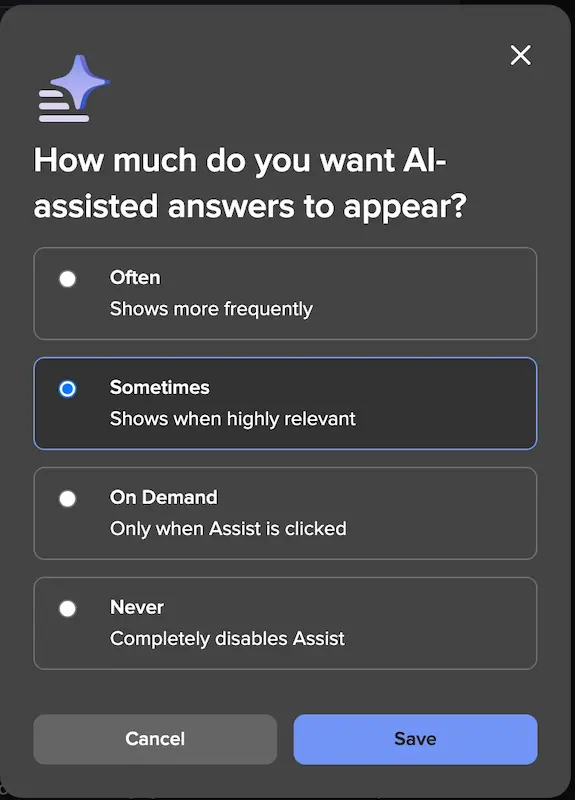 DuckDuckGo's Assistant Settings
People are also applying this theory of 24-hour-teacher, though, to fields like therapy because people can get help, more-or-less for free, 24 hours per day. But there’s no way of verifying these diagnoses. They just feel right. As Mark Blyth said, the safest job is health-care worker, but the kind who takes care of old people.
This lady is a perfect stand-in for the typical fool who believes so fervently that AI will keep getting better. She plays a shitty country song that seems to perfectly emulate the style of an actual, human country singer and then says “that’s pretty good.” Willison tries to tell her, “yes, it’s good, but it’s not great.” Which is a good point: AI results triangulate toward mediocrity. Humans under capitalism do this as well but AI accelerates the shit out of it until no-one can hear themselves think. Or, at least people like this lady can’t hear themselves think.
But then she summarizes something he’s been saying as,
“[…] you feel this this technology will democratize the creativity and the means for human beings to be able to express themselves.”
Which is, like, yes? Yes!
But she interrupted him pretty coarsely to say it. I think I’m just accustomed to a different style of interview—where you let your smart guests talk until they’re done.
And then comes a completely unnuanced question like the one at 54:00,
“Tell me more about guardrails. I mean, how can, how can the US institute guardrails and safety practices, if countries like Russia and China are not going to do the same thing and as they are seeking AI dominance as well?”
JFC. Stop being so brainwashed and stupid.
The question should be “How are we supposed to trust the output of tools to improve ourselves when they contain ideological guardrails that are completely unknown to us?”
Instead, Simon says, “That’s a really good question.”
It is not a good question. It is a dumb question steeped in imperial dogma, hopelessly mired in the propaganda that the US has the best intentions and is trying to hold back the tsunami of evil coming from the red bear and the yellow dragon. Willison was pretty weak here but you can’t win ‘em all.
Stack overflow is almost dead by Gergely Orosz (Pragmatic Engineer)
The article is mostly pretty superficial and moronic—reiterations of the title with no analysis—but the chart it provides is interesting.
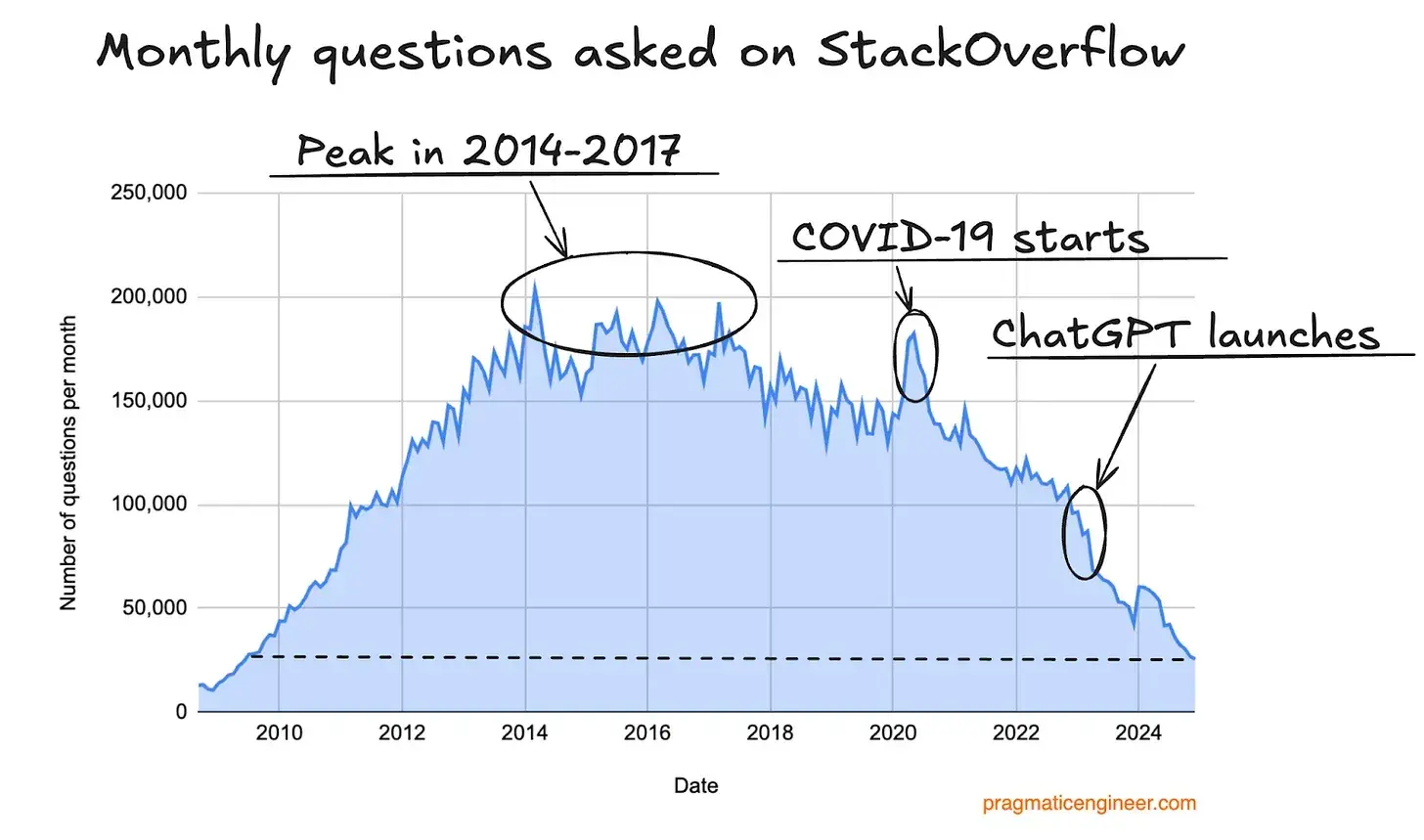 The last 15 years of questions asked on StackOverflow
“In January, I asked if LLMs are making Stack Overflow irrelevant. We now have an answer, and sadly, it’s a “yes.” The question seems to be when Stack Overflow will wind down operations, or the owner sells the site for comparative pennies, not if it will happen.”
The pronouncement in the title is not wrong, it’s just that the author is more gloating about how right he was to predict StackOverflow’s demise, rather than wondering about the implications of LLM-usage sawing off the branch on which it sits.
I’m not being an ass: the author is really just republishing the chart and adding some words, like these,
“I’ll certainly miss having a space on the internet to ask questions and receive help – not from an AI, but from fellow, human developers. While Stack Overflow’s days are likely numbered: I’m sure we’ll see spaces where developers hang out and help each other continue to be popular – whether they are in the form of Discord servers, WhatsApp or Telegram groups, or something else.”
The thing that made StackOverflow powerful was that it was open to search engines. It was part of an information economy that was somewhat egalitarian in that anyone could find and read answers. The system encouraged people ask questions and to provide answers.
It seemed to work quite well and it became the go-to source of knowledge about niche questions that generally don’t end up in documentation. The source was constantly refreshed with new information for 15 years.
It is now dying, replaced by a tool that offers, at best, a snapshot of the data that StackOverflow had sometime in the recent past and no mechanism for growing that information in the future. The LLM approach cannibalizes the business model that generated the data that it needs to be useful.
This gloating about the death of StackOverflow because of how awesome LLMs are is ignorant and short-sighted, but not surprising.
Recognizing AI Hype and How People Can Fight Back/Dr. Emily Bender and Dr. Alex Hanna by Chuck Mertz (This is Hell!)
This is a really good discussion about all of the parts of the world of AI that people tend not to talk about. The discussion almost always revolves around efficacy whereas these two amazing guests haven’t forgotten about how the technology is enabled by having stolen a tremendous amount of content, something that nearly everyone else conveniently forgets about.
There’s an excellent answer at about 1 hour in, where Chuck asks about the automation of administration of the state, to which Emily gives a brilliant answer. The next ten minutes are a really good back and forth, discussing the power dynamics.
Emily says,
“It is OK to use automation in some cases, but we need to always be asking what are we automating? Why are we automating it? Who’s benefitting from it? Who’s being harmed? And, for those being harmed, is there means for recourse? Or is this thing running so fast, and at such scale, that, even if there’s one window you can walk up to, it’s got an enormous line out the door, to get your issues resolved. We should always be skeptical when someone says ‘we’re going to do this with artificial intelligence now.‘ Or even if they say ‘we’re going to do this automation now.‘
“You frequently hear, ‘well, this is better than nothing.’ And that is always a trigger to ask, ‘why is the alternative nothing?’ Why have we structured systems so that we’re literally looking at a choice between automated system—maybe, for example, using synthetic-text-extruding machines for medical care or mental-health care—and … nothing. Because, we have so much in the way of possibility in our society, on our planet, that the real alternative is never nothing. We just have to make the political will to come together and make something better.”
And not just take the lazy, inhuman option dangled like a tempting bauble by a billionaire.
Alex says,
“This is a thing that researchers like to call automation bias, that if it comes out of an automated process, it seems more objective.”
He goes on to discuss the degree to which AIs, combined with this bias, might contribute to and exacerbate conspiracy theories.
A little later, Emily is back, with,
“And this is in the context of private use: If you find utility, then that utility is yours but it rests of the back of stolen labor and also labor-exploitation, so think twice. Also, environmental impacts…it is all packaged up in this nice, friendly interface that hides all of that from you. If you are finding ‘efficiencies’ on the job, I would think twice about who’s actually benefitting from that. Are you getting more time off? I sincerely doubt it. Right? Things are going faster because you are using ChatGPT or whatever—again, stolen-labor-stolen-data–driven system—those benefits are going to accrue to the boss, OK? It might feel good in the moment, but I think that it will be, at best, a short-term gain.”
When Chuck asks how the companies were able to just “steal” so much content—without which they wouldn’t exist—Emily replies,
“It is basically the strategy of it is better to ask forgiveness than permission, at scale. And it is profoundly anti-social.”
The Programmers’ Credo: we do these things not because they are easy, but because we thought they were going to be easy by Maciej Cegłowski (Twitter)
I as reminded of this today because I found myself fixing up very enticing code offered up by an LLM. I asked it to translate a bunch of calls to schtasks to corresponding PowerShell-native commands. I did this because I wanted to make the code more flexible, to be able to “fix up” the scheduled tasks that were missing on a system instead of assuming that none of them existed.
I would never have bothered to do this, except that I was able to generate the initial conversion with an LLM. The more I tested and massaged it, though, the more I discovered that it had simply hallucinated arguments and I found myself pulling the plug on it and just wrapping the commands in something like this instead.
$taskExists = (schtasks /query /fo LIST | findstr UT_INITIAL_BACKUP) -ne $null
if (-not $taskExists)
{
    // Create task…
}
Programming
What happens when a team dedicates 10% of their time to fixing technical debt? by Abishek Anthony (Zühlke Engineers: Software Engineering Corner)
“When tech debt piles up, it constrains agility and slows time-to-market. Companies may find themselves outpaced by more nimble competitors — not due to inferior ideas, but due to bloated systems. A study titled “Code Red: The Business Impact of Code Quality” by Adam Tornhill and Markus Borg, analyzed 39 proprietary production codebases and revealed that: Low-quality code contains 15 times more defects than high-quality code. Resolving issues in low-quality code takes 124% more time. Issue resolutions in low-quality code are far less predictable, with 9 times longer maximum cycle times. This research highlights the tangible cost of technical debt and poor code quality on development speed and predictability.”
“The “broken windows” theory applies to software: once mess is tolerated, care diminishes. This sets off a vicious cycle where the bar for quality drops across the board. To address these risks effectively, we must first understand how different roles perceive and influence technical debt — because the way people think about tech debt shapes how (or whether) it gets resolved.”
“Great architects don’t just react to debt — they anticipate it, advocate for addressing it, and design to avoid it.”
“Finds a balance between short-term delivery and long-term maintainability.”
““I don’t want to touch this module—every change breaks something.”
““Every bug fix here takes forever because of tech debt.””
“Not all debt is bad. Strategic technical debt — taken on consciously to validate ideas, meet a critical deadline, or accelerate discovery — can be powerful. The key is intentionality and a plan to pay it back.”
I weep for the many minds we lose to the sloppy expressiveness offered by Python. It’s such a local maximum. So many people stuck on that hill thinking they’re the king of the mountain.
It’s a good place to start but one should know when to move on.
What Every Programmer Should Know about How CPUs Work by Matt Godbolt • GOTO 2024 (YouTube)
This is an absolutely brilliant and approachable ~45-minute video. He discusses how branch-prediction can affect even very high-level languages, contrasts with C++ and then discusses bloom filters, replacing divides with modulos or other operations, and so on.
Fun
Potenzspritze E-Cargo-Bike 🤝 by Renato Kaiser (YouTube)
“Antiauthoritäre Demeter KITA…”
ROFL
Diskussion um Nemo by Renato Kaiser (YouTube)
“Und 20Min isch kei ziitiig.”
This is what his show is like, just two hours of well-written tirades that hit point after point after point of everything we should fix in this world.
College by Jesse Welles (YouTube)
Jesse helpfully included the lyrics directly in the video description! So nice. I included them all because I thought that they were clever. They are much better when sung, though.
“i’m gonna tell ya all a tale that’s been told to me a time or two
a thing ya oughta do if ya wanna be of good repute:
ya better go to a college
take out a loan
move back in with yer folks
cause you’ll never own a home
work a couple of gigs
that ya don’t need a degree to do
deliver some food
and live the with guilt
the misery ya builts on you“a long time ago in a town far away
folks told me if i wanna see a brighter day
then ya better hit books boy
get yerself a degree
i never knew the whole country’d
get the same damn trophy as me“they’re glad to take yer money
glad to take yer time
put ya in a bunch of debt
before you ever make a dime
you might make a connection
if you can weather the haze
they push ya through like cattle
and hand diplomas out like hay“there’s a mutually agreed upon
mediocrity
between the students and the teachers
and administrative faculty
you pretend to try
they’ll pretend you earned the grade
but if everyone’s here
how in hell are we all great?“college is a racket
no matter how ya stack it
little tax bandits
with a 4 year plan, it’s
lucrative endeavor
sold with a moral component
ya know the road hell is
paved with good intentions
and good diplomas“and when it’s time to toss the hat
well the troubles jus begining
cause ya know there aint a job
and the loans won’t be forgiven
and what little you know now
ya probably oughta forget
ya shoulda been a plumber
now yer dumber and deeper in debt“can you even call it living without 40 grand around yer neck
“well if ya wanna be a doc
or if ya wanna build a bridge
ya better get the piece of paper
ya better slap it on yer fridge
but if you wanna make a livin
brother don’t make it hard
skip the adderal prescription
get a YouTube subscription
a laptop and a library card”
Video Games
The Witcher 4 Tech Demo Unreal Engine 5 by GamersPrey (YouTube)
“This demo provides a glimpse at a number of 5.6’s powerful new open world features in action—all running on PlayStation 5 at 60 fps with raytracing—including the new, faster way to load open worlds via the Fast Geometry Streaming Plugin.
“We get a peek at the power of 5.6 for handling busy scenes full of high-fidelity characters and visual effects like Chaos Cloth and an early look at Nanite Foliage, which provides a fast and memory efficient way to achieve gorgeous foliage density and fidelity, slated for release in UE 5.7.”
They also talk about things like,
“so Siri and Kelpy, they’re perfectly synchronized when mounting from any angle and speed and we also support root-motion movement on Kelpy, so controlling her feels
realistic and grounded.”
And,
“Unreal Chaos Flesh Solver and these machine-learned deformations so you’ve got realistic muscles moving and stretching under Kelpy’s skin without compromising the
performance.”
I feel like I’m watching a commercial for Westworld.
“[…] instead of the same card approach we’ve been using for the past 20 years, artists
should be free to take a nanite approach to foliage, modeling every single leaf and pine
needle. And the old LOD tricks of the past, they needed a complete rethink and in their place it’s a new adaptive voxel representation in Nanite. It’s volumetric, it’s fully 3D, it is super fast to render, and these dense clusters of triangles turn into these cubes, which at a
distance, they’re no larger than a pixel and they react to the changing light of our dynamic sun and our shadows and they allow artists to render whatever amount of foliage is needed to achieve their vision without compromise.”
Phew. That’s … a lot.
In fairness, it looks amazing.
The level of detail is gob-smacking. You have to see the town. There are puddles, a watery sun, shadows, dirt, apples rolling on the ground. The character models and facial animations. The clothes. The leather. It all moves and flexes. Woof.
The budget for NPCs simultaneously on-screen without dropping below 60FPS on a PS5 is 300. Skeletal mesh agents, or something like that.
The distance-rendering is seemingly with pop-in. Impressive.