
Links and Notes for June 27th, 2025
Published by marco on
Below are links to articles, highlighted passages[1], and occasional annotations[2] for the week ending on the date in the title, enriching the raw data from Instapaper Likes and Twitter. They are intentionally succinct, else they’d be articles and probably end up in the gigantic backlog of unpublished drafts. YMMV.
[1] Emphases are added, unless otherwise noted.↩
[2] Annotations are only lightly edited and are largely contemporaneous.↩
Table of Contents
- Public Policy & Politics
- Journalism & Media
- Economy & Finance
- Environment & Climate Change
- Medicine & Disease
- Art, Literature, & Cinema
- Philosophy, Sociology, & Culture
- Technology & Engineering
- LLMs & AI
- Programming
- Sports
- Fun
Public Policy & Politics
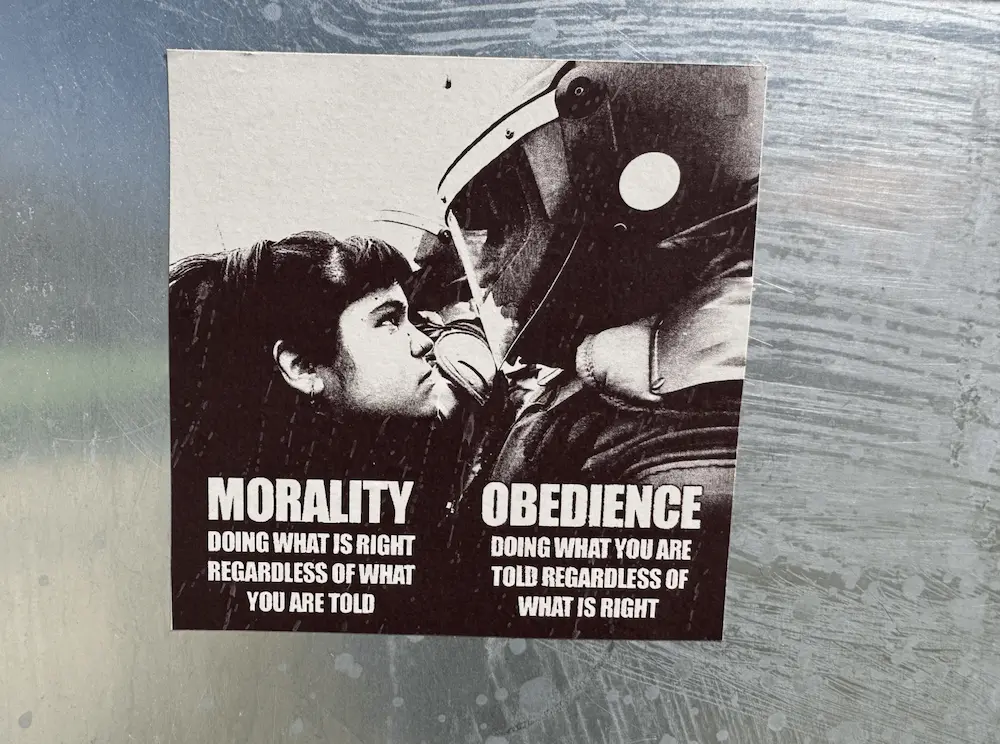
Morality
Doing what is right regardless of what you are told.Obedience
Doing what you are told regardless of what is right.
White girl explains Israel-Iran Conflict by Julie Nolke (YouTube)
~5 minutes to catch you up on the status of the region. No notes.
Socialism Wins Its American Normandy by Matt Taibbi (Racket News)
“Mamdani is different. Born in Uganda to a postcolonial theorist and a future Hollywood director, he’s a fancy prep school kid like me (Bank Street in Manhattan) and a recent immigrant — in itself not bad, but the crises of America’s past aren’t in his political muscle memory. You’ll get a better sense of his beliefs reading father and Columbia prof Mahmood Mamdani’s impenetrable Citizen and Subject than you will watching docs about Mario Savio or Woodstock.”
Jesus fucking Christ Taibbi. This is Bircher Society coded, bro.
“[…] he’s as polished as they come in the conventional-political-skill department, able to adjust his style for any situation and never losing his cool before crowds or a camera. Ironically in this he’s not unlike Barack Obama, a politician about whom he once tweeted, “Hasn’t Obama shown that the lesser evil is still pretty damn evil?””
Fuck, Matt. This is really stupid. Just a brainless gotcha take. Get offline. Stop watching Fox News. Remember who you were when you were researching and writing “I Can’t Breathe”. Those people, from Staten Island, they voted for Mamdani. Stop being a dick.
“If the concept only has to hold up long enough to get a college student laid, socialism works. You only land in the big lol once you take the step New York just has, into reality. The part no one mentions at campus parties is that the replacement for markets in socialism is not just human authority, but dumb authority. Yes, prices can be oppressive, but try swapping out organic pricing for committees of sociology majors and AOC types deciding how much they think shoes or ice cream or a house should cost.”
You’re a hopeless retard, Matt, just copy/pasting from Reason with your brain completely disengaged. You used to think that the markets were broken; now that you’re making more money, you’re shitting your pants that the socialist barbarians will be at your gates with pitchforks and torches. Well, they wouldn’t be if you weren’t being such an unreasonable dick about all of this. Who do you think decides how much things cost now, you doofus? The prices are being fixed by billionaire monopolists right now. The people voted for having them be set by the government. That is not optimal, but it is an improvement.
“This system doesn’t work and has always made a significantly more massive mess of things than capitalism, but the Mamdanis of the world won’t be talked out of it until they get to blow $78 million on a borough co-op that sells alley tomatoes and halal Oreos before going under.”
Matt is telling us that he knows better than everyone else. But this is 2025 Matt, who’s pretending like he didn’t spend decades uncovering how rotten the economy already is. He’s also pretending that $78 million is a lot of money in a city that spends over $4 billion (over 50x as much) on its police force (at least the last time I looked; it’s probably higher now). So 2% of that money to build grocery stores that will sell people food that they can afford? In what world do you make fun of that? In what world do you not hope that that can be achieved so that people can finally stop worrying about at least one thing in their lives?
What happened to you, man?
Now, Taibbi’s all, “don’t touch a running system and don’t you dare propose an alternative.” As usual, when capitalism starts feathering your nest, you suddenly resist any change that results in fewer feathers for you and more for undeserving, lazy, stupid, and otherwise good-for-nothing moochers. Cool story, bro. Where have I heard that one before? Oh, yeah, it was called Atlas Shrugged.
“I went to school with Mozambicans in the Soviet Union and had a good friend from there with whom I played chess regularly. He would have laughed at the “non-coercive” line, because his family’s land had been nationalized […]”
I have listened to stories of people learning about a country’s inner workings, as told to them by people who were almost certainly only temporarily disenfranchised members of the ruling class. It’s wild to read story after story about the injustice of a movement that would topple despots. These people don’t think of themselves as an undeserving parasite of an upper class and instead bend the world’s ear, finding useful idiots like Taibbi who amplify their message about the injustices visited upon them by socialism with its ruthless focus on egalitarianism and justice. I’m sure we’re supposed to also rend our garments when billionaires fail to land business deals or have to pay a tax.
“These are people who’d scream murder if you suggested they share profits with lesser sites or sacrifice any autonomy, but don’t tell them they don’t believe! They have fetishistic attachments to global resistance movements even though most come from wealthy families who’d be among the first to have their “dignity” surpluses hoovered up under a real proletarian revolution. Most irritatingly — I’ve seen this — they feel total impatience with any actual underclass people who resist their vast wisdom on anything, from economics to education. These new media pioneers worship ZOHRAN! Don’t be surprised if his career becomes the avatar that galvanizes them behind his quest to Lena Dunhamize world attitudes.”
This entire paragraph would be gobbledygook to 99% of the people who voted for Mamdani. It only means something to the hyper-online, to people like Taibbi who can’t stop getting entangled in straw-man arguments with online dipshits. Taibbi’s entire politics is now shaped by opposition to niche and pathologically online hustlers. He has no pros. He only contradicts. A pity.
The article Matt Taibbi gobbled by the Vampire Squid in the Vampire Castle by Yasha Levine (Nefarious Russians) discusses how Matt, despite his protestations to the contrary, has changed. It’s fine, of course. Go ahead and change your mind about things. But stop pretending that you’ve always believed the things that you write about today because there is far too much proof to the contrary.
“His whole point in the article was not that the government was bad and that it should be shrunk to the size of a peanut so that a true free-market can flourish, but that the outsized power of corporations had corrupted American society — creating a system of legalized extortion, fueling a series of disastrous speculative bubbles, and robbing regular people at every turn. He wasn’t optimistic about free-markets like he is today — he was gloomy and defeatist, concluding we are run by a bunch of capitalist criminals who have turned America into a “gangster state” and who rob us at every turn.”“It’s not always easy to accept the reality of what we now routinely allow these people to get away with; there’s a kind of collective denial that kicks in when a country goes through what America has gone through lately, when a people lose as much prestige and status as we have in the past few years. You can’t really register the fact that you’re no longer a citizen of a thriving first-world democracy, that you’re no longer above getting robbed in broad daylight, because like an amputee, you can still sort of feel things that are no longer there.
“But this is it. This is the world we live in now. And in this world, some of us have to play by the rules, while others get a note from the principal excusing them from homework till the end of time, plus 10 billion free dollars in a paper bag to buy lunch. It’s a gangster state, running on gangster economics, and even prices can’t be trusted anymore; there are hidden taxes in every buck you pay. And maybe we can’t stop it, but we should at least know where it’s all going.”
He goes on to say that,
“At the peak of his loving relationship with the prog-liberal side of American culture, he even wrote a BLM-inflected book about the killing of Eric Garner and police brutality — I Can’t Breathe. You could say it was peak liberalism on Matt part — similar to Nancy Pelosi’s bending the knee in the wake of BLM. I doubt he had any real care for the black and poor people at the gestapo end of America’s law and order system.”
I don’t buy this, either, though, Yasha. It’s more complicated than that. I read the book. It seemed quite earnest. Even as recently as when he started Useful Idiots with Katie Halper, he was still toeing that line. He hadn’t turned yet. But I don’t believe he was always faking it. I don’t think he’s capable of that level of sociopathy. He’s not socially adept enough for that. You just have to listen to him in interviews. Matt is deeply uncomfortable in the spotlight, although maybe he’s getting better at it now.
What is a democratic socialist? by Corey Robin
“What the socialist seeks is freedom.
“Under capitalism, we’re forced to enter the market just to live. The libertarian sees the market as synonymous with freedom. But socialists hear “the market” and think of the anxious parent, desperate not to offend the insurance representative on the phone, lest he decree that the policy she paid for doesn’t cover her child’s appendectomy. Under capitalism, we’re forced to submit to the boss. Terrified of getting on his bad side, we bow and scrape, flatter and flirt, or worse — just to get that raise or make sure we don’t get fired.
“The socialist argument against capitalism isn’t that it makes us poor. It’s that it makes us unfree. When my well-being depends upon your whim, when the basic needs of life compel submission to the market and subjugation at work, we live not in freedom but in domination. Socialists want to end that domination: to establish freedom from rule by the boss, from the need to smile for the sake of a sale, from the obligation to sell for the sake of survival.”
“[…] there’s overlap between what liberals and socialists call for. But even if liberals come to support single-payer health care, free college, more unions and higher wages, the divide between the two will remain. For liberals, these are policies to alleviate economic misery. For socialists, these are measures of emancipation, liberating men and women from the tyranny of the market and autocracy at work. Back in the 1930s, it was said that liberalism was freedom plus groceries. The socialist, by contrast, believes that making things free makes people free.”
Up With Zohran by Hamilton Nolan (How Things Work)
“[…] who may be on the verge of something surprisingly big. All of these people were there, on the hot sidewalk. They would come up and say a few words and Zohran would break out in a smile at the memory they shared, and he would hug them and pose for pictures. I have seen many politicians in many places go through this same routine and one thing that distinguishes Zohran from most of them is that, in my judgment, he looks genuinely happy doing this. He seems to actually like people. You can’t say that about everyone running for mayor.”
“American politics is dirty and oligarchical, but there are some races, like this mayoral primary, that throw it all into exceptionally sharp relief. On one side, the likable young believer who wants affordable homes and free buses and seems to actually enjoy the presence of his fellow humans, enough to inspire forty thousand people to go fan out across the big city knocking on doors for him. On the other side, the grim, disgraced, sexually harassing ex-governor, high-handed, dismissive, remote, inaccessible, campaigning from on high, fueled by a super PAC filled with more than $20 million by a handful of billionaires, endorsed by the skeletal faces of the old establishment.”
Complete Relief Or Chaos by Scott Greenfield (Simple Justice)
“But for an administration already bent on defying district court orders, the CASA decision not only sinks the nation into chaos, where some impacted by his unlawful commands will be protected while others, maybe just a town line away, will be exposed to whatever the men with guns do. And they won’t have the AG, the org, the class action, the money or the opportunity, to do anything about it. It will be chaos. It will be unequal protection. It will fly in the face of over 100 years of established legal precedent. And thanks to the Supreme Court, district court judges will be powerless to do anything about it.”
“And too many of the MAGA faithful embrace the simplistic “aliens bad” mentality, such that they care no more about the removal of immigrants who entered lawfully than those who came unlawfully over the border, or married a Marine or raised three sons who served in the Marines. They’re aliens, and that’s all they need to know to hate them and take comfort in their belief that they get what they deserve.”
I do love how Greenfield would be utterly befuddled to hear that anyone might wonder how he doesn’t apply the same logic to Israelis’ attitudes toward Arabs.
“[…] the Supreme Court has also turned United States District Court judges into the aliens of the judiciary, who are no longer empowered to provide the equitable relief necessary to address the irreparable harm before them, reducing judges inferior to the Supreme Court to quasi-impotency and, thus, irrelevancy. It was never a choice between an imperial presidency and an imperial judiciary, but a judiciary with the authority to fulfill its purpose of preventing harm until a matter was decided. It’s not completely gone, but it’s sufficiently gone that we will be reduced to chaos, confusion and unconstrained harm.”
The following video provides a pretty good analysis, which notes that the Trump party (née Republicans) doesn’t think that they will either ever lose power or they think that no-one else would be willing to use this power to enact executive orders that would counteract their edicts.
this is so messed up… by Hasan Piker (YouTube)
US Supreme Court backs dictatorship in ruling on birthright citizenship injunction by Joseph Kishore (WSWS)
“With this decision, the administration could implement sweeping and unconstitutional executive orders beyond what it has already done—bans on protests and strikes and the arrest of workers, censorship of political opponents and the press, and the stripping of other basic democratic rights—without fear of court orders halting enforcement on a nationwide basis. Rights, in this conception, become privileges available only to the wealthy, and the Constitution becomes a flimsy piece of paper that can be violated with impunity.”
“But the implications of the ruling go far beyond this specific case. It guts the power of the judiciary to stop unconstitutional actions by the executive. It means that even when a federal court rules that a presidential order violates fundamental rights, the judge would have no power to prohibit the order from being enforced in the future.”
“The decision takes place under conditions of ever more blatant presidential criminality. The Trump administration has launched an illegal bombardment of Iran, escalated the mass roundups of immigrants, and has sought to deport student activists opposing the genocide in Gaza. The fascist gang around Trump has responded to the election of Democratic Socialists of America member Zohran Mamdani in New York with threats of violence, deportation and the criminalization of political dissent.”
Haaretz report exposes deliberate Israeli policy of massacring aid-seekers in Gaza by Andre Damon (WSWS)
“On Friday, the Israeli newspaper Haaretz published an in-depth report substantiating the existence of orders instructing Israeli soldiers to fire into the crowds. Internally, the massacres are officially justified as a form of crowd control, with soldiers moving groups of unarmed people from one place to another by shooting at them.
“[…]
“Each day, often late at night or early in the morning, tens of thousands of people have lined up at the GHF distribution sites to receive food, which is only available for one hour, causing a chaotic rush of starving people.
“According to the report, there is no method of crowd control except for live bullets. Those who attempt to collect food, which is simply left on the ground, too early or too late are shot.”
“Just one day before Haaretz published its revelations, the US State Department announced that the Trump administration had provided $30 million in funding for the GHF. State Department deputy spokesperson Tommy Pigott called the group’s actions “absolutely incredible,” declaring that they “should be commended and supported.”
“In an apparent confirmation of the reporting by Haaretz, the Israeli military has launched an internal war crimes investigation into shootings at the aid centers. As always, such investigations are nothing more than PR operations, aimed at creating the illusion of oversight while allowing those guilty of perpetrating war crimes to go unpunished.
“In a statement Friday, Netanyahu and Israel Katz, the defense minister, accused Haaretz of propagating a “blood libel” against the Israeli military, which they called “the most moral military in the world.””
Netanyahu Says It’s Antisemitic For Israeli Soldiers To Describe Their Own Atrocities by Caitlin Johnstone (Substack)
“In quote after quote after quote we read Israeli soldiers describing atrocities they were ordered to commit which they knew were wrong. I guess Israel’s PR machine never counted on some of the soldiers they sent in to perpetrate the Gaza holocaust having an actual conscience.”
Cross the Courts Off the List by Hamilton Nolan (How Things Work)
“[…] the Supreme Court knows the political situation, understands the risks of handing Trump power, and, with that knowledge, continues to decline to stop him. The court’s insistence that it is a source of philosophical legal reasoning rather than dirty politics has always, of course, been bullshit, but that makes this case even scarier—because it means that the Republican justices on the court stared Trump’s rising dictatorial nature in the face, considered the possibility of restraining him, and decided not to do it.
“They are checking out of the game. If Trump has not crossed a red line sufficient for the Supreme Court to rein him in already, then the red line is so far away that we will all be in prison before he reaches it.”
“What remains on the “Who will stop them?” list. In addition to the courts, you can cross off “The Republican Party,” which has been fully purged of all opposition. You can cross off “Congress,” which has marginalized itself to such an extent that its power is now mainly to go on cable news shows and complain. And you can cross off “The business community,” which—despite having, in theory, enough capital to squash Trump’s ambitions, has proven itself to be so greedy, short-sighted, and cowardly that it wouldn’t even stand up for its own long-term interests when it could have, and certainly will not now, when the danger of government retaliation is higher than ever.”
Norman Finkelstein on Israel, Zohran Mamdani and the coming class war | The Big Picture by Middle East Eye (YouTube)
Near the beginning, he talks about Zohran Mamdani’s campaign,
“I went out campaigning for him—we were outside the 7th Avenue stop in Brooklyn of the Q and the L line, for those who know New York City—and I would tell people, in my opinion, this is a very simple election. It’s as simple as you get. The election is about: do you believe the city belongs to the upper east side? Or do you believe the city belongs to all of us?
“And then I took out the campaign literature and I said, ‘this is what I found in my mailbox.’ [shows poisonously anti-Muslim anti-Mamdani campaign flyer]. This is a question of, ‘do you believe in plutocracy, ruled by the rich, or do you believe in democracy, ruled by the people?’
“You could disagree with Mamdani on this issue, you could disagree on that issue, that’s fine. But this is not really about the issues anymore. This is about who the city belongs to. And, as that real estate mogul Roeckler put it: this is the capital of capitalism. So it should belong to the capitalists. It should belong to the billionaire class.”
At 34:00,
“What happened with the Israeli-US attack has now opened the door wide to any state launching an attack, at any moment, on any pretext, or with any pretense.
“There’s no legal—I know it sounds dramatic but, I think it’s factually correct: the simultaneous Israeli-US attacks on Iran without any public reaction as to their legality—obviously there was public reaction about what happened: will it lead to escalation? Will there be a war? Yes that happened—but with no public reckoning of the legality, in my opinion, signals the international legal order died on those days.
“It no longer is functional. Now, I know the skeptic will say, ‘it was never functional,’ and, yeah, there’s truth to that. But there was pretense. There was pretense. Has anybody even raised posed the question, ‘should Israel and the US be held in violation of—in breach of—the UN charter?’ It’s not even come up.”
At 01:17:30,
“Hypocrisy is a compliment that vice pays to virtue. They’re not doing that anymore.”
When you’re hypocritical, you’re at least acknowledging that you have failed to live up to a moral common ground. Once you stop being hypocritical, you have renounced a common morality.
Trump revokes protected status for over half a million Haitian immigrants by Jacob Crosse (WSWS)
“The termination is effective Tuesday, September 2, 2025, leaving over half a million Haitians, some who have been in the US for over 15 years, barely 10 weeks to find another legal pathway to remain in the US or face detention and deportation to a country the US State Department warned not to travel to in March 2025.”
The cruelty is the point.
“The war on sovereignty.” by Patrick Lawrence (The Floutist)
“Apart from the deaths of innocents, there are the risks of political chaos, the destruction of an economy, the damage to productive capacities, the social dislocations, the ruined dreams of countless Iranians who had been preparing to contribute one or another way to the human cause.”
“But we must not omit the principle of national sovereignty as we weigh the damage of what we now witness. An American-led war on sovereignty has blighted the community of nations for many decades. Many of us know this, and those who missed this elephant in the living room should now face it squarely. In my view the United States and Israel just opened a decisive front in this long-running combat. Let us not leave so extreme and momentous a breach off our list.
“As the Zionist state extends its illegal aggressions further into West Asia—with some measure of American support at every stage—the fundamental implications of this its 21–month spree of criminality and terror are bitterly plain. The Israeli–American operation against Iran—and it seems to me by no means over—confirms an era of lawlessness and disorder such as humanity has not known for centuries. It is time, I mean to say, to consider in a world-historical context the conduct of the Zionist state and its American sponsor as they abuse the territorial integrity of another West Asian nation, possibly on the way to another “regime change”—this quite openly now.
“It has been evident for some time—my date for this point of departure is 11 September 2001—that “the international rules-based order” is a preposterous misnomer for a long regime of chaos, violence, and at times near-anarchy. I think of the U.S. invasion of Afghanistan in the autumn of that year, the invasion of Iraq two years later, the bombing of Libya eight years after that, the Central Intelligence Agency’s long, covert operation to topple the Assad regime in Syria, Israel’s incessant attacks against Iran, covert and overt, and now the genocide in Gaza and the attacks on Lebanon, the grinding, barely visible assaults on Venezuela and Nicaragua. If Iran is a front-line state in the war against sovereignty, so should we think of these latter.”
“One could cast the U.S.–Israeli aerial invasion of Iran as another page in this book. As an exercise of raw power in the name of raw power it is comparable with many others that preceded it—another unrestrained, uninhibited contravention of international law and all norms associated with it. Its perpetrators make no apology for themselves, just as in the past. And there appears to be no prospect of an effective multilateral censure or intervention in the cause of global justice.”
This is what Norman Finkelstein was saying above, perhaps more succinctly. The era of lawlessness didn’t just start: it’s been going on for decades, if not over half a century. The U.S. is the prime driver of it. Korea and Vietnam are not to be left off the list. It has become ever more difficult for even the most fervent supporters of lining their own wallets to ignore that the hypocrisy isn’t even partly credible anymore, so it is increasingly left away. All that is left is the exercise of raw power and “might makes right”.
Gaza’s Hunger Games by Chris Hedges (Substack)
“Israel, with its targeted assassinations of at least 1,400 health care workers, hundreds of United Nations (U.N.) workers, journalists, police and even poets and academics, its obliteration of multi-story apartment blocks wiping out dozens of families, its shelling of designated “humanitarian zones” where Palestinians huddle under tents, tarps or in the open air, its systematic targeting of U.N. food distribution centers, bakeries and aid convoys or its sadistic sniper fire that guns down children, long ago illustrated that Palestinians are regarded as vermin worthy only of annihilation.
“The blockade of food and humanitarian aid, imposed on Gaza since March 2, is reducing Palestinians to abject dependence. To eat, they must crawl towards their killers and beg. Humiliated, terrified, desperate for a few scraps of food, they are stripped of dignity, autonomy and agency. This is by intent.”
“Palestinians are corralled like livestock into narrow metal chutes at distribution points which are overseen by heavily armed mercenaries. They receive, if they are one of the fortunate few, a small box of food.”
Hedges recounts the story of Yousef al-Ajouri, who’d gone to get food from one of these deadly “distribution points”.
“As I crawled, I looked over, and to my surprise, saw several women and elderly people taking the same treacherous route as us,” he explained. “At one point, there was a barrage of live gunfire all around me. We hid behind a destroyed building. Anyone who moved or made a noticeable motion was immediately shot by snipers. Next to me was a tall, light-haired young man using the flashlight on his phone to guide him. The others yelled at him to turn it off. Seconds later, he was shot. He collapsed to the ground and lay there bleeding, but no one could help or move him. He died within minutes.”
“Within moments, the boxes were empty. Most of the people there, including women, children and the elderly, got nothing. Some begged others to share. But no one could afford to give up what they managed to get.
“The U.S. contractors and Israeli soldiers overseeing the mayhem laughed and pointed their weapons at the crowd. Some filmed with their phones.”
“Israel has obliterated the civilian and humanitarian infrastructure in Gaza. It has reduced Palestinians, half a million of whom face starvation, into desperate herds. The goal is to break Palestinians, to make them malleable and entice them to leave Gaza, never to return.”
Practice Small, Daily Acts Of Sabotage Against The Imperial Machine by Caitlin Johnstone (Notes From The Edge Of The Narrative Matrix)
“Do something every day to help undermine public perception of the empire.
“Draw attention to its abuses in places like Gaza.
“Get people laughing at its absurdities and hypocrisies.
“Spread distrust in the imperial propaganda services known as the western press by spotlighting their deceptions and manipulations.
“Help people to recognize all the ways their government is screwing them over for the benefit of the rich and powerful.
“Facilitate the collective dawning of the realization that everything westerners have been taught about their society and their world is a lie.
“Help people to understand that it really, truly does not need to be this way.
“Use every means at your disposal to help open up the next pair of eyelids to the ugly reality of the empire.
“Cultivate a habit of daily acts of sabotage against the imperial machine. There is always something you can do.
“You cannot defeat the machine by yourself, but you can do something every day to help tilt our society’s collective consciousness toward tearing it down together.”
“Maybe the child did so fully knowing that it would send the man into a murderous rage, because the man had been horrifically abusing the child his entire life.
“Maybe instigating a physical confrontation in full view of the public was the child’s last desperate attempt to expose the man’s depravity, in the hope that everyone would finally see what’s happening and do something to stop the abuse.
“But nobody’s stopping it, because the man has spent years charming and befriending everyone in town — or frightening and intimidating them if that’s easier.
“So now everyone’s watching a grown man beat a child to death and pretending they’re watching a fight, when they all know deep down what they’re really watching is a cold-blooded murder by a cold-hearted man, who should have been stopped and locked away a long time ago.”
Democrats Are PANICKING Over Mamdani's Win (w/ David Sirota) by Bad Faith / Briahna Joy Gray (YouTube)
At 29:00,
“Sirota: You couldn’t have built a more pure experiment in a lab, right? You had on one side the comic-book super-villain, unlikable—you know, I saw some quote in the New York Times of one, I think it was one of his aides, who says, ‘this guy doesn’t even like people. He can’t interact with people,‘—just the worst possible, most unlikable candidate with all of the money, versus an incredibly likable candidate with a very popular message, with none of the big money. I mean, certainly, as I just said some resources to compete, but none of the huge money.
“So let’s see—in this sort of pure experiment—if we the oligarchy can still buy this election. Cuz if we can still buy this—running a completely sort-of detestable comic-book super-villain with no redeeming qualities—and we can still buy an election against a super-likable guy with a super-popular message, then basically democracy really doesn’t exist.
“And I was saying that, honestly, before this election, I said to a bunch of friends, ‘listen: if Andrew Cuomo wins this election, like it’s essentially over. Like the whole thing, the whole process, this whole idea of democracy and accountability is just a joke.‘ It makes a joke out of it, right? I mean, this guy had so many scandals, he had to be bounced out of the governor’s office and somehow can just come back and be able to just waltz back in and be rewarded would have…
“Briahna: …and endorsed by some of the same people who needed to to step down.
“Sirota: It’s incredibly nihilistic and disturbing. And I asked some of…I asked Bill Delasio, I asked Ormani himself, what do you make of the fact that Andrew Cuomo can be who he is, having done what he did—I mean, this is a guy who presided over the deaths of thousands of New York City residents and gave immunity to the nursing-home CEOs whose lobby groups were giving him money, immunity from the victim’s families lawsuits, right? That’s just one of the many scandals. This guy can do this and still—forget about even winning —can still be a viable candidate, can still run for an office, to be rewarded for that record. But the the fact that he was even competitive is a really depressing statement on the state of our politics.
“And I asked him “What do you make of this?” And a lot of it was “Look you know he’s got a famous last name. He’s got a lot of money to amplify his message.” And we live in a time where if you have enough money to amplify your own message, and you have a famous name, you can be competitive. And that’s why I think the people behind him are so freaked out. They’re like “We can’t necessarily buy everything. We can’t own and buy it all.”
“If you’re used to getting everything, if you’re used to always getting your way, then momentarily not getting your way is very shocking to you. I mean, it’s very scary. I mean, […] when you’re so accustomed to privilege, the most minimally humane policies for others—like the ones that Mamdani has been pushing—those can seem like—when you’re so accustomed to privilege and so accustomed to buying elections, the most minimally humane policies, the most minimal challenge to your electoral dominance probably feels like oppression, right?
“Briahna: Free buses! What’s next? Human rights?
“Sirota: So that’s why I think this is such an important moment: because it’s really a mask-off moment for how dominant the oligarchy has been, how entitled they feel to determine all of the political outcomes, and how shocked they are that there might be some modicum of a check on their power.”
Israel Supporters Are Exhausting, Insufferable Narcissists by Caitlin Johnstone (Notes From The Edge Of The Narrative Matrix)
“Shut up. Shut up. Shut the whole entire fuck up. Everyone is sick of your bullshit. […] Your feelings don’t matter. The world does not revolve around you and your feelings. Your emotional response to whatever made up nonsense you’re choosing to have a melodramatic tantrum about today is completely irrelevant.
Every single Palestinian who died today, individually, matters infinitely more than every feeling you’ve ever felt about every imaginary phantom you’ve pretended to feel threatened by.”
“The real story is not that one musical act said “death to the IDF” at Glastonbury Festival, the real story is that a huge number of acts spoke out in support of Palestine at Glastonbury Festival. They’re just making the story about one of those acts hoping you won’t notice that supporting Palestine and opposing Israel is what’s popular and cool now.”
How ‘Israel’ Ends, According To A Former ‘Israeli’ by Indrajit Samarajiva (Indica)
“Mizrahi says,”“This final beating, Mizrahi says, will be defeating. But the coup de grâce will not come from Iran, but from Palestinians themselves.”“The next phase of this war is going to be much more devastating for Israel. It is going to be so devastating, it’s going to disrupt the country completely. It’s going to bring the country to a standstill. It’s going to make it impossible for the IDF to command its divisions and battalions. Because every command center is going to be hit in a devastating, destructive way. With the big missiles, not the small missiles that we have seen mostly this far. And many Israelis are going to remain in the dark. Many neighborhoods are going to be destroyed. Many Israelis are not going to have internet or cellular communication. Some media channels and outlets will cease to exist because they are not built for something like this. And basically Israel will cease to function as a country.
“And once Iran achieves this, it will stop its campaign. Because Iran’s campaign is not meant to kill great numbers of Israelis. This is not their intention. Their intention is political, and of course military. It is to stop Israel, to destabilize, to disrupt, and to destroy Israel as a country. Okay, not to do an Israeli Holocaust. This is not their intention. And again, wisely, they don’t want to risk a nuclear reaction. They want to win the war, they want to destroy Israel.”
“What Mizrahi says is, “It’s going to be a [Palestinian] village of 10,000 people surrounded by two or three settlements with 200, 300 or 50 people and one or two military posts with 10 or 15 soldiers in each of them. And this constellation is what suffocates that village because this is the ratio of population in the West Bank. So now the Palestinians in that village and all those villages will realize that the settlers and the soldiers are basically alone and they cannot defend themselves and they cannot call for reinforcements. And when an intifada breaks under these conditions, this is going to be a major, major, major event. This is going to be a major event.”
“And make no mistake, as Frantz Fanon said, “decolonization is always a violent event… In its bare reality, decolonization reeks of red-hot cannonballs and bloody knives.” Mizrahi acknowledges this when he says, “This is how I predict ‘Israel’ will end. Through large scale and extremely violent intifada.””
“The only critiques I might offer of Mizrahi’s thesis are that A) ‘Israel’s’ command and control may not fall so easily, B) Hezbollah may not be able to take the North because its own North is exposed to Al Qaeden Syria now and C) that cowardly but cunning Turkey may play spoiler, or even Egypt from the West. Germany only fell when the USSR physically took Berlin, and neither Iran nor Yemen can physically march to Jerusalem. Other parties may swoop in during the chaos. From the frying pan to the fire, from the occupation to the Ottomans. Mizrahi also discounts the nuclear option and direct American intervention, but those are still wild cards which can get played during wild times. The American and ‘Israeli’ eschatalogic is to bring the end times on, and they may just yet. But broadly I think Mizrahi offers a coherent theory. A how to the when that was predicted back then.”
Now What? by Patrick Lawrence (Scheer Post)
“there is the science, such as unscientific minds, mine among them, can understand it. I have found Ted Postol a careful, persuasive witness ever since he discredited those false-flag chemical weapons incidents in Syria at the height of the Western-run operation to bring down the Assad regime. Take a look at the video of his talk with Daniel Davis. He did the same thing this time: Here are the physics, here the thermodynamics, this is what would have to have happened if the obliteration story was true, and here is how we know it did not happen.”
Why ‘Global’ Conferences Aren’t Global by Ann-Murray Brown (ZNetwork)
“the people who actually live these challenges, the ones with solutions born from necessity, are locked out by visa requirements, registration fees, and an entire ecosystem designed to keep the conversation comfortably familiar. By familiar, I mean discussions that stay safely within Western paradigms of development and progress, that frame problems through the lens of those who benefit from current systems, and that generate solutions palatable to existing institutions, ensuring that any changes proposed won’t fundamentally threaten the structures that created these challenges.”
“When we consistently hold climate summits in European capitals, development conferences in Washington D.C., or humanitarian gatherings in Geneva, we’re not just choosing venues. We’re choosing whose voices matter. Consider Amara (name changed for privacy), a climate researcher from Ghana whose groundbreaking work on drought adaptation was praised by peers worldwide. When invited to present at COP negotiations in Bonn, she spent three months navigating visa requirements, only to be denied at the final interview. The reason? The consular officer wasn’t convinced she’d return home. Meanwhile, her European colleagues boarded planes without a second thought.”
“The dominance of Western English, wrapped in academic jargon and “professional” conventions, creates invisible barriers that are just as effective as visa denials. Local terminology becomes “unscientific.” Indigenous frameworks are deemed “unpolished.” Community knowledge is relegated to “testimonials” while policy advisors from the North fill expert panels.”
“[…] systematic segregation of knowledge based not on its validity or effectiveness, but on the institutional credentials of those who hold it. This creates a rigid hierarchy where a PhD from Oxford studying climate change from air-conditioned offices ranks above a farmer who has successfully adapted crops to shifting rainfall patterns for decades. We’ve created a system where proximity to impact matters less than proximity to power.
“This inversion of credibility isn’t accidental. It serves to maintain existing power structures by ensuring that those who benefit from current systems remain the arbiters of change.”
“Consider the absurdity: a World Bank consultant who’s never lived in poverty becomes an expert on poverty reduction, while a community leader who’s lifted hundreds out of destitution becomes a ‘case study.’ This isn’t just intellectually dishonest. It’s practically counterproductive.”
“To learn more about the Forum or its convening model, visit the Global Climate Finance Fund social media page. We stand at a crossroads. We can continue reproducing the geographic gatekeeping that undermines our effectiveness and legitimacy, or we can embrace genuinely inclusive approaches to global governance. The voices locked outside our conferences aren’t asking for charity, they’re demanding justice. And justice, in this case, means access to the conversations that shape their futures. The world’s challenges are too urgent, and the stakes too high, for anything less than truly global solutions developed through truly global participation. The question isn’t whether we can afford to change, it’s whether we can afford not to.”
That concluding paragraph might be too hopeful because it’s still too conciliatory.
“Power concedes nothing without a demand. It never did and it never will.”
—Frederick Douglas
Trump’s silence on loss of Ukraine lithium territory speaks volumes by Jennifer Kavanagh (Responsible Statecraft)
“Trump has lost interest in Ukraine almost entirely. Trump was already frustrated with flailing efforts to reach a peace agreement in the three-year old conflict before two weeks of crisis in the Middle East wiped Ukraine off the White House’s radar. Trump skipped his meeting with Zelensky by departing the G-7 conference in Canada early, and, although the two did meet on the sidelines of the NATO summit a week later, Ukraine’s war was noticeably left off the summit’s agenda, in no small part to avoid surfacing disagreements between the United States and NATO allies on the issue. There has been no talk of extending new U.S. military aid packages to Ukraine, and even Ukrainian offers to buy U.S. weapons have been met with limited enthusiasm.”
IT PASSED by Hasan Piker (YouTube)
“I saw so many Republicans be like, “Oh, people are no longer going to be able to sit at home and play video games in their mommy’s basement. They have to get a job.” It’s like, dude, that’s not how this works. Like, Medicaid is not a payment plan for unemployed people. It’s just healthcare, you demon.”
Pas De Roi by Ted Rall
“July 4th will see the second “No Kings” protests across the U.S. against Trump and his haughty style of governance. Once again, the soft American Left forgets the lessons of the 1960s and indulges in a performative series of demonstrations with no chance of striking fear in the hearts of the ruling class. Effective protest movements are sustained, happening frequently, even daily, while inconveniencing and terrorizing the rich and powerful with the fear that nonviolence might give way to real disruption. Gathering every few weeks, on a Saturday or national holiday when businesses and government offices are closed, while promising to remain peaceful, is a sad misdirection of organization and energy that ought instead to be directed into building a real Left opposition.”
Local news spots tourists snapping selfies at “Alligator Alcatraz” (Reddit)
 Tourists at Alligator Alcatraz
Tell me again the story about “never again”.
People don’t care. They glory in the imprisonment, enslavement, subjugation, and slaughter of the other. And it’s so easy to create others. It’s so easy to get people to not think of other people as people. Israel is not alone in this. Don’t ever think that. They are just as in thrall to this poisonous mindset as any of the other so-called elite nations, nations that separate their populations into classes, into castes, with deserving Brahmins and undeserving Dalit. Burn it all down.
Scott Horton: Coups, WMDs, & CIA – A Deep Dive Into What Led to the US/Israeli War With Iran by Tucker Carlson
This is a nearly three-hour interview with the encyclopedic U.S.-American historian Scott Horton, who spends the first hour recapping the 20th-century history of Iran and Israel. He covers a lot of the history of U.S. support for all varieties of radicals from Middle-eastern countries. Tucker says something about “Islam being the world’s only officially nonviolent religion” and how it keeps being made out to be inspiring people to be slavering jihadis when it’s really the CIA that’s doing that and that Tucker’s “not buying it anymore.”
Horton notes that Israel was selling weapons to Iran well into the 90s. They spend quite a while talking about a guy named Darryl Cooper, whom they call “the best historian in America”, whatever that means. Horton just started a podcast with him.
Tucker’s weirdly laser-like focused on Christians getting killed but whatever. Maybe he thinks it’s a lever to show the hypocrisy of the U.S.‘s policies, that they will inevitably lead to the deaths of “important” people like Christians.
“The damage that National Review did to the country, it’s hard to overstate, in a very insidious way.”
The spend a lot of the middle section discusses the degree to which neocons have taken over the U.S. government and, largely used that power to arrange sweetheart deals for military supplies and stable energy sources for Israel. They’ve also been hot for hitting Iran for decades, especially because they could then guarantee that Israel would have control over much larger oil sources. The first attempt was in Iraq, but the real target was Iran.
It’s funny: as I listen, I realize that, while we agree on a lot of history, that there is an empire and that it’s evil, we would disagree on the solutions. I have a sneaking suspicion that they think that they should still be in charge, but that more competent people should be doing it. In fairness, Tucker did say near the beginning that he suffers from the same disease that many others in the U.S. do, which is that he tends to think that non-U.S.-Americans aren’t very smart. That is, he constantly underestimates them. It’s classic Dunning-Kruger and I’m not quite convinced that he has stopped doing it.
As a case in point, Tucker says that all of this regime-change is like a drunk who gets hammered, feels terrible, but then drinks again to feel better, to which Horton responds, “well, that’s a government program for you.” Libertarians are incorrigible. He knows that a lot of the power of the neocons came from deep ties to corporate lobbies of military-hardware companies that were purely interested in keeping the ball rolling for themselves.
The history that Horton tells is correct but it sounds nonsensical and mad but he doesn’t dig down to what the explanation is for it. Why? Because it would force him to recognize that so-called free-market corporations act just as badly—if not worse—than his hated government organizations. And these are more powerful and more destructive and more rapacious—because they don’t have any good intentions. Their only intention is to grow, to have more. They are doing it by sowing destruction among anyone not in their elite.
This convinces me that Libertarians are just anarchists who haven’t finished baking. They recognize that large organizations tend to look out for themselves rather than their original goals but they think that this tendency exists for only governmental organizations. They glory in the free market because they can’t get their heads out of Ayn Rand’s apparently nearly infinitely capacious ass.
Honestly, it makes them look kind of dumb. They’ll continue to sing the U.S. National Anthem and think that it just needs some minor tweaking—probably by large companies like anything owned by their heroes Peter Thiel or Elon Musk.
Like, they keep talking about how evil some Al Qaeda members are for having killed U.S. soldiers…just one breath after they’ve finished talking about how understandable it is for them to have fought the invasion of the empire. I don’t think they quite see (yet) what they need to see. They weep for every U.S. soldier—because they’ve been programmed to—but not for any of the millions of people that they’ve helped kill. They are still deep in the grips of the alienation of the other.
Horton: “They’re worried about their [whatever country] national interests, and we’re worried about … their national interests, too, instead of ours.” But why does it seem like that, Scott? Because the U.S. represents the interests of large corporations, not its precious citizens (who are each worth so much more than any other citizen of the planet, as I’m sure you’d agree). This is not a critique of Horton! It’s an attempt to understand why he and Tucker are blocked, so close to the goal of understanding that the U.S. is a gas station, it’s a dozen companies in a trench coat. And that that is the problem, not government per se.
Their unwavering focus on the U.S. being amazing causes them to avoid issues of morality more than they would, if they were even slightly more enlightened. Like, why should the U.S. be able to just bomb foreign countries, even if they agree with the reasoning? And, if they can’t be forced—as Christian—to consider the morality or justice of an action, can they not see that the U.S. sets a precedent of violence? Tucker said near the beginning that he’s against all violence…so why isn’t he apoplectic about the U.S. having bombed Iran? (In fairness, I think he is in other videos and essays, just not in this one).
With 12 minutes left, Horton finally says, “consider how this looks to Iran”. OMG Finally! He goes on to say that they’re responding extremely reasonably and rationally, with Israel and being the unhinged member (but not the U.S., at least not mentioned).
I can’t understand how you can learn so much history, to see it right before your eyes, and still be unable to connect the dots.
I’m kind of happy that they didn’t talk about immigration because I know that Tucker is not good on immigration, although a Libertarian like Horton should be good on it because he should believe in a person’s inherent freedom to move regardless of the wishes of states.
Still, they’re much better than so many others. They are allies. Horton is anti-empire on principle, whereas Tucker seems to be anti-empire because it’s impractical (literally) and too expensive (bankrupting the U.S.) Bizarrely, they both still believe that Trump can save them. I am flabbergasted.
Trump’s big, beautiful gulag by Ryan Broderick (Garbage Day)
“[…] the facility, which appears to be nothing more than barely enclosed bunkers full of chainlink fencing and bunkbeds, cost $450 million and is already flooding. “Not only is this an environmental disaster, but it is inhumane and not even close to being safe,” Eskamani wrote on TikTok. Democrats would like our domestic gulags to be humane, safe, and affordable, thank you very much.”
“This is not the first migrant detention center in the US, of course. There is an entire network of both public and private Immigration and Customs Enforcement (ICE) facilities spread across the country. There is also the Guantanamo Bay detention center, which has been repurposed recently to hold migrants. But Alligator Alcatraz is a decidedly different approach. It is both highly advertised and on US soil.”
“[…] content that desensitizes you. That normalizes state violence and, most importantly, turns it into a meme. Trump’s administration knows that most effective propaganda of the 21st century is viral, ephemeral, and, crucially, stupid. Something CNN hosts can joke about on air, distracted by how idiotic the name is. How goofy the T-shirts are. Completely removed from the human misery happening behind closed doors.”
Journalism & Media
 Donald Trump's invitation to impeach him
“Stupid AC, Alexandria Ocasio-Cortez, one of the “dumbest” people in Congress, is now calling for my Impeachment, despite the fact that the Crooked and Corrupt Democrats have already done that twice before. The reason for her “rantings” is all of the Victories that the U.S.A. has had under the Trump Administration. The Democrats aren’t used to WINNING, and she can’t stand the concept of our Country being successful again. When we examine her Test Scores, we will find out that she is NOT qualified for office but, nevertheless, far more qualified than Crockett, who is a seriously Low IQ individual, or Ilhan Omar, who does nothing but complain about our Country, yet the Failed Country that she comes from doesn’t have a Government, is drenched in Crime and Poverty, and is rated one of the WORST in the World, if it’s even rated at all. How dare “The Mouse” tells us how to run the United States of America! We’re just now coming back from that Radical Left experiment with Sleepy Joe, Kamala, and “THE AUTOPEN,” in charge. What a disaster it was! AOC should be forced to take the Cognitive Test that I just completed at Walter Reed Medical Center, as part of my Physical. As the Doctor in charge said, “President Trump ACED it,” meaning, I got every answer right. Instead of her constant complaining, Alexandria should go back home to Queens, where I was also brought up, and straighten out her filthy, disgusting, crime ridden streets, in the District she “represents,” and which she never goes to anymore. She better start worrying about her own Primary, before she thinks about beating our Great Palestinian Senator, Cryin’ Chuck Schumer, whose career is definitely on very thin ice! She and her Democrat friends have just hit the Lowest Poll Numbers in Congressional History, so go ahead and try Impeaching me, again, MAKE MY DAY!”
This is a peek into the petty, vengeful mind of the president. He packed a lot in there. Ilhan Omar’s was born in Somalia and the reason why it’s questionable whether it has a government is primarily due to the U.S. and other NATO members. It reminds me of the rambling and vindictive nature of his Easter message in 2025. It’s kind of funny that Trump’s hatred of her is one of the main things keeping AOC relevant—her own politics and efficacy have sidelined her for long months, if not years.

“Happy Easter to all, including the Radical Left Lunatics who are fighting
and scheming so hard to bring Murderers, Drug Lords, Dangerous
Prisoners, the Mentally Insane, and well known MS-13 Gang Members and
Wife Beaters, back into our Country. Happy Easter also to the WEAK and
INEFFECTIVE Judges and Law Enforcement Officials who are allowing this
sinister attack on our Nation to continue, an attack so violent that it will
never be forgotten! Sleepy Joe Biden purposefully allowed Millions of
CRIMINALS to enter our Country, totally unvetted and unchecked, through
an Open Borders Policy that will go down in history as the single most
calamitous act ever perpetrated upon America. He was, by far, our WORST
and most Incompetent President, a man who had absolutely no idea what
he was doing – But to him, and to the person that ran and manipulated
the Auto Pen (perhaps our REAL President!), and to all of the people who
CHEATED in the 2020 Presidential Election in order to get this highly
destructive Moron Elected, I wish you, with great love, sincerity, and
affection, a very Happy Easter!!!”
It hits the same beats: Sleepy Joe, Auto Pen, Radical Left. This one manages to mention how the 2020 election was stolen from him instead of focusing on how smart he is relative to all of the other dum-dums.
Twitter and Truth Social (does anyone use that except for him?) allow us to see real-time ramblings akin to those of Nixon or Johnson when they’d been drinking heavily.
Helen from Wales Vs. The BBC by Ryan Broderick (Garbage Day)
“Bob Vylan’s set, however, is not on iPlayer. The group has been dropped by United Talent Agency and had their US visas pulled. And, according to the, uh, BBC, Glastonbury’s organizers were “appalled” by the crowd chants during Bob Vylan’s performance. Starmer and a whole bunch of UK politicians have called both Kneecap’s and Bob Vylan’s sets “hate speech.””
“Outlets like The Daily Mail and The Sun are flooding the web with outraged articles about Glastonbury, demanding Kneecap and Bob Vylan be arrested, and a bunch of right-wing influencers associated with outlets like GB News are calling Helen a race traitor. What is not being reflected in a lot of the media reports from this weekend, however, is how these incidents were not just rappers criticizing Israel on stage, but huge crowds, at what is easily the most mainstream music festival in the UK, possibly even the world, chanting along with them.”
““Whatever you make of this and wherever it may be going, I think we have to agree on one simple fact: the toothpaste is fully out of the tube here,” X user @flying_rodent wrote. And, as Chapo Trap House’s Felix Biederman wrote, “There is no partisan or cultural counterweight for hundreds of millions of people seeing thousands of the worst images they’ve ever seen, and then hearing almost every prominent figure in Western politics say ‘this is fake, and I love it.’””
Iranian Blackout Affected Misinformation Campaigns by Bruce Schneier
“Dozens of accounts on X that promoted Scottish independence went dark during an internet blackout in Iran.
“Well, that’s one way to identify fake accounts and misinformation campaigns.”
I can’t get over what a jingoistic and simplistic moron Bruce Schneier is. He’s at the same time a preeminent security researcher and a guy who can’t imagine that a country with 90M people might have a few dozen of them who are interested in the independence of a country not their own. You know, like Americans who tweet non-stop about Palestinian independence could only be tools of the state somehow, right? Schneier can literally not conceive of a scenario in which Iranis are legit like other people and might just be obsessively dedicated to a cause like Scottish independence.
I’m not saying they’re not bots. I have no idea. But Schneier apparently gave zero consideration to the possibility that they weren’t. Why? Because Iran, that’s why. Because he is, unfortunately, at least a little bit racist, in the sense that he doesn’t feel that others have the capacity to feel human feelings and have human lives, especially when they are official state enemies.
Simon Sinek: You're Being Lied To About AI's Real Purpose! We're Teaching Our Kids To Not Be Human! by The Diary of a CEO / Stephen Bartlett (YouTube)
He starts off OK. We make some of the same points, e.g., at around 20:00, Sinek says,
“Isn’t it ironic that they want to do a universal income standard universal income now that the knowledge workers are losing their jobs, but when the factory workers were losing their jobs, those same people were massively against these kinds of things.”
It’s less ironic and more predictably hypocritical but I’ll take it.
Bartlett is such a disappointing sparring partner though. He keeps citing Sam Altman as Altman ever says anything interesting or fact-based.
At around 25:00, Sinek says,
“Be aware of the messenger…you won’t have anybody who owns an AI company talking
doomsday scenarios it’s not in their economic interest even if they secretly harbor that [idea].”
Meanwhile, most of Bartlett’s questions start like this,
“A friend of mine, who’s a billionaire in London, he knows the CEO of one of the biggest AI companies in the world, who i can’t name…”
Bro, just stop. Sinek should be calling him out on this utter tripe. It’s not content. It’s anecdotal and it’s an appeal to authority, where Bartlett assumes that wealth imbues authority.
At around 29:00, Sinek says,
“I remember when when the internet showed up and like brick and internet shopping showed up and all the technologists were like ‘it’s the end of stores. It’s the end of bricks and mortar. Like, they’re done. Like, we’ll never go to a shop again.‘ Well, that didn’t happen. Now, shops struggle to compete against Internet, but that’s a price thing, right? That’s a business-model thing. But we like going shopping.
“Because, again, they’ve—all of these companies—always forget—especially technologists—they all forget that the end-user is a human being, and most of us don’t fully understand everything. Even our iPhones. Most people use a small percentage of all the capabilities of our ipPhones. Most of us don’t even know how to change the damn settings to make it do something we want, right? And neither do your kids; it’s not an adult thing, right? It’s not an old person thing.
“And there’s a few people who get more out of it and good for them. Some people use it just as a phone; fine. And it’s a bell curve. So, I think there will be a few people and a few companies that will get more value out of these things [AI] than the rest of us, but I think he’s right: I think there’ll be a revolutionary bit and then it’ll settle [down].”
At around 34:00, Sinek says,
“I believe in world peace. I don’t believe in a world without conflict. I believe a world in which we can resolve our conflict peacefully without the need to go to war to resolve conflict…this is why I like democracies because democracies can solve conflict without bullets. […when] I say a real skill, I mean go do something difficult: build something; design something; imagine something; write something.”
Perhaps my critique of Sinek is that he doesn’t follow his own conclusions into the political and economic realm. He doesn’t name names about why things are so frustratingly bad. I think it’s because his market is people with a lot of money, so he can’t come right out and say that they’re the problem. In the end, he knows which side his bread is buttered on.
At 44:00, he says,
“When was the last time you called a friend out of the blue and just said thanks for being my friend. Like, hey, just wanted to call and just tell you I love you just tell you thank you and, you know, that’s all. Just a quick just two minutes. Just want to say thank you for being my friend.”
Every single one of my friends would think that I was dying.
“Keep a gratitude journal.”
Have fun with that, bro. Jesus.
OK, now he’s trying to convince people not to use AI to fix their relationship problems and now he thinks that he’s invented “makeup sex is the best sex” and “angry sex is the best sex” even though he doesn’t come right out and say that.
I can’t get away from the creeping feeling that this is quickly devolving into “this is what people think an intellectual conversation sounds like.” They’re just citing anecdotes back and forth without really even bothering to lay down a narrative thread. Sinek’s OK but two hours is a bit much for me. Bartlett is definitely someone who has ridden to a fame among a certain class of person who doesn’t realize that they’ve stopped at an intellectual local maximum, either because they can’t see—or aren’t exposed to—higher peaks, or because they couldn’t climb them anyway.
You don’t believe me? Here’s Bartlett’s story at 01:00:00,
“I had a flashback a second ago, as we were talking about this idea of scarcity, to one of my favorite brands in the world. It’s a clothing brand and I was obsessed with this clothing brand. I’d spend a huge amount—I don’t spend money on clothes—I would spend a huge amount of money every time they came out with a new item.
“One day, the founder of the brand—and everybody knows this brand—he posted a photo from his factory. It was like a video and what I saw in the video was the shirt I was currently wearing as I watched the video. In a massive bucket, with 4,000 others of the exact same shirt and, in that moment, fell out of love. I fell out of love because, in my head, I’d painted this like artisan picture of them sewing it, these two guys sewing it in their bedroom.”
Even Sinek had to say that he probably saw that picture in an ad. Bro, I mean, this is not revolutionary philosophical thinking. Now he’s reading a LinkedIn ad, FFS.
Now, it’s Sinek’s turn to be solving problems for the upper-middle-class world.
“I have a dear friend who’s going through it right now she just can’t find love, and she it’s because she doesn’t love herself. And she knows it. You know, it’s a hard thing to do, so if Bumble can crack that code, more power to him. But, this is the problem with a lot of these things, you know? They’re common knowledge; we just don’t do them. Everybody knows how to be healthy. Everybody knows how to exercise. Everybody knows what eating right means. We don’t do it because wrong is easier and right takes effort.”
Or, and bear with me on this, people don’t know these things because they are literally trained the other way by an absolute tsunami of advertising and poisonous culture that is more interested in selling you something so that Bartlett’s billionaire friends (his words) and the people who hire Sinek for their corporate retreats can make their markets and profits grow.
Maybe “everybody” isn’t nearly everybody but it’s only everybody you know or are exposed to. Most people don’t have time to be healthy or to exercise or to walk to work or eat right. They can’t afford to. Because of the poisonous system that you either can’t see—fish don’t know what water is—or which you’re deliberately ignoring in what makes some of your otherwise reasonable and humanistic arguments seem at best anodyne and, at worst, positively hypocritical.
You can’t sit there and pretend to be this great philosopher of life in this year of our Lord 2025, and then talk for two hours without mentioning capitalism, or empire, or inequality, or oligarchs even once. You don’t have to quote Marx, but you could at least acknowledge that a lot of the reason why the world doesn’t work the way you’ve described it as you wishing it were, is because of external factors that are very actively preventing it from being that way.
I know people who like him will think I’m being jealous but I find this kind of discussion quite superficial. It’s like AI: it pretends to be deep but it steers toward the mean.
I like that he says that good things take time and they take work. Put in the work every day and good things will happen. We don’t know when.
“The reason most companies won’t do it is because they need it to happen by the end of the quarter or the end of the financial year. It may or may not. I have no clue. And I cannot predict that it will or won’t. It’ll work 100%. I just don’t know when. And the problem goes right back to the beginning of this conversation: we’re all so obsessed with the output, we’re all so obsessed with the result, that
we’ve completely ignored the value of the journey. And people would rather hit the number at the end of the year than build a good strong company.”
Bro! Now talk about how the infinite-growth economy promotes this thinking! Talk about how there is very little room in the system for boutique companies that buck the tide and swim against the current because all of the incentives point the other way. You can only do so much when everyone is rewarded for doing it the easy way by eating your lunch, at least in the short term.
And I’m not being unfair to him. He says nice things like,
“I think building a good company is better than building a fast company. I think building a good relationship is better than building a fast relationship. And we’re all so obsessed with speed and
immediate results […]”
But we’re not obsessed with them because we necessarily want to be! It’s because most people can’t ignore the reward mechanism that encourages them to be the biggest asshole they can possibly be and get away with it. He doesn’t examine why our cultures seem to be like that when others are not. He doesn’t examine at all how capitalism—as she is lived—inevitably leads to this condition. It’s like a mathematical attractor. The formula always works out the same. You have to change the underlying conditions. And here, there is hope. There is hope because it’s not human nature. This isn’t how people have to live. It’s how we’ve been trained to live, most of us. Very few people swim against that current. If we could get the system to stop rewarding bad behavior, we would no longer have assholes bubbling to the top. We would no longer have that vicious cycle where the assholes win, then they rig the game more so that only assholes can win. Sinek’s mind seems to shy away from the natural conclusion to his life-view, which is revolution. He’s trying to be the nice guy while still selling his services to the bad guys.
“I can’t delete Instagram completely—as much as I’d love to—but I hid it. So, you know, you can do that on iPhone. You can take it off. It’s gone. It’s hidden, It says “hide app” and then I—and when you go into the search, you know, when you go search—”suggest”. I took it off the suggestions, which most people don’t even know you could do that. So I took it off the suggestions. So when I go to—because I realized what I was doing, is I’m like, when I’m bored, I just pick up my phone and I just like…and then I see Instagram and I just click it like a zombie and then I’m done for an hour.”
Bro, read a book. Read an essay. Watch a discussion between actual intellectuals. Go for a walk. Write something. Draw something. Learn a language. How are we supposed to have hope for ourselves when Simon fucking Sinek can’t keep himself out of the hole of app-suck without tricking himself?
I can’t tell if he’s trying to be relatable by telling people he’s just as likely to get addicted to a stupid app as anyone else, or if he really is that weak-willed after his near-enlightenment that he has to trick himself into not wasting hours on an app he hates but, either way, it’s not a great look.
Still, he’s much more affable than Bartlett. I could talk to Sinek but I couldn’t stand to be in a room for more than five minutes with Bartlett. Humanity will be judged for the fact that he has a Wikipedia page.
He says things like,
“I am building businesses and brands, and I know that community is one of the most important things that everyone building a brand or business is thinking about at the moment. So there’s a big difference between having an audience, which is what you might have on like a podcast or something and having a community and I’m—as a brand leader and as an entrepreneur—I’m trying to shift from having an audience over to having a community and that’s about like relationships and shared values.”
“As a brand leader and as an entrepreneur.” I weep at a world where this guy is getting high-paid consulting gigs. This is truly a dark timeline (Wikipedia).
Sinek doubles down on this glorified self-description,
“I’m an idealist and and I’m consistent in the way I talk about things, from the day I started to now—and won’t ever change.”
Um, OK. I guess that’s good? Or is he unwilling to learn?
“And I think that’s the value of values and the problem with the modern world we live in and the pressures that people face is money and fame and all the rest of it and you know influencer status. I think it sometimes forces us to question our values or walk away from them.”
The first sentence is just gobbledygook but I’m citing it because he at least finally notes that the “modern world we live in” might not be optimal but then he names a bunch of shit that 95% of the population doesn’t actually consider to be anywhere near a top priority.
Simon, I’m positively begging you to notice that you are talking about people wealthy enough to have their “fame” or “influencer status” be higher on their priority list than “eating” or “taking care of your kids.” These are first-world problems, bro.
“I think none of us have the courage or the strength to stay true to our cause by ourselves—very few of us—we need to have at least one person who believes in us, to give us the strength to stick to it because the temptation—the temptation you and I have both, at various times, gone through, it like when you start making money […]”
Again, I’m not sure he’s just trying to be relatable here. I think that he really hasn’t examined how the desire for more and more and more has been so deeply ingrained by a sick society that he doesn’t even consider whether there might be another way to be. It’s like he’s never heard of socialism or communism.
“i don’t have a problem with the concept of being an influencer if you bring something of value the only
time i have a problem with it is is if you make it about you”
Do you see how this is just a superficial analysis? The most successful influencers don’t make it about themselves because that’s necessarily what they want. They do it because that’s what the algorithm rewards. And if the path to self-sufficiency is along one of the roads offered by the handful of algorithms, then they will do that. He talks as if these people are inherently bad when, instead, they’re been duped into being anything but their authentic selves—they have no purpose other than to satisfy the algorithm to make money—and he somehow ends up blaming them? Of course you’re responsible for yourself, but you’re not going to solve the problem of influencers without addressing the fact that its the system that’s largely at fault. If the world weren’t so high-pressure and desperate for so many people, there would be no allure to being an influencer.
I listened to a bit more and they’re talking about Bartlett’s “masseuse’s loneliness” and the thought that went through my head is that neither one of these guys is really relatable for me. I feel like Sinek could fake it better—because I feel like he’s faking it a bit with whomever he talks to because he’s kind of a therapist, a chameleon. He says,
“[…] one of the reasons she should be grateful for the friendship is you kept trying …”
Whoof. We are talking about Bartlett’s masseuse. Bartlett, as he mentioned several times, has friends who are billionaires, and he is a “brand leader and as an entrepreneur”. Are we kidding around that these two have any idea what this masseuse’s life is like? That she’s dragging her little folding table with the wobbly leg up Bartlett’s mansion’s driveway and thinking that she’s visiting a friend? Are these guys that deluded? Do they really not understand class relations at all? No notion of power dynamics? They think that they are so enlightened that they’re really friends with the person that they pay to oil them up and rub them down? Wild.
They really are that out of touch, though. Here’s them talking about what they did during lockdown.
“Simon: Look at lockdown, when we all went through lockdown. I mean, what skill did you practice during lockdown? What did you learn?
“Bartlett: DJing, running, cycling
“Simon: DJing. Right. I did Kintsugi. It’s the Japanese art of fixing broken things
with gold.”
AHAHAHAHAHA. Dude. One of you is DJing and the other one of you is making art with gold.. I guess I’m just accustomed to listening to people discussing more prosaic points of view rather than how they spent their time, whiling away the lockdown while people were bringing them DoorDash and groceries. I mean, f@&k, can you be a bit more out of touch with the people you’re pretending to commiserate with? It’s pretty pretentious.
Time for a commercial break: a wallet for your credit cards. I am not kidding. It’s why I had to mention it. There was another one for an energy drink whose name utterly escaped me. Incredible. Like, the guy goes from “unburden yourself and grow” to shilling for an actual physical wallet that some almost certainly wildly overpriced piece of junk made by children in China and energy drinks. The contrast is jarring. Gotta make that bread, though.
The longer this interview goes on, the more pretentious it gets. Sinek doesn’t seem to consider how privileged he and his friends are to be able to pick and choose who they associate with and who they do business with. He could at least mention that he’s lucky enough to be able to stand on principle as he’s hobnobbing with one CEO after another (his words, not mine … he can’t stop talking about all of the important and famous people he knows, but won’t mention).
The stories of privilege keep coming: all of the jobs he was talking about, where he’d collected his experience, were that he “chose the people”, not choosing the higher salary. This is, again, advice for a certain segment of society. Simon’s advice is for the elite, which is, I suppose, why it starts to stick in my craw more and more as we approach the end of the second hour.
Sinek ends the over-two-hour interview by showing how he’s moved nearly to tears by having gotten military challenge coins from the U.S. military, FFS. Cool story, bro. They even made one just for Simon.
Bartlett, of course, gushes,
“Build. Teach. Lead. That is such a beautiful mantra for life.”
Now they’re both nearly in tears. Over how awesome the U.S. military is. I am speechless.
There’s No Undo Button For Our Fallen Democracy by Jason Kottke
“[…] when everything that happened during Trump’s first three months in office happened and (here’s the important part) shockingly little was done by the few groups (Congress, the Supreme Court, the Democratic Party, American corporations & other large institutions, media companies) who had the power to counter it, I knew it was over. And over in a way that is irreversible, for a good long while at least.”
This is why people like Kottke and his liberal ilk are all so fucking useless in the battle, in the war. He is only now realizing that maybe the Democratic Party and American corporations might not quite be in alignment with him. That’s quite a lacuna. I mean, welcome, but also, where the fuck have you been? Oh, yeah, looking out for #1 and your own while the empire that was temporarily coddling you was chewing its way through the rest of the world on your behalf.
“Since then, I’ve been recalibrating and grieving. Feeling angry — furious, really. Fighting resignation. Trying not to fall prey to doomerism and subsequently spreading it to others. (This post is perhaps an exception, but I believe, as Cottom does, in being “honest and clear” when times call for it.) Getting out. Biking, so much biking. Paying less attention to the news. Trying to celebrate other facets of our collective humanity here on KDO — or just being silly & stupid. Feeling overwhelmed. Feeling numb. But also (occasionally, somehow) hope?”
Bro, you have to wake the fuck up right now and stop feeling sorry for yourself because, as long as you do that, you’re still part of the problem. You see, you’re not really at the top of the list of victims right now. You’re not on the first page; you’re not in the first chapter; you’re not in the first volume. You spent several posts just this year wondering which elite college you’re going to send your children to. Stop whining. It’s fucking embarrassing. You’re in the empire, you’re part of the empire, you continue to benefit from the empire. Any fighting you do should be for the empire’s victims who are in the first volume, in the first chapter, on the first page, at the top of the list. Maybe open your sobbing fucking gob about Palestinians for the first fucking time ever, instead of puling about how bad you have it under the Trump regime.
“All of this is exhausting. Destabilizing. I don’t know what I’m doing or what I should be doing or how I can be of the most service to others. (Put on your oxygen mask before assisting others, they say. Is my mask on yet? I don’t know — how can I even tell?) I barely know what I’m trying to say and don’t know how to end this post so I’m just gonna say that the comments are open on this post (be gentle with each other, don’t make me regret this) and I’ll be back with you here after the, uh, holiday.”
Oh, you sweet summer child—children, if you count all of the whiners he cited—you really should take the time to find your fucking cojones and be part of the solution. Inform yourself. Don’t start with BlueSky, you numbskull. Get out of your echo chamber. It’s a lot more morose in there than it has to be.
She Got Ratf***ed by The Dems, Will the Same Happen to Zohran? (w/ India Walton) by Briahna Joy Gray (YouTube)
This is a great conversation with India Walton, who was the socialist candidate for mayor in Buffalo in 2021.
“In 2021, DSA candidate India Walton successfully won the Buffalo, NY primary over establishment incumbent Byron Brown. She would have been the first socialist mayor of a large city since Frank Zeidler left office as mayor of Milwaukee in 1960. But she never became Mayor. Brown sued to get on the ballot, failed, but launched a successful write in campaign. Echoing the current Zohran Mamdani moment, Governor Hochul declined to endorse Walton, though she was backed by WFP, and had secured endorsements from Chuck Schumer, Bernie Sanders, and AOC. She joins Bad Faith to give her unique perspective on what it’s like to win a Democratic Party primary, only to be beaten by the Democratic Party establishment, offer advice to Zohran Mamdani, who once campaigned for her in Buffalo, and offer her feelings on the viability of using the Democratic Party as a vehicle for real change.”
I was watching the interview and they showed a clip from a FOX News show where a lady from FOX was questioning the pro-Semitic credentials of people like Jerry Nadler and Chuck Schumer. She very openly declared that she would do so if they were to deviate from 100% support for Israel and her economic policies, as she saw them. She admitted without shame or deceit that she sees the charge of anti-semitism as such a powerful cudgel that she would freely use it against even the most obviously pro-semitic people to whip them into line with her thinking. She’s not even trying to hide it: just declaring the hollowness of her approach and complete lack of principle right out loud.
Economy & Finance
Coding in a material world by Iris Meredith (deadSimpleTech)
“[…] we encounter a lot of detachment from reality these days, and it seems to be at the core of our lot of problems. People lying habitually and shamelessly, dunces being placed in a position of real power over experts, people in high positions making deeply stupid decisions… people act as they are unconstrained by materiality, consequences or the laws of physics.”
“Shareholder value as a concept is deeply ephemeral and immaterial, so maximising it at the expense of the material actions that go into running a company is naturally going to do some weird shit: after all, materially damaging one’s ability to actually do the thing that one’s business does in order to make a number go up is hard to square with most ingrained human instincts about how to do shit.”
“Given that a significant chunk of our population struggles to read a newspaper and thus gets most of their information from spoken and video sources, it’s unsurprising that a lot of these people will struggle to get a grasp on what is actually, materially happening (at least beyond what they personally experience).”
“I don’t think that Friedman et al. deliberately set out to create this situation, to be honest: these economists were capable (if evil) thinkers with at least some connection to material realities. In fact, I think that’s a large part of the problem: if you’re sufficiently materially rooted, it’s extremely hard to understand how someone with nothing but contempt for materiality thinks. Thus, inadvertently (though what these thinkers were actually trying to achieve is just as abhorrent), Friedman et al. created an ideology and a business environment where grifters could flourish like never before. So long as stock prices went up or something else went right well enough that investors were convinced, and so long as the grifter could lie effectively and convincingly enough, they would succeed. This means that, consciously or unconsciously, a lot of the people in the workforce at present are basically grifters.”
“[…] managers and high-ups in businesses tend increasingly to become the kinds of people who don’t know how to do shit and think that this qualifies them to speak over us on subjects that we know more about. This contempt for the material, in fact, is a large part of what I suspect causes the stupidity and malice that I describe in my epistemology article (linked above).”
Notes on the socioeconomic crisis in Russia by Evgeny Kostrov (WSWS)
“In particular, 22 percent of Russians said in 2024 that their situation had worsened compared to 2022. The same number of Russians reported an improvement. The remaining 56 percent said their situation had not changed. However, as of 2024, 90 percent of Russians had a median income of between 12,000 (below the official subsistence minimum!) and 50,000 rubles (between $153 and $636) per person. At the same time, the richest 10 percent had a median income of 74,000 rubles ($941) per person in 2024. This is the only group that has not been affected by rising food, housing and clothing costs.”
I’m honestly not sure what to make of these numbers. I can’t even guess the time period over which the $941 per person are earned. Is that per day? Month? Year? I would guess per day but that’s a very unconventional way of expressing income.
“It is noteworthy that since these are median figures, not averages, we can say with certainty that 85 percent (124 million people) of Russians live on less than 50,000 rubles ($636) per person per month. Fifty-five percent of Russians (80 million people) live on less than 30,000 rubles ($382). Fifteen percent of Russians (22 million people) live on less than 17,000 rubles ($216). For comparison, the official subsistence minimum in Russia in 2024 was 15,500 rubles ($197).”
Those are more understandable numbers. The income levels are really, really, really low. I’m assuming that the cost of living is also much lower.
“Huge injections of money into the military economy have led to the growth of a whole caste of people connected with the war in Ukraine, who have made large fortunes and are now far ahead in terms of living standards compared to the rest of the population, which is already bearing the brunt of the crisis.”
So, same as it is in every country that goes to war—or wants to.
“Just recently, on June 7, Putin adopted amendments to Article 135 of the Labor Code, according to which employers now have the full right to deduct up to 20 percent of workers’ wages for “violating labor discipline.” In effect, this is a partial return to the system of fines in Russia, which was abolished in 1917 after the February Revolution.”
“One of the most serious systemic problems in Russia is the decline of public education. On an ideological level, the state is ever more aggressively interfering in school curricula, which are brought in line with the Putin regime’s promotion of Great Russian Chauvinism and a nationalist falsification of history. At the same time, the state keeps undermining teachers’ salaries and working conditions.”
So, same as in the U.S. So much in common, yet deemed an enemy.
“According to Minister of Labor and Social Protection Anton Kotyakov, by 2030 the shortage of teachers will exceed 480,000. The shortage of school staff in many regions of the country is between 30 and 40 percent, depending on the region.”
“One of the most striking examples of the decline in the number of teachers is the reduction in the number of physics teachers from 61,000 to 31,000 between 2002 and 2022. As a result, only a small number of schoolchildren are enrolling in engineering specialties, which are so necessary for many industries, covering only 37 percent of the required enrollment plan for engineering specialties.”
“It should be recalled that in 2021, Russia’s population declined by 1.4 million people as a result of the healthcare system’s inability to cope with the coronavirus pandemic, exacerbated by the policies of Putin’s regime.”
““By 2030, in order to replace staff retiring due to age and attract additional young people to the industry, we need 496,000 medical workers with secondary specialized and higher education: 276,000 doctors of various specializations and 220,000 workers with secondary specialized education.””
“If this increase in losses continues, Russia will lose 520 people per day during the fourth year of the war. Such an increase in casualties inevitably raises the question of a new mobilization in Russia, as the approach of recruiting volunteers with high pay has already practically exhausted itself.”
“Putin wants to strike a deal with Trump to avoid a direct war with US imperialism. But Trump’s principal strategy is to prepare the US for the start of a war with China, which is becoming increasingly inevitable as the trade war fails to reverse the effects of the economic decline of US imperialism. Moreover, the European powers, upon which the continuation of the war in Ukraine increasingly depends, are becoming ever more aggressive. The recent trip by German Defense Minister Boris Pistorius is a telling sign of the shift in initiative from the US to Europe in the war against Russia. The European arms campaign is unprecedented since the 1930s, the years immediately preceding World War II.”
“Today, the contradictions of world capitalism once again present the world with the prospect of a world revolution of the working class. The objective conditions exist for Russian, Ukrainian and European workers, as well as American, Asian, Latin American and many others, to mobilize on an internationally unified basis and to prevent a Third World War.”
Cracks opening in long-term bond market by Nick Beams (WSWS)
“The relationship between debt, the overall US economy and the crisis it could produce were the subject of remarks by Larry Fink, the head of the giant BlackRock hedge fund, to a Forbes conference in New York earlier this month.
“Pointing to the $36 trillion debt, he said: “We have a tax bill that’s going to add $2.3 trillion, $2.4 trillion on the back of that. If we don’t find a way to grow at 3 percent a year … we’re going to hit the wall. If we cannot unlock the growth and if we’re going to stumble along at a 2 percent economy, the deficits are going to overwhelm this country.”
“The US growth rate may not even hit 2 percent as forecasts by the IMF put it at between 1 percent and 2 percent, with the possibility it could be lower if the Trump tariffs have a recessionary impact.”
This is why everyone is so desperate for AI to be the next big thing that floats the growth in the economy. They—and we—are absolutely fucked without it.
Defusing the Stablecoin Time Bomb by Yanis Varoufakis (ZNetwork)
“So, what is the alternative? Suppose that US residents could download a Federal Reserve digital wallet from any app store. Imagine that they could then ask employers to deposit their pay into that wallet and even transfer money from their commercial bank accounts to take advantage of the Fed’s overnight interest rates as well as free transactions.
“Using the same blockchain technology of stablecoin issuers, the Fed could guarantee that every payment or transfer is utterly private, while enabling everyone to see how much money sloshes around the system in aggregate, thereby preventing the authorities from creating new money without everyone knowing.
“This would be the mother of all stablecoins, without any of the drawbacks. Speed, efficiency, and privacy would be combined with a higher interest rate on deposits (compared to commercial banks) and the copper-plated security that your digital tokens are 100% Fed-backed US dollars with none of the moral hazards or doom loops afflicting private stablecoins. Moreover, this public system comes with an additional advantage: it makes possible a trust fund for everyone.”
Environment & Climate Change
America Is Just A Gas Station With Nukes by Indrajit Samarajiva (Indica)
The U.S. exports $117B in oil per year. China exports under $1B. With natural gas, it’s the U.S.‘s $42B to China’s $3B. And, with coal, it’s the U.S. at $15B to China at $1B. The U.S. is clearly dominating fossil fuels.
In renewable, it’s China with $65B of exports of lithium-ion batteries to the U.S. at $3B. For solar panels, it’s China at $40B to the U.S.‘s nearly non-existent $69M. In electric cars, it’s a bit closer, but still China with $38B has a huge and growing lead over the U.S., with $12B.
“[…] you can simply understand why America is attacking Russia and fracturing the Middle East. They’re trying to corner the market in Europe and literally kill the competition. The Ukraine war was just America’s way of sticking up Europe, blowing up Germany’s pipeline to Russia, and forcing them to buy over-priced American product. In the same way, America’s sanctions and actions against Venezuela and Iran are just attacking the competition. And America’s sanctions against China are trying desperately to keep the green revolution down […]”
“What we are witnessing is the fire sale at the end of White Empire, where they’re unloading weapons in every direction and pollution to high heaven. Everything must go, including the marketing department. It’s just fuck you, pay me now. It’s the end of all pretensions.
“In this sense, Trump is a fitting representative. He is the ugly American, who says what America does quite openly. Trump unabashedly says he loves fossil fuels, what other Presidents were more bashful about, while still bashing them out. Every American President increased oil and gas production while mouthing platitudes about the planet and pretending like they gave a fuck. Remember that America is a business. The CEOs change, but the business stays the same, and the oil and gas business is all that’s left of the deranged colonizer state, given a continent to devour, and then a world to inflame.”
Environmental Regulations Are Literally Baking Europeans to Death
“[…] most Americans experience heat waves as a sweaty annoyance. Our European counterparts are not so fortunate, thanks to excessive regulations driving up the price of energy and outright banning certain air conditioning units.”
Well, the rest of the world is going to continue to suffer from increasing heat because the U.S. nearly single-handedly stymied all forms of regulation related to climate change because it literally only makes money by selling oil and gas and bombing shit. But hell, Reason ain’t never gonna talk about something like that, no matter how polished they think their economic chops are.
There is absolutely no other take that an author at Reason magazine could possibly have on this. And don’t even be fooled for a second that the author actually gives a shit about Europeans dying of heat-related causes. This is all about pushing the libertarian agenda of no regulation, as it is in the States, where energy consumption per-capita is much, much higher per person than in Europe (where it’s much higher than most of the rest of the world).
The U.S. doesn’t even manufacture things anymore and its per-capita consumption is through the roof, precisely because of things like air-conditioning, the prevalence of which makes it much easier to build shoddily insulated houses. Now, Europeans don’t live in houses or buildings with the best insulation either but they are getting better and they have put a plan into action to get better over the next decades. Minergie buildings don’t need air-conditioning because they’re more efficient and better-insulated by design.
“Air conditioning markedly increases household electricity consumption, electricity is more expensive throughout Europe, and Europeans are poorer. American gross domestic product (GDP) per capita was $85,810 in 2024, while the European Union’s GDP per capita was 27 percent lower ($62,434), per World Bank data.”
What the actual fuck are you going on about? Are you suggesting that Europe of all places couldn’t afford air-conditioning if it wanted it? That’s the argument? Are you fucking nuts? Of course it could. It’s been plundering the rest of the world for centuries. It has more than enough wealth. It just doesn’t have the will to stop funneling it all to a handful of its richest people, so it imposes austerity instead, leaving most people high and dry and incapable of handling things like much-hotter summers.
Ventilation Shutdown is One of the Cruelest Ways to Kill Animals by Michael Windsor (CounterPunch)
“Ventilation shutdown plus (VSD+) is an incredibly inhumane method of killing lots of animals at once by shutting off the air supply and driving up temperatures, causing organ failure and suffocation. It must stop.”
TIL that this exists. I guess that’s how they kill millions of animals in such a short time. I’m kind of speechless. History will not judge us kindly.
Medicine & Disease
Medical groups warn Senate budget bill will create dystopian health care system by Beth Mole (Ars Technica)
“The president of the American Academy of Pediatrics, Susan Kressly, released a stark statement saying the legislation “will harm the health of children, families, and communities.” The cuts to Medicaid and the Supplemental Nutrition Assistance Program (SNAP) will mean that “many children will not have healthy food to eat. When they are sick, they will not have health insurance to cover their medical bills—which means some children will simply forgo essential health care.” And the cuts are so deep that they will also have “devastating consequences that reach far beyond even those who rely on the program,” Kressly added.
“Rick Pollack, president and CEO of the American Hospital Association, laid out the “real-life consequences” of 11.8 million Americans moving from insured to uninsured. It “will drive up uncompensated care for hospitals and health systems, which will affect their ability to serve all patients,” Pollack said in a statement. “It will force hospitals to make service line reductions and staff reductions, resulting in longer waiting times in emergency departments and for other essential services, and could ultimately lead to facility closures, especially in rural and underserved areas.” The result will be “irreparable harm to our health care system.””
Oh, whoops, I read “underserved” as “undeserving”. I’m sure that’s a typo, though, ‘cause that’s almost certainly how it’s written in that big, beautiful bill. And that “irreparable harm” is only for the poors, man, so who cares? God, why is every so concerned about the health care of people who can’t even buy things, by definition? Why should anyone care about them? Unless we figure out how to make delicious hamburgers or high-octane fuel out of them, the poor are useless.
Medical groups are obviously a bunch of communists who pretend to care about the poors by pretending that the poors even exist. Have you ever met a poor? No? Neither have I. So why are we spending all of this money on them? And, even if they do exist, fuck ‘em! If they wanted health insurance, they would have worked harder not to be poor.
The children, you say? Tough shit. Should have had better parents. Hey, maybe if you survive long enough, you can figure it out, get successful and stomp on some poor people so hard that you not only don’t know that poors exist, but you don’t care at all when other people keep talking about them like they do. Fuck the poor.
How the ‘myth of Phineas Gage’ affects brain injury survivors by Richard Fisher (Aeon)
“The charge exploded prematurely, firing the iron straight through his head. Miraculously, Gage survived. He was transported, bloodied but conscious, to his hotel room, where a doctor called John Harlow cleaned and dressed his wounds. Gage convalesced for 73 days and then returned to his hometown in neighbouring New Hampshire. Harlow described Gage’s recovery as ‘without a parallel in the annals of surgery’, attributing it to Gage’s ‘physique, will, and capacity of endurance’ and to the ‘recuperative powers of nature’.”
“The comparison of these two people illustrates the core problem that dogs the idea of social disinhibition: the fact that it relies for its meaning on the highly variable interpretation of what constitutes appropriate behaviour. The members of the jury at Muybridge’s trial – recruited explicitly to represent the wider community’s ethical priorities – believed it was appropriate for Muybridge to kill his wife’s lover. In fact, not only was Muybridge acquitted for the murder, he was celebrated, as recorded in the Sacramento Daily Union:”“These events are fascinating and slightly baffling from a contemporary perspective – to explain them might take a whole new essay. But they demonstrate how unpredictable morality is and show something important about how it works: what constitutes appropriate behaviour isn’t something maintained by the individual. Rather, it is produced collectively through continual negotiation. The individual brain can’t take sole responsibility for the practices we all rely on for counterbalancing our wilder impulses. That’s why we have legal systems. And when people do get isolated, they are at greater risk of criminalisation.”“A large crowd gathered in front of the court-room, and as Muybridge descended the steps a free man, they cheered vociferously and long. He was surrounded by the crowd, every man of which seemed anxious to congratulate him first.”
How is the behavior of “celebrating a murderer” baffling? Criminals are lauded if the story is spun correctly. Society never cared about principles in this regard. It still doesn’t. People don’t even consider whether they might measure information and commands against their principles—largely because they don’t have any.
“[…] maybe Gage was just pissed off. The idea that a person could not only have an injury of the kind Gage survived, come very close to death, lose sight in one eye, then lose their job, and not feel at least a little aggrieved and confused for a while seems an unworldly expectation. As research conducted by the University of Oxford demonstrates, survivors of life-changing injuries report profound and varied impacts on their attitudes, whether their injuries included neurological consequences or not.”
“The stories told about Gage and the theories of frontal lobe function that draw on his life speak powerfully to our beliefs about morality and free will. But they are not really scientific. Instead, they are drawn from spiritual beliefs and superstitions. They revive the 17th-century ideas of Thomas Hobbes about civilisation’s role in suppressing the most barbarous aspects of human nature. They sustain imagery from pseudosciences like phrenology, in which personality and morality were ‘read’ in the shape of a person’s skull. They reinforce hierarchical metaphors of the human soul belonging to ancient Greeks like Plato, who believed reason was ‘immortal’ and ‘divine’ and was placed in the head, closer to the heavens, as a sign of its superiority to the emotions residing the torso.”
“If we could stop thinking of the brain like it’s a Rubik’s cube, then perhaps we would have more capacity to talk about what’s truly iconic about Gage: that he survived, both as a body and a person. Perhaps we could remember him not as the gothic monster imagined in the literature but instead as someone who rescued dignity from catastrophic circumstances, who achieved both self-reliance and meaningful connection, without the aid of rehabilitation professionals, and against extraordinary odds.”
Art, Literature, & Cinema
“Symbolic Retaliation” by Hinternet Editorial Board (Hinternet)
“[…] how sad it is that all the great anarchist thinkers are dead now, and all the great Christian anarchist thinkers, long dead. What we are left with is a constant stream of analysis of global geopolitics, but all from people who take for granted that their purpose as analysts is to determine which side is righteous, and then to take that side. How naive!”
“[…] include The Empty Cup, which is the Substack wing of the Brooklyn-based School of Radical Attention, […]”
That school is new to me. Perhaps I’ll check it out.
“[…] We will also mention how heartened we are to see Lapham’s Quarterly make its return, in part with a new significant presence on Substack […]”
I have occasionally read Lapham’s Quarterly over the years, but never very consistently. It’s like Harper’s for me. I suppose it’s because neither one of these has a particularly useful RSS feed. At least SubStack has that.
The Poems of Maxim Morel I by Sam Jennings (Hinternet)
“Twilight settles on my eyelids. Distant waves ebb and splash lightly on the shore, from which my boat is soon to cast off. The end of things draws near. But once I had a little island all my own. Once I had an ocean to myself. And from the ringlets and oracles of foam that twirled and played in that great salt sea, the sad wrecked mariner of my soul was visited — visited by a Venus, an Undine, an Oceanid, born of the waves, sent to my heart, to save me there. And when she had completed my redemption, she climbed back into the sea, and took that part of the heart in which all the yearnings of youthful mariners are stored. These poor verses are all that remains.”
They Don't Make Them Like They Used To by House of Tabula (YouTube)
Lots of wonderful and beautiful snippets of many classic films, all described in ways that make you want to watch them all, right away.
Philosophy, Sociology, & Culture
Autofiction Is All We’ve Ever Known by Hinternet Editorial Board (Hinternet)
“That is not what happens because we are not, or not only, recording devices; we are the active composers, producers, and engineers of the “work” that gets recorded and called by the name of memory. Sometimes our generative power in this domain is great enough as to not need to be built from the germ of an independently occurring event at all; this is what happens in the case of “false memories”. But most of the time the truth is somewhere in between: there was a “real-world” event, but the memory is not entirely of it. The memory is a collaboration between the event furnished by the world and the narrativizing power furnished by the brain. For my part I often say that my “first” memory is of a mourning dove landing on a chainlink fence in 1975, though it is clear to me that this has as much to do with an after-the-fact selection of the event, and a subsequent mental and affective solicitude towards it, rather than any bare impression the dove itself —many generations ago, now, in dovetime— may have made.”
“Simply acknowledging the active role of the conscious mind in fixing and conserving memories does not of course release us from any normative concern to get the past right, nor does it obliterate the firm distinction between truth-telling and lying, which seems to play a part in maintaining the cohesion of all human societies. Yet different societies deploy different criteria for what is to count as truth-telling, and our own society, with its rigidly empiricist criteria, is an unusually restrictive outlier.”
“This is a term that occurs most commonly in connection with writing, as in a “demotic script”, whereby a technology previously monopolized by a highly specialized class is simplified and rendered suitable for adoption en masse, as we saw for example in the transformation of Egyptian hieroglyphs beginning in the 7th century BCE. Ancient examples like this one are typically only partial; the demoticization of writing did not translate into anything close to universal literacy for Egyptians. Modernity, however, may be seen as the first great downward transfer of elite privileges to ordinary people, with an expectation, at least eventually, of 100% adoption rates.”
“Over the course of the previous century, it was primarily literacy that justified a distinction between the so-called Second and Third Worlds. The crumbling Soviet Union may have had roughly the same GDP as Botswana in 1990, but it also had literature, and academies and prizes named after its heroes of literature, and so on, and it successfully projected into the world, even under conditions of economic collapse, its full participation in modernity at least along this axis.”
“[…] the real shape of the future, such as it is emerging in the present, is one that requires a significant modification of Warhol’s dictum: “In the future we will all be famous for 15 people.””
“[…] as Lucian already understood, the proliferation in prose of untrue claims straddles an oft-misunderstood boundary between the desire to deceive and the desire to create. So far, social-media untruths have mostly been engaged, by “serious” people, as deceptions. It is time, I believe, to start taking a serious interest in their creative potentials as well.”
“So far, in human history, our creative impulses have succeeded in insinuating themselves into every new information technology that comes along. In early phases of this process, these impulses appear destructive, irresponsible, deceitful. But this is only because they are at the vanguard of larger-scale adaptation to the new social epistemology that any technological revolution necessarily brings with it.”
Face it: you’re a crazy person by Adam Mastroianni (Experimental History)
“This is the obvious-but-overlooked insight that you find when you unpack: people spend so much time doing their jobs. Hours! Every day! It’s 2pm on a Tuesday and you’re doing your job, and now it’s 3:47pm and you’re still doing it. There’s no amount of willpower that can carry you through a lifetime of Tuesday afternoons. Whatever you’re supposed to be doing in those hours, you’d better want to do it.”
Are you fucking kidding me? You can’t be that tone-deaf. Most people are fucking miserable because they force themselves to do work they couldn’t care less about so that their children won’t starve. You are talking about a small slice of society that can actually choose what they want to do.
Society is currently constructed to push more and more people into the precariat, where they will work whatever damned job is offered to them just to pay the rent. People who can choose what happens with their own lives are not wanted. If they’re not desperate, then they’re not malleable.
I wish more people who claim to be able to solve problems would stop wasting time trying to fix superficial problems for people who basically don’t have any real problems and get to work helping their fellow, subjugated vassals get out from under the boot on their neck. But they don’t, and they won’t—because they don’t see those people, they don’t know those people, they can’t conceive of those people in anything but the most abstract of terms.
 It's about all of us, one way or another
“It’s about autism and EDS and intersex variations and about trans people and also it’s about golden blood and it’s about blind people, it’s about screaming all day long and howling the night out that you exist even if you’re not everywhere, you’re small but your heart beats and your lungs pump air and they want you forgotten in the pages of a book they won’t read.”
To Make Life Easier: Socialism and the Mamdani Campaign by Corey Robin
“I said that socialism was about turning hysterical misery into ordinary unhappiness. […]
“Conservatives, centrists, and liberals often speak of democratic socialists as if we’re utopian dreamers. The irony, of course, is that we’re the opposite. We just want to make life a bit easier—and a bit freer—for people. Conservatives are the crazed utopians, imagining the stronger and healthier and more Aryan types that will emerge from life as a daily struggle. And liberals and centrists just have their heads in the sand, with no idea just how much people struggle every day and sick and tired they are of it. Realists those centrists and liberals are not.”
Of AI and Washing Machines by Austin Jones (Austin's Journey for Meaning)
“Long before AI came about, I had the tools to automate texting to my mom. My mom texts me, “Good morning,” each morning and, “Sleep well, I love you” each night. What a bitch, am I right? Well before I got my first tablespoon of maturity, I kinda thought so. The gall to want to talk to me every day! Don’t you know I’m desperately trying to define myself without you – I digress. With some Apple Shortcuts and a decent bank of rewordings of “I love mum. Have a great day!”, I would be off to the races. This even got to the point of flow design before I realized, do I want a program texting my mom for me? Imagine the crushing sadness that she’d feel when she’d find out.
“That said, it’s important to let work be done for you. Delegation is a very important skill. But you can’t delegate away your own purpose. So, text your mom, write your papers, be a human, but let the machines wash the clothes.”
I think people have delegated away their own purpose, to the point which they don’t even know they might want one.
So is Everybody Giving Up On, Like… Doing Things? by Freddie deBoer (Substack)
“[…] a modern culture in which so many people seem unwilling to work for anything other than skipping work. I always laugh at social media “hustle” culture, not just because of its aesthetic absurdity and juvenile brand of machismo but also because the people within it have a very odd definition of hustling. If you dig into that world, you’ll find that a primary fixation lies in “side hustles” that are meant to represent supposedly passive income, like owning property and collecting rents. The question is, literally, “How can I get something for nothing?” This is all built on delusions − I assure you that being a landlord is very far from passive − but also underlines the fact that this culture valorizes work as an abstract demonstrator of value but has no actual intrinsic respect for work, itself. For effort, for struggle, for exertion. If you click a #hustle hashtag on Instagram you are very likely to find yourself looking at posts about crypto, which for most people at this level of sophistication represents the hope of buying a speculative asset and waiting around until it makes you rich. And you call this… hustling?”
“[…] conceptions of the good life among younger adults seem to almost always depend on the idea of beating the system, of getting something for nothing. I understand that the valorization of work has traditionally had a lot of unfortunate associations, such as functioning as propaganda for employers who don’t want to adequately compensate workers. But fundamentally, I don’t understand what becomes of a human species when we no longer are able to celebrate the value of caring about shit and doing your best in an effort to get a good outcome.”
“I’ve always argued that college is so beloved in American culture, despite everything, not only because of its reputation as an endless bacchanal of partying and excess but also because most people really do love to learn. I still maintain that belief, but the more stories come in about the lengths students will go to in order to collect a grade while doing nothing, the more my faith is undermined.”
“I know that cheating has always been with us, but the combination of internet connectivity and a collapsing sense that anyone has any duty to anything but their own momentary selfishness have really done a number on academic integrity. I find it really deeply depressing, all of these reports from the front lines which describe student after student who has relentlessly chipped away at the actual work of being in college, finding cheats and workarounds to get through their four years (at like $60k per) without ever having to work at anything and thus without ever having an opportunity to learn anything. Do these kids know how little the actual degree matters, compared to the ability to actually do things? And do they not understand how much fun it can be to not understand something, work hard to understand it, and succeed?”
No. They have no idea. Well, they kind of have an idea. They’ve probably experienced that kind of epiphany while playing video games. At least some have.
“Many people have pointed out the bleak reality of masses of college students having ChatGPT write essays that college instructors then have ChatGPT grade, producing end comments that the students don’t read. Hard to imagine a more potent symbol of a civilization that has painted itself into a corner of meaninglessness, a culture of people who are busily undermining the justification for their own economic value. But again, some version of this long predates the LLM era; students have long cribbed essays from elsewhere, which instructors then pretended to grade with no actual engagement with the text, using a macro to paste in pro forma comments that reflect on nothing specific in these essays, which will never be found out because the students don’t read them. No ChatGPT required! And yet still you see the same spirit of not doing what you have dedicated your life to doing, at least temporarily. It all feels very bleak.”
“I just don’t understand the impulse to get past or through or by fundamentally elements of the human experience. Get past them to do what?”
“I think that’s exactly what we’re getting right now, LLMs not as massively impactful transformer of society but as just the latest new technology that divides us from one another, the walls between people going up just a bit more. More to the point, as I’ve said, this isn’t really about AI at all, but about the bizarre cultural turn whereby the very idea of deliverance through hard work and effort − and the rewards they can offer − is dismissed out of hand by a young generation that will settle for nothing other than an existence of floating around in a digital bath of empty, fleeting pleasures.”
In their defense, that’s what they’ve been taught. That’s also what most of their heroes from previous generations do.
Technology & Engineering
Make Fun Of Them by Edward Zitron (Where's Your Ed At?)
“It’s tempting to believe that there is some sort of intellectual barrier between you and the powerful — that the confusing and obtuse way that they speak is the sound of genius, rather than somebody who has learned a lot of smart-sounding words without ever learning what they mean.”
“Powerful CEOs and founders never, ever get asked to explain what they’re saying, even when what they’re saying barely resembles an actual answer. ”
“I know some of you might read this and say “these people can’t be stupid! These people run companies! They make huge deals! They read all these books!” and my answer is that some of the stupidest people I’ve ever met have read more books than you or I will read in a lifetime. While they might be smart when it comes to corporate chess moves or saying “this product category should do this,” none of these men — not Altman, Pichai or Nadella — actually has a hand in the design or creation of any of the things their companies make, and they never, ever have.”
Man, a book is not a book. If you’re reading leadership books, then you’re not reading. Leadership books are written by people who think they’ve figured it all out and think that they can make a buck off of people who want to hear it. And there are a lot of people desperate to hear what the magic answer to life is. The answer “it depends,” while correct, doesn’t move much paper.
“Regardless, I have a larger point: it’s time to start mocking these people and tearing down their legends as geniuses of industry. They are not better than us, nor are they responsible for anything that their companies build other than the share price (which is a meaningless figure) and the accumulation of power and resources.
“These men are neither smart nor intellectually superior, and it’s time to start treating them as such.”
He doesn’t say “men” because they are all men, in this genre.
“[…] if that were the case we’d have far more coverage of defense contractor Lockheed Martin. It made $1.71 billion in profit last quarter, and hasn’t had a single quarter under a billion dollars in the last year.
“I’m being a little glib, but the logic behind covering OpenAI is, at this point, “it makes a lot of money and its product is popular,” which is also a fitting description of Lockheed Martin. The difference is that OpenAI has a consumer product that loses billions of dollars, and Lockheed Martin has products that makes billions of dollars by removing consumers from the Earth. Both of them are environmentally destructive.”
“Why are we not more horrified? Why are we not more forlorn that this is where hundreds of billions of dollars are being forced? The most prominent company in the tech industry is an unstable monolith with a vague product that can only make $10 billion a year (revenue, not profit) as the very fabric of its existence is shoved down the throat of every executive in the world at once. Also, if it’s not fed $20 billion to $40 billion a year, it will die.
“Give me a fucking break.”
“The reality is far simpler: we have an industry that has spent nearly half a trillion dollars between its capital expenditures and venture capital funding to create another industry with the combined revenue of the fucking smartwatch industry. What I’m writing isn’t inflammatory — in fact, it’s far more deeply rooted in reality than those claiming that OpenAI is building the future.”
“What we’re watching is a mountain of waste perpetuated by the least-charming failsons of our generation. Nobody should be giving Satya Nadella or Sam Altman a glossy profile — they should be asking direct, brutal questions, much like Joanna Stern just did of Apple’s Craig Federighi, who had absolutely fucking nothing to share because he has never been pushed like this.
“Put aside the money for a second and be honest: these men are pathetic, unimpressive, uninventive, and dreadfully, dreadfully boring. Anthropic’s Wario (Sorry, Dario) Amodei and OpenAI’s Sam Altman have far more in common with televangelist Joel Olstein than they’ll ever have with Steve Jobs or any number of people that have actually invented things, and they got that way because we took them seriously instead of saying “wait, what do you mean?” To a single one of their wrongheaded, oafish and dim-witted hype-burps.”
“Sam Altman is nowhere near delivering a functioning agent, let alone anything approaching intelligence, and really only has one skill: making other companies risk a bunch of money on his stupid ideas.
“No, really! He convinced Oracle to buy $40 billion of NVIDIA chips to put in the Abilene Texas “Stargate” data center, despite the fact that the Stargate organization has yet to be formed (as reported by The Information). SoftBank and Microsoft pay all of OpenAI’s bills, and the media does his marketing for him.
“OpenAI is, as I said, quite literally a banana republic. It requires the media and the markets to make up why it has to exist, it requires other companies to pump it full of money and build its infrastructure, and it doesn’t even make products that matter, with Sam Altman constantly talking about all the exciting shit other people will build.”
“These people love to say “ah, but didn’t you see-” and present an anecdote, when no anecdote will ever defeat the basics of “your business doesn’t make any money, the software doesn’t do the things you claim it’s meant to, and you have no path to profitability.” They can yammer at you all they want about “lots of people using ChatGPT,” but that doesn’t change the fact that ChatGPT just isn’t that revolutionary, and their only play here is to make you feel stupid rather than actually showing you why it’s so fucking revolutionary.”
“For those of you that don’t wish to lick the boots of the people fucking up every tech product, the tent is large, it’s a big club, and you’re absolutely in it.
“A better tech industry is one where the people writing about it hold it accountable, pushing it toward creating the experiences and connectivity that truly change the world rather than repeating and reinforcing the status quo.
“Don’t watch the mouth, watch the hands. These companies will tell you that they’re amazing as many times as they want, but you don’t need to prove that — they do.”
What do we talk about when we talk about “globalize the intifada?” by Corey Robin
“According to The Forward, Mamdani is, in fact, correct on this issue: Until November 2023, the US Holocaust Memorial Museum did use the word “intifada” to translate its article on the Warsaw Ghetto Uprising [into Arabic].”
“If we’re going to start talking not about the meaning of words, but about what words mean to certain groups, or individuals within those groups, we’re going to have to reckon with the fact that Muslims are as much a part of the New York population as Jews are. However crazy this may seem to you, the fact is, words mean something to Muslims, too.
“And if intifada may mean to New York Jews (and I stress the may) violent terrorism against Jewish Israelis—though let’s not forget that the First Intifada was overwhelmingly nonviolent, which is why it was so inspiring to many Jewish Israelis at the time—we have to acknowledge that it may mean something very different to an almost equivalent size population of New York Muslims.
“Then the question becomes: Why must Mamdani speak only to the feelings and anxieties and perceptions of Jewish New Yorkers, forsaking the feelings and anxieties and perceptions of Muslim New Yorkers? Couldn’t they be made to feel abandoned, insecure, anxious, by a Muslim man disavowing a term that is commonly recognized in parts of their world as a generally positive, nonviolent term?”
“Mamdani grew up in New York City after 9/11. Any of us alive then and old enough to remember will know that this was a terrible time for Arabs and Muslims in New York (and much of the country). They were constantly being forced to denounce and disavow words that were not only taken out of context or mistranslated, but were also subjected to the power elite’s Humpty Dumpty test: Words mean whatever I, member of the ruling class, want them to mean, and if you know what’s good for you, you’ll admit that.
“If you’re any kind of a sentient being, surely you can feel the humiliation in what Mamdani is describing. Do those feelings and anxieties not count?
“Here we come to what I think is the underlying reality of this whole controversy.
“When Jewish New Yorkers say that politicians ought to be sensitive to their anxieties and fears and vulnerability, they’re speaking from a position of relative privilege and power. It’s not because Jews in New York are a marginalized or subjugated or persecuted minority that they feel so confident in telling the man who won the Democratic Party primary and could very likely be the next mayor of NYC, pay no attention to what words actually mean in their own language, pay attention to what we take those words to mean, to us, pay attention to our experience.
“When Andrew Cuomo and Hakeem Jeffries and Kirsten Gillibrand and every other powerful politician—not to mention the even more powerful mavens of Wall Street and real estate—say the same thing, on behalf of Jewish voters, that just proves the point even more: Jewish feeling matters to these power brokers, a lot, not as a matter of morality but as a question of power, in politics, culture, and the economy. Ignore it at your peril, people like Jeffries and Gillibrand and so on, are saying.
“When Mamdani speaks as a Muslim or on behalf of Muslims, he doesn’t speak in that cast or vein. He knows he’s speaking for a community that is far more besieged and far less powerful. because he speaks on behalf, in this one instance, of a community that is far more besieged and far less powerful. He speaks in the language of entreaty.”
Passages from the Life of a Philosopher by Charles Babbage (Archive.Org)
“On two occasions I have been asked, — “Pray, Mr. Babbage, if you put into the machine wrong figures, will the right answers come out ?” In one case a member of the Upper, and in the other a member of the Lower, House put this question. I am not able rightly to apprehend the kind of confusion of ideas that could provoke such a question.”
I am using this.
Read “Psychopolitics” by Byung-Chul Han 🔥 (Reddit)
“People who fail in the neoliberal achievement-society see themselves as responsible for their lot and feel shame instead of questioning society or the system. Herein lies the particular intelligence defining the neoliberal regime: no resistance to the system can emerge in the first place. In contrast, when auto-exploitation prevails, the exploited are still able to show solidarity and unite against those who exploit them. Such is the logic on which Marx’s idea of a ‘dictatorship of the proletariat’ is based. However, this vision presupposes that relations of repression and domination hold. Now, under the neoliberal regime of auto-exploitation, people are turning their aggression against themselves. This auto-aggressivity means that the exploited are not inclined to revolution so much as depression.”
—Byung-Chul Han (Psychopolitics: Neoliberalism and New Technologies of Power)
LLMs & AI
by Kyle Orland (Ars Technica)
“In a memo to employees earlier this week, Meta CEO Mark Zuckerberg shared a vision for a near-future in which “personal [AI] superintelligence for everyone” forms “the beginning of a new era for humanity.” The newly formed Meta Superintelligence Labs—freshly staffed with multiple high-level acquisitions from OpenAI and other AI companies—will spearhead the development of “our next generation of models to get to the frontier in the next year or so,” Zuckerberg wrote.”
What utter tripe. Ludicrous codswallop. None of that is going to happen. He is delusional. This is the tip of the economy. It’s running on absolute fumes.
Thankfully, the article was extremely skeptical, comparing this pivot to AI to the same all-in pivot to the Metaverse that prompted the company’s name change about four years ago.
Cursor: Clarifying Our Pricing by Simon Willison
“Cursor changed their pricing plan on June 16th, introducing a new $200/month Ultra plan with “20x more usage than Pro” and switching their $20/month Pro plan from “request limits to compute limits”.”
“[…] that $200/month plan for 20x the usage of the $20/month plan is an emerging pattern: Anthropic offers the exact same deal for Claude Code, with the same 10x price for 20x usage multiplier.
“Professional software engineers may be able to justify one $200/month subscription, but I expect most will be unable to justify two. The pricing here becomes a significant form of lock-in − once you’ve picked your $200/month coding assistant you are less likely to evaluate the alternatives.”
$2,400 per year is being covered as if it is a not unreasonable amount of money to spend on a single tool. This makes it equivalent to Visual Studio Enterprise, for example. I wonder which price point will make people sober up and start wondering whether they’re actually getting $2,400 of value out of this tool per year?
Programming
The Hovercar Framework for Deliberate Product Design by Lea Verou
“At its core, this framework is about breaking down tough product design problems into three more manageable components:”
- North Star: What is the ideal solution?
- Constraints: What prevents us from getting there right now?
- Compromises: How close can we reasonably get given these constraints?
“One way to frame it is, is that 2 & 3 are the product version of tech debt.
“It’s important to understand what constraints are fair game to ignore for 1 and which are not. I often call these ephemeral or situational constraints. They are constraints that are not fundamental to the product problem at hand, but relate to the environment in which the product is being built and could be lifted or change over time. Things like:”
“Unlike ephemeral constraints, certain requirements are part of the problem description and cannot be ignored. Some examples from the below:”
- Engineering resources
- Time
- Technical limitations (within reason)
- Performance
- Backwards compatibility
- Regulatory requirements
- : Efficiency and discoverability
- : Conciseness and readability
“[…] sometimes simply reframing the North Star as a sequence of milestones rather than a binary goal can be all that is needed to make it feasible. For an example of this, check out the below. In my 20 years of product design, I have seen ephemeral constraints melt away so many times I have learned to interpret “unimplementable” as “kinda hard; right now”.”
 Fielmann is such a bad web site
It’s time to order contact lenses again, so it’s time to bitch about the Fielmann web site. We been here before, in 2021 and earlier this year in 2025
- Check out the image above. This is a site for people who can’t see well, by definition. Look at that awesome contrast between the font color and the background. So professional.
- The tiny fonts in the check-out form are still there.
- Does it show my default payment option in the summary and then select a different payment option when I actually check out? Of course it does. Because that’s how shitty this web site is.
- Did I quickly find a 6-pack of the contacts that I want? Yep. I could show my most recent order and add it to the shopping cart. How about finding a larger pack for the same presctiption? Nope. You have to find it yourself. Does it fill in my prescription when I select the larger pack? It does not. Can I add it to the cart? Mysteriously, I cannot. There’s an option that they’re pushing hard to set up a subscription—because of course they are—and I can’t even get the button to enable when I select that option. I would only have saved 2% so I just gave up on saving money and bought two of the six-packs instead. At least I was allowed to increase the number of six-pack boxes in the order form. FFS.
Talk: Local-first is not going to win, but that’s okay by Niki Tonsky
This talk was pretty decent, even though it rambled a bit. I liked the following graphic, showing where local-first could possibly bring value.

             [ Beautiful ]
          [   Easy to use   ] <== Local First
       [   Easy to understand  ]
    [        Solves problem       ]
 [             Affordable            ]
Writergate #24329 by Andrew Kelly (GitHub)
“Deprecates all existing
std.ioreaders and writers in favor of the newly providedstd.io.Readerandstd.io.Writerwhich are non-generic and have the buffer above the vtable − in other words the buffer is in the interface, not the implementation. This means that althoughReaderandWriterare no longer generic, they are still transparent to optimization; all of the interface functions have a concrete hot path operating on the buffer, and only make vtable calls when the buffer is full.“[…]
“These changes are extremely breaking. I am sorry for that, but I have carefully examined the situation and acquired confidence that this is the direction that Zig needs to go. I hope you will strap in your seatbelt and come along for the ride; it will be worth it.”
Sports
Writer’s Workout by Yasha Levine (Nefarious Russians)
- Do full body/multi-muscle group workouts. For muscle building to be beneficial, it should be holistic — that is, it should mimic as closely as possible real movements that you would perform in the real world.
- Try to exercise outside. The sunlight and fresh air will be as good for you as the workouts — a big difference from the fluorescent lights and recirculated air you get in gyms. [I work out at home inside usually, but I do morning stretches outside on the terrace. –Ed.]
- Train for strength and feeling good in your body rather than for a “look.” Whether you’re chunky or skinny, as long as you’re strong and healthy you’ll look good […]
“[…] this is a very socialist kind of workout: communal, anti-consumerist, anti-commercial, focused on health and wellbeing over looks. And it’s how men in the Soviet Union worked out. Pretty much every man had a set of kettlebells. That’s how the kettlebells arrived in the United States — brought here by Soviet immigrants.”
This has been my workout for decades. Body-weight fitness. Pushups, sit-ups, pull-ups, jumping jacks, squats, squat-jumps, squat-kicks, leg-lifts, dips, L-sits, squat thrusts, mountain climbers, jumping rope, kettle-bell, and on and on. I have a bunch of set workouts that I do that are meditative, at this point. Sometimes I try something new. Sometimes I mix it up. Sometimes I do something from Real Fit Life, sometimes I do something from my old Jeet Kune Do workouts.
Fun
Cheating Expert Answers Casino Cheating Questions | Tech Support | WIRED by Sal Piacente (YouTube)
I ain’t reading all that. I’m happy for u tho. Or sorry that happened. (KnowYourMeme)
Never ask a metal head by Dovydasmusic (Instagram)
A friend sent this to me because he knew that it would honestly make me so happy. Just watching a pot-bellied Asian dude in glasses asking a metalhead by the side of the road to play Perpetual Burn is such a spectacularly deep cut and I am here for it. And the kids lined up on the stone wall, watching him do his thing in real life…man that coulda been me 35 years ago.