
Can monsters contribute to the conversation?
Published by marco on
This documentary was originally released as Das Netz in German. The narration is in German, with hard-coded English subtitles. Many of the interviews are in English.
The Net − the Unabomber, LSD and the Internet by Lutz Dammbeck in 2003 (YouTube)
In a way, the people interviewed in this documentary are similar to the ones I’d just seen in Cybertopia. They are largely unaware of their own shallowness, enamored by their own capacity to think, doling out the few morsels of knowledge that a younger, more mentally nimble self had collected, but also largely incurious now. The same guy who cited the following,
“We create tools. And then, we mold ourselves to the use of them.”
Also refused to even discuss anything that the Unabomber had written because his manifesto was trash and he was a trash person and his ideas were trash and anyone who murders anyone doesn’t have anything worthwhile to say. Q.E.D. Also, he hadn’t actually read the manifesto because why bother? A true intellectual.
Stewart Brand is a much stronger thinker, capable of separating the medium (Kascinski) from the message (what are we doing with technology? What is it doing with us? Are we heading in a useful direction?)
Dammbeck received a letter from Ted:
“Florence, Colorado, 28 Februar.
“Sehr geehrter Herr Dammbeck
“Vielen dank für Ihren brief und Ihre fragen, die ich versuchen werde zu beantworten. Ich nutze diese Gelegenheit, um meine Kenntnisse der deutschen Sprache zu verbessern. Ich bin kein Wissenschaftler. Vor 30 Jahren doch Mathematiker. Aber ich habe den größten teil von dem was ich über die Mathematik wusste vergessen.
“Ich meine, dass Utopien wahnsinnig und gefährlich sind, besonders die von einer technologischen gesellschaft. Die Technologie ist eine ganz eigenwillige und äußerst gefährliche macht, die uns dahin führt wohin sie uns führen muss. Das wird weder durch den Zufall noch die Willkür arroganter Bürokraten, Politiker, oder Wissenschaftler bestimmt, sondern das technologische System muss einfach menschliches verhalten seinen eigenen Erfordernissen anpassen. Das ist notwendig damit es funktionieren und sich immer weiter ausdehnen kann.
“Sie fragen mich auch einiges zum Manifesto. Alle veröffentlichten Versionen des Manifestos sind unrichtig, denn sie enthalten schwerwiegende Fehler. Wenn sie eine richtige version des Manifestos bekommen wollen, kann ich sie Ihnen liefern.”
There follows a long section on Norbert Wiener and the origin of cybernetics, arguably the disease that infects so many otherwise useful minds.
The next interview is with Larry Roberts, the guy who founded Arpanet, whose work was deeply linked to the U.S. military buildup in the Cold War. He also has nothing to discuss about Kascinski’s ideas.
“Roberts: He’s crazy. We have people like that in our society.
“Dammbeck: But he was a mathematician. He studied in Harvard.
“Roberts: Hitler was a painter. He studied in Vienna.
“Dammbeck: Have you read the manifesto?
“Roberts: [jokes] You mean, Mein Kampf? [seriously] No, I didn’t read it. I didn’t read Mein Kampf either.
“Roberts: What am I afraid of? I’m afraid of the Al Qaeda. I’m afraid of cancer. But I don’t know enough. Even if we knew how to cure cancer, if we had more knowledge, then we wouldn’t be afraid of it.
“Dammbeck: How do you know that cancer is an illness? Krankheit? It’s an illness of modern society. It’s an illness of civilization.
“Roberts: Yeah, but someday, I believe will understand how to cure cancer. Or prohibit cancer. I believe that will happen long before we have an electronic battlefield or a machine that we can’t control.
“And, when we know how to cure or prohibit cancer, we will no longer be afraid of it. It’s a question of knowledge, of eliminating ignorance. Ignorance is a state of no knowledge. Ig-no-rance. It’s not stupidity. That’s something else. Ignorance. It causes fear.”
This is a wonderful segment that illustrates how un-self-aware most of these intelligent—and powerful—people are. He is incapable of learning anymore. He is incurious. He doesn’t even listen to Dammbeck’s question. He just repeats something I’m sure his wife (who lurks in the background) has heard him say a million times.
Knowledge is the savior. Sure, buddy. And let’s look at your prediction, 22 years later. Do we have a cure for cancer? No. Do we have world-girdling data centers to write smutty haikus? Yes. Do we have electronic battlefields? Yes. Do we have machines that we can’t control? Well, someone controls them, but it’s not us. But I wouldn’t expect even the 2003 version of Roberts to have been able to grasp the nuance of that argument, or to be at-all willing to engage with it. He already knew everything.
The narrator:
“Was habe ich bisher? Ich habe einen ehemaligen Mathematiker über dessen Systemkritik keiner meiner Interviewpartner reden will und ich habe Ingenieure und Künstler die von Technologie besessen sind. All das gehört offensichtlich zu einem System dessen Konturen ich erst erahne. Anscheinend ein geniales Feedbacksystem [Rückkupplungssystem], dass jeden angriff und jede Störung umgehend als Energiezufuhr für seine weitere Perfektionierung nutzt. Wer braucht so etwas? Wer denkt sich so etwas aus?”
Another letter from Kascsinski:
“Als ich ihnen schrieb, dass der begriff einer Utopie wahnsinnig und gefährlich ist, meinte ich nicht, dass alle Utopien wahnsinnig gefährlich sind, sondern, vor allem, die Utopie, dass man eine Gesellschaft nach einem bestimmten idealen Muster erschaffen. Könnte Sie selbst zweifellos Ihre eigene Vorstellung von einer Utopie haben. Ein anderer mensch hat eine andere Vorstellung, die sehr verschieden von der irrigen sein kann. Würde es ihnen gefallen, dass er Ihnen seine Utopie aufzwingt? Haben sie das recht ihm ihre Utopie aufzuzwingen?”
Next is a historical segment about Heinz von Förster, who worked at the Biological Computer Lab at the University of Illinois. He interviews Heinz, who is very, very old. Heinz speaks perfect German. They watch a video of him, another recent interview, where Heinz talks about how he’d learned the Tractatus Philosophicus by Wittgenstein by heart, as a child, and he’d made himself unausstehlich with citations from it during family discussions. Heinz is introspective and much more open than most of his American counterparts (except for Stewart Brand).
“Ich habe erkannt, im laufe meines Lebens, [dass] je mehr ich mich mit Physik beschäftigen, dass ich eigentlich ein meta-Physiker bin.”
It gets much better from there.
“von Förster: […] weil die Frage nicht beantwortbar ist. So, kommt es nur darauf an wie interessant ist die Geschichte die der erfindet, wie der entstanden ist.
“Dammbeck: Da ist man natürlich ganz nah bei der Kunst. Wenn also, dass es darum geht eine gute Geschichte zu erzählen, also eine poetische Geschichte.
“von Förster: Ja genau. Das ist die Sache. Es besteht ein Zweikampf oder Dreikampf oder einen Zehnkampf zwischen den verschiedenen Poeten.”
They discuss how our worldwide system of interacting machines are based on what he called Lückenhafte Theorien, where placeholders serve to cover up missing knowledge.
“Dammbeck: Aber es gibt doch irgendwo grenzen?
“von Förster: Eben nicht. Das ist das schöne. Da kann man immer wieder weiter.
“Dammbeck: In der Logik?
“von Förster: Genau.
“Dammbeck: Aber in der Realität?
“von Förster: Wo ist die Realität? Wo haben Sie die?”
Much later, he interviews one of Kascinski’s victims, who lost an eye to a mail bomb.
“Once a man is a murderer, I don’t give a damn what his opinions are. His opinions are of no interest to me. What I know of him, is that he is a murderer, a creator of pain and suffering. And his opinions are disqualified from being of interest to any civilized human being.”
I’m gonna say it: That’s dumb. Yeah, he lost an eye. Kascinski took an eye from him. But a worse thing he did to that poor man is that he made him dumb. Ignorant. Information is information, it doesn’t matter whence it comes. I’m interested in any opinion, any formulation, if only to learn how I would counter it.
People find value in what Kascinski said. Just saying “DON’T” is stupid. It’s not going to lead to a world where people can read Kascinski, whose ideas are interesting—and which have gained more and more relevance to our dystopian reality—but whose acts were evil, without worshiping him.
That’s the problem. Everyone’s dumb. Everyone’s a fool. The people who can’t read him because they hate him, and the people who can’t understand what he writes without revering him. It’s all stupid. Except for this documentary. I very much liked it.
Mad by Zach Weinersmith (SMBC)
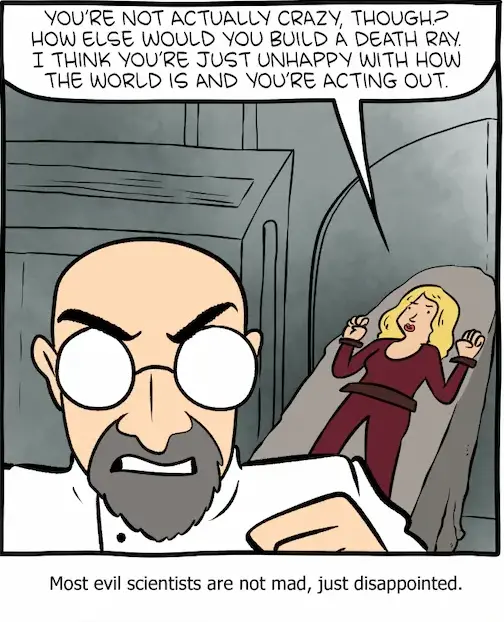 Most evil scientists are not mad, just disappointed.
“You’re not actually crazy, though? How else would you build a death ray. I think you’re just unhappy with how the world is and you’re acting out.”
Are we watching the same documentaries, Zach?