
Capsule Movie Reviews Vol.2026.04
Published by marco on
Read the explanation of method, madness, and spoilers.[1]
- Bruno Manser − Die Stimme des Regenwaldes (2019) — 8/10
- Memoirs of a Geisha (2005) — 8/10
- The Birdcage (1996) — 6/10
- Doug Stanhope: Discount Meat (2024) — 8/10
- Blue Velvet (1986) — 8/10
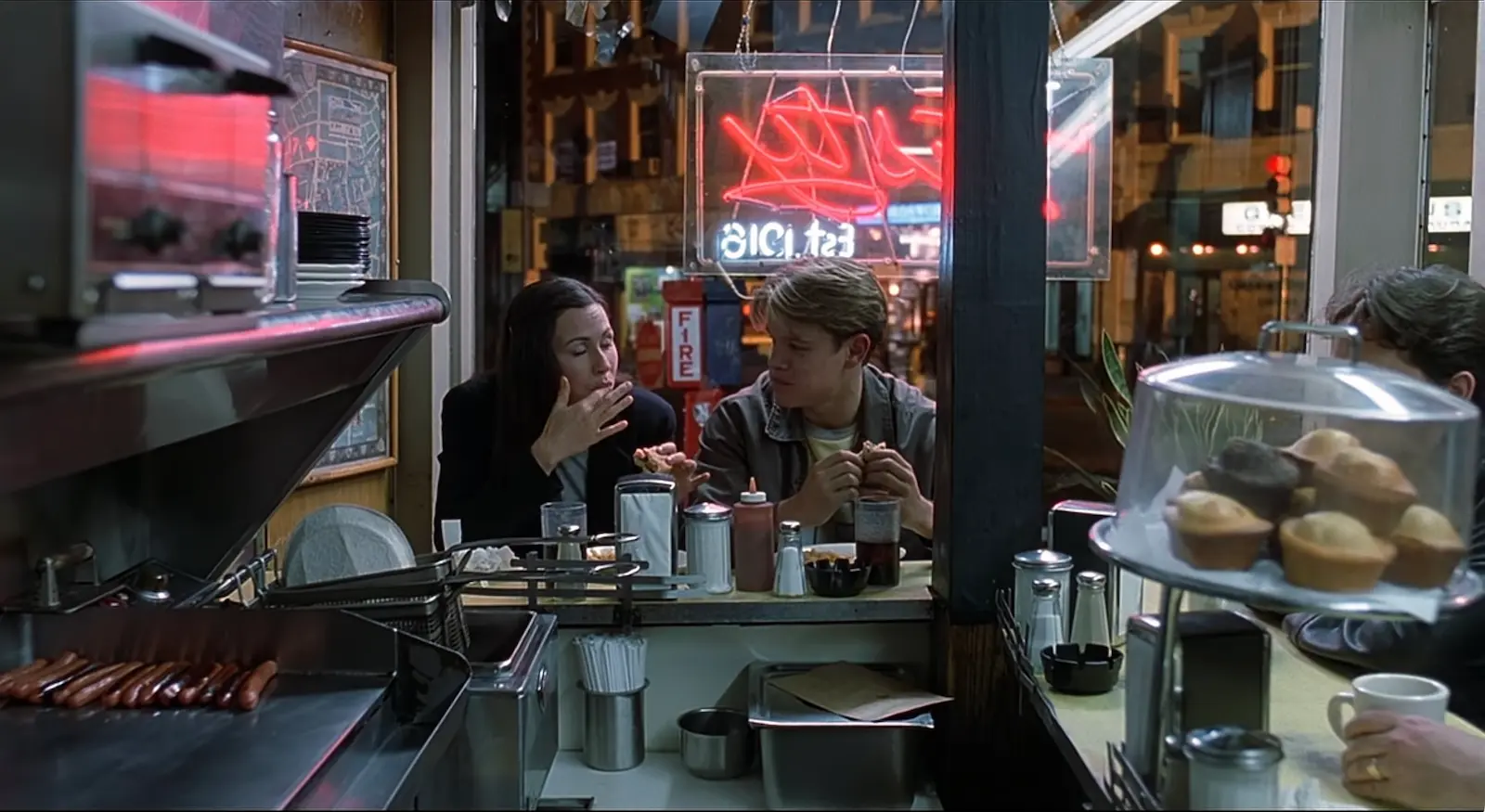
- Good Will Hunting (1997) — 10/10
- Speed (1994) — 7/10
- The Silence of the Lambs (1991) — 10/10
- A History of Violence (2005) — 7/10
- Carrie (1976) — 8/10
- Bruno Manser − Die Stimme des Regenwaldes (2019) — 8/10
This is a fictional rendering of the true story of Bruno Manser, a Swiss environmental activist who traveled to Malaysia in 1984, at 30 years old, to commune with nature and to try to find the Penan, aboriginals who live in the jungles there. At first, they were wary, but they eventually adopted him as one of their own. He learned their language and, four years later, was fully integrated.
The logging begins, felling large swaths of the Penan homelands. They can do nothing to stop it, as the stronger will always win in such situations. And the stronger have come with bulldozers, ownership papers, and armed policemen, staking a claim over lands that other people live on. Why does this happen? Because they can.
Manser asks his chief Along (Nick Kelesau) why they don’t talk to the loggers, to try to reason with them. Along responds that they don’t listen to the Penan as they don’t consider them to be human. They care as little about the Penan as they do about any of the animals and trees. Manser can make them care. He confronts the workers on the site with the Penan behind him. The workers send him to the site boss, who tells Manser that there’s nothing to be done. They have the permits. Manser tells them his plan to block their logging roads. The blockade works as the police are unwilling to enforce the right of way by allowing the workers to bulldoze women and children. Journalist James Carter-Long (Matthew Crowley) gets the word out for Manser and the Penan.
The Penan stay out on the roads, defending their checkpoints…but suffering because they weren’t in the cool jungle that they call home. Instead, they were living a miserable existence on a dusty road, a foretaste of the lives they would lead once the Malaysian government would “resettle” them onto reservations. Capitalist logic dictates this is what you do with people who are living on land that you have decided belongs to you. It contains precious natural resources that you can just take for free, and the Penan weren’t using them. This is capitalism unfettered by morality or justice. Plunder is the name of the game no matter where you go.
After a long time of working together, journalist James succumbs to pressure, taking the Malaysian money to turn in Manser, who is eventually chased from Malaysia, forced to leave his precious Penan, including the young lover he’d taken, Ubung (Elizabeth Ballang). He returns to Switzerland to dedicate his life to protecting the Penan’s jungles. He starts a small organization with a few like-minded and largely sympathetic activists, like Roger (Benjamin Mathis) and Barbara (Vera Flück).
He has some successes—he speaks with Boutros Boutros-Ghali, who advises him on tactics—but mostly suffers cumulative setbacks as the Malaysian government and the powerful logging lobby grind down any resistance over the years. At one point, Manser organized an action during a G7 conference where he climbed the façade of a building in London to unfurl a banner deriding the destruction of the rain forest. Barbara streaked across the forecourt in order to distract people enough for Manser to get started on his climb.
During this time, we learn more about Manser’s relationship with his parents, Ida (Charlotte Heinimann) and Erich (Daniel Ludwig), who worked for the Sandoz chemical company. This is a point of contention for Bruno, who sees his father’s entire career as having been part of a destructive machine, whereas his father … doesn’t. At least not yet.
His father would eventually, after cancer had taken him much closer to the grave, have a moment of clarity, in which he sees that most people are just shuffling along through lives pre-planned for them by a society that is dedicated to eating them alive to feed the fortunes of those at the top. Long story short, he sees Bruno for the shining light of principle that he is, and questions everything he’d done in his own life, rather than butting heads with Bruno, as he’d often done before.
While satisfying, this part felt a bit like it had never happened, at least not in this most obvious way. At any rate, if you’re the kind of person who shares this viewpoint—and I am—then it offered a nice little frisson of spiritual victory in a film otherwise filled with setbacks and victories for the usually bastards who always seem to win. As long as you have your happiness is all well and good, but man, that Sword of Damocles hanging over you, and under the control of all those whose entire philosophy is diametrically opposed to yours is grating.
Even a large success was tempered with failure, when the U.N. agreed that a U.N. commission should have sovereignty over decisions made about the Malaysian jungle but only for environmental reasons, not cultural ones. Not only that, but even were one to tangentially be able to relate the plight of the Penan to an environmental cause that would be legally defensible, the Penan don’t merit protection because they are nomadic and therefore cannot even be considered to be a people under the cloistered Westphalian mindset that dominates international law.
Manser eventually returns to Malaysia, sneaking onto the reservation to find Ubung living in what he considers to be squalor, as compared to the lushness of the jungle home that they used to share. She takes offense to this characterization, as it is the only life left to her and she lives there with her son and husband, who works in a factory. The Westphalian state has subsumed the Penan and “improved” their lives. Resistance is futile.
Manser returns to the jungle, where he finds Along still fighting the good fight, still fighting for their independence. Manser comes up with a plan to map the entire territory, thereby making it a legal “nation” to which the Penan would have rights under international and Malaysian law. Manser sets off into the jungle to share the plan with the other chieftains. He is never heard from again. The Penan fight for their rights to this day.
We watched the movie in the original Swiss German, Penan, and English, with German subtitles.
- Memoirs of a Geisha (2005) — 8/10
Chiyo (Suzuka Ohgo) lives in a Japanese fishing village by the sea, but not for long. Capitalism conspires with its evil benefactors to force her father to sell her and her sister Satsu (Samantha Futerman) to two houses in Kyoto. It is 1929.
Despite her eyes having “too much of the sea in them” (they’re blue) Chiyo is taken under the tutelage of Mother (Kaori Momoi). She lives in her house with the gentle Granny and Auntie (Tsai Chin) but also the beautiful but evil Hatsumomo (Gong LI) and her protégé Pumpkin (Zoe Weizenbaum).
Hatsumomo is immediately jealous of Chiyo, almost certainly because she’s more than sly enough to recognize her potential. Therefore, she relentlessly calls her ugly, frames her for crimes, and otherwise tries to get her to run away with her sister Satsu. Chiyo eventually arranges to run away with her sister but is locked in the house as punishment on the evening that she’d promised to meet her. Satsu runs away on her own, never to be heard from again.
Chiyo injures herself trying to escape and Mother makes her a servant rather than a geisha-in-training. It is at this time that Chiyo meets the Chairman (Ken Watanabe) and falls in love with him pretty much immediately. He was the first person who was ever genuinely nice to her, seemingly expecting nothing in return. He buys her a sweet ice, gives her some money, and ties it in a handkerchief of his. She keeps the totem but spends all of the money at a temple, praying that she will become a geisha and be able to spend her life with him.
Years later, Chiyo is ready to become Sayuri (Ziyi Zhang) and begin her tutelage under Mameha (Michelle Yeoh) while Pumpkin continues under the brutal regime of Hatsumomo. Mameha is wonderful from beginning to end, devoted to Sayuri’s well-being, and even making a huge bet on her earning an even more spectacular purchase price for her virginity than even Mameha had earned, when she’d set the all-time record.
Sayuri enters the Chairman’s orbit again but ends up working for his business partner—to whom he owes his life—Nobu (Kôji Yakusho), even though she desperately wants to be with her love. She is nothing if not patient, understanding how society works. She ends up getting 50% more money than anyone had ever had before her, and it was paid by Dr. Crab, who then takes her virginity.
This high price was immediately confiscated by Mother but she also immediately names Sayuri as her heir, enraging Hatsumomo and Pumpkin. Hatsumomo gets mad-drunk and nearly burns the whole place down, having discovered Sayuri’s crush on the Chairman. She is banished, never to be heard from again.
WWII begins, throwing all of Kyoto into an uproar of refugees. Sayuri escapes into the countryside to work on a farm, spending the war years making kimonos. At the end of the war, Nobu shows up to ask her to once again take up the mantle of the geisha, to convince U.S.-American Colonel Derricks (Ted Levine) to invest with Nobu and the Chairman. Mameha is back, as is Pumpkin, who has become, over the course of the occupation, a famous and seemingly quite enthusiastic escort.
Sayuri rejects the Colonel’s sexual advances, then learns from Nobu that he wishes to sponsor her as his geisha. She wants nothing of the sort, as she is still devoted to her dream of the Chairman. She contrives to have Nobu catch the Colonel taking advantage of her but Pumpkin betrays her and brings the Chairman instead, who will presumably write off Sayuri forever for her indiscretion, which is, like, utterly wild, to consider, but this very much feels like a Japanese Wuthering Heights at this point, so we’ll just run with it. Why did Pumpkin do it? Well, because she was still pissed that Mother had preferred Sayuri as an heir. Say what you want about her but the girl can hold a grudge.
Back in Gion, Kyoto, Sayuri is called to a meeting in a tea house, expecting to see Nobu but encountering the Chairman instead, who finally confesses not only his reciprocal love for her, but that he’s always known who she was, but that he spent decades giving Nobu preference because of his debt to him. All’s well that ends well.
This was an utterly beautiful film, justly winning awards for Art Direction, Cinematography, and Costume Design. The music by John Williams with cello solos by Yoyo Ma and violin solos by Itzhak Perlman didn’t win, but was nominated. Lovely.
- The Birdcage (1996) — 6/10
I already watched and reviewed this movie in 2014. I can only confirm my feelings from that review: while I was initially more excited to see Robin Wiliams, Nathan Lane, and Hank Azaria flounce and mince around their environs, the relentless kowtowing to homophobia is too much of a turnoff.
I understand that there are hateful people in the world. I just don’t enjoy watching a movie in which one of them is a 20-year-old son Val (Dan Futterman, who was nearly 30 at the time, and looked it) who was raised by two fathers, but who doesn’t seem to have learned anything from them and is far more interested in marrying into the powerful family of his empty shell of a girlfriend, no matter how Ku-Klux-Klan-adjacent they might be.
I further understand that the film is ostensibly making fun of these stereotypes but it gives them so much uncritical screen-time that it’s hard to take seriously as satire. Even Armand (Robin Williams) seems to be embarrassed of Albert (Nathan Lane) and largely on the same page as Val, who is visibly disgusted by how queer everyone else is. Val is absolutely unconvincing in the role of someone who was ostensibly raised in that home, in that family. It is unclear why they are all so forgiving of his beastliness. With only initial reluctance, they clear the entire apartment of its unacceptable gayness.
The in-laws arrive, utterly unafraid to spout the most hateful, small-minded things, with which everyone pretends to agree. The shining moment is when Albert appears as Val’s mother, leaning heavily into the role of a woman nearly as small-minded as Senator Keely (Gene Hackman, perfectly cast) and his wife (Dianne Wiest, also perfectly cast). It’s a relatively good setup but it takes so long for anything good to happen, with everyone cringingly accepting the lead from the worst people in the room.
What do Armand and Albert have to gain from jerks like the Keelys? They only just found out that Val is engaged to their daughter—how are they so invested in making this thing happen for their utterly ungrateful son that they are willing to give up the lives they’ve built for it? It’s utterly unbelievable today, especially considering how unabashedly out they are in real life. Was this really the gayest you were allowed to make a movie in 1996? It’s a Schande.
Even once Albert’s identity is lifted by Val—who makes a completely unexplained turnaround to honesty—the entire group still accepts wholeheartedly the axiom that the Senator’s career and reputation are absolutely to be protected from the ignominy of being associated with queers. Newspeople just march into the club with gigantic film cameras, as if the club has no bouncers whatsoever. The Senator and his wife dress up in drag, with the Senator performing a seamless move to dressing in drag, lamenting that no-one wants to dance with him because he’s not pretty.
This is all pretty ridiculous and lazy and largely a waste of a good cast. I suppose it might have been groundbreaking at the time but, with 30 years hindsight, it just all feels so gauche, like watching pickaninny films from the 1930s. I wanted to give it an extra star for the cast but ended up not doing so, as I found the number of unreasonable and bigoted people in this movie to be a bit overwhelming.
- Doug Stanhope: Discount Meat (2024) — 8/10
I somehow missed Doug’s latest special when it came out over a year ago. Luckily for me, Doug is a good guy, and he posted the whole damned thing on his YouTube channel for free. Doug Stanhope is the most consistently moral comic working today, or at any time in the last couple of decades. He has never sold out nor will he ever. He carries the legacy of Bill Hicks, with more of a focus on domestic politics (particularly mental-health care and the homelss) than foreign policy. He is devastatingly funny, deeply satirical, a brilliant writer, and occasionally filthy, which is, great, right? He is unflichingly filthy, like John Waters. What he’s joking about are generally dark things, so you gotta laugh of cry, but, if you’re gonna laugh, you can’t help swearing a bit. Or a lot.
Doug Stanhope (2024) − DISCOUNT MEAT [Full Special 18+] by Doug Stanhope (YouTube)
00:00 No Opener
00:49 The Problem With This Special
02:12 9/11 vs. Covid (Expired Meat)
16:04 You’re Going Down With Me
29:12 Keeping Up With AA
30:43 Trip Advisor
36:22 High Notes #1
41:29 Experimenting With Sobriety
49:46 Perfectly Cooked Bacon
01:01:14 High Notes #2
01:06:55 Me In Blackface, Here’s a Clip
01:09:30 Mob Mentality… plus Inc*st
01:14:34 Leaving On All Fours
On the information silos of the 21st century,
“There used to be a consensus of truth, like some stable flooring. It’s a war in Iraq, let’s say. Yes, there was a war in Iraq and, as a comic, you could have any angle: “it’s a war for oil” or “fuck the terrorists, let’s nuke ‘em back to the Stone Age.” But at least you’re standing on the same ground: There is a war in Iraq. There was not a vocal screaming third party going, “there is no war in Iraq; it’s a false-flag operation cuz the Earth is flat, and Iraq is on the underside of it, so if you try to deploy troops there, they just fall into under-space.””On suicide and taking it with you,
“How about some common sense or we look at suicide as a business decision? Anytime you hear the expression ‘he died penniless’—why is that a negative? That should be your goal. This is what you strive for, that you get down to fucking put the last $1.75 on a gift certificate. I had nothing left to fucking give. I don’t have a bucket list, but I do harbor every grudge so, instead of writing a list of things I want to do before I die, I jot down names of people who are coming with me.”On the problems posed by sobriety,
“Sobriety…it’s an altered state for me, so it’s like, ‘this is weird.’ People do this but the problem that I found with sobriety is, what it does, it will add an extra day into every day that you do it. And I don’t know what to do with that kind of time.
“Your average day—24 hours—8 hours of consistent, plodding drinking, and then you have 8 hours of passing out, sleeping it off, and then 8 hours of recovery. And I go, ‘where fuck the am I?’ And check your phone, and then, you know, pay a bill, feed a pet—so they call you functional—and then start drinking again.
“That’s a normal person. You take out the 8 hours of drinking, then you don’t even need the 8 hours of recovery part. Like, it’s two days basically. You go ‘what the fuck am I going to do?’
“It’s like if they told you, if you’re a non-drinker, and they say yeah sleep isn’t a thing anymore—they eliminated that—what are you going to do with that other eight hours? Get another fucking side family? Fucking learn a language on the Rosetta Stone? No, that’s why I drink. I don’t know what to do with those eight hours already; don’t double it.”
There is no other comic I know who’s doing this kind of material. Thought you can say that he carries the mantle of Bill Hicks, he is uniquely Stanhope. There is no other comic like him.
- Blue Velvet (1986) — 8/10
I watched and reviewed this movie in 2011. I let the rating stand although I might have given it a 7 too. It’s almost a bit too deliberately weird and hurried in some places.
Mr. Beaumont (Jack Harvey) suffers a bizarre accident while watering his lawn. He is injured pretty badly, not least by a small, neighborhood dog who runs up to bounce its front paws up and down on his balls as he lies supine with his watering hose offering the enticement splashing over his belly that attracted the dog in the first place.
Jeffrey Beaumont (Kyle MacLachlan) is home from college. He visits his father in the hospital. On the way back, he finds a human ear in a field he crosses. He takes it to the police. This discovery leads him to learn of Dorothy Vallens (Isabella Rossellini), who is somehow involved. He meets and starts to romance high-school senior Sandy Williams (Laura Dern) as they investigate the odd goings-on.
Jeffrey decides to investigate Dorothy’s apartment. Taking equipment from his father’s hardware store, where he’s holding down the fort, he pretends to be a bug-sprayer and gets into her apartment, managing to steal keys that he can use to come back later.
He and Sandy go to Dorothy’s club, where they watch her start to sing Blue Velvet. Certain that she’ll be there for a while, they head back to her apartment, where Jeffrey breaks in. Sandy lays on the horn as agreed, but Jeffrey is taking a leak and doesn’t hear her. This is actually pretty funny. He’s forced to hide in the closet when Dorothy surprises him. Dorothy is expecting a visit from Frank (Dennis Hopper), so she puts on her blue-velvet robe.
She catches Jeffrey in her closet when he makes a noise, threatening him with a knife, and even nicking his face with it. She is in control, taking sexual advantage of him, making him undress. Frank shows up as she’s seducing/semi-raping Jeffrey and is forced to shove him, naked, into the closet again.
Frank enters like a snarling force of nature, yelling at her not to look at him, telling her to spread her legs, slapping her around a bit, then inhaling from what looks like an oxygen mask, then using her as a prop as he gets off. It’s non-penetrative rape. It is ugly. But it also kind of looks like they’ve both been down this road a few times before. Frank’s not there for the first time. And Dorothy’s attitude is … complicated.
Afterward, Jeffrey comes back out of the closet and tries to console her but eventually sneaks away to Sandy. Before he leaves, he finds Dorothy’s picture of her husband Don and their son. He suspects that Frank is somehow holding them captive. That explains the complicated part of Dorothy’s attitude a bit better.
Jeffrey can’t stop thinking about Dorothy, even as his relationship with Sandy inexplicably deepens. I write “inexplicably” because they seem to barely know each other but they’re already professing their love for each other. This, though Jeffrey has gone back to visit Dorothy at least once, and not for coffee, it’s definitely for sadomasochistic sex, in which she demands that he hit her. When he refuses, she attacks him first, provoking him into doing it anyway. Complicated and definitely discomfiting.
At Dorothy’s club, Jeffrey is drinking his customary Heineken and sees Frank, as well as Yellow Man (Fred Pickler), a man in a yellow suit, who Jeffrey had photographed with Frank earlier. Jeffrey returns to Dorothy’s apartment for some clowning around. Frank and his crew catch him leaving. Dorothy introduces Jeffrey as a neighbor, which no-one believes.
They take a psychotic joyride together to Ben’s (Dean Stockwell) place, where Frank is a sociopath and Ben blows it off, lip-syncing his way through Roy Orbison’s In Dreams. Back in the car, Frank makes moves on Dorothy, with Jeffrey and his crew of three guys in the car, grabbing for her tits with one hand while jamming the gas mask on his face with the other. Jeffrey pops Frank in the nose and is dragged out of the car, where Frank molests Jeffrey, kissing him with his bloody face before beating him unconscious.
Jeffrey wakes up in the sawmill yard where they’d stopped for their little party the previous evening, walking home with a decent shiner. He goes to the police to talk to Sandy’s father Detective Williams (George Dickerson). At the station, he sees the Yellow Man working there. Williams mysteriously tells Jeffrey to ignore what he’s seen.
Jeffrey picks up Sandy for a date. They smooch, declare their love, then drive home, pursued by a vehicle that Jeffrey assumes is Frank. It’s not. It’s Sandy’s quarterback-boyfriend Mike (Ken Stovitz), who is about to beat on Jeffrey, when a confused, bruised, and stark naked Dorothy appears on the porch, looking for Jeffrey. It’s unclear how she got there, or how she even knew where he lived, or where her clothes went. At any rate, Sandy bravely helps Jeffrey bring her to her house, where Sandy’s mom isn’t too impressed by the whole scene, as the only thing that Dorothy seems able to say—as she stands stark-naked in the woman’s living room—is “He put his disease in me.”
The Yellow Man hurries to clean up the mess at Dorothy’s apartment, killing a few of Frank’s henchmen, but not before they’ve killed Dorothy’s husband. He also takes some serious damage himself, still standing but not long for this world. Jeffrey shows up to find the macabre scene, then radios it in, unaware at first that Frank has a police radio but then figuring it out soon enough to set a trap for him.
Frank shows up, a psychotic force of nature, hunting through the apartment for Jeffrey, finally ending up at the closet. He opens the door wide, unaware that Jeffrey had pilfered the Yellow Man’s gun and can now use it to put out Frank’s lights with a shot right between the eyes.
- Good Will Hunting (1997) — 10/10
Will (Matt Damon) is from Southie in Boston. He lives alone and is picked up every morning for work by his best friend Chuckie (Ben Affleck). At night, they join two other goofballs, Morgan (Casey Affleck) and Billy (Cole Hauser), and go out drinking. They go to Little League games together. They start fights with other locals; the one we see is in retribution for some guys harassing a girl. The cops show up and arrest them for starting it.
Will’s working as a janitor at MIT, mopping outside Fields Medal winner Lambeau’s (Stellan Skarsgård) classroom, where he tells his students that he’s put up a hard problem on the chalkboard outside. Fame, fortune, and maybe a Fields Medal awaits any student who can solve it by the end of the semester, Will solves it. Lambeau is a bit mystified when no student steps forward to claim the solution. He puts up an even-harder problem, one that he and his team had taken two years to solve. Will solves this one as well. Though Lambeau catches him doing it, Will gets away before Lambeau can get a good look at him.
On a night out with his friends, slumming in a bar near MIT/Harvard, he meets Skylar (Minnie Driver), impressing her with his acumen in dismantling a snobbish Harvard student who’d tried humiliating Chuckie. He dismantled him with an overwhelming barrage of knowledge that showed he’d learned all of the mainstream history but also the alternate, much-more accurate version as well (he would mention The People’s History of the United States later in the film, a book that I would end up reading only 10 years later, in 2004).
Lambeau eventually finds out who he is, learning that he’d been working as a janitor as part of his parole program. He finds Will in court, where he’s defending himself—if he’s so smart, why doesn’t he know that a man who represents himself has a fool for a client?—and doing an OK job of it, if not as good a job as he’d done before, where he’d gotten himself free again and again by citing obscure legal works from the 1800s, which he’d inhaled into his eidetic memory, and from which his lightning-fast mind could construct legal defenses. The judge doesn’t buy it this time and sentences him. Lambeau intervenes, getting Will’s sentence lightened to having to work with him at the university as well as getting therapy.
While Will is genuinely intrigued by the thought of working on high-level mathematics, he is not at all interested in therapy. He tortures five therapists until he finally ends up in the office of Sean (Robin Williams), a Harvard classmate of Lambeau’s, who is, in his own way, just as smart as Lambeau and Will.
After Will brings the brunt of his intellect to bear on him in the first session, Sean ripostes in the second session to show that, while there is such a thing as intelligence (which you’re born with) and knowledge (which you can acquire, limited only by your intelligence), it’s wisdom (which anyone can acquired by learning from experience) that matters most.
It is with wisdom that Sean trumps both Lambeau and Will, having learned that there are experiences that are just as important as learning things because those experiences are what makes us human. And what’s the point of knowing things, of being smart, if you’ve no-one to share it with?
As I watch this movie again, a couple of decades after I’d watched it the first time, I realize that both Will and Sean were more than a little formative for me, coming at a time in my life when I was toying with Libertarianism. I had my own Sean who rescued me from that wayward way of thinking, a friend from university who I ended up working with in New York, and who showed the same level of near-infinite patience that Sean does with Will with a smart guy who rounded up “having learned some stuff” to “knowing everything”.
 Good Will Hunting − date #1Will begins to date Skylar, and begins to open up to Sean, as Sean has opened up to him. Sean has earned Will’s trust, and Sean is started to teach Will the one thing that he can’t learn from books: how to be a human being. Will has a hard road, as he was raised in foster homes, an orphan. Sean tells him that, just as Will can’t suppose to know everything about a person from books he’s read, neither would Sean presume to know what it’s like to grow up as an orphan simply because he’s read Oliver Twist.
“Sean: You don’t know about real loss, ‘cause it only occurs when you’ve loved something more than you love yourself. And I doubt you’ve ever dared to love anybody that much. And look at you… I don’t see an intelligent, confident man… I see a cocky, scared shitless kid. But you’re a genius Will. No one denies that. No one could possibly understand the depths of you. But you presume to know everything about me because you saw a painting of mine, and you ripped my fucking life apart. You’re an orphan right?
[Will nods]
Sean: You think I know the first thing about how hard your life has been, how you feel, who you are, because I read Oliver Twist? Does that encapsulate you? Personally… I don’t give a shit about all that, because you know what, I can’t learn anything from you, I can’t read in some fuckin’ book. Unless you want to talk about you, who you are. Then I’m fascinated. I’m in. But you don’t want to do that do you sport? You’re terrified of what you might say. Your move, chief.”Will does not prove to be an easy nut to crack for anyone: Lambeau is certainly not going to do it because he never finished growing up himself, and because he has long ago accepted the rigid confines of a world that trapped him by calling him smart so often that he never thought to seek anything more. Their relationship is complicated by the fact that Lambeau has had his self-image shattered by this young man to whom everything Lambeau struggles to achieve comes so easily. Lambeau is accustomed to being the smartest guy in the room and has no practice for this relationship at all. Will is not equipped to be the one that lets him down slowly.
“Will: Do you know how easy this is for me? Do you have any fucking idea how easy this is? This is a fucking joke! And I’m sorry you can’t do this, I really am. Because I wouldn’t have to fucking sit here and watch you fumble around and fuck it up.
Lambeau: […] You’re right Will. I can’t do this proof. But you can, and when it comes to that, it’s only about… it’s just a handful of people in the world who can tell the difference between you and me. But I’m one of them.
Will: Sorry.
Lambeau: Yeah, so am I. Most days I wish I never met you. Because then I could sleep at night, and I wouldn’t… and I wouldn’t have to walk around with the knowledge that there’s someone like you out there.
[Will leaves the room]
Lambeau: And I wouldn’t have to watch you throw it all away.”Skylar could do it, and Lord knows she tries, mature beyond her years, but Will has literally nothing in his makeup that would make him trust her .It is impossible. He only knows how to lie to her and then burst out angrily when she fails to see through his lies to deduce the exact truth that he’d worked so hard to hide. He immediately concludes that this is because she’s not quick enough to keep up with him, because he’s still a child emotionally.
“Will: [talking to Skylar in her dorm room] What do you wanna know? That I don’t have 12 brothers? That I’m a fuckin’ orphan? You don’t wanna hear that… no, you don’t wanna hear that. You don’t wanna hear that I got fuckin’ cigarettes put out on me when I was a little kid! That this
[points to his left ribs]
Will: is ‘cause the motherfucker stabbed me! You don’t wanna hear that shit, Skylar. Tell me you don’t wanna hear that shit isn’t fuckin’ surgery!”Sean comes the closest to doing it, and finally does, connecting on a level that only he can, finally being able to reveal to Will that he, too, was beaten mercilessly as a child, by his drunken father. I write “finally” because he had to wait for Will to draw it out of him rather than using it as a tool.
“Sean: My father was an alcoholic. Mean fuckin’ drunk. He’d come home hammered, looking to whale on somebody. So I’d provoke him, so he wouldn’t go after my mother and little brother. Interesting nights were when he wore his rings.
Will: He used to just put a belt, a stick, and a wrench on the table. Just say, “Choose.”
Sean: Well I gotta go with the belt there.
Will: I used to go with the wrench.
Sean: Why the wrench?
Will: Cause fuck him, that’s why.
Sean: Your foster father?
Will: Yeah.”Will ends up crying in Sean’s arms; it’s a legitimate breakthrough that gives Will a lot to think about. What really seals the deal, though, what really wakes Will up to what a chickenshit he’d been for a while now, creeping around, doing only what he was good at, afraid to try anything else, like trust or love, was his best friend Chuckie.
“Will: [both leaning on a pick up truck while drinking beers and smoking cigarettes on a construction site] What do I wanna way outta here for? I’m gonna live here the rest of my fuckin’ life. We’ll be neighbors, have little kids, take ‘em to Little League up at Foley Field.
Chuckie: Look, you’re my best friend, so don’t take this the wrong way but, in 20 years if you’re still livin’ here, comin’ over to my house, watchin’ the Patriots games, workin’ construction, I’ll fuckin’ kill ya. That’s not a threat, that’s a fact, I’ll fuckin’ kill ya.
Will: What the fuck you talkin’ about?
Chuckie: You got somethin’ none of us have…
Will: Oh, come on! What? Why is it always this? I mean, I fuckin’ owe it to myself to do this or that. What if I don’t want to?
Chuckie: No. No, no no no. Fuck you, you don’t owe it to yourself man, you owe it to me. Cuz tomorrow I’m gonna wake up and I’ll be 50, and I’ll still be doin’ this shit. And that’s all right. That’s fine. I mean, you’re sittin’ on a winnin’ lottery ticket. And you’re too much of a pussy to cash it in, and that’s bullshit. ‘Cause I’d do fuckin’ anything to have what you got. So would any of these fuckin’ guys. It’d be an insult to us if you’re still here in 20 years. Hangin’ around here is a fuckin’ waste of your time.
Will: You don’t know that.
Chuckie: Let me tell you what I do know. Every day I come by to pick you up, and we go out drinkin’ or whatever and we have a few laughs. But you know what the best part of my day is? The ten seconds before I knock on the door ‘cause I let myself think I might get there, and you’d be gone. I’d knock on the door and you wouldn’t be there. You just left.
[A beat.]
Chuckie: Now, I don’t know much. But I know that. ”During all of this, Lambeau is organizing interviews for Will at various high-powered consulting companies. Will has a date with Skylar, so he sends Chuckie in a suit to stand in for him. He does a great job, extorting a “retainer” of $73 from the guys at one interview. Will shows up to the NSA interview himself, where he’s asked why he wouldn’t want to work for someplace as awesome as the NSA.
“That’s a tough one, but I’ll take a shot. Say I’m workin’ at the N.S.A. and somebody puts a code on my desk. Something no one else can break. Maybe I take a shot at it and maybe I break it. I’m real happy with myself because I did my job well. But maybe that code was the location of some rebel army in North Africa or the Middle East. Once they have that location, they bomb the village where the rebels are hidin’. Fifteen hundred people that I never met, never had no problem with, get killed.
“Now the politicians are saying, “Send in the Marines to secure the area,” ‘cause they don’t give a shit. It won’t be their kid over there gettin’ shot, just like it wasn’t them when their number got called ‘cause they were in the National Guard. It’ll be some kid from Southie over there takin’ shrapnel in the ass.
“He comes back to find the plant he used to work at… got exported to the country he got back from, and the guy who put the shrapnel in his ass got his old job… ‘cause he’ll work for 15¢ a day and no bathroom breaks. Meanwhile, he realizes the only reason he was over there in the first place… was so we could install a government that would sell us oil at a good price.
“Of course, the oil companies used a skirmish over there to scare up domestic oil prices. A cute little ancillary benefit for them, but it ain’t helpin’ my buddy at $2.50 a gallon. They’re takin’ their sweet time bringin’ the oil, of course. Maybe they even took the liberty to hire an alcoholic skipper, who likes to drink martinis and fuckin’ play slalom with the icebergs. It ain’t too long till he hits one, spills the oil… and kills all the sea life in the North Atlantic.
“So now my buddy’s out of work, he can’t afford to drive, so he’s walkin’ to the fuckin’ job interviews… which sucks because the shrapnel in his ass is givin’ him chronic hemorrhoids. Meanwhile, he’s starvin’, ‘cause every time he tries to get a bite to eat, the only blue plate special they’re servin’… is North Atlantic scrod with Quaker State.
“So what did I think? I’m holdin’ out for somethin’ better. I figure, fuck it. While I’m at it, why not just shoot my buddy, take his job, give it to his sworn enemy, hike up gas prices, bomb a village, club a baby seal, hit the hash pipe and join the National Guard?
“I could be elected president.”
Will finally turns 21. He no longer has to go to therapy. He takes his leave of Sean. They promise to stay in touch. Sean is hitting the road—China, India, Baltimore—taking a risk of his own, maybe going to write a little. Chuckie, Morgan and Billy present Will with his birthday present—he’s expecting them to kick his ass, but instead, they got him a car. “This is ugliest car I’ve ever seen.” But he loves it. He bails on the job he’d accepted, stops by Sean’s place to leave a note that reads, “I gotta see about a girl,” and heads west, for California.
Two hours of non-fat movie. incredible writing, incredible dialogue, incredible acting, beautifully filmed. No notes. Will and Sean were both formative characters, since I was 25 when I first saw this film. I have to smile now when I think how the balance has shifted in whom I find most admirable.
- Speed (1994) — 7/10
The last time I watched this was in 2011, in French. I had forgotten that the movie started with an attempted hostage-taking by ex-cop Howard Payne (Dennis Hopper, unhinged in a way similar to his role as Frank in Blue Velvet), where officers Jack Traven (Keanu Reeves) and Harry (Jeff Daniels) thwart his attempt to extort $3.5M by rescuing the hostages out of a rigged elevator. They get a commendation, pissing off Howard even more.
Howard is back soon enough, rigging a bus to blow sky-high, to get Jack’s attention, then informing him of another bus that has a bomb on it, that’s set to go off if the bus drives more slowly than 50MPH. Jack jumps into action, chasing down the bus and making his way onto it. There is a bit of commotion, with driver Sam (Hawthorne James) getting shot by a passenger and Annie (Sandra Bullock) taking the wheel. Stephens (Alan Ruck, i.e., Cameron from Ferris Bueller’s Day Off) is also on the bus, as a tourist. Jack phones in the bomb threat to Harry and Capt. McMahon (Joe Morton) and they start the operation.
Annie’s driving and she’s gonna drive through a bunch of stuff to keep the bus at over 50MPH. They have a police escort that clears a path for them as they careen around a corner, on two wheels, toward an empty stretch of freeway. Unfortunately, the highway’s not finished. There’s a gap. Annie’s gonna have to jump it. She floors it up to 70MPH … and lands it. They’re still going. 50MPH. This is patently ridiculous because, although Jack says that “there’s usually an incline,” there was clearly no incline and no reason why the bus jumped upwards instead of sinking like a stone and, at best, smashing into the other side of the bridge or, at worst, making a huge crater under it.
They exit at LAX, with Jack realizing that they can circle on the tarmac instead of using roads. Howard calls Jack to tell him that he still wants his money. Jack convinces him to let him get off the bus so that he can arrange it for him. Howard can no longer see them from the cameras in the helicopters because they’re banned from the airport airspace. Jack jumps on a sled hooked to a cable and slides under the bus, trying to defuse the bomb. There’s too much debris on the tarmac and he’s jostled loose. He saves himself by jamming a screwdriver in the gas tank, clinging to the bottom of the bus, and then climbing back onboard with Ortiz’s (Carlos Carrasco) help.
He’s back where he started: the bomb’s not defused. He soon finds out that Harry had led a raid on Howard’s house, which had been rigged to blow. Harry’s gone. Howard’s going to get his money, and Jack is still on a speeding bus with a live bomb on it. He notices something—Annie’s sweatshirt logo, a “wildcat”—that makes him realize that Howard is tapped directly into the bus’s backward-facing camera. It’s transmitting on a UHF signal that Jack gets McMahon to intercept, with the help of a news crew. They manage to capture a one-minute loop and are forced to go with it because the gas tank is emptying out. There’s no time left.
They loop the tape and get everybody off the bus, except for Annie and Jack. They are forced to ride a metal slab out of the bottom of the bus, coming to a shuddering stop in a construction site, a bit banged up. Howard still doesn’t know that they’ve rescued all of the hotages.
Jack commandeers their ambulance to go to the scene of the money drop to try to catch Howard (because the other 200 cops there wouldn’t have been able to do it, I guess). Howard gets wise to the deception with the camera feed, puts on a cop’s uniform, and convinces Annie to come with him. Jack discovers that the money drop in the trash can had a false bottom, so the bag had dropped through the ground and into Howard’s waiting arms. Jack drops through the hole to find Howard just getting away, then discovers that he has Annie with him, wired with explosives.
Howard escapes with Annie in tow on a subway car, which Howard directs toward a dead end, for some reason, but whatever. He locks Annie to a subway pole, kills the driver, and then realizes that Jack is on the train.
Howard is a retired cop—so he’s at least 50 if not much olders—and he’s missing a finger and therefore not really able to use one of his hands. The other hand is clutching the bomb trigger. He somehow manages to climb on top of the train and fight Jack—a robust 30-year-old cop—to a standstill on top of a moving subway train. Jack pops his head off by smashing it into an overhead traffic light, snatching the trigger at the last minute. But c’mon, there’s no way that Howard could possibly have gotten up there in the first place, nor any reason why he would have even tried it.
Jack drops back into the train, defuses the bomb, and gets the vest off of Annie. The train can’t be stopped, though. The emergency brake is broken because Howard shot up the board.
Annie’s still handcuffed to the train, though. They can’t move the pole.
Jack decides to speed up the train so that it derails before it plows into the end of the tunnel. They do not explain why the shot-up engineer’s control board that is useless for braking the train is still perfectly serviceable for accelerating it.
Jack and Annie clutch each other around the subway pole as the train car careens around a turn, leaves the track, slides up a grade, and crashes out onto the city street, tipping over and sliding sideways to a stop. They are alive and more-or-less unhurt. The movie ends with them in each other’s arms, pledging to paper over any cracks in their stress-initiated relationship with lots of sex. Sounds like a plan.
- The Silence of the Lambs (1991) — 10/10
Clarice Starling (Jodie Foster) is an FBI trainee in Quantico. She is called off of the training course into the office her chief Jack Crawford (Scott Glenn). He has an assignment for her: interview Hannibal Lecter (Anthony Hopkins) to find out what he knows about a serial killer named Buffalo Bill (Ted Levine). Clarice descends into the bowels of the asylum for the criminally insane where Hannibal has spent the last eight years, under the care of the unctuous Dr. Frederick Chilton (Anthony Heald). Lecter chafes at this injustice. He is surrounded by drawings he’s made from memory of Florence.
This first meeting is cinema legend. The tension, the back-and-forth, the slow-reveal of both characters. It’s mesmerizing. And it’s not even their best interaction in the film. That would come later but their second conversation in the prison, during which they negotiate his transfer to a prison cell with a view of some nature in exchange for his help on catching Buffalo Bill. Lecter agrees, but only if Starling also agrees to divulge more information about herself.
Clarice deciphers Hannibal’s first clue to discover a head in a jar in a storage unit somewhere in Baltimore. Soon after, Crawford takes Starling along to West Virginia, where another victim has arisen from a riverbed. During the autopsy, they discover what turns out to be a death’s-head moth chrysalis lodged in her throat, placed there by the killer after her death. They soon discover the same thing in the severed throat of the head-in-a-jar that they’d found earlier. Two pushpins in the map now.
Senator Martin’s (Diane Baker) daughter Catherine (Brooke Smith) has been kidnapped by Buffalo Bill. Though the first deal with Lecter had turned out to be fake, the senator now offers a real one. Lecter agrees to help but only if he’s transferred to Tennessee for a meeting with her. Desperate, they agree. It is in Memphis that Clarice and Hannibal have their greatest exchange, where she relates to him a story from her childhood about the slaughter of lambs on her uncle’s Montana ranch, where she’d relocated after having been orphaned when her father had been killed in the line of duty. In exchange, Lecter gives her more information to decode.
“Lecter: First principles, Clarice. Simplicity. Read Marcus Aurelius. Of each particular thing ask: what is it in itself? What is its nature? What does he do, this man you seek?
Starling: He kills women…
Lecter: No. That is incidental. What is the first and principal thing he does? What needs does he serve by killing?
Starling: Anger, um, social acceptance, and, huh, sexual frustrations, sir…
Lecter: No! He covets. That is his nature. And how do we begin to covet, Clarice? Do we seek out things to covet? Make an effort to answer now.
Starling: No. We just…
Lecter: No. We begin by coveting what we see every day. Don’t you feel eyes moving over your body, Clarice? And don’t your eyes seek out the things you want?”Lecter plans his escape, palming a gold pen carelessly left unguarded by Chilton. He uses this to unlock his handcuffs and then overpower two guards, killing them both. This is also quite a famous scene. The music, the rapturous look on Lecter’s face as he clubs one guard to death and then, unfolding a switchblade, approaches the other, who had crawled off after having been clubbed and heavily maced.
Their comrades soon come up to investigate and find an abattoir. One of the guards hangs high up on the cage in the center of the room, disemboweled and crucified on sheets and intestines. The other lies on the floor, his face in utter ruins. He lives, though. They hurry him out of the building, down the elevator. Blood drips from the elevator ceiling, onto the sheet. The police suspect that Lecter is on top of the elevator, hiding, injured, and planning his escape. They hurry their colleague out to the ambulance, then cautiously approach the elevator. Peering down the shaft, they see Lecter’s motionless body lying atop the elevator. They fire once into a leg. He doesn’t move. They open the trapdoor in the ceiling…and the guard’s lifeless body drops down.
In the ambulance, Lecter rises from the bed, peeling the other guard’s face off of his own. He kills everyone in the ambulance, drives it to a remote area, kills a tourist, stealing their clothes, and escapes.
Meanwhile, Starling and her colleague Ardelia (Kasi Lemmons) deduce that the first victim Fredericka was the one whom Buffalo Bill “coveted” and that she was therefore someone that he saw, possibly every day. Clarice travels to the village where the victim lived, looking into her home, discovering that she was a seamstress, and that her dress patterns were nearly identical to those found on the victim’s back.
Clarice further deduces that Buffalo Bill is looking to make a woman suit out of his victims’ skins. She communicates this all to Crawford, who acknowledges but then tells her that he is helicoptering to Jame Gumb’s house, whom they have discovered is Buffalo Bill by investigating gender-change-operation applications. Clarice is too far away to get there but Crawford thanks her for her help, telling her that they couldn’t have done it without her. Then he abruptly hangs up.
Clarice follows a weak lead to the house of one of Fredericka’s last customers, finding that the lady had since moved. Buffalo Bill answers the door, inviting her in while he looks for the previous owner’s phone number. Clarice sees a death’s-head moth land in the kitchen. We watch her apprise the changed situation in milliseconds. She pulls her weapon but doesn’t fire. Buffalo Bill sidles away, going for his own weapon, but retreating into the basement. Clarice follows.
Catherine is in the basement now, clutching Precious the dog, which she’d lured into her pit in order to force Buffalo Bill to let her make a phone call. Now she shouts to Clarice to get her out of there. Clarice pursues Bill deeper into the basement when everything turns pitch black. She fumbles around, eyes wide, as Bill lurks nearby, watching her through night-vision goggles. As he approaches, he cocks his pistol. Starling reacts instinctively, firing in the direction of the sound and blowing him back into a weak point of the basement, letting in the light of day to illuminate Bill gurgling out his last breaths on the ground.
At the party celebrating her FBI class’s graduation, she receives a phone call from Lecter.
“Starling: Where are you, Dr. Lecter?
Lecter: I’ve no plans to call on you, Clarice. The world is more interesting with you in it. So you take care now to extend me the same courtesy.
Starling: You know I can’t make that promise.
Lecter: I do wish we could chat longer, but…I’m having an old friend for dinner.”- A History of Violence (2005) — 7/10
Tom Stall (Viggo Mortenson) owns a diner in the small town of Millbrook, Indiana. He is married to Edie (Maria Bello). They are very much in love, arranging a hot sexy-times date, stashing their young daughter Sarah (Heidi Hayes) with a babysitter and their son Jack (Deborah Drakeford) with a girl friend.
Two thugs drive through their town, flat broke and looking to score some money at Tom’s diner. They’re also kind of looking for a little violence. They find it. Before one of them can start working on Tom’s waitress, he smashes the coffee pot across the mug of the other one, causing him to drop his gun. He flies over the counter to grab the gun, pivot, and plug the other one full of bullets. The one he’d knocked down stabs Tom in the foot with a knife. Tom swings around and puts a bullet right between his eyes, then swivels to cover the door.
The few customers and his employees are in shock. One of the guys is leaking most of his face and brains onto the floor. Tom just looks coolly at the mess that used to be his face.
Edie picks Tom up from the hospital, threading him through several reporters, and safely back home. The next morning, Edie visits Tom at the diner, which is hopping. Some out-of-towners walk in—Carl Fogarty (Ed Harris) and two others—who start calling Tom “Joey”.
Fogarty keeps showing up toe harass the family, scaring Edie and Sarah at the mall, but also getting Edie wondering whether what he says is true. Jack gets into a fight at school, finally unloading on a jerk who’d been harassing him all year. He just went to town on him and his friend, just tooling them up like it was his job. At home, Tom chastises him for having resorted to violence, which Jack thinks is pretty rich coming from him, and which Tom proves him right by cracking him across the mouth, so, well, there’s that. Jack stomps off outside.
Carl is outside with his two henchmen. He reveals that they’ve caught Jack and tell “Joey” that he has to go with them. Tom is not into it, and he sure doesn’t like it when one of the thugs points his gun at him. He crushes the guy’s nose up into his brain, dropping him like a bad habit. The guy is spasming on the ground, clearly on his way out. “Joey” grabs the gun he’d dropped and puts two into the other guy’s chest. Carl pops “Joey” in the shoulder—although it looked like he’d clipped him closer to the neck, just above the collarbone. Just as Carl is about to finish off a supine Tom, Jack unloads his dad’s shotgun into Carl’s back.
Edie once again enters Tom’s hospital room but we all know that it’s Joey’s hospital room and he admits as much, saying that he’d spent years suppressing his old self and that Edie was what had allowed him to complete his transformation. At home again, Sam the sheriff (Peter MacNeill) has some questions but Edie lies for Tom to cover things up. Edie and Tom fight, yelling at first, then with Edit seeming to provoke “Joey” into making an appearance with some hard slaps. Joey very much does appear, responding to her several blows with blows of his own, then tackling her on the stairs, where they lock lips and legs in aggressive, enthusiastic, and consensual make-up sex but Edie walks away immediately after, exuding disgust with her body language, either for herself or Joey or both.
Tom gets a call from his brother Richie (William Hurt), who tells him that playtime is over and that he will come and get him in Millbrook if Tom doesn’t come back. This is kind of a hollow threat because Joey has already killed what seems to have been Richie’s best henchmen. But whatever, Joey drives all night to settle things, once and for all.
Richie is butt-hurt by everything. Joey offers to settle things peacefully. Richie has other ideas. One of his henchmen approaches Joey from behind with a garrotte. Joey takes some damage but takes care of him, then kills the other two henchmen before escaping the room. Another henchman joins Richie as they cautiously head out of the office and into the house.
Where’s Joey? The door to outside stands open. Richie goes outside. The door slams shut. Shots fire. A body drops. Joey opens the door to confront Richie with his pistol raised. He doesn’t hesitate for a second. Right between the eyes.
Tom drives back, finding his family at the dinner table. Jack and Edie won’t make eye contact. Sarah gets him a plate and silverware. Jack offers him one of the dishes. Edie looks at him with red-rimmed eyes. Tom returns the red-rimmed stare. Fin.
This is a David Cronenberg film and it shows. It’s like a David Lynch movie but with less bizarre symbolism. This was a straight-up mobster movie with some heavy psychodrama.
- Carrie (1976) — 8/10
I had seen this movie before but I must have seen it on U.S. television because I absolutely did not remember that it started off with a girls’ volleyball game, quickly followed by the credits playing over the girls prancing around the locker room buck naked. Director Brian DePalma front-loaded so much full-frontal nudity that you almost wonder which country the film was made in. Carrie (Sissy Spacek) dropped the last point in the volleyball game outside but she’s still enjoying her shower, like really enjoying it.
That is, things are going fine until she gets her first period, her blood mixing with the water. She freaks out because she has no idea what might be going on—her mother apparently never taught her anything about what would be happening to her. She stumbles out of the shower, screaming desperately to the other girls to help her. They just laugh and push her back, calling her an idiot for not knowing what a period is, and hounding her naked ass into a corner, where they start to pelt her with sanitary napkins. Chris Hargenson (Nancy Allen), Norma (P.J. Soles), and Sue Snell (Amy Irving) are among them.
The phys-ed teacher Ms. Collins (Betty Buckley) pushes through the crowd and consoles Carrie but not before she uses her telekinetic powers to blow the light bulb above them. Later, in the principal’s office, the principal keeps getting her name wrong, which pisses her off. She is meek and shy but her telekinetic powers betray her ire. She flips his stupid, smelly ashtray when he gets her name wrong for the last time. She leaves immediately, heading home.
The most unbelievable part of the whole scene is that a wallflower like Carrie would ever have gotten undressed in front of the other girls, especially girls who spent every single day tormenting her. That is not a thing that happens. Carrie would have scuttled off without showering. This applies even more given her extremely religious upbringing, which would have instilled a deep sense of shame about her own body. Anyway…
Walking home, a neighborhood boy tries to torment Carrie. She uses her mind to flip him off of his bicycle, spilling him onto a lawn (lucky for him; he deserved worse). He scowls at her, as if she were the bitch for having spoiled his attempt at running her over with his bicycle.
Her mother Margaret White (Piper Laurie) visit’s Sue’s house to peddle the word of the Lord. She is a religious zealot, who soon lays into her own daughter for “being a woman now” and that she “can see the sin inside of her.” She traps Carrie in a tiny closet, with a Bible and a positively creepy Jesus figure.
Carrie’s out of the hole, and she breaks a mirror with her mind. I have no idea how she’s never broken her mama’s head. She lies to her mother about how the mirror broke.
Back at school, everyone continues to be horrible. Even Mr. Fromm (Sydney Lassick) picks on Carrie, though Tommy Ross (William Katt) kind-of half-defends her when she calls his poem beautiful. He’d obviously not written it himself but no-one questions its provenance. At detention, Ms. Collins puts the girls through the paces with what look like boot-camp-style calisthenics. Director DePalma is really just lovingly showing a bunch of purportedly teenaged girls working out in short shorts, though.
While Chris doesn’t finish her first detention—and is therefore out of the prom—Sue sticks with it, but she soon recruits her date Tommy Ross to go to the prom with Carrie. She has a plan. Meanwhile, Carrie’s out with her boyfriend Billy Nolan (John Travolta), who plays the same brainless shit he’d always played in the 70s. He doesn’t like to be called dumb but he likes to get laid a lot more. He keeps smacking Chris when she calls him a dumb shit and she keeps reeling him back in. She recruits him to do “something important”, literally expressing her hatred for Carrie White while she’s blowing him.
Ms. Collins calls in Sue and Tommy to find out what’s going on because she doesn’t believe that it will be good for Carrie, no matter what she’d told Carrie just a minute before. Tommy manages to get her to say yes to going to the prom with him, even though she deeply suspects something is up.
Now, Carrie’s got to tell Mama.
“Go to your closet and pray. Ask to be forgiven.
Boys. The boys. The boys. Yes, the boys.
After the blood come the boys.
Like sniffin’ dogs, grinnin’ and slobberin’ and trying to find out where that smell comes from.”Carrie closes all of the windows in the house with her mind. Her mama calls her a witch, and that Satan is working through her.
In a separate scene, a bunch of guys go with Chris to a pig farm, where they slaughter a pig or two with a sledgehammer. Just casually brutal. They collect the blood in a bucket and mount it up in the gym. I hadn’t remembered that they’d telegraphed the final scene so early. They also rig the election to make sure that Carrie’s up on stage at the right moment.
On the night of the prom, Mama is going through it, castigating and flagellating herself, and freaking out, until Carrie uses telekinesis to put her down not once, but twice. She’s trapped on the bed but her mouth still works: “Though shalt not suffer a witch to live.”
Tommy picks Carrie up. She is dolled up and looking quite nice. She wants to wait in the car because she’s scared. Poor Carrie, she’d even sewed her own dress, making her ten times as useful as any of the other girls. Ms. Collins pops by and Tommy even seems to have relaxed a bit and is maybe starting to see Carrie for a human being. It’s kind of hard to tell. He even gets her out on the dance floor, He calls her beautiful and is really selling it. He says to vote for themselves for king and queen. Carrie does so, whispering, “to the devil with false modesty.”
Carrie and Tommy are elected queen and king of the prom. Most people seem to be genuinely celebrating, including Ms. Collins, who is so happy for Carrie. Chris and Billy are under the stage, ready to dump the bucket of blood. I just realized that Sue really had no idea! She and Tommy really were sending him to the prom with Carrie to do something nice for her! Sue pulls back, shocked, as she sees the rope up to the bucket. Ms. Collins sees Sue and they both dash forward. Sue sees Chris and Billy under the stage. Tommy kisses Carrie on stage. Ms. Collins throws Sue out of the gym, then closes the doors.
The bucket drops, emptying blood all over Carrie. Norma shrieks silently with laughter in the front row by the stage, exhorting others to follow suit. All we hear is the bucket banging against the rafter, the blood splashing like a waterfall. Tommy looks up, clearly perplexed. He mouthes “What the hell?” The bucket hits him in the head; he tumbles unconscious to Carrie’s feet. Norma shrieks even harder. Carrie starts hearing her mother’s voice, saying “they’re all gonna laugh at you” over and over and over.
Chris and Billy get out just before Carrie slams the doors shut with her mind. She puts out all the lights but the red one. Tommy lies unconscious at her feet as she guides a firehose to knock down students everywhere. She electrocutes a few teachers. Even Ms. Collins gets it. Fires break out. Billy and Chris are still watching, looking in. Carries descends, ethereally graceful, from the stage, seemingly floating out of the gym as it burns down. The fire trucks pass Carrie walking down the street, in her bloody dress. Chris and Billy try to run her down, but she flips their car, rolling it into a fireball.
Carrie is home. There are candles everywhere. Carrie goes upstairs, to the bath. Her mother is hiding behind the bathroom door. She does not move as her daughter passes by. She clearly sees that Carrie’s covered in blood.
After her bath, the girl pleads with her; she just wants a normal mother. She doesn’t have a normal mother.
“Carrie: It was bad, Mama. They laughed at me. Hold me, Mama. Please hold me.
Margaret White: I should’ve killed myself when he put it in me. After the first time, before we were married, Ralph promised never again. He promised, and I believed him. But sin never dies. Sin never dies. At first, it was all right. We lived sinlessly. We slept in the same bed, but we never did it. And then, that night, I saw him looking down at me that way. We got down on our knees to pray for strength. I smelled the whiskey on his breath. Then he took me. He took me, with the stink of filthy roadhouse whiskey on his breath, and I liked it. I liked it! With all that dirty touching of his hands all over me. I should’ve given you to God when you were born, but I was weak and backsliding, and now the Devil has come home. We’ll pray.
Carrie: Yes.
Margaret White: We’ll pray. We’ll pray. We’ll pray for the last time. We’ll pray.”Mama stabs Carrie in the back with a large kitchen knife she’d hidden from her. Carrie rolls down the stairs. Mama follows, grinning from ear to ear, and making the sign of the cross with the knife. But you can’t kill a telekinetic like that. Carrie sends several kitchen implements flying into her mother, pinning her against the doorway, crucified, with her head tilted beatifically against her shoulder, and with the implements having struck in all of the places where Jesus had been wounded.
If Carrie was a child of trauma before, then her prom night ain’t gonna help. She pulls her mother off of the pillars, dragging her into the religious closet as the entire house comes crashing down, and catches fire. Carrie is done with this world. She closes her eyes.
Sue is the only survivor. She visits the site of Carries burned-down home. The lot is for sale. The sign says “For Sale” but someone wrote “Carrie White burns in hell!” on it. Sue brings flowers. As she puts them down, Carrie’s bloody hand reaches up out of the soil. Twas but a dream. Sue awakens, screaming. I jumped a mile, and I knew it was coming.
[1] These are notes for me to remember what I watched and kinda what I thought about it. The amount of text is not proportional to my enjoyment. I might write less because I didn’t get around to it when it was fresh in my mind. I rate the film based on how well it suited me personally for the genre, my mood and. let’s be honest, level of intoxication. I make no attempt to avoid spoilers. Links are to my IMDb ratings↩