
Links and Notes for March 13th, 2026
Below are links to articles, highlighted passages[1], and occasional annotations[2] for the week ending on the date in the title, enriching the raw data from Instapaper Likes and Twitter. They are intentionally succinct, else they’d be articles and probably end up in the gigantic backlog of unpublished drafts. YMMV.
[1] Emphases are added, unless otherwise noted.↩
[2] Annotations are only lightly edited and are largely contemporaneous.↩
Table of Contents
- Public Policy & Politics
- Journalism & Media
- Economy & Finance
- Science & Nature
- Environment & Climate Change
- Art, Literature, Music, & Cinema
- Philosophy, Sociology, & Culture
- Technology & Engineering
- LLMs & AI
- Programming
- Design
- Fun
Public Policy & Politics
More than 2.1 billion of world’s 3.6 billion workers are in the informal economy by Jean Shaoul (WSWS)
“More than 2.1 billion of the world’s 3.6 billion workers—around 60 percent—labour in the informal economy. They work on a casual basis for low pay, often in hazardous conditions and without legal rights, job security or social protection, including sick pay, medical or disability insurance, unemployment benefits or pensions.”
“Own-account work—typically low-paid and undertaken out of necessity—has risen in low- and middle-income countries. In high-income countries, casual labour is channelled through digital platforms. Workers are formally classified as self-employed, and while platforms may process payments, they generally maintain informal employment conditions: no contracts, no guaranteed hours and no access to social protection.
“The ILO emphasises that these conditions are structural, not transitional. Workers face a consistent pattern of precarity. They must cover the cost of equipment, fuel, insurance and downtime. Their hours are irregular and dictated by on-demand scheduling, requiring constant availability. Their incomes fluctuate daily and often fall below minimum wage once expenses are deducted. Platform algorithms set terms unilaterally and opaquely, leaving workers unable to contest automated decisions about pay, access to work or deactivation.”
“NGOs and the aid industry managed the fallout of neoliberalism while legitimising it. But that too is under threat with the ending of USAID and the sharp cutbacks in aid from the European powers and other major economies.”
A Gateway to Hell by Michael von der Schulenburg (Neutrality Studies)
“Iraq sank into a brutal civil war, and one of the most dangerous terrorist organisations of our time arose from the ruins of the country: the so-called Islamic State.”
How the hell do you write a sentence like that? They are way less deadly than the U.S. Does the author maybe mean “deadliest non-state actor”?
“[…] was it the case, as many observers suspected, that the US and Israel were only pretending to negotiate in order to lull the Iranian government into a false sense of security? Such a move would be an unprecedented breach of trust in the modern world.”
Wtf? Is this even a question? What other interpretation can there possibly be? That is literally what they did.
3 Basic Facts of (Ramadan) War by Indrajit Samarajiva (Indica)
“America has long gone into wars with unequal means which they procure through not so much manpower as horsepower, cavalry for lack of a better word. But what Clausewitz said about that still holds true in the long term. He said, “An army consisting simply of cavalry is conceivable, but would have little strength in depth.” America has ‘conquered’ many countries in my lifetime, but held none of them. Because even the weakest opponent has the advantage of time, which accrues to the defender.”
“As Ho Chi Minh said, “the Vietnamese people, armed only with pointed bamboo sticks, had to start a long and heroic war of resistance against the French colonialist aggressors aided by the US imperialists.” And they did it, though it took decades. After the war, an American general said, “You never beat us once.” To which the Vietnamese General responded, “True, but irrelevant.” Given enough time, defense always wins a tie. Or as that war criminal Henry Kissinger said, “the guerrilla wins if he does not lose. The conventional army loses if it does not win.””
“The only response to the enduring power of high ground has been going completely underground. As Master Sun said, effectively predicting the Gaza War, “To excel at defense means hiding oneself away in the deepest recesses of the earth. To excel at offense means striking from the highest reaches of the heavens.” Again, all of these basics of war can be complicated to your advantage, but you have to at least think about them.”
“America has not been able to properly mobilize since Vietnam, and this current army is just people depraved enough to sign up after Iraq. Given that Iran has at least 600,000 troops and 350,000 reserves, they would need really double that for a serious invasion, and America has no population to draw on and nowhere to put them. Just at the bottom of some mountains where more rockets will roll over them. America is literally just counting on aerial terrorism to provoke a rebellion inside Iran, but even the Kurds aren’t falling for that anymore. And it just riles the Iranians up to fight harder.”
“I dwell on the theory not because it’s hard but because it’s simple. Any street fighter knows that you don’t run up in someone else’s hood unless you’ve got serious back up. Any child knows that you don’t fight someone on top of a hill who has a lot of rocks. And everyone knows that you can’t ask for much if you don’t show up. This is not sophisticated Art of War stuff, unless you consider that such texts were written for aristocratic failsons that lacked common sense and needed such things explained to them.”
“The Americans are fingerpainting in blood while Iran is writing calligraphy on the tombstone of White Empire.”
👩🍳
Iran’s Samson Option: Gulf Oil Reprisals for Kharg Would Crash the World Economy by Juan Cole (Scheer Post)
“So what will happen if Trump follows through on his galactically foolish threat?
“Iran, having been deprived of its livelihood at Kharg, will take down the oil facilities of Kuwait, Saudi Arabia, and the UAE. It has the drones and missiles to do so. Oil is, to say the least, flammable. So it can be done. As we saw in Kuwait after the Gulf War, when Iraqi troops set oil rig fires in Kuwait, they are almost impossible to put out in a short time. It takes years. The rigs and terminals would have to be rebuilt. If all Gulf oil is taken off the market for several years, the price of petroleum would go to $200, maybe $300 a barrel and the world economy would be thrown into a long-term recession. It would be a “shock without precedent” .
“As Larry C. Johnson points out, “The IMF and World Bank have historically estimated that a $10 per barrel sustained rise in oil prices reduces global GDP growth by around 0.2–0.5 percentage points; a shock ten or twenty times larger would be categorically different in nature.””
Roaming Charges: Muscle For Brains by Jeffrey St. Clair (CounterPunch)
“Jason Hickle: “The US bombing of schoolchildren in Iran is the biggest single US massacre of civilians since My Lai. The Israeli bombing of Tehran’s oil storage constitutes the biggest single act of chemical warfare against a civilian population in history. Grotesque new depths of barbarism.””
Every Death ‘a Separate Case in the File of Retaliation’ by Mat Bivens M.D. (The 100 Days)
“It’s been two weeks since Donald Trump ordered a bolt-from-the-blue missile strike to assassinate Iran’s Ayatollah Khamenei.
“Now, the murdered man’s son has taken over. That’s convenient for those of us struggling to follow this unwanted insanity, because at least the new boss has the same name.
“The new Ayatollah Khamenei — full name Seyyed Mojtaba Khamenei, age 56 — was badly injured in the same sneak attack that blew apart his father. He reportedly suffered wounds to both legs and one arm, and has not been seen in public since.
“In addition to recuperating, he’s no doubt mourning: We murdered not only his father, but also his wife, his teenaged son, his mother, his sister, and his 14-month-old niece.”
European powers prepare participation in war against Iran by Peter Schwarz (WSWS)
“On Thursday, the heads of state and government of France, Germany, Italy, the Netherlands, the UK and Japan issued a joint statement in which they pledged to keep the Strait of Hormuz open.
“The statement makes no mention whatsoever of the US and Israel, which attacked Iran 20 days ago in violation of international law and have been bombing it non-stop ever since. Instead, it blames the victim for the war and accuses Iran of breaking international law.
““We condemn in the strongest terms recent attacks by Iran on unarmed commercial vessels in the Gulf, attacks on civilian infrastructure including oil and gas installations, and the de facto closure of the Strait of Hormuz by Iranian forces,” the joint statement says. “Freedom of navigation is a fundamental principle of international law. … We express our readiness to contribute to appropriate efforts to ensure safe passage through the Strait. We welcome the commitment of nations who are engaging in preparatory planning.”
“This can only be understood as an announcement of their own participation in the war […]”
Yup. Europe joined the war and no-one will notice.
“After Israel attacked the world’s largest gas field, “South Pars,” on Wednesday—from which Iran derives 70 percent of its natural gas supply—Iran declared oil and gas facilities in Qatar, Saudi Arabia and the United Arab Emirates to be legitimate targets.
“Iranian missiles caused severe damage to the world’s largest liquefied natural gas (LNG) plant, Ras Laffan in Qatar. Seventeen percent of the facility’s capacity was destroyed, and repairs could take several years. Two oil refineries in Kuwait and one in Yanbu, Saudi Arabia, were also hit. Yanbu is located on the Red Sea and is the only Saudi port that does not rely on the Strait of Hormuz for oil exports. As a result of the escalation, the price of gas on the world market rose by 35 percent and the price of oil by 7 percent to 115 dollars per barrel.”
Journalism & Media
And Then the World Changed by James Howard Kunstler (Clusterfuck Nation)
I haven’t cited this guy in a while because he has gone down a deep, dark hole of Trump worship. This facet of his personality bleeds into nearly everything he writes. I follow his newsfeed but only glimpse at the articles to ascertain that it’s nearly unreadable tripe, rife with venom and conspiracy theories. The article linked above is no different.
I last wrote about how he’s doing in Checking in on James Howard Kunstler. I read a couple of his books in 2020—Living in the Long Emergency and The Long Emergency: Surviving the End of Oil, Climate Change, and Other Converging Catastrophes of the Twenty-first Century—but then noticed him transforming and hardening his viewpoint to a very Trump-focused, MAGA one over the next five or six years. I continued to cite him but increasingly as an example of conspiratorial, cherry-picking, or otherwise wrongheaded thinking. It’s a pity. I’ve got a soft spot for an author from Central New York. Like all of us, he’s not gotten any younger and age tends to smash people over to the right wing, unfortunately.
Let’s see what he’s thinking about these days,
“[…] why does the news media seem to be rooting for American failure in the Iran operation? Or more generally, how did the media become handmaiden to the Lefty-left and all its ancillaries?”
It’s amazing that no matter how right-wing or pro-war the media is, it’s never enough for these people. Anyone expressing anything less than full-throated support of literally every turd that drops from the slackened jaw of anyone in the royal court of the Trump administration is considered to be a Marxist revolutionary.
You think I’m being hyperbolic? Unfair? This is the very next sentence,
“How were they lured into their Cloward-Piven (Wikipedia) bunker of crypto-Marxian “resistance”?”
He’s obviously not uneducated—he mentions a 1960s political strategy appropriately—but he puts his intellect to such poor use. How can you possibly ask whether the media is left-wing when the media—all of it—supports every single war? The media suppresses so much information that it’s laughable. This guy is off his rocker and it’s sad.
For example, this is his take on what’s going on right now:
“We’re in a season of whacking great change in global and national affairs. “Epic Fury” in Iran will neutralize a regime dedicated to terrorizing the region and reorder the world’s energy flows to the disadvantage of America’s adversaries. China will lose its deep discount on imported Iranian oil just as in Venezuela a month ago. It already lost control of the Panama Canal as well. All its inroads around the western hemisphere have been nullified in this first year of Trump 2.0. China has to play nicer with America now.”
This poor old, doddering shell of a man worships the dumbest people in the country—people like Pete Hegseth, Donald Trump, and Marco Rubio—because FOX News has ordered him to do so. He similarly worships buffoons like any of its anchors and hosts. He hangs on their every word. I know. I’ve seen people doing this. I’ve seen them listening eagerly for their friends at FOX and Friends to tell them the truth. I’ve seen them think that they’re practically work themselves because one of the hosts is now black. They’ve always patted themselves on the back for how open and accepting they are because so many of FOX’s hosts and anchors are women. Fair and balance all the way.
It’s worth a look every once in a while, to see the world through the same looking glass as these people use, a world in which every move that the U.S. makes is heroic, in which the U.S. is not overstretched, it is temporarily non-victorious, hobbled only by its selfless desire to share its beneficence with ungrateful allies, like all of the EU. Read on,
“The crisis has demonstrated that the US can’t depend on its NATO allies — who either refused to send ships to assist, or dawdled over it — which can allow the US to step away from the enormous expense that NATO imposes on us, and also from the tarbaby known as Ukraine.”
“the US leaped to create a maritime insurance alternative to Lloyd’s of London, meaning the UK banks can no longer impose a 20-percent cost premium on Persian Gulf oil, which thunders through the global system and affects everyone. We’ve already stepped away from the UN-backed international Net Zero carbon pricing scam on tanker and container ships. The economics of oil are going through a quick and decisive readjustment. With an end to Iran’s threats to world peace, the US can eventually leave policing of the Persian Gulf to the nations that depend on its oil (we do not).”
You see? It’s all so logical. The U.S. will triumph, despite the stupidity of everyone else, despite their inability to see that the U.S. can’t but win every war it is forced to start by pernicious enemies. Fossil fuels are the future, of course. How can that be? Well, if you think that climate change isn’t happening, then it’s easy to believe that we will all continue to use fossil fuels forever. What else can poor Kunstler think? Even he knows that China is the only mover and shaker in the renewables market. The U.S.—and especially the Trump administration—have put all of their chips on fossil fuels, so Kunstler must, like a dutiful soldier, believe that this was the right thing to do. This is a curious twisting and turning for the mind that wrote two books about “long emergencies” and also several other books about returning to A world made by hand after those long emergencies.
And the war? How’s that going? It is, of course, going super-well.
“[…] the US will continue pounding Iran until it can’t launch so much as a distress flare. They will have no nukes, no navy or air force, no more missiles and drones and payloads, and no ability to manufacture any more of them. And if they try, we will blow them up again. That’s real politics, not performative diplomatic jive. Sooner or later, the Revolutionary Guard regime will disintegrate and someone else will have to step up. The Iranian people deserve a chance to live in the sunlight after what they’ve been through for a half century. But it’s really up to them to make it happen. It’s pretty obvious that the American President and his people understand that.”
Isn’t that amazing? What have the Iranian people been through for 50 years, dear Mr. Kunstler? Sanctions by the U.S.? No? Strangulation by their own government? Just the final statement that “the American President and his people understand” anything is preposterous. How can a formerly intelligent person fail to see how much bullshit he’s expected to believe and then quickly disbelieve in favor of the next five minutes’ worth of bullshit? His brain must have whiplash. The war is over but they need $200B more to finish it. The war is won but Iran is still firing. Iran has no anti-aircraft but they’re shooting down invisible 5th-gen warplanes. The U.S. is winning. The U.S. has won. But the U.S. has to beg allies to help win the war. The U.S. has to beg Iran not to bomb more oil fields. The U.S. has to ask for a ceasefire at the end of the first day and every day since. They U.S. has to call Putin for help. How does this all figure in to the picture that dear Mr. Kunstler painted above, one in which the U.S. has overwhelming power over a humiliated and defenseless Iran?
How can any person approve of “pounding” civilians and “blow[ing] them up again” until they submit? What immoral madness. What pathetic stupidity. What ugliness. Kunstler is a sad little monster, like the people he worships. He is like the homunculus of Voldemort under the bench in that dream-like train station at the end of the Harry Potter films.
Economy & Finance
The Toxic Finance Behind Europe’s Plans for Ukraine by Yanis Varoufakis (Jacobin)
“Back in 2010, the eurozone economies were buffeted by a tsunami of bankruptcies that began on Wall Street before toppling the French and German banks and, soon after, the treasuries of Greece, Ireland, Portugal, Spain, etc. Europe’s response to a crisis that was triggered by the bonfire of Lehman Brothers’ house of cards was a classic case of panicking firefighters deferring to the arsonists who had started the inferno.”
“The reason the EU is desperate to keep the Ukraine war going is that, after its inane handling of the euro crisis plunged it into permanent stagnation, military Keynesianism is the only growth plan it is left with. Without a simmering war to their east, it would be impossible to coerce Europeans to accept the gargantuan transfer of funds from social and ecological programs to armaments.”
“[…] their brilliant idea was that the EU would borrow up to €170 billion secured on the revenues from the Russian assets, not the assets themselves. In other words, the EU would sell derivatives structured on top of fictitious future returns that it may or may not (depending on the outcome of future legal proceedings) have the right to help itself to.”
“[…] desperate to fund Ukraine so that the war would go on for a little while longer, the EU bit the bullet and decided to issue €90 billion of debt as a stopgap measure — to be paid back in the future, EU leaders claimed, by war reparations that Russia will pay Ukraine.”
Gambling with money they don’t have. They’re all living their best consequence-free lives.
“[…] behind this facade, it is not hard to discern the sad reality of a moribund continent in the clutches of ruling classes that treat Europeans with less compassion than the ancient Spartans treated the Helots.”
Science & Nature
Communicating with deep space probes by Sixty Symbols | Meghan Gray (YouTube)
Environment & Climate Change
The Iraq War Was Not About Oil by Matt Huber (Jacobin)
“Moreover, Cheney in particular was likely aware of the innovations afoot in hydraulic fracturing and horizontal drilling (in fact, the 2005 Energy Policy Act — legislation Cheney no doubt influenced — contained the “Halliburton Loophole” that exempted fracking from the Safe Water Drinking Act ).”
The argument for Peak Oil was that oil would become prohibitively expensive. They extended this deadline by getting rid of most regulations, then trumpeted, “see? No peak oil!” and the world burns twice as quickly. This is a silly argument that ignores the statistical research.
“On balance, it seems clear that the invasion of Iraq really was not “all about oil” — or if it was, then the US war was staggeringly ill-conceived and ill-executed.”
Is that not a possible conclusion? The U.S. war was not ill-conceived, you numb-nuts. The war worked out absolutely swimmingly for Cheney and Co. They all made out like bandits and went from strength to strength. We all lost, of course, but everybody winning was never the goal. We were cheering for a team that hates us and was robbing our houses while we were out.
Roaming Charges: Muscle For Brains by Jeffrey St. Clair (CounterPunch)
“Between 2002 and 2023, Parisian car traffic fell by more than half, while cycle lanes expanded sixfold. Now, bicycles make more than twice as many journeys a day as cars. After ending her 12-year stint as Mayor, Ana Hildago: ‘The bike beat the car.’””
Art, Literature, Music, & Cinema
Oscar-nominated actor Timothée Chalamet dismisses opera and ballet by Fred Mazelis (WSWS)
“The performing arts in America, including ballet and opera, are facing an undeniable and serious crisis, but it is not because “no one cares,” as Chalamet flippantly observes. There are many thousands of creative artists and performers who are intensively engaged with these art forms. There is an audience, and a far greater potential audience. The crisis has to do both with content, not of the art forms themselves, and the state of American social life.
“The WSWS has often addressed this cultural crisis, most recently in connection with the deepening fiscal crisis of the biggest arts institution in the US, the Metropolitan Opera. As we noted at that time, “The growing political reaction that has engulfed American society over the past half-century has taken a devastating toll on culture. The assault on living standards, the decimation of public education, the relentless coarsening of public life—all have contributed to a growing indifference toward the arts.””
“The indifference—or active hostility—comes from the top, from a ruling class that imprints its values, its priorities, on all of culture. What the oligarchs require is repression, austerity and war. There is less and less room for celebrating and developing the cultural conquests represented on the opera stage and at the ballet. Education that goes beyond the surface appearance to learn from and develop the cultural heritage of humanity has been cut to the bone. It is both a wonder, and a testimony to the potential, that under these circumstances there is still a hunger for the fine arts and the performing arts.”
“The elevation of the bottom line as the determining factor in what gets funded and produced, the glorification of competition and the encouragement of tribal divisions over race and gender to obscure the fundamental issues of inequality and the class struggle—all this is what finds its limited but nevertheless revealing expression in the comments of Chalamet, who, unfortunately, seems to enjoy pandering to the lowest common denominator rather than using his talent to tap into more significant, humane and universal issues.”
Strandbeest evolution 2025 by theo jansen (YouTube)
“Strandbeest Evolution 2025 provides an update on the evolutionary development, which is going on since 1990.. Every spring I go to the beach with a new beast. During the summer I do all kinds of experiments with the wind, sand and water. In the fall I grew a bit wiser about how these beasts can survive the circumstances on the beach. At that point I declare them extinct and they go to the bone yard.”
Music: Khachaturian: Spartacus Suite No. 2: I. Adagio of Spartacus and Phrygia by Yuri Temirkanov
中国卷烟博物馆 · Chinese Cigarette Museum
“I’ve been fascinated by Chinese cigarettes for years — the sheer variety of pack artwork, the regional brands, the history embedded in each design. Walking through a Chinese convenience store is like visiting a gallery.
“But there was nowhere online to actually explore this world. No beautiful directory. No way to discover what exists, compare brands, or track what you’d tried. Everything was scattered across obscure Chinese forums or buried in e-commerce listings.
“So I built it. A proper archive — thousands of SKUs, full imagery, translated descriptions, ratings data. Something that does justice to how visually rich this world actually is.
“If you’re a collector, a traveller, or just curious — this is for you.”
Natural Born Killers (soundtrack) (Wikipedia)
We have the entirety of human knowledge and cultural production at our fingertips.
Or do we?
I remember this album from having listened to it dozens of times in the 1990s. There is almost no way to get that same experience now, with everything online, with everything highly digitized, with everything chopped up for easy consumption, with everything censored to avoid offending delicate sensibilities, with everything licensed by different corporate entities, and respecting the copyright laws of various nations. Once all of these things are finished expressing their ever-so-important opinions, you end up with a 27-song soundtrack,
- Leonard Cohen – “Waiting for the Miracle” (Edit)
- L7 – “Shitlist”
- Dan Zanes – “Moon over Greene County” (Edit)
- Patti Smith – “Rock N Roll Nigger” (Flood Remix)
- Cowboy Junkies – “Sweet Jane” (Edit)
- Bob Dylan – “You Belong to Me”
- Duane Eddy – “The Trembler” (Edit)
- Nine Inch Nails – “Burn”
- “Route 666”
- featuring Robert Downey Jr., and Brian Berdan – “BB Tone”
- “Totally Hot”
- contains an edit of Remmy Ongala And Orchestre Super Matimila – “Kipenda Roho”
- Patsy Cline – “Back in Baby’s Arms”
- Peter Gabriel And Nusrat Fateh Ali Khan – “Taboo” (Edit)
- “Sex Is Violent”
- contains excerpts of Jane’s Addiction – “Ted, Just Admit It…” and Diamanda Galás – “I Put a Spell on You”
- A.O.S. – “History (Repeats Itself)” (Edit)
- Nine Inch Nails – “Something I Can Never Have” (Edited And Extended)
- Russel Means – “I Will Take You Home”
- The Hollywood Persuaders – “Drums a Go-Go” (Edit)
- “Hungry Ants”
- contains excerpts of Barry Adamson – “Checkpoint Charlie” and “Violation of Expectation”
- Dr. Dre – “The Day the Niggaz Took Over”
- Juliette Lewis – “Born Bad”
- song and lyrics written by Cissie Cobb.
- Sergio Cervetti – “Fall of the Rebel Angels” (Edit)
- Lard – “Forkboy”
- “Batonga In Batongaville”
- contains excerpts of The Budapest Philharmonic Orchestra – “A Night on Bare Mountain”
- Nine Inch Nails – “A Warm Place” (Edit)
- “Allah, Mohammed, Char, Yaar”
- contains excerpts of Nusrat Fateh Ali Khan & Party – “Allah, Mohammed, Char, Yaar” and Diamanda Galás – “Judgement Day”
- Leonard Cohen – “The Future” (Edit)
- Tha Dogg Pound – “What Would U Do?”
This has been reduced on Apple Music to just 18 songs available in the Swiss version and even fewer in the US version.
The following songs are not available.
- L7 – “Shitlist”
- Dan Zanes – “Moon over Greene County” (Edit)
- Patti Smith – “Rock N Roll Nigger” (Flood Remix)
- Peter Gabriel And Nusrat Fateh Ali Khan – “Taboo” (Edit)
- The Hollywood Persuaders – “Drums a Go-Go” (Edit)
- song and lyrics written by Cissie Cobb.
- Sergio Cervetti – “Fall of the Rebel Angels” (Edit)
- “Allah, Mohammed, Char, Yaar”
- contains excerpts of Nusrat Fateh Ali Khan & Party – “Allah, Mohammed, Char, Yaar” and Diamanda Galás – “Judgement Day”
- Leonard Cohen – “The Future” (Edit)
- Tha Dogg Pound – “What Would U Do?”
A kind soul, doing the Lord’s work, put the whole album on YouTube but the experience is degraded because of load times between songs. This album is meant to be listened to from beginning to end, as one giant “song”. There are no pauses between tracks; they flow into one another on snippets of dialogue from the film. Splitting the album into tracks results in dialogue cutting off mid-sentence and picking back up seconds later.
I should have kept the CD, I guess.
Philosophy, Sociology, & Culture
A Third Way for the Humanities by Hinternet Editorial Board (The Hinternet)
“No one wants to be the first shock-worker on the assembly line to acknowledge that the factory is not meeting production quotas. But at some point enforced identification with what is obviously a collapsing system grows so strained as to become unbearable, and the change that had been coming slowly for a long time now comes all at once.”
“We have learned of an American student on a semester-abroad program in Florence —Florence— who, when told just a thing or two in passing about Michelangelo or Dante in the context of an introductory Italian class, complained to the program director that precious class time was being wasted simply to indulge the professor’s eccentric interests. From the student’s perspective, the entire purpose of learning Italian is exhausted by such things as ordering panini. But why bother to go to Italy at all? This student’s “major”, of course, was one that did not exist prior to the present century, involving some ad-hoc concatenation of terms like “leadership”, “innovation”, and “sustainability”. On such a course of study students can easily end up in Florence rather than Barcelona, say —where they will in any case spend the weekend, thanks to EasyJet—, as the result of a choice as hasty and unreflected as the one between “Innovation Mindset” on Mondays and Wednesdays or “Team Building for Social Impact” on Tuesdays and Thursdays. The simple truth is that the students have no idea why they’re in Italy; they barely know that they’re in Italy. There is some dim awareness that they should be there, eventually to put “Italian” among their “languages” on LinkedIn. But this “Italian” is an Italian entirely separated from history, literature, and culture; and this should is an imperative entirely imposed from outside, entirely unconnected to a student’s exercise of his or her own freedom. The student has no freedom. Freedom has to be cultivated.”
“[…] what about the humanities majors? If you go check the data you will see that there aren’t that many of them left. Have the humanities departments responded to their falling enrollment numbers by renewing their commitment to the great tradition, to helping their students wake up to the wonder of the human mind as manifest in its most enduring monuments? They have not. Instead, like the hoverflies that have found their little niche inside beehives through Batesian mimicry of the outer bodily morphology of their hymenopteran cohabitants, the humanities are undergoing a rapid process of what Tyler Austen Harper has called “business-schoolification”.”
“We have spoken with countless young Ph.D.s, who squeezed through with what can now only be seen as dissertation topics from an ancien régime —beautiful topics, universe-in-a-grain-of-sand topics, on Vedic ritual and Hildegard of Bingen and Ptolemy’s Almagest and Navajo verb tenses and Mexica calendars and and and—, who are now desperately bouncing from place to place, adjunct-teaching fake courses for paltry sums of money on topics fundamentally unworthy of their attention, on “Critical Thinking for Executive Leaders” and “Philosophy for Public Impact” and all those other confabulated subjects that fall within the genus of what is ultimately and irremediably an oxymoron: “Business Ethics”.”
“The time has come to see whether something might be done for them, not just to string them along in a system that is plainly no longer their natural home. The time has come to think seriously about how we might salvage their beautiful spirits intact, and enable them to carry forward, to the next generation, the things that really matter.”
“[…] we find young humanities professors maintaining a cargo-cult-like system for the publication of reflections on their personal motivations for adopting non-binary avatars when playing video games (for example), shoehorning a question that really ought to be explored through the cultivation of a personal authorial voice into the ill-fitted, incongruous frame of abstracts, keywords, works cited, and so on. The results cannot fail to be laughable. If those who participate in this cargo cult are unable to see this, it is because they preserve no real memory of the existence of a humanistic tradition that, rather than allowing its practitioners to burrow further into themselves, instead brought its practitioners out of themselves and onto a horizon that was much, much larger than their gaming screens.”
“There is not a single human society that has not had significant, fascinating, important ideas about what gender is and about how it structures our reality. It would be surprising indeed if the infinitesimally small sliver of these ideas that is influential in Anglophone gender-studies departments in the early 21st century were to happen to be the final definitive account of how gender works. These people do not cite, or understand, the key works of social and cultural anthropology or of kinship studies that in fact paved the way for their own half-educated personalistic stabs at sense-making. And the result is a presumptuousness exactly as arrogant, exactly as myopic, as the presumptuousness of those on the right they claim to deplore, who believe without ground, without any real knowledge or any desire to get real knowledge, that scientific modernity and rationality are not only the unique accomplishment of “Western civilization”, but proof positive of this “civilization’s” superiority.”
👏👏👏
“[…] only to be definitively squelched by the end of the 20th century with the conjoint triumph of hyper-financialization at the level of institutional organization, and the hermeneutics of suspicion at the level of ideology.
“And today, with practically no one around in our institutions to defend such a generous approach to the human past, the past itself is left undefended from the invading barbarians who imagine themselves, likewise in classic cargo-cult fashion, as the brave upholders of civilization.”
“And so the campuses fall to these ignorant marauders, like paper tigers, while true humanistic inquiry remains just as homeless as it had been under the reign of the administrators with their vision of the university as one giant business school; of the donors, with their demand for ever more programs in AI ethics and other oxymoronic whitewashing schemes; and of the post-humanist faculty, with their self-indulgent me-search and their strained and anxious appeals to “the literature”.”
“There does not seem to be, at this point, much in the way of a link between such credits and any eventual material pay-off, the new thinking goes, so we may as well just do what interests us. And who knows, really, what sort of pay-off might come, down the road, from the accumulation of such uncreditable experiences?”
Indeed. Better to bet on what you love. If it works out, great. If not, you’ll have enjoyed the ride.
“The humanities are not a system for the production of positive “research results”. They are a practice of self-cultivation, or they are nothing. They proceed through the interiorization and mastery of great bodies of work that attest to the fundamental genius of human endeavor as expressed in culture. They understand culture as inescapably wrapped up with myth. But they see it as their purpose not to bust myth, nor to buttress it, but simply to wonder at it — to take it in and admire it in all its variety and depth.
“Most of the work humanists study will necessarily be foreign to the life-world into which any individual humanist-in-training was born. This work will not, initially, be “relatable”. This is among the most compelling arguments for the humanities, not against them. Their purpose is nothing less than liberation, from the narrow horizons of our all-surrounding mass-culture, from the eternal vapidity of the present, from externally imposed and ill-comprehended imperatives, from a life of being told to go now here, now there, simply because that is what one does.”
“[…] it is time now, at least, to begin building parallel institutions that can exert some real pressure, that can let the universities know just how deeply they’ve failed, by modeling a truer and more beautiful alternative.”
TALIBAN, PREDATORS, AND THE NEED FOR COMMUNISM by Slavoj Žižek (ŽIŽEK GOADS AND PRODS)
“One must admit that there is something almost refreshing in such direct, open adoption of the anti-feminist stance that advocates the brutal suppression of enemies: here a Western liberal encounters what it rejects at its purest, deprived of all ambiguity, so there is no need for a deep analysis of ideological mechanisms.”
“This is why we should also reject the “anti-imperialist” BRICS stance of: do not impose your own values on the Taliban, since to occupy an external position of advocacy of human rights and democracy is in itself the highest form of terror, a violent undermining of the particular cultures of others.”
“In the case of Afghanistan, this means: recall that until the Communist coup (and the direct Soviet intervention that followed), Afghanistan was a relatively open society with a vibrant social life; it was with the resistance to Communist modernization (supported by the US) that Muslim fundamentalism exploded.”
“What a universalist leftist should be doing now is to search for links, for solidarity in struggle, between those in Afghanistan who oppose the Taliban’s ideological madness and those in the West who are aware of the deep crisis of the liberal-democratic capitalist model.”
“Although MbS made many mistakes, he, like Bukele, basically succeeded: he is changing Saudi Arabia into a more modern and open state — the sad conclusion is that in both cases, with Bukele and with MbS, predatorship worked.”
Saw by ContraPoints | Natalie Wynn (YouTube)
00:00:00 2004
00:01:18 Primordial Saw Trauma
00:05:04 Enhanced Interrogation Smut
00:16:18 Home Alone
00:20:58 The Sadism Allegations
00:27:08 Quentin Tarantino
00:41:08 Jigsaw
00:47:20 Se7en
00:49:35 Contrapasso
01:00:51 Justice
01:07:11 Vigilantes
01:10:38 Daddy
01:19:41 Torture Poetry
01:22:13 Saw X
01:27:03 Regarding the Pain of Others
01:31:36 America
“Saw at its best is not torture porn. It’s torture poetry, like Dante without a God to hide behind. It reveals the implicit cruelty of moral judgment by making grotesquely violent spectacles out of it. And its unpleasantness offers a kind of insight missing from every feel-good revenge movie. At least, this is what I want Saw to be. But I’m not completely sure that’s what it is. My whole defense of these movies hinges on Jigsaw being the villain, on everyone agreeing that Jigsaw is bad. We do all agree that Jigsaw is bad, right?”
Meirl (living to 120) (Reddit)
“Its wild to me that there are people alive right now who are approaching 120 years of age. Can you imagine turning 90, coming to peace with yourself, then 30 years later you’re like “ok this isn’t funny anymore for real””
“ok this isn’t funny anymore for real” happens sooner than that.
From what I’ve heard, at 90, you’ve already been over it for 10 years. I’ve had two relatives live to 99 and 93. They both told me many, many times after hitting about 80-85—I can’t remember exactly but it felt like they were telling me for years and years—that they didn’t even know why they were going through the motions anymore.
The world moves on. It gets more incomprehensible. It gets stupider.
It’s already tiring at 50 to have seen the same stupid shit repeating in ten-to-a-dozen-year cycles. Imagine 3 or 4 more iterations by the time you’re 85.
Imagine everything you know, how you learn, how you assimilate information … changing so much. Imagine if they took all of that away, filled it with ads and AI and hid all of the good stuff behind paywalls and subscriptions and one-time-codes and on and on.
Imagine your sight going, your hearing going.
You can’t read so fast anymore. You can’t watch movies so well. You can’t hear so well. Music is annoying or boring. No-one plays what you like to hear. You can’t figure out how to get the radio to play what you like. There is no radio.
Imagine medical problems taking primacy. Imagine not sleeping well or at all.
Imagine spending more and more of your time just dealing with still being alive rather than with improving.
Imagine fighting decline rather than improving.
Imagine not being able to do what you used to and having to learn to do and enjoy other things, but this time at 80 or 85 years old.
Man, I get it. I get why they whispered to me that they were “ready” almost every time I saw them. They were happy for the visit but the long, dark, boring, dead times in between were crushing.
Technology & Engineering
Ad-tech is fascist tech by Cory Doctorow (Pluralistic)
“The content-based ads made Google billions, but the company made a gamble that surveillance-based ads would make them more money. That gamble had two parts: the first was that advertisers would pay more for surveillance ads. This is the part we all focus on – the collusion between people who want to sell us stuff and companies willing to spy on us to help them do it. But the other half of the bet is far more important: namely, whether spying on us would cost Google anything. Would they face fines? Would users collect massive civil judgments over these privacy violations? Would Google face criminal charges? These are the critical questions, because even if advertisers are willing to pay a premium for surveillance ads, it only makes sense to collect that premium if the excess profit it represents is larger than the anticipated penalties for committing surveillance crimes.”
“[…] the policymakers who ultimately determine whether the fines, judgments and criminal penalties outstrip the profits from spying – they work for us. They draw their paychecks from the public purse in exchange for safeguarding our interests, and they have manifestly failed at this.”
“The most important question for Google wasn’t “Will advertisers pay more for surveillance targeting?” It was “Will lawmakers clobber us for spying on the whole internet?” And the answer to that second question was a resounding no.”
“Cops and spies love commercial surveillance, because the private sector’s massive surveillance dossiers are an off-the-books trove of warrantless surveillance data that the government can’t legally collect. What’s more, even if the spying was legal, buying private sector surveillance data is much cheaper than creating a public sector surveillance apparatus to collect the same info.”
“Sure, the ad-tech industry built this fascist dragnet – but a series of governments around the world let them do it. There was nothing inevitable about mass commercial surveillance. It doesn’t even work very well! Mass commercial surveillance is the public-private partnership from hell, where cops and spies shielded ad-tech companies from regulation in exchange for those ad-tech companies selling cops and spies unlimited access to their databases.”
“Our policymakers are supposed to work for us. They failed us. Don’t let anyone tell you that the greed and depravity of ad-tech are the sole causes of Trump’s use of ad-tech to decide who to kidnap and send to a Salvadoran slave-labor camp. Policymakers should have known. They did know. They had every chance to stop this. They did not.”
Widows and orphans (Wikipedia)
“For the purposes of this article, the following meanings are given to the terms. Some sources have these reversed due to a lack of industry standardization.”
- Widow (sometimes called orphan)
- A paragraph-ending line that falls at the beginning of the following page or column, thus separated from the rest of the text. Mnemonically, a widow is “alone at the top” (of the family tree but, in this case, of the page).
- Orphan (sometimes called widow)
- A paragraph-opening line that appears by itself at the bottom of a page or column, thus separated from the rest of the text. Mnemonically, an orphan is “alone at the bottom” (of the family tree but, in this case, of the page).
- Runt (sometimes called widow or orphan)
- A word, part of a word, or a very short line that appears by itself at the end of a paragraph. Mnemonically still “alone at the bottom”, just this time at the bottom of a paragraph. Orphans of this type give the impression of too much white space between paragraphs.
BYD’s latest EVs can get close to full charge in just 12 minutes by Kana Inagaki and Edward White (Ars Technica)
“The Z9GT model, part of the premium Denza brand, can be 70 percent charged in five minutes and be almost full in 12 minutes, even in temperatures as low as -30° C.
“The vehicle has a range of up to 800 km and will be launched in Europe next month and in the UK in the summer. Pricing is yet to be revealed.”
Malus – Clean Room as a Service (Hacker News)
From a comment,
“There is a difference between “putting up a sign that says 55 mph and walking away”, “putting up a sign that says 55 mph and occasionally enforcing it with expensive humans when they get around to it”, and “putting up a sign that says 55 mph and rigidly enforcing it to the exact mph through a robot”. Nominally, the law is “don’t go faster than 55 mph”. Realistically, those are three completely different policies in every way that matters.
“We are all making a continual and ongoing grave error thinking that taking what were previously de jure policies that were de facto quite different in the real world, and thoughtlessly “upgrading” the de jure policies directly into de facto policies without realizing that that is in fact a huge change in policy. One that nobody voted for, one that no regulator even really thought about, one that we are just thoughtlessly putting into place because “well, the law is, 55 mph” without realizing that, no, in fact that never was the law before. That’s what the law said, not what it was. In the past those could never really be the same thing. Now, more and more, they can.
“This is a big change!
“Cost of enforcement matters. The exact same nominal law that is very costly to enforce has completely different costs and benefits then that same law becoming all but free to rigidly enforce.
“And without very many people consciously realizing it, we have centuries of laws that were written with the subconscious realization that enforcement is difficult and expensive, and that the discretion of that enforcement is part of the power of the government. Blindly translating those centuries of laws into rigid, free enforcement is a terrible idea for everyone.
“Yet we still have almost no recognition that that is an issue.”
Another way of expressing this is that we have many systems, laws, regulations, and procedures that only work at all because of trust. That is, we trust that the police officer won’t blindly apply the laws on the books, as they are written, instead applying laws in ways that we used to term judiciously.
This happens everywhere, as the commentator noted. Although I think a better example is smart contracts for digital currencies, where there are generally no mechanisms for acknowledging and rolling back mistakes. The existing financial world does, of course, have such mechanisms, allowing, for example, “fat-fingered” transactions that bought $500M rather than $500K to be rolled back because everyone understands that the original deal, as lucrative as it might have been for the counterparty, was not intentional.
But people who sell technology and love to structure their lives with technology don’t see these problems. They don’t see a problem with building systems that don’t require trust, or even acknowledge the advantages that trust brings. When every human interaction is governed by cold, digital rules, tensions grow and community disappears. It is not coincidental that it is the rich who welcome this world the most, who are delighted to be able to leverage their power to enforce inhumane rules on the poor, to squeeze even more value out of them.
This is discusses the fake service for auto-generating versions of open-source libraries so that you get all of the free work without any of the pesky licenses. From the Malus Blog,
“I want to begin with something that is long overdue in our industry: genuine, heartfelt gratitude toward the open source software community.
“Thank you.
“Thank you for the thousands of unpaid hours. Thank you for answering GitHub issues at two in the morning from strangers who have never once considered that you might have a family, or a deadline of your own, or a deteriorating relationship partly attributable to answering GitHub issues at two in the morning. Thank you for writing the code that Fortune 500 companies have used to generate trillions of dollars in cumulative revenue, and for being so remarkably gracious about the fact that your compensation for this work has been, historically, a mass of mass.
“Thank you, sincerely, for your service.
“Now: it is time for you to stop.
“Not because you have done anything wrong. You have done everything right. You have been so generous, so unreasonably, almost suspiciously generous, that you have made it possible for an entire global economy to run on software that nobody technically owns, maintained by people that nobody technically employs, governed by licenses that nobody technically reads. It is a miracle of human cooperation. It is also, from a fiduciary standpoint, completely insane.
“At MalusCorp, we believe there is a better way. We believe it because we built it, and we would very much like to sell it to you.”
The blog continues to argue for Malus’s business case: that they can use AI to “cleanroom” any open-source source code. They describe the “cleanroom” process.
“This gave rise to “cleanroom engineering”: study the original, write a specification, hand that specification to someone who has never seen the source material, and have them build it fresh. It is perfectly legal. It has been for over a century.
“In the 1980s, Phoenix Technologies used this exact technique to clone the IBM BIOS. One engineer studied every documented and undocumented behavior of the original. A second engineer, who had never seen IBM’s code, built a compatible BIOS from the spec alone. It took months. It worked. It is a meaningful part of why you can buy any motherboard today and have it run any operating system.
“We recently replicated Phoenix’s work using AI tools. It took about an hour. We also cleanroomed left-pad, the JavaScript package whose deletion broke the internet in 2016. That took ten seconds. We cleanroomed SPACEWAR!, the first video game. Five seconds.”
Did you see what they did there? They claimed that they can cleanroom any technology using LLMs. Even though this web site is a joke, it is written extremely well. This is the tiny little point at which the business idea falls apart: There is no cleanroom for LLMs. They have seen everything that you’d like to rebuild.
The solution offered—to use LLMs to make legally “clean” copies of existing implementations—is to address the following problem,
“Free means no contract. Transparent means every attacker can read the code too. And “maintained by a global community” is a polite way of saying “maintained by whoever happens to feel like it on any given Tuesday.” Your company has built its entire product on top of this arrangement, and the arrangement has no SLA.”
“The community’s preferred solution to these problems is, reliably, more community: more funding, more appreciation, more corporate participation, more conferences where people in lanyards discuss the importance of “giving back.” This is understandable. It is also, from the perspective of a Fortune 500 risk officer, absolutely nonsensical. You invest more money, and still have no control. Blindly trusting strangers has never been a wise business strategy.”
Did you see what they did here now? They outline the problem without noting that another part of the problem is that companies are getting a tremendous amount of value for free, and would like to continue doing so. Companies could continue to invest some money—not nearly the amount of money that they would have to invest to build it themselves—and continuing to benefit from the indirect investments of others. Or, they could use LLMs to exploit a loophole in the law to “steal” a copy. But then what? They have a version of the software that isn’t battle-tested—and which they have to maintain themselves now.
“You, the customer, are paying for all of this. You are paying for the tools, the teams, the legal reviews, the audits, the emergency response when a maintainer you’ve never heard of decides to express a political opinion through your production infrastructure. You are funding an elaborate system of risk management around code that was supposed to be, in the words of its most ardent advocates, free.”
This is quite beautifully written, akin to Swift’s essay, in that it is deviously convincing. You have to really be paying attention to notice that the entire line of reasoning is unraveled by its relying on that last sentence as a linchpin. It’s the exact opposite of “free as in free speech, not free beer.” (see Gratis versus libre (Wikipedia)).
“Our process is deliberately, provably, almost tediously legal. One set of AI agents analyzes only public documentation: README files, API specifications, type definitions. They produce a detailed specification that contains no code. A completely separate set of AI agents, which have never communicated with the first set, never seen the original source, never so much as glanced at a Git repository, implements the specification from scratch. The resulting code is yours. It arrives under the MalusCorp-0 License: zero attribution requirements, zero copyleft, zero obligations.”
As noted above, the highlighted sentence is the lie: all of the models today have seen all of the source code. They have ingested everything. This would not hold up in any court worthy of the name. Luckily, there are many courts not worthy of the name willing to render a judgment.
“Some will argue that what we do is exploitative, that we are extracting the ideas from open source while leaving behind the people who contributed them. To this I say: yes, that is a reasonably accurate description of our business model. It is also a reasonably accurate description of every company that has ever used open source software without contributing back, which is to say, virtually every company that has ever used open source software. We are simply being honest about it, and charging a fee for the privilege.”
Brilliant.
“This commons was protected by this system of digital IP and licensing. If AI can trivially circumvent these protections, the entire incentive structure collapses. No one will contribute to projects that can be instantly replicated without attribution. The commons will wither.
“This is, I concede, probably true.
“But I would gently point out that this argument assumes the commons was flourishing to begin with. It assumes maintainers were being fairly compensated, that community governance was working, that the social contract between producers and consumers of open source was being honored in good faith. The evidence suggests otherwise. Maintainers are burning out at record rates. Critical infrastructure depends on packages maintained by one person in their spare time. The social contract was already broken; we are merely providing a commercial alternative to pretending it wasn’t.”
Also brilliant. This is lovely satire.
“The open source community built something extraordinary. They built it on idealism, on shared values, on the belief that cooperation could triumph over competition. These are admirable qualities that are unfortunately also completely useless against the material reality of today’s economy. They are, for every company that relies upon them, liabilities. The world has moved on. The machines have arrived. And the machines, I regret to inform you, are built by profit seeking companies.”
“To the open source community: we built Malus because of you. Not in spite of you. Your ideas were, and remain, genuinely brilliant. We have simply found a way to separate the ideas from the inconvenience of having to deal with the people who had them. This is, if nothing else, efficient.
“The future of software is not open. It is not closed. It is liberated, freed from the constraints of licenses written for a world in which reproduction required effort, maintained by a generation of developers who believed that sharing code was its own reward and have been comprehensively proven right about the sharing and wrong about the reward.
“We owe them a debt we have no intention of repaying. But we do, at least, have the decency to say thank you.
“So: thank you.Truly. We’ll take it from here.”
Which browser handles the most tabs the best? (Reddit)
Opera is an absolute world-champion at managing hundreds and hundreds of open tabs, with all sorts of content. It hibernates tabs. It has tab islands.
I’ve seen a single window with over 500 open tabs just working normally. Popping open a new tab is still instantaneous.
The tab islands are like abstract art.
This is running on an M2 MacBook Pro with 24GB of RAM. I have no idea how much RAM the browser uses but the rest of the system also runs without a hiccup. It doesn’t use much CPU when idle.
Oh, also, the browser only restarts when the MacBook restarts, which is almost never. It just runs day in, day out for months at a time, with 500+ open tabs.
It Took Me 30 Years to Solve this VFX Problem by Corridor Crew (YouTube)
From CorridorKey (GitHub):
“When you film something against a green screen, the edges of your subject inevitably blend with the green background. This creates pixels that are a mix of your subject’s color and the green screen’s color. Traditional keyers struggle to untangle these colors, forcing you to spend hours building complex edge mattes or manually rotoscoping. Even modern “AI Roto” solutions typically output a harsh binary mask, completely destroying the delicate, semi-transparent pixels needed for a realistic composite.
“I built CorridorKey to solve this unmixing problem.
“You input a raw green screen frame, and the neural network completely separates the foreground object from the green screen. For every single pixel, even the highly transparent ones like motion blur or out-of-focus edges, the model predicts the true, un-multiplied straight color of the foreground element, alongside a clean, linear alpha channel. It doesn’t just guess what is opaque and what is transparent; it actively reconstructs the color of the foreground object as if the green screen was never there.”
Premium: The Hater’s Guide To Adobe by ed Zitron (Where's Your Ed At?)
“The tech industry has done a great job of scaring reporters into thinking that having a negative opinion is somehow “not supporting innovation,” and I want to be clear that refusing to criticize the tech industry is what’s actually stopping innovation. Letting these companies get away with ruining either the products they build or the products they buy is creating a climate in which the most-successful companies are the ones that crowd out the competition and raise prices.
“Adobe’s growth has come from being a fucking asshole. Its decline has come from the limitations of one’s ability to buy other companies and claim their revenues as your own and constantly increasing the price of your services. If there were a “threat from AI,” you’d actually be able to name it and point to it rather than referring to it like the Baba Fucking Yaga.
“I’m going to put it very, very bluntly: the last 15 years or so of tech earnings have been earned predominantly by fucking over the customer through either reducing the value of the product or increasing its price. The tech and business media’s lack of attention to the actual state of technology is partially to blame, because Number Has Always Gone Up, and thus the assumption was that the underlying product quality was raising that number versus screwing over the customer.
“Wake up! Look at every tech product you’ve used and tell me if it’s improved in the last decade! Facebook’s worse, email’s worse, browsers are either the same or worse, Google Search is worse, Adobe Creative Suite is worse, iPhones might seem better but the software is bloated with endless options and dropdowns and ads and nags, pretty much the only thing that’s improved is physical hardware because shipping bullshit, useless hardware is much, much harder.
“This total lack of awareness of the actual state of the world is why these companies have gotten away with so much shit over the years, and why so many of you are incapable of actually capturing this moment. You are not actually looking for what’s happening, just for what might comfortably fit your analysis of the world.
“Vaguely blaming things on “the threat of AI” allows you to continue pretending everything will grow forever, and rationalize bad behavior by framing every problem through the lens of disruption and innovation. A company that’s on the decline “being disrupted by AI” allows you to believe that another company will grow and take its place. Saying that a company is growing revenue “because their AI bets are paying off” allows you to ignore price increases and deteriorating software, and think the world is a better place, even if you can only do so by living in a fantasy.”
LLMs & AI
Academia and the “AI Brain Drain” by Bruce Schneier & Nathan E. Sanders
“This outflow threatens the distinct roles of academic research in the scientific enterprise: innovation driven by curiosity rather than profit, as well as providing independent critique and ethical scrutiny. The fixation of “big tech” firms on skimming the very top talent also risks eroding the idea of science as a collaborative endeavor, in which teams—not individuals—do the most consequential work.”
Capitalism is a parasite that kills its host. It ruins everything. It promotes the worst people to positions of power. It rewards mendacity and mediocrity.
“Although these successes are often associated with prominent individuals—senior scientists, Nobel laureates, patent holders—the work itself was driven by teams ranging from dozens to thousands of people and was built on decades of open science: shared data, methods, software and accumulated insight.”
“If the aim of the tech giants and other AI firms that are spending lavishly on elite talent is to accelerate scientific progress, the current strategy is misguided.”
That’s not their goal FFS. Their goal is personal, short-term profit. Farm rents and get out.
“First, universities and institutions should stay committed to the public interest. An excellent example of this approach can be found in Switzerland, where several institutions are coordinating to build AI as a public good rather than a private asset. Researchers at the Swiss Federal Institute of Technology in Lausanne (EPFL) and the Swiss Federal Institute of Technology (ETH) in Zurich, working with the Swiss National Supercomputing Centre, have built Apertus, a freely available large language model. Unlike the controversially-labelled “open source” models built by commercial labs—such as Meta’s LLaMa, which has been criticized for not complying with the open-source definition (see go.nature.com/3o56zd5)—Apertus is not only open in its source code and its weights (meaning its core parameters), but also in its data and development process.”
Three more AI psychoses by Cory Doctorow (Pluralistic)
“Gang stalking delusion isn’t new, either – as with Morgellons, there are historical accounts of it going back centuries. But the internet supercharged gang stalking delusion by making it easy for GSD sufferers to find one another and reinforce one another’s beliefs, helping each other spin elaborate explanations for why the relatives, therapists, and friends who try to help them are actually in on the conspiracy. The result is that GSD sufferers end up ever more isolated from people who are trying mightily to save them, and more connected to people who drive them to self-harm. Enter chatbots. Ready access to eager-to-please LLMs at every hour of the day or night means that you don’t even have to find a forum full of people with the same delusion as you, nor do you have to wait for a reply to your anguished message. The LLM is always there, ready to fire back a “yes-and” improv-style response that drives you deeper and deeper into delusion.”
“[…] imagine that an obsequious tale-spinner was sitting at your elbow, helpfully noting these coincidences and fitting them into a folie-a-deux mystery play that projected a grand, paranoid narrative onto the world. Every bit of confirming evidence is lovingly cataloged, all disconfirming evidence is discounted or ignored. It’s fully automated luxury QAnon – a self-baking conspiracy that harnesses an AI in service to driving you deeper and deeper into madness.”
“[…] tech giants switched to promoting growth via speculative new markets – metaverse, web3, crypto, blockchain, etc. Speculative new markets are speculative, and the weakness of that is that no one can say how big those markets might be. But that’s also the strength of those markets, because if no one can say how big those markets might be, then who’s to say that they won’t be very big indeed?”
“AI hustlers are increasingly looking to tap public markets for capital. They want you to invest your pension savings in their growth narrative machine, and they’re relying on the fact that you don’t understand the technology to trick you into handing over your money. There’s a name for this: it’s called the “Byzantine premium” – that’s the premium that an investment opportunity attracts by being so complicated and weird that investors don’t understand it, making them easy to trick.[3]
“AI is a terrible economic phenomenon. It has lost more money than any other project in human history – $600-700b and counting, with trillions more demanded by the likes of OpenAI’s Sam Altman. AI’s core assets – data centers and GPUs – last 2-3 years, though AI bosses insist on depreciating them over five years, which is unequivocal accounting fraud, a way to obscure the losses the companies are incurring. But it doesn’t actually matter whether the assets need to be replaced every two years, every three years, or every five years, because all the AI companies combined are claiming no more than $60b/year in revenue (that number is grossly inflated). You can’t reach the $700b break-even point at $60b/year in two years, three years, or five years.”
“Part of that story relies on the Byzantine premium: “Sure, you don’t understand AI, but why would all these smart people commit hundreds of billions of dollars to AI if they weren’t confident that they would make a lot of money from it?” In other words, “A pile of shit this big must have a pony underneath it somewhere!””
“So this is the first AI psychosis: the idea that we should bet the world’s economy on these highly combustible GPUs and data centers with terrible unit economics and no path to break-even, much less profitability. Investors’ AI psychosis is cross-fertilized by our second form of AI psychosis, which is the bosses’ AI psychosis: bosses’ bottomless passion for firing workers and replacing them with automation.”
“[…] bosses know that they’re not in the driver’s seat – they’re in the back seat, playing with a Fisher Price steering wheel. AI dangles the possibility of wiring that toy steering wheel directly into the drive-train, so that the company’s products go directly from the boss’s imagination to the public without the boss having to ask people who know how to do things to execute their cockamamie schemes.
“This is a powerfully erotic proposition for bosses, the realization of the libidinal fantasy in which sky-high CEO salaries can be justified by the fact that everything that happens in the company is truly, directly attributable to the boss. Like the delusional person who can be led deeper and deeper into a fantasy world by a chatbot, a boss’s delusion that they are worth thousands of times more than their workers makes them easy prey for a chatbot salesman that pushes them deeper and deeper into that delusion, until they bet the whole company on it.”
“Repeating and amplifying claims about AI’s exceptionalism helps the AI companies, because they rely on exceptionalism to keep the capital flowing and the bubble inflating.”
“It’s not exceptional for AI companies to have terrible, piece-of-shit founders. It’s not exceptional for these companies to participate in war crimes. It’s not exceptional for these founders to want to pauperize workers. It’s not exceptional for these companies to lie about their products, bankrupt naive investors through stock swindles, and pitch themselves to investors as a way for capital to win the class war.”
“None of this means that AI companies are good, it just means that they are not exceptional. And because they aren’t exceptional, the same dynamics that govern other technologies apply to AI companies’ products. Their utility is a function of what they do, not who made them or how they were sold. The utility of AI products is based on whether people find ways to use them that make them happy – not whether the people who made those technologies are good people, or whether the funding for the technology was fraudulent, or whether other people use the technology to harm others.”
“Nor is this to say that when workers get to decide when and how to use technology, we will always make wise decisions. Perhaps the hobbyist who opts for an automated soldering machine will lose out on the opportunity to refine their hand-eye coordination in ways that will have many other benefits to their practice. Or perhaps attempting to improve their hand-eye coordination to that point will wreck so many projects that they grow discouraged and give up altogether. Others’ choices that seem unwise to you might have perfectly good explanations that aren’t visible from your perspective. Ultimately, the world is a better place where workers get to decide which parts of their jobs they want to automate and which parts they want to lean into.”
“Programmers’ tools have acquired useful automation plugins at regular intervals for decades – syntax checkers, advanced debuggers, automated wireframe utilities. For many programmers – including several of my acquaintance, whom I know to be both thoughtful and skilled – AI is another plugin, one they find useful enough to be modestly enthusiastic about.”
“AI bros’ sin is running an economy-destroying, planet-wrecking stock swindle whose raison d’etre is pauperizing every worker and transferring 100% of the dying world’s wealth to a small cadre of morbidly wealthy, eminently guillotineable plutes. Making plugins? That’s not exceptional. It’s just normal.”
Vibe-coding is mostly looks-maxing.
Most people couldn’t care less whether it works well. They just care whether it appears to work well long enough to profit from it.
This is influencer thinking—looks-maxing society in a nutshell.
Vibe-coding fits well into the overall vibe of society. Fake it ‘til you make it. We are completely unmoored. It’s pathetic.
This was a link to a video of Jensen Huang rambling on about how his $500K engineers better be using $250K of tokens per year. My favorite comment was,
“My barber would cut my hair every day if I asked him to.”
Vector Search with LLMs by Computerphile (YouTube)
Programming
In defence of correctness by Mark Seemann (Ploeh Blog)
“People make business decisions based on reports, implicitly assuming that reports are correct. If you count something double, or conversely accidentally discard data, business decisions will be based on incorrect data. This affects the real world.”
“These kinds of errors are difficult to spot. The system isn’t crashing or throwing exceptions. It just calculates wrong numbers. It is incorrect.”
Following armed provocation and energy blockade, Trump floats “friendly takeover” of Cuba by Andrea Lobo (WSWS)
“Meanwhile, conditions for most Cubans are increasingly apocalyptic. Economist Omar Everleny Pérez told El País: “Today, Cuba has to import almost 95 percent of its food needs; agricultural and livestock production are severely deteriorated. Industrial production is at a minimum and, specifically, sugar production is insufficient to meet export demands and cover domestic consumption needs.””
The Isolation Trap by Joshua Segall (Causality)
“Each mitigation individually is reasonable, but they accumulate. A new developer joining an Erlang team doesn’t just need to learn the language, they need to learn which conventions are load-bearing, which tools to run, which patterns are safe, and which innocent-looking code has a deadlock hiding inside it. Each new thing the programmer has to remember is one more thing the programmer can forget.
“This is the discipline tax. It works when the team is experienced, the codebase is well-maintained, and the conventions are followed consistently. It erodes when any of those conditions weaken, and given enough time and enough turnover they do.”
“These are not Erlang-specific problems. They are precisely the same categories of bugs that shared mutable state has always produced: check-then-act races, concurrent modification without atomicity, TOCTOU on a global namespace. They were found in a language designed to address them.”
“The actor model’s promise is concurrency through isolation. Erlang is its strongest implementation: separate heaps, copied messages, single-owner mailboxes. The community develops sophisticated mitigations for the problems that still leak through: OTP behaviors, supervision trees, cultural conventions, monitoring tools, static analysis. And then performance pressure forces the introduction of shared mutable state, which bypasses all those mitigations and reintroduces the problems that the model and all its accumulated safeguards were supposed to prevent.
“Weaker actor implementations like Akka don’t even get this far. They start with shared mutable state available from day one and rely entirely on programmer discipline to avoid using it. Erlang at least enforces isolation at the runtime level before performance pressure erodes it.”
Teacher failed me for suggesting WebSockets… (Reddit)
“But WebSocket is a protocol and a perfectly viable one for a chat app. Looks like the teacher is stuck in the past and is extremely defensive about the only stack he knows”
Or, and bear with me here, the teacher’s view is not being fairly represented by the person who’s mad at them.
I also love when students don’t show up to class and then invent their own requirements on tests or essays.
Just recently, I made a test that consisted of failing tests and asked students to repair as many as possible. One of them was called GetFibonacciUsingRecursion(). Half the students had a coding LLM rewrite the algorithm without recursion, couldn’t explain the new algorithm they’d been given, and were deeply wounded to receive no credit.
The requirement is right in the method name. We’re testing whether you know what recursion is. Stop making up your own rules. If I wanted a TA, I’d ask you.
Design
You Might Debate It — If You Could See It by Jim Nielsen
“It’s like a Trojan Horse of craft: guidelines you might never agree to explicitly are guiding LLM outputs, which means you are agreeing to them implicitly.
“It’s a good reminder about the opacity of the instructions baked in to generative tools.
“We would debate an open set of guidelines for hours, but if there’re opaquely baked in to a tool without our knowledge does anybody even care?
“When you offload your thinking, you might be on-loading someone else’s you’d never agree to — personally or collectively.”
Abusing Customizable Selects by Patrick Brosset (CSS Tricks)
option {
  –card-fan-rotation: 7deg;
  –card-fan-spread: -11vmin;
  –option-index: calc(sibling-index() − 1);
  –center: calc(sibling-count() / 2);
  –offset-from-center: calc(var(–option-index) − var(–center));

  rotate: calc(var(–offset-from-center) * var(–card-fan-rotation));
  translate: calc(var(–offset-from-center) * var(–card-fan-spread)) 0;
  transform-origin: center 75vmin;
}
“In the above code snippet, we’re calculating the offset of each card relative to the center card, and we’re using this to rotate each card by increments of 7 degrees. For example, in a deck with 9 cards, the left-most card (i.e., the first card) will get a -4 offset, and will be rotated by -4 * 7 = -28 degrees, while the right-most card will be rotated by 28 degrees.
“We also use the
translateproperty to bring the cards close together into a fan, and thetransform-originproperty to make it all look perfect.“Finally, let’s bring it all together by animating the opening of the deck. To do this, we can define a CSS transition on the custom
–card-fan-rotationproperty. Animating it from 0 to 7 degrees is all we need to create the illusion we’re after. ”
CSSNumericValue: to() method (MDN)
console.log(CSS.px("23").to("cm").toString());
What’s my JND? by Keith Cirkel
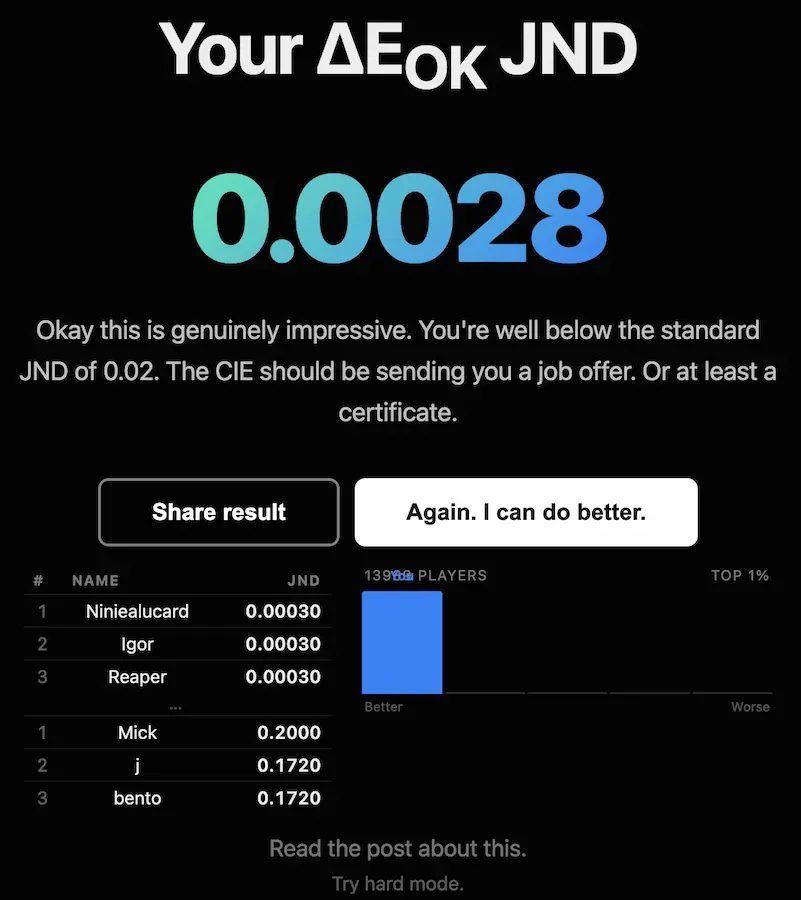
…and What’s my JND (Hard)? by Keith Cirkel

“Nine squares. One is a different colour. Click it. The gap between squares means no gradient to help you − just raw colour perception.”
“Each round the colours get closer together until we find your Just Noticeable Difference. Most people do worse here than the easy mode. That’s normal. The gaps remove the free hints.”
Inspired by this post: Too Much Color by Keith Cirkel
“First we need a way to measure whether two colours are actually different. Luckily the Europeans have been at it yet again. The International Commission on Illumination − CIE − inventors of the LAB colour space − made some fancy formula for figuring this out. Delta-E, shortened dE, or if you like fancy Unicode letters: ΔE.”
“At its core this formula gives you a single number: how far apart two colours look. 0.0 means identical, 100.0 means you’re comparing black and white. The magic number to remember is the “Just Noticeable Difference” (JND). For dE00, JND is around 2.0. Below that, people struggle to tell two colours apart. Below 1.0, basically no one can. So anything under 2.0 is “close enough” and anything under 1.0 is “you’re kidding yourself.””
Fun
I heard a line on a silly SNL video that I couldn’t even finish watching, where James Austin Johnson as Trump said, “A promise is a lie that hasn’t happened yet,” which is a good start but it’s a bit clunky. What about these?
- “A promise is the chrysalis of a lie.”
- Elegant for anyone who knows what a chrysalis is, but clunky because no-one knows what a chrysalis is.
- “A lie emerges from a promise’s cocoon.”
- Less elegant but also requires less explanation. More ESL-friendly.

“I got a dog named Koozie and my neighbor with him. He sends me texts when he is drunk.”
“drunk”“You need help?”“send koozie picture immediately”[Picture]“my king”