
U.S. is on another crusade
Published by marco on
Introducing Stanislav Krapivnik
This is a good analysis by someone I’d never heard before. His take is mostly the same as other analysts, though his point of view is unique, in that he’s a former U.S. Army officer with Russian roots. He moved to Russia from the U.S. over 20 years ago and is fluent in Russian.
Iran War Spreading: Russia Gets Involved by Neutrality Studies | Pascal Lottaz | Stanislav Krapivnik (YouTube)
Stas pointed out that,
- The U.S. has started a holy war by killing Ayatollah Ali Khamenei. It’s akin to killing the Pope. And they’re celebrating it, practically parading his head around on a stick.
- The Strait of Hormuz is closed, so prices will begin to rise, especially in Europe, as they “go to bingo fuel.”
- There are unconfirmed reports that the U.S.S. Liberty has been hit.
- They’re killing children on purpose. It’s not collateral damage. This is not only how Israel rolls but how the U.S. has always rolled, all the way back to WWII. They raped and pillaged, then projected their behavior onto the Red Army, which had the death penalty for rape or marauding. The U.S. firebombed so many cities in Germany, even in the north of France. They have always killed with impunity and overwhelming force.
- Russia is providing material support to Iran in the form of diesel and refined fuel, as well as drones, jets, and almost certainly pilots.
- The negotiations are a bad joke and no-one with a brain in their heads believes a word that the U.S. or Israel has to say. They are duplicitous to a fault.
“The Americans have unleashed something they can’t control. Hezbollah is all in, because if Iran goes down, Hezbollah is done. Hezbollah is all in. Hamas will probably go in. This is just going to continue expanding and Americans are not ready. No matter what [members of the Trump administration] say, Americans have died. There’re American casualties. And there’s going to be a lot more of them.
“So the only message I have to people in the West, you’re being marched off a cliff. Time’s up. Either go do something, hit the streets, put pressure on your governments, or you look at your children and know that they don’t have a future. I mean, this is it.”
McGovern and Krapivnik
Ray McGovern is a founding member of Veterans for Peace and also a former CIA officer who’d worked and advised at the highest echelons of the U.S. government, having served under seven U.S. presidents. Professor Marandi is a professor at a Tehran university.
Attacks on US Bases: Air Defense Didn’t Work? − McGovern and Krapivnik by Stanislav Krapivnik (YouTube)
This is an excellent discussion of mostly Iranian and U.S. logistics, about the ability of the U.S. to resupply itself, on how Iran’s production is state-driven and powerful, like Russia’s, whereas private industry in the U.S. cannot deliver. Stas mentioned that Raytheon recently increased production of Patriot missiles by 10%, from 600 to 660 missiles. That’s a maximum of 330 targets total per year.
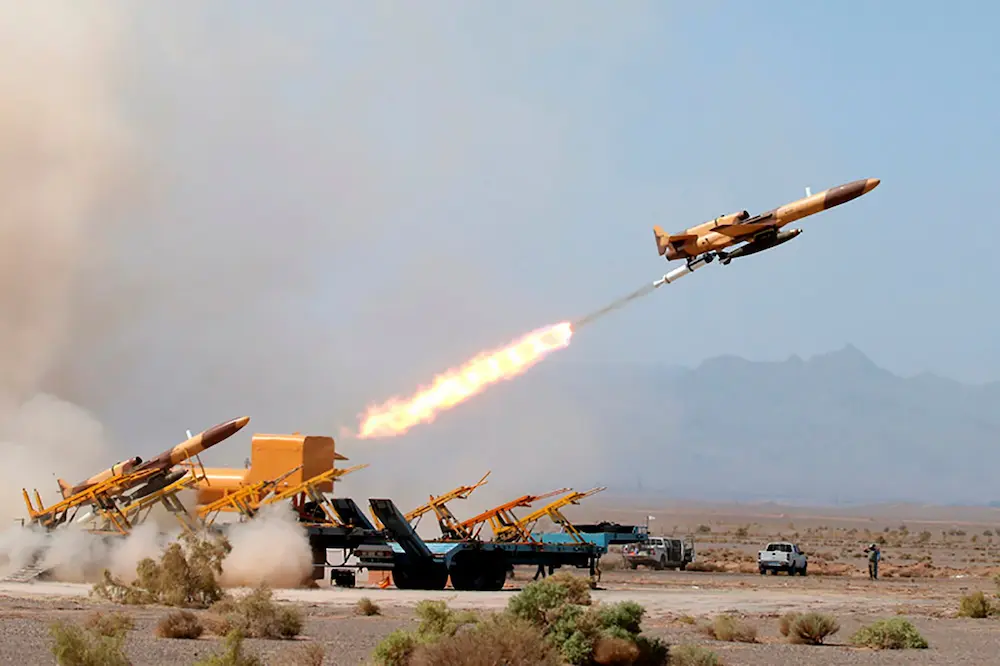 Iranian DronesProfessor Marandi was excellent as always. He noted that Iran hasn’t used any of their newest stuff. Even their 15-20-year-old stuff is hitting its targets, which kind of surprised everyone in Iran, as well as in the call. Radar installations in U.S. bases are being hit by the dumbest, oldest drones without firing a shot. Iran is setting up for the long haul. Israel is a side-show for them. They could flatten it at any time but they don’t want to waste missiles on it (probably because they also know that Israel would attack with a nuke or a dozen).
McGovern says that the U.S. is going to run out of ammunition in a week. Trump and his crew just put it all on red and spun the wheel. If Iran keeps going from strength to strength in defying Israel and the U.S., then they will win this war, if it can be said that anyone wins a war. As Marandi said: Iran is getting hurt but it will not lose. It is so prepared for this that the U.S. has nothing—other than nukes, which he didn’t say, but I’m saying it—that can defeat them. The U.S. and Israel are massively overextended. Like everything else in the U.S., they’re more about the the pre-game show than about the game.
00:00 — US Israeli attack on Iran overview
03:03 — Situation in Tehran and evacuations
05:29 — War inevitability and White House logic
09:46 — Trump motives and US politics
12:54 — Objectives of assassination strikes
15:08 — Iran strikes Gulf US assets
19:50 — Russian Chinese reactions assessment
23:04 — Russia stance and diplomacy future
27:17 — US negotiations distrust history
31:18 — Iran planning long war strategy
34:48 — Impact on Iranian society alliances
39:04 — Long war and Israel risks
43:37 — US logistics and missile limits
47:18 — Iran Gulf strategy escalation
51:20 — Condolences and human cost
53:05 — Russia China view on Trump
56:03 — Possible short US war scenario
Pascal Lottaz citing Iván Ramírez de Arellano
Pascal Lottaz was born and educated in Switzerland but he’s lived in Japan, working for a university there, for over a decade. He cites analysis published largely on Twitter that seems quite insightful and will probably prove to be quite prescient in the coming weeks and months. It has already predicted the last couple of weeks quite well.
Iran’s Massive Strike Doctrine by Professor Pascal Lottaz (YouTube)
This was another excellent report, even though he made us listen to way too much Keir Starmer (he said he included the longer clip because the man should speak for himself but it was still annoying because it’s Starmer).
Pascal cited analysis by Iván Ramírez de Arellano, The Jomini of the West (Twitter) at length.
“The rapid, unprecedented escalation of Operation Epic Fury is already the subject of rigorous analysis by analysts, strategists, and operations researchers. Although still only within the initial 48 hours of the onset of hostilities, the current course of operation reveals stark, alarming divergences between the tactical military success celebrated by the Allied coalition and the campaign’s long-term geopolitical viability.
“The joint US-Israeli campaign and the Iranian response are already illustrating the structural limits of air power, the fragility of global energy markets and the mathematics of modern inter economics exposing critical vulnerabilities in the US Israeli operational design. It is questionable if the United States and Israel are operating within a coherent and achievable theory of victory.
“The stated Allied war aims are maximalist. To permanently remove Iran from the ranks of confrontation states by either toppling the regime entirely or failing that completely disarming its massive ballistic missiles and drone arsenal. However, historical precedents and rigorous operational modeling indicate that enduring regime change cannot be achieved solely through aerial bombardment. By executing a deception strike against Ayatollah Khamenei without the introduction of occupying ground forces or a coordinated internal revolutionary vanguard capable of securing the political vacuum, the Allied coalition has failed to constrain the Iranian state.
“Instead, massive aerial kinetic expenditure merely cripples and fragments the state apparatus. It expands rather than constrains the space of possibilities for regional chaos. The death of the supreme leader rather than inducing immediate societal capitulation for a Venezuelan-style democratic transition has likely unified hardline Iranian nationalist elements and the surviving IRGC cadres under the desperate survivalist doctrine.
“Additionally, Iran’s aggregate arsenal estimated prior to the conflict at over 2,500 medium-range ballistic missiles and 8,000 short range systems and tens of thousands of loitering munitions is simply too vast and too deeply entrenched in subterranean bunkers to be entirely disarmed from the air. Recognizing their inability to win a conventional counterforce duel against US stealth bombers, the regime’s decentralized. Surviving commanders have naturally defaulted to countervailing strikes against soft, highly lucrative targets.
“The US lacks the physical defensive density required to permanently shield the oil monarchies from these dispersed asymmetric attacks. If these monarchies cannot be protected, Iran retains the capacity to wreck financial markets, devastate the global economy, and consequently destroy the political viability of the current US administration for a generation, highlighting that the risk of escalation are multiplying hourly without a viable exit strategy.
“Conversely, Western threat assessment historically fixated on Iran’s ability to mine or blockade the straight of Hormuz. While disruptive, this is a maritime choke point that can eventually be secured and cleared by the United States Navy overwhelming superiority. However, the true existential existential strategic lever available to Tehran is the systemic physical destruction of the onshore oil and gas processing infrastructure of the Gulf.
“Because Saudi Arabia, the United Arab Emirates, Bahrain and Kuwait serve as indispensable logistical co-belligerents hosting the air bases and the naval headquarters from which American power projects, their critical energy nodes are rendered legitimate high priority military targets under the laws of armed conflict.These facilities, specifically the export terminals, sit comfortably within the range of Iranian short-range ballistic missiles, cruise missiles, and inexpensive Shaheed drone swarms.
“If the IRGC facing existential annihilation initiates a scorched earth campaign against these specific nodes, the physical backbone of the global energy system will be severed. The strategic calculus here is to inflict such severe pain on global markets that the international community forces the US to hold its military operations. The financial markets have already begun pricing in this instability. Brent crude closed at $72.87 and on Friday before the strikes and analysts at Barclays and Goldman Sachs project that if the infrastructure targeting scenario materializes Brent crude will rapidly blow past $100 per barrel representing a catastrophic 37% jump.
“Under such immense domestic economic pressure, the United States executive branch might implement draconian export controls to stabilize domestic American fuel prices. This political maneuver would leave the European Union and the United Kingdom completely devoid of both Russian natural gas and Gulf energy supplies, effectively fracturing the Western geopolitical alliance and plunging Europe into an unprecedented energy vacuum.
“Likewise, the US and Israel are currently prosecuting a highly asymmetric war of attrition that Western military-industrial bases are poorly positioned to sustain economically. Operation Epic Fury relies almost exclusively on advanced ballistic missile defense systems to protect critical infrastructure. This necessitates that expenditure of multi-million dollar interceptors such as the terminal high altitude area defense or THAAD and the standard missile 3 to defeat legacy Iranian ballistic missiles and mass-produced drones warms that cost a fraction of the defensive interceptor.
“This inverted cost exchange ratio strongly favors Iran’s saturation strategy. Iranian operational resilience potentially backfilled covertly by material support from Russia or China may likely simply outlast Western interceptor stockpiles. Iran’s vast missile inventory serves effectively as an ablative sponge designed specifically to absorb and exhaust western high tier interceptors. Once these finite interceptor stockpiles fall below critical operational thresholds, Allied bases, aircraft carriers, and the vital Gulf energy infrastructure will be left exposed to undefended cascading saturation strikes, rendering the Allied position militarily untenable.”
Pepe Escobar and Larry Johnson
Pepe Escobar is on fire and full of information, more about the political situation than about the military progress, or lack thereof. Larry Johnson also discussed the politics, but focused a bit more on the military situation, which is that “the U.S. has effectively been driven out of the Middle East and the Persian Gulf.”
Pepe Escobar & Larry C. Johnson: US-Israel HIT Tehran, Iran DESTROYS Tel Aviv, Hezbollah NOW Joins by Dialogue Works | Nima R. Alkhorshid (YouTube)
Larry had very choice words for Pete Hegseth. The story that four U.S. F15s were shot down by the Kuwaitis in a friendly-fire incident is completely non-credible. The Kuwaitis haven’t been able to shoot down Iranian drones (which are much slower) but they can target and shoot down fighter jets that their targeting systems are programmed not to shoot down?
He pointed out that, with oil prices set to shoot up, Russia is going to benefit economically as well.
Iran has refused all calls for peace or a ceasefire from the U.S. The wheels are in motion and they are going to let the chips fall where they may. They see that they have the wind behind them.
Neither the U.S. nor Israel has dared to fly over Iran because their air defenses are intact—because, as Nima pointed out, they’re shooting up police stations and schools rather than tactical infrastructure.
The U.S. aircraft carriers have pulled back to Cyprus, which is over 1000 miles away, which means two refueling ops for any jets making sorties to Iran. Iran can and has hit Cyprus, though.
The video is almost 2 hours long but I found it extremely informative.