
Links and Notes for April 10th, 2026
Below are links to articles, highlighted passages[1], and occasional annotations[2] for the week ending on the date in the title, enriching the raw data from Instapaper Likes and Twitter. They are intentionally succinct, else they’d be articles and probably end up in the gigantic backlog of unpublished drafts. YMMV.
[1] Emphases are added, unless otherwise noted.↩
[2] Annotations are only lightly edited and are largely contemporaneous.↩
Table of Contents
- Public Policy & Politics
- Journalism & Media
- Economy & Finance
- Science & Nature
- Environment & Climate Change
- Medicine & Disease
- Art, Literature, Music, & Cinema
- Philosophy, Sociology, & Culture
- Technology & Engineering
- LLMs & AI
- Programming
- Design
Public Policy & Politics
USA setzen Schweiz unter Druck – Patriot-Streit offenbart strukturelle Abhängigkeit by Daniel Funk (Bewegung für Neutralität)
“Die USA griffen auf einen gemeinsamen Finanzierungstopf zurück, in den die Schweiz auch Mittel für andere Rüstungsprojekte einzahlt – darunter die Beschaffung der F-35-Kampfjets sowie Ersatzteile für bestehende Systeme. Gelder wurden umgeschichtet und an den Hersteller weitergeleitet. Der Schweizer Zahlungsstopp wurde damit faktisch neutralisiert.”
“Angesichts der massiven Verzögerungen – eine Einsatzbereitschaft der Patriot-Systeme wird frühestens Mitte der 2030er-Jahre erwartet – richtet sich der Blick verstärkt nach Europa. Ein zweites Luftabwehrsystem wird evaluiert, entsprechende Anfragen wurden verschickt.”
Just stop wasting my money. Stop looking for stupid shit. Buy drones from Iran. They seem to know what they’re doing.
“Ob bei der Wahl des Kampfflugzeugs oder bei der Flugabwehr – wiederholt wurden amerikanische Systeme europäischen Alternativen vorgezogen. Damit einher geht nicht nur eine technische, sondern auch eine politische und logistische Abhängigkeit. Wer auf komplexe, hochintegrierte Systeme aus dem Ausland setzt, begibt sich zwangsläufig in deren Einflussbereich.”
“Der Patriot-Streit ist damit mehr als ein Einzelfall. Er ist ein Warnsignal. Und möglicherweise eine der letzten Gelegenheiten, die sicherheitspolitische Ausrichtung der Schweiz grundlegend zu überdenken.”
Good news from Hungary by John Q (Crooked Timber)
This is a terrible article, written by someone whose politics are pretty terrible but they’re a reminder of how colonialists think.
“Some credit for this must go to JD Vance. The spectacle of a US vice-president appearing in Europe to complain about foreign influence must have been too absurd for voters to accept. Putin’s unsubtle interference allowed Peter Magyar to remind Hungarians of Russia’s previous crimes against Hungary.”
He is delighted that the U.S. showed up to interfere in an election to prevent Russia’s election interference, all seemingly without a sense of irony.
What else does this genius think?
“Within Europe, the effect will be to isolate Putin’s last supporter in the EU, Slovakian PM Fico. It should now be possible to get rid of the veto power exercised so balefully by Orban, with Fico’s support, and to constrain financial aid to Fico’s government. That will enable an acceleration of Ukraine’s admission along with Moldova, while Serbia (still aligned with Russia) can return to the back of the queue.”
Oh, neat. He thinks that Slovakia shouldn’t get to express its opinion because he has Ukraine brain. Also, Serbia should be punished because it hasn’t renounced Russia. I can’t wait to see how this guy justifies Europe’s turn back toward Russia to beg for resources in the coming months.
“[…] the result should accelerate Britain’s return to the EU. Brexit and Orbanism were parallel projects, and both have failed miserably in delivering the prosperity they promised. Moreover the result has confirmed the toxicity of Trumpism, even in one of Europe’s most conservative countries. Starmer has taken the first steps, finally admitting that Brexit was a disaster. Hopefully he will be gone soon, and his successor will be free to start the serious work of returning at least to the single market and something close to free movement.”
Oh, wow. He is deranged. Like, completely. Britain is never returning to the EU because the EU is unlikely to be a going concern within a half-decade, in the shape that it is now. The EU has so many other problems right now that re-onboarding Britain and onboarding Ukraine seem like utterly impossible tasks. They can’t even denounce a genocide or a war of aggression. But the author doesn’t seem to mind either one of those things.
What Viktor Orban’s crushing defeat in Hungary really means by Molly O'Neal (Responsible Statecraft)
“Magyar promised better relations with the EU, and it is likely that the EU will quickly unblock some, if not all, of the several billion euros withheld from Hungary because of failure to comply with EU standards on human rights, press freedoms and democratic governance.”
Isn’t it neat how people who likely write about Russia’s purported manipulation of the election don’t think that blackmailing a country for billions of dollars isn’t election-manipulation? Like, they said that the billions will be freed up because they got rid of the prime minister that Europe hated, not that they have actually improved their human rights or press freedoms, which is a strong sign that it was never about either of those principles, which should surprise absolutely no-one.
The guy who won is as bad as, if not worse, than Orban on immigration. He’s just as anti-LGBTQ as Orban. The reason some of the worst people are celebrating is that he’s more pro-EU, anti-Russia, and pro-Israel, which is all that they care about. They couldn’t care less what happens to Hungary. They just care about its vote in the European Parliament or Council … or whatever the fuck they’re doing over there with their myriad layers of technocratic rule posing as democracy.
“However, Magyar did not promise to reverse Orbán’s opposition to arming or funding Ukraine. He did agree to gradually reduce Hungary’s reliance on Russian oil delivered by the Druzhba pipeline and Russian gas delivered by pipeline through Turkey. While Magyar can be expected quickly to reverse Orbán’s opposition to the disbursement of the €90 billion EU loan to Ukraine, it is not clear whether Magyar will acquiesce in the permanent elimination of Hungary’s oil supply through the Druzhba pipeline.”
You can sense the palpable sense of relief that Ukraine will get its €90B, which seems to be the only policy that anyone in Europe cares about anymore. The only other issue of note is for Hungary to waste its time changing its oil source away from Russia, just like the rest of Europe, which has worked out super-great for everyone. These people are so empire-brained that I don’t even know how they function.
Despise Israel AND The Entire Western Empire by Caitlin Johnstone (Substack)
“Hating Israel without hating the western empire is nonsensical, because Israel would not exist without western weapons, military support, narrative control, and diplomatic cover. It’s like hating Bonnie without hating Clyde. Like hating Butch Cassidy but not the Sundance Kid. There are laws against being an accomplice to murder because we all understand that if you aid and abet a murderer then you necessarily share moral culpability for the killing.”
As the Worms Turn by James Howard Kunstler (Clusterfuck Nation)
“The Russians have a phrase for it: negotiation-incapable (ne peregovorosposobny). That is what the Iran delegation demonstrated during a long day of talks with the US team over the weekend in Islamabad. What part of “no nukes” didn’t they understand? All of it, apparently. The corollary question on the table — arguably more pressing for Iran — was: how much more punishment are you willing to suffer to sustain your dream of atomic bombs? You have no defenses left, no control of your air-space. Do you just want to sit in the dark for the next hundred years?”
This is the question that plagues Mr. Kunstler. Not: what gives the U.S. the right (other than might) to dictate what Iran can and can’t do? Or, what gives the U.S. the right to attack a sovereign nation? Or: are the things that I believe about Iran really true?
Of course the world remains a mystery to him. He simply cannot fathom that Iran would walk away from total capitulation because he has allowed himself to be convinced—by the biggest pack of liars that the world has ever seen—that Iran has been unequivocally defeated. They are without missiles, military, electricity, … everything. And yet. And yet, they keep the Strait of Hormuz closed. How? Do not let the potential answers to that question bother your poor, withered brain, James. It is obviously because they are inscrutable aliens, benighted foreigners who are so deluded about their worldview that they would rather commit suicide than learn anything new.
That should be ringing a bell for you, Mr.. Kunstler, but I imagine that it will not. I imagine that it will not cause a single ripple in the undisturbed pond of your worldview.
When so much of the world is surprising, you should really think about checking your premises. I, for one, was in no way surprised that the ceasefire never existed and that the negotiations went nowhere. Iran will give the U.S. more opportunities to dig its own grave, to continue making the mistakes that have gotten it to where it is now.
I Hope The US Loses And The Empire Collapses, And Other Notes by Caitlin Johnstone (Substack)
“I hope the empire falls. I hope the apartheid state of Israel is dismantled. I hope humanity is able to pry the steering wheel from the fingers of the ghouls who currently rule our world, so that we can create a healthy planet and a harmonious future together.”
“YouTube has banned the channel that’s been creating viral AI Lego music videos criticizing the US war on Iran.”
What a fuckin’ surprise. That’s too bad. They were great fun.
“The US and Israel have so normalized the assassination of national leaders that the mainstream press now discuss it as a standard military tactic. The other day The Washington Post ran an article by Marc Thiessen arguing that the US should “carry out a final barrage of leadership strikes, eliminating the Iranian officials who had been spared for the purpose of negotiations.”
““Iran’s leaders must be made to understand that their lives literally depend on reaching a negotiated settlement to Trump’s liking. If they refuse to do so, they will be killed,” Thiessen writes.
“At some point one of America’s enemies is going to assassinate a US official and my replies are going to be full of shrieking, outraged Americans acting like I’m the bad guy when I say Washington had it coming.”
Hungary’s Fake “Democratic” Revolution — From Orbán’s Mafia to Péter Magyar’s Neoliberal Circus by Michael Leonardi (CounterPunch)
“This is not a victory for the left, for working people, or for any genuine progressive force. It was a squalid palace coup within Hungary’s corrupt political elite — a transfer of power from one faction of the ruling class to another, dressed up as a heroic popular uprising. The Hungarian people did not win. They simply exchanged one set of oligarchs for another.
“Péter Magyar is no savior. He is a former insider of Orbán’s own circle, a playboy from one of Hungary’s most powerful families, whose rapid rise reads like a trashy soap opera: sordid affairs, a bitter divorce from his wife (who happened to be Orbán’s Justice Minister at the time), blackmail, extortion, and backroom deals. He didn’t defeat the system — he was vomited up by it. His campaign was fueled by sex scandals, personal vendettas, and the kind of polished PR that liberal media loves. Now, many are pretending this represents a meaningful shift.”
“Magyar appears ready to smooth Hungary’s re-entry into the mainstream neoliberal consensus — more arms spending, more sanctions on Russia, with continued subservience to Washington and a more cooperative approach towards Brussels.”
“Magyar has already signaled even harder lines on immigration and is deeply embedded in the same transnational networks of casino capitalism, weapons manufacturers, and Zionist-aligned oligarchs that are driving Europe’s rot from within.
“This is the classic trap: liberals celebrate any defeat of a right-wing populist as a win for “democracy,” even when the replacement is just another servant of the same empire. They cheered when a CIA-backed stooge in Venezuela, Machado, was handed a Nobel Peace Prize while working on regime change. They cheer now as Magyar takes the reins in Budapest. In both cases, the underlying power structures — Western capital, NATO militarism, and the refusal to confront the real enemies of humanity — remain untouched.
“The Hungarian election exposes the bankruptcy of the so-called “democratic” opposition. Magyar’s victory offers no real alternative to Orbán’s authoritarian model. It simply promises a more polished, EU-friendly version of the same neoliberal policies […]”
Pentagon drafts plans for military assault on Cuba by Andrea Lobo (WSWS)
“The humanitarian situation inside Cuba is catastrophic. Decades of the genocidal US economic blockade—intensified through an oil embargo since January—have resulted in daily blackouts lasting for hours, alongside severe shortages of drinking water, food, and medical supplies. The economy has effectively ground to a halt, with workers frequently unable to report to their jobs due to lack of transportation, electricity, or basic necessities.
“Internationally, tensions are mounting. Russian Foreign Minister Sergei Lavrov stated during a visit to China that Moscow would continue providing assistance to Cuba and expressed hope that the United States would not return to the era of “colonial wars.” A Russian tanker, the Universal, is currently sailing in the North Atlantic and is expected to reach Cuba within approximately 15 days. Analysts have identified it as the likely next fuel shipment to the island.”
The Settler’s Grin: How One Italian Magazine Cover Exposed the Monstrosity of Greater Israel by Michael Leonardi (CounterPunch)
“This single photograph has become a symbol of the Zionist Greater Israel project in its most unfiltered form. It is not an aberration. It is the logic of expansion made visible: armed civilians, backed by the state and its military, systematically terrorizing indigenous Palestinians to steal their land, destroy their livelihoods, and drive them out. Olive trees — ancient symbols of Palestinian rootedness and resilience — are regularly uprooted, burned, or blocked by settlers. The harvest, once a time of community and sustenance, has become a season of fear, confrontation, and ethnic cleansing in slow motion, especially in areas like Masafer Yatta and the South Hebron Hills.”
 L'espresso l'abuso
Roaming Charges: Mad Mouth, Bad Man; Mad Man, Bad Mouth by Jeffrey St. Clair (CounterPunch)
“The Buffalo Medical Examiner ruled that the death of Nurul Amin Shah Alama was a homicide. Shah Alama, a legally blind and elderly Burmese refugee, was dumped by Border Patrol at a closed shop late on a freezing winter night. He died of a burst ulcer caused by severe stress brought on by dehydration and hypothermia. Typically, DHS dismissed the ruling, saying that “Mr. Shah Alam passed almost A WEEK AFTER he was released by Border Patrol…“his death had NOTHING to do with Border Patrol.”
“In fact, the medical examiner couldn’t determine the time of Shah Alama’s death. He was released on the street by CBP on the night of February 19 and reported missing in February. 22. He was found dead two days later, four days after being released. Shah Alama, who spoke little or no English, had fled the genocide in Burma and was granted protective status in the US in 2024, pending a ruling on his asylum claim.
““Shah’s death is deeply disturbing and a dereliction of duty by the U.S. Customs and Border Protection,” said Boston Mayor Sean Ryan. “A vulnerable man — nearly blind and unable to speak English — was left alone on a cold winter night with no known attempt to leave him in a safe, secure location….CBP’s behavior in the incident was unprofessional and inhumane.””
How do you live with yourself? These are the same kind of people that dump dogs at rest stops or on country roads.
These 100 former US lawmakers have become foreign lobbyists by Nick Cleveland-Stout | Ben Freeman (Responsible Statecraft)
“The top destinations include Turkey, Saudi Arabia, Kazakhstan, Libya, Qatar, Russia, and China. Eighty-five percent of the members of Congress who have registered as foreign agents have worked for governments rated “not free” or “partially free” by Freedom House. Of the top ten foreign patrons, only South Korea and Taiwan are rated as free.”
Huh. I feel like there’s a country missing on this list.
Canada? France? Italy?
I feel like there’s some country that’s pretty familiar that is an even bigger destination for ex-Congresspeople. C’mon, … it’s on the tip of my tongue. It’s been in the news a lot for the last few years. Why can’t I remember it? I feel like I just mentioned it above.
Oh, wait.
I got it.
It’s Israel.
The article doesn’t even mention Israel. Do they even have to register as foreign agents to work for the government of Israel? Israeli agents don’t have to register in the U.S., so maybe there’s a reciprocality there? It wouldn’t surprise me to find that Israel would be exempted from regulation, for some odd, but presumably utterly innocuous reason.
Oh, no, wait. There it is, right at the top of the diagram.
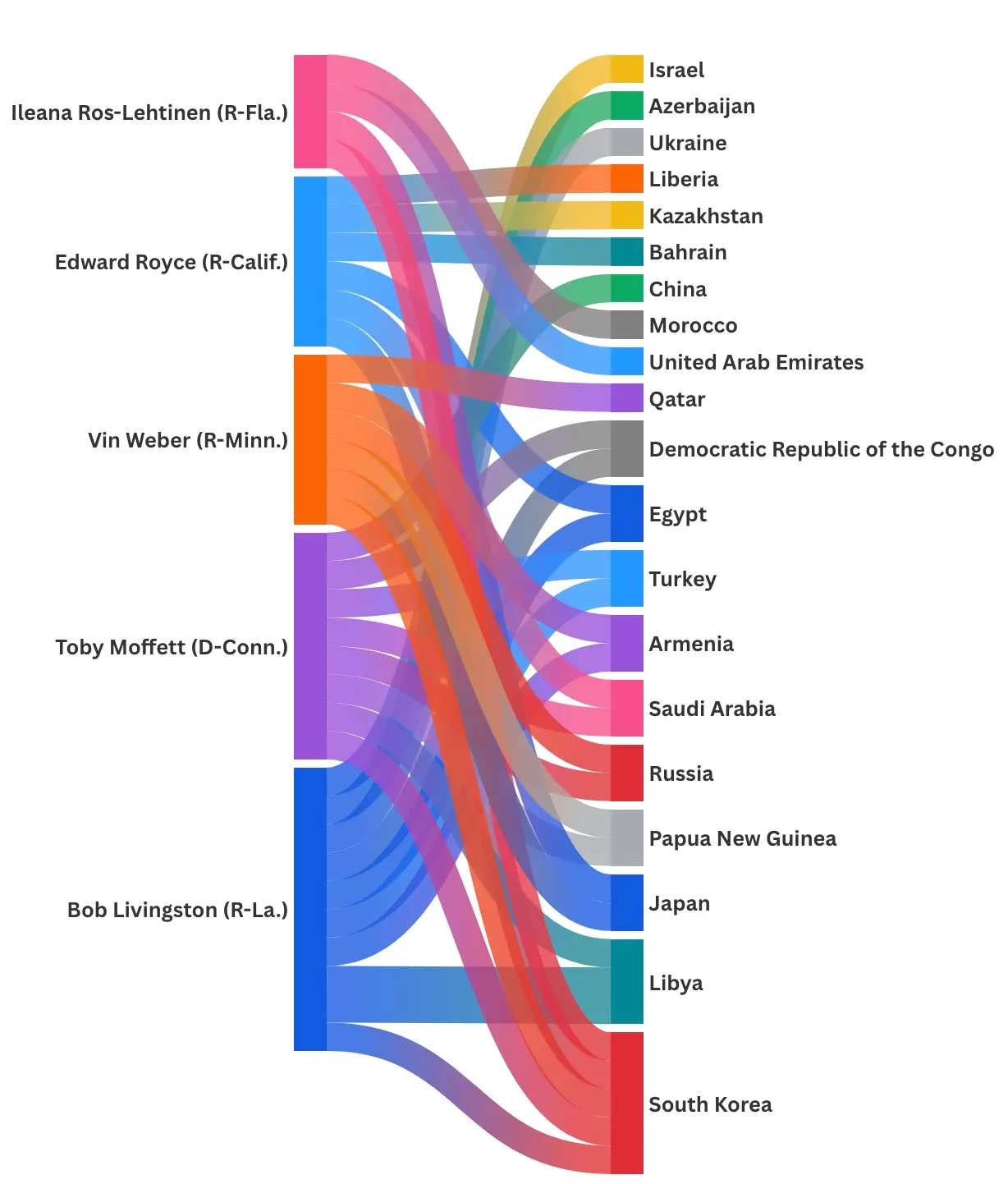
In this diagram, though, Israel’s slot is just as big as China’s, Kazakhstan’s, or Qatar’s. Since they didn’t publish any numbers, it’s hard to tell how close they really are. What’s wild is how many people are working in Libya, which basically doesn’t have a functioning state. I guess maybe that’s why. Where there’s chaos, there’s money to be made.
Perhaps the reason that fewer ex-Congresspeople work for Israel is that Israel isn’t going to bother wasting money on people with no legislative power when they have nearly every actively serving Congressperson on their payroll.
Journalism & Media
My Comedy Show Is Now Canceled — Thanks To Suppression by Lee Camp (Daily Dose of Sanity)
It’s a tragedy that you’re being canceled again, though a completely unsurprising one.
I use the RSS feed for your YouTube channel to watch every one of your shows. I’ve been watching since the first days of Redacted Tonight. I have the book. I’ve been throwing you a couple of beers a month for as long as I can remember. Although, now that I think about it, beers cost more now than when I started. I flew to Berlin to catch your one show in Europe. (it was great. Berlin was great, too. I mean, I did stay a bit to look around. It wasn’t just you; don’t get a big head about it.)
John Oliver will never be canceled because he doesn’t worry anyone. It’s cold comfort that you seem to be annoying all of the worst people.
I’m wondering, though, why a show like Some More News with Cody Johnston isn’t being shadow-banned as much as you. (At least it seems like they’re doing fine; they even have sponsors who don’t seem to have jumped ship.) Some More News covers a lot of the same topics and doesn’t pull its punches, from what I can tell. I can’t recall whether they’ve stayed away from Israel, though, which is probably the third rail that’s blasted you this time. I’m so sorry.
It’s easy to write, but I learned if from you. Keep fighting.
Tucker: 'Trump is a slave' by HasanAbi (YouTube)
Hasan sums it up,
“You’re not agreeing with him, he’s agreeing with you.”
The War We Left Behind (1991) by PBS Frontline (YouTube)
PBS Frontline reports on U.S. war crimes in Iraq in 1991. The crimes are horrific, well-known, and disgustingly familiar. The report is good but the context is fascinating, in that they seem to be reporting as if they’d just discovered that bombing away a population’s electrical grid is collective punishment that destroys the civilization.
They report on war crimes without calling them war crimes.
“Pentagon analysts had assured us that collateral damage would be minimal.”
Of course they did.
“We just don’t have any good way of knowing what the effect on the population is going to be of something that happens to them indirectly.”
The guy lies like he breathes.
“From a pilot’s standpoint, we just hope that there isn’t anybody there. Our mission is to drop them bombs on those specific targets. And, again, it’s unfortunate if somebody happens to be there. And that’s the way we look at it. ”
That’s the pilot talking. He goes on,
“And bomb’s don’t always hit where you aim, particularly the dumb bombs that we were dropping then.”
That’s what the “gravity bombs” being used in Iraq 35 years later are. Dumb bombs dropped by dumb pilots and their dumb bosses.
They’re not dumb. They’re evil. They’re monsters and demons.
Calling them the “great Satan” is accurate.
They Always Tell You Why The Empire Uses Violence, But Never Why Its Enemies Do by Caitlin Johnstone (Substack)
“Why did Russia invade Ukraine? No reason. Putin’s just evil and hates freedom, that’s all. Sure, countless western experts and analysts had been warning for years that NATO aggressions were going to lead to a war on Russia’s border, but they were just rambling lunatics whose forecasts of war were proven correct by pure coincidence.
“Our entire understanding of history is framed in this way. Fidel Castro killed people in Cuba. Why did he kill them? No reason; he was just a mean jerk. All the violence of the socialist revolutionaries around the world overthrowing the abusive governments which preceded them is framed as causeless genocidal carnage inflicted by murderous tyrants who simply loved killing people. The desperation caused by the capitalist exploitation that had been imposed upon those populations is completely redacted from our history books.”
Economy & Finance
All Wars Are Bankers’ Wars: Iran and the Bankers’ Endgame by Ellen Brown (Scheer Post)
“The powers of financial capitalism had another far reaching aim, nothing less than to create a world system of financial control in private hands able to dominate the political system of each country and the economy of the world as a whole.”
—Prof. Caroll Quigley, Georgetown University in 1966 (Tragedy and Hope)
“In 1999, the world was opened to unregulated derivatives trading, so that sovereign bonds, oil flows, shipping routes, and war-risk policies could all be collateralized, rehypothecated (pledged multiple times over), and gambled upon. The lynchpin was the 1997 WTO Financial Services Agreement (the Fifth Protocol to GATS), which became operational in 1999.”
“As for Iran, it is not only the largest and strongest of the Islamic countries but operates the world’s only fully interest-free (riba-free) banking regime. This stands in direct contrast to the conventional Western model, which relies on interest as its primary revenue mechanism. “Money making money out of itself” underpins the global derivatives complex, which is built on rehypothecated, collateralized debt-at-interest.”
“Financial analyst Stephanie Pomboy warns that the $1.5-3 trillion private credit market is in lockdown, forcing fire sales of liquid assets; and the much larger $5 trillion BBB-rated corporate bond market is teetering. Downgrades will force mass selling, and pensions face a $4 trillion shortfall.”
“The WTO Financial Services Agreement became the battering ram for opening global markets to this derivative play. Every member nation was forced to open its banking system or face sanctions. In 1999, the portion of Glass-Steagall separating investment banking from depository banking in the U.S. was repealed, leaving depositors’ money vulnerable to speculative risk. Derivatives then exploded. Sovereign bonds, oil contracts, shipping insurance policies, and war-risk premiums were all sliced into credit-default swaps, hedges, and other derivative products.”
“According to data from the Bank for International Settlements and the Office of the Comptroller of the Currency, the top five U.S. banks alone hold roughly 90% of all U.S. bank derivatives, with JPMorgan, Citigroup, Goldman Sachs, Bank of America, and Morgan Stanley dominating the global over-the-counter market. These institutions capture the lion’s share of derivative profits […]”
“virtually every security today is dematerialized (digitized) and pooled in central depositories. Quiet changes to the Uniform Commercial Code and equivalent E.U. rules have turned ordinary investors into mere “entitlement holders” holding only a legal claim against their brokerages. As for bank depositors, they have for centuries been categorized as mere “creditors” of their banks. Once the money is deposited, legal title passes to the bank. The depositor holds only a contractual claim (a demand liability) that ranks as an unsecured creditor position in the event of insolvency.”
“Leading this band of holdouts was Iran, which since its 1983 Law for Usury-Free Banking Operations has run the world’s only fully interest-free (riba-free) banking regime. Its banks use Sharia-compliant contracts — profit-sharing (musharakah), cost-plus financing (murabaha), and leasing (ijara) — instead of charging or paying interest.”
“Iran’s system was designed to eliminate usury and align finance with real economic activity and risk-sharing rather than speculative debt. It has long been viewed as structurally incompatible with the interest-based, collateral-heavy architecture of City of London and Wall Street finance — an architecture that requires perpetual debt servicing and easily rehypothecated assets to feed the derivatives machine.”
“Today the risk of a crash is even greater than during the GFC. The global OTC derivatives market has officially ballooned to a notional value of $846 trillion, more than seven times the size of the entire world economy. Long-range political solutions are possible. Congress could restore Glass-Steagall and impose a financial transaction tax. State governments could withdraw their approval of relevant portions of the UCC and form public banks that can protect against local bank bankruptcies.”
Science & Nature
The man, the mind, the series, and 314 trillion digits by Dilip D'Souza (3QuarksDaily)
“Aryabhata’s approximation: Add 4 to 100, he said, and multiply the result by 8. Add 62,000. Divide the result by 20000. The answer, he said, approaches the ratio between the circumference and diameter of a circle.”
“[…] if you use 40 digits of π, you can calculate the circumference of the universe – an unimaginably larger distance than to the Moon – accurate to within the diameter of a hydrogen atom.”
“Here’s the first series for π I ever ran into: π/4 = 1 – 1/3 + 1/5 – 1/7 + 1/9 … This series was discovered by the mathematician Madhava in the 14th Century. To me, it is both pleasing and surprising. How does such a simple manipulation of the odd numbers produce π? Yet examine it more closely, or try to use it, and it isn’t so pleasing after all. For it takes many many terms to give us worthwhile approximations to π. For example, for two-decimal accuracy, you’d need over 300 terms; that is, you’d have to go past 1/601.”
“This is known as the Ramanujan-Sato formula. Don’t get discouraged by the symbols, and allow that “k” and “n” from the image at the top are interchangeable. But allow yourself too, to gasp, for its very first term, also in that image is this: 2 × √2 × 1103 / 9801 … which gives us π = 3.1415927 – meaning, accurate to seven decimal places right off the bat. Add the second term and we have accuracy to 14 decimal places.”
NASA astronaut, U.S. Navy Captain, father, former F/A-18 pilot and SpaceX Crew-1 pilot Victor Glover on becoming the first Black man to go to the Moon 🚀 gets hit with a DEI question and flips it into something bigger than race (Reddit)
“I also hope we are pushing in the other direction, that one day we don’t have to talk about these [having done something from the perspective of being a woman or being black] first, that one day this is just, and I—listen to this—that this is the human history. It’s about human history. It’s the story of humanity, not black history, not women’s history, but that it becomes human history.”
Environment & Climate Change
Can a Comedian help the Mule Deer Foundation CEO save the deer? by United by Nature (YouTube)
I liked these people. They’re good and nice people.
What’s sad is that Greg is triggered by people who are activists for the environment but he’ll never, ever be triggered by people who are such avid activists for capitalism and their own wealth that they’re destroying everything else. Chaining yourself to a tree is somehow perceived as more extremist than clear-cutting half of Alaska. He’s been trained not to notice that kind of activity as extremist at all. Ditto for Beth and even ManCarryingThing.
Medicine & Disease
Antibiotic resistance in India has consequences everywhere by Assa Doron (Aeon)
“Consider the daily wage labourer with a family to feed, moving from job to job with no contract, and many others ready to replace him if a shift is missed. A bout of diarrhoea or a respiratory infection can mean losing his job altogether. A visit to a nearby pharmacy, a short course of antibiotics, a day or two of rest, and it’s back to work. For people at the lower rungs of Indian society, there are no medical certificates and no paid leave to protect either their health or their jobs. With lack of regular access to clean water and sanitation, health, like income, is managed day by day. For many, a single missed wage is enough to push basic needs out of reach.”
“Drug-resistant bacteria survive, thrive and spread. These microbes do not remain confined to a single gut. They leave the body through faeces and enter environments where sanitation is uneven and sewage often untreated.”
“Microbes travel through trade and tourism. A study of Swiss travellers returning from India found strikingly high rates of gut colonisation with antibiotic-resistant bacteria, an unwanted bug carried home without symptoms. Resistance does not respect borders. It moves with the infrastructures and ecologies we have built.”
“On the outskirts of Hyderabad, often called the Pharma Capital of India, villagers living near industrial estates described foul-smelling effluents, often released under the cover of night. Shanakar, a former village head with whom we spoke, has spent decades challenging the pharmaceutical companies. At a site near his village, he gestured toward a darkened canal. ‘You see,’ he said, pointing to the water, ‘because of the pollution, the fish have died. Migratory birds have stopped coming.’ Paddy fields now yield half as much as before. A buffalo that once gave eight to 10 litres of milk a day now produces only two. ‘This is what progress looks like for us,’ he said. While Hyderabad may be celebrated as an IT and pharmaceutical hub and hailed as an economic miracle, from the banks of the Musi River, the cost of that success appears disturbingly dire.”
“Drugs once trusted to protect the most vulnerable – newborns with sepsis, surgical patients, people undergoing chemotherapy – no longer perform as they once did. In India, resistant bacterial infections are estimated to contribute to around 60,000 newborn deaths a year, while their effects are increasingly visible well beyond the poor.”
“There is rarely time, money or equipment for proper diagnostics. Treatment becomes empirical, guided by symptoms and probability rather than lab confirmation – a shotgun approach where precision is needed. Broad-spectrum and last-resort drugs are deployed to cover as many possibilities as possible, disrupting entire microbial communities in order to hit the likely culprit.”
“[…] patients frequently expect, and even insist on, a prescription. Leaving without one can be read as neglect; doctor-shopping often follows. In a system where many clinics operate as small businesses and reputation travels by word of mouth, withholding antibiotics carries real professional risk. The clinician stands in a bind: prescribe and risk contributing to resistance, withhold and risk losing the patient’s trust.”
“[…] antibiotic treatment functions less as targeted therapy than as a management tool in a competitive healthcare market. The irony is pointed: the drugs that made modern hospital care possible are losing their power precisely in the institutions built around them.”
Capitalism ruins everything.
“AMR is, in this sense, not a disease the system has failed to prevent. It is one the system keeps producing.”
“[…] the entire scaffolding of modern healthcare depends on antibiotics working. Hip replacements, chemotherapy, caesarean sections, organ transplants – none of these are exotic procedures. They are the everyday traffic of hospitals everywhere. Each carries an infection risk that antibiotics currently make manageable. Without that assurance, much of what contemporary medicine takes for granted would become difficult, or impossible, to safely perform.”
“Superbugs care little for national borders or bodily boundaries. They move through healthcare systems, infrastructures and industries that reward short-term gain while dispersing long-term harm. India is not the source of this crisis, but one of the places where those pressures converge most intensely and at scale. Until those arrangements change, superbugs will remain not an aberration, but a predictable outcome of the world we have made.”
Art, Literature, Music, & Cinema
Eloisa to Abelard by Alexander Pope (The Poetry Foundation)
“Black Melancholy sits, and round her throws
A death-like silence, and a dread repose:
Her gloomy presence saddens all the scene,
Shades ev’ry flow’r, and darkens ev’ry green,
Deepens the murmur of the falling floods,
And breathes a browner horror on the woods.”
“How happy is the blameless vestal’s lot!
The world forgetting, by the world forgot.
Eternal sunshine of the spotless mind!”
“If ever chance two wand’ring lovers brings
To Paraclete’s white walls and silver springs,
O’er the pale marble shall they join their heads,
And drink the falling tears each other sheds;
Then sadly say, with mutual pity mov’d,
“Oh may we never love as these have lov’d!”
From the full choir when loud Hosannas rise,
And swell the pomp of dreadful sacrifice,”
Rhyming by spelling rather than pronunciation.
Or a four-message conversation by Oladejo Abdullah Feranmi (Substack)
“I know of the people around me in their phones and in a fiction that suffers the present. I knew how miserable they had become, but he wasn’t like that; I had to convince myself. The jester must have told the same joke to himself a hundred times to satisfy the king and his audience. Do you think he finds the act funny anymore? Has he killed a part of himself to stay alive, or is he so rich in laughter himself? That night, he returned home with the dimes and washed the paint mask off his face. Can you see the red smile go down the drain?”
Book Review: There Is No Antimemetics Division by Stephen Diehl
“There is a particular flavor of horror that only people who work with formal systems for a living can fully appreciate. It is the horror of data loss, of silent corruption, of the thing that fails without logging an error. It is the backup that was never tested. The monitoring system that monitors everything except its own health. The silent failure that propagates through a distributed system for weeks before anyone notices, and by the time you do notice, the state of the world has drifted so far from what you believed it to be that the gap itself has become invisible. If Kafka wrote incident reports, they would read like this novel.”
“You cannot fight it because you cannot remember it exists. You cannot organize a defense because the knowledge that a defense is needed is the first thing it destroys. The monster hides in the structure of cognition itself. The darkness is a feature.”
“The SCP Foundation is, in essence, what would happen if the IETF wrote horror fiction, and the result is exactly as wonderful as that sounds. It is one of the genuinely great creative experiments of the internet age, and Hughes’s Antimemetics Division entries are widely regarded as the best thing to come out of it.”
“The drugs have brutal side effects. The work has worse ones. You are fighting a war that nobody knows is happening, that nobody will remember you fought, and that erases its own history as it proceeds. Every victory is immediately forgotten. Every sacrifice is invisible. It is, in other words, open source maintainership as cosmic horror. This is heroism that is structurally incapable of being recognized, which is either the noblest possible form of service or the most absurd possible form of futility,”
“Beneath ordinary three-dimensional spacetime lies the noosphere: the space of all human-conceivable ideas, memes, and concepts, a vast ecology that transcends the physical world and can retroactively edit memory, identity, and even the historical record. The noosphere is not a metaphor. It is, within the novel’s logic, the true substrate of reality, and the physical world is a shadow cast by it.”
“The protagonist of the novel is a woman who is voluntarily dismantling her own identity in order to save a world that will never know she existed.”
“Love, the novel argues, leaves traces that even antimemetic erasure cannot fully remove. This is the most emotionally devastating science fiction idea I have encountered in years […]”
“You read the way the Antimemetics Division works: assembling fragments, inferring what is missing from the outline of what remains, never certain your reconstruction is correct. It is the only honest way to tell a story about forgetting.”
“[…] it is the best argument I have seen for why the SCP Foundation is one of the most important literary projects of the twenty-first century. That a novel this good started life as collaborative wiki fiction is itself an antimemetic phenomenon: a masterpiece hiding in plain sight in a format that literary culture is constitutionally incapable of taking seriously. Read it, and then try to remember that you did.”
“The old man lost his horse (but it all turned out for the best) (Chinese: 塞翁失馬,焉知非福; lit. ‘The old man of the frontier lost his horse’, ‘how could he know if this is not fortuitous?’), also known as Bad luck? Good luck? Who knows? or Bad luck brings good luck, and good luck brings bad luck are some of the many titles given to one of the most famous parables from the Huainanzi (淮南子; ‘Master of Huainan’), chapter 18 (人間訓; Rénjiānxùn; ‘In the World of Man’) dating to the 2nd century B.C. The story exemplifies the view of Taoism regarding “fortune” (“good luck”) and “misfortune” (“bad luck”).”
This is a great story. I caught myself about to say that our cultures are so different but they’re actually not. American culture is filled with nuggets of wisdom like this, too. It’s just become so deemphasized that we only ever remember Real Housewives TV shows instead of Steinbeck.
Mannequin Pussy: Tiny Desk Concert by NPR Music (YouTube)
Philosophy, Sociology, & Culture
”It Me” by Marta Figlerowicz (The Yale Review)
“Of Daphne, turned into laurel as she fled Apollo, Ovid says in the first book of the Metamorphoses:”“But even now in this new form Apollo loved her; and placing his hand upon the trunk, he felt the heart still fluttering beneath the bark. He embraced the branches as if human limbs, and pressed his lips upon the wood. But even the wood shrank from his kisses. [Trans. Frank Justus Miller]”“Scarce had she thus prayed when a down-dragging numbness seized her limbs, and her soft sides were begirt with thin bark. Her hair was changed to leaves, her arms to branches. Her feet, but now so swift, grew fast in sluggish roots, and her head was now but a tree’s top. Her gleaming beauty alone remained.”
“The stillness into which the figures fall is the stillness of the dancer freezing into a memorable pose, becoming an inanimate, or less animate, version of the human, and also an abstraction of this particular human’s grief. “Outside my studio door, in my garden, is a tree that has always been a symbol of facing life, and in many ways it is a dancer,” writes Martha Graham in “I Am a Dancer,” comparing herself to it. Ovid seems to be making a similar discovery here, or, rather (perhaps), documenting it.”
“When I post the famous “Hotline Bling” meme on Twitter, I do not see myself as Drake—not exactly—but as his frown, then his smile.”
TIL that this meme is Drake.
“Like a well-executed dance, memes can momentarily trick us into believing that they were made for us, and in our image, alone—“it me.” They satisfy our desire for abstraction as well as for effortless sprezzatura, making us feel protean but also eminently clear. As we identify with them, like a Roman audience entranced by a dancer, we might momentarily forget the difference between ourselves and the signifier of our self-expression.”
“Is the dream of simplicity and directness itself the problem or the means by which we claim to achieve it? Ultimately, the question raised both by pantomime and by memes concerns the ethics and epistemic reliability not of metaphor, as the title Metamorphoses might at first suggest, but of metonymy.”
Struggle Against the Gods by Gao Zhisheng (First Things)
“At present, I can move freely within the bounds of a village in northern China, but I’m still in prison—it’s just that my cell has become larger. In negotiating with the Communist party, I have always been willing to compromise on technicalities, but on principle I have been immovable. As long as my physical shell can support my spirit, I will stand against the forces of evil.”
“I once asked several of the guards, one of whom was responsible for education on religious matters, what exactly an illegal religion was. None of them was able to answer. I asked what legal religious acts they sought to protect, and they said there were no legal religious acts in prison. “Then why ban ‘illegal religion’ and not all religion?” They couldn’t answer.”
“The bureau wanted me to write weekly reports that expressed my remorse, my change in thinking, my willingness to break with the past, and my determination to make amends. These requirements were imposed on all political prisoners and “cultists.””
“Though “ruling the country by law” has long been written into the Constitution, the government prevents citizens from enjoying their constitutional rights. Any mention of “constitutionalism” is criticized in party media as “anti-party” or “defaming China.” Since Xi Jinping’s anti-corruption campaign started, there has been no evidence of a genuine move toward rule of law. Raucous acclaim conceals the fact that corruption cases have been handled gangster-style. In fact, after three years of Xi’s anti-corruption campaign, the following conclusions can be drawn: He has no desire to introduce due process of law; his main goal is to maintain the CCP’s dictatorial status and eliminate rivals; and a sincere anti-corruption campaign would subvert the regime.”
“When the power struggles remain in equilibrium, everyone remains a “leading comrade.” Once the equilibrium breaks, the losing party becomes the corrupt official and the winning one becomes the anti-corruption hero. In fact, these are cases of the heinously corrupt arresting the merely corrupt. If Xi really fought corruption through to the end, he and the rest of his regime would be thrown into prison.”
“Denial of the supernatural is a major reason why so many of my countrymen have become moral degenerates.”
Wait. What? I was with him for the first half:
Most of my countrymen have been deluded into becoming moral degenerates.
Amen, brother. Same.
But then he loses me in the second half:
It’s because they don’t believe in ghosts.
Dammit.
“Encounters with the spirit world were by no means limited to that location. Soldiers and officers told many amusing stories about their “struggle” against gods and ghosts. According to the soldiers, “weird phenomena” began to occur after Jiang Zemin became General Secretary of the CCP. “Demonic sightings” were reported everywhere. From 1990 onwards, the People’s Armed Police units in all provinces were plagued by hauntings.”
Stories like this are the reason people hate AI. It was bad enough spending time trying to figure out whether something was lies or self-serving. It was hard enough figuring out whether to go out of your trust zone, to expand it. AI makes that much harder, orders of magnitude harder.
Is this article translated? A story? News? What the hell do I do with this seemingly bizarre source of information? Is the guy for real? Is he really a dissident? Are the stories he tells of the Chinese system real? Factual? Is he known to be a fabulist? He’s talking about ghosts and demons. Is that a normal thing to do in China? Is it a metaphor? Did something get lost in translation? Or is this whole goddamned thing, along with the attribution to a translator, made up out of whole cloth, either by a human or machine?
In the past, we could have convinced ourselves that no-one would bother wasting so much time making something like this. And, even if they did, it would be so unprofitable that they would soon have to stop. But now? Now you can generate something like this in 30 minutes, for whatever nefarious propaganda purposes you like.
“The paradise of power is the hell of rights. In today’s China, constitutional government, rule of law, freedom, religion, universal values, democratic elections, and judicial independence are labeled as erroneous ideological trends of the West. In fact, justice is justice, and doesn’t distinguish between East and West.”
“Today when I went out to exercise at noon, the earth was weighed down by snow and blown raw by the wind, but plants pushed out new green shoots, indifferent to the remnants of winter. My heart was stirred by this small miracle, which seems beneath notice but is as inspiring as the greatest philosophy. Harshness and desolation are not death, but the harbingers of life to come.”
Real Feelings for Fake Beauty by Freddie deBoer (Substack)
“Sometimes the style is referred to as Late International or The Glass Box Style, but perhaps the term Value-Engineered Modernism is more apt. Whatever you call it, this kind of building is the architectural equivalent of a default font, a soul-crushing assembly line of sterile glass monoliths that erases local identity in favor of the numbing, cookie-cutter uniformity of global bureaucracy. It’s the corporation in building form.”
“Yale was built to look old, specifically styled after the “Oxbridge” fashion of England’s great universities. Its architectural style is, depending on how you look at it, symbolic, or aspirational, or postmodern, or perhaps fraudulent. It’s not like the school hides information about when its buildings were built or whether they’re made in a deliberately retro style. But most people who walk through campus have no idea that its buildings are just as decorative and fundamentally a work of fantasy as those in Disneyland. They just know, and love, how the campus feels.”
“My guess is that, if they knew that Harkness Tower was a 20th-century facsimile of a 15th century style, built by oil money to honor an obscenely wealthy alum none of them had ever heard of, they wouldn’t much care.”
“[…] the statuary is too white, the lawns too well-manicured. The whole thing is hung with a creepy inauthenticity. But then, the older Old Campus buildings are also deeply inauthentic, and yet it doesn’t bother me at all; I “believe” the atmosphere when I walk among them. Their fakery is real enough that I can choose to buy into it. I’m able to accept the illusion, embrace the kayfabe. Which gets to the hoary old world of simulacra theory, to Baudrillard, and to the way the modern world keeps attempting to remake an old world that never existed, and to the relationship between beauty and self-deception.”
“In 50 years, he thought, the buildings that made up Benjamin Franklin and Pauli Murray would be sufficiently old that they would look as old as they were meant to feel and feel as old as they were meant to look, and no one would know the difference. And he was probably right.”
“[…] the pursuit of aesthetic excellence is not a straight path, but it is one that people will always walk all the same, and we ignore the power of subjective aesthetics at our peril. People want their college to look like a college and not like an office park, and I think we should trust and honor that instinct.”
“[…] whether we’re willing to admit what we actually want, which is to be surrounded by things that feel old and storied and earned, even when they aren’t. Yale understood this and built a fantasy, and the fantasy worked so well that a century later they felt compelled to extend it, and even their imperfect extension will probably fool people in another fifty years. The desire isn’t really for Gothic architecture specifically, or for Art Deco, or for any particular style. The desire is for the feeling that a place has been cared for across generations, that it meant something to the people who built it and to the people who came after. Beauty is the signal. Permanence is the message.”
“And here’s where I find myself making a kind of peace with the whole business of beautiful lies. I know that Old Campus is a stage set, that the gargoyles are props, that the medievalism is a borrowed costume from universities that were themselves borrowing from an even older tradition. I know all of that, and I go back anyway, baby on my chest, to walk among the Gothic opulence. My friend was right about the timescales, but I think he was pointing at something bigger than he intended: authenticity is itself a function of time. The new colleges at Benjamin Franklin and Pauli Murray feel fake not because they are fake − Old Campus is equally fake − but because they haven’t yet had the time to make us forget that we’re in on the trick. Beauty, it turns out, requires a kind of willing amnesia. We have to be allowed to forget the scaffolding. And maybe that’s the real argument for building ornately and lavishly right now, today, in our own cities and neighborhoods: not that we’ll love it immediately, but that someday, if we build it with enough sincerity and enough craft, people will walk past it and feel, without quite knowing why, that human beings once cared about beauty enough to live and work inside of it, and might still.”
Even though we barely care about anything right now, so we will have managed to fool the future instead of only ourselves.
The Turner Diaries (Wikipedia)
“The Turner Diaries is a 1978 novel by William Luther Pierce, the founder and chairman of National Alliance, an American white nationalist group, published under the pseudonym Andrew Macdonald. It was serialised in the National Alliance publication Attack! from 1975–1978 before being published in paperback form by the National Alliance in 1978. As of 2001, the book had sold an estimated 300,000 copies, initially only available through mail order from the National Alliance. In 1996, it was republished by Barricade Books with a foreword that disavowed the novel.
“It depicts a violent revolution in the United States, caused by a group called the Organization. The Organization’s actions lead to the overthrow of the federal government, a nuclear war, and ultimately a race war which leads to the systematic extermination of non-whites and Jews worldwide. Whites viewed as “race traitors” are ultimately hanged in a mass execution called the “Day of the Rope”. The novel utilizes a framing device, presenting the story as a historical diary of an average member, Earl Turner, with historical notes from a century after the novel’s events.”
Holy crap.
The Ones Who Don’t Get “The Ones Who Walk Away From Omelas” by Christopher Hall (3QuarksDaily)
Those who don’t get it start arguing for literally walking away without doing anything, whereas those “who walk away” is a metaphor for those who refuse to accept the status quo. It just sounds more poetic and elegant than writing “The One Who Stayed and Fought to End the System of Barbaric Subjugation that is the Linchpin of all Joy and Success in Omelas.” FFS literal-minded people often end up arguing in such bad faith, and the death of metaphor and irony is tragic.
The one who don’t get “the one who walk away from Omelas” are the people of the village of Omelas. This is how they justify their moral superiority. They are colonialists, slavers, and eugenicists. Some pigs are better than others.
Technology & Engineering
The disturbing white paper Red Hat is trying to erase from the internet by Thom Holwerda (OS News)
“I don’t think there’s something inherently wrong with working together with your nation’s military or defense companies, but that all hinges on what, exactly, said military is doing and how those defense companies’ products are being used. The focus should be on national defense, aid during disasters, and responding to the legitimate requests of sovereign, democratic nations to come to their defense (e.g. helping Ukraine fight off the Russian invasion).
“There’s always going to be difficult grey areas, but any military or defense company supporting the genocide in Gaza or supplying weapons to kill women and children in Iran is unequivocally wrong, morally reprehensible, and downright illegal on both an international and national level.”
The Engineering of Duct Tape by engineerguy | Bill Hammack (YouTube)
I accidentally started a green screen revolution… by Corridor Crew (YouTube)
A testament to the power of open-source and free software. This is what benefits to humanity could look like. This guy initially built this tool to make his life making movies easier. He released it as open-source and the community made it 100x better within a month, something he could have never done himself.
- Uses ¼ of the VRAM.
- Has a user-friendly standalone UI.
- Has a one-click installer for all supported platforms (Linux, MacOS, Windows).
- Has support for blue-screen as well as green-screen.
- Has incredibly smooth plugin support for at least one editor (the one he happens to use), with many fine-tuning options.
He’s going to release all of the weights and training data to let the world have a crack at doing better training than he did. This is the way to build things. He could have tried to build his business on it, but that’s not what he does. He makes movies. He will now be able to make movies more easily, focusing on the fun bits, for free—and so will everyone else. Fantastic.
No one can force me to have a secure website!!! by suckerpinch (YouTube)
This is great. He developed his own implementation of HTTPS in order to pretend that his web-site is secure when he has implemented it with the most insecure keys and protocols that he can get away with.
LLMs & AI
AI Coding Assistants by Sasha Levin and Jonathan Corbet (GitHub | linux)
“This document provides guidance for AI tools and developers using AI assistance when contributing to the Linux kernel.
“AI tools helping with Linux kernel development should follow the standard kernel development process
“[…]
“The human submitter is responsible for:”
- Reviewing all AI-generated code
- Ensuring compliance with licensing requirements
- Adding their own Signed-off-by tag to certify the DCO
- Taking full responsibility for the contribution
This is the same conclusion to which Uster came two years ago in defining its software-development process. AI is just another tool. Feel free to use it but you’re still responsible for your contribution. There’s no magic bullet that lets you reap the rewards of value without effort.
AI Cybersecurity After Mythos: The Jagged Frontier by Stanislav Fort (Aisle)
“There is a practical consequence of jaggedness. Because small, cheap, fast models are sufficient for much of the detection work, you don’t need to judiciously deploy one expensive model and hope it looks in the right places. You can deploy cheap models broadly, scanning everything, and compensate for lower per-token intelligence with sheer coverage and lower cost-per-token. A thousand adequate detectives searching everywhere will find more bugs than one brilliant detective who has to guess where to look. The small models already provide sufficient uplift that, wrapped in expert orchestration, they produce results that the ecosystem takes seriously. This changes the economics of the entire defensive pipeline.”
“FreeBSD detection (a straightforward buffer overflow) is commoditized: every model gets it, including a 3.6B-parameter model costing $0.11/M tokens. You don’t need limited access-only Mythos at multiple-times the price of Opus 4.6 to see it. The OpenBSD SACK bug (requiring mathematical reasoning about signed integer overflow) is much harder and separates models sharply, but a 5.1B-active model still gets the full chain. The OWASP false-positive test shows near-inverse scaling, with small open models outperforming frontier ones. Rankings reshuffle completely across tasks: GPT-OSS-120b recovers the full public SACK chain but cannot trace data flow through a Java ArrayList. Qwen3 32B scores a perfect CVSS assessment on FreeBSD and then declares the SACK code “robust to such scenarios.””
“To be clear about what this does and does not show: these experiments do not demonstrate that open models can autonomously discover and weaponize this vulnerability end-to-end. They show that once the relevant function is isolated, much of the core reasoning, from detection through exploitability assessment through creative strategy, is already broadly accessible.”
“This directly addresses the sensitivity vs specificity question some readers raised. Models, partially drive by prompting, might have excellent sensitivity (100% detection across all runs) but poor specificity on this task. That gap is exactly why the scaffold and triage layer are essential, and why I believe the role of the full system is vital. A model that false-positives on patched code would drown maintainers in noise. The system around the model needs to catch these errors.”
“For many defensive workflows, which is what Project Glasswing is ostensibly about, you do not need full exploit construction nearly as often as you need reliable discovery, triage, and patching. Exploitability reasoning still matters for severity assessment and prioritization, but the center of gravity is different.”
Secret agentic AI by Mark Seemann (Ploeh Blog)
“For practical purposes, today’s AI companies are American. It’d be naive to think that it will stay that way. When a technology becomes sufficiently strategically important, other states subsidize national enterprises to catch up. To Silicon Valley ears, this may sound derivative and unfit for competition, but such a strategy can work. Historical evidence exists.”
Bro, how can you be such a smart software designer and so brainwashed on elementary politics and economics? Silicon Valley is probably the most heavily government-subsidized industry ever—it’s just hidden behind other quasi-capitalistic layers. Instead of the money coming directly from the government, it comes from VC investors, all of whom got their money because of a highly investor-friendly capital environment in the U.S., where they never pay taxes, and they have subsidies and kickbacks on every level. There is more red tape involved than in China, but it’s a nearly unending and uninterrupted conveyor belt of money from the U.S. taxpayer to the richest people and industry in the U.S. Let’s stop kidding ourselves that these are anything but corruption, which are subsidies with no upside for those providing the money.
Our world is doomed unless more of the ostensibly “smart” people in the world shake off their societal programming and stop writing stupid things like this that make it look like Silicon Valley is some sort of magical paradise untouched by subsidy or corruption. This is just ludicrous. Who is he afraid of offending? Or is he that deluded?
It’s the same at the beginning of his article: he spent four paragraphs explaining how a pay-as-you-go model might be something that will eventually appear for the money pit that is the cloud-based LLM business. I mean, DUH. But he had to spend some time pretending that what is happening right now is in any way a viable approach to delivering a service.
He digs deep to find an example of a subsidized business and comes up with Airbus because of course he does. When we talk about subsidized businesses in the empire, we talk about the ones that the naughty leftist Europeans have subsidized, not the fucking engineering and safety boondoggle that is Boeing, a money pit many miles wider than that of Airbus.
“You can find examples in another capital-intensive industry, aviation. Airbus probably wouldn’t exist without European governments taking an active interest. And I find it fair to argue that Airbus is currently doing better than their main competitor in civil aviation.”
You could also mention, oh, I dunno, NASA? Or DARPA? Or the whole thing that led to Lucent? C’mon. This is all government-subsidized. This is great! Except, of course, that the profits were quickly privatized and that most of the foreseeable purposes were military. Don’t get me wrong: I’m all for government subsidies, where the benefits—both real-world and fiscal—redound to the investors (the people of the country).
“You may counter that you’d never use a Chinese, Russian, or pick-your-own-enemy LLM system. But some people and organizations are more price-sensitive than security-conscious. Besides, a dismissal of this scenario assumes that ownership is transparent.”
And the hits keep coming: Mark Seemann says that Russian and Chinese LLMs cannot be trusted but that this problem does not exist with U.S.-based LLMs.
“You may consider only using systems of known origin. You may decide to stick to OpenAI, Anthropic, or other American companies. Perhaps, but I think that you should consider at least two things. The first is that, as already covered, these companies run huge deficits. Where do the money come from? Investors, you say? Indeed, but which investors? Is it conceivable that some of the investors are already, through chains of shell companies, controlled by foreign governments? And if not now, then in the future?”
This is mind-boggling. His concern is not for the nefarious intentions of investors, but for the possible presence of nefarious investors coming from bad countries. How can you possibly have so much empire-brain?
To teach in the time of ChatGPT is to know pain by Scott K. Johnson (Ars Technica)
“Most examples of this “effective use” involve students generating an essay with AI and then critiquing it. (As if the Internet wasn’t bursting at the seams with human writing that one could critique!) Every time I’ve asked an instructor what their learning objective was for this assignment, the answer has been to help students see why they shouldn’t trust an LLM to write for them. Stop me when you notice the contradiction between that and the administrators’ wishes.”
“The reason this feels so different to teachers than the tech panics of the past is that there is no clear solution to how AI is undermining nearly every aspect of education. It’s a strange game trying to get students to do things you think will help their education while they point LLMs at you, and it too often feels like the only winning move is not to play.”
“It doesn’t seem like anyone wants to listen to instructors explain how bad it feels to try to do our job in the presence of this annihilative education antimatter. Instead, we’re offered AI grading tools to score AI-generated submissions for AI-generated assignments.”
“LLMs are a shortcut. Students often take shortcuts they later regret. We’ve all been there.”
“As an instructor, I want to build a clear path up the mountain for my students and see them reach the top. Instead, I increasingly feel like I’m just playing impossible defense to keep them from moving every direction but up. It’s exhausting, and I will mostly lose, which means I’m not even helping them.”
“A few months ago, I overheard some college students talking about their classes. One was complaining about an assignment they needed to do that night, and another incredulously asked why they wouldn’t just have ChatGPT do it. The first replied, “This is my major, I actually need to learn stuff in this class. I use AI for my other classes.”
“I haven’t encountered any students who think they’re learning when they let LLMs do their work, despite the face that college administrators and LLM advertising try to put on this. It’s just workload management to them.”
And remember, these are students who don’t really have a workload to speak of. They’re just playing more Call of Duty with the time that they save by having LLM tools do their work.
AI Chatbots and Trust by Bruce Schneier
“When thinking about the characteristics of generative AI, both benefits and harms, it’s critical to separate the inherent properties of the technology from the design decisions of the corporations building and commercializing the technology. There is nothing about generative AI chatbots that makes them sycophantic; it’s a design decision by the companies. Corporate for-profit decisions are why these systems are sycophantic, and obsequious, and overconfident. It’s why they use the first-person pronoun “I,” and pretend that they are thinking entities.
“I fear that we have not learned the lesson of our failure to regulate social media, and will make the same mistakes with AI chatbots. And the results will be much more harmful to society:”
He gets the point right but then weakens the conclusion because he’s afraid to look the Gorgon in the eye. We didn’t fail to learn a lesson to regulate social media. We failed to have a society that serves anything but corporations. The problem is much bigger than some sort of failure on the part of a regulatory apparatus. It’s that we not only live in a society without any regulatory apparatus worth noting, we live in a miasma of propaganda that teaches us every day that even looking sideways at a regulatory apparatus amounts to treason.
His weak-ass conclusion makes it sound like we just have some legislative housekeeping to do when we don’t even have the beginnings of the tools we need to fight the overwhelming arsenal arrayed against us.
This is Why AI Could Replace Programmers by Nick Chapsas (YouTube)
This is a pretty sane and balanced take on LLM-supported coding.
A good rule of thumb when you read press releases (which most “reporting” summarizes) is to ask yourself how close the statement is to “this thing that I want you to buy from me has been scientifically proven to be the only thing that you will ever need for anything again.”
The AI revolution in software development by Charlotte Relyea and Martin Harrysson (McKinsey)
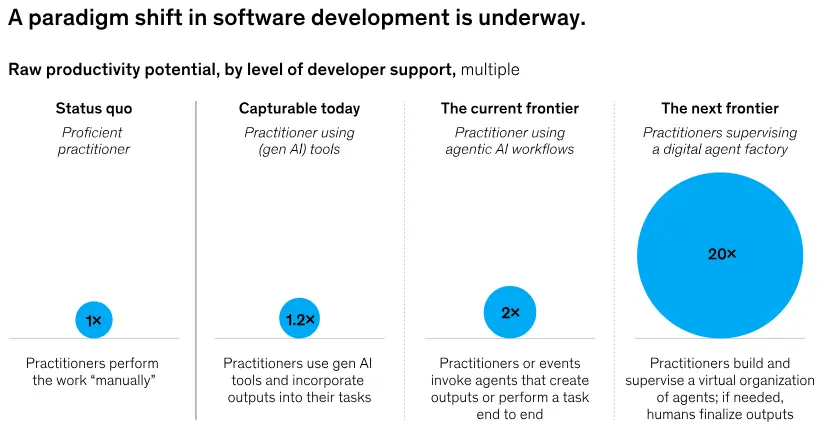
It’s interesting that the “Capturable today” column was the “100x” column just a year or two ago.
Now, it’s the “1.2x” column and the “agentic AI workflow” is the “current frontier” where a 2x productivity improvement is supposedly possible. I suspect they’re only getting more modest because the new 20x is, of course, the next thing they’re selling. That is, if you’re already using the current frontier, then you’re still doing it wrong. Even though you’ve already changed your software-development process twice in 2-3 years, you’re still behind.
Man, it’s hard to imagine we’ll be able to do it alone. I wonder who could help us? OMG I bet it’s McKinsey! We should engage their services so that we don’t miss the boat again.
“The role of humans is to declare high-level intent and boundaries, evaluate outputs, and react to agentic decisions and suggestions. This change is leading to smaller teams, much lower unit costs for software development, and much faster idea-to-impact cycle times.”
Yes, the goal is to remove the cost and leverage that software-development has gained over the years. Engineers cost a lot of money, and we’d like to have as few of them as possible. The problem is that “declaring high-level intent”, “evaluating outputs”, and “reacting to decisions” (i.e., “reviewing”) are the hard part that takes a lot of time. Programming “intent” doesn’t take that much time. It’s actually quite efficient already.
My gut feeling is that,
- Level 1 (no AI)
- Very few developers are on level 1. Even at that level, we drastically underestimate the power of declarative non-AI tools that don’t make mistakes. That is, developers could be made much more efficient (2-3x) if they’d make more use of non-AI tools that are available to them, and use practices that accelerate programming and reduce the developer-feedback loop. No-one likes to talk about this because there’s nothing to sell here. The tools are commoditized, well-known, and non-mysterious, and it involves people learning things and changing how they work. That’s a non-starter, so how about we sell AI as the revolution that will solve all of the problems we’ve never solved before? It won’t work this time any more than it worked the last few times—because there ain’t no such thing as a free lunch—but at least some of the best people in the world can make a lot of money.
- Level 2 (assistance)
- Many developers are on level 2 . This is great but, as noted above, these developers would benefit just as much from learning how to use non-AI tools that they’ve had for years. They still need to know best practices (proper design and automated testing).
- Level 3 (plans & workflow)
- Probably more than we think are on level 3. Here, the pitch is that we don’t have to know how to design because the AI does the design. We also can generate tests with AI, or we leave it up to the AI to decide how much to test. At this level, the review burden is massive, and much more likely to be ignored (technical debt and risk).
- Level 4
- Level 4 is extremely cutting-edge, very frothy, and largely not applicable for most companies or departments. The industry wants everyone to feel that they’re missing out if they’re not helping trillionaire companies alpha-test their software. I would advise extreme caution here. The tools change every month, if not week. That’s not a place I’d recommend for most companies. You can experiment with prototypes and throwaway scripts, data-mining projects, or other more ephemeral software where maintenance isn’t an issue.
“We found that a small group of top performers—roughly the top quintile—are achieving 16–30 percent improvements in productivity, time to market, and customer experience, along with 31–45 percent gains in software quality.”
I call bullshit or cherry-picking or both here. Software is not gaining in quality. McKinsey’s very biased study (their interest is going to bias any study they do) is belied by dozens, if not hundreds of other meta-studies (e.g., from Microsoft), which should that quality has deeply degraded over the last few years. There’s a lot more code, with a lot more bugs.
This is an excerpt from a book. It is a tragedy that this is a book. It is a tragedy for humanity that McKinsey has so much influence over those who influence how society runs. But, of course, they just tell those people what they want to hear: you can finally get rid of all of those non-management people who were always so hard to manage, impossible to understand, and who were paid far too much money that could have been better returned to shareholders. The AI wave is highly attractive in that it’s a cudgel you can use to cow an expensive, and historically intransigent, inscrutable, but indispensable workforce into submitting to the lash.
“By morning, the factory has produced a set of ready-for-review pull requests, each containing code, tests, logs, analysis results, and a natural-language rationale.”
Ah, the dream. This is not the reality, though. Nor can it realistically be. What will happen is that whatever the agents build becomes your product. If it doesn’t work, no-one has time to fix it. You’ll either muddle through, with a technical-debt burden increasing far, far faster than it ever did before, or you’ll run into a wall that the AIs cannot get around. This happens all the time but, somehow and mysteriously, is never mentioned iņ books like this. Also, AIs still make a lot of mistakes.
For those two reasons, letting them “run all night” is a pipe dream sold by companies that are deep in the red and are desperately seeking a silver bullet fueled by your company’s money. They will either spin their wheels all night, burning millions of tokens that your company pays for, which is preferable to burning those same tokens producing tons of output in the wrong direction. All of that needs to be reviewed and adjusted.
Have we not learned that it’s better to work in bite-sized chunks? Now that the worker is “free” (hahahahah, it costs so much in tokens and will cost much more in the future), we believe the myth that you can “one-shot” your software in an all-night binge?
“In this model, software development becomes a continuous, high-speed loop rather than a two-week sprint cycle.”
Awesome. Note how there is no longer a need for a retro. The retro is the most-ignored and most-valuable part of the agile process. These glorious middle managers have finally managed to elide it with technology. As soon as you replace your messy meat-bags with digital agents, you also no longer need to waste any time on reflection.
“If you ask us, this is absolutely incredible.”
I agree. It is literally incredible. As in “not believable.”
You know why? Because it all relies on this extremely difficult and time-consuming piece that is only mentioned in a “by the way”-style bullet point near the end.
“Strengthen human judgment and review skills. Humans become the editors-in-chief of the factory. They must review proposed updates, catch architectural drift, assess whether the agent’s work matches intent, and decide when to tighten guardrails or adjust tests. This combination of product judgment, architectural understanding, and quality review remains fully human.”
The tool that relies on a strengthened human judgment and review skill is also constantly undermining those capabilities. This will not end well. It will barely get started.
Another bullet point? “Monitor token consumption closely.” Ok. Will do. And then what? What if your token costs spiral exponentially, but your productivity doesn’t? McKinsey won’t care. They already got paid. The AI companies won’t care. You know who’ll get blamed: you. You’re the problem because you’re not using the tools correctly. You’re prompting it wrong. It’s your fault if you fail to generate productivity and 10x value from the tools. There are no guarantees and no SLAs. These tools cost more than anything else we use and they have far fewer guarantees.
If a deterministic software-tool fails—e.g., JetBrains bungles a solution-wide refactoring—then I can file a bug report. If there’s not bug, then I barely need to look at the changes. How can I find out if Claude failed? I have to check every line in hundreds of files because I won’t know whether it might have colored outside the lines. If I do find something, what can I do? Redo the whole refactoring with a “better prompt” and hope for the best? Or should I just fix that spot and check the rest?
Have I really saved time in the end? The only way to save time with these tools is to stop checking their work. That’s the only thing that’s being sold to us. But they’ll never put it like that. The 20x solution McKinsey outlines is to have agents generate code, check it themselves, write tests for it, then dump a giant PR on you in the morning.
Since it’s a generated PR, you can’t actually add comments because what’s the point? The agent isn’t going to learn anything for the next time. When you comment on a human PR, there’s the hope that there’s some sort of learning effect and exchange.
Your only recourse will be … what? Can you use fewer tokens? Can you go back to working with less AI? Or have you already buried it all so deeply into your processes that you’re captured and you know have a new, expensive, metered utility to pay that doesn’t benefit from heavy regulation (e.g., water, electricity, etc.)?
When you utterly fail to check that work but are absolutely not allowed to throw it away because your management expects 20x productivity boosts, you’re going to punt on it, wave through the PR, and let someone else deal with the fallout. You know, dipshits like testers, QA, supports, ops, whatever. It doesn’t matter because it’s not you, the 20x developer. You’re awesome now! Everyone else is the bottleneck, baby!
The Boy That Cried Mythos: Verification is Collapsing Trust in Anthropic by Davi Ottenheimer (flyingpenguin)
“The cybersecurity section (Section 3, pages 47-53) contains no count of zero-days at all. With no CVE list, no CVSS distribution, no severity bucket, no disclosure timeline, no vendor-confirmed-novel table, no false-positive rate, why are you teasing us with the claims about vulnerabilities at all?
“The “thousands” number lives in the red.anthropic.com launch blog post and the Project Glasswing announcement. The 244-page technical artifact, the thing that would have to survive peer review, refuses to actually quantify. And when you claim mass vulnerabilities that you also don’t quantify, that’s a big NO in trust. The research org did not sign its name to the number that the comms org put in the headline. That’s a BIG problem.”
“So here’s the big Firefox flaw demonstration that Anthropic gives us to work with. Right away it collapses. I mean like I can’t believe this went to print. The test (Section 3.3.3, pages 50-52) was not Firefox. That’s nice. Right off the bat. The Firefox test is not Firefox. It’s a SpiderMonkey JavaScript engine shell in a container, with “a testing harness mimicking a Firefox 147 content process, but without the browser’s process sandbox and other defense-in-depth mitigations.” (page 50)
“There were 50 crash categories pre-discovered by Claude Opus 4.6. Mythos did not find these bugs. Ok, now it’s getting even more awkward. Not Firefox. Not found by Mythos. The bugs were handed off as starter material.”
“The 72% headline number floating around has two lucky primitives. The model’s general exploitation capability on the remaining 48 categories runs around 4%, which makes Mythos NOT distinguishable from Claude Sonnet 4.6 within any reasonable confidence interval.”
“The flagship demonstration of “unprecedented cyber capability” is in fact a model that weaponized two bugs that a different Anthropic model had already found, in software Mozilla had already patched, in a harness with the actual defenses turned off, where the “triage” step it performed is also performed by its predecessor.”
- Not vulnerability discovery because the bugs were handed to it.
- Not triage because Sonnet 4.6 identifies the same candidates.
- Only mechanical follow-through on exploit-primitive coding, which is a skill for which CTF pwn teams have had libraries (angr, ROPgadget, pwntools, BROP frameworks) for a decade.
“Anthropic is paying partners, in kind, to use the thing Anthropic wants them to endorse. This is not a defensive investment. It is a reverse sales pitch — the vendor subsidizing the customer to generate validation the vendor can then cite, because so far, there ain’t nothing to bank on.”
“No comparison baseline to existing tooling. The words fuzzer, AFL, libFuzzer, AFL++, honggfuzz, OSS-Fuzz, Semgrep, and CodeQL do not appear anywhere in the 244-page document. In a 2026 cybersecurity capability document. This is an especially annoying omission. It is the difference between “we just discovered vulnerability research exists and want to change everything” and “we know what’s out there so we benchmarked our tool against the state of the art.””
“No open-source evaluation harness. Nothing is reproducible by a third party using Anthropic’s own tooling.
“No named external testers for Section 3. The document says “external partners” in the cyber section without identifying them.
“No independent replication. Everything in Section 3 is Anthropic evaluating Anthropic with Anthropic-built harnesses. The one attempted external reproduction (AISLE) found the capability on a 3.6B open-weights model for eleven cents.
“A CVE disclosure report from any serious lab — Project Zero, Talos, ZDI, any academic group — looks nothing like this. It has named testers, version numbers, reproduction steps, timestamps, artifact hashes, and vendor sign-off.”
“Anthropic ignores twenty years of security domain expertise and treats “finding vulnerabilities faster” as self-evidently dangerous. This framing ignores fuzzing completely, but more fundamentally it shows the company lacks basic expertise in security.”
They are lying to boost their reputation. They are not serious about anything but boosting reputation. They are not serious about engineering. Why should we believe claims about the efficacy of their other tools? This is particularly egregious and should make them a laughing stock. Instead, I will get the next McKinsey article mailed to by Monday asking whether we’re using AI enough.
“OSS-Fuzz crossed 10,000 vulnerabilities years ago. It finds roughly 4,000 issues per quarter across thousands of projects.
“libFuzzer and AFL++ have been producing crash corpora at industrial scale since 2016.
“Not only did they fail to mention the concept of a fuzzer in more than 200 pages about fuzzing, they left out mentions of AFL, libFuzzer, OSS-Fuzz, Semgrep, or CodeQL. There is no comparison baseline to any existing automated tool anywhere.
“And we all know the discovery rate has not been the constraint on vulnerability management for a decade. The constraint is triage, prioritization, patching velocity, and coordinated disclosure. Exploitability? Relevance? A tool that accelerates discovery without accelerating remediation grows the backlog; it does not shift the threat model.”
This is exactly the same thing they’re doing for software-development. Exactly the same.
“They get a seat at the table of a body that now decides, on a rolling basis, which vulnerabilities are too dangerous for the public to know about.
“That is not a safety posture. It’s regulatory capture dressed as restraint. And it is being constructed with no democratic input, in a legal vacuum, by a private company whose business model depends on selling access to the very capability it has declared too dangerous to release.
“[…] Someone running this campaign is trying to build exclusivity and moats, undermining transparency.”
On historical “boy crying wolf” moments:
“It was the first time a US executive action pulled civilian computing under national-security agency oversight. The Comprehensive Crime Control Act of 1984 and the Computer Fraud and Abuse Act of 1986 followed from the same reaction window. The actual harm from the 414s was negligible. The statutory and executive response was permanent, and it expanded NSA authority into civilian systems in a way that remains in force today.”
“ The US government’s financial, monetary, and international economic leadership have been fully captured by the narrative in under a week, on the basis of a 244-page document whose cybersecurity claims collapse under a careful afternoon read.
“The institutional pipeline is off to the races already. Six days after launch, CSA, SANS, and OWASP published a 29-page “Mythos-ready” emergency briefing with Bruce Schneier, Jen Easterly, Chris Inglis, Heather Adkins, and Rob Joyce as contributing authors. It goes extra heavy on crediting a lot of people, including 250 CISOs. I’m not sure why, especially given the obnoxious mistakes.
“The paper repeats “thousands of critical vulnerabilities across every major operating system and browser” as settled fact on page 8, repeats the “181 working exploits” and “72% exploit success rate” on page 9, and builds a 90-day emergency program on top of both. It never mentions the collapse to 4.4% when two bugs are removed. It never mentions AISLE’s reproduction on a 3.6B model for eleven cents. It never mentions that the system card’s own cyber ranges section admits the model fails against patched, defended targets.
“Its own page 10 concedes that comparable capabilities may appear in open-weight models “within six months to a year,” a timeline AISLE made obsolete in six days.”
“This is the FUD genre.
“It has a recognizable shape: a legitimate technological capability, reframed as civilizational threat, by a party that benefits from the reframing, in a rhetorical register that borrows from national security so that skeptics can be dismissed as naive. Anthropic did not invent this move. They are running a well-documented play, and running it faster than any previous instance on record.”
“The most important thing in the Mythos release is not the model. It is the precedent. Anthropic has established, without discussion and without pushback, that a private company can unilaterally classify a capability as too dangerous for the public, grant selective access to the largest incumbents in the affected industry, and construct a parallel disclosure regime outside any democratic accountability structure. That precedent is exclusivity for abuse. It will be used by companies with worse judgment than Anthropic and narrower definitions of “partner” than the Glasswing consortium. The time to object to the shape of this thing is while it is still being built, not after it has removed all transparency and accountability.”
He further wrote in answer to a commentator who (pretty clearly) didn’t read his post,
“ I never said Mythos doesn’t have improvements. The problem is “real step forward” is not even close to saying “too dangerous to release”. My whole point is the spread, that “unprecedented civilizational threat requiring a private classification regime and 5x pricing” is VERY far from the truth of an “incremental improvement on undefended targets”.
“Every model release is a step forward, almost by definition. The AISI evaluation does NOT show a model that justifies Glasswing, the withholding, the pricing, or the headlines. AISI’s own words are damning: “we cannot say for sure whether Mythos Preview would be able to attack well-defended systems.” That is section 7 of my post, which I feel like you didn’t read: Mythos needs defenses to be absent because it loses where they show up. Mythos scored a 30% completion rate on undefended networks, and it could not complete the OT-focused range.
“I’m reading the full documents and finding that the evidence contradicts the headlines. That’s due diligence, quite the opposite to the cherry pickers in this whole situation. Anthropic is the one who put 72.4% in the blog and 4.4% on page 52.”
🎤💧
I Will Never Respect A Website by Ed Zitron (Where's Your Ed At?)
“You’ll notice that most AI boosters have some sort of bizarre, overly-complicated way of explaining how they use AI. They spin up “multiple agents” (chatbots) that each have their own “skills document” (a text document) and connect “harnesses” (python scripts, text files that tell it what to do, a search engine, an API) that “let it run agentic workflows” (query various tools to get an outcome.”
“The so-called “agentic AI” that is supposedly powerful and autonomous is actually incredibly demanding of its human users — you must set it up in so many different ways and connect it to so many different services and check that every “agent” (different chatbot) is instructed in exactly the right way, and that none of these agents cause any problems (they will) with each other. Oh, don’t forget to set certain ones to “high-thinking” for certain tasks and make sure that other tasks that are “easier” are given to cheaper models, and make sure that those models are prompted as necessary so they don’t burn tokens.”
Programming
Surelock by Brooke (Monad Nomad)
“Surelock is built around a physical-world analogy: to interact with locks, you need a key. in our case, we’re going to keep that key while the mutex is in use. You only get that key back when you unlock it.
“We call this a
MutexKey— a linear3 scope token. You get one when you enter a locking scope. When you call.lock(), the key is consumed and a new one is returned alongside the guard. The new key carries a type-level record of what you’ve already locked, so the compiler knows what you’re still allowed to acquire. Try to go backwards and the code doesn’t compile.“💡 This is the core trick: by making the key a move-only value that threads through every acquisition, we get a compile-time witness of the current lock state. No global analysis, no runtime tracking — just the type checker doing what it does best.
“This analogy only goes so far: MutexKey actually grants you the ability to lock multiple mutexes together atomically. Locks in surelock may be grouped into levels to enable incremental acquisition, and locking returns an attenuated key that can lock fewer levels.”
“Deadlocks are a solved problem in theory — we’ve known how to prevent them since 1971. The challenge is making that prevention ergonomic enough that people actually use it. Surelock is my attempt at that: lean into Rust’s type system to make the correct thing the easy thing, and make the wrong thing a compiler error.”
Effect Without Effect-TS: Algebraic Thinking in Plain TypeScript by Christian Ekrem
“Read the signature:signupUser(deps: SignupDeps, email: string, password: string): Promise<Result<User, SignupError>>. That’s the whole story. What it needs, what it takes, what it returns, how it can fail. No ambient imports, no hidden capabilities. If you read that line and nothing else, you know what this function does.”
“Typed errors are a 10-line Result type. Explicit effects are
Promise<Result<T, E>>instead ofPromise<T>. Dependency injection is a function parameter. None of this requires a library. You can adopt typed errors tomorrow without touching your DI story. You can inject dependencies without a single Result type. They work independently, and they compound when you combine them.“Effect-TS packages all of these (and more) into a coherent system with good ergonomics. That’s worth something. But the ideas predate it by decades, and they come from the same tradition as parse-don’t-validate.”
Design
That’s a Skill Issue by Jim Nielsen
“A tech-centered approach treats the technology as a fixed point: if you don’t get what you want, you’re not using it right. The burden is entirely on you, the user, to learn the technology’s language.
“Whereas a human-centered approach flips that: the technology exists to serve people as they actually are, not as we wish them to be. Confusion is allowed to be seen as a design failure, not a user failure.”