
Links and Notes for April 24th, 2026
Below are links to articles, highlighted passages[1], and occasional annotations[2] for the week ending on the date in the title, enriching the raw data from Instapaper Likes and Twitter. They are intentionally succinct, else they’d be articles and probably end up in the gigantic backlog of unpublished drafts. YMMV.
[1] Emphases are added, unless otherwise noted.↩
[2] Annotations are only lightly edited and are largely contemporaneous.↩
Table of Contents
- Public Policy & Politics
- Journalism & Media
- Labor
- Economy & Finance
- Science & Nature
- Environment & Climate Change
- Medicine & Disease
- Art, Literature, Music, & Cinema
- Philosophy, Sociology, & Culture
- Technology & Engineering
- LLMs & AI
- Programming
- Fun
- Video Games
Public Policy & Politics
White House Press Briefing on Trump Assassination Attempt by Tadhg Hickey (YouTube)
I honestly cannot tell whether this is satire or poor Tadhg just reading an official transcript in a wig. Like, he may very well just be reading a Truth post.
More than six million Haitians need urgent humanitarian aid: ‘The population is at breaking point’ by Carlos S. Maldonado (El Pais)
“The figures emerging from the island reveal the depth of the collapse: more than six million people — more than half the national population — require urgent humanitarian assistance to avoid succumbing to hunger, disease and violence.”
“Haiti’s collapse has been dizzying. In January 2024, there were around 300,000 internally displaced people. By April 2026, the figure had reached 1.4 million.”
“The healthcare system has suffered a near-total collapse: only 30% of health facilities across the country remain operational. The remaining 70% ceased operations between 2020 and 2026 due to the complete lack of safety guarantees for staff and patients.”
“The international community views Haiti with a mixture of helplessness and weariness. There is frequent talk of “donor fatigue,” a notion that Silva Chau insists should be eradicated from the diplomatic lexicon. “There is no excuse for saying that nothing can be done. There is an obligation to provide the necessary resources,” she states firmly.”
A Feral and Savage Party by James Howard Kunstler (Clusterfuck Nation)
And from the batshit right-wing, there’s this interpretation, which is what everyone over 65 is reading all day every day. For a hot second, I didn’t notice who’d written it, so I thought it was an article about the Republican party. I was wrong.
“[…] labored to throw thousands in prison, ran a fake pandemic op, queered two elections, hijacked the courts, shut down opposing opinion, and poisoned the minds of several assassins?”
They acknowledge these things are happening but that it’s despite the administration’s best efforts to thwart the all-powerful Democrats in perpetrating them. Fascinating.
“Don’t expect the action to remain “mostly peaceful,” either. The idea, of course is to get violent so as to goad President Trump into invoking emergency powers to put down an insurrection.”
Yes, of course. Trump needs goading in order to turn violent.
“I doubt that President Trump will shrink from invoking the Insurrection Act […]”
I don’t even know why it would matter whether there’s legal justification for anything the Trump administration does. This guy writes like not having invoked the act would be handcuffing the Trump administration. That’s so ludicrous on its face that this guy seems to be living in a parallel universe.
He has a solution, though: change how elections work. What a surprise.
“President Trump might have to use the Insurrection Act to stop what has been an ongoing coup against his elected administration by an opposition party that has turned criminal and traitorous. He may have to convene extraordinary military tribunals to adjudicate crimes that include those committed by the federal judiciary itself. If he does all this, it must include an executive order mandating common sense election procedure for the midterm: citizenship and photo ID required, paper ballots only, no vote-counting machines, voting only on one day deemed Election Day, and mail-in ballots limited only to military, people required to be out of the country, and the disabled. All this is looking increasingly unavoidable.”
He writes about an “ongoing coup against [the Trump] administration” by the feckless Democrats. If you’re weak enough to lose to the Democrats, then you deserve what you get. None of this is happening, though, other than in his fevered imagining. His solution is to only allow good people to vote, by executive fiat. This guy used to hate the government. Look at how much he loves the federal government once his cult leader is in charge. It’s so sad.
Roaming Charges: Bad Citizens by Jeffrey St. Clair (CounterPunch)
“The Democratic establishment is incapable of admitting that they habitually run bad candidates, with no ideas, who are in the pockets of the Israel lobby, the war-making industry, the surveillance state, Big Pharma, Big Ag, Big Tech, the real estate industry and the banks. Instead, they blame voters for refusing to overlook these fatal flaws.”
Journalism & Media
FOX NEWS IS LOSING IT by HasanAbi (YouTube)
Top comment:
“Fox News acting like they aren’t a constant megaphone for the dumbest fucking conspiracy theories ever conceived.”
Another one,
“They’re EATING CATS AND DOGS!”
TrueAnon Episode 543: The Freaky Warble of the Black Canary by TrueAnon (Patreon)
“We welcome Jacqueline Sweet back to the studio to talk about her new exposé on Canary Mission, the pro-Israel doxing group; plus the Blaze’s J6 pipe bombing story and more…”
Brace Belden:
“There’s this guy who might have done January 6th a little bit.”
and
“If someone is suing you, that means that they’re afraid. It means you’re “over the target.””
Holding Out for a Hero feat. Hasan Piker by Chapo Trap House (YouTube)
This was a very funny discussion of the state of the union after the fourth assassination attempt of Donald Trump at the White House Correspondents’ Dinner. It’s front-loaded with a lot of funny hot-takes—Felix talks a lot, but has a pretty high hit rate—and the final 10-15 minutes are filled with very pithy statements that I feel were extemporaneous and which I’d like to have included in a transcript, but it was too long.
They discussed how most of the noise that we’re hearing—about Hasan Piker in particular—is largely a disciplining effort on the part of the media and the single party in the U.S. They understand that he is not what they say he is, which is why they must lie about him to dissuade people from ever actually watching him. He is charming, charismatic, funny, humble, intellectually curious, fair, well-educated, loquacious, well-spoken—but also deeply versed in the argot of multiple generations of netizens—and interested in justice and a good life for all. He alternatively calls himself a communist or socialist but isn’t interested in labels. This is why they need to shut him down. He’s Chomsky without the boring monotone.
In fairness to the Chapo Trap House crew: they continue to fight the good fight and have been fighting it in the public eye longer than Hasan has. They’re all on the same team. Hasan seems to be breaking out faster right now than they are, though they had their moment as the so-called “dirtbag left.” They are all deeply dedicated to the same mission outlined above, sewer socialism, getting people lives of dignity, stopping wars, encouraging human flourishing.
To be clear, almost none of our societies promote any of that as a primary cause. They promote profit and occasionally hope that some of the above shakes out as a result of minting billionaires. Almost no-one. Maybe Cuba. Maybe China a little bit. Maybe Switzerland. But the profit motive still reigns supreme. If that were to falter and everything else would be working fine, then most regimes in most countries would change what they were doing. We see it now with the next wave of proposed austerity measures to pay for wars of plunder.
It’s honestly not so difficult to be on the right side of justice when the other side is so wildly unprincipled, immoral, unethical, and clearly demonic.
Our Rulers Take So Very Much And Give Us So Very Little by Caitlin Johnstone (Substack)
“Sure plutocrats are killing our biosphere, but hey, at least they’re creating technology that lets you avoid the cognitive discomfort of writing your own words and thinking your own thoughts.
“Sure the empire is butchering human beings at horrifying scale around the world, but on the bright side it’s creating refugees who will move to your country and bring you treats that you can order from an app on your phone.
“Sure imperialist extraction is robbing the resources and exploiting the workers of the global south at extortionate fees, but on the other hand you get to wear a new outfit every day because the clothes you ordered online are dirt cheap thanks to transcontinental slave labor.
“Sure our rulers are rapidly caging us in a digital surveillance network of ever-increasing intrusiveness and control, but golly gosh they just keep gifting us all these nifty free social media platforms that we simply cannot stop ourselves from scrolling through for some reason.
“[…]
“Sure it’s only a matter of time until we find ourselves policed by armed robots and facial recognition murder drones and praying the government AI doesn’t shut off our digital money because our eyes lingered a bit too long on an anti-Israel meme, but at least we can have fun placing Polymarket bets on the next country the United States is going to bomb.”
Grievance Poisoning in the First Degree by Hamilton Nolan (How Things Work)
“Some philosophers are wrong and some are crazy and some are impenetrable and I would certainly never recommend that you try to follow all of them at once, but I am grateful to them for teaching me the basic lesson that your beliefs should be based on principles. Your values should be in line with your principles. There should be underlying reasons for your conclusions. These principles and values and reasons and conclusions should all fit together in a reasonably coherent way.”
“It’s a list a child would make! “MY PHILOSOPHY: 1. You must be NICE to me. 2. My hunger for candy shows that I am SMART.” It’s embarrassing! Have some self respect, dude. You are a right wing billionaire weapons merchant. You are the human face of technological totalitarianism. You are the embodiment of just how close America is to a horrifying public-private partnership of fascism. You are the closest thing that we have to Dr. Evil. Stop acting so thirsty. It’s unbecoming. Your job is not to grovel for praise from Silicon Valley people who have not finished a book in the past 14 years. Your job is to keep doing cartoonishly evil shit until a hero finally vanquishes you. We all know you’re awful. Don’t work so hard to be awful in new and more tedious ways.”
Labor
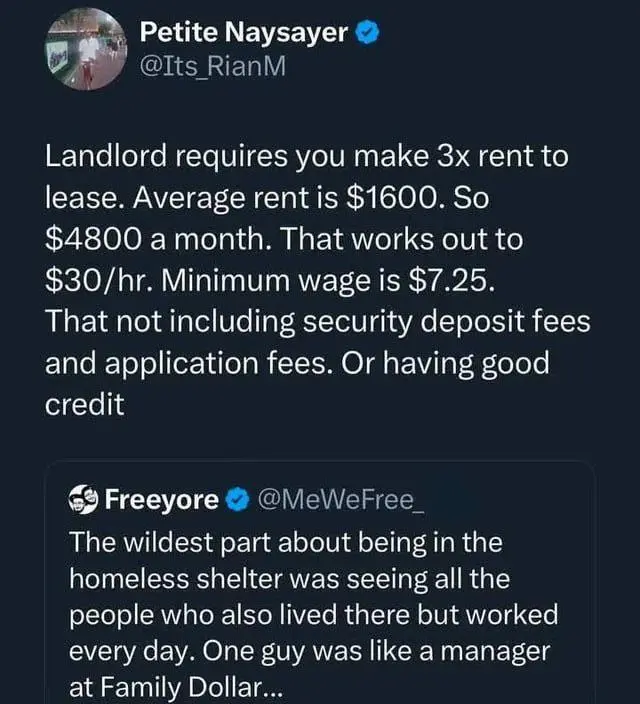 What does minimum wage even mean fr
“The wildest part about being in the homeless shelter was seeing all the people who also lived there but worked every day. One guy was like a manager at Family Dollar…”
“We must learn to disobey.” by Patrick Lawrence (The Floutist)
“There was an ordinary German living during the Nazi regime’s grotesque excesses. When he left for work each morning and whenever he was in public, he made sure to carry two briefcases, one in each hand. “He was never obliged to salute in allegiance to the Reich.”
“In 1946 a French novelist named Georges Bernanos, a man of very mixed persuasions, published a book that came out in English four years later with the title Tradition of Freedom. This topic was much on the minds of European intellectuals at the time. The Bernanos book appeared a few years after Fromm published Escape from Freedom and just as Sartre was finishing the trilogy of novels he called The Roads to Freedom. All of the writers were concerned with questions of engagement, individual commitment, and spiritual exhaustion.
“Parenthetically, the original, 1946 title of the Bernanos book was La France contre les robots: In specific terms Bernanos intended the book as a critique of the Americanization of postwar societies—the “robotization” of Western civilization, whereby technological efficiency threatens to destroy all notions of freedom and replace all human values.
“Here is a passage in the Bernanos book that is pertinent to our topic, and I wish very much it weren’t. It falls at his conclusion and I will read it in full:”
“I have thought for a long time now that if, some day, the increasing efficiency for the technique of destruction finally causes our species to disappear from the earth, it will not be cruelty that will be responsible for our extinction and still less, of course, the indignation that cruelty awakens and the reprisals and vengeance that it brings upon itself … but the docility, the lack of responsibility of the modern man, his base, subservient acceptance of every common decree. The horrors that we have seen, the still greater horrors we shall presently see, are not signs that rebels, insubordinate, untamable men are increasing in number throughout the world, but rather that there is a constant increase in the number of obedient, docile men.To the extent this passage bears upon our time—and it seems to me dreadfully to our point—it places a severe limitation on all thoughts of a restoration or reinvention. By definition, to restore or renew or reinvent requires people dedicated to the undertaking, and I see little sign most American citizens are even thinking about any such endeavor.”
“My mind goes in many directions when I consider this question. One of these is to Dietrich Bonhoeffer, the Lutheran pastor active in the anti–Nazi resistance and who, in 1945, gave his life up for what he knew to be right. In The Cost of Discipleship Bonhoeffer famously wrote of “Cheap grace” and its opposite, “costly grace.”
““Cheap grace is the grace we bestow on ourselves,” he wrote. He meant, to resort to a shorthand I think will hold up, the grace of good intentions without action and the acceptance of the risk action requires of those who take it. I associate cheap grace with passivity, with acquiescence in the face of wrongs. Straight to my point this afternoon, Bonhoeffer wrote that, in this state of cheap grace, “we suppose the account has been paid in advance; and, because it has been paid, everything can be had for nothing.””
“If we—we Americans most of all—have not altogether missed our Machiavellian moment, and it is very possible we have, I think it lies in these thoughts, and I will conclude with them. If we have responsibilities in our time of lawful lawlessness, and of course we do, they must begin with acting while accepting the price action exacts, and with learning how to disobey.”
Economy & Finance
Kerosinmangel – Bitte gehen Sie weiter, hier gibt es nichts zu sehen by Jens Berger (NachDenkSeiten)
“Bei der Hälfte des Treibstoffs, die importiert wird, kommen wiederum drei Viertel aus Raffinerien, die in der Golfregion beheimatet sind – zum größten Teil aus Kuwait und den Emiraten. Der letzte Tanker, der die Straße von Hormus passiert hat, ist bereits letzte Woche in Rotterdam angekommen. Nun kommt nichts mehr und selbst wenn die Seewege sich wie durch ein Wunder heute wieder öffnen würden, wird es noch sehr lange dauern, bis wieder Kerosin nach Europa verschifft werden kann – mehr als 80 Raffinerien in der Region sind Angaben von Branchenexperten durch die Kriegshandlungen teils schwer beschädigt worden und fallen ohnehin auf unabsehbare Zeit aus.”
“Für die größten kontinentaleuropäischen Drehkreuze des Flugverkehrs war dies interessanterweise indirekt nur durch die NATO möglich. Flughäfen wie Amsterdam, Frankfurt, Köln-Bonn, Brüssel, München oder Zürich werden über das CEPS-Pipelinesystem der NATO mit Kerosin versorgt, das größtenteils über die Raffinerien und Häfen der Energiehubs Rotterdam und Antwerpen gespeist wird.”
“[…] der Dachverband der Fluggesellschaften IATA bereits im Herbst letzten Jahres – also lange vor dem Irankrieg – eine Warnung aussprach, in der es heißt, die Kerosinversorgung in Europa laufe durch die Folgen der Russlandsanktionen auf einen Notstand zu. Ohne strukturelle Reformen bei der Kerosinversorgung drohen demnächst den Flughäfen, die nicht an eines der großen, zentralen Versorgungsnetze wie der CEPS angeschlossen sind, schon bald physische Engpässe. Wie gesagt – diese Warnung wurde bereits vor dem Irankrieg ausgesprochen.”
“Große Airlines, wie die Lufthansa, können das noch wegstecken, da sie den Großteil der Einkäufe über Warentermingeschäfte (Hedging) gegen Preisschwankungen abgesichert haben. Aber die Preise fürs Hedging steigen natürlich mit dem Kerosinpreis und es ist nur eine Frage der Zeit, bis die Kerosinpreissteigerung sich auch massiv auf die Ticketpreise überträgt – die Kerosinkosten betragen in normalen Zeiten rund ein Viertel der operativen Kosten von Fluglinien.”
“Schätzungsweise landen und starten pro Tag rund 80 Langstreckenjets voll mit „Billig-Krempel“ von Aliexpress und Temu in der EU, die pro Jahr rund 4,6 Milliarden Kleinsendungen an europäische Haushalte transportieren. Mit steigenden Kerosinpreisen dürfte dieses Geschäftsmodell auch ökonomisch nicht mehr nachhaltig sein.”
“Bevor das Kerosin physisch knapp wird und die Flugzeuge nicht mehr starten können, werden die Flüge zuvor ohnehin vom Flugplan gestrichen, weil sie aufgrund der Preise nicht mehr nachgefragt werden.”
“In Deutschland wird dies vor allem für die ostdeutschen Flughäfen Berlin-Brandenburg und Leipzig-Halle auch gelten, die nicht an das NATO-Pipelinesystem CEPS angeschlossen sind, sondern ihr Kerosin über die ostdeutschen Raffinerien PCK Schwedt und Leuna beziehen, die ihrerseits von den Russlandsanktionen ohnehin bereits schwer getroffen sind. Da kommt die aktuelle Meldung, dass der russische Konzern Rosneft die Durchleitung kasachischen Öls über die Druschba-Pipeline womöglich bereits im Mai unterbrechen will, natürlich zum denkbar ungelegensten Zeitpunkt. Honi soit qui mal y pense [Ein Schelm, wer Böses dabei denkt]. Ohne russisches Öl kein Kerosin aus Schwedt. Ohne Kerosin aus Schwedt könnten am BER schon bald die Lichter ausgehen.”
“[…] wer jetzt nicht in den Urlaub fliegt, fliegt womöglich lange nicht mehr; nicht nur weil sein Ferienflieger womöglich mangels Treibstoffs am Boden bleiben muss, sondern weil er selbst sich den Flug schlichtweg nicht mehr leisten kann oder der Flug gestrichen wurde, weil viele andere Mitbürger ihn sich nicht mehr leisten können.”
Will Gravity Pull Down the AI Bubble? by Dean Baker (CEPR)
“I have always been skeptical about how much money the AI folks would be able to pocket for themselves. Remember, the issue here is not how useful AI is or will end up being. The question is how much of the benefits (or harms) from AI that Nvidia, Alphabet, Meta, and the rest can capture for themselves.
“Here, the competition from China is a very big deal. This is not just a question of which country at the end of the day ends up having better or more efficient AI; the issue is that the Chinese AI companies provide serious price competition for US models. This will limit the extent to which US companies can make huge bucks on their products.
“At the moment, it looks like the cutting-edge Chinese AI company, Deep Seek, is coming out far better on price than the US leaders, OpenAI and Anthropic.
“[…]
“Deep Seek also has the advantage that it is an open-source system, which means that companies can alter the models and run them on their own computers rather than loading data onto the cloud. This means they don’t have to worry about losing control of proprietary information. By some accounts, usage of Chinese AI already vastly surpasses usage of AI from US companies.”
Roaming Charges: Bad Citizens by Jeffrey St. Clair (CounterPunch)
“Financial Times: “The number of white-collar prosecutions in the US has fallen to its lowest level in at least 40 years, leaving many white-collar criminal defence lawyers facing a major problem: they have nothing to do.” Grift, graft and greed are good again!”
🤦♂️
DEBT INC.: GUILT, CREDIT, AND THE ALGORITHMIC FUTURE by Slavoj Žižek | Alenka Zupančič (ŽIŽEK GOADS AND PRODS)
“This possibility that arises with modernity is a possibility of a more radical alienation, which can lead to something like the sacrifice of the sacrifice itself: we can be asked or expected to sacrifice everything we have for a cause, but the next level, so to speak, is when we are then asked to sacrifice/betray this cause itself, the very thing for which we were willing to sacrifice everything. In this case, we don’t just lose everything we have; at the horizon looms the loss of everything we are.”
“Credit means that when we receive or borrow something—especially when we borrow money—our debt grows with time, and we must return more than we were lent. We pay for the time during which the Other holds us “in credit,” and we pay, so to speak, for the very access to debt. The notion that money could generate (more) money—that value could emerge from nothing but time—stood in deep conflict with theological orthodoxy. For this reason, in the Middle Ages only non-Christians (Jewish, and later Lombard or Florentine bankers) were permitted to lend at interest, often acting as intermediaries. Of course, this also meant that Christians could use them to lend money at interest without themselves being held accountable—thus giving rise to the classical antisemitic topos of the usurious “Jew.””
“[…] the company uses existing profits (already extracted surplus) to inflate its own market value, rather than to reduce liabilities or invest productively. This creates the appearance of growth while in fact indebting the future, since fewer productive investments mean less real foundation for future profit. In other words, the company pays itself in the present by borrowing against its own future capacity to produce. Present “profits,” in this sense, are nothing but debts—debts that, in most cases, someone else will eventually have to repay (or lose their job), even as this profits-debts are presented as the fruits of the company’s past and present “success.””
““Cheap debt” means that one can actually profit from acquiring debt: access to low-interest credit is more desirable, and economically more advantageous, than having no debt at all.”
“[…] the modifications and shifts in the functioning of the global capitalist economy do not stop with the form of financial capital, which thrives on interest and speculation—where profit comes from anticipating price changes, from betting on future movements, and where prices do not depend on any value tied to commodities or the “market,” but rather on what investors think others will think.”
“What financial capital achieves by converting time into interest, algorithmic capital achieves by converting desire into a specific form of engagement—“attention” has become one of the key market categories. The “interest rate” of our connected lives is measured not in percentages but in notifications, clicks, and emotional volatility: each moment of distraction is a micro-installment in the debt of our attention. The result is a form of soft servitude, in which the future—once the site of possibility—becomes the primary terrain of capitalization.”
“Algorithmic capital extends this one step further: it speculates not only on the future of production or exchange, but on the future of desire (thus, we could add, robbing desire of its future). Like financial derivatives, algorithms convert uncertainty into a field of calculation; they extract surplus not from things, but from “subjectivity”—from the circulation of affect and attention.”
“We live in a regime where desire itself accrues compound interest, and where the future, as both Marx and Lacan might agree, is mortgaged to the endlessly deferred satisfaction that sustains the system. (In the sense that, on the one hand, it promises “full, ultimate satisfaction,” while on the other hand it profits from its structural impossibility.)”
“Jodi Dean argues that contemporary capitalism has ceased to function as capitalism in any meaningful sense and has instead morphed into a neo-feudal order. Rather than organizing social life primarily through markets, wage labor, and competitive production, today’s dominant system is increasingly structured around enclosure, rent extraction, and relations of dependency. In her account, what is decisive is not simply that capitalism has become more unequal or more monopolistic, but that its basic mechanism has shifted: instead of capital investing in production in order to generate profit, we see the consolidation of power through the control of infrastructures, access, and networks, enabling owners to demand payment simply for entry and participation. The central figure is no longer the capitalist entrepreneur competing in a market, but the lord who owns the gate, the channel, the platform, the territory, and who can therefore extract tribute from all who pass through.”
“Digital platforms and financial infrastructures thus operate as private estates: they enclose what once appeared as public or common spaces (communication, sociability, information, even attention), and they regulate access to them in increasingly arbitrary ways. Users and workers do not simply “participate” in these spaces; they are rendered dependent upon them, compelled to remain within them because their economic, social, and symbolic existence is increasingly mediated by them. Dean emphasizes that extraction here is continuous and ubiquitous: it is not limited to the workplace or the labor contract but extends across the whole of life, in the form of subscriptions, fees, data extraction, algorithmic visibility, and the constant conversion of activity into value for others. What looks like openness and connectivity is, from this perspective, an enclosure of the commons: a privatization of the conditions of social existence.”
Witness the recent cutoff of Claude Code to an entire company for a perceived transgression. Or the over 2000 people sanctioned by the EU who have no access to money or payment because they are accused of expressing forbidden ideas.
“Those at the top occupy positions of insulated sovereignty, while those below are locked into various degrees of precarity and dependency. This hierarchical organization undermines collective political struggle not only materially but symbolically: subjects are individualized, sorted, and divided, encouraged to compete for recognition, attention, and platform access, rather than to recognize themselves as part of a common antagonistic position.”
This sounds like Marxism where the difficulty encountered by the proletariat in its struggle to escape the system is exacerbated by the system’s heretofore unparalleled ability to atomize, to distract, to seduce, to subdue, to immiserate, to shame and humiliate, and to render hopeless. It obliterates imagination, forestalling even the consideration of an alternative.
Science & Nature
Why not Venus? by Maciej Cegłowski (Mars For The Rest of Us)
“The way I like to think about this question is that we can’t lose. Missions to the clouds of Venus are either going to find life or some kind of brand new chemistry, either of which will be a breakthrough discovery in planetary science. There’s basically a guaranteed Nobel prize waiting in the skies of Venus for whoever wants to collect it. A more sober case for exploring the planet is that we only have three terrestrial worlds to work with. We should learn all we can about how they formed, how they function, and why their fates diverged if we want to better understand exoplanets that humanity won’t be able to physically visit for millennia.”
“The science return on any airship design with 2026 sensor technology would be phenomenal, and they could all be rigged to drop a series of sondes or mini-landers down to the surface.”
“The final and most metal approach is to dispense with refrigeration entirely. NASA has been experimenting with integrated circuits made from silicon carbide that can take a thermal beating. The Glenn research lab has kept chips running at temperatures over 500°C for a year, and even built prototypes that function at 900°C. These electronics are primitive, but more than capable of handling signal processing, amplification, basic imaging, and many of the other tasks you want in a Venus lander.”
Environment & Climate Change
Roaming Charges: Bad Citizens by Jeffrey St. Clair (CounterPunch)
“The question, as always with EVs, remains: how is the electricity powering the cars generated. In Singapore, 95% of the electricity is generated from natural gas and LNG.”
While true, do not be distracted from the fact that an electricity-powered vehicle has the potential to be powered by cleaner energy, where a fossil-fuel-powered vehicle does not. It’s a big step in the right direction, and will hopefully not be wasted. Recycling is a similar dynamic: you need people to start separating their waste, even if you can’t recycle any of it yet. There is only a limited window of opportunity, though, before people become disillusioned.
“Why is Georgia burning? 99.8% of the Southeastern US is now in drought, smashing the previous record of 87%. 94% is in severe drought (previous record: 71%). The worst drought by far the region has seen in decades.”
“In 1990, coal provided 90% of Danish electricity. Today, it is less than 3%. Meanwhile, nearly 60% of Denmark’s electricity generation is powered by wind.”
“Costa Samaras, director of the Carnegie Mellon University Scott Institute for Energy Innovation, on news that the Trump administration will pay two more offshore wind companies $900 million to walk away from their projects:”“Hold on. We, the taxpayers, are going to pay companies $900 million, which is more than 6x what we spend on wind power R&D, to NOT build wind power at a time when electricity prices are spiking and we need more clean power?”
“The median forecast predicts that the gathering El Niño in the Pacific Ocean will be the strongest in 150 years. That’s the median forecast. There’s a 50 percent chance it could be much worse.”
Medicine & Disease
Before the Opioid Crisis, We Had the Valium Crisis by Matt Bivens, M.D. (The 100 Days)
“[… ] we could just start the college student on medication, to help her get comfortable with the government’s psychopathology.”
“Sedative pills of the newly discovered benzodiazepine family poured out of doctors’ offices and pharmacies in the 1960s and 1970s, in return for fabulous sums of money. Librium® had hit the market in 1960 (nine years before the advertisement referenced above), and was soon earning tens of millions of dollars a year. Valium®, its younger and more popular sister, debuted two years later. Both blockbusters, as recently reviewed here, were manufactured by Hoffman-La Roche pharmaceuticals and marketed by Arthur Sackler’s ad company.
“Valium® became the first medication in history to rack up more than $100 million in annual sales. And then, even as the business world gaped in awe at the thought of a $100 million drug, Librium® was also a $100 million drug, while the saturation marketing of Valium® had sent it soaring ten times higher, and it became the first drug to earn $1 billion in annual sales.”
“Everyone involved in pushing benzodiazepines like Librium® and Valium® initially denied they were addictive; and then, when evidence that benzodiazepines are addictive became incontrovertible, they insisted that the problem was not the medication, but the person, since he or she probably had “an addictive personality” and would just get addicted to something else.”
That sounds very familiar. These people are demons.
“[…] without the Valium craze of the 1960s-1980s, there’d have been no Opioid Crisis of today. One pathological, market-rewarded behavior amasses resources and know-how to launch another.”
“In the pilot episode of the sit com “The Brady Bunch,” which aired in 1969 — the same year as the “college students need Librium” journal ad — the soon-to-be Mr. and Mrs. Brady commiserate by telephone about their wedding day jitters.
““Why don’t you take a tranquilizer?” she suggests.
“Marriage and college are apparently both something to get through on drugs.
“[…]
““I took one,” he replies.
““Well, maybe you should take another one?” she suggests, as if it’s the most utterly reasonable thing imaginable to keep pounding sedation on your wedding day. He declines because, while he’s fine with tuning out the ceremony, “there’s the honeymoon to consider.””
“Valium® became — year in and year out, for the entire decade of the 1970s — the most prescribed medication in the world.
“Or at least, in the Western world. Doctors in the Soviet Union were futzing around with their own discoveries. These included ß-phenyl-GABA, a sedative available in Soviet cosmonaut medical kits, and phenazepam, a benzodiazepine 10 times more powerful than diazepam. Both are still used in Russia today.”
““Millions of people — government officials, businessmen, policemen, farmers, journalists, doctors, among others — keep the tranquilizer at hand to swallow in periods of stress,” reported The New York Times in 1974. Pointedly, the newspaper described Valium® as “a multipurpose drug unknown 15 years ago,” but now with “so broad a spectrum of medical uses and … so frequently prescribed that many Americans are born and die with Valium in their bodies.””
“The headline tells us this woman’s world “orbits around doctors,” and the text explains further that you are treating her for hypochondriasis. While you’re doing that, the ad says, why not also start her on Valium®? The ad recommends diazepam 10 mg four times a day — a shockingly high dose. (If, in my emergency department practice, I saw a patient on half that dose, I would be concerned enough to investigate the situation.)”
“For those keeping score at home, reasons to be started on a benzodiazepine like Valium® or Librium® include going to college, getting married, being afraid of your mother-in-law, resenting your older sister, keeping house, succeeding in business, or being a government official, police officer, farmer, journalist or doctor. What could go wrong?”
How to train your brain to see possibility instead of doom by Dr Hannah Critchlow (The Guardian)
“It can feel as though the world is tilting towards chaos: political shocks, economic instability, technological upheaval and a constant stream of bad news. Faced with so much uncertainty, many of us default to a sense of impending doom. But is that reaction hardwired – or can we train ourselves to keep a more open mind?”
Man, I was hesitant about this recommended article but the first paragraph—cited above—is such a doozy. It is, at least, honest. This is exactly what the rest of the article is about. It admonishes people for not noticing how awesome everything is. She’s absolutely terrible: a terrible writer with terrible ideas.
Maybe everyone should take Qualudes? F@&k, the Guardian sucks @ss.
Art, Literature, Music, & Cinema
✅ “There are myriad ways…”
✅ “There are a plethora of ways…”
⛔ “There are a myriad of ways…”
✅ “The number of ways are myriad”
✅ “The number of ways comprise A, B, and C”
✅ “The number of ways is composed of A, B, and C”
⛔ “The number of ways is comprised of A, B, and C”
My friend replied,
“merriam-webster (and oed and cambridge and wikipedia (but merriam-webster has the nicest dictionary)) says you are an old man yelling at a cloud and you can use myriad as a noun
you are right about comprise tho ❤️”
Merriam Webster, OED, and Cambridge are all trollops whispering whatever the customer wants to hear as long as he’ll come upstairs with them and leave behind a satchel of specie minutes later. That said, the FreeDictionary agrees. I very much prefer their explanation to MW’s suspiciously slop-like formulation.
“Usage Note: Throughout most of its history in English myriad was used as a noun, as in a myriad of reasons. In the 1800s, it began to be used in poetry as an adjective, as in myriad dreams. Both usages in English are acceptable, as in Samuel Taylor Coleridge’s “Myriad myriads of lives.” This poetic, adjectival use became so well entrenched generally that many people came to consider it as the only correct use. In fact, however, both uses are acceptable today.”
For comparison, the MW version,
“Recent criticism of the use of myriad as a noun, both in the plural form myriads and in the phrase a myriad of, seems to reflect a mistaken belief that the word was originally and is still properly only an adjective. As the entries here show, however, the noun is in fact the older form, dating to the 16th century. The noun myriad has appeared in the works of such writers as Milton (plural myriads) and Thoreau (a myriad of), and it continues to occur frequently in reputable English. There is no reason to avoid it.”
God, that is so much worse. They both say the same thing but the first version is so much more legible to me.
It tickles me that people who can’t write well will be accused of having used LLMs to write their texts, even though they were the ones from whom the LLMs learned how to write in the first place.
Dawn of a New Educational Era: Confronting the Epic Crisis in 2024 Without Teachers (NLI Institute)
- On average, 79% of U.S. adults nationwide are literate in 2024.
- 21% of adults in the US are illiterate in 2024.
- 54% of adults have a literacy below a 6th-grade level (20% are below 5th-grade level).
- Low levels of literacy costs the US up to 2.2 trillion per year.
- 34% of adults lacking literacy proficiency were born outside the US.
This is not a coincidence; it is deliberate. You won’t join the revolution if you don’t even understand you need one.
Philosophy, Sociology, & Culture
Turing Test 2.0 by Corey Mohler (Existential Comics)

“The essence of a human being is not to work, it is not to follow instructions – it i to act freely in the world with intention, to create meaning, and to enact our will on the world.
“Double Radical Freedom!”
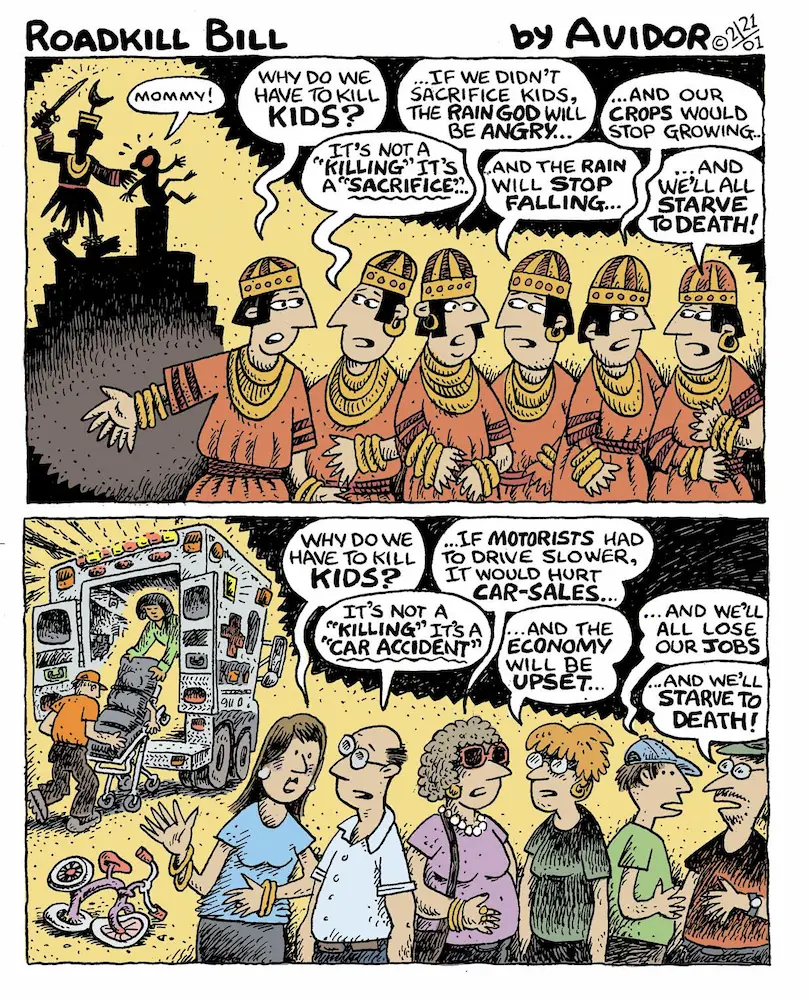
“Why do we have to kill kids?
It’s not “killing.” It’s a “sacrifice”…
…If we didn’t sacrifice kids, the rain God [would] be angry…
…and the rain [would] stop falling…
…and our crops would stop growing…
…and we’[d] starve to death!”
“Why do we have to kill kids?
It’s not “killing.” It’s a “car accident.”…
…If motorists had to drive [more slowly], it would hurt car-sales…
…and the economy would be upset…
…and we’[d] all lose our jobs
…and we’[d] starve to death!”
I hadn’t noticed the atrocious and inconsistent grammar in this comic until I started transcribing it.
We Are (Still) Living in the Long Boring by Freddie deBoer (Substack)
“In 1900, 100 out of 1000 American infants died before their first birthday, 10% of all lives snuffed out in their first year. By 1950 it was around 30 out of 1000. By 1970 it was about 20. When I was born it was less than 10. Now it sits at a little less than 6. The entire 1995–2024 window we’re looking at is the nearly flat tail-end of a transformation that was essentially complete before the “digital revolution” began. The heavy lifting, the core development and progress in sanitation, antibiotics, pasteurization, hospital births, happened far earlier, specifically in that magic 1870ish to 1970ish window I always talk about. You can say, hey, we haven’t seen major advances here because we’re near the limits of progress, there isn’t much further to go! But if that’s true, it kind of proves the point, right?”
“American households spent about 50% of their budgets on food in 1870, about 15% in 1970. We could add the maternal death rate during childbirth, which fell 99% from 1900 to 1970, and we could add the share of homes with indoor plumbing or electricity, and we could add workplace safety and the decline of workplace mortality by more than 80% in that period, etc and etc and etc. That all constitutes genuinely revolutionary progress, and once you see its scale you can’t unsee it.”
“The fundamental architecture of daily material life − how we heat our homes, how we move from place to place, how we grow and store and cook food, how we build structures − has changed remarkably little since 1970. Yes, medicine has progressed a great deal, but look at those charts above; the vast majority of the work of reducing deaths from disease and increasing longevity was accomplished long ago. A person transported from 1926 to 1976 would find the world nearly unrecognizable. A person transported from 1976 to 2026 would find it, after some orientation, quite familiar. The cars go to the same places. The planes aren’t even marginally faster. The houses are built the same way. People still die of cancer.”
“I’d rather be living in 2026, enjoying the benefits of that long-passed fertile period, than living in the teeth of all that incredible innovation in the 1910s, watching thousands die of the Spanish flu. I just think people should be clear-eyed about the era they’re living in. What modern invention would you really take over indoor plumbing, or pain killing medication, or the airplane? I think any honest person would have to say, none of it. No, you would not trade food refrigeration for TikTok. No, you would not trade routine handwashing as a mass phenomenon for the OLED TV. And no, you would not trade the EKG for ChatGPT.”
“Your Sams Altman and Darios Amodei are circus barkers whose net worth is directly dependent on getting you to believe their shpiel, so I’ll leave them aside.”
“LLMs write code, generate images, produce music, summarize documents, draft prose… which is to say, they have achieved mastery over the exact domains that were already, by any sane measure, overprovisioned. Was anyone saying that we didn’t have enough digital writing, images, videos, music, video games, or applications, a few years ago? The core triumph of technological growth is taking scarcity and creating abundance. Well, LLMs create an abundance, that’s for sure. But there was already an abundance of text, online, and an abundance of images, and there’s some insane stat like 24 hours of video gets uploaded to YouTube every second or whatever, and yes, there has been an abundance of code, of programs, of apps. And before we got these fancy new tools to produce more code, there wasn’t a lot of people saying “Gee, what we need is more apps, the app store is too empty.””
“We needed (and still need) cheaper energy, more housing, better cancer treatments, functional mass transit, and a replacement for the internal combustion engine people actually want to use. [those last two are uniquely U.S.-American problems] What we received instead was a machine that can write a cover letter in four seconds and generate a photorealistic image of SpongeBob jackin it. The question of whether this constitutes civilizational transformation should answer itself. Right?”
“Code cannot insulate your house; no algorithm has ever laid a water pipe; the internet has not built a single mile of high-speed rail. What our current stagnation shows, collectively, is that the improvements in material human life that matter the most − abundance in warmth, in calories, in clean water, in physical safety, in hours of freedom from labor − were all achieved by technologies that operated on atoms: steel, concrete, copper wire, chlorine, penicillin. The digital revolution produced real and genuine gains within its own domain, but it never breached that membrane between the virtual and the physical, and LLMs show no signs of doing so either.”
“[…] the leap from “AlphaFold is sometimes useful to structural biologists” to “we are on the threshold of defeating disease” is not an inference supported by evidence but rather a narrative that a certain kind of mind finds emotionally necessary.”
Or, more likely, potentially personally profitable if you can get other people to believe it.
“[…] each generation of technologists, confronting the gap between what their tools can do and what they wish they could do, fills that gap with imagination and calls it the future.”
“[…] we cannot sit back and wait for technological progress to save us. The only solutions to our problems − the problems of hunger, of poverty, of injustice, of disillusionment, of alienation − are political solutions. I understand feeling totally defeated by that idea, given what politics is like on this planet. But it’s all we have. We start to build the political structures that can enable humanity to take care of all of us or we drown. There is no fate but what we make.”
“Consider what that century actually delivered. Electrification, meaning not just the lightbulb but the complete rewiring of industrial production, household labor, and urban organization; indoor plumbing and modern sanitation, which did more for human life expectancy than anything medicine has yet accomplished; the internal combustion engine, which annihilated distance and remade geography; the telephone; commercial aviation; refrigeration; central heating; antibiotics. The Green Revolution in agriculture, which most contemporary Americans know nothing about, ended famine as a routine feature of agricultural life. Radio and then television enabled (for the first time in human history) simultaneous mass communication across a nation. Any one of those categories is more substantial than the entire sweep of growth in computing technology in the last 50 years or so.”
“These weren’t merely new inventions or products or possibilities; each was a restructuring of the basic conditions of existence. Before electrification productive work ended at sundown. Before indoor plumbing fetching water was a several-hour daily task for most households. Before refrigeration the organization of daily meals was governed entirely by what hadn’t yet rotted. Before antibiotics a scratch could kill you. Before commercial aviation the journey from New York to London took a week by sea.”
“Gordon’s point isn’t merely that these were humanity-altering technologies, but that the improvements these technologies delivered were one-time gains. You go from no electricity to electricity once. You go from outhouses and wells to indoor plumbing once. The gains are enormous, irreversible, and non-repeatable. And they are, by and large, done.”
Roaming Charges: Bad Citizens by Jeffrey St. Clair (CounterPunch)
“In 1988, George Will attacked novelist Don DeLillo for humanizing Lee Harvey Oswald in his novel Libra and blaming “America” for shaping Oswald’s character. The pious Will denounced DeLillo as “a bad citizen.” DeLillo, who rarely says anything publicly, took Will’s attempted slander as a badge of honor, saying: ”I don’t take it seriously, but being called a ‘bad citizen’ is a compliment to a novelist, at least to my mind. That’s exactly what we ought to do. We ought to be bad citizens. We ought to, in the sense that we’re writing against what power represents, and often what government represents, and what the corporation dictates, and what consumer consciousness has come to mean. In that sense, if we’re bad citizens, we’re doing our job.””
“Don DeLillo: “Half the world is redoing its kitchens; the other half is starving.””
How uncertainty-tolerant are you? by Jeroen van Baar (An Educated Guess)
“[…] researchers have long interpreted IU as a psychological trait, a relatively stable feature of one’s personality. I know of no other personality trait whose average level has shifted by a whole standard deviation over the course of a few decades. Either IU is not a trait but a situation-specific attitude, or something has drastically changed how trait IU develops over childhood. Either way, young adults in Canada and the U.S. have become less tolerant of uncertainty over the past thirty years.”
The School Reformer “Accountability Era” Narrative Simply Does Not Add Up by Freddie deBoer (Substack)
“ESSA is best understood as a reform of how states meet federal accountability requirements than a repeal of the requirements themselves. And the clue is in the names: No Child Left Behind, Every Student Succeeds…. The only way the Obama administration was going to get very hostile Congressional Republicans to pass the bill was by emphasizing continuity with Bush’s NCLB.”
“What changed at the federal level after 2015 was largely a) rhetorical and b) administrative; the substance of test-based accountability was picked up and carried forward by the states. Every state continues to operate a federally required accountability system that rates schools using student test performance as the dominant input, though ESSA provoked the addition of “school quality” and “student success” measures. The large majority of states still assign schools A–F letter grades, 1–5 star ratings, or similar summative labels, driven primarily by proficiency and growth on state assessments.”
“The “Nation’s Report Card” still gets published on its NCLB-era schedule, and districts continue to live and die by those numbers in the local press. It’s just weird to act as though we’re in a dramatically different era of American public schooling; we are not.”
“This is one of the weird things about this whole debate, the way that the rhetoric of a loud fringe and the actions of a tiny number of outlier schools and districts are mistaken for actual meaningful pedagogical and policy change. They aren’t. More than a decade after its repeal, it’s remarkable, the degree to which NCLB still determines national ed policy.”
“NAEP gains during the NCLB era were heavily concentrated in elementary grades and in math (precisely the subjects and levels where the test-and-punish pressure was most intense) while reading gains at the 8th grade level were much weaker, and 12th grade scores barely moved at all. This is exactly the pattern you’d expect not from genuine learning improvements but from score inflation through fraud and teaching to the test.”
“National trends outside of the classroom, like those relating to food insecurity, often have the biggest impact on test scores. Given that knowledge, ascribing noisy NAEP score changes to national policies that were implemented piecemeal and at very different rates is irresponsible, especially given the surge in scores from the 1990s and how it complicates the simplistic narrative.”
“The PISA declines visible in American math and reading scores over the 2003–2022 period aren’t remotely anomalous; they’re part of a near-universal pattern among wealthy, developed democracies. In particular, the Netherlands, Finland, Belgium, Canada, and Australia − that is, countries with many economic and social similarities but radically different curriculum philosophies, funding structures, pedagogical traditions, etc − all show trajectories strikingly similar to that of the United States.”
“[…] what the data show is convergence: a broad, shared downward drift across the developed world that almost certainly reflects forces operating above the level of any individual nation’s classroom policy. Pinning these trends on American policy choices, without accounting for why virtually identical trends appear in countries that made very different choices, is not serious analysis.”
“[…] what do I suspect? I suspect that it’s related to the fact that children and adolescence have, in the past ten or fifteen years, almost universally adopted a kind of technology that has unique capacity to suck up their attention, drain their mental energy, and waste their time. I think in a decade we’re going to have very strong evidence that it was always the smartphones.”
“Demanding accountability allowed elites to believe that compassion consisted of demanding more from teachers who were asked to do the impossible and students struggling against major socioeconomic barriers. But politicians and neoliberal wonks found that this profoundly unfair behavior towards public educators could be effectively rebranded as high expectations. Accountability rhetoric allowed politicians to posture as champions of children while systematically undermining the working conditions of teachers and narrowing the curriculum to whatever could be cheaply measured. We allowed pundits to talk endlessly about “what works” to improve test scores while refusing to confront the most basic empirical fact in all of education: that schools are downstream of society, not the other way around.”
The quiet disappearance of the free-range childhood by Stephen Johnson (The Big Think)
“Georgia’s old law, for instance, defined neglect as the failure to provide “proper” parental care. The new law replaces that with “necessary” care and sets a higher bar for neglect: Parents must demonstrate “blatant disregard” for their child’s safety — putting them in imminent, obvious danger. The law also explicitly states that allowing a reasonably capable child to walk to school or travel to a nearby park unsupervised does not, by itself, constitute neglect.”
What a clown car that country is. Like, they have to make laws stating blindingly obvious facts because too many people with power are deed-down-to-the-bone stupid and have no idea that they are.
“Current FBI data shows about 350,000 juvenile missing person reports per year, most of which are resolved quickly and do not involve abduction. Of cases that do involve abduction, the vast majority are committed by someone the child knows — often a parent in a custody dispute — rather than a stranger.
“Stranger kidnappings are exceptionally rare. They occur roughly 100 times per year, which works out to a 1-in-720,000 annual risk of a child being kidnapped — less likely than being struck by lightning at some point in their life. Couple these odds with decreasing violent crime rates over the past several decades in the U.S., and you might think today’s parents would be generally comfortable letting kids be outside on their own.”
“[…] a 2025 Harris Poll of kids ages 8 to 12 in the U.S. found that about two-thirds had never walked or biked to a nearby place without their parents.”
“[…] fearing another report to DFCS could land Mallerie in jail. “Maybe our culture is going to get even more risk-averse,” she says. “I just feel like every adult is like a little sentinel. Like they’re going to spot us, and they’re going to report us if they see anything that they don’t agree with.””
Technology & Engineering
Why Japan has such good railways by Samuel Hughes (Works in Progress Magazine)
“Japan’s vast railway network is divided between dozens of companies, nearly all of them private. The largest of these, JR East, carries more passengers than the entire railway system of every country other than China and India. Each year, JR East carries four times as many passengers as the whole British railway system, even though it has fewer kilometers of track, serves about ten million fewer people, and competes with eight other companies.”
“Japanese cities have the lowest residential density in Asia, and a plurality of the Japanese live in houses, usually detached ones. The urban area of Tokyo, the densest Japanese city, has a weighted population density less than that of many European cities, including Paris, Madrid, or Athens. Japanese cities have vast low-rise, predominantly residential suburbs, built at densities that might be higher than what is typical in the United States, but that would be quite normal in Northern Europe.”
“Japan is a place where cars and car-oriented lifestyles compete on a level playing field.
“Japan is one of the only countries to have privatized parking. In Europe and North America, vast quantities of parking space is socialized: municipalities own the streets and allow people to park on them at low or zero cost. Initially with the intention of encouraging the provision of more parking spaces, Japan made it illegal to park on public roads or pavements without special permission. Before someone buys a car, they must prove that they have a reserved night-time space on private land, either owned or leased.”
“Japanese roads are expected to be self-financing. Motorways are run by self-contained public cooperatives, very similar to the statutory authorities that ran English roads and canals between 1660 and the late 1800s, and funded by tolls on their users. Vehicle registration taxes, which are allocated to localities for road construction and maintenance, are worth three percent of the Japanese government budget.”
And, in Switzerland, we have an automobile GA for CHF 40.-
Sam Altman is “the face of evil” for not reporting school shooter, says lawyer (Ars Technica)
“the AI company overruled recommendations from its internal safety team. More than eight months prior to the school shooting, trained experts had flagged a ChatGPT account later linked to the shooter as posing a credible threat of gun violence in the real world. In those cases, OpenAI is expected to notify police—which, in this case, already had a file on the shooter and had proactively removed guns from their home previously—but that’s not what happened.”
Did you catch that? Anything in the cloud is being watched, it’s being pored over. Experts are reading what you’re doing, even when you think it’s private. Nothing is private. The police are listening. The companies are listening. Everyone is listening. They have tools to detect patterns in your behavior and make your life a living hell unless you can prove that you’re not guilty of what the machines and experts have inferred you to be guilty of doing.
LLMs & AI
7 Questions with Jeremy Howard (Answer.ai, fast.ai) on Open Source AI and Agents by NVIDIA Developer (YouTube)
“I think people who go all-in on agents right now are basically guaranteeing their obsolescence. The reason is like one of two things is going to happen.
“Either like we get AGI, […] we’re all obsolete, in which case, it doesn’t matter. I don’t think that’s likely, but it could be more likely that doesn’t happen. In which case, if you’ve outsourced all of your thinking to computers for the last few years, you’ve stopped becoming a more competent human being. You’ve stopped upskilling. You’ve stopped learning. You’ve wasted your time and you’re going to be in a group of people that is of no use to anybody.
“AI is actually great at helping you learn. You know, you can ask it to, you know, find good resources for you, to help you with misunderstandings.
“So I would say also if you’re running an organization, if you go all in on agents, there’s a good chance in two years time that will turn out to be the decision that destroyed your company. And the reason why is that if in this quite likely future where we don’t have short-term AGI, etc., what’s happened is you’ve created much much more code that fewer and fewer people understand that you can’t build on top of. You got two-week wins of like 18% faster.
“But, in two years time, you end up with a massive spaghetti. Then people will look around the company and say we can’t make anything anymore. It’s kind of like happened when lots of companies used to outsource their work to the contractors and at some point they […] forgot how to do it ourselves.”
Programming
CSS As A Query Language (evdc.me)
“In Datalog, we do this with relations. A relation is a set of tuples (this is also the definition of a SQL Table, not entirely coincidentally). A tuple is a list of atoms. E.g. in the example above, parent is a relation. parent(alice, bob) is a tuple in the parent relation. The parent relation is a set of pairs, such as the (alice, bob) pair, indicating “Thing 1 in this pair is the parent of Thing 2”.”
“We can also intersect sets, just like CSS can. This is usually called a join. Repeating the same variable name twice in a rule body joins on that variable:”% These are unary relations, aka sets of atoms. Also yeah comments use `%`. woman(alice). man(bob). parent(alice, bob). parent(bob, carol). % "X is the mother of Y, if X is the parent of Y, and X is a woman." % X was repeated in the body, so it's a join. mother(X, Y) :- parent(X, Y), woman(X).“The example above essentially intersects “the set of all parents” with “the set of all women”, to form “the set of all mothers”.
“A Datalog rule looks like this:”
“Read :- as “if”. The right side is your body — a list of conditions, all of which must hold simultaneously. The left side is your head — the new fact you’re asserting is true whenever the body holds. Commas in the body are “and”. Sohead(X, Y) :- body1(X, Z), body2(Z, Y).ancestor(X, Y) :- parent(X, Y). means: “For all possible values of X and Y, X is an ancestor of Y, if X is a parent of Y.””
“This is something SQL couldn’t do before theWITH RECURSIVEkeyword, which exists precisely because people kept needing to do stuff like this. (In typical SQL fashion,WITH RECURSIVElets you express any recursive computation, but only if you shoehorn it into a weird syntax and semantics that doesn’t always compose well with other parts of the language.). It’s something CSS definitely can’t do. But it’s literally the first textbook example for Datalog.”
“Here is how a naïve Datalog engine works (informally):”“This is called “naive evaluation”. It runs until the set of known facts stops growing, which is called the fixpoint — the point where applying all the rules produces nothing you didn’t already have.”
- Start with your base facts — the ones you wrote down explicitly, like
parent(alice, bob).- Look at every rule. Match the “body” against the currently known facts, substituting in values for variables in the process.
- For each such match, add the “head” of the rule to your list of known facts.
- If you added anything new in step 3, go back to step 2.
- If you didn’t, stop. You’re done.
“The CSS Working Group has been orbiting towards something similar to “CSSLog” for years. They wanted “element queries” or “container style queries”, ran into the problem of infinite loops and fixpoint semantics, and solved it by restricting the direction of information flow: descendants can query information about ancestors, but not the other way around. This keeps it finite, without fixpoint semantics, as information can only propagate down the tree, and we never inject new “base facts”, so to speak.”
“CSS maestros may point out that you could partially fake it with custom property inheritance. Something like:”“This is a bit hacky but basically works, actually, for this specific case. CSS is pretty good at making hacks look like features, but inheritance is not actual transitive closure (e.g. one could imagine transitive closure along a property chain other than the parent/child relation built into the DOM structure), and so a slightly more complex version of this problem will break it. It’s the principle of the thing!”[data-theme="dark"] { –effective-theme: dark; } [data-theme="light"] { –effective-theme: light; } @container style(–effective-theme: dark) { :focus { outline-color: white; } }
The Zig project’s rationale for their firm anti-AI contribution policy by Simon Willison
“In Contributor Poker and Zig’s AI Ban (via Lobste.rs) Zig Software Foundation VP of Community Loris Cro explains the rationale for this strict ban. It’s the best articulation I’ve seen yet for a blanket ban on LLM-assisted contributions:”“In successful open source projects you eventually reach a point where you start getting more PRs than what you’re capable of processing. Given what I mentioned so far, it would make sense to stop accepting imperfect PRs in order to maximize ROI from your work, but that’s not what we do in the Zig project. Instead, we try our best to help new contributors to get their work in, even if they need some help getting there. We don’t do this just because it’s the “right” thing to do, but also because it’s the smart thing to do.”“Zig values contributors over their contributions. Each contributor represents an investment by the Zig core team − the primary goal of reviewing and accepting PRs isn’t to land new code, it’s to help grow new contributors who can become trusted and prolific over time.
“LLM assistance breaks that completely. It doesn’t matter if the LLM helps you submit a perfect PR to Zig − the time the Zig team spends reviewing your work does nothing to help them add new, confident, trustworthy contributors to their overall project.”
Fun
Das sind die Signal-Phishing-Nachrichten, mit denen deutsche Politiker ausgespäht wurden (Der Postillon)

“Hier spricht der Signal Support.
“Wir vergeben automatisiert Regenbogenflaggen als Profilbild. Wenn Sie dagegen Einspruch erheben wollen, klicken Sie auf folgenden Link: nogay.phishing.ru”
That URL. So good.

“Level 1 idiot shit is texting a link to myself because I don’t know an easier way to get it from my computer to my phone. Level 44 idiot shit is hearing my phone buzz 1.5 seconds later and going “oh who’s that””
Video Games
Modern rendering culling techniques (krupitskas 🌦️)
“The tricky part is avoiding visible pop-in. Common mitigations are dithered fade-out, aggressive LOD before the cull point, or impostors (billboards that replace the real mesh at distance).”
“One thing worth knowing: in a traditional vertex + fragment pipeline, backface culling happens after the vertex shader has already processed the vertices. So you don’t save vertex work, only rasterization and fragment work. In more GPU-driven pipelines, you can move this decision earlier, for example in compute or task/amplification work that culls meshlets before they ever reach rasterization.”
“This is the core tradeoff with object-level culling: many small objects give you fine-grained culling opportunities but each one is a draw call and a CPU-side visibility test. A handful of large objects is cheap on draw calls, but you’re stuck rendering the whole thing even when 90% of its triangles are offscreen − and you pay vertex shader cost for all of them, since the rasterizer clips after vertex shading, not before.”
“All major graphics APIs expose occlusion-query-style features. Direct3D 12 has query heaps, Vulkan has occlusion queries, and Metal has visibility result buffers. The idea is the same: render proxy geometry, typically the object’s bounds, and count whether any samples passed the depth test. Zero visible samples means the proxy was fully occluded from that view, so the real object can usually be skipped.”
Kind of like a bloom filter: if the coarse version doesn’t pass the depth test, then the more fine-grained version wholly within its volume also wouldn’t. if it does, then you have to do the work to depth-test the real geometry. The work you save on not rendering fine-grained geometry far outweighs the “wasted” work of depth-testing the proxy model for which you have to end up doing proper depth-testing and clipping on the real model anyway.
“The upside is zero readback latency since it all happens on the CPU before you submit anything to the GPU. The downside is CPU cost and the need to maintain a separate simplified occluder mesh, since you can’t afford to rasterize your full scene geometry.”
“The simple version is one pass: cull everything against last frame’s Hi-Z, render what survives. It’s cheap, but objects that just became visible get wrongly culled and stay invisible for one frame.
“The two-pass version fixes this. Pass 1 tests objects that were visible last frame, renders the survivors, and builds a fresh Hi-Z from them. Pass 2 then takes everything that was culled in pass 1 and retests it against the new Hi-Z. Anything that just became visible gets a second chance and renders this frame. The Hi-Z used in pass 1 is still one frame old, so there’s a small residual inaccuracy that no extra passes can fix. In “normal gameplay” you won’t notice it. The case where it breaks down is a hard camera cut, like a sudden 90-degree rotation: pass 1’s visible set is basically wrong, the rebuilt Hi-Z is unreliable, and you get one bad frame. Engines usually detect this and fall back to a full depth prepass for that frame.”
“The normal cone is particularly clever. If all the normals in a meshlet point roughly the same direction, you can reject the entire meshlet with a very cheap cone-vs-view test. It’s basically backface culling at the cluster level.”
“The other key piece is the software rasterization path Nanite uses for very small triangles. Once triangles get tiny, the fixed-function hardware rasterizer starts carrying a lot of overhead per triangle. Nanite handles those cases with a custom software path while larger triangles still use hardware rasterization. The result is that you can have scenes with billions of triangles where only the visible, appropriately-sized triangles actually get rasterized.”
“Culling is one of those topics that looks simple from 10,000 feet and then turns into a pile of tradeoffs the moment you build a real renderer. The right answer is almost never a single technique. In practice, you stack them: distance and frustum culling first, some kind of occlusion next, then finer-grained systems like meshlet, light, and shadow culling where the content justifies the extra complexity.”
“The hardware does this, but we can do it earlier and skip the downstream cost. The trick is the 2D homogeneous determinant from Olano and Greer’s “Triangle Scan Conversion using 2D Homogeneous Coordinates” − you build a 3×3 matrix from the triangle’s clip-space xyw coordinates and check its sign. No perspective divide needed, which avoids a bunch of edge cases with w near zero.”
“Even a triangle that’s inside the frustum and front-facing can still rasterize to zero pixels if it’s smaller than a pixel or falls between pixel centers. To detect this you have to match exactly what the hardware does − 23.8 fixed-point snapping (8 subpixel bits is standard on most GPUs). Snap the vertices to the subpixel grid, build the bounding box, and check whether any pixel center falls inside it. If not, the triangle rasterizes nothing, and we cull it.”