
Capsule Movie Reviews Vol.2026.08
Published by marco on
Read the explanation of method, madness, and spoilers.[1]
- Rebel Moon − Part One: A Child of Fire (2023) — 6/10
- Rebel Moon − Part Two: The Scargiver (2024) — 6/10
- Taylor Tomlinson: Prodigal Daughter (2026) — 8/10
- Shamik Chakrabarti: Despite Appearances (2026) — 8/10
- Pete Holmes: Silly Silly Fun Boy (2026) — 8/10
- Sorry We Missed You (2019) — 8/10
- The Man in the Iron Mask (1998) — 8/10
- Scent of a Woman (1992) — 9/10
- The End of the Beginning of the End (2026) — 7/10
- Cleopatra (1963) — 6/10
- Rebel Moon − Part One: A Child of Fire (2023) — 6/10
The first scene is an over-the-top invasion, a slaughter of an entire world and culture by an implacable and unstoppable Empire, represented by Atticus Noble (Ed Skrein), whose visage is chiseled—and not in a realistic way, but more like you see in comic books. He establishes himself early as a one-dimensionally bad guy with no morals and no ethics. He bargains with peasants but only for fun. He has the scion of the ruling family kill his father in order to save his mother and sisters. As soon as the boy has been shuffled off, Noble kills them all anyway, with obvious pleasure.
We cut to another planet, with the biggest moon ever, to find Kora (Sofia Boutella) plowing a field. Pretty soon, she’s plowing her own field with Den (Stuart Martin) to encourage the harvest. The next day, Empire arrives.
Writer and director Zack Snyder has made a film that is a pastiche of visuals from every other science-fiction or fantasy movie you’ve ever seen. One person looks like Furiosa, another guy is like Han Solo, the whole vibe screams Riddick, but there’s also a good deal of Dune-like religion and magic, though some of it also looks a bit like Twelve Monkeys. The giant siege ship The King’s Gaze reminds me of the Götterdämmerung from Iron Sky. There’s a Star Wars cantina scene—the list goes on and on. Most generously, it’s an homage; less generously, it’s like he wants to prove that he could have made those scenes as well, like he needs to put his imprimatur on everything.
There’s a relatively graphic sex scene at the beginning of this one (as well as in the next one), which is somewhat out of place with the rest of the film—but it’s like he asked, what if Star Wars had some softcore in it? Wouldn’t that be better? What if the girl were on top, showing off her magnificent, hard body, and dark, dark, prominent nipples for long minutes? I dunno Zack. This seems to say a lot more about you than I think you’re willing to admit.
Zack Snyder doesn’t like body fat on anyone. He gets some of the most dehydrated and cut actors in the business. Noble looks like he’s sitting at about 2-3%. Even in a film this long, every damned shot has been positively blasted with after-effects. Every face glistens with post-processing. It doesn’t look bad necessarily, but it does look fake. It’s almost distressing. The intricate detail on each scene looks more like a video game than like a movie with people in it.
There is a lot of imagination that went in to this movie. The story is kind of predictable, the characters are sometimes quite one-dimensional, but a lot of the visuals and sets are pretty cool. However, you just can’t look past how much of this movie is so much uglier than it needed to be. I just don’t understand what he’s doing. Every shot has at least 1/3 of the scene blurred out, sometimes nearly beyond recognition. This is not how cameras work. It is jarring. There are uncountable blurred scenes, scenes with light sources in the background, conversations that are in such extreme close-up that they look like they were filmed in front of a high-school cardboard-cutout set.
- Rebel Moon − Part Two: The Scargiver (2024) — 6/10
As noted in the review for Part 1, this part also starts with a pretty graphic sex scene. Snyder wasn’t finished plumbing his nigh-infinite well of questions to answer that other films that were too chicken to answer. What about if Han and Leia did it doggy-style? For, like, long minutes? What if we saw two extremely fit and well-endowed people going at it for, say, a good six or seven minutes, right before the imperial ships arrive and two hours of shooting starts?
What if—and bear with me here—we throw in a twenty-minute, extremely bloody flashback scene that was of a regicide accompanied by a diagetic orchestra? What if that story were told while the lovers were still in bed, glistening and exhausted from their copulatory efforts?
The next morning, they are in the fields, farming. There is a montage. It’s all in slo-mo because it’s Zack Snyder. I am watching the director’s cut because I wanted to let him put his best foot forward. There is a five-minute music video of chanting music set to farmers hand-reaping their crops. All of the men are reaping in tank tops so that you can see their glistening muscles. That is so stupid. You wear long sleeves when you have anything to do with manually working in the fields. Otherwise, your damned arms are cut to ribbons by dusk.
I felt kind of bad about writing “five-minute music video” above but I underestimated. It’s ten minutes.
But now, we begin the reminiscing of the group of warriors. General Titus (Djimon Honsou) goes first. This movie would be 90 minutes long it weren’t nearly exclusively in slow motion.
Anyway, where the first film was about collecting the group of super-warriors that would take on the Empire, this second film is largely concerned with filling in their back-stories. I suppose you could pretend that it’s filling in more detail about the Empire but it is limned as wholly destructive and incomprehensibly savage, destroying seemingly for the sheer joy of it. Slow-motion heads are popped by the dozens.
It’s like everyone has nearly the exact same origin story. There are some neat details, like how Nemesis (Bae Doona) had gotten her robotic gauntlets: she’d cut off her own forearms with cauterizing hyper-blades—I don’t know if that’s what they’re called but Zack almost certainly called them something like that in the script—that she’d inherited from her now-peaceful but once-warlike tribe to install the gauntlets, which came with the blades.
Tarak’s (Staz Nair) story is similar—Empire tore apart his world for no perceivable reason—but he ran rather than joining the Empire or fighting it directly. Kora (Sofia Boutella) doesn’t repeat the story she’d told Gunnar (Michiel Huisman) earlier. They depart.
We’re back to slow-motion farming. The music is so subtle that it’s less like a music video and more like an industrial-instruction video. Or perhaps like something you’d see in a really fancy and modern museum that shows how life “used to be in the village.”
There follows some love scenes between some of the budding couples and then a slow-motion montage of the villagers training for battle, now that they’ve brought in the crops.
The director’s cut of this one feels quite long. There are some very stilted expositional scenes after the final battle. It’s not good. This is mostly due to Kora being a very stilted actress but also very much due to some very uninventive writing. This is kind of like Stranger Things S05, where you realize that there are 20 minutes left, long after the movie should have ended. He’s going for a Tolkien-esque ending, with the young girl singing in some unknown language—maybe it’s elvish—but it feels exceedingly odd.
There follows a setup for third film—naturally—but I honestly don’t think even Zack Snyder is going to get the money for that project. Balisarius (Fra Fee) looks absolutely lost and ridiculous in his king’s garb. He’s wearing so much makeup and has such an obviously fake beard that the CGI scene over which he looks isn’t even close to the fakest-looking thing in this scene. I mean, that shit could have been made with AI no problem. The end.
- Taylor Tomlinson: Prodigal Daughter (2026) — 8/10
This is the fourth special I’ve seen with Tomlinson. The other three are linked below.
This one’s right up there with the best of them. Some parts are a bit long but I very much like her storytelling style. The final skit was pretty good, even though it almost felt a little forced (as in, it was trying harder to land than her jokes). It was pretty good, though.
Quotes taken from Taylor Tomlinson: Prodigal Daughter (2026) Movie Script (Springfield! Springfield!)
On winning over the flock
“I do feel for pastors on Christmas and Easter. Those are big weeks at church, right?. Those are recruitment weeks. That’s when everybody comes out of the woodwork. That’s when the decaf Christians swing by. You only see those motherf*ckers twice a year and you got to blow their minds so hard with the extras that they upgrade their subscription to weekly.
“That’s a lot of pressure.
“And as the pastor on Christmas and Easter, you can’t get creative. You can’t get weird with it. No acoustic set. You have to play the hits. You gotta tell the stories, right?
“Easter’s a better story than Christmas, in my opinion. If you don’t know, Easter is the crucifixion and resurrection of Jesus Christ. It’s where all our merch is from.”
On the similarities between stand-up and preaching
“My uncle’s cool. The only person who understands what I do for work. He and I have similar jobs. We’re both out here on the weekends, changing lives.
“Yeah. No, he hates it when I say that. He hates it so much. I’m always trying to talk shop with him. I’m like, “Hey, Jim. How was your early show?” “You know it’s first service, Taylor.” I’m like, “I just noticed you had a heckler on the late one.” He goes, “That person was yelling ‘Amen’ and ‘Hallelujah’ to agree.” “Worst kind of heckler, Jim, because they’re being supportive, but they’re still disrupting your flow, right?”
“I go, “You know, I donate 10% of what I make too.” He’s like, “To who?” “My agent, but it’s still a tithe.” I’m like, “I’m kidding, Jim. I know we don’t do the same thing.” “But think about this.” “I make them feel guilty Saturday night.” “You save their ass Sunday morning.” “I set them up, you spike the ball.””
On being hypothetical cousins
“I was a nightmare in my twenties. I was dating a guy once. We were on the couch one night. We weren’t fighting. I thought that was weird, so I turned to him and I said, “Hey, babe, if you found out that we were cousins would you break up with me?”
“And he goes, “Yes!” And I was like, “Whoa, fast.” “No follow-up questions. You’re just out like that?”
“He goes, “It’s illegal, Taylor.” I’m like, “So are mushrooms, and we did those.” “Now you’re this law-abiding citizen just ‘cause we’re cousins?” He goes, “You’re so wrong about this. Ask anyone we know.”
“So I texted the three happiest couples in my phone, and I said, “If you found out you’re cousins, you didn’t know when you met, haven’t known this whole time, have the same relationship you always had, but whoops, you’re cousins, would you break up?” And they all wrote back, “Do we have to tell anybody?”
“I showed him my phone, and I said, “That’s what love looks like.””
On inspiring more fear than empathy
“I was dating a guy once and I said, “Hey, babe, when you don’t hear back from me for a few hours, do you get scared that something bad might’ve happened to me?” And he goes, “No.” “I get scared you’re mad at me.”
“Men would rather you be dead than mad at them. Men would rather be in mourning than in trouble. That’s the truth. If a guy misses five calls from his wife, he’s like, “Hope this is the paramedic who found her.””
On HR trainings
“That [HR] PowerPoint was fun, where they go through different scenarios, ask you, “Appropriate or inappropriate?” Spoiler alert, they’re all inappropriate. I didn’t know. I thought they were supposed to inspire conversation and debate. No, they’re all a clear thumbs down if you know what you’re doing.
“I had my own private HR training. Probably because they knew I was the weakest link on set. They did it during hair and makeup. It was me, Deb, and Havana, who did my hair and makeup for the show. Jill’s going through the different scenarios.
“She goes, “All right, scenario number one.” “Kyle tells Sharon on her birthday, ‘Doesn’t matter how old you get, I would still be down,‘ and he winks at her.” “Is that appropriate?”
“And we were like, “Do you have a picture of Kyle?” “Is it the next slide? How tall is Kyle? What’s he smell like?” “What’s he working with? How old’s Sharon? Is she ovulating?” “We don’t have enough information to answer the prompts, Jill.””
On surrogate pregnancies
“I do love the idea of a surrogate. What a power move. “Can you hold this for nine months?” “I’m … I’m so busy. I’m getting a call. Don’t eat fish.”
“You breeze back in nine months later, their guts are everywhere, you have a blowout. You’re like, “Thank you so much.” “Thank you.” “Hey, hey, you’re glowing. You’re brave. Money’s on the nightstand. Five stars.” “Bye!”
“You’re like, “That was a lot.” “I’m gonna do no-contact delivery next time.” “You’re in the right place.” “Leave it on the porch, take a picture. I’ll get it when you’re gone.” “No, you’re at the right house.” “Look, if I was an extrovert, I would have had it myself.””
- Shamik Chakrabarti: Despite Appearances (2026) — 8/10
Despite Appearances by Shamik Chakrabarti (YouTube)
Shamik is a very cool, very low-key, and very funny guy. He starts off with a long bit about a laptop bag that he lost in an auto-rickshaw, from which he will veer off on tangents for the rest of the show, finally finishing his story in the last minutes.
He goes to the police station to report the loss and spends a good deal of time regaling us with tales of Indian bureaucracy. He looks like a tall computer nerd, but he claims not to be very smart, so he’s constantly being mistaken for being more intellectually capable than he is, usually to his amusing detriment.
From the police and bureaucrats, he moves on to family (or course) but it’s clever, very well-written, and very well-delivered in his understated way. There is an actual plot that picks up the threads, weaving them into a coherent whole that he plops onto the stage at the end for us to marvel at for the magic of all how all of the callbacks end up fitting together.
- Pete Holmes: Silly Silly Fun Boy (2026) — 8/10
I found his style unconventional at first—he primes his audience to laugh by laughing at himself—but his material is strong, funny, and quite good. His schtick is a bit the same as Bargatze’s, in that he discusses his helplessness, especially vis á vis his much smarter and mentally stronger wife.
Pete Holmes | Silly Silly Fun Boy by Pete Holmes | 800 Pound Gorilla Media (YouTube)
On 13th floors and transgender people
“There’s no 13th floor in my hotel in Mexico. No 13th floor in my hotel here in town. Isn’t that weird? I think it’s crazy. In this day and age, we still skip the 13th floor because it’s an unlucky floor. Same with hospitals. There’s no room 13. Same with airplanes. There’s no 13th row. Isn’t that nuts? I think it’s weird.
“I know people that complain that transgender people relax. You’re going to like it. Look at my friendly open face. We’re going to safe pastures. You’re going to like this one. I think it’s funny.
“I know people that complain that transgender people make up such a small percentage of the population, but they get special treatment. But I know a lot of transgender people. I don’t know a single person who’s afraid to stay on the 13th floor of a hotel. And we’ve been bending over backwards for these psychos for hundreds of years.”
On mistaking a truck for a car
“I’ve noticed that the people that have the hardest time changing people’s pronouns based on their gender identities, the people that struggle with that the most are the same people that get really mad if you call their truck a car. It’s just an observation. [laughter] It’s the same group. Like, let’s take your car. It’s a truck. Okay. Jesus Christ. just saw a windshield and four tires. I just assumed, oh no, I got to remember that to make you feel safe. Fuck you, Chad.”On Boston’s having always been on the right side of history by calling peole “queers”
“How excited was Boston when queer became the appropriate term? If you’re not laughing, it’s cuz they don’t know anything happened. Do you understand? They’ve been going strong with queer the whole time. They were grandfathered in to being politically correct. They were just holding on to queer like GameStop stock. They just held on to it. They were diamond hands on queer. Then one magical day in Somerville, Mass, they’re like, “This queer likes that I’m calling him a queer.” Like it’s magic. They don’t know what happened.”On apologizing for childhood trauma
“Whenever I’ve wanted my dad to apologize to me for hurting my feelings, I always just end up apologizing to him for having hurt feelings. And that’s not a big laugh line, but if you go home feeling a little bit less alone, that’s also my job.”On being loud and proud for the children
“There’s a Jeep Cherokee. I think this adds color to the story. He has a custom bumper sticker over the entirety of his back windshield. It said, I’m not making this up. It said, “Smoke pot, eat pussy, smile a lot.” That’s what it said in big block silver letters for children and clergy to read.”On the impossibility of proving that God exists
“You won’t find evidence for God here. What are you nuts? We’re like characters in a book looking for evidence of the author inside the book.”- Sorry We Missed You (2019) — 8/10
Ricky Turner (Kris Hitchen) is struggling to keep himself and his family afloat. He is married to Abby (Debbie Honeywood) and they have two children, the teenaged Seb (Rhys Stone) and tweenaged Liza Jane (Katie Proctor).
Ricky has a basic education and no vocational training to speak of, so he’s up against it in a tough job market. Abby works thanklessly as a home-care worker for a ruthless employer. She needs the family car to get to appointments and has a reasonable amount of freedom, despite the gig-like nature of her job.
Ricky decides that he wants to give “entrepreneurship” a go by selling the car and investing the proceeds in a franchise: he’s to be a self-employed delivery driver who “owns” his own truck. His supervisor at the company that hands out orders and deliveries is a hard-ass named Maloney (Ross Brewster), who’s just a real bastard of a man. Ricky quickly learns that his independence is not just limited but utterly nonexistent. He paid for the truck and he’s paying it off but he has no control over his schedule or his life—Maloney does.
Not only is Ricky’s life a never-ending series of timers counting down, but Abby’s life has gotten considerably worse without a car. She’s taking a bus to her extremely tightly planned appointments, and finds she has almost no time to care for her patients. Her employer is not much better than Mahoney, if at all.
Liza Jane spends “take your daughter to work” day with her father, on his route, helping him out and getting a feel for the dreariness of his job, the unfriendliness of the people with whom he has to deal. There are a few bright spots, though, but not many.
Seb decides that it’s time to act out, as a rebellious teenager. He skips school and, when he’s there, he causes enough trouble that his parents get called in. He and Ricky fight over the set of missing van keys and Ricky cracks him one. Funny story: while the corporal punishment would widen the chasm of an already flourishing estrangement between father and son, it was little Liza Jane who’d hidden the keys because she’d not wanted her father to leave them again.
Late to work and hounded by Maloney—given one last chance to redeem himself—Ricky is working late and is jumped by gang of youths, who beat him for his paltry money, and also destroy the expensive scanner he’s been “leased” or “loaned” by Maloney’s company. That’s gonna cost him. But it’s also humiliating to be taken down by a bunch of snot-nosed kids who have nothing but disdain for a working-class man who’s “just” a delivery driver. No respect. None at all.
First, though, he’s got to get through the hospital, where he is in a long line of the desperately impoverished, waiting to get treatment. Though the wait is long, at least Abby is there with him. She’s also missing work, or sleep, which will likely cost them dearly.
Ricky is a mess to look at. He picks up a call from Maloney to learn that he just wanted to let Ricky know that the most important thing is for him to take care of himself and make sure he’s proper stitched up and recovered before returning to work, noting that Ricky’s health and his family’s comfort and safety is what really matters. He’s to take all the time he needs. Naaaahhhh, just kidding! Maloney dispenses with the niceties by ignoring them entirely and tells Ricky that he owes him £1,000.- and that the interest payments are going to be brutal.
Seb returns to the fold in time to commiserate with his battered father, but they won’t be together long. Ricky forgoes treatment, tearfully dragging his shattered body behind the wheel to try to get another scanner and finish his shift. He treats the job as if it’s a video-game level to be won, as if matters more whether those packages are delivered than whether he and his family survive or even achieve a modicum of comfort or even dignity.
This was an excellent film, a brutally honest film that depicts reality for so many people, as evidenced by the article After Amazon worker dies at Troutdale, Oregon warehouse, management ordered employees to work around the body by Bryan Dyne (WSWS), which I’d read soon after having seen the film. It writes,
“A worker identified as Sam, whose name was changed by the Western Edge to protect her from retribution, has CPR training and asked her supervisor for permission to assist a woman who was already performing chest compressions. The supervisor refused. “It has to be management or a safety team,” Sam was told. “Please get back to work.” Sam pressed further. The supervisor reportedly replied, “Just turn around and not look. Let’s get back to work.”
“Workers at PDX9 were not allowed to go home until the end of the 3:45 p.m. shift, with management claiming they would be paid in full for the entire day. The night shift was also canceled, with employees supposedly compensated, but Sam reported that Amazon has yet to honor that.”
- The Man in the Iron Mask (1998) — 8/10
King Louis XIV (Leonardo DiCaprio) AKA “the sun king” is a debauched ruler. He continues to be defended by the musketeers, which still includes the captain of his guard D’Artagnan (Gabriel Byrne), and once included the intellectual Aramis (Jeremy Irons), the drunken and rabble-rousing Porthos (Gérard Depardieu), and the tortured soul Athos (John Malkovich), whose son Raoul (Peter Sarsgaard) is to be engaged to Christine (Judith Godrèche), whose beauty catches the eye of the rapacious Louis, with predictable consequences for all.
Ok, maybe not so predictable, but predictably bad: Louis sends Raoul to his death at the front of one of his unwinnable wars in order to clear the way for his seduction of Christine. Athos loses his faith in his vow of fealty to the crown. Even though he’s already retired, he begins to foment unrest among his former colleagues, including Aramis, the Jesuit, who is actually the secret leader of the rebellious Jesuit army that has been resisting against and long planning to depose the king.
Louis continues to escalate his depravity, ordering his musketeers to shoot any and all Frenchmen rioting for lack of food. The former musketeers are now fully on board to depose the king—all but D’Artagnan, who at least agrees not to betray them. The others soon get wind of a mysterious prisoner in an iron mask, who’d been held for most of his life on the island prison of Île Sainte-Marguerite. It turns out that it was Aramis who’d put him on the island and in the mask, on the orders of the king.
The musketeers—sans D’Artagnan—perform a daring prison break to free the man in the iron mask, who they learn is King Louis’s twin brother Philippe (Leonardo DiCaprio). Once they realize that they are identical twins, and that Philippe has turned out to be a dead ringer for Louis—despite the fact that his face was in an iron mask for most of his life, he seems to have suffered no disfigurement, bad skin, or other detriment—they plan to kill Louis and replace him with Philippe.
At a masquerade ball, they perform the switch, kidnapping Louis and replacing him with Philippe. The same evening, D’Artagnan manages to foil the plot, rescuing Louis and capturing Philippe, even as the musketeers escape. At D’Artagnan’s request, Louis does not kill Philippe. Instead, in his infinite mercy, he returns him to his iron mask. Christine, who’d realized what Louis had done to her fiancé, hangs herself.
D’Artagnan has finally had enough and joins his comrades in rescuing Philippe from the Bastille, where Louis has had him confined. Louis is there with his other guards, and he demands that D’Artagnan give himself up, desist immediately, and he will receive a swift death as a reward. The haughtiness is breathtaking.
At some point in here, there’s a brief reveal that D’Artagnan is actually Philippe’s father—and thus also father to King Louis—because he’d been schtupping Queen Anne for decades at this point.
The musketeers charge the guards, who all deliberately miss their targets, shamed into this passive rebellion against a clearly mad monarch. Frustrated, Louis takes matters into his own hands and tries to stab Philippe but ends up stabbing his father D’Artagnan, who shielded his “good” son from his “evil” son. D’Artagnan’s successor Lieutenant Andre (Edward Atterton) finally subdues Louis, leaving Philippe to take the role of king.
His first act as king is to pardon his brother, who is allowed to live out his years in confinement but without an iron mask. The end.
I gave it an extra star because of the strong cast and performances, even though the story was a bit trite.
- Scent of a Woman (1992) — 9/10
The film starts at an unnamed boarding school. It kind of looks like Hamilton College’s campus, which I attended decades ago. The students are uniformed, though, which is absolutely not like Hamilton College. The students are extremely classist, with a particularly awful group of young men who have access to way more money than manners or personality. I recognized George Willis, Jr. (Philip Seymour Hoffman) in the group, but no-one else. They offer Charlie Simms (Chris O’Donnell) a discounted vacation package, knowing that he couldn’t afford even that, just to toy with him. He handles them with aplomb. It is 1992 and this film is already about inequality and class.
Charlie takes a long-weekend job on Thanksgiving, caring for the cantankerous Lt. Col. Frank Slade (Al Pacino). He is blind, abrasive, and he imbibes a tremendous amount of Jack Daniels whiskey. Charlie, on the other hand, comes from a poor family, and he attends Baird College on assistance combined with a National Merit Scholarship.
God, it’s wonderful watching 34-year old movies. He’s working all weekend, taking care of a blind man for four days, and he’s going to be paid $300. And this was going to be enough to pay for his airfare home from Missouri to Oregon.
He’s got the job. No-one else showed up for it.
Charlie also works at the library. George shows up to cajole him into letting him take a reserve reading out of the library. They happen up the rest of the idiot crew, who are planning some horrific prank that will be appallingly stupid and self-serving. And the whole school cheers because they are uniformly assholes? I guess everyone really hates Dean Trask (James Rebhorn).
Dean Trask bears down on George and Charlie to find out who’d pranked him and ruined his car. They are both threatened with expulsion. George is absolutely amazing as a filthy, self-serving elitist.
Charlie is off to New York with the Colonel. They’re flying first class. The Colonel is a force of nature.
“Charlie: Why are we going to New York?
The Colonel: All information is on a need-to-know basis.”The Colonel loves women.
“The Colonel: What can you say? Who made ‘em? God must have been a fuckin’ genius.
“The hair.. They say the hair is everything, you know. Have you ever buried your nose in a mountain of curls − just wanted to go to sleep forever?
“Or lips. And when they touched, yours were like − that first swallow of wine − after you’d just crossed the desert.
“Tits. Hooah! Big ones, little ones, nipples staring right out at ya, like secret searchlights.
“Mmm.
“Legs. I don’t care if they’re Greek columns or secondhand Steinways. What’s between ‘em: passport to heaven.
“I need a drink.
“Yes, Mr Simms, there’s only two syllables in this whole wide world worth hearing: pussy. Hah! Are you listenin’ to me, son? I’m givin’ ya pearls here.”
They arrive in New York, checking in to the Waldorf Astoria Hotel. The Colonel asks for Jack Daniels and high-class escorts. Their driver Manny (Gene Canfield) thinks he can arrange something. Then they’re off to the Oak Room for dinner. Charlie asks why the Colonel is splashing out so much cash. The Colonel informs him that they’re on a farewell tour.
“I’m going to lie down on my big, beautiful bed at the Waldorf Astoria, and I’m going to blow my brains out.”They dine and sleep. Charlie awakes to the Colonel getting fitted with a suit by Sofia (Anh Duong), a tailor.
Charlie calls George to get an update. The Colonel knows the whole story. He stabs directly to the heart of the matter. He tells Charlie to sing like a bird, but he doesn’t mean it. He just wants to tell Charlie that this is the world they’re in: the elites eat up people like him no matter what. All you have are your principles.
Citing from later in the movie,
“It’s fuck your buddy, cheat on your wife, call your mother on Mother’s Day. Charlie, it’s all shit.”Next stop is the Colonel’s older brother’s house for Thanksgiving Dinner.
“The Colonel: Gail strikes me as a very beautiful woman, but, you know, there’s a little tension in her voice. I don’t know what it is. It could be one of two things, either Gail is nervous or unsatisfied.
Harry: What’s your point, Uncle Frank?
The Colonel: You ought to go down on her.
Harry: Cut it out, Frank, will you?
The Colonel: You’ve gotten so wrapped up in sugar [he’s VP of marketing as a sugar company], you’ve forgotten the taste of real honey!
Gail: Frank, for God’s sake!
The Colonel: Hear that voice? There’s fire under that dress.”Harry retaliates by telling the story of a how a drunken Frank had lost his eyesight juggling grenades at Fort Benning, where he’d been dumped after being passed over for promotion to General. He’d not been able to hold his tongue and the higher-ups hadn’t liked it, so Frank had torpedoed his chances and had been consigned to a dead-end assignment. Harry ends by spitefully calling Charles “Chucky” one last time. Frank leaps on him, pounds him up against a wall and grabs his windpipe in a chokehold.
After this altercation, Frank bids farewell. Charlie grabs his arm and Frank doesn’t seem to notice (although it’s not correct: the blind person is supposed to take the sighted person’s arm, and Frank had severely reprimanded him for having done it before.)
The next day, The Colonel and Charlie argue in the morning about his service revolver but they quickly reconcile. Charlie divulges a bit more about his dilemma: he’s been offered a bribe tin the form of a free ride to Harvard. He says he can’t squeal.
“You’re gonna have a tough time in the world, Charlie. To ease the blow, lemme buy you a drink. C’mon.”They meet Donna (Gabrielle Anwar), a gorgeous and bored young lady, who’s waiting for her partner to show up. She is charmed by Frank in a way that probably couldn’t even be depicted in a film anymore, where any uninvited attention is rounded up to rape, but that tango scene was movie magic. Absolutely lovely. Her partner Michael (David Lansbury) appears and disappoints with his every word and gesture. The implication is clear.
Their next stop that night is an escort. Frank goes up alone and returns hours later, deeply satisfied. Charlie has found out that George is getting ready to squeal.
The next morning, Frank is melancholic. Depressive. Suicidal again.
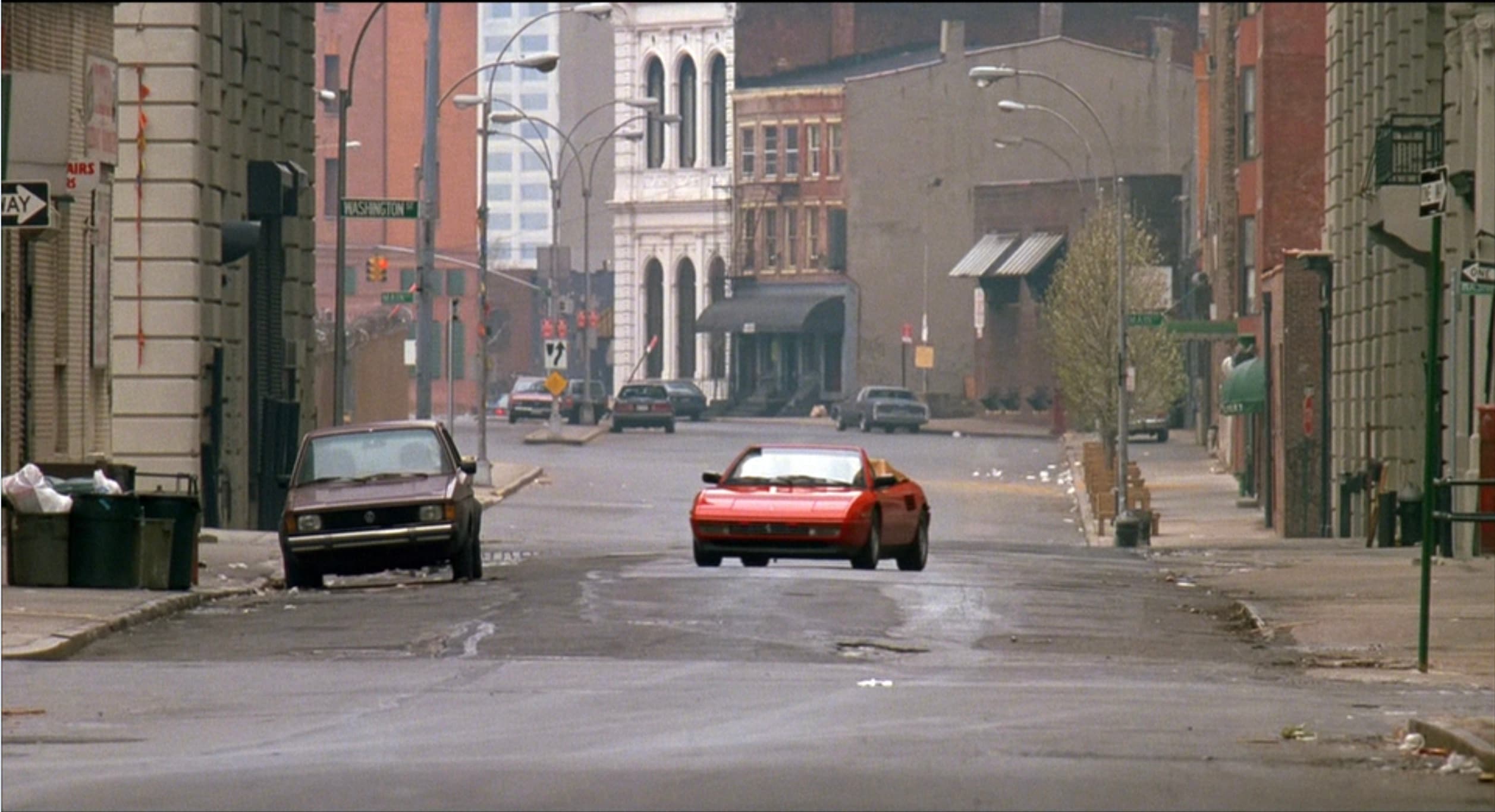
 They go to a Ferrari dealer and bribe an older salesman to let them take it for a ride. Once out of sight, Charlie lets the Colonel drive along the back streets of Manhattan. They get pulled over and he talks his way out of it. After returning the car, on the way back to the Astoria, Frank has a manic episode, deep in the dumps, acting wildly. Charlie gets him back to the hotel.
The Colonel sends Charlie out for cigars. Charlie comes back early, without them, to find the Colonel in his dress blues, getting ready to kill himself.
“I’m gonna shoot you, too. Your life’s finished anyway. Your friend George is gonna sing like a canary. And so are you. And once you’ve sung, Charlie, my boy, you’re gonna take your place on that long, grey line of American manhood. And then you will be through.
“I’m gonna kill you, Charlie, cause I can’t bear the thought of you SELLIN’ OUT!
“You break my heart, son. All my life I’ve stood up to everyone and everything, because it made me feel *important*. You do it… because you mean it. You’ve got integrity, Charlie. I don’t know whether to shoot ya or adopt ya.”
With this crisis averted, Charlie realizes that he’d missed his flight—the Colonel hadn’t even booked a return ticket. They get their driver to drive them from Manhattan to New Hampshire, where Charlie gets dropped off at his school, just in time for his disciplinary hearing. Though he’d not been invited, the Colonel follows soon after.
“Be careful what kind of leaders you’re producing here. I don’t know if Charlie’s silence here today is right or wrong. I’m not a judge or jury, but I can tell you this: He won’t sell anybody out to buy his future! And that, my friends, is called integrity. That’s called courage. Now that’s the stuff leaders should be made of.
“Now I have come to the crossroads in my life. I always knew what the right path was. Without exception, I knew. But I never took it. You know why? It was too damn hard. Now here’s Charlie. He’s come to the crossroads. He has chosen a path. It’s the right path. It’s a path made of principle that leads to character. Let him continue on his journey.
“You hold this boy’s future in your hands, committee. It’s a valuable future. Believe me. Don’t destroy it. Protect it. Embrace it. It’s gonna make you proud one day, I promise you.”
The committee deliberates very briefly.
“Mr. Simms is excused from any further response to this incident.”Hoo-ah.
Cue all the students cheerly and applauding wildly. Cue fathers and businessmen looking vaguely uncomfortable because they know that their lives have no honor and that their every privilege stems from a lack of principle.
Outside, the Colonel meets Christine Downs, a political-science teacher. He flirts unashamedly with her. We are to understand that perhaps something will come from their meeting. He identifies her scent: “Fleurs de Rocaille” (“Flowers from a brook” he says, though rocaille actually means “rocky ground” or “rock garden”).
Manny drops them off at the Colonel’s house, then drives Charlie back to the school. Charlie lingers long enough to see the Colonel treating his grandkids more like grandkids.
- The End of the Beginning of the End (2026) — 7/10
David Cross is still doing his standup at 62 years old and it’s a bit uneven. He tells pretty good stories but some of them are pretty long.
David Cross | The End of The Beginning of The End (Full Comedy Special) by David Cross | 800 Pound Gorilla Media (YouTube)
- The letter to a neighbor in Park Slope was good.
- The handjob/massage story was decent, but way too long.
The slave bit was quite good.
“The Machu Pichu trail goes to show you how there are benefits to slavery.”“I think that I would have been a really great slave-owner. No, hear me out! Like, where other masters’ slaves would wish they were my slaves.”- He then tells stories about hoarding junk in storage units (“92% of all storage units on the planet Earth are in the U.S.”) and giving it away, like in a cardboard box on the side of the road. “People will collect things that other people in the world need.” This was probably the best bit.
- He closes on a bit about abortion, which was ok.
- Cleopatra (1963) — 6/10
Julius Caesar (Rex Harrison) arrives in Egypt by ship. It is impressive. This is a movie with hundreds—if not thousands—of extras who were invited just for one five-second panning scene. And they built incredibly large sets, putting together gigantic buildings just for a few scenes.
Caesar meets Cleopatra (Elizabeth Taylor) when she is delivered to his rooms rolled up in a carpet. It is absolutely unclear why she chose to be delivered in this manner but she clearly chose it because she’s also clearly in charge of the palace, which is hers, and Caesar is her guest. Oddly enough, she needs him to restore her to power somehow. She must be a queen in exile, I guess.
The scenes in Cleopatra’s baths are lush and incredibly detailed. There are beauties everywhere, and much more lasciviously displayed than I’d have expected from a 1960s Hollywood film. Like, you can see a lot of Elizabeth Taylor.
The library of Alexandria burns. The Romans are monsters. They don’t seem to care that their having set fire to the Greek ships has caused the library to burn. There follows a huge battle scene, where the Romans breaks through the ranks of the Greeks, who are still putting up a fight but are doomed to lose against the overwhelming opposition.
Cleopatra seduces Caesar. I am skipping a lot of exposition and dialogue here but that this the upshot. She bears him a son.
There follows a bunch of intrigue along with some Olympics-opening-ceremony-level set pieces, one of them with a lot of “African” dancers, again showing a lot more skin than I’d have thought would have been allowed in theaters in 1960s U.S.A.
Cleopatra enters with Caesar’s son, both seated on a throne set on a giant, black sphinx that rolls in on giant wheels. Slaves transfer her palanquin to the ground, where she greets and bows to Caesar. Caesar begins to teach his child to rule.
Mark Anthony (Richard Burton) enters the picture. A bunch of stuff happens, just one sumptuous scene after another, almost overwhelming. The acting is not great. Richard Burton kind of lumbers around and seems kind of drunk. His arms are kind of laughably skinny. The myth of Elizabeth Taylor’s beauty has been greatly exaggerated. I think people were just amazed that her décolleté stayed closed throughout the film.
And don’t get me started on the boring camera work. They spent all their money on that panning shot in the beginning. Now we’ve got a single static camera filming scenes that are minutes long, filled with only conversation.
After a drunken bacchanalia, Marcus follows Cleopatra to her bedroom, where he yells at her. But then, you know. You know what happens. He has his way with her.
There are a lot of naked male legs in this movie. Just forests of hairy legs topped by short togas. it’s really a unique look for a movie this long.
Anyway, Marcus Antonius and Cleopatra schtup some more and then he returns to Rome, where he marries some other lady—Octavia—in order to secure the empire. Cleopatra flips the fuck out when she gets the news, taking a knife to a rack of clothes and then to her giant, round bed.
Antonius is back, professing his love for Cleopatra. Caesar’s son denounces him for his love of the Egyptian whore and declares war on part of his own empire, then kills Cleopatra’s old messenger with a spear, which is like, a beta move, bro. You don’t need to kill the old man, you pussy.
I can’t look away from Ramos (Martin Benson), who is the spitting image of Mr. Spock.
Anyway, we now have a naval battle on our hands, with flaming projectiles that I’m not so sure aren’t anachronistic. But sure, let loose. I like that Antonius enters battle with a giant cup of wine. I guess Richard Burton had that written into his rider—that he gets to drink on set during longer scenes.
Anyway, there are a lot of sinking boats and things don’t seem to be going that well for Marcus Antonius. He sees Cleopatra fleeing the scene and gives chase, even though his commanders beg him to stay, to give his men courage and succor. No dice. He chases after the lady. Cleopatra receives Antonius but orders her guards to disarm him first.
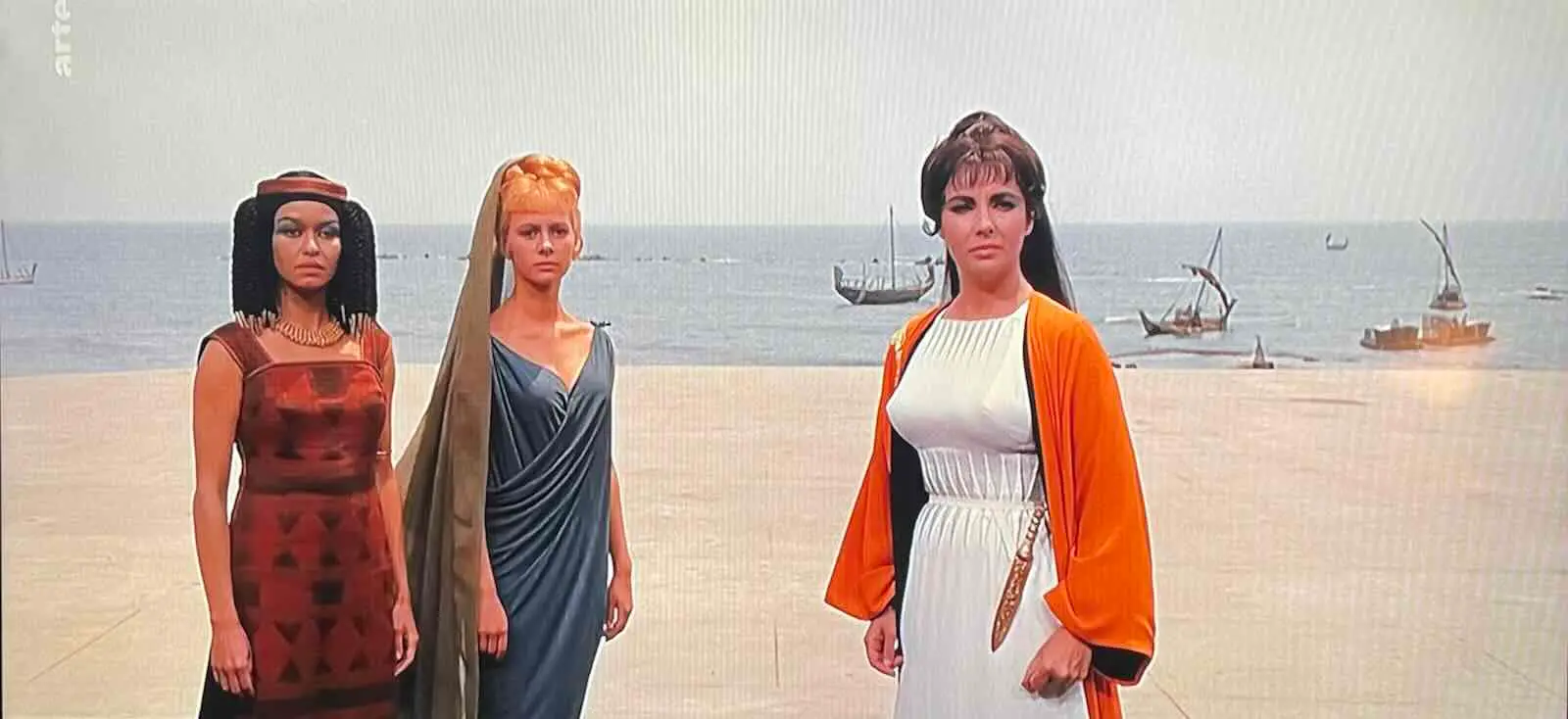
 Cleopatra with her lieutenants and her double barrelsThe sets continue to unrelentingly good. This movie is way too long, but at least it’s pretty. The costumes aren’t all they’re cracked up to be. The bustiers are kind of ridiculous. Exhibit A to the right.
So what else happens? Um, Marcus Antonius loses his army in the sands. Am I watching Dune now? Or Lawrence of Arabia? Oh, neat, now we have yet another gigantic set piece, this time with what looks like hundreds of horses arrayed against a lone Marcus Antonius. They refuse to fight him, taking him with them instead. Thinking himself to have been abandoned by Cleopatra, he commits showy suicide, ramming his sword into his Entrails. His “friend” reveals to him that he was just fucking with him and that Cleopatra is actually waiting for him.
This next part is worth describing in detail because they seem to have had endless money. Cleopatra is in an onyx temple with golden statues all around. His friend brings Antonius to what looks like a window-washer’s platform that is pulled up by two of Cleopatra’s female servants, where he finishes his days with his head in Cleopatra’s lap, surrounded by even more gold and gilding and dark stone. What a set!
Antonius dies in her arms. Caesar Octavius gloats. Cleopatra swears she will commit suicide. Octavius pretends that he’s in control. She swears on her son’s life that she will not kill herself. She knows that her son is already dead.
I watched it in German because the original language wasn’t available and no subtitles were available either. This is one of the rare movies that has been synchronized to German in which most of the people use the familiar verb form with one another. It makes sense when they’re in bed with one another but it feels very odd in official discussions between Cleopatra and Antonius, where using anything but the formal is inconceivable. It lends the whole film a nearly thrown-together and casual U.S.-American air, which isn’t great. It felt like a comedy that wasn’t funny, almost as if Mel Brooks had directed it but not written it.
[1] These are notes for me to remember what I watched and kinda what I thought about it. The amount of text is not proportional to my enjoyment. I might write less because I didn’t get around to it when it was fresh in my mind. I rate the film based on how well it suited me personally for the genre, my mood and. let’s be honest, level of intoxication. I make no attempt to avoid spoilers. Links are to my IMDb ratings↩