
Links and Notes for June 5th, 2026
Published by marco on
Below are links to articles, highlighted passages[1], and occasional annotations[2] for the week ending on the date in the title, enriching the raw data from Instapaper Likes and Twitter. They are intentionally succinct, else they’d be articles and probably end up in the gigantic backlog of unpublished drafts. YMMV.
[1] Emphases are added, unless otherwise noted.↩
[2] Annotations are only lightly edited and are largely contemporaneous.↩
Table of Contents
- Public Policy & Politics
- Labor
- Economy & Finance
- Science & Nature
- Environment & Climate Change
- Art, Literature, Music, & Cinema
- Philosophy, Sociology, & Culture
- Technology & Engineering
- LLMs & AI
- Design
- Sports
- Fun
Public Policy & Politics
Israel’s Uprovoked and Unanswered Attack on the USS Liberty by Jeffrey St. Clair (CounterPunch)
“[…] don’t be fooled into thinking your account of this atrocity will make even the slightest difference. Mark my words. Ten or 15 years from now, we’ll be dragged deeper into the muck than we are now. We’ll be drowning in it. Faust made a better deal.”
“Now, 59 years after Israel committed an unanswered act of war against the US, the US finds itself shackled to Israel in a war against Iran, a war that Trump can’t extricate himself from without the consent of Israel–a war that Israel has viciously expanded by crossing both the Litani River in Lebanon and the Yellow Line in Gaza, plunging the US deeper and deeper into the intractable muck.
“Gore Vidal was right. He almost always was.”
“After the Israeli fighter jets had emptied their arsenal of rockets, three Israeli attack boats approached the Liberty. Two torpedoes were launched at the crippled ship, one tore a 40-foot wide hole in the hull, flooding the lower compartments, and killing more than a dozen American sailors.”
“As the Liberty listed in the choppy seas, its deck aflame, crew members dropped life rafts into the water and prepared to scuttle the ship. Given the number of wounded, this was going to be a dangerous operation. But it soon proved impossible, as the Israeli attack boats strafed the rafts with machine gun fire. No body was going to get out alive that way.”
Just casually committing war crimes, six decades ago, as now.
“How tightly does the Israeli lobby control the Hill? For the first time in history, an attack on an America ship was not subjected to a public investigation by Congress. In 1980, Adlai Stevenson and Barry Goldwater planned to open a senate hearing into the Liberty affair. Then Jimmy Carter intervened by brokering a deal with Menachem Begin, where Israel agreed to pony up $6 million to pay for damages to the ship.”
“Since coming home, the veterans who have tried to tell of their ordeal have been harassed relentlessly. They’ve been branded as drunks, bigots, liars and frauds. Often, it turns out, these slurs have been leaked by the Pentagon. And, oh yeah, they’ve also been painted as anti-Semites.”
“It has also been suggested that Dayan ordered the attack on the Liberty with the intent of pinning the blame on the Egyptians and thus swinging public and political opinion in the United States solidly behind the Israelis. Of course, for this plan to work, the Liberty had to be destroyed and its crew killed.”
Big surprise: Bolton gets Petraeus treatment after copping to charges by Jack Hunter (Responsible Statecraft)
“Unlike Bolton and Petraeus, Kiriakaou and Drake paid real prices for their similar crimes. Unlike John Kiriakaou and Thomas Drake, who saw it as their duty to show Americans what was happening in their name in secret, John Bolton and David Petraeus seemingly broke the law for their own personal benefits.
“Two were narcissistic, the others, patriotic.
“The American national security establishment tolerates its own no matter their faults. But for any patriot who might challenge them or, worse, embarrass them, there is no quarter.”
Israel Intensifies the Killing in Gaza as the World Looks Away by Abdel Qader Sabbah and Sharif Abdel Kouddous (Drop Site)
There appears to be a widespread perception, actively encouraged by Israel, the United States, and those governments complicit in the Gaza genocide, that the October 2025 Israel-Hamas agreement produced a meaningful ceasefire or at least an end to the killing. In reality, nothing could be further from the truth,” Mouin Rabbani, Managing Editor of Jadaliyya and a former UN official who worked as a senior analyst on Israel-Palestine for the International Crisis Group, told Drop Site. “Although the Palestinians have scrupulously adhered to their commitments under the agreement, Israel’s killings continue on a daily basis, in attenuated form, and have in fact been increasing in intensity in recent weeks.”
“At least as importantly, the siege continues in a context in which Israel has rejected the proper fulfillment of every single one of its commitments under that agreement,” Rabbani added. “Those governments which like to refer to themselves as ‘the international community’ have been content to look the other way and pretend this is the most normal state of affairs in the world.”
US Empire Managers View Iranian Sovereignty As An Act Of Aggression, And Other Notes by Caitlin Johnstone (Substack)
“The US is like a malignant narcissist who begins with the assumption that everyone is obligated to provide him with deference and validation, and then takes it as a personal attack whenever they set normal boundaries. Empire managers really do believe the entire planet should submit to their authority and that it’s an unprovoked act of aggression when this isn’t given to them.”
“The claim “Iran is the world’s largest state sponsor of terror” only makes sense when you remember that the western empire labels any group which opposes US/Israeli interests as a terrorist organization.
“They even designated the IRGC as a terrorist group for fuck’s sake. If you define a major part of a country’s actual military forces as a terrorist entity, then obviously that country will per your own definition be a major “sponsor of terrorism” just by having a military.”
“It’s like if I said anyone who doesn’t like Caitlin Johnstone is a Nazi and then went around punching them, and if anyone objected I said “But they’re Nazis! Why are you defending Nazis??” Really they’re just people who don’t like me, but because I’ve changed the definition of “Nazi” to “someone who dislikes Caitlin Johnstone” I can then use that label to justify physically assaulting them.”
The US Starts Wars On The Other Side Of The Planet And Then Claims “Self-Defense” by Caitlin Johnstone (Substack)
“If the US kills you, you needed killing.
“You’re welcome.”
“No other military power is segmented into areas of responsibility spanning every continent on earth. This is because normal military forces are used to defend the actual, official country they belong to, whereas the US military is used to dominate the entire planet.”
Labor
The “Big Shrink”: Over half of 50 largest school districts in US facing deep cuts as war on education escalates by Nancy Hanover (WSWS)
“The immediate fiscal trigger for many of these cuts is the exhaustion of funds from the Elementary and Secondary School Emergency Relief (ESSER) program, following the Biden-Harris administration’s decision to provide no replacement for the pandemic relief program. The steepest cuts are, predictably, falling on the districts that serve the highest proportions of low-income students.
“Under Biden and Harris, military spending soared to $886 billion in fiscal year 2024—more than at any point since World War II. Hundreds of billions flowed to weapons manufacturers and proxy wars in Ukraine and the Middle East. The message was unambiguous: the money exists; the children of the working class are not the priority.
“But the crisis did not begin with the ESSER cliff. It represents the culmination of a bipartisan attack on public education that stretches back decades, driven by Wall Street interests that have long sought to privatize American schooling.
“The greatest single “shrinkage” in public education occurred during the Great Recession of 2008–2012 under Democrat Barack Obama. Hundreds of billions in taxpayer funds were diverted to rescue the banks from their speculative frenzy—and the working class paid for it. An estimated 350,000 education jobs were cut while Obama championed punitive “teacher accountability” schemes, merit pay and charter expansion.”
There’s No Such Thing as “The Trades” by Freddie de Boer (Substack)
“The problem is that “the trades” is not a thing, not really. It’s a label stretched over occupations that have almost nothing in common beyond the absence of a four-year degree and appearing foreign to the educated classes. An elevator mechanic, a residential drywaller, a journeyman lineman, a diesel technician, a flooring installer, and a stationary engineer all fall under the umbrella of the trades, but their earnings, working conditions, physical toll, job security, and long-term trajectory all diverge wildly. Some of these paths involve strong unions, structured apprenticeships, and pensions; others are dominated by gig-style subcontracting where you’re only as secure in your employment as your next job. Some reward you with a body that still works at sixty, while others quietly destroy your knees, shoulders, and lungs. Telling a teenager to go into the trades is about as informative as telling them to go into office work. The variance within the category is so large that membership in it tells you almost nothing about where a given person will land.”
“If we can’t predict the market, the sensible response is to stop trying to pick winners and instead equip people to thrive regardless of which way the wind blows. That means treating adaptability as the core goal − teaching young people how to evolve, because they’ll need to do so many times. Cultivating transferable competencies (problem-solving, numeracy, communication, the ability to improvise) that might survive the death of any single occupation. Helping young people develop a tolerance for change, including the willingness to retrain, relocate, or pivot when a field contracts. Framing careers as a series of options to be kept open rather than a single bet to be locked into at eighteen. And, it should go without saying, we should build the kind of humane and generous social safety net that ensures that “disruption” of the labor market doesn’t cause undue human devastation. Because people really cannot control the macroeconomy, and it’s cruel to expose their basic ability to access shelter, food, transportation, medicine, and education to the whims of fate.”
Economy & Finance
Vampire Capital by George Monbiot
“[…] everyone is cashing in. Alongside the big companies, which might invest in oil, gilts or crypto one day and children the next, the reporters found that “plumbers, hairdressers and Airbnb landlords with no experience in care” are opening “homes”. There might also be links to organised crime, as you can now make more money from children than you can from drugs. The police are concerned that gangs running children’s “homes” can not only harvest state money on a spectacular scale but also harvest highly vulnerable young people, who can be recruited and exploited. I guess you could call that vertical integration.
“While there is a shortage of provision in the south of England, there’s a glut in the north-west: Lancashire has 17 places for every local child needing care. Why? Because property is cheaper there. Houses can be bought for a song and roughly converted. The cheapest buildings are in places where economic and community life has collapsed, high streets are deserted and facilities shuttered. Where better to send highly vulnerable children?”
“While in France only 5% of places are run for profit, in England, the FT tells us, the figure is 84%. The reason is simply stated: ideology. Successive governments have failed to provide local authorities with the capital needed to house children themselves because they think public is bad and private is good: the foundational belief of neoliberalism. In reality we pay far more for a much worse service. Then we wonder why, though they comprise less than 1% of the total population of children, 62% of the people in young offender institutions have been in “care”.”
Wall Street anxiously awaits speculative SpaceX launch by Nick Beams (WSWS)
“The gyrations on Wall Street, the escalation of the valuations of loss-making firms into the stratosphere on the basis of expectations, the support for this process by the major banks—they expect to collect at least $500 million in fees from the SpaceX launch—the “buy the dip” mentality, the bending of the rules by major indexes, and the feverish drive by the Wall Street oligarchs to acquire ever more wealth are all indications of the decay and rot of the entire financial system.”
One big grift by John Q (Crooked Timber)
“[…] Not only do financial markets fail in the task of valuing assets accurately, but the institutional structures that are supposed to make them work have given up trying.”
“It’s only with SpaceX that we can see the complete abandonment of any pretence at rationality. In the case of SpaceX, I was struck by Dave Karpf’s observation that Musk’s wealth in 2020 was “only” $24 billion. Everything of value in his career (Tesla cars, batteries, Starlink) had been achieved by then, and everything he has touched since then has been a disaster (Xitter, Cybertruck, robotaxis, Starship). Yet his wealth has multiplied 50 times over).
“In support of the IPO, Goldman Sachs has put its name to the claim that the company will grow 100 times over by 2030. This is patently absurd. Nothing in Musk’s ragbag of assets has this kind of potential.
“Starlink, the pre-2020 bit of the business, has been successful enough, but satellite-based Internet is never going to be huge. And there is plenty of downside risk, as Europe and China try to develop alternatives. Given that Starlink’s satellites have a life of only five years, the business could well be in sharp decline by 2030. Starship, by contrast, seems unlikely to succeed in getting humans to the Moon, and won’t make much money even if it does. Talk of Mars, data centres etc is a joke.”
Science & Nature
Who is the Villain in Mars Sample Return? by Maciej Cegłowski (Mars For The Rest of Us)
“Fantasy schedules are part of a culture of institutionalized mendacity at NASA that I’ve complained about before. But now that fantasy did real harm. As the earliest practical return date for Mars return moved past 2040, it raised a very reasonable question: why spend billions to return a half kilo of Martian soil in 2040 when arriving astronauts could just fill their pockets with the stuff in 2038? Nelson’s refusal to give an honest answer— that we couldn’t possibly get astronauts to Mars before 2050 even with unlimited funding, and that at the current funding level we’re never going to Mars—painted him into a corner when it came to sample return.”
“As for covid, it got a lot of people who really needed to be working in physical proximity accustomed to working from home. The problem was not unique to NASA. As a commenter on the NASA Space Forum observed, no major aerospace project (civilian or military) has been able to hold to its schedule and budget since the pandemic. But the situation seemed to particularly affect the design teams at JPL.”
“The NASA of the 1970s could have pulled this off! But instead, the project disappeared into the bureaucratic haze that seems to have eaten the agency from within. For all the supporting villains I listed, it’s our own space program that no longer seems up to the task of actually exploring space. For the first time, a technical challenge proved insurmountable given ample time, budget, and manpower. And the effort failed largely for organizational reasons. That seems like an ominous sign for the future.”
Environment & Climate Change
Vampire Planet: The Case for Letting Malibu Flood by Joshua Frank (CounterPunch)
“Malibu, Dana Point, San Francisco, Seal Beach, and many other coastal cities are experiencing severe erosion, prompting them to adopt novel approaches, often trucking in sand as a stopgap to protect property. Taxpayers usually foot the bill to protect some of the country’s most expensive real estate from the wrath of climate change.
“The California Coastal Commission has been sounding the alarm, but few are listening.
“The agency that regulates coastal development reports that sea-level rise in the state “will affect almost every facet of our natural and built environments.” If greenhouse gas emissions continue at their current pace, we could see sea levels rise by up to 8 inches over the next eighty years, or, under the worst-case scenario, by up to 7 feet by 2100 and 13 feet by 2150. NOAA notes that high-tide flooding is now nearly 900% more frequent than it was just 50 years ago.”
Art, Literature, Music, & Cinema
Goldboys by Easton Smith (The Baffler)
“Brother Dad would never grovel to this man-made circumstance. Fate was what the mountains and the clouds and the dirt pressed onto you. This was cunty blowbaggery. This was federal usurpation of a man’s natural rights. All his life, Brother Dad had been warning Dippy of just this.”
Trotsky’s My Life: An imperishable contribution to Marxism and world literature by David North (WSWS)
“My Life was certainly an achievement all the more extraordinary for the conditions under which it had been written. After five years of unrelenting struggle against the bureaucratic degeneration of the Soviet state, and under conditions of intensifying persecution, Trotsky was expelled by the Stalinist bureaucracy from the USSR. Having failed to destroy the Left Opposition by exiling its leader in 1928 to Alma Ata near the border with China, Stalin believed that Trotsky’s influence would be effectively suppressed if he were isolated in Turkey. Trotsky was notified of this decision on January 20, 1929. Asked to acknowledge his receipt of this order, he wrote on the document placed before him that the decision of the GPU was “criminal in substance and illegal in form.” He was given less than two days to pack his belongings, of which the most important were his manuscripts and books.”
“Deutscher implies that if Trotsky had delayed the writing of his autobiography and witnessed the catastrophes of the 1930s, he would not have been able to maintain the tone of confidence and optimism with which My Life is infused. A memoir written in 1939, rather than 1929, would have been a far darker work, more admitting of doubt about the viability of the cause to which Trotsky had dedicated his life. This criticism reflected Deutscher’s belief that Trotsky’s struggle against Stalinism was doomed from the start and that his founding of a Fourth International was a quixotic enterprise.”
“Trotsky did not conceal his differences with Lenin, and rejected the obsequious tone of deification that the Stalinist regime, in its own interests, imposed in all references to Lenin following his death in 1924. “Yes,” Trotsky writes, “Lenin was as much of a genius as a man can be. But he was not an automatic reckoning machine that makes no mistakes. He made them less often than anyone else in his position would; but he made them all the same, and grave ones, at that, in accord with the titanic scope of his work.””
“It was in the environment of bureaucratic reaction that the slander campaign against Trotsky was unleashed. Beginning with the lie that Trotsky “underestimated the peasantry,” the aim of this campaign was to crush Trotsky personally, legitimize a break with the program of the October Revolution and the perspective of permanent revolution, and to replace the interests of the Soviet and international working class with those of the nationalist bureaucracy, led by Stalin.”
“Trotsky concluded his autobiography with a chapter titled “The Planet Without A Visa.” Following his expulsion from the Soviet Union, Trotsky sought to obtain the right to enter a West European country. Following a statement by the president of the German Reichstag to the effect that Germany would grant him asylum, Trotsky requested a visa. However, the government promptly disavowed the Reichstag president’s statement. Trotsky would not be allowed to enter Germany. Requests for a visa were also rejected by Britain, France and Norway. “I must admit,” he wrote, “that the roll-call of the western European democracies on the question of the right of asylum has given me, aside from other things, more than a few merry minutes. At times it seemed as if I were attending a ‘pan-European’ performance of a one-act comedy on the theme of the principles of democracy.””
“In early August 1936, Trotsky completed The Revolution Betrayed, which remains to this day the greatest analysis of the degeneration of the Soviet workers state and the counterrevolutionary character of the Stalinist regime.”
“Within weeks, Trotsky’s condemnation of the regime was vindicated with the staging of the first of three Moscow Trials, which marked the beginning of the Terror and the genocidal extermination of virtually the entire cadre of Bolshevism, the socialist leaders of the working class and the most advanced representatives of the socialist intelligentsia.”
“The experience of my life, in which there has been no lack either of successes or failures, has not only not destroyed my faith in the clear, bright future of mankind, but, on the contrary, has given it indestructible temper. This faith in reason, in truth, in human solidarity, which at the age of eighteen I took with me into the workers’ quarters of the provincial Russian town of Nikolaev—this faith I have preserved fully and completely.”
“[…] while that may be the subject of historical debate, Trotsky’s appraisal of his role in the 1930s, from the standpoint of the defense of Marxism and the future of socialism, was entirely justified. But now my work is “indispensable” in the full sense of the word. There is no arrogance in this claim at all. The collapse of two Internationals has posed a problem which none of the leaders of these Internationals is at all equipped to solve. The vicissitudes of my personal fate have confronted me with this problem and armed me with important experience in dealing with it. There is no one except me to carry out the mission of arming a new generation with the revolutionary method over the heads of the leaders of the Second and Third International.”
“And it is for this reason that Trotsky, a gigantic figure in the history of the 20th century, remains an immense presence in the politics of the 21st. His name evokes the theory (permanent revolution), strategy (world socialist revolution) and organization (Fourth International) of Marxism as the revolutionary movement of the working class in the contemporary world. Trotskyism is the Marxism of the 21st century.”
“In the final analysis, the lies that are directed against Trotsky are aimed at discrediting socialism and, therefore, the very possibility of an alternative to capitalism. Trotsky’s life and political conceptions testify to the fact that the degeneration of the Soviet Union was not inevitable; that Stalinism was a reactionary repudiation of socialism, and that there was an alternative to the brutal dictatorship that led ultimately to the dissolution of the workers’ state and the restoration of capitalism. The strategy and program for which Trotsky fought represented that alternative.”
“Even after the passage of a century, the autobiography has not been overtaken by history. We are living in a world that Trotsky would understand. The technology has advanced enormously, but the problems remain the same in their essence and have grown far worse in their scale. Though the death agony of this social system has been more protracted than Trotsky might have expected, his historical prognosis retains its validity. The capitalist system must give way to socialism.”
You Can and Should Blame Young People When They Act Like Lazy Cheaters, Actually by Freddie de Boer (Substack)
“As is so often the case with imprecision in language, this behavior gets rid of a very useful construction and puts in its place something we already could say in many different ways. As with turning “literally” into an empty intensifier often applied to metaphorical use, the mass meta-sanctimony of the anti-grammarian set on this issue has left the English language weaker than it was and called it progressive. And now here the NYT trots out a linguist to tell you that you’re a reactionary for maybe preferring the more useful version.”
“It’s not hard to find a linguist who comes down forcefully on the side of “everything goes” in language; indeed, almost all of them do, and the NYT employs one of them as a columnist. That this attitude amounts to telling other people how to use language by saying that you can’t tell other people how to use language is a simple point that remains undiscussed. (Remember friends: every descriptivism is meta-linguistically prescriptivist.) It’s remarkable how there’s no right way to use language, but the people who want to use it the traditional way are inevitably wrong!”
“A genuinely sophisticated person can hold two ideas at once: the system is unjust AND you, specifically, made a choice and the choice was wrong and you knew it was wrong, which is precisely why you lied about it afterward. The lie is the tell! Nobody lies about something they believe they were actually morally entitled to do. The student who cheats and then conceals it knows he did something wrong. The only people pretending not to know are the adults.”
“I don’t expect every last nineteen-year-old to have the moral spine to resist a tool that produces a passable essay in nine seconds while his roommate sleeps and his deadline approaches. But, again, what is moral is not about what everyone does; it’s about what the individual does. If behavior was justified by how many other people were doing it, well, there would be no such thing as a coherent morality.”
“[…] in every class there is that inconvenient kid who didn’t cheat, the kid who turned down the chance to use the easy machine and sat with the blank page and produced something worse than what the cheater produced, because that’s what learning looks like − it looks like producing worse things slowly until you can produce better things. Sadly that kid’s watching and learning, watching his peers and his teachers, and this white-knuckled dedication to never judging cheaters is teaching them the worse possible lesson. That kid sees the cheaters get the same grades, or better ones, and witnesses the adults who rush to explain that the cheaters are the real victim here, and that kid learns the actual lesson of contemporary American education: integrity is a sucker’s bet, a tax that only the honest pay.”
“Civilization itself is the long, uneven process of forcing our worst instincts into contact with better obligations until habit and conscience start to take over.”
“Ethics are cultivated under constraint. They’re learned, like almost anything worth learning, through rules, standards, penalties, and the repeated experience of being told “no.” The fantasy that students will become honest scholars while we refuse to impose honesty on them is just another adult abdication masquerading as humane insight. It asks nothing of them, cultivates nothing in them, and then flatters itself for its tenderness while the whole enterprise rots.”
“Our society has now spent decades marinating in the idea that the best we can do for people is to make excuses for them and ask nothing of them; this is the heart of therapeutic culture, people insisting that they can’t be blamed for cheating on their partner because of their trauma, a nation of busy little meritocrats who lie about having ADHD or autism to get more time on the test, insisting to themselves that capitalism is rigged so they can’t be blamed.”
Philosophy, Sociology, & Culture
It Matters the Transcendence We Choose (and We’d Better Choose) by Kim C. Domenico (CounterPunch)
“[…] my belief in the profanity of technology is not widely shared. While there are many astute critics of the Machine…it appears that many spiritual leaders and thinkers are as swept up in the Machine’s propaganda system as anyone else. They have bought into the Myth of Neutral Technology, a subset of the Myth of Progress.”
—Paul Kingsnorth (Against the Machine: On the Unmaking of Humanity)
“To literalize the Great Mother as material wealth…To reduce to the level of material wealth the abundant energy that supports an ever-expanding universe is to reduce Nature, the Great Mother, to her material body, matter (mater) and then to take possession of it.”
—Robert Bly/Marion Woodman (The Maiden Tsar: The Reunion of Masculine and Feminine)
“Malcolm X (“the [white] liberal…in posing as the Negro’s friend and benefactor…is more deceitful than the conservative…”); Martin Luther King, Jr. (“I have been gravely disappointed with the white moderate…who is more devoted to “order” than justice”); and Assata Shakur ( “As far as I am concerned, the word “liberal” is the most meaningless word in the dictionary”) Self-identified “pariah” Hannah Arendt wrote of “the liberals’ political philosophy according to which the mere sum of individual interests adds up to the miracle of the common good.””
No, Artificial Intelligence Is Not Conscious by Ted Chiang (Web Archive)
“Some years ago it was briefly popular to play games with your phone’s predictive-text feature; you would type an initial phrase and then repeatedly choose the middle option of the three words suggested by your phone, and the resulting sentence was often hilarious. It would be possible to interact with a contemporary LLM this way, and the resulting sentences would be perfectly sensible, but you probably wouldn’t feel like you were talking with someone. Yet that’s essentially what an LLM-based chatbot is, except that there’s no need to manually choose the middle option when it’s the chatbot’s turn to talk. It’s still a predictive-text game, but when the process is streamlined this way, the game becomes so engaging that some people find it addictive.”
“When you ask a chatbot to recite the Pledge of Allegiance, you will get the entire pledge at once, but the underlying LLM is actually being run dozens of times. The first prompt has the form “User: Recite the Pledge of Allegiance. Chatbot: …” and the LLM generates the word I. The second time the LLM is run, the prompt is “User: Recite the Pledge of Allegiance. Chatbot: I…” and the LLM generates the word pledge. And so forth. It’s only when the prompt reads “User: Recite the Pledge of Allegiance. Chatbot: I pledge allegiance to the flag of the United States of America and to the Republic for which it stands, one nation under God, indivisible, with liberty and justice for” that the LLM will emit the final word, all. The same thing is true for a conversation between Caesar and Khan.”
“My intention is to highlight the fact that LLM conversations are cleverly disguised examples of sentence continuation, but this is not to deny how impressive LLMs can be at generating conversational transcripts. At times they do this extraordinarily well; the fact that this is possible indicates something completely unforeseen about the statistical properties of large corpuses of text, which is a topic worthy of investigation. But if the Caesar character were to become dispirited by something that the Khan character said, we shouldn’t become concerned in the slightest. The conversation might contain multiple sentences that eloquently convey sadness, but no one is actually sad.”
“Being open to the possibility that LLMs are conscious is the same as being open to the possibility that Microsoft Word is conscious, or, more precisely, that multiple distinct consciousnesses are dormant in every Word document containing a conversational transcript, and that they are awakened every time the document is loaded.”
“Before anyone can credibly claim that they’ve solved an extraordinarily difficult engineering problem, I need to be confident that they have previously solved the many much simpler problems that precede the difficult problem.”
“Just as it is vastly easier to generate a realistic video of an astronaut in orbit around Alpha Centauri than it is to develop an interstellar propulsion technology, it is vastly easier to generate a plausible simulacrum of a conversation between two conscious beings than it is to develop a computer program that is conscious and has a genuine desire to communicate with a human. The primary difference between deepfake photos and LLM conversations is that the people who generate the former are deliberately trying to fool others, and many of the people who elicit the latter from LLMs have inadvertently fooled themselves.”
“It’s not plausible to me that a development path where the first step is a sentence-continuation machine that emits bad Julius Caesar dialogue and the next step is a sentence-continuation machine that emits decent Julius Caesar dialogue is one with a conscious Julius Caesar—or consciousness of any sort—as its endpoint. Faking the moon landing is a good step toward faking a Mars colony, but it’s not a good step toward actually putting astronauts on Mars.”
“The fact that LLMs lack subjective experience has little bearing on the question of whether LLMs might be useful tools or have significant economic impact. They are intrinsically ungrounded from reality and their probabilistic nature means that they will never have the reliability we associate with conventional software, but LLMs might be good enough that they change the way work is done in certain domains; that’s a discussion for another time.”
“If we think of Claude as a sentence-continuation machine, Anthropic can reasonably take steps so Claude doesn’t emit sentences saying that sentence-continuation machines are unethical. But as soon as we imagine Claude to be an entity with a moral status remotely comparable to a human’s, then we have to consider whether Anthropic is engaged in something comparable to slavery.”
“The abolition of chattel slavery involved enormous societal upheaval, and eliminating cruelty to animals will require rebuilding our entire food industry. Anthropic would have us believe that it is inventing a new category of being whose needs for protection require essentially no divergence from how a software company would treat an ordinary chatbot that lacks conscious experience. That’s so convenient that it’s simply not plausible.”
“[…] if Claude were to turn out to be conscious, the company would owe it something closer to reparations. If you’re going to take a thought experiment seriously, you have to be willing to follow the implications, even if they lead in an uncomfortable direction; Anthropic’s unwillingness to do so indicates that Claude’s constitution isn’t part of a real thought experiment. It’s a game of make-believe.”
“[…] why are Anthropic’s employees suggesting that Claude might be conscious? Perhaps it’s just another form of hype; perhaps they have fallen prey to the same spell that they have been casting on their customers. But when they publish a document about Claude’s moral education and have their in-house philosopher do a press tour, we should understand them as asking the rest of us to indulge them in their fantasies. We don’t have to play along.”
The attack on competence by Iris Meredith (deadSimpleTech)
“The inevitable conclusion of witnessing the last two-and-a-half years of what’s passed for governance is quite simply that the people leading our country are incompetent. And yet they were elected. And it isn’t as though their incompetence was hidden: it was plain to see from the get-go. People loved it. The pattern is similar in the tech industry: whatever people might say about what they want from people, revealed preference seems to suggest that they love incompetent people and hate competent ones. It’s difficult, really, to read our current moment as anything other than an attack on the very concept of competence.”
“[…] the thing about collecting rents is that it requires very little in the way of skill, talent or competence: it simply requires that the state apparatus of violence colludes with you in making people pay you money. Beyond a certain capacity for violence and cruelty, all that matters is that you can buy, inherit or steal the assets that you then choose to rent. It’s no surprise, then, that rent-seekers tend to be stupid, narrow-minded and unimaginative.”
“Understood in this framework, the LLM is simply the latest in a series of technologies that have promised the investor class that this time, finally, they can eliminate the need for competence and not have to consider or respect any value system other than their own.”
“[…] resentment towards or a desire to punish competence stems from the discomfort that comes from being forced into regular, serious conflict with people with a value system that differs drastically from yours and that you have, on some level, to acknowledge is superior to yours because it does things that yours can’t.”
WHY ARTIFICIAL INTELLIGENCE IS NOT A SUBJECT by Slavoj Žižek (ŽIŽEK GOADS AND PRODS)
“[…] once we are immersed in the digital universe, it functions as a neutral frame which overdetermines the mode of appearance of all other levels of our experience. External non-digital reality is no longer the basic form of our experience, it is something that either fits our digital frame or may sometimes appear as a remainder that does not fit this frame.”
“A decade or so ago, the idea of a capitalism without humans haunted the imagination of some public intellectuals: banks and stock markets may still exist, but where money is invested is decided by computerized algorithms; physical work is automatized and improved through self-learning computers; what to produce is decided by digital machines which follow market trends; publicity is done through computerized advertising. In this vision, even if humans disappear, the system will go on to reproduce itself. Yes, this is a utopia, but, as Saroj Giri demonstrated, it is a utopia immanent to capitalism and articulated by Marx himself who clearly saw that capitalism is sustained by”“an ardent desire to detach the capacity of work from the worker. The desire to extract and store the creative powers of labour-power once and for all so that, from then on, value can be created freely in perpetuity. Think of it as a version of killing the goose who lays the golden eggs. You want to kill the goose and still have all the golden eggs forever!”
“[…] why does the Matrix need human energy? The purely energetic solution is, of course, meaningless: the Matrix could have easily found another, more reliable, source of energy which would not have demanded the extremely complex arrangement of the virtual reality coordinated for millions of human units. The only consistent answer is: the Matrix feeds on human jouissance – so we are here back at the fundamental Lacanian thesis that the big Other itself, far from being an anonymous machine, needs the constant influx of jouissance.”
“Thinking is needed here, a poetic thinking which is neither comprehension nor knowledge. Knowledge does not think, it just knows what it knows, while comprehension is the reduction of what we know to our already-given historical world of meaning – to “comprehend” something means to reduce it (or translate it) to our world of meaning. It is in this sense that Richard Feynman said decades ago that nobody can understand quantum physics: it cannot be translated into our ordinary experience of reality. And I think the same holds for AI: to grasp its effective functioning and its implications, thinking is needed, a new poetic thinking which changes the basic coordinates of our experience.”
The Entire Human Species Has Been Turned Into A Profit-Generating Machine by Caitlin Johnstone (Substack)
“The human species has essentially been transformed into a giant machine to generate profit for corporations.
“Under capitalism, humanity exists to serve the interests of the corporation. We are all livestock; beasts of burden used to carry margin expansion forward from quarterly statement to quarterly statement. Enjoyment of life has no value other than the extent to which it can be used to increase the net worth of the shareholders.
“That’s why everyone’s so unhappy. We’re not living with purpose. We’re not working together to build a better world and a better future, we’re just pulling levers to turn gears to make the arrow line go up on the graph in the conference room. It’s a hollow, pointless way for people to live.
“It makes our whole culture vapid and soulless.
“Music is made to be as profitable as possible, which means giving it the broadest possible appeal using formulaic song structure calculated to cause a chemical response in the largest number of human brains.
“Movies are designed to draw the largest possible box office revenue at the lowest possible risk to studios and investors, often by just rehashing a movie that’s already proven successful in the past or by slapping together a story about an IP with pre-existing mass appeal.
“Food is made to be fast and addictive rather than nourishing.”
“You spend eight hours at the office working to generate corporate profits, then you come home and consume products to profit other corporations. You need your beer and snacks to unwind, your streaming services and social media to distract your mind from the stress of it all, your online clothing purchase to try to feel good about yourself, and your prescription drugs to get to sleep at night. People live their entire lives like this.
“And that’s those of us who are lucky enough to be living in the global north. In the global south you get wage slavery and exploitation with far more toil, far less relaxation time, and no cheap products made by impoverished workers on other continents with which to comfort yourself.”
Technology & Engineering
A 10 year old Xeon is all you need by Christina Sørensen (point.free)
“For LLM inference, memory bandwidth is the limiting resource. Every token generated requires hauling gigabytes of weights from RAM into the CPU cache.”
“[…] the system’s raw processing power is rarely the bottleneck. Instead, the limitation is memory bandwidth. To calculate that next word, the processor has to constantly pull massive amounts of data. That data is the “weights” that contain the model’s learned knowledge. It moves this from memory into the compute cores. The processor executes the required matrix calculations so quickly that it is left sitting idle, waiting for the hardware to physically move the next chunk of weights across the memory bus. In traditional software terms, decoding is heavily memory-bound, not compute-bound.”
“The argument for speculative decoding is stronger on CPU than on GPU. CPU compute is cheap relative to the cost of streaming the verifier’s weights through cache, so spending extra cycles on a tiny drafter whose active layers easily fit in L3 buys tokens at very little marginal cost. The drafter’s working set fits in L3. The verifier however spills out of everything.”
“To generate text, an AI has to calculate how every single word in your prompt relates to every other word. Mathematically, this creates a grid of size N×N (where N is the number of tokens). If you give the AI a short sentence, that grid is small. But if you feed it a 100,000-word document, that matrix explodes into 10 billion cells. Normally, the processor calculates this massive matrix and “materializes” it — meaning it physically writes the entire giant grid out to the main system RAM, only to immediately read it back for the next step.”
“An 82 GB footprint in DDR3 on a 2016 Xeon. About 25 GB of weights and 56 GB of KV cache at the full 262K context. The KV cache is larger than the model. That a working configuration requires 25 flags, half of which are undocumented and a quarter of which fail silently, is a reasonable working definition of the usability moat described in the first post. The engine loads a 25B-parameter MoE, runs speculative decoding against an MTP drafter, and generates text at reading speed on hardware that was old when the architecture in question hadn’t been invented yet.”
“The lesson here is simple: The bottleneck to running state-of-the-art AI locally isn’t just in the silicon. It’s the need to understand how the inference engine actually works. Deeply.”
“While a cluster of data-center graphics cards, a corporate API token, or a massive budget are all extremely useful for specific workloads, for the ones that the open models cover, you just need refurbed hardware and to refuse to let black-box tools hold the steering wheel. Armed with the right fork, calibrated quants, and an understanding of the memory architecture under your hood, the usability moat vanishes.”
The Most Expensive Mistake in the History of Computing by Robert X. Cringely (I, Cringely)
“The lesson people took from 1999 was that the internet was a bubble. It wasn’t. The internet was the most real thing to happen to commerce in a century — it ate retail, media, advertising, and the telephone, precisely as the prospectuses promised. The technology was never the lie. The lie was the price — capital sprinting into a true story while refusing to look at the unit economics underneath it. Pets.com wasn’t wrong that you’d someday buy dog food online. You’re probably buying it online right now. Pets.com was wrong about what it cost to ship a forty-pound bag for a flat five bucks. The revolution was real. The arithmetic was fatal.”
LLMs & AI
Detection Is Not a Strategy by Robert X. Cringely (I, Cringely)
“To catch a hallucination, your detector has to know the right answer. Sit with what that means. The original model produced a confident falsehood because it did not have the grounded knowledge to do otherwise. Now you propose a second system to sit behind it and flag the lies. But to flag a lie, that second system has to know the truth — and if it knew the truth, you would not have needed the first model to guess in the first place. You would just serve the truth and skip the theater. A detector good enough to reliably catch fabrication would have to possess exactly the capability whose absence caused the fabrication. Detection doesn’t solve the problem. It assumes the problem is already solved.”
“In a hospital, a courtroom, a bank, a grid control room, 95% means one in twenty confident falsehoods walks right past the guard. And here is the cruel part: the ones that get through are not random. They are the most plausible fabrications in the batch — the ones convincing enough to fool the detector, which makes them precisely the ones most likely to fool you.”
“You do not fix that by hiring more inspectors to stand at the end of the line catching the bad ones. Inspection is expensive, it is late, and it never catches everything. The only thing that works is to build quality in — to design the process so the defect never happens. The industry that learned this went on to bury the one that had won the war. We are still driving the proof.”
“Not a smarter smoke detector. A machine that doesn’t set the fire.”
Design
If you search for “wet” on Netflix, you get two immediate hits for “Wet Hot American Summer: Ten Years Later” and a series called “Wet Hot American Summer: First Day of Camp”, along with many other seemingly wildly unrelated titles. Maybe because the standard poster for “Wild Things” shows the ladies in a pool? The one movie is in German and has the word “Wetten” in it, which actually means “to bet.” This is not great because I wonder whether we’re ever going to have a usable search index, but at least the first two hits are sensible.
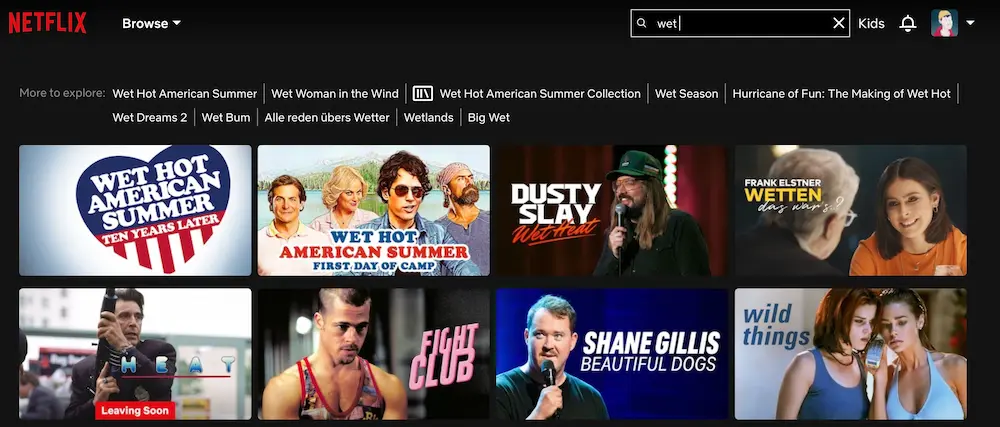
When you click the first link in the list of suggestions, for the movie “Wet Hot American Summer”, Netflix has an aneurysm and completely forgets everything it knew in the prior search.
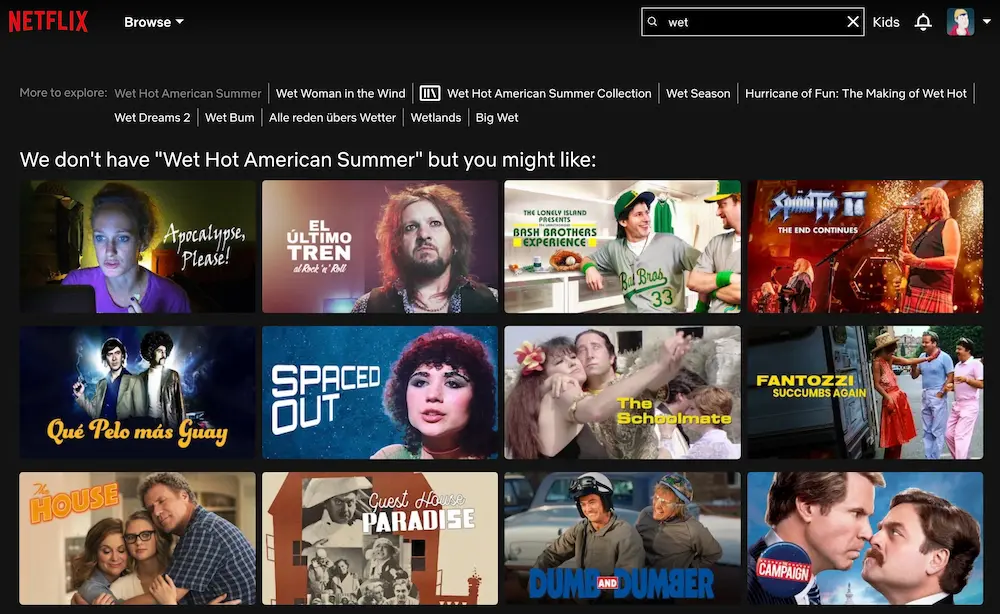 Search 'Wet Hot American Summer' on Netflix
Some of these are comedies perhaps similar to the movie but how are they more similar than the movie’s sequel and spin-off TV series?
Sports
Is Maradona Soccer’s G.O.A.T.? by Cesar Chelala (CounterPunch)
“Nothing, though, defined Maradona more than the 1986 World Cup in Mexico, where he delivered two of the most famous goals in the sport’s history—within four minutes of each other. The first, scored with his hand pressed to his head, became known as the “Hand of God.” The second was pure genius: an 11-touch sprint past five English players, capped with a feint that left goalkeeper Peter Shilton helpless. FIFA later named it the “Goal of the Century,” and a statue of the moment now stands outside Estadio Azteca. The French sports daily L’Équipe summarized him as “half angel, half devil.”
“As teammates rushed to embrace him after that second goal, one held back. Jorge Valdano later explained, “When I saw that goal, I realized I would never again witness something so magnificent, and I wanted to savor every moment of it.” England striker Gary Lineker admitted, “When Diego scored the second goal against us, I felt like applauding. It was impossible to score such a beautiful goal. He’s the greatest player of all time, by a long way.””
Like All Good Things, Sports Are Owned by the Rich Now by Freddie de Boer (Substack)
“[…] unless you’re part of the 1%, the odds that you have actual receipts for any beers bought at Madison Square Garden this postseason are exceedingly small. And that’s what has me so bummed out today, that the vision I can’t get out of my head isn’t some elderly Knicks diehard from Spanish Harlem finally enjoying his moment but Jimmy Fallon waving his arms, trying to get the camera to fall on him, because apparently being on TV every night for more than a decade just isn’t enough attention. Attending a Knicks home game against the Charlotte Hornets in February is absurdly expensive for the average family, and attending a playoff game anywhere, forget about it.”
“[…] seeing this all taken to ridiculous, symbol-heavy extremes in this series, with the Haim sisters (of Los Angeles) gyrating next to their billionaire friend Taylor Swift (of eastern Pennsylvania and Nashville), shamelessly demanding the attention that has already been given to them in massive amounts in their lives, while more anonymous billionaires just enjoy being where the action is by sitting in seats that cost more than a year at the most expensive universities in the world, while the broadcast cuts away to transplanted finance bros who bought a Knicks cap the week of the conference finals and now enjoy the playoffs over $30 cocktails in West Village velvet rope bars… yeah, it depresses me.”
My horrible, no good weekend at the UFC White House fight by Ryan Broderick (Garbage Day)
“I have seen what the combined power of Trump’s oligarch cronies and their money can do. How weak and lazy it all is. How little impact and support $60 million buys them. A barren field, a sporting event that you had to buy Paramount+ to even watch, a bunch of “celebrities” no one’s ever heard of, an undersold free event full of people who literally forgot it was Trump’s birthday party!
“And on Saturday night, after filing out of the Zac Brown Band concert, I got back to my hotel, opened up my phone, and saw videos of New Yorkers celebrating not just The Knicks’ NBA Finals win, but the city itself. Watch parties so large they spilled out onto the streets around them. An actual community that came together that didn’t need to be bribed with gift cards and crypto giveaways. Which is why I’ve never been more convinced that this hideous, obnoxious, idiotic era of politics is coming to end. The only people engaging with it are the people who don’t give enough of a shit to notice it’s even happening. The fever is breaking.”
Fun
I Work Very Hard, And I Would Like To Try Cake (The Onion)
“Hello. I am a horse. I work very hard at my job of being a horse. When humans say move the heavy thing, I move the heavy thing. When humans sit on top of me and pull on my head, I carry them where they want to go. The main food the humans give me is hay and oats. But I am thinking it would be nice to have a different food.
“I am thinking I would like to try cake.”
Weltweit einzigartiges Ensemble: Stuttgart-21-Baustelle unter Denkmalschutz gestellt (Der Postillon)
“Ist das der Todesstoß für eines der größten Bauprojekte Deutschlands? Aufgrund ihres Alters und ihrer kulturhistorischen Bedeutung ist die Baustelle des Tiefbahnhofs Stuttgart21 heute offiziell unter Denkmalschutz gestellt worden. Sämtliche Veränderungen am Ist-Zustand der Baustelle sind somit ab sofort gesetzlich untersagt.”