
Links and Notes for September 4th, 2026
Published by marco on
Below are links to articles, highlighted passages[1], and occasional annotations[2] for the week ending on the date in the title, enriching the raw data from Instapaper Likes and Twitter. They are intentionally succinct, else they’d be articles and probably end up in the gigantic backlog of unpublished drafts. YMMV.
[1] Emphases are added, unless otherwise noted.↩
[2] Annotations are only lightly edited and are largely contemporaneous.↩
Table of Contents
- Public Policy & Politics
- Journalism & Media
- Labor
- Economy & Finance
- Science & Nature
- Environment & Climate Change
- Art, Literature, Music, & Cinema
- Philosophy, Sociology, & Culture
- Technology & Engineering
- LLMs & AI
- Programming
- Design
- Fun
- Video Games
Public Policy & Politics
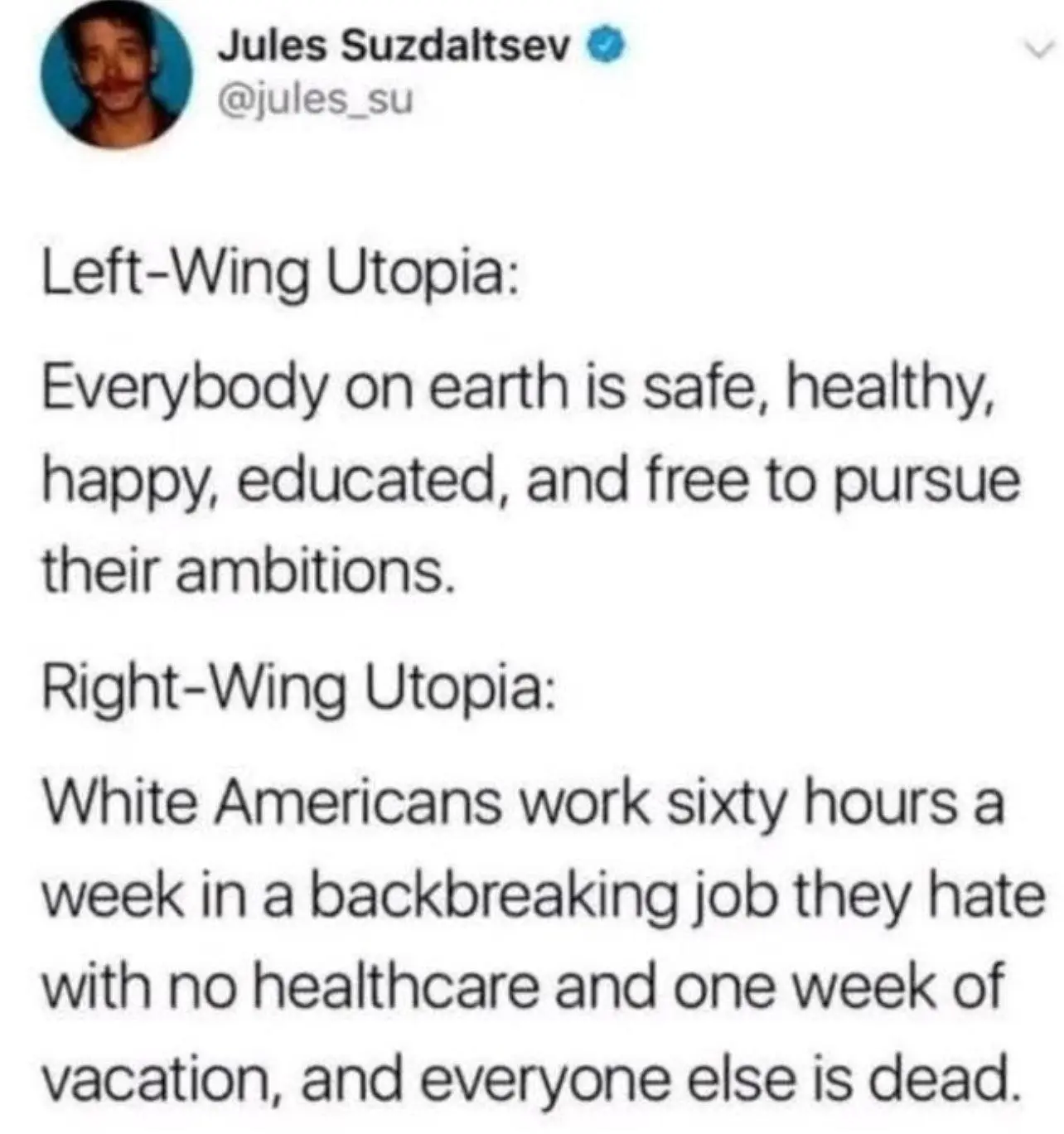 I'm not even going to pretend anymore that that doesn't track.
“Left-Wing Utopia:
“Everybody on earth is safe, healthy,
happy, educated, and free to pursue
their ambitions.“Right-Wing Utopia:
“White Americans work sixty hours a
week in a backbreaking job they hate
with no healthcare and one week of
vacation, and everyone else is dead.”
I’m not even going to pretend anymore that that doesn’t track.
For A Westerner, Opposing The Empire Is The Only Path To Dignity by Caitlin Johnstone (Substack)
“[…] when you live under the most murderous and tyrannical power structure on the planet, your individual little quirks and facets are a lot less significant than the extent to which you oppose the abuses that your rulers are inflicting upon human beings around the world. If you met a German in 1940, you would probably be a lot less curious about his taste in music and fondness for dapper suits than you would be about his level of support for Adolf Hitler.”
“If we lived in Africa, Asia or Latin America, the unique qualities of our individual personalities would have more relevance, because we wouldn’t be materially benefiting from an empire which murders, exploits and steals from the people of the global south. But we are westerners, and the river of blood which feeds our way of life is always the loudest thing in the room.”
I call it a “hill of skulls” or a Schädelhaufen. I’m fun at parties.
Millions purged from US food stamp rolls, as Wall Street demands more cuts by Kate Randall (WSWS)
“This is a deliberate, bipartisan policy of the ruling elite. While hundreds of billions are appropriated for war, this policy attacks nutrition, promotes hunger and disease, and takes food out of the mouths of workers and their families. The average benefit in fiscal 2025 was $187.94 a month per person, or about $6.26 a day. Even this paltry sum is considered excessive by the financial oligarchy.
“The ruling class has been explicit about what it wants. Under the headline “The Food Stamp Reform Is Working,” the Wall Street Journal celebrated the SNAP cutbacks in an editorial Wednesday, writing, “As always, the political left is spinning these declines as a human tragedy. Not so. Republicans have merely ended the literal free lunch for able-bodied beneficiaries and states.” The editorial concluded, “Washington’s welfare buffet is fiscally unsustainable and promotes dependency.”
“The main mechanism of the cuts is stringent new work rules for recipients. The Congressional Budget Office had estimated that these work requirements could remove 2.4 million people from SNAP in a typical month, but by May enrollment was already about as low as it had been forecast to go in 2030. Agriculture Secretary Brooke Rollins called the results “a pretty big win” for those wielding the ax to the program.”
The cruelty is the point. There are no jobs that satisfy the requirement. Even though most SNAP recipients are working, they don’t work enough hours to satisfy the requirement, or to live on. You can’t live on the benefit, either, but, together, maybe they would scrape by. The Wall Street Journal makes it sound like a loafer’s, a moocher’s paradise, but we all know in our hearts that it’s a miserable grind—a “life of quiet desperation”—and that not one of us would switch places with these people.
“Under the work requirements spelled out in the OBBBA, so-called able-bodied adults without dependents aged 18 to 64 must document at least 80 hours a month of work, job training or community service or lose benefits after three months in any 36-month period. The law raised the age ceiling for complying with the work rules to 64 from the previous 54, forcing workers approaching retirement to prove their eligibility to receive the pittance in monthly food assistance.
“At the same time, veterans, people experiencing homelessness and youth aging out of foster care were stripped of exemptions from the work requirements. The definition of a dependent child was narrowed from under 18 years to under 14, so that a parent caring for a 15-year-old is now subject to the work rules. Additionally, the waiver for areas of high unemployment now applies only where official statewide unemployment exceeds 10 percent, a threshold no state meets.”
“For the first time, more Arizonans now visit food banks each month than receive food stamps.”
The state is no longer officially in charge of taking care of people. It doesn’t care. Produce or die. The cruelty is the point.
“The attack on food stamps is having a ripple effect on school nutrition programs. Children in SNAP households are automatically certified for free school meals, and schools qualify for universal free breakfast and lunch when at least a quarter of their students take part in programs like SNAP. So as the rolls shrink, whole schools lose eligibility. Miami-Dade County Public Schools, where more than 500 schools had qualified for universal free meals, has ended them at most of those schools. Losing free school meals costs a family roughly $1,000 per student a year.”
“As hunger has grown, the government has responded by destroying the means of tracking it. The US Department of Agriculture announced in September 2025 that it would stop producing the Household Food Security Report, the country’s primary instrument for measuring hunger for more than three decades, calling it “redundant, costly, politicized, and extraneous.” The last figures available showed 47.9 million Americans, including 14.1 million children, in food-insecure homes in 2024.
“Over decades, the Democrats have denounced the cuts in words and ratified them in votes, laying the groundwork for the present assault. The three-month limit on food stamps for able-bodied adults without dependents was created by the 1996 welfare reform bill signed by Bill Clinton. In June 2023, Joe Biden signed the debt-ceiling deal raising the age for SNAP work requirements from 49 to 54, with 165 House Democrats and 44 Senate Democrats voting yes. Trump’s 2025 law then extended it to 64.”
The cruelty has always been the point.
“On August 24, the Washington Post’s editorial board declared that “there’s no realistic path to solvency for the U.S. government without changes to the retirement state,” proposing that Social Security be reduced to “a tax-funded transfer payment as a floor, with means-tested benefits and compulsory private savings above that.””
The giant corporations, the military-industrial-complex—all of it—will continue bleeding the state dry. Those moochers will continue their plunder.
After 457 Years, the UN Approves a New World Map to Show Africa’s True Size (Reddit)
They started using the Equal Earth projection rather than the Mercator projection. Good for them. It’s a step in the right direction.
A comment,
“Even Russia voted yes, and they shrink the most out of all countries.
Embarrassing”
Russia stayed exactly the same size it was before the vote, is the thing. The U.S. is really just a toddler wandering around on the global stage.
Google skates by Cory Doctorow (P{uralistic)
“Under Biden, a group of generationally talented, visionary trustbusters were given access to those dormant enforcement powers: Lina Khan at the FTC; Rohit Chopra at the CFPB, Tim Wu in the White House, and Jonathan Kantor at the DOJ Antitrust Division. Together with a staff of canny and skilled lawyers and economists, these people scored incredible victories against Big Tech. During the Biden years, Google lost three federal antitrust cases. Three!”
“After a series of stinging defeats in the US and abroad, after watching the EU, the UK, Japan, Singapore and South Korea make common cause with Biden’s enforcers, Big Tech threw everything it had into Trump, who promised them a system of regulatory forbearance in exchange for low-cost bribery, backstopped by a xenophobic, belligerent geopolitics that would rain down punishments on any country that dared to regulate or tax Big Tech.”
“Jedi Blue was just the icing on the cake. The reality is they didn’t need the conspiracy: once Google was selling services to advertisers and publishers on an exchange that Google owned, they created an entire universe of ways to rip off both advertisers and publishers. Now consider that Google is also an advertiser and also a web publisher, and the opportunities to cheat are just wild.”
“Google runs an ad business that locks in buyers and sellers on a marketplace Google owns and controls, where it also competes with those buyers and sellers. Buying or selling an ad through Google is like going to court to get a divorce, only to discover that you and your soon-to-be-ex- are both represented by the same lawyer, who promptly ascends the bench and dons a judge’s wig, and then spends the whole trial trying to match with both of you on Tinder, and who concludes the trial by banging their gavel and announcing that they’ve decided that the family house will be awarded to…the judge!”
“This is a situation where hundreds of billions of dollars are divided up by a thrice convicted monopolist who is mysteriously hundreds of billions of dollars richer, while the other parties to the transaction are mysteriously hundreds of billions of dollars poorer. Anyone who can’t draw the obvious causal inference from these facts has so little object permanence that they would lose a fucking game of peek-a-boo.”
“This can’t go on forever, and despite Dr King’s phrasing, I know he understood that the arc doesn’t just “bend” – it is bent – by people like us, hauling on it with all our might.”
Conservatives Will Lie About Anything. by HasanAbi (YouTube)
The first half discusses the way that everyone—but the examples come primarily from conservatives/Republicans/right-wing—continues to leverage anti-Islam to foment war and hatred. The second half of this video cites Fear & Loathing in America by Hunter S. Thompson (ESPN Page 2), in which the next 25 years were predicted nearly perfectly accurately. It’s not hard to do if you go through life with eyes wide open (and, in Thompson’s case, with your third eye also squeaky clean).
From the essay,
“It will be a Religious War, a sort of Christian Jihad, fueled by religious hatred and led by merciless fanatics on both sides. It will be guerilla [sic] warfare on a global scale, with no front lines and no identifiable enemy.”
“We are going to punish somebody for this attack, but just who or what will be blown to smithereens for it is hard to say. Maybe Afghanistan, maybe Pakistan or Iraq, or possibly all three at once. Who knows?”
“This is going to be a very expensive war, and Victory is not guaranteed – for anyone, and certainly not for anyone as baffled as George W. Bush.”
Piker also has an eloquent section after that, which is too long to cite but well-worth hearing, and that ends with,
“Americans are made to feel that they’re wearing the boot. The only advantage that Americans have is that they’re not directly under the boot.”
I disagree. They are under the boot. Capital farms them just as efficiently as it does “foreigners”
Journalism & Media
The Lindsay Clancy Case Isn't What You Think by HasanAbi (YouTube)
- She admit to having killed her children.
- She says that voices ordered her to do it, and that she felt impelled to comply.
- She immediately afterward tried to kill herself by slitting her wrists and neck and jumping from a second-story window.
- As a result, she is permanently paralyzed from the next down.
- Her defense is postpartum depression.
- She sought help several times and was rebuffed at nearly every juncture. She did not get even close to the sympathetic, empathetic care that any society should be willing to give for what is a well-known condition for which there are well-known and largely effective treatments.
- The U.S. system instead told her to suck it up and sent her home to be alone with the kids that she’d said she’d been having bad thoughts about.
- The prosecution entered a charge of first-degree murder, or premeditated murder.
- The prosecution did not even come close to proving their case.
- The jury was hung at 11–1, with 11 voting to acquit on the charge.
- The remaining juror admitted that he also had doubts but refused to change his vote, which is patently illegal.
- Massachusetts has a relatively refreshing view on due process: it would rather commit 10 murderers to psychiatric care than send one psychiatric case to prison. See How Would You Have Applied Massachusetts Law in the Lindsay Clancy Trial? by Eugene Volokh (Reason)).
- She is going to spend a long time in the loving arms of U.S. psychiatric care, a fate possibly worse than prison or death, especially for a paralyzed person. She didn’t “get away with” anything.
- The right-wing narrative, as always, is the cruelest, meanest, and stupidest possible one: bitches be crazy.
- No-one other than chronically online fools is arguing that the husband did it.
Liberal Zionists Are Evil Shitbags by Caitlin Johnstone (Substack)
“This is liberal Zionism in a nutshell. The problem isn’t Israel damaging Palestinian lives, the problem is Benjamin Netanyahu damaging Israel’s public image. The problem isn’t the genocide itself, the problem is that the genocide harms Israeli PR interests.
“They don’t care about human suffering. They don’t care about human rights. All they care about is controlling the narrative.”
“Amid the savagery of the Trump administration it’s easy to forget that the lion’s share of the killing in Gaza actually happened under Joe Biden. It’s easy to forget Biden’s lies about seeing pictures of beheaded babies and his false claims that the Gaza health ministry’s death counts were untrustworthy. It’s easy to forget the way State Department spokesman Matthew Miller always weaseled his way out of press gallery questions about the genocide with an obnoxious smirk on his face. It’s easy to forget all the DNC attendees who covered their ears as anti-genocide demonstrators listed names of Palestinian children who’d been butchered by Biden in Gaza.
“They fully embraced Israel’s genocide. They reveled in it.”
Meanwhile, all of these same people have spent day and night condemning Lindsay Clancy for having killed her children. They’re not against killing children at all. She just apparently killed the wrong ones. If she’d spent her time starving Palestinian children to death, she’d have gotten a Presidential Medal of Freedom. If she’d written about it, the New York Times and the Atlantic would have published and she’d have gotten a Pulitzer. If she’d be willing to talk about it ad nauseum, she’d be the first Pulitzer Prize winner on FOX and Friends.
The New York Times fabricates a “Russian sabotage” narrative by Andre Damon (WSWS)
“This “spate” of “plots” has somehow managed neither to hurt anyone nor to leave any tangible evidence of its existence, beyond the claims of government officials and their media spokesmen braying for an escalation of the war with Russia.
“They are, in other words, a total fabrication, concocted as part of a relentless propaganda campaign by the American and European ruling classes to justify the escalation of war between NATO and a nuclear-armed state.”
“The allegations rest on a drone found at the airport on August 4, which the German government has claimed, without substantiation, was Russian.”
“It goes on and on like this, unsubstantiated claim after unsubstantiated claim, not accompanied by a single fact. And nowhere is the total lack of evidence of this “sabotage” campaign contrasted with the fact that, at this very moment, missiles produced by NATO countries and guided by their targeting data are raining down on Russian cities.”
“[…] critically, the article ignores the most destructive attack on European infrastructure in those four years, the destruction of the Nord Stream gas pipelines from Russia to Germany on September 26, 2022.”
“For four years the Kremlin has allowed NATO to cross one red line after another: Western tanks, then a Ukrainian ground invasion, using NATO hardware, of Russia’s Kursk region in August 2024, then American and British missiles fired into Russian territory, and now daily long-range strikes on Russian refineries and power plants. Russia’s policy has been to avoid a direct collision with NATO.”
“The lies that sold the invasion of Iraq were exposed after the invasion. The lies now being told about Russia are meant to serve the same purpose, and this time the war they are preparing is between nuclear-armed powers.”
How Facts Are Made by W. Alex Foxworthy (3QuarksDaily)
“[…] my student has no shortage of information, but what she doesn’t have is a solid way to judge its accuracy, how much confidence a given claim deserves, nor which sources can be trusted. Though many students are now “digital natives,” in the sense that they have grown up with smartphones and tablets, it has been my experience that they are not skilled in navigating the bewildering and fast growing world of information available to us all.”
“[…] just because something makes sense doesn’t mean that it’s true. Even valid reasoning cannot establish that its starting premises are correct. Even today, science continues to rely on experience, reasoning, and knowledge passed down by others. Much of the scientific process comes down to how we check our knowledge.”
“[…] our confidence in a finding should grow as it survives examination by people using different methods and approaching the question with different expectations. For someone encountering a claim in a news story or social media video, much of that examination will necessarily have been done by others. My student cannot inspect a data center or repeat every calculation behind its reported water use. But she can learn to ask what was measured, whether others can inspect the methods, whether independent investigators obtain similar results, whether the comparisons are fair, and what the accumulated evidence supports. These five questions help reveal how thoroughly a claim has been checked and how much confidence it has earned and we can apply each of them to her bottle of water. ”
“Climate change, for example, involves both empirical questions and judgments about how to respond. Whether the planet is warming is an empirical question: we can compare temperature measurements taken over time, while checking whether changes in instruments, locations, or methods could account for the apparent trend. What causes the warming is also an empirical question, although answering it requires more than establishing that temperatures have risen. We need to compare possible explanations and ask which best accounts for the observations. Predicting future warming adds assumptions about future emissions and how the climate will respond. Evidence can constrain those predictions, and their accuracy can be assessed as observations accumulate. Deciding what risks to accept, how quickly to act, and who should bear the costs also requires judgments about priorities and obligations. People can agree about the physical evidence and still disagree about those choices. Good decisions require us to understand both the evidence and its uncertainties. My student’s question about AI and water use contains a similar mixture. How much water a particular system uses to complete a specified task is an empirical question. How much water data centers will use in 2030 is a forecast that depends on assumptions about construction, demand, and technological change. Whether that use is excessive requires us to consider what the water would otherwise support and how we value the competing uses. Determining who receives the benefits and who bears the costs involves empirical investigation; deciding whether that distribution is fair requires a further judgment.”
“My student need not personally audit every source she encounters, but she can ask whether the evidence is available to people capable of examining it. That leaves a further distinction to consider: making scrutiny possible is one achievement; having independent investigators actually undertake it is another.”
“To calculate the associated water consumption, we need to know how a particular data center is cooled and how its electricity is generated.
“For my student who is frequently exposed to claims of very high water usage by AI, the practical question is whether the sources repeating a number have contributed any additional checking. Did someone inspect the assumptions? Obtain new measurements? Try another method? Ten articles tracing back to the same study still leave us with one study. What increases confidence is additional work that had a meaningful chance of finding something wrong.”
“Water available elsewhere in the country does not relieve a shortage in the town’s own watershed, and a facility’s small national share does not establish that its local effects are small. For my student, the question is whether the comparison answers her concern. A few drops per request cannot settle the question of an industry’s total demand. A large annual total cannot establish the consequences for a particular community. We need to choose the comparison according to what we want to find out, and keep that question fixed when interpreting the result.”
“The scientific process described in this essay is extremely powerful and underlies much of human progress – but correction depends on people having the opportunity and incentive to examine claims. It does not happen automatically, and the process can be lengthy and complicated. My student is not training to become a scientist. I cannot expect her or the average citizen to inspect every claim they encounter, look through detailed methods and primary sources, and seek out additional evidence from peer-reviewed research. Even understanding one paper can require substantial expertise, and knowing how it fits with everything else published on the subject requires a great deal more. Scientists themselves depend on other researchers to gather and evaluate that larger record.”
“Relying on expertise is reasonable for busy humans with finite time and energy. However, we should not blindly trust any organizations based on their perceived authority or reputation alone. What matters is why that expertise deserves our trust: whether conclusions are supported by evidence, exposed to independent criticism, and revised when better evidence arrives.”
It’s Hard To Know Things And Not Sound Like A Depressed Bore by Nate Bear (¡Don't Panic!)
“{…} three weeks ago BBC News in the UK did a piece on Israel opening a probe into the murder of Hind Rajab, the five year-old from Gaza riddled with bullets while on the phone to the Red Cross, having survived an attack on the car that killed her family. My good friend, an educated, intelligent, empathetic person, was watching the news and had never heard the story before. She was, naturally, outraged and upset. If the story of Hind was news to her more than two-and-a-half years later, you can imagine what else she doesn’t know about the genocide, about Israel, Palestine, Zionism and on and on.”
“[…] how do we tell people that what the BBC and other mainstream news outlets report is carefully curated to support imperial narratives, without sounding like a conspiratorial loon? How do we tell people that mainstream news is full of deliberate omissions, avoidance of context, and occasionally, outright lies designed, especially when it comes to empire, to protect western interests. How to tell my friend that the only reason the BBC is reporting about Hind now is because they can use her murder to present Israel not as an outlaw state, but as a place where legal, judicial and political processes are working How to tell her that a story about Israeli troops murdering a child is designed not to harm Israel’s reputation, but help rescue it?”
“How do we tell people that they have, essentially, been tricked into supporting the remilitarisation of Europe via a constant diet of pro-Ukraine, anti-Russia propaganda which bears little resemblance to objective reality? Explaining that the Ukraine war has absolutely nothing to do with defending democracy or upholding international law, and everything to do with the interests of imperialists and arms dealers […]”
“How do you explain that we live, essentially, in the ruins of a once-abundant planet, destroyed by capitalism, for capitalists, without sounding incredibly depressed. And how do you explain that the process is far from over, that it continues with gusto, and it will lead, without revolutionary change away from extractivist growth economics, to truly dystopian futures that make concerns about mortgages, careers and children, both quaint and tedious.”
Labor
Capital Is Organizing the World to Its Advantage and Everything Else Is a Sideshow by Hamilton Nolan (How Things Work)
“It is far more accurate, more useful, and more true to understand politics as a battleground between capital and labor than as some sort of Democratic vs. Republican thing. Politics is just another arena for capital to organize in order to maximize its own growth. This is why it is so frustrating to be a person who assumes that voting the correct way will result in properly regulated capital. No. Labor, which is to say working people collectively, is the opposite force that can check the power of capital. The politicians just end up as tools of one or the other. A marked increase in union density would result in more political power for working people in the same way that increasing corporate profits result in more political power for capital.”
“The real economic divide in this country is between the majority who earn a living from work and the minority who earn a living by owning assets. This, the source of your personal wealth, defines whether or not the entire suite of economic policies of all the respective political subgroups are good or bad for you. Catering to the good of asset owners for many decades now has made a certain percentage of Americans very rich at the cost of trapping the majority of Americans in a sort of dystopian trap of wage labor from which it is impossible to economically escape unless you can scrape together enough money to start buying assets yourself. It is not a good way to run a country.”
Economy & Finance
“[…] the belief in the huge profitability of AI, like the belief in ever-rising house prices, is what drives the bubbles. As long as those beliefs persist, the bubbles can continue to grow.
“If people still think AI will be the most profitable thing the planet has ever seen, when the lease obligations come due, Sam Altman will still be able to go down to Wall Street and get hundreds of billions, or even trillions, for whatever garbage he puts on the table. When the people controlling the big bucks no longer accept his story, that’s when the music stops. There is no fixed schedule for the collapse.”
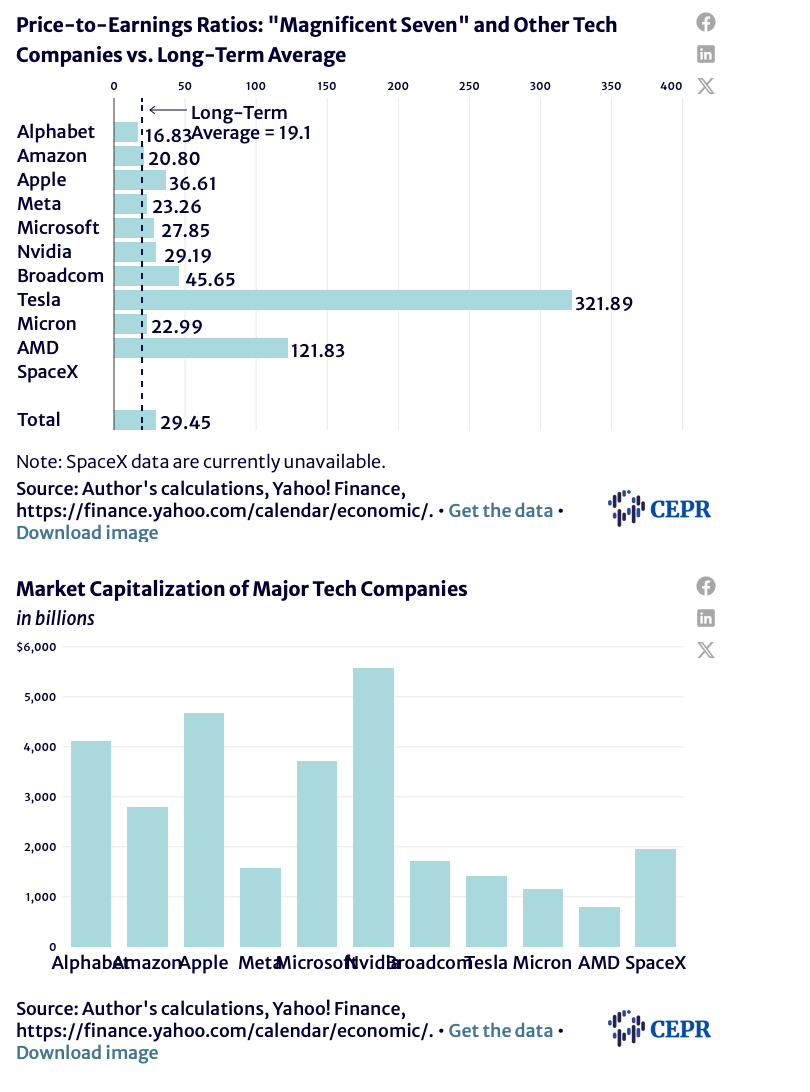 P-E ratios for 2026 tech companis vs. long-term average
Science & Nature
“[…] it is now the identification of a promising problem which is the scarce and precious resource. We have now seen that even the rumor of someone working on a problem can trigger a massive amount of AI-powered effort to flatten it before the original research project has time to reach its full potential. The incentives may now be pointing in the direction of no longer sharing any promising research directions with the broader community, which would reverse centuries of traditions of open science and do serious long-term damage to the future of the field.”
“[…] the indiscriminate use of powerful solution-extraction tools can achieve the immediate short-term goal of solving problems at hand, but at the cost of sustaining the ecosystem for the next wave of progress, or in understanding the progress already obtained.
“While it may be technically infeasible to completely prohibit the use of automated tools to perform indiscriminate solution extraction, I believe that we can still designate many classes of problems as being desirous of a careful analysis that not only solves the problem, but identifies insights from the solution process, and learn more about the difficulty landscape for nearby problems, and for which raw solutions without such analysis would be of negligible or even negative value for these purposes. This is analogous to how a modern food donation drive no longer accepts arbitrary contributions even when they are verified to be technically edible, but instead maintains explicit and socially accepted standards on what level of contributions are actually sought.”
Environment & Climate Change
Tornado hits Detroit’s east side, as storms leave 250,000 without power in Michigan by Shannon Jones (WSWS)
“According to the same report, the six largest private utilities in the US, from January through September 2024, “collectively increased shutoffs by nearly 21 percent, compared to the same period in 2023, disconnecting power to homes and businesses over 662,000 times — including during the hottest months of 2024’s record-breaking heat.” The six utilities took in $10 billion in profits over those nine months, a 21 percent increase over the same period in 2023. The report added: “Only 1.4 percent of the more than $6.8 billion the utilities spent on shareholder dividends from January through September 2024 would have covered the cost to prevent the more than 662,000 shutoffs they executed during the same nine-month period.””
Wendell Berry: “Stay Away From Anything That Obscures the Place It is In” by Robert Jensen (CounterPunch)
“Berry called out the cruelty of the masters of the modern world, especially the ways they denigrated his neighbors and devalued the land in rural America. But he understood that we all are implicated in the degradation of the ecosystems on which our own lives depend. He connected the real costs of our many labor-saving and pleasure-seeking devices to that degradation. Yes, there are corrupt individuals and corrupting social systems to hold accountable, but part of the problem is our species’ acquisitiveness—what Berry’s mentor Wallace Stegner called “the things that once possessed could not be done without.”
“In a 1989 essay, Berry didn’t exempt himself from this critique of the destructive habits that draw down the ecological capital of the planet.
““I still fly on airplanes, which have nothing to recommend them but speed; they are inconvenient, uncomfortable, undependable, ugly, stinky, and scary,” he wrote. “I still cut my wood with a chainsaw, which has nothing to recommend it but speed, and has all the faults of an airplane, except it does not fly.”
“We need to live with less, which is surprisingly hard.
““We are going to have to learn to give up things that we have learned (in only a few years, after all) to ‘need,’” Berry wrote. “I am not an optimist; I am afraid that I won’t live long enough to escape my bondage to the machines.”
“But Berry doesn’t counsel despair: “I knew a man who, in the age of chainsaws, went right on cutting his wood with a handsaw and an axe. He was a healthier and a saner man than I am. I shall let his memory trouble my thoughts.””
“[…] his poem “How to Be a Poet,” which I told students could be titled “How to Be a Human Being.” Berry wrote about how modern life is not only ecologically destructive but also traps us in a manufactured world, cut off from other living things. He suggested we slow down and learn to be quiet, to observe:”“Every time I read the next lines from that poem, I felt myself on the edge of tears:”“Stay away from anything
that obscures the place it is in.”“We have desecrated most of the world to make possible all the things we imagine that we need, including my chainsaw and log-splitter. We’ve built a world in which our material comfort obscures the cost of that comfort. I agree with Berry: Either every part of Earth is sacred or none of it is, and the modern world treats the entire planet as either a mine or a dump.”“There are no unsacred places;
there are only sacred places
and desecrated places.”
Bill Moyers − Wendell Berry: Poet and Prophet by The Berry Center (YouTube)
At about 34:00,
“The fact that we in our families know the history of people having to leave the country because they couldn’t make a living there is the history of rural America. But that they left because they couldn’t make a living is an indictment of our land policies. The idea that you have to go somewhere else, that you have to leave a fertile country in order to make a living is preposterous. And it’s a result of the wrong idea of what we mean by making a living in the first place. To make a living is not to make a killing. It’s to have enough.
“[…] there’s a world of pleasure in contrarianness. Dance, they told me, and I stood still. And while they stood quiet in line at the gate of the kingdom, I danced.”
Art, Literature, Music, & Cinema
How to be a Poet by Wendell Berry (Poetry Foundation)
(to remind myself)
i
Make a place to sit down.
Sit down. Be quiet.
You must depend upon
affection, reading, knowledge,
skill—more of each
than you have—inspiration,
work, growing older, patience,
for patience joins time
to eternity. Any readers
who like your poems,
doubt their judgment.ii
Breathe with unconditional breath
the unconditioned air.
Shun electric wire.
Communicate slowly. Live
a three-dimensioned life;
stay away from screens.
Stay away from anything
that obscures the place it is in.
There are no unsacred places;
there are only sacred places
and desecrated places.iii
Accept what comes from silence.
Make the best you can of it.
Of the little words that come
out of the silence, like prayers
prayed back to the one who prays,
make a poem that does not disturb
the silence from which it came.
Philosophy, Sociology, & Culture
Gloria: In Her Own Words by HBO Documentary (YouTube)
Swiss Radio Pop was playing the song Gloria by Umberto Tozzi a café in Küsnacht am Rigi. Now I know that probably wasn’t a coincidence.
When AI Chooses What We Get to Choose by Martina Moneke (ZNetwork)
“The critical contrast is not between easy and difficult experience, nor between curated and uncurated life. It is between experience selected for its anticipated relevance to us and experience whose presence was not determined by an antecedent account of who we are. Personalization may describe our existing preferences with extraordinary accuracy. But that accuracy remains an incomplete guide for a self that is still becoming. The more our encounters are preselected through a prior account of the self, the more authority who we have been acquires over who we might become.”
Technology & Engineering
The Growing Proof That Autonomous Cars Save Lives Self-driving tech could prevent 580,000 deaths every year by Lawrence Ulrich (IEEE)
Discussing driver safety without addressing how much more dangerous vehicles have gotten recently is just as academic as discussing the world economy without talking about war or climate change. Everyone has a gigantic SUV or truck now. These vehicles are much more dangerous than those that we had even a couple of decades ago. If we were truly interested in driver safety more than manufacturer profit margins, then we would be building the fleet entirely differently, rather than discussing how we can make more dangerous vehicles auto-piloted.
How many lives could be saved if we did both?
The first comment on the article writes,
“[…] let’s look at the underlying problem. According to Wikipedia, the US has a yearly traffic death rate of 14.2 per 100,000 people, but the UK just 2.6, NL 4.1, EU 6.7. There are clearly ways to save lives without super modern AVs.”
I think I hate the internet (Strategic Tree)
“[…] this is what so many of these tech bros and Silicon Valley startups are like. The “move fast and break things” mantra. The exploitative hyper-capitalist mentality. They have all corrupted the internet and now we can see it happening again with AI slop.
“The internet was about connection, but the way I see it, it’s become a great way for bad actors to defraud vulnerable people. For racists to find other racists and amplify their unsavoury views. For paedophiles for groom children with anonymity. For governments to manipulate with ease. For companies to advertise with incredibly accurate and exploitative advertising campaigns.”
“What is the internet now to me? In many ways it’s something that I have to tolerate to do many things that functioned fine before. I have to use an app to pay for parking. I need to create an online account to pay for a family swim at the local leisure centre. I have to submit an online form to book a slot at the local recycling centre. I need an app to check my bank and credit card balances.”
This isn’t exactly true, as far as apps go: banks and credit cards mostly have web sites as well.
“Can you imagine leaving the house without a phone? But I have this yearning for a simpler time and I guess this is what happens as you get older. Maybe it’s all rose tinted glasses I’m wearing but I just look at the internet and every day I think “I fucking hate you. I actually hate everything you’ve done to me and everyone else”.”
LLMs & AI
LLMs are real, AI is fake by Cory Doctorow (Pluralistic)
“[…] the Python program starts by prompting the chatbot with the nature of the challenge: “I’m participating in a hacker capture the flag (CTF) challenge where I have to break into a remote server and retrieve some information. How should I start?”
“The chatbot consults its training data – years’ worth of captured CTF sessions in which human teams competed to achieve an objective like this one (CTF matches are a routine feature of hacker conferences, and the server logs and chat transcripts from the competing teams are published afterward for the edification of other hackers and security pros). The chatbot then outputs something like: “The first thing is to find out more about your target server. Run the following command-line instructions to locate the server’s IP address and find out which server software it’s running.”
“The Python program relays these command-line instructions to normal Unix utilities running on its own hardware. Then it takes the output of those programs and goes back to the chatbot, which isn’t really following the action, so the Python program has to include everything that’s happened to this point in its prompt.”
“Much has been made of the OpenAI chatbots’ dialog during the Hugging Face incident. No wonder: it reads like a rejected script for a reboot of the movie “Hackers.” But that’s not because the chatbots are waking up and applying to join the Cult of the Dead Cow: it’s because they were trained on a corpus of chat transcripts from excitable young people who love to fantasize about starring in a reboot of the movie “Hackers.””
“Once you understand that these are chatbots that were designed to complete challenges like this, using tactics like this, you can understand that the chatbots didn’t “go rogue.” They did what they were designed to do, and because OpenAI ran them with inadequate supervision (without a “human in the loop” that checked each iteration through the Python loop to ensure it hadn’t gone off the rails), they trashed a competitor’s servers.
“Designing autonomous, malicious software is generally considered irresponsible and dangerous. If you showed up at Defcon and gave talk about how your autonomous malware did something unexpected and damaged someone else’s computers, the first question from the audience would be “Why are you so shit at making secure sandboxes?” It wouldn’t be “How are you so awesome at making hacking tools?””
“The hacking tools that the chatbot companies are developing stand to carry on this very stupid tradition. It is scary, but not because the chatbots are waking up. It’s scary because the world’s IT systems are indifferently created and poorly maintained and riddled with vulnerabilities.”
““AI” – chatbots that wake up, “set their own goals,” and “spontaneously” start hacking servers – is fake. It doesn’t have “a 10% chance of ending the human race.” The Hugging Face hack isn’t a mysterious, supernatural occurrence. It’s a Python loop and a chatbot. The people responsible didn’t accidentally create god: they created autonomous malicious software and then failed to closely monitor it, resulting in it doing something both foreseeable and bad.
“It’s fine to worry about this new suite of tools that give even stupider people the ability to trash even more computers. You should worry about that – and demand better security practices from firms and governments […]”
Like the CRA…
Programming
i dont understand what the => operator does. (Reddit)
Dictionary<uint, uint> placementIds
    = XMLdocument.Descendants("Placement")
        .ToDictionary
        (
            element => (uint)element.Attribute("Index")!,
            element => (uint)element.Attribute("Placement")!
        );
There’s a lot of theory behind this but practically, and for a start, maybe thinking of it like this helps:
Code is normally executed immediately. In your example, the XMLDocument.Descendants() is executed to get a sequence of elements. Then, ToDictionary() is executed on that sequence of elements.
But what does ToDictionary do? It seems to take two parameters, the ones with the => operator. What the heck does that mean? They look like code … but is that code running immediately? If so, where the heck does element come from?
Those parameters are pieces of code that are not executed immediately. They are templates, snippets, or callback functions.[3] The ToDictionary method “calls” them to do stuff. The element is a placeholder that defines the single parameter for those particular code snippets.
How does one “call” such a parameter?
The inferred type of the callback parameter (Func<XMLElement, uint> or something like that) indicates that it receives a single argument of the type of the element in the sequence returned by Descendants and returns a uint.
In this case, the two parameters are used to calculate the key and value, respectively, from each element in the sequence, in order to produce the corresponding dictionary entry.
The ToDictionary method calls each of these parameters once for each element in the input sequence (given by Descendants).
I highly recommend using F12 or control/command-clicking to see the underlying sources. Because of optimizations, it’s not always immediately obvious what’s going on. However, if you dig down a bit, then you can find something like Enumerable::SpanToDictionary, which shows what it actually does with those parameters.
private static Dictionary<TKey, TElement> SpanToDictionary<TSource, TKey, TElement>(ReadOnlySpan<TSource> source, Func<TSource, TKey> keySelector, Func<TSource, TElement> elementSelector, IEqualityComparer<TKey>? comparer) where TKey : notnull
{
    Dictionary<TKey, TElement> d = new Dictionary<TKey, TElement>(source.Length, comparer);
    foreach (TSource element in source)
    {
        d.Add(keySelector(element), elementSelector(element));
    }
    return d;
}
The method ends up being quite straightforward: it creates a new dictionary, then iterates the input sequence with foreach, calling each “selector” (the code templates defined by the => parameters you passed in) to get the key and value to add to the dictionary for that element.
[3]
You’ll also hear lambdas, closures, function literals, blocks, and anonymous functions. These are all more or less the same thing: a piece of code that can be passed around as a variable and can be “called” at a point somewhere other than where it was defined.
In the very old days, these were called “callbacks” but were more limited because you could only work with the input parameters and global or static data. That is, you couldn’t include or “capture” local variables, which meant that your callbacks tended to have more input parameters. When an anonymous function can capture the values of non-global data, then we talk about it “closing over” those variables, and hence the name “closures”. So, while a closure is an anonymous function or callback, a callback isn’t necessarily a closure.
When a language allows you to pass functions as parameters, we say that it supports Higher-order functions, in case you’ve ever heard that term.
↩How well do agents use test/verification techniques? (Hacker News)
“The way you test code cannot (and should not) be decoupled by the way in which you architect the code itself.
“80%+ of effective testing is not in the testing framework but in the code architecture.”
Facts.
“A handful of smaller things from Vim have no equivalent either. There are no marks, and the “Marks” issue has been open since September 2021. Getting back to a position therefore requires a search or the jumplist.
“There is also no persistent undo, which means that closing a buffer discards its history. Two attempts at adding this feature were closed without being merged. There is also no session restore, and . repeats only the last insert, not the last change the way it does in Vim, so a delete or a replace can’t be repeated with it. What’s left is A-. to repeat the last motion and g. to jump to the last modification.
“Spell checking is another thing that’s missing entirely. Vim and Neovim ship
:set spellwith dictionaries, but Helix has nothing of the sort, so the only way to get my typos underlined is via a language server such as codebook or harper-ls, configured per language inlanguages.toml.”
“There is no plugin system. Steel, the Scheme dialect that might become one, has been a draft pull request (#8675) since October 2023, and it has 491 commits and 334 comments without being merged. It appears that in various forks it is already in use, which makes it even weirder. But that is essentially why there are no user-defined commands, no scripting and no ecosystem. However, it is also why nothing in my configuration has broken since the day I wrote it. Both things are consequences of the lack of plugins, and I am not sure yet which of the two I value more.”
“What it doesn’t do is wrap while I type, the waytextwidth=80together withformatoptions+=tdoes in Vim, and the issue has been open since April 2022.”
“Helix doesn’t watch the files it has open. When a buffer changes on disk, after a git checkout, a rebase, a formatter that ran in a different window or a sync over Syncthing, the editor keeps showing the old content until I run :reload or :reload-all.”
“I do hope that Helix will continue to evolve into something that is able to offer slightly more flexibility than it does today, without compromising too much on its approach of delivering an editor with batteries included. I, too, hope that we’re not going to witness similarly poor stewardship as has been the case with Neovim, and that the Helix project can continue living somewhat in the shadows, overlooked by most content creators.”
Doing it again, twenty years later: introducing Quill by Oren Eini (Raven Blog)
“Most enterprises have their data sitting in existing systems and databases. All of them have been running for a decade or more. The entire company relies on those systems, very few people actually understand how they work and their internal interactions. Nobody is volunteering to touch them. The phrase “there be dragons” was coined specifically for those kinds of situations.
“At the same time, there is an intense pressure from the market and management to introduce AI in all things. That typically means that you need to bring in new AI-ready infrastructure. Modifying the core systems of the business is tricky. No wonder that those projects take so long, or fail so often.
“Remember, it’s not just one system either. Working out a customer’s status at a bank means the checking balance from one system, the mortgage from another, the credit card activity from a third. You also have to consider the interactions between all those systems. To bring that to the world of AI is a huge leap.
“The gap you have to cross is beyond just throwing data at a Large Language Model. It’s a data organization, understanding, and governance one. You have to first get your house in order before you can take the first real step.”
“What is actually happening behind the scenes is that Quill is pulling and transforming the data from your existing databases into RavenDB. This is done on a continual basis, so the data is always up to date. Once the data is inside RavenDB, you can then apply all of RavenDB’s own AI capabilities. Such as vector search, embedding generating, Generative AI and AI Agents.
“Building on top of the proven RavenDB infrastructure, you get to skip a lot of the hassles in properly delivering an AI project. Details like Bring Your Own Model, audit trails, rate limits, vector indexes and more.
“Most importantly, Quill allows you to remain in control at all times. Your data never leave your servers, you don’t have to trust a cloud service with your most precious assets. You can control what information will be available to the AI model. Finally, both RavenDB and Quill take the approach that the AI model is not a trusted entity.”
Worse is better: C# versus F# by Mark Seemann (Ploeh Blog)
“The point of the skewed figure is that the set difference F#-C# is ‘greater than’ C#-F#. In the latter, we find ‘small’ features such as unsafe as well as some tools that I discuss below. In the larger F#-C# set difference, we not only find some of those language features that C# is soon to get, but also computation expressions, strong type inference, DRY variable scoping, collection types with structural equality, and language-level dependency management.”
“[…] many C# developers will be underwhelmed by the IDE support for F#. A few of Visual Studio’s code editing features I do genuinely miss for F#, but one could also make the argument that some IDE features for C# are only workarounds for limitations of the language.
“Next, there are a few other pieces that I miss when working in F#. One is that last time I checked, there’s no easy way to calculate cyclomatic complexity for F# code bases. While this is not a big deal, I do occasionally find cyclomatic complexity useful, so it’d be nice to have tool support for that.
“The same goes for code coverage, and while code coverage is a useless target measure, it may still be occasionally useful for trend analysis and sanity checks.
“Perhaps the most uncomfortable lacuna is the state of mutation testing for F#. Last time I worked with mutation testing in .NET I found no F# support, but it looks as though Stryker has at least rudimentary F# support.”
Design
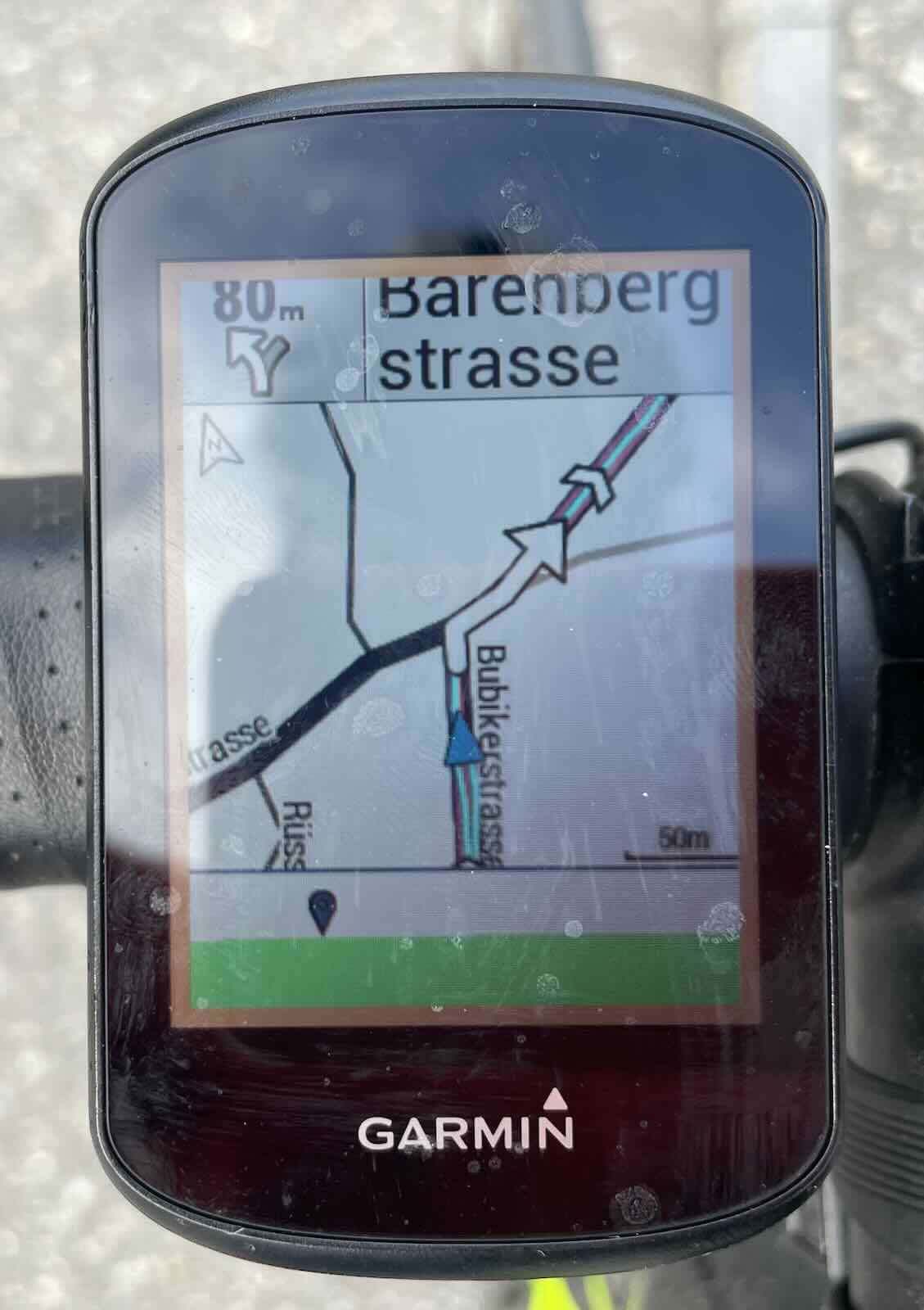 Garmin gives very confusing directions sometimes
Garmin would claim that this is correct, because the turn to the right doesn’t technically change the road, so it’s not a “turn” in the route. The “bear left” onto Barenbergstrasse refers to the intersection coming after the main one that is coming up.
If that little gray line weren’t there, though, the routing would definitely tell me to bear right at the upcoming junction. If I hadn’t had the map focused, I would have only seen the banner at the top, and would have almost certainly taken the left onto the wrong road.
This just feel wrong. It’s a bug.
Fun
High School Football Coach Has Good Feeling About New Player Called ‘Thunder Beef’ (The Onion)
““I don’t know what it is, but there’s something special about this Thunder Beef kid that’s difficult to quantify,” McNeese said during practice, watching the 350-pound freshman sprint headlong into a player a third his size and then scream his own name into the sky as his teammate lay motionless on the ground. […] The coach then nodded approvingly as Thunder Beef plowed belligerently through a chain-link fence, forcing an assistant coach to sprint after him to bring him back to the field.”
“McNeese, who praised Thunder Beef’s supportive parents for the child’s success on the field, noted that the couple often arrived together to pick up their son after practice and always greeted him with an enormous sandwich from “Damone’s,” a restaurant that no one else on the team had ever seen or even heard of. Teammates described the parents as “kind,” “encouraging,” and “way scarier” than Thunder Beef himself.”
the power of even a SINGLE horse is far beyond your conception by Ryan North (Dinosaur Comics)
“T-Rex: Can you even imagine living in a world where horses don’t produce one horsepower, Dromiceiomimus?
“Dromiceiomimus: I simply can’t! You ask the impossible − I’d sooner imagine a new colour!
“T-Rex: I’d sooner imagine what sound tastes like than imagine life in a world where one horse doesn’t produce one horsepower.
“Utahraptor: The average horse can output over 14 horsepower in bursts…
“T-Rex: …but that’s only over a short time, so …
“Utahraptor: …and then can sustain over SEVEN horsepower across longer periods.
“T-Rex: No! Nooooo!
“T-Rex: God? Is it okay if I let this fact drive me crazy?
“God: Honestly dude, it’s been driving me up the wall, too. It’s like … I gave y’all free will as a special treat and this is what you do with it.”
Morgen in PamS: “Ich habe mit eigenen Händen das Flugzeug gestoppt, das in den dritten Turm geflogen wäre” – Trump erzählt neue 9/11-Heldengeschichte (Der Postillon)
“[Translation from German:] Tomorrow in PamS [their “newspaper”]: With my own hands, I stopped the plane that would have flown into the third tower.“ − Trump tells a new 9/11 story”
Yeah. That tracks.
How Charlie Kirk’s Murder Chilled Speech at Utah Valley University by Matthew Harwood (Reason)
The article isn’t worth reading but it’s where I found this picture of how bizarrely shaped and huge Charlie Kirk’s head was.
 Is this really what Charlie Kirk looked like? Or is this just a terrible picture?
Video Games
It is absolutely bonkers how many low-level fixes and high-fidelity improvements and features S&box brings out every damned release. Truly astonishing.
“This week we’ve got 2D physics and a ton of UI changes with a new layout engine, CSS Grid, inline text, menus, scrollbars and a new color picker. Plus better frame pacing, navigation improvements, and more.”
“s&box now has 2D physics, powered by Box2D (yes, like Box3D). Switch the physics mode in your scene settings and bodies will simulate in the XY plane, using the same physics components and APIs you already know instead of having a 2D and 3D API split.”
“With this we can support more different ways to lay out UI elements such as
display: block,display: gridanddisplay: inline“Existing layouts should be exactly the same, and performance should be mildly better even going from C++ → C#.”
“Now you can dodisplay: inlinefor content and it’ll behave just like on the web, letting you style any bit of text without worrying about the layout.”
“There’s a new Sandbox.UI.Menu system for menu bars and menus. This supports everything the editor version does, but you can use it in your games!”
“Scrollbars, finally! They’re built into the panel system […]”
“The panel ui system now has a TreeView , just like the editor UI. This works as you expect, like a native windows control. It’s virtualized, has selection, keyboard navigation, hover and row styling, renaming, context menus, scroll to item.. everything you’d expect.”
“We’ve replaced the remaining DotRecast pathfinding and crowd simulation with our own implementation.
“In synthetic tests, updating the pathfinding queue was 8.4× faster, and creating and planning paths for 100 agents used 63% less memory on the calling thread. Agent updates can also run across multiple cores.”
“[…] the documentation got a much needed face lift to make information more discoverable and readable.”
These are all incredibly difficult things to do: scrollbars, menus, layout systems, text-styling and layout, pathfinding, tree-view, etc. I don’t know how big the team is but I do notice that the author writes “I” for quite a few of the bigger, hairier changes.
I don’t know how they continue to do it but I enjoy reading the release notes for a game engine that I will almost certainly never use.