
Links and Notes for October 16th, 2026
Published by marco on
Below are links to articles, highlighted passages[1], and occasional annotations[2] for the week ending on the date in the title, enriching the raw data from Instapaper Likes and Twitter. They are intentionally succinct, else they’d be articles and probably end up in the gigantic backlog of unpublished drafts. YMMV.
[1] Emphases are added, unless otherwise noted.↩
[2] Annotations are only lightly edited and are largely contemporaneous.↩
Table of Contents
- Public Policy & Politics
- Journalism & Media
- Labor
- Economy & Finance
- Art, Literature, Music, & Cinema
- Philosophy, Sociology, & Culture
- Technology & Engineering
- LLMs & AI
- Programming
- Design
- Video Games
Public Policy & Politics
 Never argue with somebody John Brown would have shot
The Red Sea Cannot Be Won by War by Yohannes Woldemariam (ZNetwork)
“Many landlocked countries prosper through negotiated access to neighboring ports. Ethiopia itself relies extensively on Djibouti. Transit dependence creates economic vulnerabilities, but these are problems of diplomacy, infrastructure and regional cooperation, not grounds for territorial acquisition.”
Switzerland is very landlocked and is doing just fine. It’s been centuries since it was colonized though.
“The people of Tigray have already endured catastrophic losses. Renewed warfare threatens further displacement and destruction. Eritreans likewise face the prospect of another war after decades of militarization, economic hardship and political repression. Neither population stands to gain from another cycle of violence.”
Police Commissioner Tisch mocks Mandani, DSA at New York banquet by Barry Grey (WSWS)
“A grinning Mamdani, who mounted the Dias amid scattered boos, joined in the standing ovation for the police chief.
“Tisch is a Zionist and billionaire heiress whom the “democratic socialist” mayor held over from the Eric Adams administration. She opened her remarks with the crack, “Things got a little hot for me this week. Anyone hiring?”
“Just two days before, after the DSA had officially urged him to remove Tisch, Mamdani announced, “Jessica Tisch is the police commissioner. I have no plans to change that.”
“At another point in her speech, Tisch alluded to Mamdani’s repeated meetings with Donald Trump—three since the mayor’s election last November—quipping, “There’s a lot of talk these days that the mayor’s friends don’t like me. That’s simply not true. President Trump and I get along great!””
She is absolutely taunting him because why shouldn’t she? Her power will keep working until, one day, … it doesn’t. Today is not that day, though. And Mamdani is, unfortunately, not the guy who will bring that day closer.
For now, people like Tisch—billionaires—will continue to enjoy the power that comes with wealth and which is granted by other wealthy people, like the Zionist 1% in New York City. Their day will come. It’s been a long time coming. But it’s also a long time going.
Luckily, though, it seems to be coming on its own, like a slow tide rolling in, inexorable, but on its own schedule and for its own reasons.
“The Post editorial, titled “Mamdani wisely ignores the DSA and sides with his top cop,” gave the mayor a verbal pat on the head.”
See how they taunt our powerlessness? For now, they know that they’re in charge and they can’t imagine ever not being in charge. Complacency is the enemy of empire but empires can take lifetimes to fall.
“Mamdani and the DSA represent privileged sections of the middle class, which seek not the abolition of wage slavery, inequality and imperialist war, but rather a division of the spoils, currently monopolized by the financial oligarchy, that is more favorable to them. As the escalating crisis of capitalism makes class compromise impossible and fuels a massive growth of working class struggles, the Mamdanis and DSAs of the world join forces with the counterrevolution. Their greatest fear is the emergence of an independent movement of the working class.”
It is very difficult not to disagree. This is not a purity test. Mamdani’s betrayals of his campaign rhetoric are not minor transgressions like forgetting to give a land acknowledgement. This is about shock troops in his streets. This is about him letting the police act in his city as the police have always acted toward protesters, the underprivileged, and minorities. ICE are shock troops. He is silent as his own shock troops protect and aid them. He pledges money to combat an invented discrimination against the ruling class while being silent about his own police suppresses the voices of the real underclass. These are real red lines. He is going full Obama.
A Change Is Going To Come by Baby Huey in 1971 (YouTube)
After mass October 17 protest, French government prepares dictatorship by Alex Lantier (WSWS)
“On Monday, Prime Minister Sébastien Lecornu spoke after an emergency cabinet meeting, pledging a “massive penal response.” He announced “partial and very localized curfews,” even as the Marseille police prefecture banned gatherings across the entire city. Asked whether he would declare a state of emergency, which suspends democratic rights and lets police arrest citizens at will, Lecornu replied: “If necessary, clearly we could. For now, curfews seem more suited to the situation.””
Richard Wolff, Cornel West, & Norman Finkelstein: America Is in DENIAL | On Mamdani, Tucker, & Trump by Robinson Erhardt (YouTube)
An incredible conversation. 131 minutes.
00:00 Introduction
01:06 What Do Elections Actually Change?
05:47 How Enthusiasm Turned Into Disappointment for Zohran Mamdani
09:36 The Deep Denial in the United States
14:11 Is Another New Deal Still Possible?
17:27 The Repression of American Colonialism
23:49 Is America’s Decline Irreversible?
30:25 Cornel West on Bernie, Mamdani, and Colonialism
42:12 America Fears Socialism—But for How Long?
44:36 Neoliberalism Is a Curse on Socialism
49:06 Jill Stein and Why Cornel West Left the Green Party
52:15 Bernie Sanders and the Holocaust
59:52 Is Tucker Carlson Dangerous for the Left?
1:06:53 Can Immigration Be Fixed?
1:11:04 How Capitalism Destroyed Itself in Germany
1:15:21 Do Blacks Have Legitimate Complaints About Immigrants?
1:19:23 International Relations
1:21:04 Biden, Obama, and Red Lines
1:25:09 What If Our Heroes Were Racist?
1:27:27 Will the Rest of Us Ever Be Prosperous Again?
1:42:29 Who Is Pumping Denial Down America’s Throat?
1:48:55 John Stuart Mill on Truth
1:50:34 Rick’s Biggest Mistake in Life
1:57:00 Cornel’s Biggest Mistake in Life
2:01:49 The Academy Caved to Biden, Trump, and Israel
This Is What It’s Like to Spend Your Life in Prison by NYT Opinion (YouTube)
“How could you take a an 18-year-old person and just take the worst decision he ever made and hold him responsible for it for the rest of his entire life? And not even consider that you may have changed? He was the thug on the streets 25 years ago, and we’re angry at that person, not realizing that that person no longer exists—actually hasn’t existed for like over 20 years.”
That gentleman was very eloquent. Later in the short video, he said,
“I make sure that my life is very purposeful. Every time I invest myself into someone else, I free a part of myself. A part of me will leave here with you. I’m going to love people so passionately until a part of me will always live outside of the gates of Angola.”
Journalism & Media
Exploring the Mirror World of the Chinese Internet: Interview with Yi-Ling Liu by Merle Groneweg (Jacobin)
“China’s internet is known for a vast system of censorship and surveillance that has evolved alongside its booming digital economy. Yet the story of the Chinese internet is not simply one of authoritarian control or unrestricted growth.”
I am not hopeful that this article will be aware that this lead-off description of the Chinese Internet could just as easily be describing the Western Internet. How is this not worth mentioning? I know that the interviewee is Chinese, so it makes sense that this is not the focus but you could mention, in passing, that China’s approach is not really that unique, no matter how much we try to convince ourselves that it is.
The tone-deafness continues,
“It includes top-down regulators such as the Cyberspace Administration of China and the Ministry of Industry and Information Technology and their censorship directives, as well as censors at social media companies who scrub content from the web. And there is another part we don’t often talk about: the internalized self-censorship people experience when deciding whether or not to speak.”
Also not worth a knowing chuckle that you might as well be discussing the social-media landscape in the U.S. FFS the U.S. forced the sale of the U.S. arm of TikTok so that it could exert censorship of Palestinian issues. When the interviewer says,
“[…] the censorship apparatus as well as the directives regarding which content to censor have evolved tremendously over the past three or four decades. Non-permissible content has expanded beyond the traditional “three Ts” — Tiananmen, Taiwan, and Tibet — to a much wider range of topics […]”
…it is really hard not to notice how the censorship in the West is the same as China’s but just about different topics. It’s not that I don’t think that the Chinese censoring their Internet is bad. It’s a propaganda system, aimed at shaping how its people think,
“[…] a broader shift toward actively shaping what society and relationships should look like, driven by a sense that capitalism and liberalism had taken China too far and produced unhealthy values that needed to be reined in. I would put the government’s encouragement of “positive energy” in the same category.
“It’s no longer just: “Don’t say this, don’t say that.” It’s also: “Here are the values we want to encourage.” That includes patriotism and Chinese civilizational strength, but also more traditional ideas about marriage and social behavior.”
So, yeah, but “Here are the values we want to encourage” is literally the definition of what media does, and what society should be interested in doing. It gets sketchy when those values are advantageous to the state or the power that is promulgating the message and detrimental to those who are supposed to believe it. In the case of China, it’s the state doing it; in the U.S., it’s a handful of billionaires.
“For a long time, the United States was invested in the idea that China would eventually become more like America: a free market and Western-style democracy. Tech companies entered China assuming they could operate within its constraints, but that liberalization would eventually follow.”
This is not true. Tech companies were always interested in making more money than they’d earned and hoped that China would be the place to do it. Tech companies do not care one bit about free markets—they’re actually against them—or Western-style democracy. The U.S. was invested in the idea that it could vassalize China; once it realized that this was not going to happen, it decided on conquering it instead. That’s not going to happen, either, but there’s a lot of money to be made in sucking the U.S. coffers dry in trying.
All the way at the end of the interview, Liu expresses a rather politely formulated doubt,
“The idea that the American internet is free and open while the Chinese internet is closed and authoritarian is falling apart. I’m skeptical when that binary is used to justify policy agendas. In the US AI Action Plan, for example, the race to defeat “authoritarian AI” with “democratic AI” is invoked to justify building more data centers, rolling back regulations, and weakening intellectual property rights for artists and creatives.”
It’s not falling apart. It was only ever true for a couple of years, long before the U.S. Internet was corporatized and nearly exclusively turned into a weapon of propaganda. Most Western citizens spend all of their time online in spaces at least as heavily controlled and censored as those in China.
A strong ending, though.
“It was a small and transient but also beautiful moment. It reminded me of the promise of the early internet: bringing people together in unexpected ways, unmediated and unfiltered — although technically, they were still filtered through the RedNote app.
“What struck me was how much people cared about the same things. They wanted to know what people on the other side paid for groceries or rent, whether they found meaning in their work and what their everyday lives looked like. They were sending each other photos of their cats.
“It was a genuine example of grassroots exchange, and I think it felt so good precisely because that kind of interaction has become so rare. Often people approach China with preexisting ideologies, whether from the right or left political spectrum. There’s a tendency to project our desires onto the country. Among parts of the American left, that can mean glorifying China as an ideal communist state and a counter-model to imperialist America.
“But I think people should pay closer attention to the experiences and voices of people in China.”
Military-Industrial Complex Assures Investors That Wars Will Be Endless, And Other Notes by Caitlin Johnstone (Substack)
“Basically there are three different groups:”
- People who know things are fucked but are too busy, exhausted and propaganda-addled to oppose the status quo.
- People who benefit from status quo fuckery.
- People who know things are fucked and fight the status quo.
“Group 1 is the largest. Group 3 is the smallest.
“Right now those of us in the third group can’t do anything about the exhaustion and busyness of the people in the first group, but we CAN do something about how confused and propagandized they are. The most important thing you can do to help nudge us toward revolution at this juncture in history is therefore to inform, educate and spread awareness to counteract all the status quo indoctrination keeping public consciousness away from revolutionary politics.
“By doing this we can start moving people from Group 1 into Group 3. Once Group 3 outnumbers Group 2, things will start moving very fast.”
Labor
Not Looking Forward by Evel Economakis (CounterPunch)
“A bright-eyed young woman comes up to my post and hands me her suitcase. She’s accompanied by a person I guess is her mother. As I wrap her bag, we get to talking. It turns out the proud mademoiselle is flying to the Big Apple to attend Columbia University. My feet are wet but my woolen socks are keeping my feet warm enough. “Columbia’s a good school,” I say off-handedly, noticing the surprised look on both their faces when I add, “I got a Ph.D. in history there.” Not the best advertisement for my alma mater, but what can you do?”
Claude, don’t touch my lump by Adam Mastroianni (Experimental History)
“Seventy-one percent of American adults think that AI will lead to fewer jobs in the next 20 years. All over the world, a plurality of people agree. The CEO of Anthropic says that AI will spike the unemployment rate to 10-20% in the next 1-5 years. We can all hear the creaking and the screeching of the Terminators as they lumber toward us—not to kill us, apparently, but to do all of our graphic design, make all of our spreadsheets, and send all of our emails. I get why people feel this way. It seems so obvious that as technology improves, unemployment should increase. One day you’re on an assembly line, screwing the doors onto washing machines, and the next day they invent a robot that can screw on 1,000 doors in a minute, and now you don’t have a job anymore.”
“The genius of the book is that each of the mouse’s desires are impossible to predict in advance, because they are conditional on the previous desire being satisfied. The mouse only wants the straw once it has the milk; after all, a straw is useless to a milk-less mouse. Thus, the boy can be lulled into believing that each demand will be the last, when in fact the mouse’s appetites are inexhaustible.”
“People in the jobs that are supposed to be the most susceptible to LLMs are, as far as we can tell, exactly where they were the day ChatGPT was released four years ago: Even as the blob continues to grow, it isn’t spreading in the ways we expected it to. Indian IT companies were supposed to get wiped out by AI, and while their stock prices have fallen, their revenues and headcounts have not.”
“Radiologists were supposed to the first doctors to get replaced by machines; instead, their salaries are at all-time highs.”
“[…] bank tellers didn’t go extinct. They didn’t even become endangered. According to the Bureau of Labor Statistics’ 2025 data, there are still over 329,0006 bank tellers in the US—more than mail carriers (328,000), nurse practitioners (323,000), data scientists (262,00), electrical engineers (296,00), and city bus drivers (159,000). Not bad for a job that’s supposedly obsolete.”
“[…] humans, by our nature, are dopes for the idea that the future will be magically unlike the past. How many failed relationships, aborted novels, and abandoned workout regimens have begun with that mantra? How many loans have been made to shiftless siblings who promise that, this time, their boozing days really are behind them? Why are we so eager to believe in impending discontinuities, in trendlines that are just about to bend sharply upward or downward, in a tomorrow that doesn’t have anything to do with today?”
“We do know this: many have gone broke betting against the wiliness of humans. I have met plenty of people who believe that our species is perfectly predictable, controllable, and replaceable, and I can’t help but notice that these self-styled masterminds are rarely able to predict, control, or replace anyone. Their ingenious schemes are always going awry because pesky humans keep refusing to act according to stereotype. I find this reassuring. There is something wonderfully rascally about homo sapiens, some bit of scrappiness that has kept us alive all these years. To call this quality “intelligence” is to underrate it. It’s more like being [a] huge pain in the ass to the universe, and to all the forces within it that wish us dead.”
“On paper, someone might appear to be responsible for tasks that could be handed to ChatGPT, like writing executive summaries or keeping track of receipts. But in reality, most folks do all sorts of things that aren’t in their job descriptions: they corner someone in person who doesn’t respond to their emails, they jiggle the ethernet cord when the credit card reader doesn’t work, they call in a wellness check when someone’s mail starts piling up.”
“I find it funny that although 60% of workers expect AI to cause job loss in their industry, only 10% of workers worry that AI will take their job. That’s probably because all of us know all the complicated tasks we have to accomplish in a day and we doubt—rightly or wrongly—that a computer could ever do them, while other people’s jobs seem, no offense, rather straightforward.”
“A severely catastrophic situation”: BNSF uses scheduling tricks to prevent rail crews from using vacation time by Omri Wolfe (WSWS)
“Both unions advertised faster vacation accrual: the SMART-TD agreement moved eligibility for the third, fourth and fifth vacation weeks forward by two years.
“But earlier accrual is of little use if workers cannot schedule the weeks they have earned. As of October 20, neither union’s national website had published a statement addressing the reported 2027 vacation blackouts or announced a public challenge to them.
“The vacation blackouts raise once again the demands that drove railroaders into struggle in 2022: guaranteed time off, an end to punitive attendance policies and the right to strike. That struggle was suppressed through the intervention of the carriers, the union apparatus and Congress. Defending railroaders’ livelihoods requires renewing the independent fight begun in 2022, which the new contracts have left unresolved.”
Economy & Finance
Interest rise starts to hit AI boom by Nick Beams (WSWS)
“[…] investors are viewing higher-for-longer interest rates as an effective tax on marginal borrowers and, in the words of one analyst, “the marginal borrower in the AI trade is anyone who is not a high-quality hyperscaler”—companies such as Amazon, Google, Meta and Microsoft.
“The tech consultancy firm Gartner has forecast that 80 percent of neocloud firms will “cease independent operations” by 2030 because of the vast gulf, running into trillions of dollars, between their capital spending and the returns to be generated from the development of AI.
“According to Gartner, data center owners would need to generate revenues of $8.5 trillion by the end of 2030 to cover their costs and generate profits on their investments. But it predicted that consumer and corporate spending would generate “no more than $3.6 trillion.””
“[…] a recent estimate by the Brookings Institution is that “spending on the AI services by all those data centers would need to account for an astounding 9.2 percent of US GDP by 2032 for their operators to make a decent economic return.”
“As with all major technological developments, there is also the threat that competitive pressures from the production of cheaper and equally efficient systems will in effect devalue investments already made.
““If you start to have competitive pressure from China, then margin projections for US tech companies will be revisited,” Charles de Boissezon of Société Générale told the FT.”
Isn’t it nice to see how easy economics is? This boils down to “these companies are spending far more money than they can reasonably be expected to make” and “if competitors offer the same product for much lower prices, then they can be expected to make even less, exacerbating the damage.” Economics is in no way rocket science.
“There was also concern because of the revelation that OpenAI’s annualized revenue, an important indicator of AI demand, was $20 billion less than the company had initially indicated.
“Anthropic has reported that its third quarter revenue has risen by nearly 50 percent to $16.8 billion. But this was slower than the pace it had indicated at the start of the year and below the expectations of some investors.”
Also, it is almost certainly a lie because Anthropic lies about everything, but especially about accounting. There is no mechanism in place currently that would call them out on their lies. Their latest numbers show them losing $8B so far this year, on $24B of revenue. They are not profitable by any realistic measure.
Art, Literature, Music, & Cinema
Motuo by Justin Smith-Ruiu (The Hinternet)
“Since that evening a full twenty years have passed. For the sake of beautiful modest girls who have not been taken from this world at the first dawn of light, never to return, I have traveled far and wide, rejoicing and working alongside many people building happy lives. If somehow, somehow, you could again meet the modest girl who has gone from this world, beckoning you like a bright flickering flame, you might caringly, warmly enclose her soft delicate-fingered hand between your palms, and speak amicably and modestly according to the counsel of your heart.”
”Hell is the Absence of God” by Ted Chiang
“For people like him, Hell was where you went when you died, and he saw no point in restructuring his life in hopes of avoiding that. And since God hadn’t previously played a role in Neil’s life, he wasn’t afraid of being exiled from God. The prospect of living without interference, living in a world where windfalls and misfortunes were never by design, held no terror for him. Now that Sarah was in Heaven, his situation had changed. Neil wanted more than anything to be reunited with her, and the only way to get to Heaven was to love God with all his heart.”
“When Janice’s mother was eight months pregnant with her, she lost control of the car she was driving and collided with a telephone pole during a sudden hailstorm, fists of ice dropping out of a clear blue sky and littering the road like a spill of giant ball bearings. She was sitting in her car, shaken but unhurt, when she saw a knot of silver flames— later identified as the angel Bardiel— float across the sky.”
This reminds me of The Boys.
“Once, a woman he’d been dating for several weeks broke off their relationship, explaining that while she herself didn’t consider his leg a defect, whenever they were seen in public together other people assumed there must be something wrong with her for being with him, and surely he could understand how unfair that was to her?”
“Sarah had been the greatest blessing of his life, and God had taken her away. Now he was expected to love Him for it? For Neil, it was like having a kidnapper demand love as ransom for his wife’s return. Obedience he might have managed, but sincere, heart-felt love? That was a ransom he couldn’t pay. This paradox confronted several people in the support group. One of the attendees, a man named Phil Soames, correctly pointed out that thinking of it as a condition to be met would guarantee failure. You couldn’t love God as a means to an end, you had to love Him for Himself. If your ultimate goal in loving God was a reunion with your spouse, you weren’t demonstrating true devotion at all.”
Idles Full Set by From the Basement (YouTube)
Idles NPR Tiny Desk Concert by NPR | TinyDesk (YouTube)
Philosophy, Sociology, & Culture
Apocalypse Now and Then by Arundhati Roy (ZNetwork)
“I believe that disrupting and vitiating the fundamental relationship between humans and language will undermine all semblance of social coherence.”
“This line of thinking may open me to accusations of having fallen prey to the inevitable moral panic that ensues when we’re faced with something new and incomprehensible – the same panic that preceded the Industrial Revolution or the coming of the computer. The question is: is that all it is? Are we just living through an uncomfortable moment of transition in the evolution of human “progress”? Or is this indeed a catastrophic rupture?”
“Interestingly, the oligarchs seem to be a lot more comfortable with Jacob Coxon than they are with some other whistleblowers. They did not rally in defence of Meredith Whittaker, now president of the Signal Foundation, who resigned from Google in 2019 after she called out its contract to build machine vision technology for US drones. Seven years later, that synthesis between the AI industry and the weapons industry is on display for all of us to see.”
“[…] artists, musicians and writers, like myself, who can sense the centrifugal churning that is sucking the beating heart from our bodies and drawing the steel threads of societal control together into one clenched, mechanical fist.”
My goodness, she is good at what she does. What a lovely sentence.
“It feels a little like that moment before the tsunami in 2004. Remember how, in Thailand and Indonesia, the ocean drew back from the coastline? People ran out to marvel at the miles of pristine new beach that suddenly emerged, not realising that, far out at sea, a wall of water was building up and would come crashing over them. We’re in that moment now. A towering wall of stupidity is about to inundate us.
“The trail of delectable crumbs on the shining sand is luring us deeper and deeper into the ocean. It reveals magical treasures, jewelled seashells and secret castles that promise a forever honeymoon, or a moneyhoon, if that’s what you’d prefer. Pick up those shells and marvel at what they can do for you. The ugly name for them is “consumer applications”. They can be your mother, lover, therapist, doctor.”
“Cyclopes is holding up the Machine God, still in his infancy, in its bloodless arms, and inviting us to bow down before him. Trust Him and give Him your everything and, in return, He’ll give you His razzle-dazzle. Colonisation always comes bearing shiny gifts. But AI is colonisation of a kind few of us can even imagine. It’s capitalism’s final destination.”
“Workers on construction sites and factory floors are required to work with cameras fixed to their heads so that AI can cannibalise their movements to train the robots that will soon replace them. The workers know they are digging their own graves, but they can’t refuse, because multitudes are waiting to take their place. Once their jobs are gone, what will the world do with the millions of “surplus people”, the fascist classification for those who consume the Earth’s limited resources but do not contribute to society? Fascists have long had their own genocidal ideas about this.”
“[…] perhaps the Indian government can lend a hand. In its recently conducted Special Intensive Revision of the country’s voter rolls, 130 million people have been deleted. Almost a tenth of the population. A nice big chunk. A civilised form of culling. They wouldn’t be eligible for a UBI, or for any rights at all. In states like Assam, some of them are employed as construction labourers to build the huge detention centres meant to house people like themselves.”
“Those of us who have already lived our lives in a different kind of world know what we are losing. But what of the generation that is about to come of age? Will it have its own language, its own thoughts, its own grief? Will it have the right to strive? To fall? To fail? To be imperfect? Will it experience the impossible pain and ecstatic pleasure of solving a math equation or creating art or literature or music of its own – however flawed? The triumph of AI will be a crime against humanness. It will bottle our brains in formaldehyde. It will destroy the world as we know it. The men who promote it and profit from it are cognisant of this,”
AI 1: FROM THE PSYCHOTIC REAL TO ORDINARY PSYCHOSIS by Slavoj Žižek (ŽIŽEK GOADS AND PRODS)
“This brings us to the distinction between ordinary-psychotic social identification and normal social identification: when we normally assume a social identity, ironic distance is included—there is no patriotism without making fun of your country, no love for your parents without ironically noticing their failures… Or, as Lacan put it, a madman is not only a beggar who thinks he is a king, but also a king who thinks he is a king. In the case of ordinary psychosis, there is no ironic distance because of the subject’s direct identification with his symbolic title. Incidentally, that is why we can say that Political Correctness in all its versions is definitely a form of ordinary psychosis: it lacks ironic distance; it is overidentified with rules and norms. Right-wing new populism is, on the contrary, much closer to the destabilised, excessive version of ordinary psychosis—”
“Apophenia is the human tendency to perceive meaningful patterns, connections, or intentionality in random or unrelated data; epiphany is a sudden, striking moment of clear understanding or profound realisation. The lesson of ordinary psychosis is that the effect of epiphany is, as a rule, an unexpected outcome of apophenia: to perceive apophenia as an event delivering a profound message is, of course, a case of psychotic hallucination, but it is simultaneously a case that can deliver a genuine creative insight—a case of what Lacan called lalangue, as opposed to standard language.”
Technology & Engineering
The technopolitics of ad-tech by Cory Doctorow (Pluralistic)
“Without surveillance, oligarchs must give up more of their fortunes to keep the public happy, because the alternative is spending even more money on guards to keep the public from building guillotines on their lawns. Surveillance lets oligarchs make targeted strikes on restive radicals, which is much cheaper than broad-spectrum policies that make us all better off and neutralize the case for guillotines.
“These are the technopolitics of surveillance, not advertising. There is nothing about advertising that demands surveillance. For centuries, advertising was not meaningfully linked to surveillance. The decision to fuse surveillance with advertising was just that – a decision, not an inevitability.
“Any time we forget this, we let spying tech bosses off the hook. After all, if advertising demands surveillance, then tech bosses are just the avatars of the great forces of history, prisoners of the imperative to spy in order to advertise. By remembering that surveillance advertising is a choice, we put the blame squarely where it belongs: on the guillotineable oligarchs who made that choice, and amassed spectacular fortunes thereby.”
“There’s nothing (necessarily) wrong with building systems to tell people about things you want them to know. There’s nothing (necessarily) wrong with paying for media with ads. It’s possible for both of these things to go awry, but they are not in and of themselves bad. They have contingent technopolitics.
“But surveillance ads have completely unavoidable, absolutely ghastly technopolitics. Surveillance ads are bad for publishers, for advertisers, and for democracy. We should ban surveillance ads.”
Hyperland by Douglas Adams/BBC in 1990 (YouTube)
“Circumventing the limitations of ‘linear’ broadcast TV, the 50-minute programme imagines a new world in which an AI software ‘agent’ − brought to life here by Doctor Who favourite Tom Baker − helps the user (played by Adams) to find and access material of interest in a global world of hyperlinked information − text, images, audio and video.
“Pop-up ‘micons’ (moving icons) conveniently link to interviews with leading technologists of the era (among them Ted Nelson, Robert Winter, Robert Abel, Kristina Hooper, Fabrice Forin and Steve Gano). […]
“Incredibly, at about the time Hyperland was being broadcast, a young CERN computer scientist by the name of Tim Berners-Lee was beavering away on URLs and HTTP, the foundations of what would become the World Wide Web.
“Even Adams, who foresaw so much, didn’t anticipate the impact the Web − and the Internet that conveys its data globally − would have on civilisation. Needless to say, the enticing infoworld envisaged in Hyperland was a public-service one of education, art, literature (including nods to Adams’ own works!) and entertainment. There’s no advertising, hacking, cybercrime, information theft, social-media addicts, unaccountable corporate domination or drug-like dependence on the smartphones that Adams himself predicted.
“And Tom Baker’s enthusiastic agent isn’t forever popping up to try and sell you something…
“Adams was a keen user of Macintosh products (the ‘Hypercard’ hypermedia environment, itself influenced by Steve Jobs’ legendary visits to Xerox PARC, must have been an inspiration)”
Ted Nelson was very interesting. From his Wikipedia page,
“Nelson has stated that some aspects of his vision were fulfilled by Tim Berners-Lee’s invention of the World Wide Web, but he disliked the World Wide Web, XML, and embedded markup – regarding Berners-Lee’s work as a gross over-simplification of his original vision:”“Jaron Lanier (Wikipedia) explained the difference between the World Wide Web and Nelson’s vision, and the implications:”“HTML is precisely what we were trying to PREVENT— ever-breaking links, links going outward only, quotes you can’t follow to their origins, no version management, no rights management.”“A core technical difference between a Nelsonian network and what we have become familiar with online is that [Nelson’s] network links were two-way instead of one-way. In a network with two-way links, each node knows what other nodes are linked to it. … Two-way linking would preserve context. It’s a small simple change in how online information should be stored that couldn’t have vaster implications for culture and the economy.”
Is Meta’s Muse assistant actually popular? by Ryan Broderick (Garbage Day)
“According to a report this month from Sensor Tower, about 30% of users still had Muse downloaded after seven days and around 20% still had it after two weeks. Though, Sensor Tower also noted something that I didn’t know actually. Muse’s retention rates are actually very good for AI assistants. Claude, ChatGPT, and Grok have seven- and fourteen-day retention rates in the mid-teens.”
“Menlo Ventures published a report last month that found that, as of 2025, 61% of Americans had used AI and that, this year, after billions and billions were sunk into the AI boom, that amount increased by three percentage points to 64%.”
“According to a June report from Bank of America, about 3% of American households pay for any kind of AI-related service, whether that’s a large language model, a chat app, or an assistant app like Muse. (Which is free, to be clear.)”
How we're all barreling toward technofeudalism by Some More News | Cody Johnston (YouTube)
“They are trying to concoct a philosophy out of a personality defect.”
How Can We Know the Dancer from the Dance? by Scott Samuelson (3QuarksDaily)
“My point isn’t simply that the context affects our enjoyment of the song. My point is that you can’t separate the song from its context. The song lives in its various contexts a bit like a chameleon among motley vegetation, fluctuating temperatures, and fellow lizards. Sure, you can isolate a chameleon in an all-white temperature-controlled cage, but it’s not like you’re now seeing it like it really is.
“On a related note, I’ve never liked it when those anti-wine snobs talk up studies about how connoisseurs are unable to tell red wine from white if they’re blindfolded and the white isn’t chilled. What a rotten way to serve wine! I’ll hazard a further hypothesis that if you’re ever [been] waterboarded in a toilet bowl full of Côte-Rôtie, you won’t enjoy the wine nearly as much as you did that one afternoon in Ampuis when you sipped a bottle of it with your paramour on the sun-drenched banks of the Rhône.
“The disastrous illusion is to believe that we can pluck things out of their contexts and enjoy, deliver, or rate them as mere products. Music isn’t just discreet MP3 files that we pipe into our ears; it’s an interactive dance among musicians, instruments, audience, place, time, and often eternity too. Wine isn’t just juice for the delivery of a Robert Parker score; it too is an interactive dance, a constantly metamorphosizing ballet of nature, culture, terroir, winemaker, merchant, drinker, food, air, and memory. The more we pretend to separate the dance from the dancers, the worse we all dance.”
LLMs & AI
There’s little that’s “inevitable” about AI by Iris Meredith (deadSimpleTech)
“An LLM absolutely cannot produce work to the highest human standards, or even a good human standard at the moment, and it’s unlikely that it ever will. Most human work, however, is not done at a good standard. At best it’s mediocre, and at worst it’s downright horrible. The bulk of human knowledge work done in an awful of settings, then, is unfortunately more or less interchangeable with that of an LLM (seriously, so much human work is just awful: I wish I could say otherwise).”
“[…] while you might get some more output from using an LLM than you might without it in some cases, the actual speed-up isn’t drastic. You might be getting between 20% and 50% more PowerBI dashboards out of an LLM-enhanced workflow than you would without LLMs, but the dashboards are likely not a core bottleneck in your business in any case, and as of now, at least, it seems that the closer you get to those core bottlenecks the fewer efficiency gains you see. Either way, I cannot help but feel that if there were a real overmatch in capability, we would very much have seen it so far. There would be at least one tech company producing five to ten times as many new tech products as anyone else and slowly forcing everyone else out of the market.”
Meta just accidentally confirmed it’s blocking Claude by Ryan Broderick (Garbage Day)
“All around the web, websites and platforms are trying to block AI from accessing their content. Delta, JP Morgan, Charles Schwab, and even Amazon have tried to build — to borrow the AI industry’s favorite buzzword — a moat that can block out pesky agents. And there are some practical reasons for this. As The Atlantic wrote last week, “Imagine every AI agent on Earth buying the same cheap paper towels.” Or, in Amazon’s case, imagine every AI agent on Earth scraping everyone’s orders and reverse-engineering their own e-commerce platform. This is why Amazon emails don’t say what you’ve purchased anymore. As one AI evangelist on X whined recently, “The internet is starting to block AI agents that were supposed to do everything for us.””
Programming
A quote from Addy Osmani, Morgan Westlee Lunt, and Qing Wang by Simon Willison
“We think “did a human read the code?” is an imprecise proxy for “what could go wrong with this change, and which check—automated or human—is the right one to catch it?”
“Asking that question also changed when review happens. Before, review was a gate at the end of the road: write the code, open a PR, wait for your colleague.
“Now, review runs continuously, more like spellcheck while you write. Most changes have been reviewed and fixed by Claude at least once before a human is asked to look. This catches most routine mistakes, and saves team attention for higher-level questions and scrutiny.”
What the fuck are you people even talking about? You are all acting as if semantic and syntactic checks appeared on the scene sometime at the end of 2025 when “AIs finally got real good.”
These goddamned fools are describing, for the most part, tools that we have had for decades. Some of those tools were and still are much better than LLM-based coding harnesses at doing the kind of checking that they’re talking about.
This notion that something “more like spellcheck while you write” is something that only an LLM-based coding harness can do is ludicrous and provably incorrect. Just saying something like that makes me extremely suspicious of how these people were working before the advent of their new “tool Gods” and even how they’re working now, in tandem with them.
“Review was a gate at the end of the road?” No! It never was! That’s just how you web-based-UI-for-PR fools did it! It was never correct to do it that way! Y’all never ran the tests yourselves, you never pulled the changes and navigated the code yourselves, you never even tried to run it. You just looked at it, on your own, and wrote some comments, maybe.
A review is best done live with the person who wants the review. It is interactive. A review is best done before you’ve even pushed or sometimes before you’ve even committed anything. OK, so maybe you’ve made a bunch of commits but you can massage them into something coherent together. The fact that these people only ever consider doing something like this with a machine reveals how deeply antisocial they are.
The value of a review was always in the high-level feedback they’re talking about when they write “higher-level questions and scrutiny”. For example, What requirements don’t you have? by Sean Goedecke points out something I’ve noticed as well: LLM-generated code is extremely defensively written, often “handling” edge cases that it doesn’t notice either can’t possibly arise logically, or don’t need to be handled because it’s not part of the product.
“[…] they have very little business context compared to an experienced human. That often manifests as them catching correctness or consistency “bugs” that are really just hypothetical unsatisfied requirements.”
You should never have been using a fellow programmer as a spellchecker, at least not in the last 20 years. There are linters, syntactic analyzers, tests, etc. for that. They can all run live to check your work as you type, all without boiling the oceans or going to the cloud. They are really, really good and almost no-one really knows about them, which is why we have to suffer fools who think that LLM-based coding harnesses are inventing programming assistance out of whole cloth.
Writing is no longer proof of work by Sean Goedecke
“[…] if you’re working on a project by yourself, why spend time creating tickets and filling them out? I suppose theoretically someone could read them to get a sense of what you’re doing, but in that case you’ve failed to communicate the project via normal channels: telling people in Slack or in meetings, writing a proposal document, and so on. The tickets are primarily valuable as evidence: proof that you haven’t just been screwing around playing video games.”
The more I read this guy, the less I find myself agreeing with him. I mostly just skimmed this article because it’s all like this—just kind of a hot take that bespeaks an approach to producing value that I find alien. Work items (tickets) have so much more value than just acting as receipts. The act of filling them out helps you align your thoughts and approach to the work you’re about to do, or helps you think about the work you’ve just done (if you write it afterward). They serve as a reminder to your future self—or someone else—about how you did something or how you solved a problem. They go with the commit history to describe the work. There is a lot of value in that beyond justifying a paycheck. But I guess no-one cares about their work or how they’re doing it.
“Jev is TypeSafe’s flagship model and the first System One model. System One models are built to make fast, structured decisions that software can use directly. Jev evaluates typed questions against a state and returns structured results directly. No text generation, no parsing. You get typed values and probability distributions that your code can branch on, sort by, and route with. Some question types also return confidence, which your code can use to decide whether and how to act on an answer.
“[…]
“TypeSafe exposes AI primitives. Similar to software primitives, our AI primitives are modular, composable, structured, reliable, and fast. Each asks a different type of question and returns a different type of answer.”
I had read about the C# API in TypeSafe Jev .NET SDK 0.7.0: Experimental Images and Bounding Boxes by Laurent Kempé.
Agentic Coding: Where I Am At Now [October 2026] by Saad Awais (Blazor Help Web Site)
“I work out the entire application from end to end in a single master MD file. When I’m happy with it, I tell the agent to create sub-MD files related to that master file, covering the individual areas of the application in more detail. I review and modify those as well.
“Then I have the agent code the first version of the entire application, end to end, in one pass.”
“With Aspire, “run the program and verify everything” is no longer a configuration nightmare. The agent can start the whole system, exercise it from end to end, read the logs when something fails, fix the code and run it again, all without touching anything real.
“Aspire, plus “pause and let me log in,” solves the testing problem for me.”
“I tell Claude that I want to create mockups with Stitch with Google, and I have it write a detailed prompt for Stitch based on the MD files. Claude already knows every screen, field and workflow in the application, so it writes a far better prompt than I would by hand.
“I paste that prompt into Stitch, and Stitch creates the mockups. I then:”
“The agent now has both the what (the specs) and the how it should look (the mockups). The first version of the UI comes out close to what I want, instead of a generic layout I have to describe over and over.”
- Save the mockups into the project’s docs directory.
- Tell the agent to code from the instructions in the MD files, including the mockups in that directory.
“That is how I’m able to create massive applications in one to two days.”
Disagreements almost always come down to how one or two words are interpreted. Often this will be a relativizing word like “massive”. It looks like it’s just an adjective but inherent in its definition is that it must be much larger than most other things. That’s what “massive” means. My disagreement comes from wondering just what he means by “massive”. Does he mean
- Number of lines of code?
- Number of things to click?
- Number of workflows?
- Impact on user efficiency?
- Complexity?
I see that the programmer in his process is primarily involved at the beginning, in building a detailed and precise specification. Since coding and testing each take hours—“don’t be surprised if it runs for hours” and “the agent tests for hours”—then I can only assume that the design phase takes the first day, or first half of the first day, if he manages to build the thing in one day.
That’s not a lot of time to spend thinking about the design of an entire application, unless it’s really a quite simple one.
I can’t help but feel that his acceptable level of polish and quality are different than that to which I’m accustomed. Even with a good style guide that clarifies how to handle generic UI/UX situations, there will still be questions that arise that only pertain to the complexity inherent in a specific feature. If everything is just standard list/detail stuff, then sure, you can just generate it.
But that’s how we’d been building apps for decades before LLM-based coding harnesses. We would build specification languages that frameworks interpreted to generate UIs for us, accessing standardized data-access models. I worked on several such frameworks. They took a spec—in the form of a structured modeling language rather than Markdown—and built an app that could set up a database with a given schema, access that schema, and automatically generated a UI for every entity in the model with a consistent and sensible UX.
Even with a powerful tool like that—that takes less than a second to start, rather than hours to write code for any new situation—you’re still spending more than half a day describing the domain model for anything but the simplest of domains.
I appreciate this guy’s detailed instructions for how to work with LLM-based coding harnesses—he offers his templates and tools as a free download—and I think he’s really able to do what he says: specify, then let the tools loose on the specification for implementation and testing. But I don’t think he’s building what I would consider to be massive applications. I would have to see one to believe it.
My father is an excellent engineer. He makes parts for various things at home in his workshop. He could buy parts. He could buy a replacement for the entire thing. He does not. He makes it himself. Is it efficient? It depends. The quality is definitely higher than that of a product he could buy on the market but it’s probably of a higher quality than he actually needs. On the other hand, the things he builds last or decades, which is more sustainable.
My father-in-law is an excellent woodworker. He makes barrels and furniture. Can you buy mass-produced furniture? Of course. Does my father-in-law’s furniture last longer? Almost certainly. Is it more fit for purpose? Usually. Does it look nicer? indubitably.
This Week In PHP Internals | Oct 22, 2026 by Artisan Build (YouTube)
This was an exciting week for PHP.
“Two critical remote code execution bugs in PHP itself, both rated 9.2, got an emergency release on October 21, a day early, after their CVE numbers leaked online. We walk through how the out-of-memory and stale-state bugs work, what the 389-file fix changes, how the coordinated disclosure broke down, and why some governments took their own websites offline until they could patch.”
AI scope creep & productivity by Oren Eini (Ayende Rahien)
“The result of that spike was an improvement of 12x. Not 12%. Twelve times faster. A 25% improvement is a wow;a 1,100% improvement is damn. In essence, we took a shortcut a couple of decades ago and had to pay a lot more than we could have.
“Note that a 15-line fix is local, easy to understand and verify. A structural change like this is… not. We also have to deal with backward compatibility concerns (we had to change the index format), verify that we get the same output in both cases, etc.
“Along the way, we found three separate bugs that had been in the product for 10 to 15 years. They’re all in very weird edge cases.”
“The PR went from 15 lines of code to about a thousand. Review time for that went from under 10 minutes to over an hour.
“Compare this to the same task four years ago: a few hours to isolate and understand the problem, a couple of hours to figure out how we could optimize this, write the code, etc. The overhead of actually reviewing the code and merging it would be pretty minimal.
“Today, it took an hour to reproduce the problem, another with the model to find & propose the original 15-line fix. Then we dove deeper into this and did the rest in another couple of hours. The 1K LoC PR would take two hours to review.”
“Interestingly enough, I don’t think we would have hit on the 15-line fix if we had been working manually. That took advantage of a library function I didn’t even know existed. We would have headed directly to the proper fix we ended up with.
“That leads to a few observations about the process. The quick fix with the AI would have delivered an inferior end result. It is funny when I say that a 25% improvement is inferior, but it would have been in this case.”
“We aren’t doing the same work faster. We’re doing more work, arguably better work. We find opportunities we would never have considered, because the cost of checking a hunch dropped significantly. The cost of accepting the answer didn’t decrease; in fact, I would argue that it became much higher.
“To be clear about the scale of this: RavenDB did not suddenly get 12 times faster across the board. As much as I wish a 1K PR could do that. A single scenario got dramatically better. That is great, but it is also more code, more behavior to understand, and more surface area to maintain.”
Design
The Future of CSS ✨: My top 10 picks for Interop 2027 by Josh Comeau
“As we head into Interop’s 7th year, it’s undeniable that the project has been a smashing success for the web. […]
“I know it’s kind of a weird time right now for web developers, and many of us are wondering whether we even need to care about this kind of stuff anymore. If we’re delegating all of our work to LLMs, do we still need to keep up with the latest-and-greatest CSS features?
“Personally, I think it’s more important than ever. We can’t expect LLMs to use modern CSS features when so much of their training data is years old. […]
“If we want to build the best possible user experiences, we’ll need to guide our agents to take advantage of modern web features, which requires us to know about them! This is something I dug into in a newsletter issue earlier this year: deep technical expertise remains incredibly worthwhile in the agentic era.”
While I agree with the sentiment, I disagree with the argument. Those who are delegating all of their design work to LLMs were already delegating all of their design work to CSS libraries or frameworks. The reason CSS-in-JS because so popular is that (A) component-level CSS wasn’t so well-supported (i.e., no scope, no @layer, no shadow DOM, etc.) and (B) most people using it aren’t really aware of design-level requirements or the need to balance them. That is, if you aren’t even aware of how slow a JavaScript-based animation or polyfill is, or how heavy it is to download on 2G or 3G, or how bad for performance and energy usage it is (layout-time vs. paint-time, etc.), or how bad for accessibility or how wastefully formulate for responsiveness (container queries and nesting FTW) then why would you even be aware that you would want to change it?
LLMs work exactly the same because code written with that attitude forms the majority of the training data. That is, honestly, unlikely to change significantly. CSS generated by LLMs is correspondingly quite verbose, wasteful, and inelegant, getting in own way with too much hard-coding and reliance on ancient patterns from a dozens years ago. It’s not quite using tables and floats, but it’s not so great at taking advantage of grids yet.
The response to the highlighted sentence about “want[…ing] the best possible user experience” is very clearly that: most of the handful of developers who do want this simultaneously don’t know what that even means. They aren’t consciously aware of accessibility concerns, nor of using lightweight, CSS-based tools to solve their problems. They don’t know that they should be using a style guide to ensure a consistent experience.
I agree that “deep technical expertise remains incredibly worthwhile,” I must also ruefully note that it almost never becomes important until everything’s on fire and paying for that level of expertise becomes unavoidable, or becomes the cheapest option.
HTML-in-canvas: Where interactive content and high performance graphics meet by Natalia Markoborodova | Chrome for Developers (YouTube)
00:00 − Intro to HTML-in-canvas
00:40 − DOM vs. Canvas
03:11 − Build with HTML-in-canvas
04:02 − Step 1: Prepare your canvas
05:13 − Step 2: Drawing HTML elements in the canvas
07:03 − Understanding the Paint Event lifecycle
09:58 − Step 3: Synchronizing interaction geometry
11:41 − Tools and frameworks
12:38 − Summary and next steps
“HTML-in-canvas API bridges the gap between expressive, accessible DOM elements and high-performance graphics. Explore how to render live, interactive DOM content directly into canvas pixels without sacrificing Web platform features like text selection and find-in-page, as well as accessibility via screen readers.”
I think that HTML-in-canvas is wonderful, from a platform perspective: it allow library developers—e.g., three.js, babylon, js—to offer support for all sorts of transformations and animations while still leveraging the full power of the DOM to declaratively describe the scene.
There are a lot of levels of API in the browser at this point, and the standards are constantly extended to increase orthogonality. E.g., you can style and animate SVGs with CSS. This feature bridges the final gap to WebGL and WebGPU contexts, without dropping you off of the “API cliff” for specifying you elements. You use the same declaration and can decide on where it’s rendered later.
This is very much in keeping with the philosophy of the web platform. It will not only allow you to render your pages, including forms, CSS animations, etc. into a highly-transformed WebGL context—think a UI rendered in perspective on a 3D wall in a rendered environment—but will also bring accessibility to those words, so anyone can work and play in the next-generation UIs.
“In 3D contexts like WebGL or WebGPU, the texture is placed onto 3D polygons that are transformed by arbitrary Vertex shaders matrices. The browser cannot inspect your shader code to know where the pixels ended up on screen. That’s why in 3D contexts, you need to construct a Dom matrix transform to let the browser know where your HTML texture should be rendered. Then you need to pass this transform to the new update geometry method. This aligns pointer events, hover states, and screen reader focus rings with the exact pixels on the screen.”
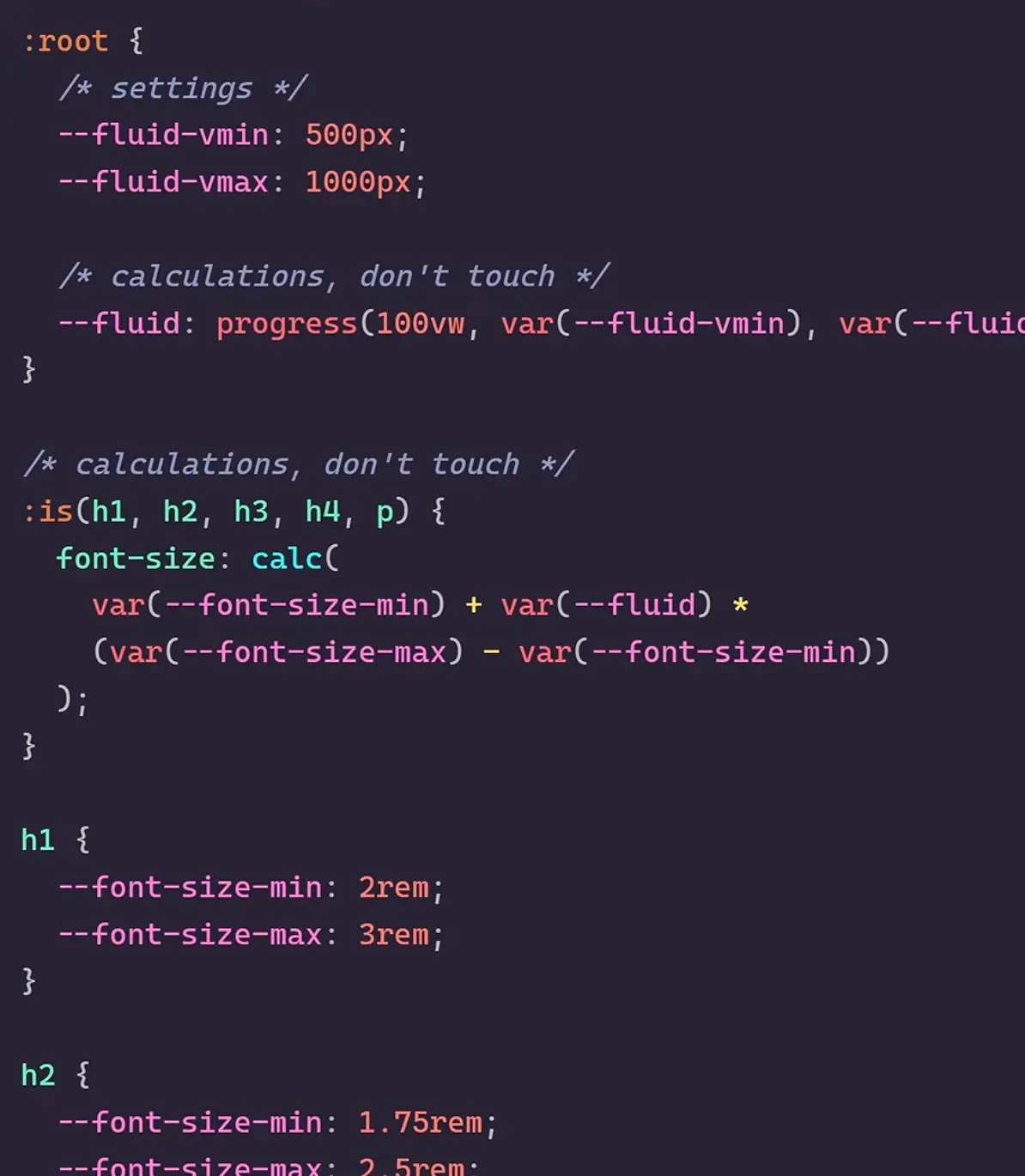
The easiest way to do fluid type now by Kevin Powell (YouTube)
:root {
  /* settings */
  –fluid-vmin: 500px;
  –fluid-vmax: 1000px;
  /* calculations, don't touch */
  –fluid: progress (100vw, var(–fluid-vmin), var(–fluid-vmax));
}

/* calculations, don't touch */
:is(h1, h2, h3, h4, p) {
  font-size: calc(
    var(–font-size-min) + var(–fluid) *
      (var(–font-size-max) − var(–font-size-min))
  );
}

h1 {
  –font-size-min: 2rem;
  –font-size-max: 3rem;
}

h2 {
  –font-size-min: 1.75rem;
  –font-size-max: 2.5rem;
}
Video Games
The Making of Grand Theft Auto VI by Jason Schreier (Bloomberg)
“[…] developers on GTA VI were banned from accessing Rockstar’s servers and tools outside the office, forcing them to use vacation days if they needed to stay home for childcare or other emergencies. Kolbe says the company plans to reexamine this policy after the game comes out, though she doubts it will switch to the more common three-days-in, two-days-out hybrid model. “The idea that we would have the game in that many environments is something that I think the security team would not love,” she says. “I think if we did not have a game that people wanted to steal as much, maybe it would be an easier conversation.” (Despite these security measures, another major leak happened in August, just before the preview on Netflix, leading to grumbling across the company that all this had been for naught.)”
“Rockstar’s leaders say GTA VI is a foundation upon which they can build new content at a faster pace, and they vow that their next release won’t take another eight years. “The engine, the tools and the team we’ve built during this project will allow us to do things more quickly,” Hooker says. “I feel confident that we can build on top of this and go more sideways than upwards to build more compelling content.” One comparison point might be the transition from Grand Theft Auto III to Grand Theft Auto: Vice City, which was made in less than a year because it was built on work that was already done. “We foundationally changed a lot of stuff on this project,” Garbut says. “But now it’s done, and we’re not going to rip it apart.””