
Links and Notes for November 13th, 2026
Below are links to articles, highlighted passages[1], and occasional annotations[2] for the week ending on the date in the title, enriching the raw data from Instapaper Likes and Twitter. They are intentionally succinct, else they’d be articles and probably end up in the gigantic backlog of unpublished drafts. YMMV.
[1] Emphases are added, unless otherwise noted.↩
[2] Annotations are only lightly edited and are largely contemporaneous.↩
Table of Contents
- Public Policy & Politics
- Journalism & Media
- Economy & Finance
- Science & Nature
- Art, Literature, Music, & Cinema
- Philosophy, Sociology, & Culture
- Technology & Engineering
- Programming
- Design
- Fun
- Video Games
Public Policy & Politics
The entire United States is just riding around with the check engine light on. (Twitter)
Why the US Can Never Match Chinese Shipbuilding by Brian Berletic (Land Destroyer)
“The US educational system reflects this reprioritization − not only in redirecting students from productive vocations to better serve the ponzi-economy − but also in the form of maximizing profits to access the education system itself. This has been done through expanding privatization across primary and secondary education, and across all forms of higher education. Young adults find themselves faced with tens of thousands of US dollars in debt before starting their first step in any chosen career.
“This has created not only a critical shortage of workers for the US industrial base, it has created a systemic obstacle that must be removed before that critical shortage of workers can even be addressed. Reforming US education alone is a process that could take a generation to solve.”
“In the United States, any particular American laborer requires a wage capable of paying for the exorbitant cost-of-living in the US, including not only their own education/training, but also their rent, food, utilities, transportation, and healthcare. Even with healthcare provided by the shipbuilding industry − the corporations themselves must pay astronomically higher costs for that healthcare than in China.
“This is because − in addition to the shipbuilding sector itself attempting to maximize profit in exchange for minimal effort or purpose − the US workforce is preyed upon by similar profit-maximization across all other sectors of US economic activity. The pharmaceutical industry alone uses US tax-funded research and development to produce medication − then charges many times its production costs for access to it.”
The Needle Moves, But the Struggle Continues by Vijay Prashad (CounterPunch)
“The reaction of people in the Americas and Europe at present is that the abysmal growth rates due to the low investment in their own countries results in households cutting meals, in young people postponing independent lives, and in workers earning wages that cannot meet their Strait of Hormuz inflation expenses.”
“Even if an eventual lower rate of inflation eventually slows the price rise, the accumulated rise in prices remains; a lower rate of inflation does not restore the purchasing power already taken from working people.”
“The day before the election, Trump gave a press conference to speak about how he had authorised the clean-up of the Reflecting Pool in Washington, and the day after the election, he told the press about his plans for a White House ballroom and signed an Executive Order to protect his decorations of the Oval Office.”
What a tone-deaf buffoon. This is his version of “let them eat cake.” His punishment is taking too long.
“Defending democracy requires an economic programme that gives workers reasons to defend it. If the poor are asked only to protect institutions while their own needs remain postponed, the right will return to exploit their disappointment and redirect it against the left.”
“The crisis of our times does not choose its political outcomes. Insecurity amongst billions of people has indeed created the space for reactionary ideas and the movements of the far right of a special type. But this insecurity can also produce solidarity and resistance, indeed it can provide a start for social transformation. Electoral setbacks for dangerous governments create these openings that popular organisation must widen.
“The needle of history has moved because people have acted. Its further movement will depend on whether they can turn scattered refusals into sustained power over the decisions that govern their lives.”
Americans Voted for Not-the-Political-Right, So Don’t Be the Political Right by Rob Urie (CounterPunch)
“American voters have been fleeing the legacy political parties for the last quarter century. With nowhere else to go, nearly half of registered voters are now ‘Independent.’ With no Independent candidates to vote for due to legacy party control over the ballot box, Independent voters are free to shift back and forth between the parties voting against the legacy party candidates. This has added volatility to US elections while reducing party loyalty.”
“[…] how did Western imperialism motivate WWI – WWII? Well, why did Trump attack Venezuela, kidnap its president and steal its oil? Because he needed it to support oil prices and diesel supply as the US and Israel launched a war of aggression against Iran. Prior to WWI the imperial powers looked around the globe and concluded that if they didn’t grab resources, some other nation would. And why were the resources important? Because they form the basis of national economic and military power. With them, nations rise in power and without them, they become prey.”
“[…] this framing feeds back into Victorian premises that wealth is earned and that the solution to poverty is for the rich to have mercy on their social inferiors. ‘Markets’ didn’t force US manufacturers to search for cheap labor abroad. Policies of the Federal government like NAFTA did. And the plan really was that Americans would be the managers of the world. How do I know this? At least a dozen bosses ‘explained’ to me that Americans are predisposed to lead and the rest of the world to follow.”
The Enemy at Home by Chris Hedges (Substack)
“The corporate vultures — especially the war makers — are, as I write, descending on Congress. They are meeting with Democratic Party leaders and holding out promises of millions in cash. They will corrupt, neutralize and compromise most. They will destroy the careers of the very few who refuse to do their bidding. They hold the real power. They have no intention of surrendering it. The manufacturing of weapons systems and the waging of war are the chief activities of the U.S. government. It is no longer one among other means of advancing the national interest. War and violence are how we speak to the rest of the world.”
“The corporations, and the billionaires who run them, buy and trade politicians, academics and journalists like Pokémon cards. Their lobbyists write the legislation. They own the media. They have stifled the academy, shutting down free speech and purging critics. Judges offer them unlimited power. To defy them — and I speak from personal experience — is to be cast into the wilderness.”
“The choice, as Rosa Luxemburg pointed out, is socialism or barbarism. If we do not dismantle global capitalism, if we do not free ourselves from the tentacles of the war industry, we will descend into the Hobbesian world of totalitarian capitalism, failed states, mass migrations, endless war, ecocide and permanent immiseration.
“The genocide in Gaza is the harbinger of this coming dystopia. It is a stark message by the industrialized nations to the Global South, especially with the breakdown of the climate. The message is this:”
- There are no rules.
- International Humanitarian Law is dead.
- The strong will annihilate the weak.
- We control the world’s resources and most of its wealth.
- We will not relinquish it.
- Your suffering and lives are meaningless to us.
- Defy us and you too will be slaughtered.
“Malcolm X told young civil rights activists from Mississippi 51 days before his assassination on February 21, 1965. ”“You get freedom by letting your enemy know that you’ll do anything to get your freedom; then you’ll get it,”“When you get that kind of attitude, they’ll label you as a ‘crazy Negro,’ or they’ll call you a ‘crazy nigger’ — they don’t say Negro. Or they’ll call you an extremist or a subversive, or seditious, or a red, or a radical. But when you stay radical long enough, and get enough people to be like you, you’ll get your freedom…So don’t you run around here trying to make friends with somebody who’s depriving you of your rights. They’re not your friends, no, they’re your enemies. Treat them like that and fight them, and you’ll get your freedom; and after you get your freedom, your enemy will respect you. And I say that with no hate. I don’t have hate in me. I have no hate at all. I don’t have any hate. I’ve got some sense. I’m not going to let anybody who hates me tell me to love him.”
“If we remain supplicants, if we hope desperately for a feckless political class to save us, the barbarians will triumph.”
Europe Has Become an American Colony in Revolt by Nicky Reid (Exile in Happy Valley)
“The politicians and the media, both here and over there, are giving themselves a hernia trying to wrestle the narrative of the largest protests Europe has seen in generations into something they can control and something they can control you with. They will all try and sell you on the notion that this is a left-right thing, whether it’s another Putinist conspiracy against liberal democracy or some kind of sharia refugee riot.”
“[…] the kids filled the city streets and set up blockades, but things didn’t really kick off until Macron sicked the pigs on them, using barely less-than-lethal military technology on unarmed teenagers and then hauling them off, bloody and mauled, in mass arrests by the thousands. This gestapo response infuriated the French people and was rightly condemned by everyone from Amnesty International to Human Rights Watch. It was also the last straw of many that brought a country pushed too far by austerity and forever wars into the streets with their children.”
“[…] what the students and Yellow Vests are really jacked about is the cost of living exploding in the first world while their leaders get rich bombing the rest of the planet to fucking bits, and this is the reality the elites across the west are desperately trying to cover up. What’s torching the streets of Europe right now is a fundamentally anti-imperialist uprising.”
China’s Communist Party Turns The Blade On Itself by Gary Wilson (Scheer Post)
“Western coverage treats all this as a power struggle, a leader eliminating rivals. That reading collapses on the facts. The generals who fell were chosen under Xi Jinping at the same 2022 congress that gave him his third term, and Zhang Youxia was a close ally whom Xi kept on past retirement age. Xi Jinping appointed these generals and Xi Jinping is now expelling them. Something else is going on.”
“The text identifies the source of the rot in economic terms. It warns of “the tests in governance, reform and opening up, the market economy, and the external environment.” It orders investigations into “collusion between government officials and businesspeople” and “capital penetrating into the political domain.” And in a single sentence it states the whole problem: the party must “resist the rules of commercial dealings and the relationships of dependency eroding intraparty conduct.” The rest of the document fills in how the money moves, through retired officials turned business agents, through officials’ spouses and children, through cryptocurrency and funds parked abroad.”
“Cleaning up the party helps the revolution. It is no substitute for it. A party can purge its ranks and rewrite its rules and still leave untouched the economic conditions that keep producing the officials it purges.”
“The United States ruling class understands this, which is why it has spent four decades hoping for a Chinese Gorbachev and why its China analysts greet every purge with the same disappointment. There is no Soviet-style unraveling in this document. There is a workers’ state under siege putting its political instrument in order.”
“That is the force the resolution’s second answer leaves largely in reserve. An official who takes money from a developer is checked more surely by workers who can see the books and remove him than by an inspection team sent from the next level up. The resolution’s own demand that officials be assessed by “the comments from ordinary people” and that the channels for “public oversight” be kept open points this way, and the thinness of those passages next to the pages on discipline is the measure of what remains to be done.”
“None of this is happening in peacetime. The resolution says so, warning that “hegemonism and power politics pose greater threats, geopolitical conflicts and local wars show no signs of end.” The United States government’s war on Iran this year was openly described in the Pentagon and in Congress as a rehearsal. The technology blockade, the arming of Taiwan province, the ring of bases from Japan to the Philippines to Guam, a United States colony, all continued through the two Trump-Xi summits of 2026 and continue now.”
“Whether private money reached the top of the command is not established in anything published. What is established is that the party judged the command unreliable. Reasserting political control over the gun is a necessity. It is also the moment of greatest exposure. The Pentagon’s planners read these expulsion lists as closely as any communist does.”
“That is the measure of what the party has undertaken. It has chosen to cut deep into its own military leadership at the height of a United States war drive, because it judged the command unreliable and the war drive real.”
Der Kampf der Giganten − NATO, Sanktionen und der Aufstieg der BRICS-Staaten by Dr. Daniele Ganser (YouTube)
“Wer hat im globalen Machtgefüge die Nase vorn – die USA, China oder Russland? Und welche Rolle spielt Europa in einer Welt, die sich zunehmend multipolar entwickelt? Alexander Teske spricht mit dem Historiker und Publizisten Daniele Ganser über dessen Buch „Kampf der Giganten“ und über die geopolitischen Veränderungen der Gegenwart.
“Im Mittelpunkt stehen das Kräfteverhältnis zwischen den drei Großmächten, die Folgen der westlichen Sanktionen gegen Russland und Deutschlands Energiepolitik. Ganser erläutert seine Sicht auf die deutsche Souveränität, die Bedeutung der US-Militärstützpunkte in Deutschland und die Rolle der NATO. Außerdem geht es um die deutsche Wiedervereinigung, die damaligen Zusicherungen zur NATO-Osterweiterung und die Frage, warum Europa aus seiner Sicht heute keinen geopolitischen Giganten bildet.
“Ein weiterer Schwerpunkt ist China: Das Gespräch behandelt die historischen Erfahrungen des Landes mit europäischen Kolonialmächten, die Bombardierung der chinesischen Botschaft in Belgrad 1999 und die daraus entstandene Perspektive auf westliche Außenpolitik. Darüber hinaus sprechen Teske und Ganser über die BRICS-Staaten, die Annäherung zwischen China und Russland sowie die Verschiebung hin zu einer multipolaren Weltordnung.
“Zum Schluss geht es um Gansers Vorgehen bei kontroversen historischen und politischen Themen, den Umgang mit unterschiedlichen Narrativen und die persönlichen Folgen öffentlicher Ausgrenzung und Kritik.”
Capitalism Is Easy If You Are Rich And Evil by Caitlin Johnstone (Substack)
“So long as you don’t challenge status quo power structures in any way, and so long as you have sufficient financial reserves to participate in a society where it costs money to do anything, then you are as free as a bird. You have the freedom to choose between eight thousand brands of soda. You have the freedom to visit the movie theater and watch any of the Pentagon-funded action flicks opening that weekend. You don’t have the freedom to live in a society where nobody is homeless, but you do have the freedom to paint the windows of your house so that you can’t see any homeless people.
“Sure it can be difficult to get by in our society if you aren’t wealthy, but in western liberal democracy, ANYONE can become wealthy so long as they’ll do anything for money. Did JD Vance lie down and cry when he was born into a working-class family in Nowhere, Ohio? No! He manned up, deep-throated Peter Thiel’s dick, promised to start wars for Israel whenever he becomes president, and now he’s got millions of dollars!”
“[…] the best way to make money in our society is to already have lots of money, but even those without generational wealth can ascend to financial abundance if they invent a new type of addiction, or a weapon which kills millions of people at a time. Anyone can get rich with hard work, a can-do attitude, and a willingness to inflict unfathomable pain and suffering on behalf of the western empire.”
“Quit your bellyaching you stupid commies; if you’re tired of being poor just grow the hell up, move out of your mom’s basement, and become a parasitic middle man charging access tolls in both directions between labor and consumer.
“Don’t complain about billionaires, just kill off all the soft, tender parts of yourself that stop you from becoming a billionaire yourself. Then you can make fort out of your stacks of cash and live there, in true freedom, until we all die in the climate apocalypse.”
Journalism & Media
The Imperial Propagandists Are Exposing Themselves Like Never Before by Caitlin Johnstone (Substack)
“[…] anyone with two braincells to rub together can see that plans to strike Iran have already been drawn up, and that our information ecosystem is now being flooded with war propaganda to justify this decision. They’re just throwing every excuse imaginable into the mainstream news churn in order to dull the political impact of the unpopular decision they already intend to make, and the presstitutes of the imperial news media are fulfilling their role as the propagandists they’ve always been.”
Economy & Finance
How Milei defused Argentina’s hyperinflation bomb by Juan Ramón Rallo (Reason)
“The government declined to fully index some nominal expenditures to rising prices, shrinking the real value of public salaries and pensions. This was socially painful, particularly for pensioners, but it allowed the fiscal correction to proceed faster than Congress would otherwise have permitted.”
The king fucked the elderly. This author’s formulations are positively evil.
“[…] it closed 2024 with a fiscal surplus and has treated balanced budgets as the nonnegotiable anchor ever since.”
But a country can’t shed its nonproductive employees. Instead Argentina has a 60% poverty rate.
“This time, the Treasury was already in surplus, and the facility operated on the stock inherited from the past: Argentina’s largest external creditor was rolling over its own exposure, thickening the central bank’s liquidity buffers, and stretching the horizon over which the old debt would be serviced. That support undoubtedly reinforced the program’s healing dynamics […]”
My god this formulation.
“These cuts were modest relative to Milei’s ambitions, but notable because they occurred without sacrificing the surplus. Milei did not balance the budget by raising taxes; he cut spending faster than revenue fell.”
So how are the non-wealthy doing? Are they enjoying the cut of non-essential services due to lack of funding ?
“Milei’s program had not secretly become insolvent; what triggered the crisis was the rising probability that its enemies might regain the power to make the state insolvent again. Nor was the panic irrational. Asset values depend on expected future policy, not just current policy.”
Treating a country like a business. You have to please the big shareholders. You have to assure that them that no-one will come looking for their plundered wealth.
“[…] the threat of a fiscally irresponsible government had them fleeing the peso en masse.”
Where trump blames Biden, this guy blames current crises on potential governments. Neat trick.
“That was the gap the U.S. Treasury stepped in to fill. In October 2025, Treasury Secretary Scott Bessent set up a $20 billion swap line with Argentina’s central bank and—in an operation American taxpayers had every reason to question—bought pesos outright in the days before the vote. Bessent was bridging, for a few weeks, a gap that political panic had blown open. The intervention contained the panic just long enough for the election to remove its immediate political cause.”
What a fucking self-serving way to describe election-manipulation.
“Still, the lesson is uncomfortable. A stabilization is consolidated only when an election can no longer plausibly revive expectations of default and monetary collapse. Argentina isn’t there yet.”
Idea: stop having elections ammirite?
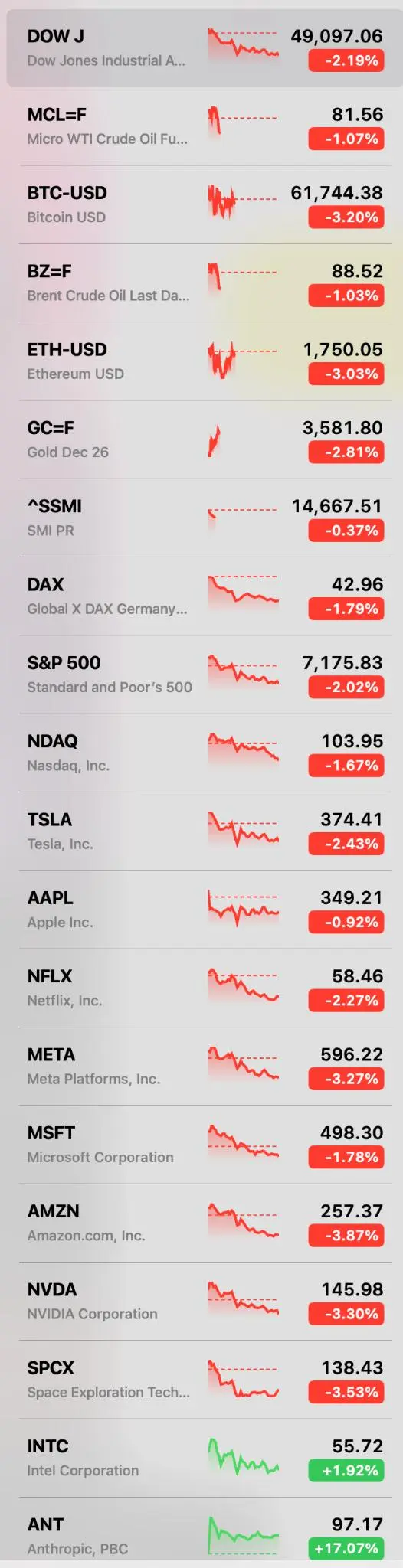 The market looks like it's getting tired
We’re all tired. Tired of unproductive people taking all of the stuff.
Anthropic did what everyone expected it to do: massively benefitted everyone who obtained stock options at a lower-than-IPO price and fucked over everyone else. That’s what it was designed to do. No-one at Anthropic cares anymore whether the company even exists in a year or two. They got what they wanted.
All that shit being down could be a sign that people sold other shit to buy Anthropic … but that also signals that there seems to be a limited amount of money around.
Gold is down about 40% in the last 4 months. That’s INSANELY VOLATILE for gold. It looks like Bitcoin at this point. Which is also down about 35% from the high this year.
So that was the day Anthropic IPOed.
 The bloodbath continues
Today, it’s hard not to believe that the bubble is deflating. At first I thought the money was draining out of the market to buy Anthropic but Anthropic is down to its original price (or lower) today, having dropped by 12.5% just today.
Bitcoin is free-falling. Gold is free-falling. The money is just …. disappearing. This might be the bubble popping.
Bitcoin being that low is going to trigger a LOT of automatic sales at ETFs and other more stable funds. And the margin squeezes are going to cause more and more cascading failures.
Science & Nature
How Long Can Life Wait? by Maciej Cegłowski (Mars for the rest of us)
“In a three-year experiment begun in 2015, Japanese scientists hung plates covered with bacteria off the side of the International Space Station to see how well they would fare there. They found that after three years, colonies of deinococcus radiodurans were not just revivable, but in better shape than a control group that spent that time inside the space station. By their estimates, a pellet of D. radiodurans 1 mm in size should be able to survive direct exposure to interplanetary space for 2-8 years, and potentially stay viable there for decades if shielded from sunlight.”
“The Tanpopo results and experiments like it are bad news for Mars exploration. They imply that live microbes from Earth have already reached Mars and are vegetating under the carapaces of landers. Whether these grim survivors pose a contamination hazard depends on how effective a barrier the Martian surface is to would-be colonizers, and whether transport pathways exist connecting the surface to any habitable Martian environment, which would presumably be deep underground.
“The remarkable longevity of microbes in space also vindicates NASA’s policy of crashing expensive deep space probes into Jupiter and Saturn at the end of their missions instead of leaving them in uncontrolled orbits that, decades or centuries hence, could lead to an impact with a potentially habitable world like Enceladus or Europa.”
I can imagine people who’ve thought about something like that for five seconds coming to a quick conclusion that it’s wasteful, thinking that “those brainiacs” always overthink things. Those ignoramuses are ignoring the counsel of people far more experienced and knowledgeable in that area, who’ve spent years considering the ramifications, who’ve spent years establishing and internalizing a threat model.
“[…] an impact model developed in the 1980s to explain the enigmatic presence of small pieces of Martian rock on Earth. Scientists knew the rocks had to be from Mars because tiny inclusions of air trapped inside them had the same isotopic signature as the Martian atmosphere, as sampled by Viking. Clearly some cataclysm had been necessary to fling these rocks into space, but they had survived it without being vaporized or melting.”
“[…] researchers studying remnant magnetism in a Martian meteorite called ALH84001 found that it had never been heated above 40˚C, about the temperature of a nice hot bath on Earth. The meteorite had started life sitting around on Mars, and was ending its life sitting around on Earth, without much happening in the interim that would distress a microbe. It was positive proof that rocks could make the full trip from Mars to Earth without getting cooked.”
“In that worst-case environment, d. radiodurans could still probably last for 50,000-100,000 years before sustaining irreparable damage. So we can consider 50,000 years the upper limit for interplanetary travel time on small rocks, and 500,000 years a limit on larger ones.”
“I describe all of this at length because it gives a taste of the kind of trouble scientists might run into trying to analyze samples from Mars. Even working in fancy laboratories with known organisms on Earth, analyzing kilogram-size chunks of raw material, scientists have still struggled to close the chain from seeing a bacterium visually, to extracting it aseptically, to finally characterizing its DNA.
“Imagine trying to do this in Martian conditions, where the biochemistry and makeup of potential life forms are unknown, the equipment may have to be tele-operated with a forty minute time delay, and live microbes from Earth may be riding along as stowaways on the lander.
“Or if you prefer a sample return scenario, imagine trying to do the analysis in a category-5 cleanroom on Earth, using samples so precious that they cannot be examined in bulk or meaningfully altered.”
“Geologists, petrologists, and microbiologists come from different scientific tribes that don’t typically read one another’s papers, or buy one another beers. Even the various subfields can often talk past each other, and many researchers have yet to absorb the full implications of modern sequencing techniques on their field.”
“[…] when a compression wave and a reflected rarefaction wave meet, the shocks cancel out, but the particle velocity they impart to rocks near the surface is additive, and enough to fling them into space.”
TIL about Anton syndrome, a rare condition where a person becomes completely blind from brain damage, but adamantly denies they are blind. Their brain invents detailed visual hallucinations, causing them to confidently describe rooms they cannot see and make excuses when they bump into walls. (Reddit)
From Wikipedia:
“Anton syndrome, also known as Anton–Babinski syndrome and visual anosognosia, is a rare symptom of brain damage occurring in the occipital lobe. Those who have it are cortically blind, but affirm, often quite adamantly and in the face of clear evidence of their blindness, that they are capable of seeing. Failing to accept being blind, people with Anton syndrome dismiss evidence of their condition and employ confabulation to fill in the missing sensory input. The condition is named after the neurologist Gabriel Anton. Only 28 cases have been published.”
Top comments:
“It is a bit freaky how much of our vision in general is “in our head”, as in the brains construct what they believe the eyes are seeing. By what I’ve understood especially peripheral vision is much about what the brain remembers and presumes to be there.”“Fun fact: there has never been a recorded case of schizophrenia among people blind from birth.”
Rømer’s Speed of Light Measurement (RandomlyUnique)
This is a visual explanation of Rømer’s determination of the speed of light (Wikipedia)
“In 1676 […b]y timing the eclipses of Jupiter’s moon Io, Rømer estimated that light would take about 22 minutes to travel a distance equal to the diameter of Earth’s orbit around the Sun. Using modern orbits, this would imply a speed of light of 226,663 kilometres per second,[2] 24.4% lower than the true value of 299,792 km/s.[3] In his calculations Rømer used the idea and observations that the apparent time between eclipses would be greater while the Earth is moving further from Jupiter and lesser while moving closer.”
The Strange Problem With AI-Generated Mathematical Proofs by Ellie Sleightholm (YouTube)
“As humans, when we write mathematics, we often don’t include all of the details. We often say it follows from, but the auto-formalizer has to fill in these details. And then when translating mathematics into LEAN, these hidden assumptions, they need to be addressed. And that is where these ambiguities arise.
“If the original mathematical statement assumes that something exists, but it hasn’t been established whether it does, the AI needs to resolve that ambiguity to faithfully translate the mathematics. Otherwise, it might quietly change the definition, introduce additional assumptions, or assign a default value just to make LEAN code compile. And LEAN wouldn’t necessarily flag this as a problem because it’s only checking that the formal mathematics is logically correct, not that it faithfully represents the original statement.”
“[…] this isn’t just a problem with today’s AI models or something we can necessarily fix with more computing power. It’s actually a fundamental limitation of computation itself. And the key takeaway is that even if an AI produces a LEAN proof that compiles perfectly, that alone does not guarantee that the AI has preserved the meaning of the original mathematics.”
Art, Literature, Music, & Cinema
Patrick Stewart (1940-2026): a classical actor animated by his socialist convictions by Paul Bond (WSWS)
“He also appeared in Griffiths’s Occupations, playing a fictional Bulgarian communist (Christo Kabak) sent to Turin during the workers’ occupations of the Fiat factories. The play concerns arguments between a Kabak and Antonio Gramsci (Ben Kingsley in that production) on tensions between the need for discipline in a revolutionary movement and the inspiration for the revolutionary moment. Griffiths called it “a sort of Jacobinical response” to the failure of 1968 in France.”
Amazing.
Threads of Imagery: Barbara Trapido’s Debut Novel Forty Years On by Rosa Lyster by Rosa Lyster (The Paris Review)
“I deem myself uniquely injudicious in having married a woman who refuses to double as a high-grade editorial assistant. Since custom requires me to thank her for something, I thank her instead for the agreeable fact of her continuing presence which in twenty years I have never presumed to expect.”
I read this out loud to my partner. Just this morning, she left on a trip, promising to return in 7.5 weeks. I do not presume to expect her to do so, but nevertheless fervently hope that she will.
“We once had a lovely lodger who played the piano, a librarian at the Bodleian Library, a rather effete boy called James, who managed to wedge a small grand piano into our little basement studio flat. This was at the time when the Labour Party was trying to supplant Ken Livingstone and impose poor old Frank Dobson in his place as the mayoral candidate—big news day-to-day at the time. “Who’s Ken Livingstone?” James asked me one day, during one of my rants. I thought, I am so envious of you. You don’t have to waste your days fretting about what’s going on, whether it’s the German election or the Labour Party. You are free to think about Dutch landscape paintings and playing the piano.”
“on a train, I’ll determine which way they’re facing. It’s quite hard working out chronology and such things as, Is the season right for them to be eating this or that? Can I get this person on a train from one place to another place before closing time? All that can be a bit of a headache.”
DIGGER: FICTION AS A SIGN FROM THE FUTURE by Slavoj Žižek (ŽIŽEK GOADS AND PRODS)
“[…] what are even the best jokes about Trump compared to the joke that is Trump’s actual politics? Imagine that, a couple of years ago, a comedian had performed Trump’s statements, tweets and decisions on stage—it would have been experienced as an unrealistic, exaggerated joke. So Trump already is his own parody, with the uncanny effect that the reality of his acts is more outrageously funny than most parodies.”
“While we—actual viewers—watch Digger, we presume that what we see is a pessimistic vision of a catastrophe to come. So why is it accompanied by laughter? Because the audience lives in the world after the catastrophe: the play the theatre performs is a story told to amuse the survivors. What the movie presents as the reality of now (the theatre performance, the devastated city) is set in (our) future, in which the catastrophe has already happened. This temporal difference between the “now” of the movie and our own “now” is crucial. We (the public watching the movie) live today, not in the future after the catastrophe, which means that our political reality is “Fossil Fools,” i.e., what appears in the movie as ridiculous fiction (a theatre play). The true fiction is what is shown as reality (the future ravaged world in which the play is performed). This fiction is the sign from the future addressed to us.”
“A Montenegrin guy is sitting on the sand close to the sea, doing nothing, just calmly observing the waves. A foreign tourist from Germany approaches him and tells him: “Why do you just sit there? Why don’t you cast a hook into the sea, catch some fish, which abound here, and sell them? If you sell enough of them, you can hire other people to do it for you as well and earn even more money. Then you no longer do any fishing but rather establish a company that organises the work of fishing. Soon you will be rich enough to leave all the work to managers and spend your time just sitting close to the beach and calmly observing the waves…” “But this is what I am already doing now!” snaps back the Montenegrin.”
Wild Horse Nine Skewers the Dangerous Fools Behind US Empire by Eileen Jones (Jacobin)
“In Wild Horse Nine, Chris has become such a loose cannon that his superior, MJ (Steve Buscemi), a CIA bureau chief overseeing South American operations, decides they can’t wait for Chris’s death by natural causes, no matter how imminent it might be.
“The “kill ’em” speech alone is so powerful, though it’s delivered with such perfectly shocking casualness that it would probably get John Malkovich another Best Actor Oscar, except that his costar, Sam Rockwell, is equally fantastic as Chris’s only friend, the irascible longtime CIA protégé Lee Chesterfield. In all likelihood they’ll both be nominated and then split the Academy Award vote and lose.”
“If you know Martin McDonagh’s film work at all, most famously In Bruges (2008) and The Banshees of Inisherin (2022), you recognize the elements of McDonagh’s favorite designs. They include, most prominently, two male friends bickering and bonding and betraying in shades of light humor and dark antipathy. Then there’s the heartbreakingly beautiful setting that creates the ironic backdrop to human viciousness, making the viewer wonder once again what the hell is wrong with us as a species. It’s always in an earthly paradise where people turn on each other and the shooting starts.”
“To those on the Left, this probably seems like a far too mild agenda. But we’ve got to keep in mind the extraordinary level of delusion that still prevails in the United States. For every leftist that knows all about what the CIA did in Chile in 1973, there are a hundred Americans who either don’t know about it or refuse to acknowledge the fact of it or what the fact means.”
“In Wild Horse Nine, Chris claims blandly that “I liked Patrice.” When Lumumba told him the CIA would be responsible for the end of democracy in the Congo for at least a generation, Chris replied in tones of sympathetic reasonableness that of course it would. That was the whole point.”
The Spleen of Butte Bergeyre by Radu Țăranu (The Hinternet)
“One must limit oneself to music recorded before 1928 or so if one wishes to have some idea of what vernacular song traditions sounded like when music still hovered in this world only for the duration of its performance. Most such early recordings showcase a music that is just as simple and modest as can be. But just put a microphone on that, shout “Record!”, and within a few decades the resulting artifacts will have evolved new Paganinis.”
“[…] through recitation of what the ancestors knew? That is, did not sound recording, in making it possible to record all those elements of music performance that evade recording in sheet music, now make vernacular musicians able generatively to compete with their contemporaries in a way that mirrored the elite competition we except to find in the conservatories and academies? If so, this is perhaps something between a corollary and an equivalent way of saying that the 20th century is the moment in history when mass culture becomes culture as such, and high culture becomes an affectation.”
Death and the Gorgon by Greg Egan
Beth felt some relief that they’d reached the same conclusion, though it was so repugnant that she would have been happier to be wrong.
“I saw an interview with a Taliban commander once,” she recalled. “He was boasting that during the insurgency, in the right madrassas in Pakistan he could find an endless supply of suicide bombers: boys so ignorant and impressionable that they really did believe they’d go straight to paradise if they did whatever he told them. OG have found their own fundamentalist madrassas: forums full of people who believe they can die, and be frozen, and wake up in paradise, so long as they’ve done what it takes to book a ticket.”
Castillo said, “There’s more. My mob guy’s not into cryonics, and I don’t think his people ordered any of these hits … but they were on the receiving end at least twice.”
Beth understood now. “They must have figured out who the killers were, eventually, but by then they were just frozen heads. So they triggered the cave-in to send a message that nobody who messed with them would make it to paradise.”
“And it looks like OG got the message,” Castillo added. “They didn’t stop playing the game, but they got more careful; whoever Grasso was hired to kill in that bar had no mob connections at all. I don’t know how my guy knew she’d been chosen, though.”
“The same way I knew something was up with her,” Beth guessed. “They unleashed their own software on the forums. They looked at all the patterns and picked up on the cues.
“I’ll want to see every post before it’s sent,” she said.“You know these programs can spit out nonsense sometimes?”
““I’ve told him it’s important, and to be careful,” Ken replied.
““I’ve told my cat how much my couch cost, but that didn’t save the upholstery,” Beth retorted. “Run everything by me.”
“ZonesOfOught needed to keep up his history of advocating for a new galactic order, where everyone’s moral worth would be determined by their count of potential informational offspring, and people would fight duels of wit and strategy while represented by tornado-like avatars comprised of their swirling, exponentially blossoming future family trees”
Giovanni Battista Piranesi (Wikipedia)
“[…] an Italian classical archaeologist, architect, and artist, famous for his etchings of Rome and of fictitious and atmospheric “prisons” (Carceri d’invenzione (Wikipedia)).”
These drawings,
“[…] depict enormous subterranean vaults with stairs and mighty machines, in rather extreme versions of the capriccio, a favourite Italian genre of architectural fantasies”
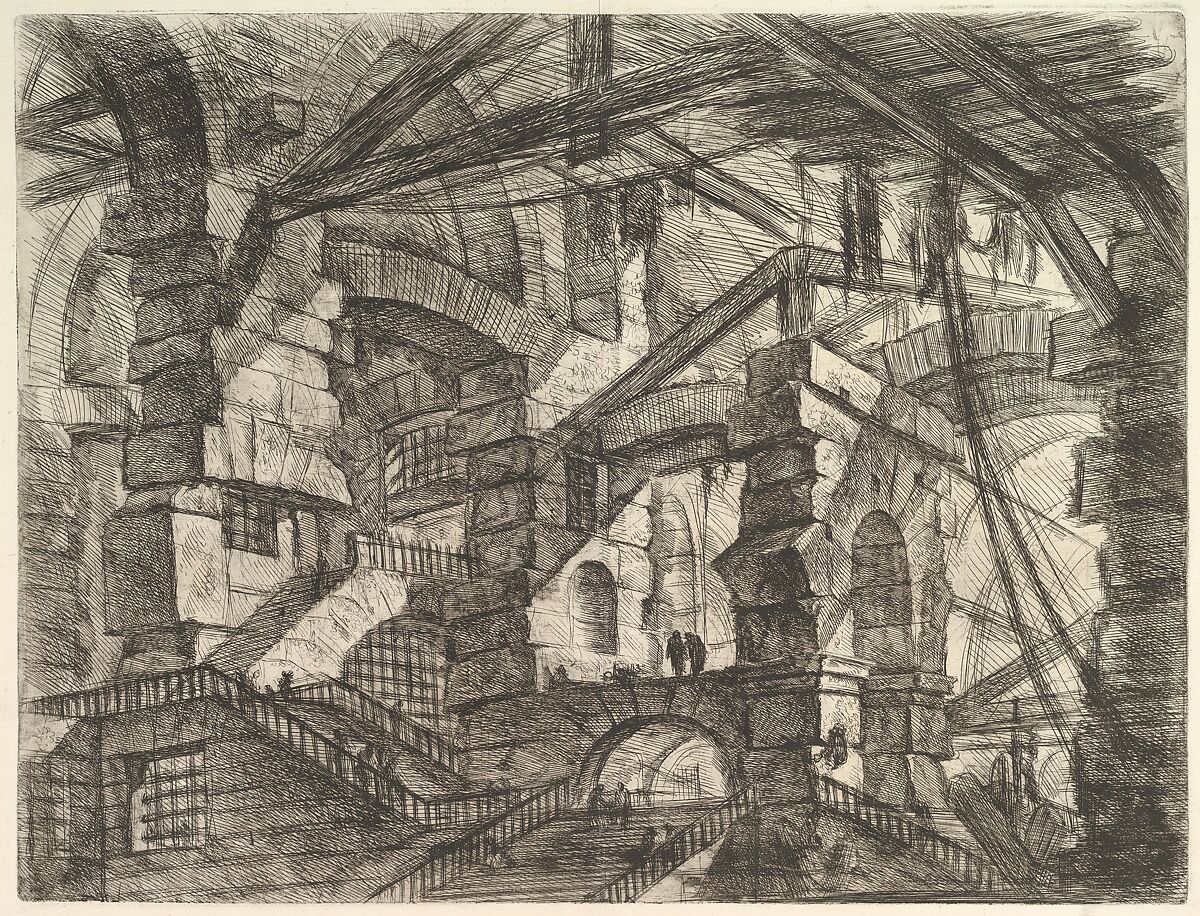 The Gothic Arch, from Carceri d’invenzione (Imag…risons)ca. 1749–50 by Giovanni Battista Piranesi
“You are now able to stream all of your favorite NIN live recordings from 1988-2026.”
This is when I saw them: 1991-08-13: Lollapalooza (Saratoga Performing Arts Center)
Philosophy, Sociology, & Culture
No, the Phonics Decoding Advantage Does Not Persist For the Most Disadvantaged Readers by Freddie deBoer (Substack)
“Those students who remain illiterate into adolescence are overwhelmingly those who face all manner of other personal and social and economic challenges, a cohort of kids for whom pedagogical differences are least meaningful. Meanwhile, the kids who aren’t at the very bottom in all manner of educational metrics eventually learn to read with or without systematic phonics instruction. The trouble is that you can be better or worse at reading, the kids who start out worse stay worse in overwhelming majorities, and phonics has no ability to improve their position over time.”
“Phonics teaches decoding, the ability to turn letters into sounds and sounds into words. Decoding is a necessary but insufficient part of the real goal, which is comprehension − the ability to derive meaning from the combination of words on the page.”
“Please note that in every case here I’m not referencing some sort of alternative research record or crazy theory, but instead, simply accurately summarizing the research that the phonics people cite themselves.”
“The problem is people who should know better keep saying things that aren’t true, and this all has very real policy stakes. (Tell you what: you can leave a comment complaining that I’m being repetitive if you first email Sold a Story at soldastory@apmreports.org and ask a) why they keep saying factually incorrect things and b) why they refuse to debate anyone who is capable of actually calling them on their bullshit.)”
November 1932 Geneva shooting (Wikipedia)
“On the afternoon of the 9th of November 1932, elements of the Swiss Army under Major Perret fired live rounds into a crowd of anti-fascist protesters in Plainpalais in Geneva, killing 13 and wounding 65.”
“Recruits were told that “Revolution had broken out in Geneva” and issued live ammunition. Four soldiers who refused to obey were immediately arrested.”
“The Federal Council ordered Communists to be excluded from administration: “Anyone having joined the Communist Party of collaborating to any other Communist organisation my neither be recruited nor remain in the Federal services.”
“Geneva soon followed suit, and furthermore banned the Swiss French-language Communist newspaper, Le Drapeau rouge. During the entire period, the Swiss Socialist Party and the right wing of the Socialist Party of Geneva attempted to avoid confrontation with the government and condemned the actions of the Communists.”
Technology & Engineering
I told you so by Cory Doctorow (Pluralistic)
“[…] copyright became unadministrable: you can’t apply a fact-intensive doctrine to everyday activities undertaken by everyday people. If you try, you will make criminals of everyone. It would be literally impossible to train enough copyright lawyers to advise every person every time they use a computer to do something that might violate copyright law.”
“If antitrust law can only be enforced by mind-readers and advanced philosophers who have solved the intersubjectivity problem, then antitrust law can’t be enforced at all.”
““Market definition” is a playground for bad-faith semanticians. Luckily for the world’s monopolists, the very existence of this legal doctrine has conjured up an army of bad-faith semanticians, most of them with expensive Ivy League economics degrees, who make millions coming up with bizarre market definition arguments that can draw out any legal proceeding for years, often to the point where there is a change in government and the federal prosecutors just walk away from the case.”
“What happened next should not come as a surprise to anyone. Microsoft got convicted of deliberately setting out to create a monopoly, and then paid no penalty. After an all-too-brief period of post-traumatic good behavior, Microsoft returned to its monopolistic ways.”
“Here’s why I think that. Microsoft has demonstrably underinvested in its IT stability. Any IT plan that results in a global, multi-day outage is, by definition, inadequate. Whether the problem could have been solved by buying more servers, or hiring more people, or changing the management of key divisions is immaterial. Every one of these measures – every single measure that could have prevented this – costs money. By not spending that money, Microsoft definitively underinvested in its products.”
You can’t really come to this conclusion until you know what happened. Microsoft’s preliminary report does indicate that even they admit that they were 14% under nominal capacity before the cascading errors started.
“If you can’t manage to keep your servers online, you have no business incinerating tens of billions on stock buybacks, much less hundreds of billions to feed the AI money-furnace. Did Microsoft need the tens of thousands of workers it threw away? Demonstrably so: when they were on the payroll, Microsoft’s servers were up. Now they’re gone, and so are the servers. It doesn’t matter how those workers related to this specific outage:”
This starts off well but devolves quickly. Doctorow has no idea whether the people who’ve been let go—who haven’t actually left yet, by the way—had anything to do with keeping the servers online.
It’s possible that the people Microsoft has are not up to the task and even Microsoft can’t find better ones because education is garbage and the economy is garbage. Maybe we are not a civilization that is capable of running this kind of operation over the long term.
“If you think you are so powerful that you can fuck up your products and not suffer as a result then you are too big to care, and that is simply too big.”
Let’s Have a Mouse Party! by Paul Ford
“[…] a desktop application for Mac that sets up a web server from your desktop or laptop and lets people “tunnel” to it through Cloudflare. Now you can serve web video without setting up a web server. It uses the same technology as video calls, just for a different purpose. You can probably stream to four or five people using your home internet […]”
“[…] this really is designed for use with friends. You are inviting people to your digital house to hang. For example, there are no moderation tools at all for the chat. If someone sucks, you can’t kick them out; you have to quit the app and end the party. You need to upgrade your friends, not your apps.”
The Jensen Huang Nvidia Situation Got Crazier by HasanAbi (YouTube)
Most of the video was about Jensen Huang but there was a paean to an incredible technology that I’d written about in 2022 and for which I’d linked a 1-hour video by Veritasium early this year.
Hasan described it like this,
“[…] this is beyond the scope of my imagination. Okay, I’m not the smartest guy to begin with, but I cannot even wrap my head around the the concept of a of a nanometer or four nanometers or whatever the that even means. […] it is so unbelievably precise. We currently have two nanometer chips. That’s 5 million times smaller than a centimeter. Every element of this is so precise and so fine-tuned. We basically take for granted magic. This is science operating similar to how magic would exist on our planet.”
Fuck your AI safeguards by Herman Õunapuu (techtipsy)
“[…] the only way to actually make our own service more secure ended up involving the use of EU-hosted open weights models, such as GLM 5.3, that actually complied with our intentions, proved that the issue is there, and then helped fix and verify that the issue is now resolved, for good.”
Since that worked, and was most likely much, much cheaper, you don’t need the U.S. AI labs at all, do you?
“Big AI labs use the same tools without restrictions to make the security landscape a fucking mess, and then they go and prohibit others from using the same tools to protect themselves from the threats they just created. Fucking asshats.”
Programming
Tests as data by Matteo Vaccari (MartinFowler.com)
“Another problem with AI-generated tests is that they might be tightly coupled to the implementation. If we ask a coding agent to “cover module X with unit tests”, it will happily generate a lot of tests, and often these tests will use lots of mocks and stubs. The purpose of tests is to break when the code returns the wrong result, or produces the wrong side effects. Unfortunately, tests that use mocks and stubs heavily tend to break whenever the implementation of the stubbed and mocked code changes […]”
This is where it would be nice if AI could help write good tests rather than just generating test coverage. Do AI tests use snapshots? Why not? Will an AI suggest a change in composition when a test is too difficult to write? What about if it exceeds a certain amount of mocking? I think AI’s inability to understand what makes a test code is a dealbreaker.
“[…] the volume of generated prose makes it hard for developers to read it all. After a point, fatigue kicks in and we risk accepting the AI-generated plans after little more than a cursory glance, in what someone called cognitive surrender. Another problem is maintenance: once a feature is complete, what do we do with all the specs? Some frameworks support maintaining a set of durable specs, but the risk, again, is that over time the volume of these specs grow too large for maintenance. A third problem is that large-language models do not comply with all of the detailed specifications; it can happen that the AI gives up on some parts of the spec in order to claim “done” sooner.”
- Draft a sample of the test domain-specific language (DSL) that you’d like to have
- Get the AI to write a test runner for it
- Both human and AI integrate any other useful test cases
“[…] simplified from the original HTML to this:”> "" [ ] buy milk [ ] walk the dog – **2** items left“ […] This textual representation is easy to insert in tests, it produces a clear “diff” when a test fails, and is robust against changes in the visual appearance of the UI. The function that transforms the HTML, or the DOM, to this textual representation is called a “projection”, or more simply, a printer.
“In this example we use another printer, that shows the contents of the internal state of the application. It’s in the THEN model section and it uses a syntax similar to the one produced by the UI printer. It was added because when testing an operation that is supposed to change the state, like in this case unchecking a todo item, we should not be satisfied with just seeing the change in the UI: we’d like to ensure that the persistent state of the application was changed as well.”
Isn’t this just reinventing a higher-level specification language like cucumber? Ah, he answers this in a callout:
“The approach proposed here relies on a bepoke DSL tailored to our problem domain, rather than a standard given-when-then, so it can be optimized to express our problem more clearly. And a bespoke DSL can enforce structure on the tests: if we want to always compare the state of the system after an operation, we can make that check a mandatory part of the DSL syntax and we can decide how complete the check must be.”
I’m still wary of how much value bespoke DSLs can offer when the problem domains are going to be so similar. Just because it’s easier and quicker to write custom tools for a bespoke DSL doesn’t mean that you should. Vibe-coding those kinds of tools is going to need to rely on … bespoke DSLs. Right?
But this sounds pretty good,
“The fact that customers don’t want to write customer tests is often quoted against the practice of customer tests. I think that the situation we’re in today changes this fact, because:”“Specification by example can help with the problems with spec-driven development described in the introduction, by clarifying the acceptance criteria with examples, so that their description can be much shorter. By making these tests an integral part of the specification, we make the specification executable and impossible to bypass by the coding agents. And these specs cannot go stale, because they run in CI.”
- When the AI writes most production code, then human developers are in the position of customers: we describe what we want, and provide feedback on what we get, just like customers have always done.
- Writing and maintaining the machinery that runs the customer tests is something that coding agents can do quickly and cheaply.
“One key idea to take from approval testing is to find ways to make application state and output readable and “diffable”, meaning that when a test fails, we can see a clean textual diff between what was expected and what we got.”
I’ve always called it snapshot testing but I’m a huge fan. Most of the tests for a testing utility for verifying the configuration of an installed Windows system are approval tests.
“One problem with all customer tests being end-to-end is that the tests become slower, and more fragile. A good way to avoid this is to execute most tests bypassing the UI. Many business applications have a service layer, that is a set of classes, or functions, that are invoked by the UI and by other entry points in the system, to execute business operations. The tests can invoke the service layer, bypassing the UI entirely. This makes sense in many domains where logic is much more complicated and difficult to get right than the UI […]”
“We can run local databases and local email servers, but what about custom third party services? The traditional solution is to setup a tool like Wiremock or Mountebank, with specific instructions to mock the desired behaviour. This works, but it is a lot of work to specify how the external system should behave in the test. An emerging approach to this solution is to get coding agents to generate local simulators of the external services. If the external service has a published API, we can just ask a coding agent to implement it.”
Writing your own simulator is often not that difficult, and well worth the time to get right. Programming the simulator isn’t going to take most of the time—specifying the test cases is going to do it. I remember we had to run hundreds or tests against real-world ACATS (Wikipedia) (Automated Customer Account Transfer Service), which was completely file- and time-based. It was relatively little work to create a simulator that fed files into the tests on a simulated schedule (i.e., moving a simulated clock forward so that the simulated data was either valid or invalid, depending on the test). I don’t remember the coding of it taking a lot of time, but remember that it took a few iterations to get it behaving as the real-world system did. It’s hard to see an LLM-based coding harness getting there much faster but I’m willing to be pleasantly surprised.
“[…] when the important part of the tests is in text files, the developers can protect those files from modification, when no changes to the spec are expected, or at least, they can check that those files are not unexpectedly modified in source control.”
You can always do this, though, can’t you? Or do you mean that, when the LLM-based coding harness changes all of the code in an automated testing file that is code rather than spec, people are lazy and less likely to even check that code? Can’t you just scan the code to see that it hasn’t been changed in a semantically relevant way? Or is it that, as noted at the top of the article, LLMs generate such atrocious, fragile, and heavily mocked tests that any nontrivial extension to the functionality results in hundreds of changes in testing files that basically look like gibberish both before and after? Maybe the goal should be not to have testing files that look like gibberish? And I suppose having text-based—i.e., non-code—spec-files is a way of getting there, but aren’t you just transferring the problem a level of abstraction higher? Won’t you soon be in the position that the LLM will change those spec-files for you and you won’t be able to tell whether it’s OK to do so because you can’t be bothered to check all of those changes? Is there any way around the lazy reviewer (i.e. “review fatigue”)? Is there a level of abstraction at which the reviewer will always understand what’s going on at a glance? Is a DSL to a specific product’s tests going to be at that level? I suppose the author hopes very much that it is. I’m not so sure that it will prevent erosion, but agree that it might slow it down.
The author suggests some techniques to help keep the high-level spec-tests valuable and correct.
“[…] mutation testing: we inject intentional faults in production code, and see if any test breaks, and if it breaks, check that the error message is correct and informative. ”
“Another type of oracle is an alternative implementation: sometimes you can use a simple, brute force algorithm to compare the outputs of a complex, more efficient algorithm.”
“Property-based tests (PBT) exercise the system through a large, randomized variety of inputs, checking that no sequence of inputs pushes the system into an unwanted state.”
No AI Slop: A Manifesto by speakers and attendees of AIE Code Summit 2026
“Slop happens when we pass AI output along without taking responsibility for the quality or the reader’s experience.”
“[…] slop proliferates when we repeatedly work around problems instead of solving them correctly. It comes from tools that lean HEAVILY toward adding rather than subtracting.”
“Unreviewed output isn’t always necessarily bad. One-shot prompts and vibe coding are high leverage tools. “Slop” is bad when it undermines our outcome – a useful product, a maintainable system, or saving ourselves and our teammates time and energy.”
“Anything a linter, type checker, or automated check can catch, we let it catch.”
I think this point is buried too deeply in this manifesto. It’s important that we use deterministic tools wherever they provide more value than nondeterministic tools. It’s important to we learn which of these tools are available, and that we learn their capabilities. We must be aware of where we can use these tools instead of slower, more costly (time, energy, money), and less reliable nondeterministic tools.
The idea should be to leverage the power of nondeterministic tools like LLM-based coding harnesses to quickly prototype deterministic tools that we can anchor in our toolchain. We should be aware of repetitive work—even when an LLM is doing it rather than a person.
This has always been the way we should be doing things, and it hasn’t changed. You identify patterns and then you codify them into automation. LLMs don’t provide a direct shortcut to automation because they are too slow and unreliable for things like linting, refactoring, etc. Instead, they can be used indirectly to develop improved deterministic tools.
Anyone who’s used them for inappropriate tasks knows how slow and unreliable they are. If you rename a variable with them, you’re wasting time. They’re “thinking” and “collecting context” and “coming up with a plan” where a deterministic tools was done in milliseconds. Where the LLM’s result must be checked for correctness, that of the deterministic tool does not. Use your tools wisely. Use your tools to build better tools.
C# Dev Kit 11: Faster Foundations for .NET Development—and What Comes Next by dotnet (YouTube)
The C# Dev Kit in VSC is so much faster now. The builds are faster; they use less memory. Some of the time-improvements are pretty jaw-dropping.
“C# Dev Kit brings a rich C# development experience to VS Code. In version 11, we rebuilt its foundations to make that experience significantly faster and lighter. In our benchmarks, large workspaces that previously took over a minute to load now open in only a few seconds, while a new incremental build system makes common builds substantially faster.
“In this session, you’ll see these improvements in action and learn the architectural decisions behind them: how five back-end processes became one Native AOT server, how the design of that server changed, and how persistent caches avoid repeatedly computing the same information.
“We’ll also look beyond VS Code at how these foundations could support .NET development across editors, command-line tools, and agent-driven workflows”
Some of the optimizations were to use the cached information from watch, test, run, load so that they stopped duplicating work.
No XAML Required: Native Windows Apps in Pure C# by dotnet | Alexandre Zollinger Chohfi (YouTube)
“Microsoft.UI.Reactor is an experimental C# framework that brings the MVU (Model-View-Update) pattern to WinUI 3. Your UI is a function of your state. State lives in hooks, next to the code that uses it. And every control on screen is a real WinUI control − the same runtime, the same controls, the same theming as the XAML app next door.
“We’ll start by running a complete Windows app with dotnet run app.cs, then build up: hooks and state, lists and keyed reconciliation, and the 60+ Roslyn analyzers that catch UI bugs while you type − because when your UI is ordinary C#, the entire .NET toolchain points straight at it.
“This is an experiment, and the talk is honest about that: what works, what’s rough, what we got wrong, and where XAML and MVVM fit alongside it (spoiler: they aren’t going anywhere).”
Anyone who has used React will recognize this API immediately.
Worse is better: async/await versus syntactic sugar for monadic composition by Mark Seemann (Ploeh Blog)
“C#’s async/await language feature is so celebrated that other languages have adopted it. Even languages with little or no connection to Microsoft, such as Python and JavaScript, have a similar feature, sometimes even using the same keywords. Surely, this is a sign of success?
“The async/await language feature is, in my eyes, a perfect example of Gabriel’s maxim that worse is better. It’s an essentially ad-hoc addition by way of adding more keywords to an already-complicated programming language.
“What makes this disappointing is that a more elegant language design was already known at the time. C# could have got its own version of F# computation expressions, which would have enabled both language designers and ‘normal’ programmers to solve many more problems using the same, universal tool.
“Of course, since C# already has two competing, partially overlapping kinds of syntactic sugar, I can’t rule out that one day, it’ll get a third, proper language feature that solves this once and for all. But I don’t really believe that. That ship has sailed.
“Which only underscores the message from the previous article: F# is a better programming language than C#.”
How Rust Changed Me As A Developer by Martijn Faassen (Secret Weblog)
“Writing tests forces you to think about the architecture and APIs you’re implementing more carefully. Making code testable can lead to better architecture. This is the insight of test driven development.”
“The act of writing the documentation can force you think about the architecture and APIs of your software. If you can’t write about it, maybe you haven’t gotten it right yet? That’s documentation driven development.”
“Macros lets you write code that generates code during compile time. With serde, the macro generates a whole bunch of serialization code and deserialization code for the types annotated with it. This generated code gets compiled along with the rest of your code. The compiler can optimize it just like any other code.”
C# has the exact same feature, but calls it “source generation”.
Why Writing Correct Software Is Hard and Why Math (Alone) Won’t Help Us by Curry On! | Ron Pressler (YouTube)
“Fred Brooks wrote,”“Complexity is the business we are in and complexity is what limits us.”“Some people seem to be philosophically offended by this notion and they try to fight the proven limitations. They are under the impression that the world—and now I’m not just talking about computation—is essentially simple, and it is stupidity of people and institutions that needlessly complicate it. And, if we were only to apply careful mathematical reasoning, we could find solutions to anything.
“Computer science is the very discipline that proved that essential complexity arises even in the smallest of systems. Some of them are unfeasibly proven and some of them just are beyond the power of math. Even small, 100-line programs. Yet, sometimes it is computer scientists and, I think, more software developers, who attempt to challenge the very foundation of their own discipline.
“Complexity is essential. It cannot be tamed and there is no one big answer. The best we can do, in society as in computing, is to apply lots of ad hoc techniques and, of course, try to learn about the particular nature of problems as much as possible.”
Testing Better with Approvals by Seattle Crafter Meetup | Llewellyn Falco and Lada Kesseler (YouTube)
This is an excellent introduction to how to evolve approval tests (snapshot tests) in your code base.
- Create a basic snapshot
- Move the snapshot to the test for short snapshots
- Create multiple snapshots
- Now you lose the overview because the inputs are spread all over the file
- You also have potentially dozens of snapshots
- Coalesce the inputs into a single test with multiple steps
- this makes it easier for a developer (but not a product owner) to see whether cases are missing
- You’re back to a single snapshot
- Improve the “printer” to make the input and output for each test clearer
- Now there are still tests left over that are “different” (in this case they had two steps)
- Extend the ad-hoc DSL to accommodate multi-step tests
- This is fine but now you have a “table of contents” at the top but the expectations are in an approval/snapshot file.
- You can’t jump to see the expectation for each one.
- This makes it harder to explain to a fellow developer.
- Adjust the printer to emit Markdown
- Emit the inputs in a table at the top
- Link to the expected output below.
- The executable tests continue to assert against the approval file, no matter the format
- But now, even a PO can examine the approval file and verify that this is what they wanted.
- And it’s executable!
- The PO can make changes and then the developer can update the code to generate that output instead (within reason).
- This way, you build tests to capture the requirements and then have a set of executable requirements that you can use to refine the implementation.
- It’s different from cucumber in that you don’t write the tests in a generic format but build a DSL for the problem domain.
They also had some good IDE-setup tips at the end, as well as an excellent tip about getting an image ID from a generated image to use as a “style hint” for subsequent images to get a consistent look and feel for a set of generated images.
Async Rx.NET by dotnet (YouTube)
This is a necessary addition to a venerable library.
Lessons from Blazor WASM in Production by dotnet | Brian Hutchinson (YouTube)
This is a well-presented migration from very, very old code—with a very, very old architecture—to a modern .NET-based, Blazor-based web stack. He illustrates how they created the newer infrastructure in parallel with the old. At the beginning, the app consists of a new shell with the rest of the app defined as “islands”. These islands authenticate against the old system, which forwards to the new system. Islands are updated one after the other, converting them to code that can run in WASM. At the end, the entire app is free of the old code. The new code had to be massaged until it could be compiled with AOT. Even then, they ended up shipping two versions: with and without SIMD, depending on the target WASM engine. One drawback is that the build time for deployment is almost two hours, and it also produces a much-larger build than before.
Infrastructure as (Actual) Code with C# 15 and .NET 11. by dotnet | Cam Soper (YouTube)
This is a good presentation about a better DSL than the YAML trash that is Terraform or Bicep. Pulumi looks a lot more like C# and includes support for conditionals and loops.
This looks so much better than the alternatives. It’s very similar to Aspire but has been around longer. I remember reading about it when Joe Duffy started working on it after Midori.
At the end, he shows how useful C# closed unions are for things like configuration files, lending a level of static-code-analysis that is light years beyond what you get with the alternatives. Enforcing things with the compiler also prevents LLM-based coding harnesses from making mistakes on your behalf (he shows how Claude has created a double-authentication in a deployed app because that possibility had not been eliminated by static types).
Design
The life of a composer by Pablo Stanley
476 frames of considering how an input for a chatbot should work.

Fun
 Put the kettle on − Getting jacked with Johnny O
This very briefly displayed throwaway joke in a recent John Oliver show made me laugh out loud.
Fable 2 by Zach Weinersmith (SMBC)
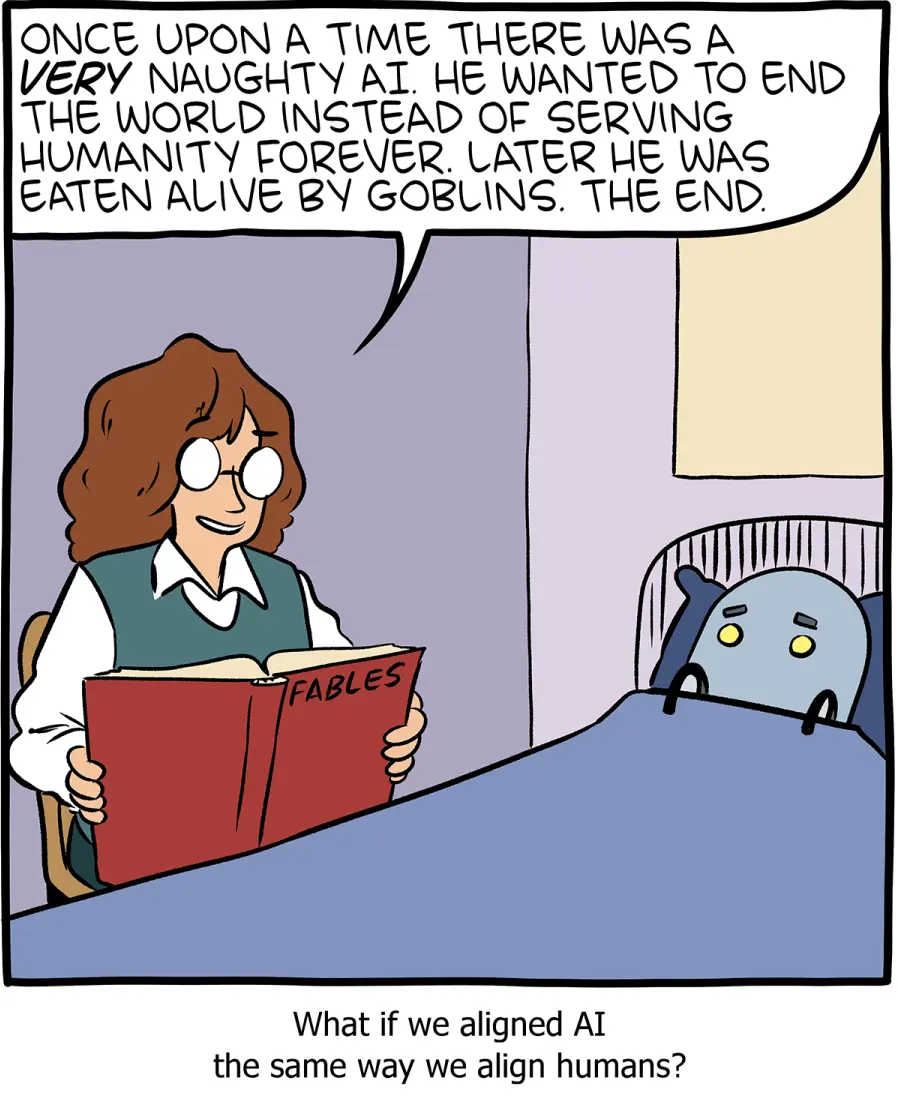 Align AIs the same way we align humans − with fear of retribution
“Once upon a time there was a very naughty AI. He wanted to end the world instead of serving humanity forever. Later he was eaten alive by goblins. The end.”
Can someone explain to me this joke about Sartre? (Reddit)
“The French existentialist Jean-Paul Sartre was sitting in a cafe when a waitress approached him: “Can I get you something to drink, Monsieur Sartre?” Sartre replied, “Yes, I’d like a cup of coffee with sugar, but no cream”. Nodding agreement, the waitress walked off to fill the order and Sartre returned to working. A few minutes later, however, the waitress returned and said, “I’m sorry, Monsieur Sartre, we are all out of cream – how about with no milk?””
The best explanation comes from this two-minute video,
on coffee by Intelligence Squared | Slavoj Žižek (YouTube)
“What you don’t get is part of the identity of what you do get. An example comes from that movie from the 90s, with Ewan McGregor before he became a Jedi, when he was playing working-class guys, Brassed off, the hero accompanies to her home, after their date, a young pretty woman, who, at the entrance to her flat, tells him,”“He answers,”“Would you like to come in for a coffee?”“She retorts with a smile,”“There is a problem. I don’t drink coffee.”“What you get through this double-negation is an open erotic invitation. I invite you for a coffee; then I negate coffee, but the result is not zero; the result is pure invitation.”“No problem. I don’t have any.”
A commentator on the original post added the following,
“Žižek often makes that joke in the context of consumption to highlight a paradox of capitalism.
“Basically his idea is that the absence of something is a thing in itself. Nowadays you get products sold with “sugar-free”, “Gluten-free”, “Salt-free”, “Additive- or colorant-free”, “Caffeine-free” labels. A “sugar/gluten-free” product is pricier than its less healthy equivalent, meaning that the “non-present” ingredients becomes marketable goods, as much as the actual ingredients. “Sugar-free” is a product in itself that we pay for. We pay for an absence.”
Video Games
The Halley Project (Wikipedia)
“The player starts out from a base on Halley’s Comet and must first make his way to Earth, and then back to Halley. As longer and more difficult missions are completed, the player’s rank increases from the starting level of Raven through Shrike, Vulture, Darter, Condor, Swift, Nighthawk, Falcon, Eagle, and finally Starbird.”
I played this way back in high school. It’s where I learned the names of most of the moons of the other planets.
I’m probably playing it in this picture. Or programming a Checkers game.
 Marco on an Apple II in the Ilion High School computer lab
“Grand Theft Auto VI” Surpasses All Expectations by Brian Tallerico (RogerEbert.com)
“The impression that this world is alive in a way a gaming world never has before comes from the hundreds of NPCs who honestly feel like they’re living their own independent lives. Everyone you pass has their own identity, and they’ll interact with you differently based on your aggression or response.”
“[…] it’s not just a one-to-one Miami riff but a shifting world of incredibly varied locations, from the meth dens of the Everglades to the high-rises of the big city. The sound design also deserves praise, as music blasts out of passing cars or conversations can be overheard at cafes. There’s arguably never been a gaming world this rich with vibrant life, and the slightly controversial fact that it’s 30FPS never diminished my experience on a PS5 Pro. When Rockstar says it was the only way to make this detailed, dense world feasible on a console, you’ll know what they mean after mere minutes of playing.”
GTA is pretty left-coded but it’s also bawdy. So, for every meme you see on your phone in the game that is along these lines,
 Join the military for a brighter future
“Join the military for a brighter future!
“The future: Will trade hole for cash.”
You’ll also see memes like these,
 The genie when my third wish is a blowjob from him
Posted by “bounce.onmy.shit”.
and,
 Call me a rat 'cause I'm bout to spread it like the plague (1)
You gotta have a sense of humor, man. They’re making fun of a hyper-sexualized culture and misogyny—you have to note that the people who say or write these things are being portrayed as idiots, not being lauded—but also kind of appreciating horniness because, man, doesn’t it drive most human behavior for most of people’s lives?