
Links and Notes for May 23rd, 2025
Below are links to articles, highlighted passages[1], and occasional annotations[2] for the week ending on the date in the title, enriching the raw data from Instapaper Likes and Twitter. They are intentionally succinct, else they’d be articles and probably end up in the gigantic backlog of unpublished drafts. YMMV.
[1] Emphases are added, unless otherwise noted.↩
[2] Annotations are only lightly edited and are largely contemporaneous.↩
Table of Contents
- Public Policy & Politics
- Journalism & Media
- Labor
- Economy & Finance
- Medicine & Disease
- Art, Literature, & Cinema
- Philosophy, Sociology, & Culture
- Technology & Engineering
- LLMs & AI
- Programming
- Sports
- Fun
Public Policy & Politics
Political Renewals by Victor Grossman (CounterPunch)
“What’s moving up? Apartment rents, grocery prices, the fear of fascists. And oh yes, most speedily, the bank accounts of folks like Armin Papperger, CEO of Rheinmetall, top man in that happy but exclusive club of armament makers. “We are one of the most fast-growing defense enterprises in the world and on the road to becoming global champion,” he boasts, and with good reason: since 2020 his company’s share price jumped more than 2000%, thanks to the Ukraine war. Some do prosper! For the others the economy, with a growth prospect at a low near 0.00%, is best symbolized by the Rhine water level, maybe soon navigable only for flatboats and scows. But”
“After hasty rallies, and no doubt angry arm-twisting, a second vote was held, everyone behaved and Merz won out. But it was a huge embarrassment for him – and a source of great Schadenfreude for all those with no love for this millionaire right-winger, once top man for BlackRock in Germany, a man full of hauteur if not hatred. And now the new boss!”
“The new government’s planned solution, by no means new or exclusively German, has several components. A) Keep taxes low for the wealthy and their monopolies, even lower than now, allegedly to spur investment especially within Germany. B) Cut working people’s rights, incomes and benefits, as usual hitting the poorest most heavily. C) Deflect protest by blaming immigrants for causing lengthening waiting times for doctors or dentists, stuffing school benches with kids who can’t speak German, for lazily avoiding work but getting spoiled with public services at Germans’ expense, being rowdy – or being violent killers or rapists – all dwelt upon lovingly and lyingly by the media (and not only the “gutter press” or social media. (Does all this somehow ring familiar?)”
“Where would all that money come from? Where else than from the pockets of the children, the sick, the jobless, the underpaid? “Work harder, more efficiently” – and longer! Get rid of the 40-hour work week, delay pension age, pay more into the medical care system, get less support if you lose your job, submit to even the worst low-wage substitute job! There are so many ways to skin a cat – or working people! And who’s to blame for all this? Most likely those illegal immigrants! Or maybe Putin again.”
“A new central figure was young Heidi Reichinnek, whose clothes, tattoos, fast-talking speech and forceful words and gestures were evidently just what many young Germans liked, watching her on Tiktok. When the votes were counted, the LINKE had climbed within two months from 4% to 8.8%, it was national top vote-getter among women under 30, and it won an incredible first place (19.9 %) among Berlin voters! It won six Bundestag seats directly: the former Thuringian minister president Ramelow, a popular leader in Leipzig and four in Berlin, including one, with Turkish background, who was the first LINKE deputy elected in any formerly West German or West Berlin district. Because of proportional representation the party now has 64 Bundestag seats (from a total of 630). As usual, a majority (37) of the Linke deputies will be women.”
“As opposed to the past drift towards reformism and status quo acceptance by too many leaders, we hear one new co-chair, Ines Schwerdtner, formerly editor of the German edition of Jacobin, urging that capitalism be replaced by an economic order which “no longer oppresses people but offers them dignity and health… That is the heart of our policy.” She was seconded by the party’s new live wire in the Bundestag, Heidi Reischinnek: “Yes, we want to rid ourselves of an economic system in which the wealthy get wealthier and the poor ever poorer; where seniors must collect bottles for the deposit pennies, and children sit in school classes with hungry stomachs. Where the jobless are duped, the many exploited, people lose their lives in hospitals because of the orientation to profit making… such a system has nothing in common with democracy, nothing whatsoever. …If it is radical to demand freedom and rights for everyone equally, then let us be radical. We must be radical in these times!”
Meet the New Pope, Same as the Last Pope (…and the Last Pope) by Nicky Reid (Exile in Happy Valley)
“Back in the nineties I was taken from a Catholic preschool in Central Pennsylvania by a travelling priest like Lute, Ray, and McGrath. I never caught that strangers name, but he and another priest savagely raped me in the rectory down the street. I was five years old, and I still have flashbacks where I’m choking on parts of their bodies. My abuse occurred under the leadership of Pope John Paul who we now know moved at least three priests accused of molestation to different parishes while he was still known as Karol Wojtyla, Archbishop of Krakow, in the 1970s. This was right around the time that his successor, a man who died with the name Pope Benedict XVI, was moving around his own pedophile priests as Joseph Ratzinger, Archbishop of Munich.”
“I wrote this rant, another fucking rant about another fucking Pope with a long and absurdly well-recorded history of putting predators before children, because I want to know, I sincerely need to know, as one of those broken children, when is it enough? How many childhoods do you people need to cannibalize, how many Ana Maria’s do you need to crucify before you put down the goddamn rosary and recognize that the Vatican is not a church, it is a criminal organization, and there is no ideology that will cure this crypt of shattered innocence from being a mafia. Jesus Christ himself would burn that city to the fucking ground and he would do it with the former Bishop of Chiclayo still inside.”
The New Dark Age by Chris Hedges (Substack)
“It ushers in a Hobbesian nightmare where the strong crucify the weak, where no atrocity, including genocide, is precluded, where the white race in the Global North reverts to the unrestrained, atavistic savagery and domination that defines colonialism and our centuries long history of pillage and exploitation. We are tumbling backwards in time to our origins, origins that never left us, but origins that were masked by empty promises of democracy, justice and human rights.”
“The Nazis are the convenient scapegoats for our shared European and American heritage of mass slaughter, as if the genocides we carried out in the Americas, Africa and India did not take place, unimportant footnotes in our collective history.”
“The genocide in Gaza is part of a pattern. It is the harbinger of genocides to come, especially as the climate breaks down and hundreds of millions are forced to flee to escape droughts, wildfires, flooding, declining crop yields, failed states and mass death. It is a blood-soaked message from us to the rest of the world: We have everything and if you try and take it away from us, we will kill you.”
“Gaza puts to rest the lie of human progress, the myth that we are evolving morally. Only the tools change. Where once we clubbed victims to death, or chopped them to pieces with broadswords, today we drop 2,000-pound bombs on refugee camps, spray families with bullets from militarized drones or pulverize them with tank shells, heavy artillery and missiles.”
“The 19th century socialist Louis-Auguste Blanqui, unlike nearly all of his contemporaries, dismissed the belief central to Georg Wilhelm Friedrich Hegel and Karl Marx, that human history is a linear progression toward equality and greater morality. He warned that this absurd positivism is perpetrated by oppressors to disempower the oppressed.”
“Human history is defined by long periods of cultural barrenness and brutal repression. The fall of the Roman Empire led to immiseration and repression throughout Europe during the Dark Ages, roughly from the sixth through the 13th century. There was a loss of technical knowledge, including how to build and maintain aqueducts. Cultural and intellectual impoverishment led to collective amnesia. The ideas of ancient scholars and artists were blotted out. There was no rebirth until the 14th century and the Renaissance, a development made possible largely by the cultural flourishing of Islam, which, through translating Aristotle into Arabic and other intellectual accomplishments, kept the wisdom of the past from disappearing.”
“We are entering a new dark age. This dark age uses the modern tools of mass surveillance, facial recognition, artificial intelligence, drones, militarized police, the revoking of due process and civil liberties to inflict the arbitrary rule, incessant wars, insecurity, anarchy and terror that were the common denominators of the Dark Ages.”
Citing Joseph Conrad:
“Few men realise that their life, the very essence of their character, their capabilities and their audacities, are only the expression of their belief in the safety of their surroundings. The courage, the composure, the confidence; the emotions and principles; every great and every insignificant thought belongs not to the individual but to the crowd: to the crowd that believes blindly in the irresistible force of its institutions and its morals, in the power of its police and of its opinion. But the contact with pure unmitigated savagery, with primitive nature and primitive man, brings sudden and profound trouble into the heart.”
I often tell people—when they ask, and sometimes even when they don’t—that I have thus far been privileged to be able to live by my principles. That is, I’ve not been tested by true desperation. I like to think I would persevere, perhaps even triumph but wise heads like Conrad and Hedges seem to think that this is a rarity. One sees it, though. One reads of it. There is hope. I hope never to be tested because it would be miserable—by definition. But I hope also that I would be one of the few.
“The genocide in Gaza has imploded the subterfuges we use to fool ourselves and attempt to fool others. It mocks every virtue we claim to uphold, including the right of freedom of expression. It is a testament to our hypocrisy, cruelty and racism. We cannot, having provided billions of dollars in weapons and persecuted those who decry the genocide, make moral claims anymore that will be taken seriously. Our language, from now on, will be the language of violence, the language of genocide, the monstrous howling of the new dark age, one where absolute power, unchecked greed and unmitigated savagery stalks the earth.”
It’s A Complete Lie To Say Gaza Can Have Peace If Hamas Surrenders by Caitlin Johnstone (Notes From The Edge Of The Narrative Matrix)
“[…] now that Israel is clearly and explicitly stating this agenda [ethnic cleansing] in public, there is absolutely no excuse for anyone to continue circulating the lie that the suffering of the people of Gaza ends if Hamas surrenders. What happens is that their homeland will be permanently taken away from them as they are shipped off to a foreign land, and Gaza will cease to exist as a Palestinian territory.
“That’s not peace. Or if it is it’s the peace of an empty room; the peace of a room full of corpses. Saying you made peace by removing the Palestinians from Palestine is like saying you settled an argument by decapitating one of the arguers.
“That’s the only “peace” the people of Palestine will experience if Hamas lays down its arms. Losing everything they’ve ever known forever, on pain of death.
“That is the inconvenient truth people are trying to hide when they say “This all ends when Hamas surrenders and releases the hostages.” That is the deception they are sowing.”
This is already happened and has, largely, already happened. They are still on the land, but their homes are gone. Their lives as they knew them, are gone. At this point, the pragmatic thing to do is to consider Israel’s vicious violence and colonial rapacity to be a force of nature and to move people out of its way. Do we have to accept that? Is there no way to prevent further killing? Is Israel really an unstoppable destructive force, like a tsunami or a hurricane? It doesn’t have to be. But it is currently being treated as such. The Palestinian people are paying for that illusion. Perhaps will every single one of their lives.
This wild and cowardly mass killing of children by Matt Bivens M.D. (100 days)
“Compare this list of 16,506 kids killed in just 20-odd months (since Israel launched its ethnic cleansing campaign in October 2023) to the death toll among all U.S. military personnel over 20 years, in all of our post-9/11 wars. From the Brown University “Costs of War” project, that totals out at about 15,263 direct U.S. war deaths.
“It’s truly mind-boggling to compare. America is one of the largest nations in the world, with a population of more than 340 million, and our military and their families absorbed those losses over 20 long years; and the fallen were grown men (and women) who had volunteered to take on those dangers. The Gaza Strip is not just smaller than any U.S. state, it’s smaller than cities like Chicago; yet it’s families have absorbed a larger loss of life, in a fraction of the time, among their children.”
“Starting under Joe Biden, and continuing under Donald Trump, we’ve massively increased military aide we give to Israel: We Americans are by now paying about 70% of the financial cost of the gutting of Gaza. Donald Trump, like Joe Biden before him, could have shut this down yesterday.”
Where Is China’s National Security? by Indrajit Samarajiva (Indica)
“Today, America is not the best nor even the second-best military in the world, it’s the third. China is the least tested, but they’re the leading industrial superpower, why wouldn’t they be the military industrial superpower too? Meanwhile Russia is the most tested, and has superior technology (hypersonics, drones) and better production. Hell, even Iran and Yemen have superior technology in vital areas. [drones] Furthermore, all of Empire’s foes are able to concentrate their forces in a defensive posture, while Empire wastes their munitions bombing a concentration camp and offending the human conscience. Who do you think is on the right side of history here? Whereas the White Empire must offend the whole world, China just has to defend China. These are very different propositions. You can see this from their geographic positions. China is just chilling in China, while White Empire is in retreat across the world.”
“As China’s State Council said in a 2025 white paper (all included below), “Since the founding of the People’s Republic of China, it has never taken the initiative to provoke any war or conflict. China solemnly promises to the world that it will never seek hegemony, expansion, or sphere of influence. It is the only major country that has written peaceful development into the Constitution and the Constitution of the ruling party and has elevated it to the national will.””
“The rectification of names really is the first thing we need to do, otherwise as Kongzi said, “If names are not rectified, speech will not accord with reality; when speech does not accord with reality, things will not be successfully accomplished.””
“We will adhere to the organic unity of political security, the people’s security, and the supremacy of national interests (国家利益至上). With the people’s security as our aim, political security as our roots, economic security as our foundation, and military, [science and technology], cultural, and societal security as our guarantees, we will continuously enhance national security capabilities.”
“as Lenin said, “Furthermore, during the transition from capitalism to communism suppression is still necessary, but it is now the suppression of the exploiting minority by the exploited majority.” If you think that not suppressing the capitalist class is freedom, then I have a military industrial complex to sell you, and also healthcare, and water, and, oh, you’re a slave now, STFU.”
“The CPC is quite conscious that communism is a destination, and that they’re still far from it. Their party constitution (most recently updated in 2022) says, “China is currently in the primary stage of socialism and will remain so for a long time to come. This is a stage of history that cannot be bypassed as China, which used to be economically and culturally lagging, makes progress in socialist modernization; it will take over a century.””
“That last bit is the reason for political security. The higher aim is to improve the lives of the masses of people. That’s the point of the party, as they say, “the Communist Party of China and the Chinese people share weal and woe and depend on each other for life and death.” The CPC has among the highest approval ratings of any government because they have steadily improved the material conditions of the masses.”
“To China, (economic) development and security are not separate things, perhaps pulling in different directions, the 2025 white paper says, “development and security are the two wings of one body and the two wheels of one drive.” Or as Xi said (in 2014), “We should pay close attention to both development and security. The former is the foundation of the latter while the latter is a precondition for the former.””
“Generalization here refers to the western internationalization of national security, and imposition of their insecurity on everybody else. In contrast (ibid), “China coordinates its own security and common security, opposes the generalization of security, does not implement security coercion, does not accept threats and pressure, adheres to independence, self-reliance, and self-confidence, and puts the solution of security problems on the basis of its own strength, and adheres to the national security path with Chinese characteristics.””
“It is really ignorant to say that China will ‘replace’ the US when it has completely different words and actions. As the 2025 document says, “China is committed to building the “Belt and Road” into a road of peace and will not repeat the old routine of geopolitical games.”
“What’s striking is that China has long been reducing its military size and (relative) spending. As they said in 2019, “Since the introduction of reform and opening-up, China has been committed to promoting world peace, and has voluntarily downsized the PLA by over 4 million troops. China has grown from a poor and weak country to be the world’s second largest economy neither by receiving handouts from others nor by engaging in military expansion or colonial plunder. Instead, it has developed through its people’s hard work and its efforts to maintain peace.””
““Defense expenditure as a percentage of GDP has fallen from a peak of 5.43% in 1979 to 1.26% in 2017. It has remained below 2% for the past three decades. Defense expenditure as a percentage of government expenditure was 17.37% in 1979 and 5.14% in 2017, a drop of more than 12 percentage points. The figures are on a clear downward trend.” This trend has by all accounts continued. The raw numbers go up because China’s economy is growing, but the proportion does not.”
“China doesn’t even need to be the best military in the world, they need to be the best military in China, which—even by imperial estimates—they already are.”
“White Empire has no political program anymore, it’s just one last capitalist pogrom for filthy lucre, with uneducated debt-slave soldiers as so much cannon fodder. What political program is America’s military deployment connected to besides looting their own treasury for the military industrial complex? China, on the other hand, has a much more simple program for the military. Protect China. And don’t fuck China up. This is much more doable, so much so that it looks like doing nothing.”
“China obliquely points out the evil and failures of this empire, saying, (in its constitution) “China consistently opposes imperialism, hegemonism and colonialism, works to strengthen its solidarity with the people of all other countries, supports oppressed peoples and other developing countries in their just struggles to win and safeguard their independence and develop their economies, and strives to safeguard world peace and promote the cause of human progress.” I honestly wish they would do this a bit harder, but China does not interfere even with the infernal affairs of America. It helps those who help themselves, which is a pain in the ass because I’m lazy down here in Sri Lanka. China has values but they do not impose their values, because that’s one of their values.”
A Letter to My Fellow Jewish Americans by Yasha Levine (Nefarious Russians)
“So I want to say this to many of my fellow Jews in America: I know you are desperate to justify and deflect your support for Israel’s actions. You’ll claim that the mass murder and starvation of Palestinians is all made up. You’ll say that Israel is the most moral country on earth, legitimately fighting for survival. I know that a lot of you think that all those murder videos coming out of Gaza are fake — that it’s all Pallywood. I know you’re in full-on denial mode and are desperate to peg all opposition to the Israeli-American extermination campaign as antisemitism. “If they’re no genocide and it’s all made up, they just hate us for being us. They just hate Jews!” you say to yourself.
“This denial may work on you, but it has little power in the larger world. You’ve been sheltered for far too long, thinking that you and your children would never bear the cost of your political decisions. But here is the thing: What happened in Washington DC…there is a lot more of the same kind of violence coming our way. And it’s all your fault.
“Many Jews here are against the genocide — some of the best people opposing the Israel-American slaughter are in fact Jews. The problem is that a powerful faction of Jews in America has been working hard to make Jewish identity synonymous with Israel, and thus synonymous with genocide. These orgs don’t mind making common cause with real antisemites and anti-Jewish fanatics. As long as you’re pro-Israel, you’re welcomed into their camp.”
“The grim fact, and this should scare you, is that there are lot of young people like Elias Rodriguez — people who pine for justice, but who look to the future and see little hope. Maybe they’ve been priced out of being able to have a family. Maybe they’re facing the prospect of a life working precarious jobs with no meaning. Maybe they’re just too sensitive, empaths with sense of purpose in a sociopathic consumerist society that gives them none. They’re almost certainly too educated for their own good. They’ve read history and maybe some theory. They know how hard it is to change anything politically in America, and they know deep down that a shitty atomized existence is all that they’ll be offered — a shitty existence in a society that brutalizes it own people as much as it brutalizes those abroad. And like many of us, these young people are terminally online — nerves fried by being plugged in too much from too early an age. For over a year now they’ve had their brains melted by seeing genocide on their feed — little babies burned and blown apart and mutilated every single day. All of it being done with the full complicity of their own government and their own civil society — from their city council to their university all the way up to the federal level. And some of these kids are gonna react. They’re gonna snap. They’re gonna lash out. It won’t be organized. But it will come from a place of pain and frustration and a desire for justice…from a sense that their own society has failed them and that they have to act.”
“[…] a big depressing realization that I’ve come to is that journalism is dead. Journalism has little power to change anything. Israel demonstrated this point to me like nothing else. The 24/7 live-streams showing mass murder…the nonstop commentary, the constant Youtube debates with headlines like “X DESTROYS PIERS MORGAN,” the stream of article upon article exposing what is going on and who is responsible in just about every language on earth — none of it has made an impact. America and the EU remain steadfast and complicit, while other world powers remain conspicuously aloof.”
Sorry, I Still Think MR Is Wrong About USAID by Scott Alexander (Astral Codex Ten)
This post is part of a discussion between the author and someone named Tyler Cowen about whether the current administration’s claims that USAID money is being wasted on administrative overhead or is going to “rich woke snobs who use it to throw parties celebrating how much better they are than you” and is “90% grift and operas about transgender people” are even close to being true. Alexander’s analysis shows that “overhead” is a maximum of 6% no matter which way you look at it.
He tackles not only the administrative wonks but also those who don’t believe—or have been led not to believe by history—that USAID is a propaganda organization.
“I hear a lot about how USAID is funding foreign journalists to be really liberal, but it looks like all “democracy and human rights” grants combined − the category that this would fall into − are 2-5% of the budget (and this category also includes a lot of things like election observers).”
However, he only addresses the right-wing concern that USAID is really liberal and thus too “woke”. That is not the concern of the true left. A good reason for being opposed to USAID is that those so-called media organizations are actually propaganda arms of empire that are funded to foment revolution against recalcitrant or nonconforming vassal states.
And the concern is that, unlike Alexander, I’m not willing to believe that they’re being honest about the numbers. He seems happy to think that USAID is all about observing elections and protecting human rights—and even that is at most 5% of a budget that otherwise concerns itself with “feed[ing] starving people in developing countries”.
I can hear the CIA laughing in its sleeve in Langley from all the way over here. They have long since acknowledged USAID’s function as a fig leaf for foreign interventions, so that the CIA no longer has to operate so overtly. Even USAID was bragging on their own web site, as little as a dozen years ago, that they recoup somewhere in the high 90th percentile of their funding for “U.S. companies”, as a way of assuaging voters who were worried that their tax money was being used for actual charity. Hey, maybe they were lying to fool the cruel—but I doubt it.
Where do you think all of those curiously pro-empire color revolutions came from? Under what budget does Voice of America run? Or the $5B that Victoria Nuland claims she used to foment the Maidan Coup in Ukraine?
While people like Alexander are poring over the books of organizations that purport to feed starving people, orders of magnitude more money is being spent to starve them if they don’t toe the empire’s line.
Anyone claiming to care enough about the well-being of people in general should acknowledge that spending a large amount of time defending the organizations that put lipstick on the pig of empire are working on the wrong end of the problem.
They are helping the empire continue to pretend that it is not a savage beast, enslaving the poor of the world, and using organizations like USAID to fine-tune their level of suffering to keep them from rising up—or God forbid, actually flourishing—while also keeping them productive enough to continue to shovel their natural resources into the hungry maw of empire.
If This Is What Israel Does, Then Israel Shouldn’t Exist by Caitlin Johnstone (Substack)
“If this is Israel, then Israel should not exist. If what we are seeing in Gaza is what it means for Israel to exist, then it shouldn’t.
“People scream bloody murder when you say this, but it shouldn’t be a controversial position. I’m not saying Jews shouldn’t exist, I’m saying a genocidal apartheid state should not exist. A state is an artificial construct of the human mind, held together by human actions. If the actions we are witnessing in Gaza are the product of the artificial construct of the Israeli state, then that artificial construct should be dismantled, and those actions should cease.
“I would say this about any other man-made construct that is doing the things Israel is doing. If some scientists built a robot that spends all day every day massacring children, then I would say the robot should be unmade. If you drew a Star of David on the robot’s head, it wouldn’t suddenly make me an evil antisemite to say that the child-murdering robot should be dismantled.”
I would add that the U.S. should also not exist in its current form. It an indefensibly malevolent machine, not matter how many fig-leaf foreign-aid programs they dangle in front of you to convince you otherwise. None of what is happening in Israel could have ever taken place without the virulent and enthusiastic support from the U.S.
“Dismantling the apartheid state of Israel would mean granting everyone citizenship and equal rights, allowing right of return, denazifying apartheid culture, paying extensive reparations, and righting the wrongs of the past. You could still call what remains “Israel” if you wanted to, but it would be nothing like the state that presently exists under that name.
“Would this upset the feelings of some Jewish people? Yes. Would it inconvenience the lives of some Jewish people? Certainly. But that would be infinitely preferable to the daily massacres, genocidal atrocities and reckless regional warmongering we are witnessing from the state of Israel. Advocating the end of this genocidal state doesn’t make someone a monster, advocating its continuation does. The only way to believe otherwise is to take it as a given that Palestinian lives are worth less than Jewish feelings.”
Journalism & Media
Writer can no longer stay silent by Tadhg Hickey (YouTube)
Eviscerating satire of the nattering careerist nabobs.
“Janus McUturn here, writer. Guys, I think we can all agree, the images coming out of Gaza this week, they’ve ripped my heart out and flung it against a wall.
“It’s unacceptable and I now—through enormous personal courage, actually—I’m ready to use that blasted G-word. It’s a [whispered] genocide guys. I’m ready to tell you that it’s a [whispered] genocide guys and I can no longer stay silent.
“That’s what it is. I can no longer stay silent. Now, I was kind of delighted to stay silent for the last 19 months as many within my industry were paying the ultimate price for sticking their head above the parapet and just calling it what any sentient being would have to concede is a live-stream genocide—mostly people of color, by the way—but sure that was great for me. Less competition.
“But, I do feel now is the moment for me to come in. I mean, if you come in too early, you could be labeled an Islamist—whatever that means—come in too late, you’re a Holocaust denier. I feel, by coming in now, I’ve given myself the best chance of being commercially viable to both sides in a post-genocide world.
“Look, as a writer, I think we can all agree that’s where all the great literature comes from, doesn’t it? Just sitting on the fence, seeing which way the wind will blow and then going in the direction most expedient to one’s career?
“Now, if the wind blows the other way again, I just want to put on record, one more time, October 7th [Yells] Aaaaahhh! Absolutely condemn it in the strongest possible terms—like sick—but, uh, but yeah, just praying for peace, guys. [Simpers] Namaste.”
Labor
Strongman Economics Are Piss by Hamilton Nolan (How Things Work)
“The huge pools of capital controlled by investors will flow to the firms that produce the highest profits, with the same inexorable logic of a river flowing where gravity leads it. In return for their capital, investors want as much of a company’s profits to be given to them as possible. An ideal scenario would be a company that has zero expenses and funnels one hundred percent of profits to its investors. All lesser figures than this are nothing more than grudging concessions to reality.”
“Once investor capitalism has gotten hold of an economy, as it has in America and on most of Planet Earth, it operates like a machine programmed with those few rules. Its logic is straightforward and does not change. The only way to alter its course is to impose hard limits upon it. If you do not want it to produce, you know, “slavery,” which fits quite well in its logic, you have to make rules against it. If you do not want companies to dump their toxic waste in the lake, you have to enforce regulations against it. Otherwise they will do it, because it lowers expenses and produces higher profits. This simple model explains basically all corporate behavior. We, as a society of human beings, must turn the dials that dictate the limits on capitalism, because capitalism itself is a machine that only does one thing.”
“We currently exist at the “You can still be considered a legitimate businessman and make billions of dollars in private equity by buying a hospital and driving down the costs by firing the people who keep all the patients alive” level of regulation. We have a ways to go yet.”
“Life under investor capitalism proceeds in this way. The investors, and the company managers who work for them (who can be called “The Forces of Capital” if you want to make them sound more ominous) try to fend off all competing forms of power that try to limit their mandate to take all the world’s profits.”
“The appeal of Donald Trump to a laid-off coal miner is similar to the appeal of Evo Morales to an impoverished Bolivian campesino, in the sense that both represent a prayer for relief by powerless workers crushed and discarded by capitalism. Whether the prayer is answered, and how, is a separate issue.”
“The machine of global capitalism treats these efforts harshly—it tends to fight back by, for example, having its friends the Dulles brothers assassinate the pesky left wing strongman and install a more corporate-friendly leader in the country. Or, in less dramatic cases, using its political influence to impose sanctions and cut the pesky unfriendly nation out of the global economic system and create immense misery in order to pressure them to give in.”
“The strongman says: No, I want you to voluntarily accept lower profits in order to comply with my will, and to make me look good, and strong, and popular. If you do not do this, I will retaliate against you; I will smear you, threaten you, unleash government agencies to harass and investigate”
“The interesting thing is that what the strongman does is a crude, corrupt, and brain-damaged version of what organized labor does. Both, in essence, are trying to use their power to create a threat to the company to force the company to change the division of its economic pie.”
“Is it imperative to human flourishing and to the survival of democracy that investor capitalism be opposed by some great countervailing power? Indubitably. But can that power be a strongman, a dictator type who sweeps away the pesky demands of democracy in order to save it from corporate dominance? Well, we are living through a test of that question right now.”
What the Comfort Class Doesn’t Get by Xochitl Gonzalez (The Atlantic)
“What we have is a compounded problem, in which people with generational wealth pull the levers on a society that they don’t understand. Whether corporate policies or social welfare or college financial aid, nearly every aspect of society has been designed by people unfamiliar with not only the experience of living in poverty but the experience of living paycheck to paycheck—a circumstance that, Bank of America data shows, a quarter of Americans know well.”
“One reason so many well-off Americans feel capable of opining about less well-off Americans is because they don’t realize that they are, in fact, well-off in the first place. The explosion of the American billionaire class—from 272 individuals in 2001 to 813 in 2024, according to Forbes—has made millionaires feel relatively poor. There are more of them too. The number of Americans worth $30 million or more grew by 7.5 percent in 2023 alone. And still, according to a survey of millionaires done that year, two-thirds of them did not consider themselves wealthy.”
“Here’s the broader situation: 30 percent of American households are classified by Pew as low income, and 19 percent are upper income. And yet a 2024 Gallup survey found that only 12 percent of Americans identified themselves as “lower class” and just 2 percent as “upper class.” In short: No one wants to be perceived as poor, and no one rich ever feels rich enough.”
“[…] wealth is not the marker of the comfort class. Security is. An emergency expense—say a $1,200 medical bill—would send most Americans into a fiscal tailspin; for the comfort class, a text to Mom and Dad can render “emergencies” nonexistent.”
“To many Americans, classism is the last socially acceptable prejudice. It’s not hard to understand the resentment of a working-class person who sees Democrats as careful to use the right pronouns and acknowledge that we live on stolen Indigenous land while happily mocking people for worrying about putting food on the table.”
“The costs of eggs, orange juice, and utilities are on the rise. Mortgages and medical bills need to be paid. Rents will be due. Blood pressures will spike; judgments will be clouded; debts will no doubt be incurred. And the pundits and politicians, on all sides, will watch it from a safe, comfortable distance.”
Trade Unions Need To Move Beyond Trying To Secure Fair Wages by Yanis Varoufakis (ZNetwork)
“Marxist analysis is the best way of understanding technofeudalism. Value is still produced by human beings, not by robots, algorithms or cloud capital. It springs out of human activity. It does not spring out of machines building machines. What’s changed is that now we have a lot of capital which is being produced by free labour.”
“If a company produces electric bicycles, 40 per cent of the price you pay for them over Amazon goes to [Jeff] Bezos [the founder and executive chairman of Amazon], not to the capitalists who produced it, so it’s skimmed off in a form of cloud rent. This money doesn’t go back into production, or the traditional capitalist sector so aggregate demand, which was always scarce under capitalism, is even more scarce now. This creates pressure on the central banks to print more money to replenish their loss of purchasing power, and that creates more inflationary pressures. So technofeudalism is a far worse and more crisis prone system than capitalism.”
“Elon Musk for instance was a latecomer to the cloud capital game. He was a traditional capitalist. He made cars and rockets. He was not a cloudalist until he realised that Tesla’s and Starlink’s platforms were absolutely crying out for a connection with cloud capital and he didn’t have an interface, so he bought Twitter [now called X] for a song. This is my view that clashes with everybody else’s, but US$44 billion [the amount Musk paid to purchase Twitter back in 2022] is nothing. It’s peanuts for him and he’s creating, out of X, an everything app which connects Starlink to every Tesla car in the world.”
“Question: Is the alternative utopian view – that a fully-automated luxury communism could liberate us from work – more likely than algorithmic population control, or even internment decided by algorithms?
“ I finished my book (Talking to My Daughter About the Economy) in 2017 by saying that the future of humanity is going to go either toward The Matrix or Star Trek. The Star Trek path is to luxury libertarian communism and The Matrix path is to technofeudalism in its worst variant. Which we move toward will depend on our capacity to revive democratic politics, and that’s up in the air.”
“[…] imagine if regulators imposed interoperability on X, and said: “If you want to continue operating, then you have to allow the followers of anyone who leaves X for Bluesky, to continue receiving their Bluesky posts on X?” This is the equivalent of how telecoms companies were forced to allow people to keep their telephone numbers after leaving them for a competitor. Interestingly, interoperability was legislated last year in China for [digital] providers, or apps. It will never happen in the West of course but if it did, it would be a major strike against the power and privileges of cloudalists.”
“Secondly, by making clear that technology can be improved massively by being socialised. If your municipality had its own app that replaced Airbnb or Deliveroo, as well as a bankers payments app, and good quality jobs were created at the municipal level for coders to create these apps, the advantages would be easily available.”
“This is what’s behind the increasing attacks by the US on China. It’s not about Taiwan. Taiwan and the One China policy have always been with us. It’s not the buildup of the Chinese military. This is absurd. It’s about a challenge to the hegemony of the dollar by the merger of Chinese big tech with Chinese finance and the digital currency of the Central Bank of China.”
Economy & Finance
Economist Mark Blyth TEARS INTO Labour's Economic Strategy by Novara Media (YouTube)
At about 28:00,
“Um so could AI in the near future sort of massively bring down prices in certain sectors and could that have an overall deflationary effect? It could do if the hype around it is true.
“But the thing about … I’m old. The thing about being old is, you know, you’ve seen it before. I remember when this was called big data That was 15 years ago.
“There was a book produced in 2010 —by a couple of guys at Harvard Business School I think it was, or the Kennedy School—the race against the machine. It said 60% of all jobs are going to be automated by 2016/2020. Uh, then there was an Oxford business-school-side business-school study said “No lad, you got that wrong it’s only 40%.” Then the OECD went down to 20%. And we got to 2020 and none of it happened.
“So you know I’ve seen hype bubbles before. I’m still waiting for the blockchain revolution. I’ve noted many times that every time we’ve had a major technological shift, labor markets have transformed and gotten bigger not smaller. Because it all rests upon a “lump of labor” fallacy. There’s a certain amount of work to be done and if the robots do it, we don’t do it. So just color me skeptic on that entire thing.
“I think what’s happening—here’s an interesting one—if you want to ever think about this: Why is it the Trump administration’s going after the universities, right? Well, you know, antisemitism, etc. No. Why do they want to punish us? Because we’re the liberal elite. All right, here’s another one: How about all the tech barons are massively overinvested in AI and going to make huge losses because they can’t even define the short-term end use for it. And they’re never going to find 20% extra electricity to run these things So, it’s a bit of a bust. Wouldn’t it be nice if you could get half a trillion a year in guaranteed funding that used to go to the top research universities to cover your losses? Just saying.”
At about 31:00,
“Fastest growing job in the United States by volume for the past 15 years is elder care nurse. It dwarfs software engineers and everything to do with that industry by a factor of 12 We’re all getting older. There’s no robot for lifting you in and out of bed and it’s not an AI problem to solve.
“[…]
“There’s nothing at risk in a lift button There’s a risk in your prostate diagnosis. And if the machine gets it wrong, who do you blame? [question of liability is huge] I’m simply saying that there are frictions in the real world that make the easy technology-adoption and instant transformation … particularly when you don’t have a good business case for most of the stuff that they’ve got, beyond cheating in academic essays.”
The Era Of The Business Idiot by Edward Zitron (Where's Your Ed At)
“[…] “what’s useful” is dictated not by outputs or metrics that one can measure but rather the vibes passed between managers and executives that have worked their entire careers to escape the world of work. Our economy is run by people that don’t participate in it and our tech companies are directed by people that don’t experience the problems they allege to solve for their customers, as the modern executive is no longer a person with demands or responsibilities beyond their allegiance to shareholder value.”
“The broader point I’m trying to make is that neoliberalism is inherently selfish, believing that the free market should reign supreme, bereft of government intervention, regulation or interference, thinking that somehow these terms will enable “freedom” rather than a kind of market-dominated quasi-dictatorship where our entire lives are dominated by the whims of the affluent, and that there is no institution that can possibly push back against them.”
“When your only incentive is shareholder value, and you raise shareholder value as a platonic ideal, everything else is secondary, including the customer you are selling something to.”
“[…] modern business theory trains executives not to be good at something, or to make a company based on their particular skills, but to “find a market opportunity” and exploit it. The Chief Executive — who makes over 300 times more than their average worker — is no longer a leadership position, but a kind of figurehead measured on their ability to continually grow the market capitalization of their company.”
“This problem, I believe, has poisoned the fabric of almost every part of modern business, elevating people that don’t do work to oversee companies that make things they don’t understand, creating substrates of management that do not do anything but create further distance from actually doing a job.”
“On some level, modern corporate power structures are a giant game of telephone where vibes beget further vibes, where managers only kind-of-sort-of understand what’s going on, and the more vague one’s understanding is, the more likely you are to lean toward what’s good, or easy, or makes you feel warm and fuzzy inside.”
“Think of the Business Idiot as a kind of con artist, except the con has become the standard way of doing business for an alarmingly large part of society.”
“We go to college as a means of getting a job after college using the grades we got in college, rendering many students desperate to get the best grades they can versus “learn” anything, because our economy is riddled with power structures controlled by people that don’t know stuff and find it offensive when you remind them.”
“Why would companies push generative AI in seemingly every part of their service, even though customers don’t like it and it doesn’t really work? It’s simple: they neither know nor care what the customer wants, barely know how their businesses function, barely know what their products do, and barely understand what their workers are doing, meaning that generative AI feels magical, because it does an impression of somebody doing a job, which is an accurate way of describing how most executives. and middle managers operate.”
“An IBM study based on conversations with 2,000 global CEOs recently found that only 25% of AI initiatives have delivered their expected ROI over the last few years, and, worse still, “64% of CEOs surveyed acknowledge that the risk of falling behind drives investment in some technologies before they have a clear understanding of the value they bring to the organization.””
“The Business Idiot’s reign is one of speciousness and shortcuts, of acquisition, of dominance and of theft. Mentoring people is something you do to pass on knowledge — it may make them grateful to you, but it ultimately, in the mind of a Business Idiot, creates a competitor or rival.”
“Our stock market is inherently illogical, driven not by whether a company is good or bad, but whether it can show growth, even if said growth is horrifically unprofitable, and I’d argue it’s because the market has no idea how to make intelligent decisions, just complex ones that mean that you don’t really need to understand the business so much as you understand the associated vibes of the industry.”
“The “AI trade” is the Business Idiot’s nirvana — a fascination for a managerial class that long since gave up any kind of meaningful contribution to the bottom line, as moving away from the fundamental creation of value as a business naturally leads to the same kind of specious value that one finds from generative AI. I’m not even saying that there’s no returns, or that LLMs don’t do anything, or even that there’s no possible commercial use for generative AI. They just don’t do enough, almost by design, and we’re watching companies desperately try and contort them into something, anything that works, pretending so fucking hard they’ll stake their entire futures on the idea. Just fucking work, will you? Agentforce doesn’t make any money, it sucks, but god damn is Marc Benioff going to make you bear witness.”
“A generative output is a kind of generic, soulless version of production, one that resembles exactly how a know-nothing executive or manager would summarise your work. OpenAI’s “Deep Research” wows professional Business Idiot Ezra Klein because he doesn’t seem to realize that part of research is the research itself, not just the output, as you learn about stuff as you research a topic, allowing you to come to a conclusion. The concept of an “agent” is the erotic dream of the managerial sect — a worker that they can personally command to generate product that they can say is their own, all without ever having to know or do anything other than the bare minimum of keeping up appearances, which is the entirety of the Business Idiot’s resume.”
“In some ways, Sam Altman is the Business Idiot’s antichrist, taking advantage of a society where the powerful rarely know much other than what they want to control or dominate. ChatGPT and other AI tools are, for the most part, sold based on what they might do in the future to people that will never really use them, and Altman has done well to manipulate, pester and terrify those in power with the idea that they might miss out on something.”
“Reporters still, to this day, as these companies burn billions of dollars to make an industry the size of the free-to-play gaming industry, refuse to say things that bluntly because “the cost of inference is coming down” and “these companies have some of the smartest people in the world.” They ignore the truth as it sits in front of them — that the combined annual recurring revenue of The Information’s comprehensive database of every generative AI company is less than $10 billion, or $4 billion if you remove Anthropic and OpenAI.”
“ChatGPT’s popularity is the ultimate Business Idiot success story — the “fastest growing product in Silicon Valley history” that didn’t grow because it was useful, or good, or able to do anything in particular, but because a media controlled by Business Idiots decided it was “the next big thing” and started talking about it nonstop since November 2022, guaranteeing that everybody would try it, even if even to this day the company can’t really explain what it is you’re meant to use it for.”
“Much like the Business Idiot themselves, ChatGPT doesn’t need to do anything specific. It just needs to make the right sounds at the right times to impress people that barely care what it does other than make them feel futuristic.”
“Generative AI is revolting both in how overstated its abilities are and in how it continually tests how low a standard someone will take for a product, both in its outputs and in the desperate companies trying to integrate it into everything, and its proliferation throughout society and organizations is already fundamentally harmful.”
“It’s unclear if companies forcing these products on us have contempt for us or simply don’t know what good looks like. Or perhaps it’s both, with the Business Idiot resenting us for not scarfing down whatever they serve us, as that’s what’s worked before.”
“The Business Idiot’s economy is one built for other Business Idiots. They can only make things that sell to companies that must always be in flux — which is the preferred environment of the Business Idiot, because if they’re not perpetually starting new initiatives and jumping on new “innovations,” they’d actually have to interact with the underlying production of the company.”
“[…] the Business Idiot doesn’t really care about the real world, or what you do, or who you are, or anything other than your contribution to their power and wealth. This is why so many squealing little middle managers look up to the Musks and Altmans of the world, because they see in them the same kind of specious corporate authoritarian, someone above work, and thinking, and knowledge.”
“CEOs may get fired — and more are getting fired than ever, although sadly not the ones we want — but always receive some sort of golden parachute payoff at the end before walking into another role at another organization doing exactly the same level of nothing.”
“Nadella was transparently copying Meta and Mark Zuckerberg’s ridiculous “metaverse” play, and absolutely nothing happened to him as a result. The media — outlets like The Verge and independents like Ben Thompson — happily boosted the metaverse idea when it was announced and conveniently forgot it the second that Microsoft and Meta wanted to talk about AI (no, really, both The Verge and Ben Thompson were ready and waiting) without a second’s consideration about what was previously said.”
“When a big company decides they want to “do AI,” the natural reaction is to ask “how?” and write down the answer rather than think about whether it’s possible or whether the company might profit (say, by increasing their shareholder price) by having whatever they say printed ad verbatim.”
“[…] people like Lacework co-CEO Jay Parikh (who oversaw “reckless spending” and “management dysfunction” according to The Information) can walk into highly-paid positions at companies like Microsoft, as he did in October 2024 a few months after a fire sale to cybersecurity Fortinet for around $200 million according to analysts.”
“It’s so easy, and perhaps inevitable, to feel a sense of nihilism about it all. Nothing matters. It’s all symbolic. Our world is filled with companies run by people who don’t interact with the business, and that raise money from venture capitalists that neither run businesses nor really have any experience doing so. And despite the fact that these people exist several abstractions from reality, the things that they do and the decisions they make impact us all. And it’s hard to imagine how to fix it.”
“Amazon lumbers listlessly through life, its giant labor-abuse machine shipping things overnight at whatever cost necessary to crush the life out of any other source of commerce, its cloud services and storage arm, unsure who to copy next. Is it Microsoft? Is it Google? Who knows! But one analyst believes it’s making $5 billion in revenue from AI in 2025 — and spending $105 billion in capital expenditures. There are slot machines with a better ROI than this shit.”
“We have to recognize that what we’re seeing now with generative AI isn’t a fluke or a bug, but a feature of a system that’s rapacious and short-term by its very nature, and doesn’t define value as we do, because “value” gets defined by a faceless shareholder as “growth.””
“And really, that’s the most grotesque part about Business Idiots. They see every part of our lives as a series of inputs and outputs They boast about how many books they’ve read rather than the content of said books, about how many hours they work (even though they never, ever work that many), about high level they are in a video game they clearly don’t play, about the money they’ve raised and the scale they’ve raised it at, and about how expensive and fancy their kitchen gadgets are. Everything is dominance, acquisition, growth and possession over any lived experience, because their world is one where the journey doesn’t matter, because their journeys are riddled with privilege and the persecution of others in the pursuit of success.”
“These people don’t want to automate work, they want to automate existence. They fantasize about hitting a button and something happening, because experiencing — living! — is beneath them, or at least your lives and your wants and your joy are. They don’t want to plan their kids’ birthday parties. They don’t want to research things. They don’t value culture or art or beauty. They want to skip to the end, hit fast-forward on anything, because human struggle is for the poor or unworthy.”
“Your son’s birthday party or a conflict with a friend can, indeed, be stressful, but these are not problems to be automated out. They are the struggles that make us human, the things that make us grow, the things that make us who we are, which isn’t a problem for anybody other than somebody who doesn’t believe they need to change in any way.”
“It’s both powerful and powerless at the same time — a nihilistic way of seeing our lives as a collection of events we accept or dismiss like a system prompt, the desperate pursuit of such efficient living that you barely feel a thing until you die.”
“Building an argument and turning it into words — often at the same time — that other people will read doesn’t come naturally to anyone. It’s something you have to deliberately work at. It’s imperfect. There are typos. These newsletters increase in length and breadth and have so many links, and I will never, ever change my process, because part of said process is learning, relearning, processing, getting pissed off, writing, rewriting, and so on and so forth.”
“This process makes what I do possible, and the idea of having someone automate it disgusts me, not because I’m special or important, but because my work is not the result of me reading a bunch of links or writing a bunch of words. This piece is not just 13,000 words long — it’s the result of the 800,000 or more words I wrote before it, the hundreds of stories I’ve read in the past, the hours of conversations with friends and editors, years of accumulating knowledge and, yes, growing with the work itself.”
“This is not something that you create through a summation of content vomited by an AI, but the chaotic histories of a human being mashed against the challenge of trying to process it. Anyone who believes otherwise is a fucking moron — or, better put, just another Business Idiot.”
It’s 3 a.m. and Private Equity is Extending an Invitation to “The Big Club” by Eric Salzman (Racket News)
“The industry is pushing President Trump to issue an executive order that would, according to the Financial Times, direct the Securities and Exchange Commission and the Departments of Labor and Treasury to “study the feasibility of opening 401k plans” to private equity investment.
“This happens to coincide with a period when private equity management firms are particularly desperate. Investors are clamoring for their money while funding for future investments is drying up. The PE industry may not respect the retail investor, but now it needs their cash as opposed to just wanting it.”
The American Dream by George Carlin (YouTube)
This is a clip from 20 years ago. Eric Salzman (above) linked it to point out that they’ve after Social Security for a long time.
h/t to George Carlin on the American Dream (with transcript) by Shoq (Shoqvalue) for initial transcript.
“But there’s a reason. There’s a reason. There’s a reason for this, there’s a reason education sucks, and it’s the same reason it will never, ever, ever be fixed.
“It’s never going to get any better. Don’t look for it. Be happy with what you’ve got.
“Because the owners, the owners of this country don’t want that. I’m talking about the real owners now, the big owners! The Wealthy… the real owners! The big wealthy business interests that control things and make all the important decisions.
“Forget the politicians. They are irrelevant. The politicians are put there to give you the idea that you have freedom of choice. You don’t. You have no choice! You have owners! They own you. They own everything. They own all the important land. They own and control the corporations. They’ve long since bought and paid for the Senate, the Congress, the state houses, the city halls—they’ve got the judges in their back pockets and they own all the big media companies, so they control just about all of the news and information you get to hear. They’ve got you by the balls.
“They spend billions of dollars every year lobbying, lobbying, to get what they want. Well, we know what they want. They want more for themselves and less for everybody else. But I’ll tell you what they don’t want: they don’t want a population of citizens capable of critical thinking. They don’t want well-informed, well-educated people capable of critical thinking. They’re not interested in that. That doesn’t help them. Thats against their interests.
“Thats right. They don’t want people who are smart enough to sit around a kitchen table and think about how badly they’re getting fucked by a system that threw them overboard 30 fucking years ago. They don’t want that!
“You know what they want? They want obedient workers. Obedient workers, people who are just smart enough to run the machines and do the paperwork. And just dumb enough to passively accept all these increasingly shitty jobs with the lower pay, the longer hours, the reduced benefits, the end of overtime and vanishing pension that disappears the minute you go to collect it, and now they’re coming for your Social Security money. They want your retirement money. They want it back so they can give it to their criminal friends on Wall Street, and you know something? They’ll get it. They’ll get it all from you sooner or later ‘cause they own this fucking place! It’s a big club, and you ain’t in it! You, and I, are not in the big club.
“By the way, it’s the same big club they use to beat you over the head with all day long when they tell you what to believe. All day long beating you over the head with their media telling you what to believe, what to think and what to buy. The table has tilted folks. The game is rigged and nobody seems to notice. Nobody seems to care! Good, honest, hard-working people; white collar, blue collar—it doesn’t matter what color shirt you have on. Good honest hard-working people continue—these are people of modest means—continue to elect these rich cocksuckers who don’t give a fuck about you….they don’t give a fuck about you… they don’t give a fuck about you.
“They don’t care about you at all… at all… at all. And nobody seems to notice. Nobody seems to care. Thats what the owners count on. The fact that Americans will probably remain willfully ignorant of the big red, white and blue dick thats being jammed up their assholes everyday, because the owners of this country know the truth.
“It’s called the American Dream because you have to be asleep to believe it.”
Trump’s Tariffs Tossed by Scott H. Greenfield (Simple Justice)
“The problem isn’t the tariffs cannot be imposed, but that the president cannot declare a fake emergency and usurp the authority the Constitution gives to Congress to do so. The IEEPA does not give Trump the authority. The Constitution does not give Trump the authority. Trump does not, and never did, have the authority. He just did it, and the court held he could not.”
“But what of the chaos wreaked upon the United States and the rest of the world? What of the monies paid, the goods unordered, the business undone, the changes made to accommodate the havoc, the losses incurred when the stock market crashed? Well, tough nuggies. While Trump’s actions here, as with his unilateral command to rendition aliens without due process or in defiance of court orders, cannot be undone, even if they will no longer fly going forward.”
Medicine & Disease
The Other COVID Reckoning by Scott Alexander (Astral Codex Ten)
“People are saying things like “COVID taught us that scientists will always exaggerate how bad things will be.” I think if we’d known at the beginning of COVID that it would kill 1.2 million Americans, people would have thought that whatever warnings they were getting, or panicky responses were being proposed, were − if anything − understated.”
Hey don’t worry about looking at measures in other countries, ok? Switzerland lost a far lower proportion of citizens with far less restrictive measures than the U.S., or China, or nearly any other country in Europe.
Art, Literature, & Cinema
How do you sing in a tonal language like Chinese? by Julesy (YouTube)
This is an interesting analysis of how singing a tonal language affects musical choice. Either you construct your music to follow the tones in the lyrics or the other way around. Or you ignore tonality to some degree, singing some words “incorrectly” but still reasonably understandably. It’s pretty complicated and seems more restrictive—though constraints are often the mother of invention.
The Nest by Hinternet Editorial Board (Hinternet)
“[…] we do need to ask you to be patient with us during this time of transition, and perhaps to accustom yourself to slightly longer delays between missives, at least for now. Given our past record, we are confident that whatever creature emerges from this present metamorphosis will be even more perfect, even closer —to continue the entomological analogy in which we are anyhow already trapped— to The Hinternet’s true and final imago.”
Pavement Made Music About Selling Out Without Selling Out by Christopher J. Lee (Jacobin)
“During one archival interview, Nastanovich pointedly corrects a journalist, insisting that they had done everything they could to be a success. At other moments, Malkmus describes how Slanted was a dream come true (“You’re set, dude”), how Crooked Rain was “a proper fucking album,” and how there were different definitions of success. While these remarks come and go in passing, there is a latent argument in the film that resembles more recent ones by the literary scholar Jack Halberstam about how failure can be a critical position, opening new spaces of freedom and expression. The band’s members were never transparently political, but they remained reproachful of an industry that perceived artists only in a reductive, monetary way.”
A pronounced issue by the-mothermayhem (Reddit)
 Whole Learning Page 1
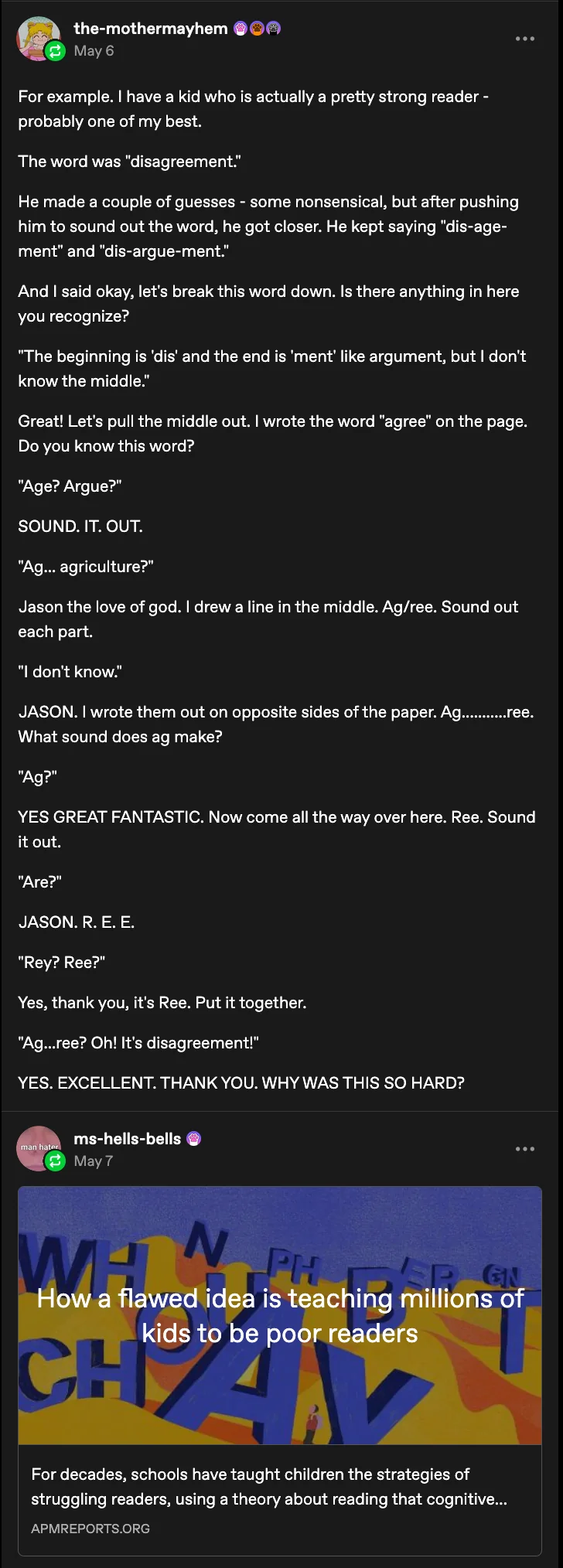 Whole Learning Page 2
 Whole Learning Page 3
I used to be mad about “whole language” reading approaches in theory but now I work with school-age kids and I am mad about it in practice.
me: the word is “commute”
kid: complete?
me: do you see a P in that word?
kid: uh…. compare?
me: where are you getting a P??? sound it out.
kid: com… complete?
me: is that a P after the M? sound it out.
kid: *stares blankly*
me: [oh right, nobody taught them how to do this. fucking hell…] okay, we’ll do this together [like it’s kindergarden even though you’re thirteen years old…]. what sound does C make?I am not a reading teacher or a dyslexia specialist but I’m having to do remedial phonics instruction for middle schoolers because nobody ever taught them how SO THEY CAN’T FUCKING READ
I cannot overstate how much these kids are just making wild guesses when I ask them to read something. Because that’s what they were taught to do. If you don’t know a word, use context clues and make a guess at what you think the word might be.
Which is a fucking insane approach to reading, by the way, and I could rant about this forever because this makes absolutely no sense and I cannot figure out how the entire educational field was duped into thinking that this makes a lick of sense.
But I also want to emphasize that even kids who are decent readers have this problem. I work with some kids who straight-up can’t read, but even my kids who absolutely can read will just guess wildly at an unfamiliar word. Those kids will go back and sound it out if I force them to, because they can read, so they have the necessary decoding skills. But they have to be pushed to do it and reminded several times to quit fucking guessing and read the actual letters on the page, Jason.
For example. I have a kid who is actually a pretty strong reader − probably one of my best. The word was “disagreement.”
He made a couple of guesses − some nonsensical, but after pushing him to sound out the word, he got closer. He kept saying “dis-age-ment” and “dis-argue-ment.”
And I said okay, let’s break this word down.
Me: Is there anything in here you recognize?
Jason: “The beginning is ‘dis’ and the end is ‘ment’ like argument, but I don’t know the middle.”
Me: Great! Let’s pull the middle out. I wrote the word “agree” on the page.
Me: Do you know this word?
Jason: “Age? Argue?”
Me: SOUND. IT. OUT.
Jason: “Ag… agriculture?”
Me: Jason the love of god. I drew a line in the middle. Ag/ree. Sound out each part.
Jason: “I don’t know.”
Me: JASON. I wrote them out on opposite sides of the paper. Ag……….ree. What sound does ag make?
Jason: “Ag?”
Me: YES GREAT FANTASTIC. Now come all the way over here. Ree. Sound it out.
Jason: “Are?”
Me: JASON. R. E. E.
Jason: “Rey? Ree?”
Me: Yes, thank you, it’s Ree. Put it together.
Jason: “Ag…ree? Oh! It’s disagreement!”
Me: YES. EXCELLENT. THANK YOU. WHY WAS THIS SO HARD?#however the situation is better in liberal states that invest substantially more money into education than conservative states
As much as I wish that was [sic] the case, “Jason” and all of his classmates are students in a strongly blue state with some of the highest educational spending per student in the country.
I’m not saying the situation is better in red states − I’ve seen what my friends who are teaching in Texas are dealing with and the situation is dire. I’m just saying it’s less of a red/blue or funding issue than you might imagine.
This is another Tumblr essay that describes the painful fallout of having taught an entire generation without phonetics, with only the “whole language” approach, which—checks notes—involves a whole lot of wild guessing because you have no tools with which to analyze—in the strictest sense of the word: i.e., “break down”, or “parse” in the case of sentences, words, and phonemes—unfamiliar words.
Can you imagine seeing a color and being so helpless that you can’t even begin to describe it? Do we just start yelling out sounds, in the vague hope that we’ll get it? Of course not. We’ll say “reddish-brown” or “yellowish-green” or something sensible. Sure, maybe you’ll then learn a new word like mauve, taupe, chartreuse, vermillion, verdigris, lavender, or fuchsia, which there’s no way you could have guessed. But your approximation will not have been completely off-base. It will be adequate for a lot of purposes.
The “whole language” approach is what it looks like when you don’t give people the tools to bootstrap, to be autodidacts. Do accomplished readers sound out words? No. They don’t They know all of the words intuitively. Is there a way to skip the tedious part of learning a language and just jump right to the fluency of an accomplished reader? No. No, there isn’t. This “whole language” approach feels very much like the AI-assisted approach to coding now being promoted for juniors and beginners. It will end in the same tragic mess that “whole language” has.
No wonder people were home-schooling their kids.
Philosophy, Sociology, & Culture
Is It Time to Flee the US? by Justin Smith-Ruiu (Hinternet)
“For Trump himself it’s no big deal either way. He reverses course, declares victory no matter what ends up happening; his opponents hate him exactly as much as before, and his supporters fail to notice. Some genuine atrocities are committed — the abduction of Rümeysa Öztürk is, so far, for me the most horrifying of them.”
“The US has in general made significant progress since the end of World War II at pursuing its military objectives without adopting a “war footing”. Americans are now able to live their lives as if war did not exist at all, or were a pure abstraction. This arrangement works, of course, only for so long as war remains a regionally contained and conventional matter — the level at which it has been maintained, so far, since 1945. One fears that if and when Americans are reacquainted with war, it will come to them in the form of a crash course.”
Well, I fear it less than fervently hope for it to come to pass, if only because it might cause them to stop supporting war all over the rest of the world, just so that they can buy a whole bunch of shit that they don’t need and benefit from some of the lowest gasoline prices in the western world.
“The guiding presumption of the Resistance, with its gleeful Ukraine boosterism, can only be that US involvement in that conflict could never come with any real cost for us. There are plenty of graduation moms all over America right now, wearing blue and yellow lapel pins as they cheer their sons on at their commencement ceremonies, who plainly are not counting the days until those boys reach their 26th birthday and get their names removed from the Selective Service registry. They support the war in Ukraine because they take for granted that it’s not going to be their sons dying.”
“Is Russia doing things right? They at least appear to be going about things more honestly. They seem not to have forgotten what war is, and to understand that there is something indecent about boosting war without accepting that to boost it is to invite it home, and to call it down upon your sons and daughters. Everything else is abstraction, magical thinking, and the Sonderweg idiocy that convinces Americans, of both sides of the political divide, that their country will always be able to avoid the dynamics that have shaped the fate of every empire before theirs.”
“[…] when I talk to actual young white heterosexual American men in their natural habitat, what I find is that the efforts of the lost decade of progressive consciousness raising were not entirely lost on them. They are sincerely at ease in multiracial and LGBTQ+ settings. Many of them have sat through a degree’s worth of courses on the liberatory potentials of trans twerking, and have come out mostly unmoved either way — they love their trans friends just fine, but suspect that whatever it is their professors were up to in this pedagogical vein might not have been the best use of their time, or of their parents’ money.
“If I might venture a theory of what is going through their minds, they are rejecting not so much a particular set of beliefs, as beliefs in general, or at least beliefs understood as a set of shared commitments that come to be accepted in the first place through rational argumentation, which then causes a community of people who affirm this argumentation’s conclusions to take shape. The based young man’s attitude toward those promoting such community, not least their normie liberal parents, is to reassure them that they do not necessarily disagree, but that they just don’t want it shoved down their throats as dogma, especially when it comes from a messenger like Cory Booker, or anyone else similarly pegged as corny.”
“The first social-media age, from perhaps 2007 until 2024, was one in which sincere-posting, though constantly mocked along the fringes, could still be described as the default mode of expression. Relatedly, an expectation emerged, in that era, of what might be called “universal punditry”: it is everyone’s duty as a citizen to take up substantive first-order political positions in public, much like in 1795 it was the duty of every French citizen to wear a tricolor cockade, lest they be taken as having royalist sympathies. By 2020 many Americans were eagerly and regularly affirming, with utmost sincerity, things they could not possibly have believed, simply because they did not wish to land in the cross-hairs of their ultra-radical and ultra-purist mutual who had already announced more than once that they would be interpreting silence on a given two-sided issue as endorsement of the wrong side of it.”
People are joiners and cultists. We need more iconoclasts.
Facing the Climate Crisis and Human Mortality (w/ Eiren Caffall) by The Chris Hedges Report (YouTube)
“Chris: you write that about greed. I, having gone to some of these elite schools, where they tout such superior education. Once these people enter the power elite. it is greed—they never have enough… [you wrote that,] “Greed like that didn’t start out bad. What alters wanting is what’s behind it. Greed and hope aren’t opposites. Greed and hope are twins grabbing for the same thing, one in fear and one in faith.” Explain what you mean by that.
“Eiren i think that there’s a baseline desire for protection, for resources, for enoughness that’s part of the human experience. And I don’t think that it necessarily breaks towards the good every time, but I think it’s more prone to breaking towards the good, if people aren’t afraid. and I feel like I write towards that all the time, in that part of writing stories about death is that, I think that people are more prone to being afraid of death and that this anti-death cult that we’ve built here in America, this idea of immortality through money or through life extensions or through perpetual youth is bound up with an inability to tell a story about death that doesn’t terrify folks.”
me_irl: a good question (Reddit)
 Is society just trying to stop me from living my life
“Has anyone actually got [sic] salmonella from eating raw cookie dough or is society just trying to stop me from living my life”
This Dystopia Would Never Be Accepted Without Extensive Indoctrination by Caitlin Johnstone (Substack)
“I am not a politically complicated person. I think genocide is bad. I think peace is good. I don’t think anyone should be struggling to survive in a civilization that is capable of providing for all. I think we should try to preserve the biosphere we all depend on for survival.
“To me these are just obvious, common sense positions, no more remarkable or profound than believing I should refrain from slamming my nipple in a car door. I do not think these views should put me on the political fringe. I don’t think they should cause me to be seen as some kind of radical. It’s not outlandish that I hold these views, it’s outlandish that everyone else does not.”
“All our lives we are trained to believe this hellscape is the healthy and expected circumstance for our species. Our parents and teachers tell us that it’s normal for things to be this way. Our pundits and politicians assure us that there’s no other way things could be and that we are living under the best possible system.”
“It takes a lot of education to make us this stupid. Our minds require a whole lot of training to accept this horrific dystopia as the baseline norm. That’s why the empire we live under has the most sophisticated domestic propaganda machine that has ever existed.”
Adoption is Good by Freddie deBoer (SubStack)
“Writers are copycats and publications are risk-averse. Like 21st-century movie studios, our more high-falutin’ periodicals are often willing to invest only in known properties, which is why reading the opinion pages of national newspapers and magazines often feel like watching the latest cinematic retread of already well-worn intellectual property. The easiest way to get published is to swim with the tide.”
“The review of Demick’s recent book in The New York Times, like The New Yorker a publication in which liberals fret and sigh and ruefully swirl their flat whites, says that in finding such juicy tales of families rent apart by adoption, Demick “knows she is in possession of gold” − journalistic gold, that is, book sales gold, attention economy gold, the kind that can be spun into lucrative careers telling childless urbanites that hicks in the hinterland who cross-racially adopt brown children are the real imperialists. And oh, does she seem pious about mining it! Reflecting on her efforts to unite a Chinese adoptee with their biological parents, Ms. Demick says, admirable brevity doing nothing to hide her crusading white lady righteousness, “I wanted to help.” Well you know what, Ms. Demick, almost all adopted parents wanted the exact same thing, and almost all of them did. You could write a story about that. But can that story get printed in The New Yorker, in 2025? No, I really don’t think it can. There’s no percentage in it. No gold.”
AI and the Post-Knowledge World by Professor Asma (YouTube)
This is a wonderful discussion of what it will mean to offload knowledge and wisdom to machines. Asma discusses how humans have always offloaded to the environment to a certain degree. He argues that offloading to LLMs is like “the man in Searle’s Chinese Room”. I think that this offloading of knowledge and still believing that it would be a path to wisdom already began with the “just Google it” generation.
This trend is paired with a not-insignificant trend toward anti-intellectualism. Knowing things isn’t cool. You’re a “nerd.” I mean, look at who’s popular out there: millions and millions of subscribers and likes and billions and billions of views for the most stultifying, inane, and soul-sucking content while well-produced and equally visually stimulating video essays—I’m pretty sure he uses AI to generate the little animations peppered throughout— by professors of logic and philosophy like Professor Asma garner 131 views and 26 likes.
He cites other examples, of how people don’t know how to navigate without an electronic map anymore—even to the point of not being able to navigate by landmarks, by observing the environment. He talks about students who can’t read Macbeth—because it’s too hard—and then think that having read the summary on Wikipedia means that they “know” Macbeth.
The point of a student reading Macbeth isn’t because the world needs one more interpretation of that play. It’s because we already know the myriad interpretations of that play and can therefore use it as a metric to determine the skill of the student in reading and interpreting a work. Once that skill level is ascertained, you have a level of trust that the interpretation delivered by that person on a work unknown to you will be competent.
We do the same thing everywhere but people don’t seem to put two and two together. You build a wooden toolbox in shop not because the world needs a wooden toolbox but because you need to learn how to build things according to spec. The toolbox is a way of determining the amount of trust I should give you when I ask you to build something I actually need.
It’s the same in programming, where I don’t need another calculator—I need to know how well you can build one. And it’s also the same for hobby projects: everyone tries their hand at a blog, or a parser, or a game engine—at least, everyone used to do this—but no-one needs these things. They are projects that help you learn your craft.
Coming back to Macbeth: while reading Shakespeare may give you insight into the human condition—he touched on pretty much every foible we still have today—but the main purpose is just to make you better and quicker at comprehension, interpretation, and assimilation of difficult material. When you’re confronted with a 14-page technical paper describing the work that needs to be done, you will be able to do it.
The argument is that you don’t need any of this anymore because LLMs will always be there to do all of that. But then, what does the world need you for? What value are you bringing to the table? You’re just the little person in the Searle’s Chinese room, accepting inputs, plugging them in, and returning outputs, having added no value into that interpretive chain. Or, as Asma put it, “you’ll just be a cog that’s happily moving information from here to here, without understanding any of it.” What’s the argument that you should be included in that team or effort when anyone else could do it just as well?
Now, that’s the argument from a person who’s spent his life doing the exact opposite of being a cog. But maybe many people would read that previous paragraph and think, “way to go, Mr. Ivory Tower, you finally figured out how the rest of us have been doing everything all along.” Maybe these laments all come far too late and LLMs are just the industrialization and culmination of a trend that’s been long in the making.
From 11:15,
“That will be the ultimate offshoring of your mind to basically the needs of probably companies probably multinational companies and politics and you’ll be left I guess to just entertain yourself which sounds pretty sweet, until you realize you don’t really know anything.”
Or maybe you don’t. Maybe you’re no longer really capable of realizing anything. But that also makes you really easy to entertain! The algorithm will easily be able to come up with content to keep you entertained until you get sleepy. Why am I even using the future tense to describe this scenario? TikTok and co. are already here. I think perhaps Professor Asma is betraying his predilection for knowledge—which I share!—and thinking that he is playing Cassandra, predicting a dystopia, whereas what he described is what many, many people who swim with the strong currents of society, whose propaganda trains them to to think of it as a utopia.
From 17:30,
“Wosniak said you’re too in your head with a Turing Test. It’s too much about language-use and not enough about real-life or practical wisdom. So, he said, the only way to really know if a computer has achieved consciousness is for it to basically make a cup of coffee. So, put the AI in a robot and have it basically make a cup of coffee from scratch because that requires it to solve all these practical problems that are embodied problems.”
He discusses further how even people don’t figure out how to make coffee on their own—they’re taught to do it. But I think another point is that, even people who think that they know how to make coffee on their own are still assuming that they’re getting beans from somewhere, and that someone has roasted them, that someone has made potable water appear somewhere in your vicinity, in many cases, coming straight from a tap in your home.
I have a brother-in-law who roasts his own beans and that is lot of work when you’re doing it with a small machine or manually in a pan. He now has a big machine that does it much more quickly and pretty much in industrial batches—but who built the machine?
Who built the parts? Who built the tools that made the machines that made those parts? Who built the tools that made the parts that built the machine that made the tools that made the parts for the machine?
Who extracted the raw materials for the parts? Who built the tools to build the machines that helped them extract those materials? Who built the machines that produced the parts for those machines?
Who built the energy infrastructure that made it possible to run the machines? The grid? The parts for the grid? The maintenance system for it? The shipping lanes that brought those parts and machines and tools and raw materials to you?
Who built the infrastructure to ensure that fossil fuels were where they needed to be when they need to be there for extracting those materials?
From 23:00,
“It’s a very strange disconnect people are having between the digital world they’re living in most of the time now, and the real world. And I think we’re starting to see more and more of this. So, every once in a while, reality punches through the simulacrum or the matrix we’re living in all the time on our screens.
“And we’re not ready for it. We’re not trained to handle it. We don’t know what to do with it. We fall over ourselves. We get bit in the face by some animal because we thought, ‘hey on TV they’re so cute.‘
“You know, this is—it’s a kind of madness. This is what Jean Baudrillard called the simulacrum. And it’s going to be fine if the simulacrum continues unabated. Because you could probably go to your grave living in this sort of mimicked world of reality, of screens.
“But, if the grid goes down and the simulacrum ends, what’s it going to be like then? Are we going to have any skills—embodied skills or practical wisdom? Are we going to be able to do any of the theoretical stuff like computations, logic, math? Are we going to know any science?
“Or are we becoming such cogs in the machine in this Chinese room I’m describing that we won’t know how to handle the real world at all when there’s a collapse of the simulacrum?
“Okay, that’s kind of a frightening place to end. Think about it though! And maybe get off your screens. Never fail to watch Professor Asma’s guide to unusual knowledge, though. Make sure that that’s a weekly thing for you. But otherwise, get outside into the sunshine and touch grass, as the kids would say.”
Professor Asma really makes me think. His videos keep getting better and better. Very holistic thinking. The work of a philosopher is to show deeper relations between seemingly unrelated things in the hope that we can learn something useful from them.
What does “from scratch” even mean?
‘Indigenous Knowledge’ Is Inferior To Science by Thomas R. Wells (3QuarksDaily)
“[…] knowledge is knowledge. Where it comes from doesn’t matter to its epistemic status. What matters is whether it deserves to be believed. The scientific revolution has provided a general approach – systematic inquiry – together with specialist methodologies appropriate to different domains (such as mathematical modeling, taxonomy, statistical analysis, and experimental manipulation and measurement). It is irrelevant that this approach first appeared in North-Western Europe and that many of the domain specific techniques were first developed and refined by white men from the ‘west’. What is relevant is that modern science allows a degree of confidence in factual and theoretical claims that has never been warranted before, and made this capability equally available to everyone around the world as the new standard for objective knowledge, i.e. knowledge that is reliably true no matter from what perspective you look at it.
“If indigenous peoples have observational data and successful technologies to contribute to this kind of systematic inquiry into what makes an ecosystem resilient, or what plants might contain molecules with pain-relieving properties, or the history of climactic events, then that should be welcomed. But the test of whether these are an actual contribution must come from whether they survive scientific scrutiny, not the authenticity of their indigenous origins.”
“Even when we suppose that indigenous knowledge claims might well be worth believing, we first subject them to systematic scrutiny – i.e. science – to evaluate their epistemic status. If they pass the test then they will be refined into a form that could be incorporated within the body of scientific knowledge, to become available to anyone who might find it interesting or useful.”
Or, as Timothy Minchin said in his 10-minute beat poem Storm,
“And try as I like
A small crack appears in my diplomacy-dike
“By definition”, I begin
“Alternative Medicine”, I continue
“Has either not been proved to work, or been proved not to work
Do you know what they call ‘alternative medicine’ that’s been proved to work?
Medicine.”““So you don’t believe in any natural remedies?”
““On the contrary Storm, actually
Before we came to tea, I took a natural remedy derived from the bark of a willow tree
A painkiller, virtually side-effect free
It’s got a weird name, darling, what was it again?
M-masprin? Basprin? Oh yeah! Asprin!”
Storm by Timothy Minchin (YouTube)
The west used to believe in a whole bunch of things that it now “knows” is mumbo-jumbo, like “bodily humours” or the “four elements.” None of those ideas had any predictive capacity better than luck. So they fell by the wayside because they often caused more harm than good.
For a long time, we had no metric, so we remained fooled by their proponents’ claims of efficacy but, once we figured it out, we realized that removing most of the blood from the body wasn’t helping you get better.
Nowadays we believe in invisible—to the human eye—creatures that attack our bodies until more invisible creatures can be rallied to fight them off, like a microscopic Helm’s Deep taking place all over you. This sounds f&@king batshit. But we also made microscopes so that we can see them and we made medicines that help our Ents win against those damned Orcs and it works. We proved that thinking about the world with this model—unverifiable though it may be with unaided human senses—is largely beneficial.
The west also still largely believes that eating tiny balls made of sugar that have been infused with a medicine whose power is inversely proportional to the amount of the medicine remaining after preparation is also super-good and beneficial. So nobody’s perfect.
We’re talking about coming up with efficacious and valuable knowledge. We’re trying to come up with materials and practices that do more good than harm. We are interested in estimating their value to society, usually with respect to other proposed solutions. How else would you determine whether how much of your energy and effort to invest in something?
Like, if someone says that you should go for a ten-mile walk to heal your pulled muscle and someone else says to put heat on it and someone else says to put ice on it, who do you believe? Do you figure out how to make heat that you can apply to it when walking ten miles would be even better? Do you waste time trying to make ice? Do you waste time walking ten miles, when it might make it even worse?
That is what science is for. Science is not woke. Science is not culturally specific. It can be practiced that way, but then it’s not science. Anyone who’s not following the rules is automatically not playing that game—they are playing a different game. Usually that game is scamming, i.e., they are trying to get you to listen to them in order to extract more value from their idea than it intrinsically has, usually for personal gain.
Technology & Engineering
 Uptime of 135 days
I just finally ended up rebooting my MacBook M1 Pro after 135 days (about 4.5 months), not because anything was wrong but because I really needed to apply some security updates. It’s just another world of stability and usability over here in MacOS-world vs. Windows-world.
LLMs & AI
Cursor: Security by Simon Willison and Security (Cursor)
“Cursor allows you to semantically index your codebase, which allows it to answer questions with the context of all of your code as well as write better code by referencing existing implementations. Codebase indexing is enabled by default, but can be turned off in settings.
“Our codebase indexing feature works as follows: when enabled, it scans the folder that you open in Cursor and computes a Merkle tree of hashes of all files. Files and subdirectories specified by ‘.gitignore’ or ‘.cursorignore’ are ignored. The Merkle tree is then synced to the server. Every 10 minutes, we check for hash mismatches, and use the Merkle tree to figure out which files have changed and only upload those.
“At our server, we chunk and embed the files, and store the embeddings in Turbopuffer. To allow filtering vector search results by file path, we store with every vector an obfuscated relative file path, as well as the line range the chunk corresponds to. We also store the embedding in a cache in AWS, indexed by the hash of the chunk, to ensure that indexing the same codebase a second time is much faster (which is particularly useful for teams).”
“Embedding reversal: academic work has shown that reversing embeddings is possible in some cases. Current attacks rely on having access to the model and embedding short strings into big vectors, which makes us believe that the attack would be somewhat difficult to do here. That said, it is definitely possible for an adversary who breaks into our vector database to learn things about the indexed codebases.”
Whether the vector database of embeddings that represent the queryable version of your code can be reverse-engineered if stolen is kind of a smaller concern vis à vis whether your actual code can be stolen from GitHub or Azure or wherever you’re storing it in the cloud. Of course, Cursor is a much newer and smaller company and is therefore granted less trust that they won’t screw up and lose your data. In this case, it’s better that the form in which they keep your data isn’t an immediately usable one (and is unlikely to be able to be made usable or completely reverse-engineered, even to the degree of disassembly of obfuscated code would be).
Desperate Times, Desperate Measures by Edward Zitron (Where's Your Ed At?)
“Again, if I’m being uncharitable — which I am — this whole thing reminds me of that model town that North Korea built alongside the demilitarized zone to convince South Koreans about the beauty of the Juche system and the wisdom of the Dear Leader — except the beautiful, ornate houses are, in fact, empty shells. A modern-day Potemkin village. Bloomberg got to visit a Potemkin data center.
“Data centers do not just pop out of the ground like weeds. They require masses of permits, endless construction, physical service architecture, massive amounts of power, and even if you somehow get all of that together you still have to make everything inside it work. While analysts believe that NVIDIA has overcome the overheating issues with its Blackwell chips, Crusoe is brand fucking spanking new at this, and The Information described Stargate as “new terrain for Oracle…relying on scrappy but unproven startups…[and] more broadly, [Oracle] has less experience than its larger rivals in dealing with utilities to secure power and working with powerful and demanding customers whose plans change frequently.”
“In simpler terms, you have a company (Oracle) building something at a scale it’s never built at before, using a partner (Crusoe) which has never done this, for a company (OpenAI) that regularly underestimates the demands it puts on its servers. The project being built is also the largest of its kind, and is being built during the reign of an administration that births and kills a new tariff seemingly every day.
“Anyway, all of this needs to happen while OpenAI also funds its consumer electronic product, as well as their main operations which will lose them $14 billion in 2026, according to The Information.
“It also needs to become a non-profit by the end of 2025 or lose $10 billion of SoftBank’s funding, a plan that SoftBank accepted but Microsoft is yet to approve, in part (according to the Information) because OpenAI wants to both give it a smaller cut of profits and stop Microsoft from accessing its technology past 2030.
“This is an insane negotiation strategy — leaking to the press that you want to short-change your biggest investor both literally and figuratively — and however it resolves will be a big tell as to how stupid the C-suite at Microsoft really is. Microsoft shouldn’t budge a fucking inch. OpenAI is a loser of a company run by a career liar that cannot ship product, only further iterations of an increasingly-commoditized series of Large Language Models.”
The Who Cares Era by Dan Sinker
“It’s so emblematic of the moment we’re in, the Who Cares Era, where completely disposable things are shoddily produced for people to mostly ignore.
“AI is, of course, at the center of this moment. It’s a mediocrity machine by default, attempting to bend everything it touches toward a mathematical average. Using extraordinary amounts of resources, it has the ability to create something good enough, a squint-and-it-looks-right simulacrum of normality. If you don’t care, it’s miraculous. If you do, the illusion falls apart pretty quickly. The fact that the userbase for AI chatbots has exploded exponentially demonstrates that good enough is, in fact, good enough for most people. Because most people don’t care.
“(It’s worth pointing out that I’m not a full-throated hater and know people—coders, mostly—who work with AI that do care and have used it to make real, meaningful things. Most people, however, use it quickly and thoughtlessly to make more mediocrity.)”
“Over the course of two months, we went from something smart that would demand a listener’s attention in a way that was challenging and new to something that sounded like every other thing: some dude talking to some other dude about apps that some third dude would half-listen-to at 2x speed while texting a fourth dude about plans for later.”
“As the culture of the Who Cares Era grinds towards the lowest common denominator, support those that are making real things. Listen to something with your full attention. Watch something with your phone in the other room. Read an actual paper magazine or a book.
“Be yourself.
“Be imperfect.
“Be human.
“Care.”
Discussing with a friend about how to get people to do that—care, I wrote:
Man, that’s a tough one. The youngest ‘uns are becoming increasingly convinced that you can get through life without your pulse getting over 80, mentally speaking. They also are being taught that life is something to “get through” rather than “enjoy” or “savor”. Or that their time here could be used to “contribute meaningfully to our shared existence.”
Step one is realizing that they might care less not out of maliciousness or laziness but because expressing that they care (e.g., about code-quality or spelling or grammar) requires a lot more work for them than it does for you. Whether it comes more easily to you or whether you’ve already put in the work, “doing it right” probably looks like a much steeper climb for them than it does for you. You might need to meet them where they’re at and be a Sherpa.
I remember a somewhat silly expression from Outside magazine a long time ago: “pain is the feeling of weakness leaving the body.” Some people avoid all sorts of pain. They’re like water, finding the path of least resistance. They don’t even know what they’re missing … but because they don’t know, they can’t care either. It’s tough not to land on “ignorance kinda bliss, ya know?”
Building a JavaScript calculator to calculate one thing by Simon Willison
“Here’s a quick demo of the kind of casual things I use LLMs for on a daily basis. […] I wanted to make sure Claude would use its JavaScript analysis tool, since LLMs can’t do maths.
“I watched Claude Sonnet 4 write 61 lines of JavaScript − keeping an eye on it to check it didn’t do anything obviously wrong.”
Look, it’s wicked cool that this works. And it’s wicked cool that he’s so quick at this. It’s super-neat that you can paste a screenshot with rates and also a chunk of JSON describing usage and it writes a custom Excel spreadsheet (basically) to calculate the number you’re looking for. This is an interesting leveraging of the system. I don’t know how efficient this is. I know it’s fast, though.
Leveraging LLMS goes hand-in-hand with automated testing by Simon Willison
“I wonder if one of the reasons I’m finding LLMs so much more useful for coding than a lot of people that I see in online discussions is that effectively all of the code I work on has automated tests.”
Exactly.
Like, how were you even writing code before if a machine can break everything this easily, bro?
Just asking questions
As I’ve stated before (perhaps not to you), I think it would be lovely if the actual effect of AI tools is to get everyone clearly specifying requirements and storing them with their code, as well as clearly writing useful automated tests. That would be an overall win.
Programming
The dynamic keyword is TRASH by Nick Chapsas (YouTube)
“Dynamic is a parachute, not a pattern.”
Nicely put.
ReSharper for VS Code is BAD by Nick Chapsas (YouTube)
This video, on the other hand, didn’t need to be made. He says that VS Code with the C# Dev Kit has “caught up”, which is absolutely not true. It’s just that he doesn’t use any of the refactoring that ReSharper and Rider support but that VS and VS Code+DevKit do not. Even just in this video, one of the refactorings that he used early in the video that was offered by ReSharper is available in neither VS nor VS Code. I don’t understand why he would be this crazy against ReSharper unless he were paid to do it.
At 3:00 at least he pops up the asterisk with full-screen text to note that you can’t use the two extensions together. You know how I already knew that? The ReSharper extension told me as much in a can-t-miss-it notification, just like it told me that it was in “preview” mode and to expect a bumpier ride. This video is weeeee bit clickbaitier than usual, Nick.
Designing type inference for high quality type errors (Considerations on Codecrafting )
“[…] just because the types can be inferred doesn’t mean there is no need for explicit syntax. After all, the user might want to explicitly provide the types in order to narrow down type errors, document the types, or place additional constraints on the code.”
“The problem is that Rust has types which exist in the type system but for which there is no syntax to actually write the type. This means that your code works as long as the types are inferred. However since there is no way to actually write the types you are using, you’re completely stuck as soon as you need to add explicit type annotations.”
“One time, I wasted considerable time attempting to add explicit type annotations to narrow down the cause of a type error in some stream code I was working on. I even tried breaking it up and addingBoxesso I could usedyn Trait, and I still wasn’t able to get it working with explicit types and still had no idea what the cause of the original compile error was. I ended up having to completely rewrite the code in question to stop using streams at all since it was impossible to debug compile errors.”
“The requirement that every inferrable type also be possible to express explicitly means that the typechecker can’t have any special powers that let it do things which can’t be done in the type syntax. There’s a constant temptation to say “oh lets just add this one extra analysis to the typechecker, that will solve a common pain point and allow more correct code to compile.” But unless you also add corresponding explicit type syntax (which you usually won’t, because that makes the language “more complicated”), you’ve just broken this rule.”
Collaborative Text Editing without CRDTs or OT by Matthew Weidner
“Sources: I learned the main idea of this approach from a Hacker News comment by Wim Cools from Thymer. It is also used by Jazz’s CoLists. I do not know of an existing public description of the approach − in particular, I have not found it in any paper on crdt.tech − but given its simplicity, others have likely used the approach as well. The extension to decentralized collaboration is based on OpSets: Sequential Specifications for Replicated Datatypes by Martin Kleppmann, Victor B. F. Gomes, Dominic P. Mulligan, and Alastair R. Beresford (2018).”
“The core problem we must solve is: What operations should clients send to the server, and how should the server interpret them, so that the server updates its own text in the “obvious” correct way?”
“The main issue with both CRDTs and OT is their conceptual complexity. Text-editing CRDTs’ total orders are subtle algorithms defined in academic papers, often challenging to read. OT algorithms must satisfy algebraic “transformation properties” that have quadratically many cases and are frequently flawed without formal verification.”
- Undo all pending local operations. This rewinds the state to the client’s previous view of the server’s state.
- Apply the remote operation(s). This brings the client up-to-date with the server’s state.
- Redo any pending local operations that are still pending, i.e., they were not acknowledged as part of the remote batch.
This is literally a rebase.
You Can Choose Tools That Make You Happy by Fernando Borretti
“Emacs is a Gnostic cult. And you know what? That’s fine. In fact, it’s great. It makes you happy, what else is needed? You are allowed to use weird, obscure, inconvenient, obsolescent, undead things if it makes you happy. We are all going to die. If you’re lucky you get three gigaseconds and you’re up. Do what you are called to do. Put ZFS in your air fryer, do your taxes in Fortran.”
“Above all, do not lie to yourself. Examine your motivations. If you pursue things out of pure obsession, and ignore reason, you might wake up and realize you’ve spent years labouring in obscurity on a dead-end.”
The Copilot Delusion by Jj (Blogmobly)
You have to keep Copilot on an incredibly short leash. I’m seeing it while I code in class with the class — sometimes it’s good, a lot of times wildly irrelevant — I’m seeing it in PowerShell queries (where there are just vast swathes of library I don’t know yet) but there, too, you have to watch it LIKE A HAWK because it is definitely going to reverse an IF on you somewhere.
“[…] and here he comes, pounding the keyboard like it owes him money, pasting in code he Frankensteined from a stack overflow comment written by an Uncle Bob disciple in 2014.”
“A chaos monkey disguised as a teammate. No tests. No profiling. No understanding of side effects or performance impact. Just blind clicking and tapping and typing. The programming equivalent of punching your TV to make the static stop.”
“This isn’t about tools or productivity or acceleration. It’s about the illusion of progress. Because if that programmer-if that thing, that CREATURE-walked into your stand-up in human form, typing half-correct garbage into your codebase while ignoring your architecture and disappearing during cleanup, you’d fire them before they could say “no blockers”.”
“A real copilot, on a commercial airline? They know the plane. The systems. They’ve done the simulations. They go through recertification. When they speak, it’s to enhance the pilot… Not to shotgun random advice into the cockpit and eject themselves mid-flight.
“Copilot isn’t that. It’s just the ghost of a thousand blog posts and cocky stack-overflow posts whispering, “Hey, I saw this once. With my eyes. Which means it’s good code. Let’s deploy it.” Then vanishing when the app hits production and the landing gear won’t come down.”
“Props where props are due. Copilot is like a thoughtless yet high-functioning, practically poor intern:”
- Great with syntax memory.
- Surprisingly quick at listing out your blind spots.
- Good at building scaffolding if you feed it the exact right words.
- Horrible at nuance.
- Useless without supervision.
- Will absolutely kill you in production if left alone for 30 seconds.
““But I just use AI for boilerplate!” you whimper, clutching your Co-Pilot subscription. Listen to yourself. If you’re writing the same boilerplate every day like some industrial-age cog monkey, automate it yourself. Write a library. Invent a macro. Reclaim some dignity. If AI’s doing your “boring parts”, what exactly is left for you to do? Fidget with sliders? Paint by numbers while the inference works it’s magic?”
“When you outsource the thinking, you outsource the learning. You become a conduit for a mechanical bird regurgitating it’s hunt directly into your baby-bird mouth. You don’t know your code. You’re babysitting it.”
“The thing will feed you trash. It’ll feed you fake wisdom from fake people and beg you to trust it. But if you want to make a fast, beautiful system − if you want to sculpt the kind of software that gets embedded in pacemakers and missile guidance systems and M1 tanks − you better throw that bot out the airlock and learn.”
“This is a profession. Take pride in your life’s work.
“You build taste by doing. By hurting. By shaving nanoseconds with surgical tools. By writing a routine on Monday, rewriting it Tuesday, and realizing Wednesday it still sucks. You don’t build taste by asking the MS Clippy of 2025 how to do your job.
“We are, in the long arc of computing history, still covered in dirt, yanking our bits around with ploughs. We ride horses. But some of us − the ones with blown-out eyeballs and scorched keyboards − some of us know how to build the next thing. Trains. Speedboats. Hypersonic jets of pure code.
“And the ones who keep using AI like it’s a divine oracle? They’ll be out there trying to duct-tape horses to an engine block, wondering why it doesn’t fly. Saying, “Hey. It’s still not flying. … … … Still not flying. … … … Still doesn’t fly fix it please.”.”
“Vampires with SaaS dreams and Web3 in their LinkedIn bio. Empty husks who see the terminal not as a frontier, but as a shovel for digging up VC money. They’ll drool over their GitHub Copilot like it’s the holy spirit of productivity, pumping out React CRUD like it’s oxygen. They’ll fork VS Code yet again, just to sell the same dream to a similarly deluded kid.”
Looking at you, Cursor.
“Because you don’t know what you don’t know. That’s the cruel joke. We’ll fill this industry with people who think they’re good, because their bot passed CI. They’ll float through, confident, while the real ones − the hungry ones − get chewed up by a system that doesn’t value understanding anymore. Just output. Just tokens per second.”
“[…] what’s worse, we’ll normalize this mediocrity. Cement it in tooling. Turn it into a best practice. We’ll enshrine this current bloated, sluggish, over-abstracted hellscape as the pinnacle of software. The idea that building something lean and wild and precise, or even squeezing every last drop of performance out of a system, will sound like folklore.”
This has already largely happened. You can’t strive for more if you don’t know that you aren’t done yet. How can you avoid the local maximum when you can’t even imagine any taller mountains?
Speculation in JavaScriptCore by Filip Pizlo on July 29, 2020 (Webkit Blog)
The first time I’d searched for this author, I found Optimizing compilation and execution for dynamic languages, which discusses the 2014 article by the same author called Introducing the WebKit FTL JIT. I see now that I never read the 2016 article Introducing the B3 JIT Compiler, but the article covered here discusses it in no small amount of detail as well.
I was pretty sure that I’d read this before; the material was quite familiar but was still quite interesting. I took a lot more notes this time through.
“Speculative compilers use profiling to infer types dynamically. The generated code uses dynamic type checks to validate the profiled types. If the program uses a type that is different from what we profiled, we throw out the optimized code and try again. This lets the optimizing compiler work with a statically typed representation of the dynamically typed program.”
“Initially, code starts out running in an execution engine that does no speculative type-based optimizations but collects profiling about types. This is usually an interpreter, but not always. Once a function has a satisfactory amount of profiling, the engine will start an optimizing compiler for that function. The optimizing compiler is based on the same fundamentals as the one found in a C compiler, but instead of accepting types from a type checker and running as a command-line tool, here it accepts types from a profiler and runs in a thread in the same process as the program it’s compiling. Once that compiler finishes emitting optimized machine code, we switch execution of that function from the profiling tier to the optimized tier.”
“While exiting out of a function is straightforward without breaking fundamental assumptions in optimizing compilers, entering turns out to be super hard. Entering into a function somewhere other than at its primary entrypoint pessimises optimizations at any merge points between entrypoints. If we allowed entering at every bytecode instruction boundary, this would negate the benefits of OSR exit by forcing every instruction boundary to make worst-case assumptions about type.”
“[…] allowing us to fine-tune the throughput-latency tradeoff on a per-function basis. Some functions run for so short — like straight-line run-once initialization code — that running any compiler on those functions would be more expensive than interpreting them. Some functions get invoked so frequently, or have such long loops, that their total execution time far exceeds the time to compile them with an aggressive optimizing compiler. But there are also lots of functions in the grey area in between: they run for not enough time to make an aggressive compiler profitable, but long enough that some intermediate compiler designs can provide speed-ups.”
“The bytecode can be interpreted by the LLInt directly or compiled with the baseline JIT, which mostly just converts each bytecode instruction into a preset template of machine code. The LLInt and Baseline JIT share a lot of code, mostly in the slow paths of bytecode instruction execution. The DFG JIT converts bytecode to its own IR, the DFG IR, and optimizes it before emitting code. In many cases, operations that the DFG chooses not to speculate on are emitted using the same code generation helpers as the Baseline JIT. Even operations that the DFG does speculate on often share slow paths with the Baseline JIT. The FTL JIT reuses the DFG’s compiler pipeline and adds new optimizations to it, including multiple new IRs that have their own optimization pipelines. Despite being more sophisticated than the DFG or Baseline, the FTL JIT shares slow path implementations with those JITs and in some cases even shares code generation for operations that we choose not to speculate on.”
“JavaScript is a slow enough language even with the optimizations we describe in this post that garbage collector performance is rarely the longest pole in the tent. Therefore, our garbage collector makes many tradeoffs to make it easier to work on the performance-critical parts of our engine (like speculation). It would be unwise, for example, to make it harder to implement some compiler optimization as a way of getting a small garbage collector optimization, since the compiler has a bigger impact on performance for typical JavaScript programs.”
“[…] this approach also means that adding new bytecodes or changing bytecode semantics requires changing all of the tiers. For that reason, we try to implement new language features by desugaring them to existing bytecode constructs.”
“The control system has to balance competing concerns: compiling functions as soon as it’s profitable, avoiding compiling functions that aren’t going to run long enough to benefit from it, avoiding compiling functions that have inadequate type profiling, and recompiling functions if a prior compilation did speculations that turned out to be wrong.”
“JavaScriptCore counts executions of functions and loops to decide when to compile. Once a function is compiled, we count exits to decide when to throw away compiled functions. Finally, we count recompilations to decide how much to back off from recompiling a function in the future.”
“Over the years we’ve found ways to dynamically adjust these thresholds based on other sources of information, like:”
- Whether the function got JITed the last time we encountered it (according to our cache). Let’s call this
wasJITed.- How big the function is. Let’s call this
S. We use the number of bytecode opcodes plus operands as the size.- How many times it has been recompiled. Let’s call this
R.- How much executable memory is available. Let’s use
Mto say how much executable memory we have total, andUis the amount we estimate that we would use (total) if we compiled this function.- Whether profiling is “full” enough.
“We say that profiling is full enough if more than ¾ of the profiling sites in the function have data. If this threshold is not met, we reset the execution counters. We let this process repeat five times. The optimizing compilers tend to speculate that unprofiled code is unreachable. This is profitable if that code really won’t ever run, but we want to be extra sure before doing that, hence we give functions with partial profiling 5× the time to warm up.”
“Each heuristic was added because it produced either a speed-up or a memory usage reduction or both. We try to remove heuristics that are not known to be speed-ups anymore, and to our knowledge, all of these still contribute to better performance on benchmarks we track.”
“If a function is jettisoned, we increment the recompilation counter (R in our notation) and reset the tier-up functionality in the Baseline JIT. This means that the function will keep running in Baseline for a while (twice as long as it did before it was optimized last time). It will gather new profiling, which we will be able to combine with the profiling we collected before to get an even more accurate picture of how types behave in the function.”
“JavaScriptCore’s compiler control system is designed to get good outcomes both for functions where speculation “just works” and for functions like the one in this example that need some extra time. To summarize, control is all about counting executions, exits, and recompilations, and either launching a higher tier compiler (“tiering up”) or jettisoning optimized code and returning to Baseline.”
“LLInt allows us to execute JavaScript code even if we can’t JIT. JavaScriptCore in no-JIT mode (we call it “mini mode”) has some advantages: it’s harder to exploit and uses less memory. Some JavaScriptCore clients prefer the mini mode. JSC is also used on CPUs that we don’t have JIT support for. LLInt works great on those CPUs.”
“[…] we designed a new language, offlineasm, which has the following features:”
- Portable assembly with our own mnemonics and register names that match the way we do portable assembly in our JIT. Some high-level mnemonics require lowering. Offlineasm reserves some scratch registers to use for lowering.
- The macro construct. It’s best to think of this as a lambda that takes some arguments and returns void. Then think of the portable assembly statements as print statements that output that assembly. So, the macros are executed for effect and that effect is to produce an assembly program. These are the execution semantics of offlineasm at compile time.
“[…] LLInt is an interpreter written in offlineasm. LLInt understands JIT ABI so calls and OSR between LLInt and JIT are cheap. The LLInt allows JavaScriptCore to load code more quickly, use less memory, and run on more platforms.”
“[…] the Baseline JIT is a mostly unoptimized JIT compiler that focuses on removing interpreter dispatch overhead. This is enough to make it a ~2× speed-up over the LLInt.”
“Running with profiling turned on but never using the results to do optimizations should result in throughput that is about as good as if all of the profiling was disabled. We want profiling to be cheap because even in a long running program, lots of functions will only run once or for too short to make an optimizing JIT profitable.”
“Let’s say thatBandCboth have to do with the latency, in nanoseconds, of executing a bytecode instruction once.Bis the improvement to that latency if we do some speculation and it turns out to be right.Cis the regression to that latency if the speculation we make is wrong. Of course, after we have made a speculation, it will run many times and may be right sometimes and wrong sometimes. ButBis just about the speed-up in the right cases, andCis just about the slow-down in the wrong cases. The baseline relative to whichBandCare measured is the latency of the bytecode instruction if it was compiled with an optimizing JIT but without that particular OSR-exit-based speculation.”
“Profiling needs to focus on noting counterexamples to whatever speculations we want to do. We don’t want to speculate if profiling tells us that the counterexample ever happened, since if it ever happened, then the EV of this speculation is probably negative. This means that we are not interested in collecting probability distributions. We just want to know if the bad thing ever happened.”
“Updating value profiles means computing a predicted type for the value in the bucket and merging that type with the previously predicted type. Therefore, after repeated predicted type updates, the type will be broad enough to be valid for multiple different values that the code saw.
“Predicted types use the SpeculatedType type system. A SpeculatedType is a 64-bit integer in which we use the low 40 bits to represent a set of 40 fundamental types. The fundamental types, shown in Figure 13, represent non-overlapping set of possible JSValues. 240 SpeculatedTypes are possible by setting any combination of bits.
“This allows us to invent whatever types are useful for optimization. For example, we distinguish between 32-bit integers whose value is either 0 or 1 (BoolInt32) versus whose value is anything else (NonBoolInt32). Together these form the Int32Only type, which just has both bits set. BoolInt32 is useful for cases there integers are converted to booleans.”
“[…] value profiling allows us to predict the types of variables at all of their use sites by just collecting profiling at those bytecode instructions whose output cannot be predicted with abstract interpretation. This serves as the foundation for how the DFG (and FTL, since it reuses the DFG’s frontend) speculates on the types of JSValues.”
“The Baseline JIT does something more sophisticated. When emitting aget_by_id, it reserves a slab of machine code space that the inline caches will later fill in with real code. The only code in this slab initially is an unconditional jump to a slow path. The slow path does the fully dynamic lookup. If that is deemed cacheable, the reserved slab is replaced with code that does the right structure check and loads at the right offset.”
“Let’s pause to appreciate what this technique gives us so far. We started out with a language in which property accesses seem to need hashtable lookups. Ao.foperation requires calling some procedure that is doing hashing and so forth. But by combining inline caches, structures, and speculative compilation we have landed on something where someo.foperations are nothing more than load-at-offset like they would have been in C++ or Java.”
“[…] inline caching is an optimization employed by all of our tiers. In addition to making code run faster, inline caching is a high-precision profiling source that can tell us about the type cases that an operation saw. Combined with structures, inline caches allow us to turn dynamic property accesses into easy-to-optimize instructions.”
“[…] watchpoints let inline caches and the speculative compilers fold certain parts of the heap’s state to constants by getting a notification when things change.”
“We typically use the presence of an exit flag as an excuse not to speculate at all for that bytecode. We effectively allow ourselves to overcompensate a bit. The exit flags are a check on the rest of the profiler. They are telling the compiler that the profiler had been wrong here before, and as such, shouldn’t be trusted anymore for this code location.”
“Note that IR mutability is closely tied to how much it describes and how easy it is to validate. Any optimization that tries to transform one piece of code into a different, better, piece of code needs to be able to determine if the new code is a valid replacement for the old code. Generally, the more information the IR carries and the easier it is to validate, the easier it is to write the analyses that guard optimizations.”
“DFG, in both non-SSA and SSA forms, forms the bulk of the DFG and FTL compilers. […] both JITs share the same frontend for parsing bytecode and doing some optimizations. The difference is what happens after the DFG optimizer. In the DFG tier, we emit machine code directly. In the FTL tier, we convert to DFG SSA IR (which is almost identical to DFG IR but uses SSA to represent data flow) and do more optimizations, and then lower through two additional optimizers (B3 and Assembly IR or Air).”
“The point of the DFG compiler is to remove lots of type checks quickly. Fast compilation is the DFG feature that differentiates it from the FTL. To get fast compilation, the DFG lacks SSA, can only do very limited code motion, and uses block-local versions of most optimizations (common subexpression elimination, register allocation, etc).”
“That’s OSR exit at a high level. We’re trying to allow an optimizing compiler to emit checks that exit out of the function on failure so that the compiler can assume that the same check won’t be needed later.”
“OSR is all about replacing the current stack frame and register state, which correspond to some bytecode index in the optimizing tier, with a different frame and register state, which correspond to the same point in the profiling tier. This is all about shuffling live data from one format to another and jumping to the right place.”
“Outside the compiler field we use the term dead code to mean something that compilers call unreachable code. Code is unreachable if control flow doesn’t reach it and so it doesn’t execute. Outside the compiler field, we would say that such code is dead. It’s important that compilers be able to eliminate unreachable code. Happily, our approach to OSR has no impact on unreachable code elimination. What compilers call dead code is code that is reached by control flow (so live in the not-compiler sense) but that produces a result that no subsequent code uses.”
“Note that the fact that this explosion happens is somewhat of a JavaScript-specific problem, since JavaScript is unusual in the sheer number of speculations we have to make per operation (even simple ones likeaddorget_by_id). If the speculations were something we did seldom, like in Java where they are mostly used for virtual calls, then the simple approach would be fine.”
“[…] the DFG compiler is also allowed to speculate by setting watchpoints in the JavaScript heap. If it finds something desirable — like thatMath.sqrtpoints to the sqrt intrinsic function — it can often incorporate it into optimization without emitting checks. All that is needed is for the compiler to set a watchpoint on what it wants to prove (that theMathandsqrtwon’t change). When the watchpoint fires, we want to invalidate the compiled code.”
“Recompiling and then speculating less at least means that the program eventually runs with the optimal set of speculations. Speculating too weakly and never recompiling means that we never get to optimal. Therefore, the prediction propagator is engineered to sometimes be unsound instead of conservative, since unsoundness can be less harmful.”
“The DFG tier mostly only moves code around within basic blocks rather than between them while the FTL tier can also move code between basic blocks. Even with the DFG’s block-local code motion, it’s necessary to know more than just the current ordering of the program. It’s also necessary to know how that ordering can be changed.
“Some of this is already solved by the data flow graph. DFG IR provides a data flow graph that shows some of the dependencies between instructions. It’s obvious that if one instruction has a data flow edge to another, then only one possible ordering (source executes before sink) is valid.”
“The combination of clobberize and the control flow graph gives a scalable and intuitive way of expressing the dependence graph. It’s scalable because we don’t actually have to express any of the edges. Consider for example a dynamic access instruction that could read any named JavaScript property, like the Call instruction in Figure 33. Clobberize can say this in O(1) space and time. But a dependence graph would have to create an edge from that instruction to any instruction that accesses any named property before or after it. In short, clobberize gives us the benefit of a dependence graph without the cost of allocating memory to represent the edges.”
“The introduction of the FTL solidified the DFG’s position as the compiler that optimizes less. So long as the DFG generates reasonably good code quickly, we can get away with putting lots of expensive optimizations into the FTL. The FTL’s long compile times mean that many programs do not run long enough to benefit from the FTL. So, the DFG is there to give those programs a speculative optimization boost in way less time than an FTL-like compiler could do.”
“It’s not obvious that exiting out of SSA would discover all of the cases where the same store can be reused for both OSR exit state update and the data flow edge. This suggests that any version of exiting out of SSA would make the DFG compiler either generate worse code or run slower. So, not having SSA makes the compiler run faster because entering SSA is not free and exiting SSA is awful.”
“We can afford to do a lot of optimizations in the DFG so long as those optimizations are block-local and don’t try too hard. Still, this pipeline is way smaller than the FTL’s and runs much faster.”
“This greatly reduces the number of type checks compared to running JavaScript in either of the profiled tiers. Because the benefit of type check removal is so big, the DFG compiler tries to limit how much time it spends doing other optimizations by restricting itself to a mostly block-local view of the program. This is a trade off that the DFG makes to get fast compile times.”
“The FTL combines multiple optimization strategies:”
- We reuse the DFG pipeline, including the weird IR. This ensures that any good thing that the DFG tier ever does is also available in the FTL.
- We add a new DFG SSA IR and DFG SSA pipeline. We adapt lots of DFG phases to DFG SSA (which usually makes them become global rather than local). We add lots of new phases that are only possible in SSA (like loop invariant code motion).
“Lots of things work best in B3, like most reasoning about how to simplify arithmetic. B3 is the first IR that doesn’t know anything about JavaScript, so it’s a natural place to implement textbook optimization that would have difficulties with JavaScript’s semantics.”
“We have found that some optimizations are annoying, sometimes to the point of being impractical, to write in DFG IR because of explicit OSR exit (like MovHint deltas and exit origins). It’s not necessary to worry about those issues in B3. So far we have found that every textbook optimization for SSA is practical to do in B3. This means that we only end up having a bad time with OSR exit in our compiler when we are writing phases that benefit from DFG’s high-level knowledge; otherwise we write the phases in B3 and have a great time.”
“The FTL handles this by having one of the operands to a B3 Check be a lambda that takes a JIT code generator object and value representations for all of the arguments. We like this approach so much that we also have B3 support Patchpoint. A Patchpoint is like an inline assembly snippet in a C compiler, except that instead of a string containing assembly, we pass a lambda that will generate that assembly if told how to get its arguments and produce its result.”
“The idea of using feedback from cheap profiling to speculate was pioneered by the Hölzle, Chambers, and Ungar paper on polymorphic inline caches, which calls this adaptive compilation. That work used a speculation strategy based on splitting, which means having the compiler emit many copies of code, one for each possible type. The same three authors later invented OSR exit, though they called it dynamic deoptimization and only used it to enhance debugging. Our approach to speculative compilation means using OSR exit as our primary speculation strategy.”
“This speculative compilation technique, with OSR or diamond speculations but not so much splitting, first received extraordinary attention during the Java performance wars. Many wonderful Java VMs used combinations of interpreters and JITs with varied optimization strategies to profile virtual calls and speculatively devirtualize them, with the best implementations using inline caches, OSR exit, and watchpoints.”
“Speculative compilation is all about speeding up dynamically typed programs by placing bets on what types the program would have had if it could have types. Speculation uses OSR exit, which is expensive, so we engineer JavaScriptCore to make speculative bets only if they are a sure thing. Speculation involves using multiple execution tiers, some for profiling, and some to optimize based on that profiling. JavaScriptCore includes four tiers to also get an ideal latency/throughput trade-off on a per-function basis. A control system chooses when to optimize code based on whether it’s hot enough and how many times we’ve tried to optimize it in the past.”
Sports
The Swiss men’s ice-hockey team lost the world cup finals in 2025 to the smelly, stupid U.S. team, which was stacked with NHL players. Switzerland had defeated them 3–0 in the first found but couldn’t get a goal in the final, even though they’d scored more than five goals a game in the ten games leading up to the final. Boo. 👎
Fun

Madlad almost gets fired by Beardo 'Witcher-Pilled' Weirdo (Reddit)
“One time I almost got fired because a district manager asked me how long it would take to fix someone’s inventory fuckup on the computer and I said “an hour and a half” and they went “how long would it take with my help?” And I said “3 hours””
Cruciverbalism and cruciverbalism-adjacent by Yours Truly (earthli.com)
I added a note today about reverse rainbows in the Connections puzzle in the New York Times.
I was just thinking today that getting a reverse rainbow is not just knowledge of correlations between words but also tests empathy. You have to not only get into the heads of other puzzle solvers, trying to figure out what they think might consider difficult—e.g., when trying to determine which group of four words is “green” and which four are “easier” and therefore “yellow”—but what the people who make the puzzle think would be easier or more difficult for their readers. That is, everyone’s making assumptions about context and knowledge in other people, triangulating toward the reverse rainbow.
Purple is often extending the four words with another word. But blue is often something to do with science or engineering—which are anathema to NYT readers—or more-obscure vocabulary. What counts as obscure vocabulary is often somewhat shocking if you’re widely and well-read. You also have to take into account that younger generations read other things—or don’t read much at all. So they won’t have encountered words that I consider to be normal, having grown up with them.
There’s also the people who are doing this whole thing in what is still their non-native language, even if they’ve long since become fluent in English. The missing cultural cues are crucial.
All in all, “reverse rainbow” add an extra layer of difficulty to Connections that ends up flexing muscles other than knowledge of trivia and ability to correlate or find patterns.
Cause of Cancer by Kids in the Hall (YouTube)
“Bruce: I’m sorry I caused all that cancer. That throat cancer and bowel cancer. I guess I was just kind of on a roll.
Dave: And?
Bruce: And I won’t do it again.
Dave: Thank you.”