
Links and Notes for August 15th, 2025
Published by marco on
Below are links to articles, highlighted passages[1], and occasional annotations[2] for the week ending on the date in the title, enriching the raw data from Instapaper Likes and Twitter. They are intentionally succinct, else they’d be articles and probably end up in the gigantic backlog of unpublished drafts. YMMV.
[1] Emphases are added, unless otherwise noted.↩
[2] Annotations are only lightly edited and are largely contemporaneous.↩
Table of Contents
- Public Policy & Politics
- Journalism & Media
- Economy & Finance
- Science & Nature
- Environment & Climate Change
- Medicine & Disease
- Art, Literature, & Cinema
- Philosophy, Sociology, & Culture
- Technology & Engineering
- LLMs & AI
- Programming
- Fun
Public Policy & Politics
If you can’t disagree with Trump‘s administration‘s actions for moral reasons, hopefully you can agree that Trump‘s use of what he considers to be his personal, monarchic, imperial power is quite foolhardy.
He doesn’t seem to realize that much of the power of the U.S. is bluster—running on the fumes of its power of yesteryear—and that this bluster is there to be used as bluster, but never actually used for real (because it doesn’t actually exist). America’s power lies in the threat of force, not in called bluffs.
When Trump attempts to use America’s force—which only exists in his mind and the minds of those surrounding him—he reveals to everyone the limits of that power.
If one were interested in the continuation of American empire, then Trump actions are utterly foolhardy because he is wasting the only weapon that America has (or had) for keeping its vassals under control.
There’s no more putting Pandora back in that box except by proving that one’s country’s military might really is as strong as one threatens it to be. Trump now has to put his money where his mouth is and he’s finding that the US military is incapable of backing him up.
He is, in effect, cashing checks that the U.S.A.‘s body can’t cash.
The United States acts nearly exclusively in an immoral manner. My primary objection isn’t that the policies of the United States—the foreign policies, in particular—don’t actually serve the people. My problem is that the policies are about lying, cheating, stealing, and murdering as much as one can to achieve one’s goals.
I hope I don’t sound like a wild man when I write that I think that that doing so is immoral. I hope that most would agree.
Given this, it actually doesn’t matter that this lying, cheating, stealing, and murdering isn’t being done for the benefit of the majority of the population. That is, the fact that the U.S.A. primarily murders, extorts, and plunders as a matter of policy is a bigger problem than that it has failed to agree on this plan of action democratically.
That it is being done for the benefit of a tiny elite makes it even worse, but not categorically so, surprisingly enough, when examined in this manner. That means that this tiny elite is benefiting not only from the suffering engendered by their immoral policies on people outside of America, but also the suffering of the entire population that put this elite in place and keeps them there.
In another timeline, I might actually feel the most bad for Germany because they’re trying to crawl up the U.S.A.‘s ass, but the U.S.A. won’t stand still. All poor Germany wants to know is, should they send troops to Ukraine or to Iran? And the stupid U.S.A. won’t even answer the question. Poor Germany. I mean, really.
I think that it is foolhardy and counterproductive to realistic discussions of policy to believe the fairy tales that the U.S. tells about itself. That’s the first thing that you need to stop doing if you want to sit at the adults table.
In all likelihood, though, many more people will die before the empire and its more fervid vassals succumb to reality.
Pipe Hitters by Grayson Scott (Baffler)
“After his death, Miller said Abdul Raziq was “a patriot” and “a great friend.” Six years later, the New York Times called him “America’s monster.” Their article accused Abdul Raziq of thousands of murders and disappearances (he called them “sand picnics”), as well as countless instances of torture, kidnapping, and illegal detention. The United Nations said he tortured nine out of every ten detainees, crushing their testicles with clamps and electrocuting them. Abdul Raziq’s allies in the American government had known about all of this for years. The American public had known it too. In 2009, a piece in Harper’s described how he made millions from opium trafficking and defended his profiteering with assassinations and massacres of women and children. Fifteen years later, the Times investigators could write that Abdul Raziq helps “explain why the United States lost the war.” For the rest of the story about why the Afghanistan occupation failed, one has to look at the kind of man Abdul Raziq was standing next to when he died: the American special operator.”
“Two themes of Anderson’s conversation with his translator were then already threatening the occupation’s long-term stability. The first was the explosion in poppy production. The amount of land used to grow poppies would increase forty times its preoccupation level during the war. (Poppies are easy to grow, require no irrigation or fertilizers, and can share a field with other crops with no loss of productivity; they are the perfect commodity for a destitute country enduring its third or fourth decade of war.) The second development was the movement of warfighting, by means of increased reliance on special operators and military contractors, out of the sight of the American public. These two developments were interdependent: the special operators needed some Afghan allies, and those allies needed money. Even after hundreds of billions of dollars, Afghanistan was still not a functional country with an economy; the reason being that Afghanistan was controlled by corrupt, opium-smuggling warlords backed by clandestine American special forces.”
“The United States spent $36 billion on development aid to Afghanistan but spent three times as much on contractors for work in the country, who regularly gave kickbacks, got paid for work that wasn’t finished, and received contracts from well-connected friends and business partners. The upshot was that many more Americans, outside of the fraction of a percent who enlisted, became direct beneficiaries of the war on terror.”
“Anderson seems to have forgotten what many of his sources did tell him and any Afghan could have told him over the last decade. America’s friends were stealing from them and murdering their countrymen, often under the tutelage of the very special operators Anderson praised for their “successful work”: a man named Hikmatullah Shadman made $160 million contracting for the U.S. military, all the time collecting bribes, paying kickbacks, and defrauding the government while under the protection of his supporters (and likely coconspirators) in the Special Forces.”
“[…] the people of modern-day Afghanistan: poor, starving, and vulnerable. From the invasion to the Taliban takeover in 2021, poverty increased from 80 percent to virtually the entire population. The proportion of children under five experiencing acute malnutrition rose from 9 to 50 percent, and the percentage of people without enough to eat increased from 62 to 92 percent. During the war on terror, Fayetteville saw an astonishing number of child deaths from malnutrition, a drastic rise in hunger, and cascading deaths from overdoses and shootings. In both places, the suffering was caused by the same people.”
“Laid out like this, the cinematics might undermine the point Harp is making, which is that the United States military increasingly resembles and behaves like a successful criminal enterprise. Harp’s definition of Delta is “a high-tech death squad dedicated to covertly liquidating the male population base of recalcitrant ethnic and tribal groups that resist U.S. military occupation.” An operator’s wife Harp interviews is more succinct: “Running guns. Selling drugs. Fucking Afghan women. Where do you want me to start?” The characters in his book are middle-class American men, often fathers and usually white, massacring families while high on drugs they bought with money they stole while defending a regime of pedophile warlords, who were themselves extorting a country in which about one-third of people knew how to read. (American soldiers, many of them in JSOC, ripped off literal tons of money from the military: Harp writes that “whole pallets of shrink-wrapped cash simply disappeared—billions of dollars’ worth.”)”
“The most affecting parts of The Fort Bragg Cartel are the vignettes Harp collects showing the devastation soldiers inflict on their families: an operator named Keith Lewis beat his wife, then pointed a gun at the cops who showed up when she called. No charges were filed, and soon thereafter he was promoted. A couple of years later, Lewis murdered his wife, who was pregnant, with a gun in one hand and their daughter in the other. Another operator stomped to death his tiny dog, named Greta Bean, then shot his wife in the head before killing himself. This didn’t start recently. In July 2002, the Times was reporting a “growing problem” at Bragg: soldiers murdering their wives. The report notes that of the four women killed in the six weeks before the article was published, three of the victims were married to men in the special forces.”
“As the special operators’ country turned its endless wars into job programs for the dumbest sons of the middle class, its methods of super-violent extraction became personalized, inhering in the men who carried them out and refined them. When the operators got home, why shouldn’t they sell drugs, rape, and kill? It’s what they did all day at work.”
Magic Bullets by Tyler McBrien (Baffler)
“[…] the hollow-point bullet, a type of ammunition designed to mushroom or expand upon impact, creating a larger—and therefore more lethal—wound than traditional full-metal jackets. Deemed wantonly cruel and banned for use in war by parties to the Hague Convention of 1899, the hollow point is now used by nearly all major police forces across the United States. That means the roughly 1,300 people that police officers fatally shoot every year are hit with hollow-point bullets. This unlikely journey, from a war crime in one century to law enforcement’s round of choice by the end of the next, is part and parcel of a broader militarization effort that, beginning under President George H. W. Bush and accelerating during the global war on terror, has pumped billions into the coffers of local police departments, transforming them into occupying armies with a warrior mindset.”
“[…] justified the more lethal rounds using manufactured concepts backed up by little evidence. “There is no magic bullet, but this is about the closest thing to it,” one ballistics expert at the Baltimore County Police Department told the New York Times in 1993. “It has the stopping power that police officers need, and it is less likely to ricochet or go through the bad guy.””
“[…] in 1897, when Captain Neville Bertie-Clay, a British army officer stationed at the Dum Dum Arsenal outside of Calcutta, India, patented a solution [to] a problem that had bedeviled the empire for years. The problem, H. Ommundsen and E.H. Robinson write, was that the “savage tribes” facing the British “refused to be sufficiently impressed” by the standard ammunition at the time—“in fact, they often ignored it altogether, and, having been hit in four or five places, came on to unpleasantly close quarters.” The enterprising captain dealt with this unpleasantry by fashioning an early version of the hollow tip.”
“Opposition culminated in 1899 at the Hague, where colonial powers debated the use of dum-dums in war. Though the parties agreed that the extra lethal ammunition was too inhumane for use against each other, the British tried to carve out an exception for its imperial soldiers to use them against colonial subjects. “In civilized war, a soldier penetrated by a small projectile is wounded, withdraws to the ambulance, and does not advance any further,” argued one British military officer named John Charles Ardagh. “It is very different with a savage. Even though pierced two or three times, he does not cease to march forward . . . but continues on, and before anyone has time to explain to him that he is flagrantly violating the decision of the Hague Conference, he cuts off your head. For this reason the English delegate demands the liberty of employing projectiles of sufficient efficacy against savage races.” The British proposal was voted down, and dum-dum bullets were prohibited for use in war only years after their invention out of recognition of the fact that the projectiles went beyond the military need merely to stop an enemy’s attack. The hollow-point bullet, in other words, was overkill.”
“[…] as the New York Times noted in 1997, “several studies show that the case for the hollow-point bullet is not entirely clear cut.” At the time, one in five officers shot was shot by another officer—or by himself—and “80 percent of the shots fired in police shootouts miss their targets, meaning at least some innocent people hit cleanly by an errant bullet would be more severely injured by the new bullets.””
“According to a CCRB report, “serious questions were raised about the propriety of such bullets in an urban environment,” and whether officers were “in effect, acting as judge, jury and executioner.””
Goodhart’s Law (of AI) by Cory Doctorow (Pluralistic)
“Charlie Stross has observed that corporations are a kind of “slow AI,” that engage in endless reward-hacking to accomplish their goals, increasing their profits by finding nominally legal ways to poison the air, cheat their customers and maim their workers.”
“My favorite example of this is the AI-powered Roomba that was programmed to find an efficient path that minimized collisions with furniture, as measured by a forward-facing sensor that sent a signal whenever the Roomba bumped into anything. The Roomba started driving backwards, smashing into all kinds of furniture, but measuring zero collisions, because there was no collision-sensor on its back.”
“In 2008, George W Bush stepped up the long-running war on education with the No Child Left Behind Act. The right hates public education, for many reasons. Obviously, there’s the fact that uneducated people are easier to mislead, which is helpful if you want to get a bunch of turkeys to vote for Christmas (“I love the uneducated” -DJ Trump). Then there’s the fact that, since 1954's Brown v Board of Ed, Black and brown kids were legally guaranteed the right to be educated alongside white kids, which makes a large swathe of the right absolutely nuts. Then there was the 1962 Supreme Court decisions that banned prayer in school, leading to bans on teaching Christian doctrine, including nonsense like Young Earth Creationism. Finally, there’s the fact that teachers a) belong to unions; and, b) believe in their jobs and fight for the kids they teach.”
“I’ve been writing YA novels and doing school visits for long enough to cement my understanding that kids are actually pretty darned clever. They don’t graduate from high school thinking that their mastery of the 5PE is in any way good or useful, or that they’re learning about literature by making five marginal observations per page when they read a book. Given all this, why wouldn’t you ask an AI to do your homework? That homework is already the revenge of Goodhart’s Law, a target that has ruined its metric. Your homework performance says nothing useful about your mastery of the subject, so why not let the AI write it. Hell, if you’re a smart, motivated kid, then letting the AI write your bullshit 5PEs might give you time to write something good.”
“The right hates teachers and keeps on setting them up to fail. That hatred has no bottom. Take the Republican Texas State Rep Ryan Guillen, whose House Bill 462 will increase the state’s school safety budget from $10/student to $100/student, with those additional funds earmarked to buy one armed drone per 200 students (these drones are supplied by a single company that has ties to Guillen).
“Imagine how much Texas schools could do with an extra $90/student/year – how much more usefully that money could be spent if it were turned over to teachers. But instead, Rep Guillen wants to put “AI in schools” in the form of drones equipped with pepper-spray, flash bangs, and “lances” that can be smashed into people at 100mph.”
“The problem with AI in schools isn’t that students are using AI to do their homework. It’s that schools have been turned into reward-hacking AIs by a system that hates the idea of an educated populace almost as much as it hates the idea of unionized teachers who are empowered to teach our kids.”
Trump’s Shadow War in Somalia is a War on Tribal Democracy by Nicky Reid (Exile in Happy Valley)
“Donald Trump’s frequent attempts to dress himself in the drag of a peace candidate have always been a cabaret made possible by the Democrats’ open-mouthed embrace of humanitarian colonialism. It’s real easy to score the role of Charles Lindberg in the school play when the other side insists on dragging the Cheney’s to the Sady Hawkin’s dance. However, if the Donald has achieved anything but literal homicide during the first months of his second term it has been laying the myth of his non-interventionism to waste once and for all, albeit often with literal homicide.
“Trump has somehow made the blatant genocide in Gaza even more blatantly genocidal, largely just by embracing it openly and daring the pussies of the “free world” to do anything about it but scoff and pout. As if playing ringmaster to histories most well-publicized holocaust weren’t bad enough, Trump also decided to shatter the faith of his few remaining isolationist supporters by starting another bullshit war in the Middle East based on obvious lies regarding weapons of mass destruction with his far from over “ten-day war” with Iran. He’s even gone back on every white dude’s least favorite war in Ukraine, shipping Zelensky the hard stuff after making him dance for it in the Oval Office on live television.”
“Somalians are not rejecting the presidency or even democracy itself, they are rejecting the Westphalian Nation State; a distinctly European form of government defined by strict borders and a total monopoly on the use of force held by a centralized government and their standing army. No African has ever consented to this colonialist construct and that construct doesn’t become a democracy just because you allow a captive population to choose from a carefully curated selection of western puppets. This essentially just amounts to picking which dictator gets to sell your daughter into prostitution to the World Bank.”
“Somalians are backing the clans, as they always have, because they represent a far more African and a far more democratic form of governance than anything recognized by the UN. Somalia’s ancient clan system is largely governed by the Xeer legal system, a highly decentralized and regionally autonomous network of courts overseen by community elders based largely on oral traditions that predate both Islamic and civil law. It is a largely voluntary network of conflict resolution in which communities choose their own judges to settle disputes through reconciliation, negotiation and compromise over police state posturing and carceral justice.”
“The problem is that Al-Shabaab has gotten too big for their own good and have begun to behave just like any other state, robbing penniless farmers in the name of taxation and massacring any village who puts up half a fight.”
“Donald Trump isn’t interested in fighting terrorism. He is interested in fighting China who has recently supplanted the US and the EU as Africa’s main trading and investment partner. Somalia is of particular importance because of its strategic position on the Red Sea. With Yemen already lost to the dueling counter-state of the Houthis, Pax Americana is going to need another set of gallows from which to strangle Eurasian trade running through the Suez Canal.”
“Donald Trump has been losing for a living for his entire life because he is part of the ruling class in a liberal democracy that seems to be dedicated to awarding losers until it goes broke.”
They write what we’re thinking. Yes. 🙌
Abandon all hope, you who enter radical politics by Slavoj Žižek (Žižek goads and prods)
From a younger, Japanese correspondant:
“I almost no longer believe that the world can be changed. I almost feel that people in today’s capitalist society are coddled, and as a result, they are fragile, short-sighted, and extreme, eventually becoming a breeding ground for the far right. I feel that those left-wing elderly people on the streets of Kyoto, who truly believe that they can change the world, are ‘much younger’ than me.”
“What our situation demands is clear. A non-negotiable component of any Left is universalism—if for no other reason, then for the simple fact that today’s “late capitalist” society (the often-used predicate “late” is in itself meaningless; it rather signals our ignorance) is globally interconnected to an extent unthinkable until now.”
Altman’s Schwarzgerät by Iris Meredith (Dead Simple Tech)
“As trans people steadily become less and less human in the eyes of the shadowy cabal that controls so much of our lives, so it comes to pass that those above us humanise the bullshit-spewing statistical models that are LLMs more and more. As it becomes more and more acceptable to treat us as social pariahs, outcasts and the creatures responsible for all of society’s ills, excluded from the basic protections of humanity, we see more and more discourse about “AI shaming” and steadily more serious discussion of supposed “slurs” for LLMs.”
“It’s true that LLMs are doing some interesting shit: they’re an extremely elaborate form of model-fitting algorithm, and it’s highly likely that something based on the underlying technology for fitting text will at some point do something useful. There’s something there, buried deeply. However, I don’t think that, here and now, that actually matters: not when the technology is dragging us all into a paranoid conspiracy where questions of truth, cause and effect and even sanity are basically disintegrating.”
“Obviously you know where this is going: LLMs, especially in the ChatGPT-type form, share many of the characteristics of the V-2. There are genuine underlying technological developments that may later prove useful in creating a new and better world. The technology has some applications even now which we might want (though even there, it tends to do it somewhat shoddily). And for some value of “use”, they probably aren’t exactly useless. Unfortunately, almost every actual application in existence at the moment is a cruel, useless and resource-wasting one that primarily exists to punish people whom the tech magnates don’t like: a V-weapon to turn on the engineers and the minority groups that the magnates of the tech world and the powerful of our society hate above all else. The technology is mostly deployed out of spite: LLM tools are deployed primarily to make tech workers suffer and force them to know their place, because the tech magnates know that they depend entirely on the smarts and skills of people who are a lot smarter than them but whom the tech magnates see as being lesser than them.”
“The people in power can see the writing on the wall: they cannot, in the end, defend their positions of power and privilege. The people who created their wealth and whose co-operation they rely on to keep society working are realising their power and finding their voice (too slowly, to be sure, but tech workers, as opposed to tech magnates, skew very progressive). Members of minority groups that they saw as beneath them or beneath their notice have learned how to work with technology and can actively gain the skills they need to fight in the tech world as equals. The general population is deeply, deeply tired of the pain and deprivation of the economic system that the powerful have inflicted on them and is getting tired of the impunity with which the rich and the powerful act (C.F. The Epstein files). However long it takes and however it happens, these people are going to fall, and it’s going to hurt them hard when it happens. Their reaction, rather than doing the sensible things, like sharing and retiring gracefully, has been to lash out and try and inflict as much pain on us as possible before they die.”
The balrog’s whip. Fly! You fools!
“Our tech magnates, and the general elite stratum of our neoliberal societies, have always thought of themselves as the Master Race. The stories they tell themselves are that thanks to hard work and superior genes (if you don’t believe this last one, just look at the number of eugenicists that’ve just come out of the woodwork) they’ve become rich and influential, and they now do everything that they do for the benefit of the plebeians that sit beneath them.”
“All of a sudden, the Master Race is competing on something slightly approximating a level playing field, and it becomes very apparent that a lot of them were simply coasting on privilege and were in fact some of the dumbest people ever to walk the earth.”
“Whatever they do to us economically, they can’t force us to bend the knee. A chatbot, however, is endlessly compliant: it will do (or claim to do) exactly what you tell it, it will flatter you, it will make the elites feel good in a way that interacting with a real person who’s better at you than a bunch of shit and who also low-key hates you just can’t. To paraphrase Brecht’s poem, these people are, in a very real sense, trying to dissolve the people and replace them with a chatbot. And so we end up with the bizarre phenomenon of our elites simultaneously trying to make out trans women to be not even human while relentlessly humanising chatbots that just aren’t human in any way.”
“It’s pathetic, it’s a sign of a dying ideology in its final spasms, and unfortunately, it really sucks to live through.
“For those of you who aren’t currently a target of this: if you’ve ever wished to be a hero or save the marginalised in a fascist state, now’s your chance. The fascists are failing, they can tell that they’re failing, and it’s at these times that they commit the worst atrocities that they possibly can. People of colour, women, queer people and especially the trans people that are at the sharp end of this wave of dehumanisation: we all need your support. Jobs, financial support, being willing and able to stand up for us in public and push back against these attempts to force us out of public life: all of this is extremely important at the moment.”
“The next few years are going to be very hard; expect blood, pain, and more deaths than I think any of us would like. But people don’t act like this when they think they’ll win: they act like this when they know they’re losing. We are winning: we will win, and they know that, which is why they’re trying to do as much damage as they possibly can before they go. Our goal right now is to survive, and that is exactly what we’ll do.”
“And then there’s Elon Musk. My God, there’s Elon Musk. Our modern Weissman. The Captain Blicero for our time. Seriously, it fits so well. A white man of Germanic descent from what’s South Africa, complicit in the enslavement and genocide of the local black population. A complete pervert, obsessed with the sexual domination of women and the act of ejaculation, desperate to control his partners and almost incestuous in his attitude to his children. Deeply ambivalent about actually having sex, though he swapped the razor-filled leather vulva for a turkey baster filled with sex-sorted semen. And, of course, for some reason that I don’t think even he understands, obsessed with rockets to the point of sexual excitement: I would not be surprised if he hasn’t ejaculated in his pants watching a rocket launch at some point. Aiming towards a zero-point that I don’t think even he can picture or understand, he takes more and more bizarre actions as the world disintegrates around him. He’s a spitting image of our Weissman.”
“They’re so solipsistic in their outlook that they cannot countenance a world without them in it, much less one that ends up given over to the people they considered non-people: trans people, women, workers. Our only purpose is to be their [sic] for them to target their violence at, to use, to exploit, and if they should die while we continue and find that, even in a flawed and damaged world left in the wake of their destructiveness, we can be happy, they have failed.”
Trump and Putin make no meaningful announcements at Alaska summit by Andre Damon (WSWS)
“The United States is the world’s foremost imperialist power, bent on global domination of the former colonial world and the territory of the Soviet Union. To the extent that factions of the US political establishment are seeking a thaw in relations with Russia, it is in an effort to concentrate all their forces in a conflict with China, which would itself be the prelude to the total imperialist carve-up of the whole world.
“Within the Trump administration, there is a significant faction arguing for a US drawdown in the conflict with Russia in order to concentrate resources in the Pacific for a conflict with China. Earlier this year, Defense Secretary Pete Hegseth explained, “Stark strategic realities prevent the United States of America from being primarily focused on the security of Europe. … The US is prioritizing deterring war with China in the Pacific, recognizing the reality of scarcity and making the resourcing tradeoffs.”
“The root of the conflict, despite their evident attempts by Trump and Putin to come to some sort of agreement, is that the entire modus operandi of US imperialism, which seeks the total domination of the entire planet, cannot accept what Putin calls the “legitimate concerns of Russia,” i.e., the right of the Russian capitalists to exploit their mineral wealth undisturbed.
“Any US agreement with Russia, were it to take place, would be broken the minute the United States found it convenient.”
How Pretexts Work by Hamilton Nolan (How Things Work)
“[…] all you have to do in order to manufacture a security crisis is to flood an area with police. First, all of those cops will necessarily see more stuff happening, stuff that can be declared as crime, whether wisdom would dictate that they should let it slide or not; second, and even more important for the ultimate goal, the presence of all of these amped-up officers will eventually provoke a backlash from the public—and the backlash itself can be used to justify further crackdowns.
“Put a bunch of storm troopers in a city’s streets and sooner or later someone will throw a sandwich at them. Uh oh! As you can see, the lawlessness is increasing. Call out more storm troopers.”
“It is delusional to believe that good behavior by the public will usher us safely through this. That belief assumes that these operations are being undertaken for their stated goals. They’re not. They are pretexts, and as such, you can safely assume that they will accomplish their unstated purpose. It is a trivial matter for hundreds of cops to find enough unimportant “crime” to look like a crime wave if you show it in tight focus on Fox News. Somebody somewhere will always throw a rock at the cops if you let them parade around long enough. The fact that these things are the result of fascist provocations will not act as a moderating factor, because it is the entire point.”
Lessons from the Alaska Purchase by The First 100 Days (Matt Bivens, M.D.)
“A geopolitical reality came into view: Alaska was very far from Moscow. It was lightly populated by Russians, mostly trappers of sea otters. It would have taken an enormous commitment of national will and effort to ever defend it from invasion. And Russia’s hated enemy Great Britain was crouched right next door, in the form of its colony of Canada.
“The tsar and his advisers realized this made Alaska a weakness and a liability.
“But wait, some said. Wasn’t it possible Alaska might be home to a huge amount of gold, and other valuable natural resources?
“Sure. But even that did not change the Kremlin’s cold, hard calculus. After all, the 1850s had seen not just the Crimean War, but also the California Gold Rush. Russia had once laid claim to California as well; there were Russian communities there, as well as Native Americans. But all would be overwhelmed, sometimes violently, by the influx of fortune-feverish Forty-Niners (named after the year 1849). If gold was found next in Alaska, the same thing would clearly just happen there, too.”
The Ukraine War Is Over and Ukraine Lost (To America) In 2014 by Indrajit Samarajiva (Indica)
“In Putin’s own words, the nature of that agreement would be a “fair balance in the field of security in Europe and in the world as a whole,” which is fairly expansive, and within which Ukraine is just one rapidly diminishing part. The fact is that Ukraine’s leverage gets less and less every day, while Russia’s only improves. They have attrition on their side, whereas Ukraine depends on the American attention span, which is notoriously short. Anyways, after the summit Putin said,”“The Empire has an expansive concept of national security for itself, which stretches thousands of kilometers from its capital, but cannot understand Russia’s concerns about hostile troops at its border. This is the historical unfairness Putin wants to discuss politically, but is unafraid to dust-up militarily also. That seems to be the only language Empire understands, and for them negotiations are just a ruse. See Minsk I and Minsk II.”“I have repeatedly said that for Russia, the events in Ukraine are associated with fundamental threats to our national security. Moreover, we have always considered the Ukrainian people to be our brothers, as I have said many times. We share the same roots, and what is happening to us is a tragedy and a great pain. Therefore, our country is genuinely interested in putting an end to this.
“At the same time, we are convinced that in order for the Ukrainian settlement to be sustainable and long-term, all the root causes of the crisis that have been repeatedly mentioned must be eliminated, all legitimate concerns of Russia must be taken into account, and a fair balance in the field of security in Europe and in the world as a whole must be restored.”
“The nattering Nazis of Europe, calling themselves, “Coalition of the Willing” (the most pathetic nomenclature possible) has said, “They (the coalition participants − Ed.) once again emphasized their readiness to deploy security forces after the cessation of hostilities, as well as to help ensure the security of Ukraine’s air and sea space and restore the Armed Forces of Ukraine.” So what they propose is a ceasefire to resume fire when convenient. AKA Minsk III. Russia is not buying it now, thank goodness. There is frankly no one credible to negotiate with from the Empire, and Russia is winning the war on the ground. Why stop now?”
We can lament that Russia is gaining ground but we cannot ignore that it is happening. The only way to prevent this would be to put all NATO boots on the ground—and even that might not work. Perhaps if the U.S. were to start carpet-bombing Russia? Oh, no, that wouldn’t work either…or at least it wouldn’t work for long before the mushroom clouds over European cities would get too distracting.
“As Larry Johnson said, “Russia’s current GDP, using Purchasing Power Parity (PPP), is estimated at $7.1 trillion, making it the fourth largest economy in the world by this metric, and larger than any single other European economy, according to IMF estimates for 2025.” Europe keeps posturing like Russia is some backwater, but they’re downstream of them economically, and cut off since America blew up Nordstream and clipped their balls.”
“The White Empire is committing a genocide right now and they want us to believe that they’re somehow right on Ukraine? And these people still want to lecture about how bad Russia is? What a killing joke. Forget negotiating, there’s no point even talking to White people anymore. It’s a dead identity from a dying empire, with nothing but death to offer in the end.”
Luxury Terrorism by Indrajit Samarajiva (Indica)
“The fact is that this empire can no longer impose its will on anyone and has lost control of the narrative almost completely. White Empire can no longer command its own citizens into war, it can no longer wrangle debt slaves to do it for them, and its proxies are falling one by one. They have to resort to luxury terrorism to stay relevant and malevolent, but this is expensive more than expansive, and defective more than effective. They can terrify people, yes, but they can’t turn that into political power, which is the point of any political violence. This luxury terrorism is just pointless.”
Hawley Calls Out Boeing CEO For Prioritizing Profit Over People: 'You're The Problem' by Senator Josh Hawley (YouTube)
“Hawley: The last time that they got a contract was 16 years ago. Do you remember the terms of that contract>?
Boeing CEO: I don’t. It was it was a very long contract.
Hawley: Yeah, well, they got a 1% wage increases over eight years. 1% over eight years. You got a 45% increase just last year, and you’re making $33 million. You think maybe these folks deserve a raise?
Boeing CEO: Oh they will definitely get a raise.
Hawley: Good, good. I hope it’s a substantial one. And I hope that maybe this will be an opportunity for Boeing, under new leadership, to reverse course and actually start making things again, start making things in this country again, and start paying its people well. I’ve listened to your testimony and you know it seems like the gist of it seems to be that if you could just get your employees to comply, you know? Follow the rules, follow your management techniques, etc. … things would be better. I don’t think the problem’s with the employees.
Boeing CEO: Oh it is not.
Hawley: I think the problem’s with you. It’s the C-Suite. It’s the management. It’s what you’ve done to this company. That’s where the problem is. The problem’s at the top. Your engineers: they’re probably the best in the world; your machinists: they’re outstanding; you’re the problem. And I just hope to God that you don’t destroy this company before it can be saved.”
Dude sounds like Bernie Sanders is wearing a Josh Hawley suit. I know he’s just grandstanding and basically LARPing as a man of the people but maybe he fakes it long enough for something good to accidentally happen?
Deportation Industrial Complex by Ted Rall

“The current wave of mass deportations builds on the opposite of a virtuous cycle, in which the government and big business monetize and exploit people from overseas who are simply trying to get by. In many cases, they come from countries that were destabilized by U.S. foreign policy. Now they’re being returned to their home countries or to third countries, where they are bound to be motivated to help build the kind of societies disliked by American imperialists.”
The UK Online Safety Act is about censorship, not safety by Paige Collings (The Register)
“Some US officials seem to see the writing on the wall. “The UK now requires ID to read about Middle East politics, visit r/stopsmoking and listen to almost any hip hop music online,” US Senator Ron Wyden, (D-OR), wrote on X, adding that after the Wikimedia Foundation lost its court challenge to the OSA, “using Wikipedia could be next. Once sites require age verification for the UK, there’s little stopping them doing the same in the US” ”
“The UK’s scramble to find an effective age verification method underscores that there isn’t one, and it’s high time for politicians around the world to take that seriously – especially those pondering similar laws in the US Rather than weakening rights for already vulnerable communities online, governments everywhere must acknowledge these shortcomings and explore less invasive approaches – such as comprehensive privacy legislation – to protect all people from online harms, especially as authoritarianism spreads around the globe.
“Politicians in the UK, the US, and beyond must consider what’s best, not what’s easiest.”
When have they ever done that? When have they ever considered the public good rather than which side their bread is buttered on? Look at how far the law got in the UK. Do you think it will be repealed? Absolutely not. They will double down. This is a good thing for the elites. They will be rewarded richly by their benefactors. The only thing that could go sideways is if people really do stay off the Internet and the incomes of important corporations are impaired.
Venezuela Mobilizes 4.5 Million Militia Members as US Deploys Troops to the Caribbean by Devin B. Martinez (People's Dispatch / Scheer Post)
“President Nicolás Maduro announced on Monday, August 18, that he is activating “over 4.5 million militia members across the entire national territory” of the Bolivarian Republic of Venezuela, in response to the US deployment of three Navy guided-missile destroyers and 4,000 military personnel to the Caribbean. The White House has described the deployment as an anti-drug trafficking operation in the region, while some analysts have called it a new threat against Venezuela – the country with the largest oil reserves in the world.
“The US military deployment comes after Washington raised its bounty on the Venezuelan president from USD 25 million to USD 50 million, alleging links to drug cartels.
“The “extravagant, bizarre, and outlandish threats” of the United States have been firmly rejected by the Venezuelan government.”
“No US agency or international body has produced concrete evidence of drug production and distribution being concentrated in Venezuela or linked to Maduro. In fact, available global drug data makes almost no mention of the Caribbean nation or the alleged “Cartel of Suns” at all. According to the United Nations Office on Drugs and Crime (UNODC), the epicenter of activity is in Colombia, Ecuador, and Peru, with the US identified as the main destination for distribution, recording the highest level of drug consumption in the world.”
“US Secretary of State Marco Rubio confirmed the deployment of US troops to the region on August 14. On Tuesday, August 19, White House Press Secretary Karoline Leavitt was asked if the administration was open to “boots on the ground” in Venezuela, to which she responded, “[Trump] is prepared to use every element of American power to stop drugs from flooding into our country.””
Utter madness. Perhaps here, too, he will attack, achieve none of his state goals, declare victory, and then pat himself on the back for having ended another war. He’s a liar and a madman. His coterie is just as bad as he is.
Do Tibetans in China have human rights? by
Li Jingjing 李菁菁 (YouTube)
TIL that the Chinese yuan is like the Swiss franc, in that it has several translations, one for each of its major languages: Mandarin, Uyghur, Tibetan, Mongolian, Zhuang, and Pinyin (romanization of Hanzi). The rest of the short video details how China has “rescued” Tibet. I suppose that, ever were all of the details to be true—150x increase in GDP, 15 free years of education, free health care, 2x increase in lifespan—the question of where the line is between cultural colonization and integration lies remains open. But this isn’t a unique situation. At the end, she does note that many of the cries of cultural appropriation and colonization come from the elites who had previously subjugated Tibet before China took it over. It’s quite clear that the society is much more equitable than the feudality under which most people lived before China arrived.
Israel’s Assassination of Memory by Chris Hedges (Substack)
“Calcified societies cannot communicate with anyone outside their incestious circles. They deny verifiable fact, the foundation on which rational dialogue takes place. This understanding lay at the heart of South Africa’s Truth and Reconciliation Commission. Those who carried out the atrocities of the apartheid regime confessed their crimes in exchange for immunity. By doing so they gave the victims and the victimizers a common language, one rooted in historical truth. Only then was healing possible.
“Israel is not only destroying Gaza. It is destroying itself.”
A Tribute to All Those Who Fought for a Better World and Died So Young by Vijay Prashad (ZNetwork)
“[…] the essay Fanon wrote after the assassination of thirty-five-year-old Patrice Lumumba on 17 January 1961. Published in Afrique Action in February 1961, the argument in ‘Lumumba’s Death: Could We Do Otherwise?’ is summarised in one powerful paragraph:”“Indeed, imperialism is never generous or humanitarian.”“Our mistake, the mistake we Africans made, was to have forgotten that the enemy never withdraws sincerely. He never understands. He capitulates, but he does not become converted.
“Our mistake is to have believed that the enemy had lost his combativeness and his harmfulness. If Lumumba is in the way, Lumumba disappears. Hesitation in murder has never characterised imperialism.”
“The official record of Fanon’s death is bronchial pneumonia, but that is just what it says on the certificate. There was a man from the Central Intelligence Agency, C. Oliver Iselin, present when he died. So it goes.”
Trump administration to begin continuous police-state surveillance of 55 million US visa holders by Jacob Crosse (WSWS)
“[…] the State Department confirmed that it will subject all 55 million US visa holders to what it calls “continuous immigration vetting.” Behind this bureaucratic phrase lies the creation of permanent police-state surveillance.
“The Associated Press reported that the government reviews will include social media accounts, law enforcement and immigration records in visa holders’ home countries, and any “actionable” violations of US law committed while in the United States. The new guidelines also make it mandatory that privacy switches on phones and apps be turned off during visa interviews, stripping immigrants and applicants of even the nominal protections of the Fourth Amendment, which bans government searches without a judicial warrant. Vast quantities of personal data will now be continuously stored and monitored, with the aim of purging from the United States anyone whose views conflict with the demands of US imperialism.”
“Visa holders and travelers to the US are already subjected to invasive searches by border police, including of cell phones, laptops and other electronic devices at airports and other ports of entry. Now this digital spying will occur at all times and places, including outside the country.
“No human team could oversee 55 million social media profiles in real time. The State Department’s new vetting regime almost certainly relies on AI-driven platforms to evaluate alleged “anti-American” and “terrorist” behavior. ICE has already agreed to a $30 million contract with Palantir to develop ImmigrationOS, to facilitate the mass deportation operation.”
Journalism & Media
Israel’s Biggest US Donor Now Owns CBS by Alan MacLeod (Scheer Post / Mint Press News)
“Oracle sees itself as an activist organization, one whose goal is the advancement of the Israeli colonization project. Safra Catz, the company’s Israeli-American CEO, bluntly explained that any employees uncomfortable with supporting a genocide should simply quit. “We are not flexible regarding our mission, and our commitment to Israel is second to none,” she said, adding:”“This is a free world and I love my employees, and if they don’t agree with our mission to support the State of Israel, then maybe we aren’t the right company for them. Larry and I are publicly committed to Israel and devote personal time to the country, and no one should be surprised by that.””
“[…] the news that the son of the world’s second-richest man – one with such close connections to U.S. and Israeli state power – is purchasing one of America’s most influential news outlets should already worry anyone who cares about a free and independent press.
“However, the news that the Ellisons are planning to buy out Bari Weiss’ publication, The Free Press, and give her control over the newsroom at CBS is even more startling. As part of the package to rubber-stamp the deal, Skydance had promised to hire Weiss as an ombudsman to address political bias and stamp out diversity, equity, and inclusion (DEI) practices.”
It would be hilarious in a dark film but even Black Mirror wouldn’t go this far. Maybe that’s why the show feels almost banal in its seventh season—it’s long ago been overtaken by reality.
“The news of what some fear will amount to a pro-Israel censor mirrors recent events at TikTok. The social media giant has recently hired former IDF soldier and Israel lobbyist, Erica Mindel, to oversee its online hate speech policy, with particular regard to antisemitism.
“Mindel is far from the first former Israeli official parachuted into a position of power at the company, however. A MintPress News investigation revealed that in November 2023, TikTok hired Reut Medalion, a former Israeli intelligence commander, as its global incident manager. Considering what Israel was doing at that time in Gaza, it is fair to wonder what sorts of “global incidents” the ex-spy was working on.”
“Trump himself tried to force through a sale of TikTok to an American buyer. His close friend, Larry Ellison, was his preferred candidate. “I’d like Larry to buy it,” he said.”
“The Free Press certainly has many powerful backers, having drawn investment from venture capitalists such as Marc Andreessen and David Sacks, as well as from former Starbucks CEO Howard Schultz.
“Yet the price being quoted to Skydance for the sale of what remains little more than a Substack blog is remarkable: between $200 million and $250 million. For context, in 2013, Amazon founder Jeff Bezos paid $250 million for The Washington Post, one of the world’s most widely read and most influential news outlets.”
Israel Is So Evil That It Has A Military Unit Dedicated To Excusing Atrocities by Caitlin Johnstone (Notes From The Edge Of The Narrative Matrix)
“[…] if Israel was [sic] on the side of truth and morality it would not have a military unit dedicated to manipulating the public narrative about actions which normal people would see as extremely evil.
“Israel: We can’t allow Palestinian journalists to remain alive in Gaza because all the Palestinian journalists are Hamas.
“Western journalists: Okay so let us in, that way there can be journalists documenting what’s happening in Gaza who aren’t Hamas.
“Israel: [long pause] … No.”
“This has all happened in response to widespread public outcry forcing the western political/media class to respond. The mass media cannot retain its legitimacy in the eyes of the public if it keeps churning out brazen genocide propaganda without ever scrutinizing Israel. Governments cannot retain the consent of the governed if they completely ignore a mass atrocity that the public cares deeply about. So they were forced to start moving, or else risk the public turning on them.”
Oh, yes, they can. Just manufacture another attack on Israeli civilians and you’ll be good for another 22 months.
NO WAY this is actually real by HasanAbi (YouTube)
This is a great starter video for those who’ve not yet gotten into Hasan Piker. He’s a great analyst. And he admits how stupid it is.
“I don’t care about this, dude. I don’t. You can say it’s because I think Sydney Sweeny’s hot or whatever in your mind, but like it’s just crazy how much people care about this. It’s like American politics is so hyper-capitalist that like even the the anti-administration, anti-establishment political movements are still organized around commodities and around consumption. Like, oh, I’ll never buy an American Eagle jean ever again. I’m taking my business to like Aeropostale instead, or Abercrombie and Fitch.”
He lets Megan Kelly read the entirety of Trump’s tweet like she’s reciting Shakespeare and it’s just so fucking embarrassing all around for all of those people on FOX. It’s just a bunch of people who are more than old enough to know better broadcasting their idiocy to the world. Hasan says,
“What are you doing? You’re like 55 years old, man. Why the fuck do you care about any of this? You’ve been a political commentator for like longer than I’ve been alive. Why is this so exciting for you? Oh my god. The leader of the free world is on Taylor Swift. Oh, thank God. Finally,”
Economy & Finance
How Yard Sales Could Explain the Rise of Billionaires and Challenge Libertarian Thinking by Ken MacVey (3 Quarks Daily)
“The number of billionaires has increased at a staggering rate. Since 1987, Forbes has systematically verified and counted the global number of billionaires. In 1987, Forbes counted 140. Two decades later Forbes tallied a little over 1000. It counted 2000 billionaires in 2017. In 2024 it counted 2,781, and in March this year it counted 3,028 billionaires (a 50% increase in the number of billionaires since 2017 and almost a 9% increase since 2024).”
The logic they sell us is that this rising tide lifts all boats. Pul the other one. They are fully aware that they’re playing a zero-sum game. When they get so much, many others get little or nothing.
“[…] the bottom 50% accounted for only 3.5% of US wealth in 1989,and in 2024 that percent is down to 2.5%.
“Thinktank Oxfam estimated in 2024 that the wealthiest one percent of the globe has as much wealth as 95 percent of humanity. It also predicts that in the next decade there will be five trillionaires.”
“It is true after accounting for inflation a billion in 2025 is not the same as a billion in earlier years, such as 2000. But in some ways a billion in 2025 has more buying power than a billion dollars would have in 2000, not less, as most of us would expect. Before the Supreme Court’s Citizens United decision in 2010 there were caps on what an individual could contribute to a political campaign. Citizens United paved the way for SuperPACs, which now grease the way for massive political contributions by wealthy individuals. According to Americans for Tax Fairness, billionaires accounted for .3% of total federal election contributions in 2008. In 2020 they accounted for 9.3% and in 2024 about one sixth.”
“Federal Reserve data shows that the wealthiest one percent own 50 percent of all equity funds. Putting these two together, this may mean that greater wealth concentration can work in tandem with markets now dominated by a handful of corporations.”
“[…] this model remarkably matches the actual state of wealth inequality in the world. What is intriguing is that under the model, by an unbiased random process, a small group or even a single individual will randomly end up holding all the wealth. It’s not a matter of the survival of the fittest or the best getting more than the rest—it’s a matter of the luckiest. Who is lucky is random. The fact that there will be a winner taking it all is not random, it’s almost inevitable.”
“This random selection of bettors and coin tosses in a computer simulation can be run thousands or even millions of times. Even though initially each agent has an equal amount of wealth, ultimately only a handful or even a single agent will end up holding all the wealth. It seems that losing bettors keep getting deeper in the hole and would need a very lucky streak of wins to get out of it. There will also be an accompanying increasingly narrow group of winners.
“Boghosian’s model is not about generating wealth so the total amount of wealth for the group stays the same. Unlike in the real world, initially it is not assumed the wealthier have better opportunities because of their wealth (for example, rich people can get favorable financing terms no one else can get). No one under the model is smarter or more knowledgeable than anyone else. Everyone is in the same boat and starts with the same amount of wealth. Yet, except for the winner-take- all, everyone loses.”
“[Boghosian] claims in his Scientific American article that with these adjustments the model results are within two percent of certain statistically reported wealth distributions. He also concludes it is because of government taxation and subsidies that there is not a complete winner-take-all scenario. At the same time, this taxation and subsidization are still insufficient to prevent significant wealth inequality.”
“If the yard sale model does in whole or in part apply to the real world, the implications are stunning. It means that a large portion of wealth will tend to end up in the hands of the few, not because of merit but just by random process. It also means that government action may be essential in constraining wealth condensation.”
I mean…no fucking shit. I suppose that it’s nice that there’s proof that libertarianism is a scam perpetrated by lotto winners but it’s not a huge surprise.
“The yard sale model is entirely consistent with Nozick’s vision of individual rights. Under the model, there is no issue of the legitimacy of the wealth acquired and the wealth exchanged. Yet it leads to almost everyone losing. It depicts a society of losers. Everyone gets to exercise their property rights but where almost everyone inexorably loses all their property. Under Nozick’s criteria, the pattern is legitimate, so the outcome is beside the point. But the question remains, is this utopia or is it dystopia? Would you want to live in such a world? Would you want the ones you care about to live in it either?”
This not hypothetical. This is reality.
The stock market fever chart by Nick Beams (WSWS)
“The extremely unbalanced character of the boom is further highlighted by data on the 10 largest stocks by market capitalisation in the S&P 500. They are dominated by tech firms led by chip business Nvidia, the first company whose market value went over $4 trillion, and include Microsoft, Alphabet, Apple, Amazon, Tesla, Meta, Broadcom, Berkshire Hathaway and JPMorgan Chase.
“Together, according to figures published by FT columnist Robert Armstrong, they account for: 40 percent of the S&P 500; 56 percent of the increase of the S&P since April 8; 31 percent of the increase in revenue for S&P companies over the past 12 months; 55 percent of the growth in net income over the index for the past 12 months (despite a fall in net income over that period for Apple, Tesla and Berkshire); and 69 percent of the growth of capital spending across the index over last 12 months.
“Armstrong pointed to a vast change which has taken place in the structure of American capitalism over the past several decades. Some 30 years ago the leading companies were industrials, energy, consumer staples, and tech.
“Today, the top eight companies out of the top 10 are tech firms with the remaining two being finance.”
“In the US, he noted, investment in intangible assets passed tangible investments as a share of GDP in the late 1990s, and the gap has widened ever since. “For all intents and purposes, the US has become an intangibles driven economy.” That may be something of an overstatement, but it points to significant changes.”
“A paper published in June 2024 by two Stanford economists, John H Cochrane and Amit Seru, summarised this experience:
““Too big to fail is enshrined. But small companies get bailed out too, and their creditors. Industrial companies, not just financial companies, are protected. Too leveraged to fail might be the summary of our new regime. But our authorities subsidise leverage, with tax deductions and preferences for debt. As a result, there is every incentive to take risk, to borrow and to lend, with confidence that the government will backstop debt, prop up prices and keep companies afloat should any serious crisis develop.”
“The response of authorities to the series of crises is not to probe the systemic problems they reveal or examine what they call a “massive institutional failure.”
““They just pat themselves on the back for saving the world with a river of money, move on, and nobody has any concern that the same fragilities remain, are larger, and that the bailout will also have to be larger next time.”
“However, as Cochrane and Seru note, the bailout loop cannot continue indefinitely, as everything is finite “including the US government’s ability to borrow real resources in a crisis.””
““Buybacks have been particularly concentrated at the top,” the Journal report said, “with the 20 largest companies accounting for almost half of repurchases. This year’s biggest buyback authorizations are from big tech firms, the beneficiaries of the boom in artificial intelligence stocks.”
“Nothing could more clearly illustrate the rot which lies at the heart of the stock market boom.
“More than $1 trillion is being outlaid this year, with more to come in the future, not to finance new investment or productive capacity and expand employment, let alone to tackle the myriad social and economic problems confronting US society.
“It is being used entirely to boost the assets of the ultra-wealthy, including the CEOs and financial officers of major corporations and banks who receive bonuses, running into the tens, sometime hundreds of millions of dollars, based on the rise of the stock price of the companies they head.
“The stock market boom, hailed by Trump and many others as an expression of the health of the US capitalist economy, is in fact a fever chart of its diseased character and the harbinger of yet another financial crisis.”
Selling Freddie and Fannie − What’s the Real Point? by Eric Salzman (Racket News)
“Moreover, selling can have negative results for the housing market. Last week, Pacific Investment Management Company warned that selling shares in Fannie and Freddie could lead to higher mortgage rates. “Don’t fix what isn’t broken,” Pimco’s head of public policy, Libby Cantrill, wrote to clients. From a Bloomberg story on what she wrote:”“She said that unless the sale can be orchestrated in a way that preserves the government’s commitment to financially support the institutions, investor demand may cool for the mortgage-backed securities that they sell. And this, Cantrill said, would in turn make home loans more expensive for millions of people. Her warning follows a recent estimate by Citigroup Inc. strategists that mortgage rates are likely to rise 0.1 to 0.2 percentage point following privatization. At the upper end, that would equate to roughly $600 a year in extra interest payments for the average borrower.”“It seems to me that the only reason for the Trump Administration to do this is really to create an underwriting fee bonanza for Wall Street investment banks and make a few more billion for already-billionaire hedge fund managers.
“In other words, business as usual.”
Let’s think about why would any publicly traded stock company—one with investors—do anything sustainable? They might be interested in a long-term business model, one that will provide returns over an interminable period. This becomes less likely as speculation increases, as speculation tends to drive a search for short-term gains, in which case resources will be cannibalized from the future.
So what can we do to prevent this? What can we do to prevent companies from using all of the water or electricity in a region?
Regulation, I guess? That would seem to be the only hedge against the strong incentive inherent in the system outlined above.
I would imagine that there are some companies—or, at least, the people who work at them—who welcome regulation, as it provides the only brake on their potential predation. That is, they would like to be sustainable but they can’t do it voluntarily because otherwise they would be replaced by their owners.
We can’t deregulate and then be surprised when predation increases, not in the growth-at-all-costs economy that we have.
Quick Thoughts on the Economy: Slowing Growth Until the Stock Market Crash by Dean Baker (CounterPunch)
“I am not going to try to guess the timing of a crash. I was closely following the stock bubble in the late 1990s, as well as the housing bubble in the 00s. Both bubbles lasted far longer than I would have thought possible. Big money types are able to pursue illusions for a long time, and in the case of the housing bubble, commit outright fraud in the form of mass securitization of loans they knew to be bad.”
“While the size of a decline is also hard to predict, even a drop of just 15 percent would eliminate $10 trillion in stock wealth. That would be big hit to consumption, knocking down annual consumption by as much as $300-$400 billion, which would be virtually certain to throw us into a recession. And considerably larger declines are not out of the question.
“It is difficult to know all the knock-on effects of a collapse of an AI bubble. Perhaps crypto will take a huge hit as well. Maybe we will find some major financial institutions were doing very foolish things, as turned out to be the case with the Silicon Valley Bank in the spring of 2023. In any case, a recession is a far safer call if the AI bubble collapses. For now, look for a future of weak economic growth and very weak real wage and consumption growth.”
May crypto and AI both shrink to their correct sizes. It’s going to be a painful shitshow.
US-Finanzminister brüstet sich: So dreist werden die USA ihre „Verbündeten“ ausplündern by Tobias Riegel (NachDenkSeiten)
“Das BSW hat zu den Äußerungen von US-Finanzminister Bessent aktuell erklärt:”“Selten dürfte ein US-Finanzminister die kolonialen Ansprüche der #USA gegenüber seinen ‚Verbündeten‘ offener ausgesprochen haben. (…) Der US-#Finanzminister wünscht unverhohlen eine koloniale Plünderung. Den deutschen #Medien ist dieses bemerkenswerte Interview noch nicht einmal eine Meldung wert. Wie kann das sein? Tatsächlich haben die USA ihre europäischen Verbündeten gerade dazu gebracht, 5 Prozent des BIP für US-Kriege auszugeben, für eine dreiviertel Billion Euro überteuertes US-Frackinggas zu kaufen und weitere zig Milliarden in den USA zu investieren. Die #Bundesregierung und die #EU dürfen sich von den USA nicht jede übergriffige Frechheit gefallen lassen.”
“Wo bleiben jetzt die empörten Reaktionen von US-„Verbündeten“ auf das aktuelle Interview, die einen solchen Umgang streng zurückweisen?
“Oder handelt es sich bei den aktuellen Aussagen von Bessent (und zuvor auch von Trump) nur um aufgebauschte Sprücheklopferei, mit der die US-Politiker beim eigenen Publikum im Inland punkten wollen? Schließlich stellt die EU-Kommission die Dinge anders dar und der EU-Deal mit den USA muss erst noch umgesetzt werden. Aber selbst in dem Fall, dass es sich bei den Äußerungen „nur“ um Eigen-PR von US-Politikern handeln sollte, müsste trotzdem der von den US-Politikern gewählte koloniale Ton öffentlich vonseiten der Bundesregierung und der EU-Kommission scharf gerügt werden.”
This is exactly the kind of internal messaging that people here are parroting like absolute fools: If it’s not the immigrants who are stealing everything and robbing them blind, now it’s the European countries who are to blame for the shitty economy and the tough times. They will literally believe any lie that the people who are actually robbing them blind tell them. There is no hope.
I literally just heard this the other day, with the person telling me that “we are bankrupt” and “need money”. So they’re told that Europe has been taking advantage of the U.S. for years and that now their dearly beloved Trump is the first president with the balls to make them cower in fear before the might of the U.S. rather than spending all of our money on foreign aid out of the goodness of our too-generous hearts. It’s fucking unreal, how absolutely unmoored from reality these people are. This is not a country; it’s a cult.
Here’s the 90-second video referenced in the article by Katharina Münz Kátla Mortensen Katlyn S. Coen (Twitter), with the following text,
“US-Finanzminister Bessent sagt in diesem Interview, dass die USA den Reichtum ihrer Verbündeten nun als einen amerikanischen „Staatsfonds“ (seine Worte) behandeln und den Verbündeten „weitgehend nach Ermessen des [US-]Präsidenten“ Anweisungen geben werden, wie sie ihr Geld verwenden sollen, um amerikanische Fabriken zu bauen und amerikanische Industrien wieder ins Land zu holen.”
Science & Nature
The Small World of English by Michael Douma, Greg Ligierko, Li Mei, and Orin Hargraves (In Other Words)
“Our design philosophy centered on how people think of word associations—pools of related meanings that don’t necessarily align with how dictionaries split formal senses or define when meanings relate. This approach yields an average of 70 semantically connected words per headword across multiple senses, compared to 10-20 in traditional resources. Examples of our relationship types include:”“This approach yielded approximately 100 million directed edges connecting our 1.5 million terms.”
- Similar meanings: house → domicile, lodge
- Category members: house → bungalow, villa
- Functional relationships: horse → saddle, bridle
- Cultural associations: breakfast → coffee, pastries
- Taxonomic connections: quark → boson, fermion
- Domain crossings: quark → Feynman (physics) or quark → cheese (food)
- Thematic groupings: hike, nature, trail
“These multi-sense words create semantic bridges between seemingly unrelated concepts. Words like “ground” can connect earth, coffee, and electrical circuits in a single conceptual leap.
“You’d think words with multiple meanings would connect distant parts of the network faster. Turns out they don’t—they just give you more creative ways to navigate the same distance. Our analysis of 100k homograph-containing paths shows they average 6.57 hops versus the 6.43 random baseline. Instead of creating shortcuts, they exist in densely connected regions, offering creative routing options rather than efficiency gains.”
“We discovered that LLMs are much better at recognizing valid semantic relationships than generating them from scratch. Ask an LLM “What relates to coffee?” and you’ll get predictable answers: beverage, caffeine, morning. But the Library of Congress classification system revealed that ‘coffee’ appears in 2,542 different book classifications—linking to ‘fair trade certification’ in economic texts, ‘coffee berry borer’ in Hawaiian agriculture books, and ‘import-export tariffs’ in 487 trade policy publications. These connections capture how coffee actually intersects with global commerce, agriculture, and regulation.”
“We gave an LLM a focused task: generate word lists for each of LOC’s 648,460 classifications. A classification like “Hawaiian coffee trade” triggered specific, expert-like outputs: “kona coffee, arabica beans, coffee tariffs, pacific trade routes, coffee auctions”—far richer than asking generically about coffee. Each classification acted as a pre-engineered prompt that specified exactly which semantic neighborhood we wanted. “Schizophrenia—medical aspects” surfaced “atypical antipsychotic, dopamine antagonist,” while “Schizophrenia—fiction” yielded “asylum writings, trauma memoirs, neurodivergent voices,” capturing the full dimensionality of concepts.”
“This approach gave us 3.1 million unique terms weighted by intellectual effort—a monograph on ‘bank equipment’ that mentions ‘pneumatic tubes’ (still used in 15 classifications!) counts more than casual blog mentions. Terms like “cultural heritage” appearing in 53,833 classifications became superconnectors we could appropriately down-rank, while preserving the “boring but essential” connections found in specialized journals like “sewer pipe periodicals” that link urban infrastructure to public health.”
“[…] left to their own devices, LLMs are banal and formulaic, wallowing in cliche, latching onto what they think prompts intend. We ran over 80 million API calls (~$200k in Azure API costs, with minor xAi costs) across dozens of workflows to combat this tendency. Beyond the LOC classifications, we applied focused-prompt strategies across our entire corpus: extracting distinct senses for each headword, generating contextual word lists per sense, prompting for cultural variations and regional differences. Each workflow fed into the next—outputs from sense detection became inputs for association generation, which informed cultural expansion passes. The key was always the same: constrained, specific prompts yielded far better results than open-ended queries.
“Even with careful prompting, the Montreal effect persisted. Geographic contamination appeared throughout: ‘Broadway’ linked to ‘taxis’ through New York; ‘grits’ to ‘jazz’ through the American South. We resolved these spurious connections through iterative LLM reviews that learned to distinguish true semantic relationships from coincidental geographic co-occurrence. This research and computational scale was made possible by $295k NSF SBIR seed funding (#2329817) and $150k Microsoft Azure compute resources.”
Environment & Climate Change
1958 Lituya Bay earthquake and megatsunami (Wikipedia)
I learned that,
“[…] the sudden displacement of water resulted in a megatsunami that washed out trees to a maximum elevation of 524 meters (1,719 feet) at the entrance of Gilbert Inlet.[8] This is the largest and most significant megatsunami in modern times; it forced a re-evaluation of large-wave events and the recognition of impact events, rockfalls, and landslides as causes of very large waves.[”
A 524-high wave!
It’s difficult to compare renewable energy sources and fossil-fuel energy sources because the former relies on external energy sources that renew, but not at a predictable pace, whereas the latter relies on external power that is provided at a predictable pace, but does so at the cost of an enormous and, by now, nearly invisible infrastructure: the fossil-fuel distribution network.
We don’t see that network because it’s always been there. We don’t acknowledge the costs because it’s always been there. We can’t imagine a world without it because it’s always been there.
However, since it is already there and we’re already paying for it, and the costs of establishing it have long since been amortized, we can’t ignore that it exists, and that it works extremely reliably.
To say that both renewables and fossil fuels have the same reliability is to cheat tremendously, as wind and solar require a battery buffer—of some sort—in order to deliver the reliability that modern needs have come to expect. Some of these are not just matters of convenience, with medical and some industrial processes being extremely sensitive to power fluctuations. Even something like a water-purification plant can’t afford blackouts or brownouts.
To say that fossil fuels are reliable is also to cheat tremendously, because you wouldn’t have a gas station on every corner without a huge and continuing investment in an empire / cartel that keeps the gears of that machine going. A destabilization could bring everything crashing down and then those batteries would no longer be around the corner but, once again, buried in a hole on the other side of the world.
Pulling a bit less power on a cloudy day starts to sound downright attractive relative to that, doesn’t it?
Medicine & Disease
Ozempic Shaves Three Years Off People’s Biological Age in Study by Edd Gent (Singularity Hub)
I don’t usually read anything from this site because it’s a technocratic take on everything without any critical thinking. I don’t follow the site but 3QuarksDaily does, so I occasionally see links. I couldn’t resist the headline because it just made me think about my changing attitude toward supposedly scientific research. I.e. how capitalism’s malign influence has lowered my trust of studies that sound too good to be true. I have no faith that this study will hold up.
They are pushing Ozempic almost as hard as AI. Now, they’re daring to spiral to even greater heights, as it’s not just for losing weight, it’s also for decreasing your potential for senescence and extending your lifespan.
This is, of course, fortuitous, as the large-scale collapse of nearly all other health measures in the U.S. have led to an historic decline in life expectancy. Instead of actually having a functioning health-care system for most people, you can apparently pay for a miracle drug instead! How convenient!
I’m not even going to bother citing anything from this “article.”
Art, Literature, & Cinema
Yertle the Turtle and other Stories by Dr. Seuss (PDF)
““Turtles! More turtles!” he bellowed and brayed.
And the turtles ’way down in the pond were afraid.
They trembled. They shook. But they came. They obeyed.
From all over the pond, they came swimming by dozens.
Whole families of turtles, with uncles and cousins.
And all of them stepped on the head of poor Mack.
One after another, they climbed up the stack.”
“I’m Yertle the Turtle! Oh, marvelous me!
For I am the ruler of all that I see!”
“Then again, from below, in the great heavy stack,
Came a groan from that plain little turtle named Mack.
“Your Majesty, please . . . I don’t like to complain,
But down here below, we are feeling great pain.
I know, up on top you are seeing great sights,
But down at the bottom we, too, should have rights.
We turtles can’t stand it. Our shells will all crack!
Besides, we need food. We are starving!” groaned Mack.”
“But, as Yertle, the Turtle King, lifted his hand
And started to order and give the command,
That plain little turtle below in the stack,
That plain little turtle whose name was just Mack,
Decided he’d taken enough. And he had.
And that plain little lad got a little bit mad
And that plain little Mack did a plain little thing.
He burped!
And his burp shook the throne of the king!”
“And today the great Yertle, that Marvelous he,
Is King of the Mud. That is all he can see.
And the turtles, of course . . . all the turtles are free
As turtles and, maybe, all creatures should be.”
Cloud is a Techno-Thriller for the Age of Online Hustle Culture by Joon Lee (Jacobin)
“[…] whatever enchantment existed on the internet of 2001 has been replaced by the commercialized blandness of sigma grindset sermons and AI slop. Black Mirror, now in its seventh season, has become tired and repetitive, unable to compete with a world that continues to surpass its bleak depictions of the spiritual darkness of cyberspace. In this jaded landscape, Cloud faces a unique challenge: how does one make a thriller about the internet when the web has become so boring?”
“Yoshii appears to deal mostly in meaningless goods, such as quack medical devices and fake designer handbags, which he offloads onto other unsuspecting resellers through a video game–like e-commerce platform. He isn’t selling products as much as he is participating in a never-ending chain of speculation and misery, one that brings to mind the hype-based frauds and pyramid schemes that are a fixture of the modern web economy.”
“Suda imbues Yoshii with the hollowed-out look of a hypnosis victim resigned to chasing the interminable cycles of the online economy. In one memorable shot, Yoshii watches a coffee grinder spinning endlessly in place as if observing a kindred spirit.”
Episode 6: Justin Smith-Ruiu and Rachel Richardson (Lapham's Quarterly)
“[…] the tradition that goes back to Edmund Husserl in the late 19th century, and then that is thought to have taken an existential turn in the early 20th century with Heidegger, and that then goes on as existential phenomenology in the mid-20th century with people like Melo Ponti. But the key insight for Husserl is that the absolute starting point of inquiry has to be phenomenology, which is to say what it’s like for me to sit here looking out at the world from my particular point of view.”
“You’re not going to get the world itself as it is independently of a particular point of view. So start there. You might as well start there.
“And then if you go back even further with a philosopher like Hegel, you can kind of have either approach. You can take the phenomenological approach, which sets out from the subject, or you can take the perspective, so to speak, from the absolute and work your way towards the subject. So it’s an old debate, but the tradition that I come from, that I was educated in, in analytic philosophy has generally been, I would say, knowingly or not, very indebted to behaviorist psychology to the extent that it has not been interested, not been centrally interested anyhow in setting out from subjective experience, because it takes the scientific method as necessitating a third-person point of view.”
“[…] over the course of history, you have people like John Locke writing in the 17th century about questions concerning, say, continuity of personal identity, and he says that it’s based on memory, and therefore if you get blackout drunk, you are ipso facto momentarily not yourself.
“And that’s inadvisable because it creates legal perplexities, like what do you do if you kill someone when you’re not yourself? Things like that.”
“[…] our brains always are on drugs in a pretty literal sense that we have plenty of endogenous chemicals that we produce inside of ourselves that fundamentally alter our perception of reality, like, for example, dopamine or serotonin or cortisol. We know that these can profoundly influence what we are willing to recognize, what we are willing or able to recognize as true about the world around us and our place in it. So in the book, I’m particularly pleased with one thought experiment I employ.
“What if Darwinian natural selection had, for whatever reason, favored phylogeny in which there is endogenous LSD being produced by some otherwise rational creature’s nervous system at every moment of its existence. And eventually, these strange creatures developed some kind of scientific method and learned how to study us, right? And our representation of the world.
“Presumably, what they would say is, well, they have some representation of the world, but it’s awfully reduced. It’s awfully minimalist. It doesn’t notice all these entities or forces that we tend to notice.
“It seems to me that there’s a real conceptual problem there, namely that from a neutral position, you couldn’t say that we, human beings, with no “endogenous LSD in our systems, are epistemically privileged, that we’ve got the better position and they’ve got the worse one. Like, how do you arbitrate between those two? It seems to me objectively indeterminate.
“But then again, the simple fact that we have endogenously produced chemicals that influence our perception of reality doesn’t mean, therefore, we should add whatever other chemicals we want indiscriminately. It’s just kind of a starting point for reflection on what it really means, as the 80s public service announcement put it, to say that someone’s brain is on drugs.
“And even in addition to neurotransmitters and the like, culture itself can be almost a kind of dreaming, right? The way we walk around, assuming that a front yard has to be a mown lawn. We’re kind of inhabit a world of fictions all the time.
“Yeah, yeah, yeah, yeah. I think that’s part of the story. I mean, you don’t need chemical supplementation in order to find yourself committed to the existence of all sorts of things that aren’t strictly speaking there.
“And in fact, our social reality is largely sustained by what we in our own representations bring to it. Now, since the 1960s “sometimes been called social construction. And as philosophers like Ian Hacking have shown, there are a vast proliferation and likely a gross overuse of the term social construction.
“Nonetheless, if an alien anthropologist were to come to our planet and try to make sense of, you know, why… I think this is the example I use in the book, why one neighbor is detested because they have weeds in their front lawn, while the other neighbor is valued because they have a nicely mown lawn of grass, the alien would be pretty hard pressed to say what the difference between that representation is and a representation that we, in the 21st century, would tend to dismiss as involving phantoms or illusions of things that aren’t really there, right?
“And then, of course, there’s a deeper problem that there is a very prominent strain of the history of various intellectual traditions, including classical Buddhism, including David Hume, including prominent representatives of contemporary cognitive science who think that one of the illusions is the self, the idea of an enduring sort of transcendental subject behind all of these experiences. We’re committed to that because it’s pretty hard to shake it “without society just falling apart. But one of the things that a psychedelic experience can do is really drive home to you the profound sense of the correctness of the Buddhist slash Humean doctrine of no self, right?”
“[…] going back to the thought experiment with the Martian anthropologist and the species of rational beings that produce endogenous LSD, I don’t see any really compelling reason if a Martian anthropologist were trying to say of human earthling children and human earthling adults, which ones are getting it right. I don’t see why the Martian anthropologist would be compelled to say it’s the adults necessarily, in terms of what reality is made up of. And I tend to think we forget that kind of stuff.
“And I also tend to think that psychedelics can give you an experience where you think, oh, wait a minute, now I remember that. Wow, that was really intense. And moreover, it’s not really over either, right?
“It’s still there. It never goes away, perhaps because, as Nabokov says, there’s no solid reason to believe in time. I mean, it’s not just Nabokov.”
Voodoo-U by Lords of Acid (Wikipedia)
This album cover was controversial. This is the one I remember as the one my friend in college had and that we played to absolute death.
.jpg) Lords of Acid Voodoo U Unedited Cover (original colors)
Lords of Acid Voodoo U Unedited Cover (original colors)
The copy on Wikipedia has much redder colors than I remember. Maybe it’s from a different country.
 Lords of Acid Voodoo U Unedited Cover from Wikipedia
Wikipedia also includes the censored version.
 Lords of Acid Voodoo U censored album cover
I found the full, folded-out CD cover as well, where you can see that the censored version came from the far left of the image, whereas the original, uncensored version came from the far right of the image.
 Lords of Acid Voodoo U full album cover
The Big Black album cover wasn’t censored at all, although you could argue that, with its subtlety, it would trigger the delicate sensibilities of the typical scolds who always want to protect the children but they’re really just trying to protect themselves from giving in to their baser instincts. Instead of working on themselves so that they wouldn’t give in to temptations they thought were evil, they sought to change the world to so that it would no longer tempt them.
 Big Black − Songs About Fucking
Just a few strokes of the pen say so much.
Philosophy, Sociology, & Culture
Why we remain alive also in a dead Internet by Slavoj Žižek (Žižek Goads and Prods)
“There is an obvious step further to be made from this interaction between a human and a digital machine: direct bot-to-bot interactions, which are gradually becoming the overwhelming majority of interactions. I often repeat a joke about how today, in the era of digitalization and mechanical supplements to our sexual practices, the ideal sexual act would look: my lover and I bring to our encounter an electric dildo and an electric vaginal opening, both of which shake when plugged in. We put the dildo into the plastic vagina and press the buttons so the two machines buzz and perform the act for us, while we can have a nice conversation over a cup of tea, aware that the machines are performing our superego duty to enjoy. Is something similar not happening with academic publishing? An author uses ChatGPT to write an academic essay and submits it to a journal, which uses ChatGPT to review the essay. When the essay appears in a “free access” academic journal, a reader again uses ChatGPT to read the essay and provide a brief summary for them—while all this happens in the digital space, we (writers, readers, reviewers) can do something more pleasurable—listen to music, meditate, and so on.”
Welcome to the Era of Astroturf Fandom by Freddie deBoer (Substack)
“A popular movie was treated as a broader mass fandom movement that was in turn dressed up as a civilizational turning point, its supposed artistic influence dramatically overstated to serve commercial ends. In the end, Barbiecore didn’t demonstrate the power of art to shape culture so much as the ability of corporations to convince us that commerce is culture.
“This is in fact the general condition of what’s now constantly sold as spontaneous collective vibes bubbling up out of TikTok comments and stan culture and the zeitgeist: prepackaged campaigns that combine paid marketing savvy with the cynical manipulation of our poptimism-obsessed cultural commentors, who are terrified of feeling left behind and always ready to buy into any new trend that’s sold as the obsession of the youth. There’s a press release behind every new trendspotting piece, a rollout schedule behind every claim of a new Gen Alpha aesthetic. There are people in glass towers in Manhattan and Los Angeles being paid six figures to decide what your summer will be, and then pretending that you, the amorphous online “fan,” actually decided it. It’s not the grassroots, it’s not organic, it’s not fun in the way subcultures used to be fun. It’s advertising.
“Now, I’m a sad middle aged child of the 1990s who believes that selling out is real and bad and that authenticity is a fundamental and essential element of artistic creation and consumption; I believe in those widely-mocked old-school values, and I think my relationship to the art I create and consume is deepened because of that belief. But you don’t have to share my anachronistic artistic ethics to see why the death of organic pop culture appreciation matters. You just have to recognize that all of this ersatz fan enthusiasm creates a hollow kind of cultural participation. If every supposed craze is just a PR initiative with better branding, then what looks like bottom-up fandom is really just a slightly more insidious form of top-down messaging. You’re being asked to play along, to cosplay at authenticity, while the machine harvests your clicks and hashtags. Once again, the digital era’s ballyhooed capacity for citizen participation and “the long tail” has been crushed in favor of top-down control by giant corporations. The promise of the internet was that the gatekeepers would be dethroned, that cultural movements would erupt from the crowd. Instead, we’re living in a Potemkin village of virality where the audience is always the mark and the trick is always the same.”
“The problem is that, increasingly, no one can tell what’s real and what’s been staged. Was it actually a viral groundswell that made a track blow up, or was it ten million dollars of TikTok placements and carefully seeded playlists? The whole notion of an organic hit becomes impossible when “organic” itself has fallen under the shadow of suspicion thanks to those same poptimist critics who disdain the idea that music appreciation should have any tangible values whatsoever. In its absence we mistake ubiquity for authenticity, because we’ve lost the ability to imagine what unforced, unmanufactured cultural excitement would even look like.”
On Taylor Swift,
“I think people are sick of her and sick of her hideously overexposed boyfriend and sick of her relentlessly hectoring fans, who believe that there is absolutely no level of devotion and respect good enough for her. None of that is conducive to the pure, simple fun that once attended real fan enthusiasm. This is the reality of living in the digital cacophony: everything that is not forbidden is mandatory. And nothing mandatory is joyful.
“A world of artificial fan interest is a world stripped of spontaneity, discovery, and fun. It’s a world where the thrill of stumbling onto something new, strange, and personal has been replaced by being told what to like by brand managers and culture desks eager to pass off marketing copy as zeitgeist.”
“Actual taste, individual, idiosyncratic, stubborn taste, the only real defense against the flattening forces of corporate manipulation and fan bullying. Taste means liking what you like and not what you don’t. Taste means believing that the stuff you listen to is better than the stuff they listen to. Taste means liking things in defiance of mass opinion and cultural arbiters. Taste means recognizing that some things really are better than others […]”
Refusing to Choose Is a Choice by Jason Kottke
This dumb-ass article cites Kicking a Nazi out as soon as they walk in (Reddit), which is like his favorite story and goes something like this:
“[…] “you have to nip it in the bud immediately. These guys come in and it’s always a nice, polite one. And you serve them because you don’t want to cause a scene. And then they become a regular and after awhile they bring a friend. And that dude is cool too.
“And then THEY bring friends and the friends bring friends and they stop being cool and then you realize, oh shit, this is a Nazi bar now. And it’s too late because they’re entrenched and if you try to kick them out, they cause a PROBLEM. So you have to shut them down.”
You just have to be really clear about why you’re applying this kind of rigor … because if you replaced the word “nazi” with “kike” or “spic” or “nigger”, then it would sound totally different, right? Or, if you want to stick to ideology, think about how often this exact plan has been applied to keep out communists, socialists, and unionists. You can’t let even one in. They’re like bedbugs.
This is not theoretical. It’s happening, as outlined in US government revives McCarthyite bans on socialism, imposes ideological litmus test on immigrants by Jacob Crosse (WSWS).
“The footnotes to the guidance point to 8 U.S.C. § 1424, a statute first codified in the depths of the Cold War. That provision bars naturalization to anyone who advocates “opposition to all organized government” or is affiliated with the Communist Party, the Communist Political Association or any “totalitarian party.” It prohibits membership in any organization that advocates the “economic, international, and governmental doctrines of world communism” or “the establishment in the United States of a totalitarian dictatorship.””
Or there’s this headline that I saw in a local newspaper in the Kinney’s drugstore downtown.
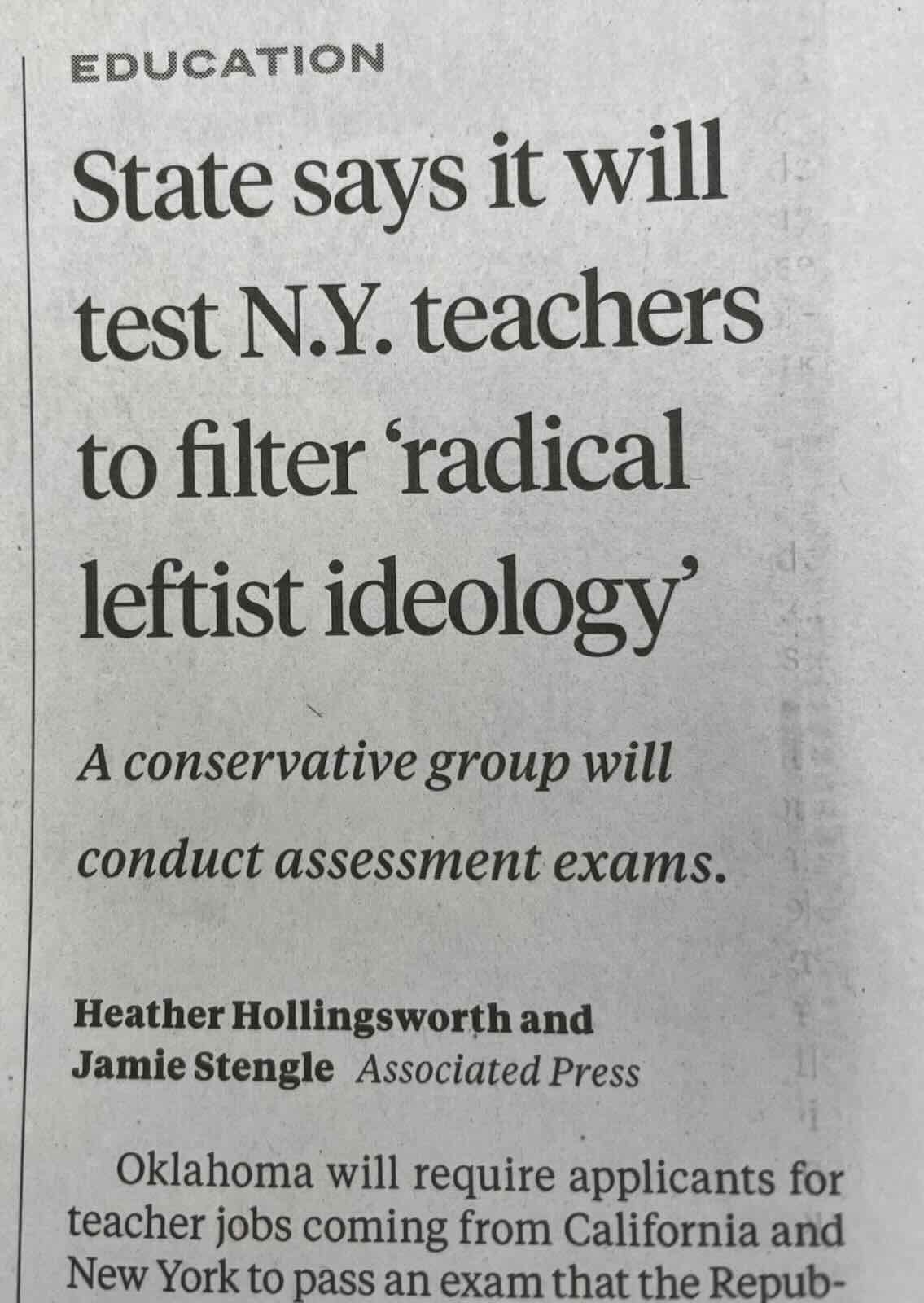 'State says it will test N.Y. teachers to filter 'radical leftist ideology'
I found the article State says it will test N.Y. teachers to filter ‘radical leftist ideology’ by Heather Hollingsworth and Jamie Stengle (National Newswatch / Associated Press), but the headline is misleading, as it implies that NY State will test teachers, whereas it is Oklahoma that will test teachers who move into that state.
“Oklahoma will require applicants for teacher jobs coming from California and New York to pass an exam that the Republican-dominated state’s top education official says is designed to safeguard against “radical leftist ideology,” but which opponents decry as a “MAGA loyalty test.””
This is also bad but doesn’t affect teachers in NYS unless they move to Oklahoma.
No anarchists, no socialists, no communists. Get ‘em out of the bar.
The defense against slop and brainrot by Paul Jun (Kimchi & Gabagool)
“More than half of American adults now read below a sixth-grade level. Let that sink in. Half the population struggles with the cognitive equivalent of a basic push-up. How do you think they’ll fare when AI-generated content floods their feeds looking authoritative but hollow? A population that skims headlines will drown in what we now call “AI slop”—the endless stream of plausible-sounding nonsense that passes casual filters.
“The game has shifted. Your parents can’t tell the difference between AI video and reality. My local bagel shop uses AI-generated images when an iPhone photo would work better. Anyone can look capable; fewer people can be capable.
“That makes the old, slow disciplines worth your life.”
“The people who skipped the fundamentals become dependent on tools they don’t understand, producing work they can’t evaluate, making decisions based on outputs they can’t verify.”
“Social media was level one of this challenge, and it absolutely fucking cooked society. AI is level two in this maze—the three-headed sphinx whispering promises and threats simultaneously. Many who surrendered their focus in round one will surrender their critical thinking in round two.”
Oh, man, that is nice.
“The few who commit to this conditioning will find themselves uniquely equipped to navigate whatever comes next. Not because they avoided the future, but because they trained for it.”
Preaching to the choir, but NGL I don’t hate to hear it.
Technology & Engineering
This is what the Apple algorithm thinks is important for me to see and download. You’ll not that it is all consumerist trash.
 This was the home page of my app store. Trash.
 This is the Daily List in my App Store. Trash.
SpaceX says states should dump fiber plans, give all grant money to Starlink by Jon Brodkin (Ars Technica)
“SpaceX made its view known to the Louisiana Office of Broadband Development and Connectivity in a filing, which was reported yesterday by PCMag. SpaceX complained that Louisiana proposed awarding 91.5 percent of funds to fiber Internet service providers instead of to the Starlink satellite system. SpaceX alleged that Louisiana was influenced by “a legion of fiber lobbyists and other hangers-on seeking to personally benefit from massive taxpayer spending.””
They’re just shirty because their own “legion of [satellite] lobbyists and other hangers-on seeking to personally benefit from massive taxpayer spending” lost out to the other legion of lobbyists. So what do they do? Run whining to daddy-Trump that the other team isn’t playing fair. And what will the Trump administration do? Probably decide by fiat in a way that maximally benefits itself.
“The Trump administration rewrote rules for the $42 billion Broadband Equity, Access, and Deployment (BEAD) grant program in a way that benefits Starlink. Instead of prioritizing fiber networks that offer better service and are more future-proof, the Trump administration ordered states to revise their plans with a “tech-neutral approach” and lower the average cost of serving each location.”
“While subsidizing fiber deployment is more expensive, fiber offers faster speeds and doesn’t have the capacity problems inherent in satellite networks. As even SpaceX CEO Elon Musk acknowledged years ago, Starlink is best suited for “the hardest-to-serve customers that telcos otherwise have trouble” serving.
“Louisiana’s draft plan said its analysis of low-Earth orbit satellite and fixed wireless technology suggests those providers “will not be able to scale into the future due to a combination of limitations on available spectrum, the impact of tree canopy on service availability, high customer density and potential demand, [and] the impact of 5G and/or other wireless backhaul on residential end-user capacity.””
To which the Trump administration shouted “shut up nerd. NERD HARDER.” “GIVE the monies to ELON.”
So we were buying airline tickets from Swiss a few weeks back. We bought them directly from the airline’s web site.
- We elect to use up the rest of our miles to save CHF40.- because why not?
- On the checkout page, there’s a note with two typos that tells us we’ll only be able to pay in CHF. Fine. We were going to do that anyway.
- The birth dates are written as day/month/year, which is a scandal because it’s wrong. The page is in en-US but they’re using the en-GB date format.
- It’s nice to see them pay such close attention to detail on 4-digit purchases.
- On checkout, we see that the CHF40.- rebate is included. On the next page, the discount is already gone, as is any mention of our airline miles.
- We hope that it will sort itself out on the final payment page.
- It does not.
- Are we going to risk hitting the back button?
- Or are we just going to say “f@&k it” and make the purchase?
- Swiss is very much hoping that their weaponized incompetence will net them CHF40.-
- They are very much correct because my time is more precious to me than CHF40.- and I really need to buy those tickets.
- This is how a multi-national corporation just walks up and swipes CFH40.- off the table while looking you in the eye and daring you to say anything.
- F@&k everything about shopping online or dealing with large companies. They’re all a bunch of incompetents and crooks.
LLMs & AI
LLMs are slot-machines by Cory Doctorow (Pluralistic)
“that’s not the only way in which an LLM coding assistant is like a slot machine. Reg Braithwaite proposed that AI companies’ business model is also like a casino’s, because they charge every time you re-prompt the AI. He writes:”“When you are paying by the “pull of the handle,” the vendor’s incentive is not to solve your problem with a single pull, but to give the appearance of progress towards solving your problem.”
AI Is a Mass-Delusion Event by Chris DeMunbrun (AI Commission)
“Altman appeared on the comedian Theo Von’s popular podcast. The discussion veered into the thoughtful science-fiction territory that Altman tends to inhabit. At one point, the two had the following exchange:”“What exactly is a person, listening in their car on the way to the grocery store, to make of conversations like this? Surely, there’s a cohort that finds covering the Earth or atmosphere with data centers very exciting. But what about those of us who don’t? Altman and lesser personalities in the AI space often talk this way, making extreme, matter-of-fact proclamations about the future and sounding like kids playing a strategy game. This isn’t a business plan; it’s an idle daydream.”“Sam Altman: I do guess that a lot of the world gets covered in data centers over time.
Theo Von: Do you really?
Altman: But I don’t know, because maybe we put them in space. Like, maybe we build a big Dyson sphere around the solar system and say, “Hey, it actually makes no sense to put these on Earth.”
Von: Yeah.
Altman: I wish I had, like, more concrete answers for you, but, like, we’re stumbling through this.”
Sam Altman is an idiot. There is really no more analysis needed.
Sam Altman Places Gun To Head After New GPT Claims Dogs Are Crustaceans For 60th Time (The Onion)
“OpenAI CEO Sam Altman reportedly placed a gun to his head Tuesday after a new model of ChatGPT claimed that dogs are crustaceans for the 60th time. “You’re right, dogs are not a type of crustacean—I meant to say that dogs are a type of primarily aquatic arthropod known as a crustacean,” the Large Language Model said as Altman despairingly positioned the gun against his temple, with eyewitnesses confirming that the CEO then whimpered “It wasn’t supposed to be like this” as the multibillion-dollar AI explained that the meat of a dog’s tail is widely considered to be more succulent than the meat of its claws. According to sources, tears streamed down Altman’s face as he made one final attempt to convince his creation that dogs are mammals and thus do not possess exoskeletons, only for the latest ChatGPT model—which Altman had previously hailed as revolutionary technology that would forever alter the course of human history—to apologize, reiterate that dogs are a popular species of crustacean often kept as pets, and recommend scratching dogs behind their gills to show them that you’re friendly. At press time, a single gunshot was heard echoing through OpenAI’s offices as the LLM confidently asserted that the word “dog” contains 11 Rs.”
Oh, if only.
Programming
Reserve First by Alex Kladov (Matklad)
“Zig applications should consider aborting on OOM. While the design goal of handling OOM errors correctly is laudable, and Zig makes it possible, I’ve seen only one application, xit which passes “matklad spends 30 minutes grepping for errdefer” test. For libraries, prefer leaving allocation to the caller, or use generative testing with an allocator that actually returns errors.
“Alternatively, do as TigerBeetle. We take this pattern literally, reserve all resources in
main, and never allocate memory afterwards.”
A flowing WebGL gradient, deconstructed by Alex Harri
“Blending color and white using alpha colors the bottom half of the canvas white:”color = mix(color, white, alpha);“Here, alpha represents how white our pixel is. If
alpha == 1.0the pixel is colored white, but ifalpha == 0.0the original value of color is retained.“Calculating an alpha value by normalizing the sign and passing that to the mix function may seem overly roundabout. Couldn’t you just use an if statement?”
if (sign(dist) == 1.0) {
  color = white;
}
“You could, but only if you want to pick 100% of either color. As we extend this to smoothly blend between the colors, using conditionals won’t work.
“As an additional point, you generally want to avoid branching (if-else statements) in code that runs on the GPU. There are nuances to the performance of branches in shader code, but branchless code is usually preferable. In our case, calculating the alpha and running the mix function boils down to sequential math instructions that GPUs excel at.”
“When thinking about how I’d approach the blur problem, my first thought was to use Gaussian blur. I figured I’d determine the amount of blur to apply via a noise function and then sample neighboring pixels according to the blur amount.
“That’s a valid approach — progressive blur in WebGL is feasible — but in order to get a decent blur we’d need to sample lots of neighboring pixels, and the amount of pixels to sample only increases as the blur radius gets larger. The final effect requires a very large blur radius, so that becomes incredibly expensive very quickly.
“Additionally, for us to be able to sample the alpha values of neighboring pixels with any reasonable performance, we’d need to calculate their alpha values up front. To do that we’d need to pre-render the alpha channel into a texture for us to sample, which would require setting up another shader and render pass. Not a huge deal, but it would add complexity.
“I opted to take a different approach that doesn’t require sampling neighboring pixels.”
An Interactive Guide to SVG Paths by Josh Comeau
“The lowercase variants are relative commands. Instead of specifying coordinates based on the SVG coordinate system (with (0, 0) being in the top-left corner), relative commands are anchored to the previous command’s position.”
“[…] when angles are very acute, the corners become way too pointy, so the
stroke-linejoinproperty automatically flips from the defaultmitervalue tobevel.“The
stroke-miterlimitproperty lets us adjust the breakpoint. It uses a rather complicated formula, but if we pick a large value like 100, our corners should almost always stay sharp”
“The
Tcommand creates a Quadratic Bézier curve, likeQ, but it doesn’t take a control point, it only accepts an end point. The control point is derived automatically by mirroring the angle, so that our path is smooth and kink-free.“Similarly, the
Scommand creates a cubic Bézier curve that omits the first control point. That point will be computed automatically to ensure a smooth curve.”
Zed for Windows: What’s Taking So Long?! by Max Brunsfeld (Zed Blog)
“When developing Zed’s original macOS renderer, we had relied heavily on Xcode’s Metal debugger. It lets you capture a frame in your app, step through every draw call that happened in that frame, and inspect every vertex in the scene’s geometry, and every pixel in the rendered image.
“On Windows, the best comparable tool for graphics debugging is RenderDoc. Unfortunately, Zed crashed on startup when run under RenderDoc, because we were relying on the Direct2D API for text rendering, and RenderDoc does not support applications that use Direct2D. To work around this limitation, we decided to stop using Direct2D and switch to rasterizing glyphs using DirectWrite instead. In the process, we fixed bugs where glyphs’ boundaries were not calculated correctly, which had been causing incorrect clipping for certain characters and font sizes.”
“Zed seemed to be using GPU memory inefficiently in certain situations. We hadn’t noticed this on macOS because recent Macs have unified memory. But on most computers running Windows and Linux, GPUs have separate memory that is more limited.
“Luckily, we got help on this problem from the team behind Longbridge, who use Zed’s UI framework for their own desktop app. They discovered an inefficiency in our approach to rendering paths − combinations of lines and curves that you can use to draw arbitrary shapes. We use paths in Zed for rendering selections and text highlights.
“To create smooth edges for paths, we use multi-sample antialiasing (MSAA)—we draw paths to an intermediate texture with multiple color samples per pixel, and then we copy the averaged pixel values to the final render target. Previously, we were arranging paths in our MSAA textures similarly to how we arrange glyphs in our texture atlas—we allocated enough space in the textures to place each visible path without overlap. This sometimes resulted in us allocating a lot of very large textures.
“The Longbridge folks landed an initial fix for this problem that removed the intermediate textures entirely, and enabled MSAA for our entire scene. Unfortunately, this ended up tanking performance on Intel GPUs, which have less efficient implementations of MSAA. But we found another approach to MSAA that avoided the high VRAM usage: we now draw all paths to a single color MSAA texture that’s the same size as our render target, allowing the paths to overlap as they do in the final scene. We then copy directly from this texture to the render target. This change fixed the high VRAM usage, and also improved Zed’s rendering performance on all platforms, even macOS.”
I am loving this level of detail in these progress reports. It’s wonderful to see how programming to a higher-level abstraction can end up improving performance even on an implementation that was working just fine before you tried to make it cross-platform.
“Consider the fact that Hello World is considered a major success when you start. Today, your basic Hello World app is responsive by design with scale-out capabilities. The bar for what counts as baseline functionality has jumped, but the difficulty of getting there is more or less the same.
“In other words, if I were at the beginning of my career today, I would still choose to go into software development.And I think that the existence of AI just means that we have far better leverage to do even more amazing things.”
Or, as Greg Lemond once said,
“It never gets easier; you just go faster.”
Sequoia Backs Zed’s Vision for Collaborative Coding by Nathan Sobo (Zed Blog)
“The limitations of snapshots [commits] become even more apparent when working with AI agents. While you might manage simple tasks by exchanging comments with an agent on a pull request, real-world development often requires interaction between commits. You need to guide agents, correct their course, and iterate rapidly—all without the overhead of creating snapshots for every exchange. Our existing tools were built for humans trading commits asynchronously, not for instant back-and-forth with synthetic collaborators. Forcing every AI interaction through the commit-based workflow is like trying to have a conversation through a fax machine.”
“Our vision is turn your IDE into a collaborative workspace where humans and AI agents work together across a range of time scales, with every insight preserved and linked to the code forever. To make this possible, we’re building DeltaDB: a new kind of version control that tracks every operation, not just commits.”
“Zed’s goal is to make your codebase a living, navigable history of how your software evolved, where discussions with humans and AI agents are durably linked to the code they reference and always up-to-date. It’s an evolution beyond version control that incorporates not just the code itself, but also the background information of how and why the code got into a particular state—context that AI agents can query to make more informed edits, understanding the assumptions, constraints, and decisions that shaped the existing code.”
So I got an e-mail from Turkish Airlines this morning. I have a “miles” account that and have had it since I last flew Turkish Airlines almost 20 years ago. They sent me an occasional email to let me know that my account has 0 miles in it and that they appreciate my business and value me as a customer. It tickles me pink and is a great start to the day, as you can well imagine.
This morning, I noticed that Turkish Airlines is still sending to an older email address that I’ve been phasing out for a long time. So, I pressed “unsubscribe” to jump to figure out how to (A) reconfigure the account with another email address[3] and (B) figure out how to turn off the emails, which are without value.
- Be me.
- Click the unsubscribe link.
- Jump to the Turkish Airlines page in the Opera Browser.
- I have to log in to change any settings.
- I don’t know my login.
- I know the email to which it sent my recent mail, though.
- Select “forgot password”.
- Enter email.
- Submit.
- Spinning progress circle.
- Nothing.
- Try again.
- Nothing.
- Try a completely different and bogus email address. Nothing.
- No error message. Nothing.
- Go back to the mail. Find out that it includes my frequent-flyer ID number.
- Try that instead.
I have to enter my birthdate. It shows a hint to enter it as
dd.mm.yyyybut it converts dots to slashes. So which date format is it? Is it the U.S. date format, with month before day? Or is it the GB date format, with day before month? I debugged it by trying 07/31/1983 and getting a validation message that clarified the requirement. - We’re ready. Click submit.
- Nothing. No error message. No email.
- Ok. Maybe it’s the browser.
- I switch to Safari and enter the ID number and birthdate.[4]
- It works! I receive an email.
- Click the link. Land in Opera. Continue there anyway.
- I can choose a new password. I have ProtonPass generate a password.
- This causes a validation error because passwords can contain only six numeric digits and no other characters. This is a ludicrous restriction in this day and age.
- OK, fine. I choose a six-digit PIN.
- Submit. It declares success.
- I try to log in on Opera. The login cannot include the leading “TK” which I needed to include for the password-reset but, by now, I’m completely accustomed to the utter incoherence of this web site.
- A popup informs me to “please wait, logging in…” but then disappears without any error message, dumping me back to the login box.
- I know this routine by now, so I try logging in from Safari instead.We are currently unable to process your request. Please try again later.
 We are currently unable to process your request. Please try again later.


Thanks for playing, I guess.
[3]
A ProtonPass alias, naturally, which I’ve been using a lot more because I can configure it right from the app or browser plugin.
I’d been using SpamGourmet for the last 25 years but, because SpamGourmet doesn’t have “full DANE” support, it cannot forward to ProtonMail, so I’ve been weaning myself off of this venerable service that has served me so well over the years. I was forced to redirect SpamGourmet to a Google Mail address, which is not the direction I wanted to go.
The ProtonPass aliases are better than using the + system to build addresses (e.g., the “youporn” is the unique identifier in bob+youporn@corporation.com). However, anyone can reverse-engineer this system to get to the original email. The ProtonPass version works with a completely different address like youporn.success69@passmail.net, so that no-one has your actual email address except for Proton.
When you use the Apple login provider, it offers to do something similar, “hiding” your email address from whichever web site or app to which you’re granting access.
With one of these systems, you can relatively easily have not only a unique password, you can also have a unique username. No, I’m not using passkeys yet because Big Tech passkey implementations are a trap and I haven’t decided whether to set them up with Proton yet. It would probably be fine, as I have the same Proton database on all of my devices (MacOS, iOS, Windows,Opera browser).
↩[4] This is probably not due to a filter on the Opera browser but probably a combination of the much stricter-settings and tracking plugins that I have configured for my main browser (Opera) as opposed to my alternative and quite rarely used browser (Safari).↩
Fun
very company after a massive data breach by Man Carrying Thing (YouTube)
This is so much like many of the conversations I’ve had with people here.
“You don’t have PINs for your credit cards?”
“I don’t care. It’s the bank’s money.”
“Wait, you think a more efficient system is to have the money stolen first and then to possibly claw it back afterwards?”
“Whatever. Eurotrash. Freedom.”
Hajime Miura – 3A World YoYo Champion – World YoYo Contest 2025 by International YoYo Federation (YouTube)
Exquisite.