
Links and Notes for August 22nd, 2025
Below are links to articles, highlighted passages[1], and occasional annotations[2] for the week ending on the date in the title, enriching the raw data from Instapaper Likes and Twitter. They are intentionally succinct, else they’d be articles and probably end up in the gigantic backlog of unpublished drafts. YMMV.
[1] Emphases are added, unless otherwise noted.↩
[2] Annotations are only lightly edited and are largely contemporaneous.↩
Table of Contents
- Public Policy & Politics
- Journalism & Media
- Labor
- Economy & Finance
- Science & Nature
- Environment & Climate Change
- Art, Literature, & Cinema
- Philosophy, Sociology, & Culture
- Technology & Engineering
- LLMs & AI
- Fun
Public Policy & Politics
The Far-Right Protest Vote in Romania by Andrei Țăranu (Jacobin)
“What is the situation of the Romanian left?
“Andrei Țăranu: The Social Democratic Party is not left-wing; it is, rather, center-right. The situation of the Left is complicated, like in Hungary, Poland, and Bulgaria . . . left-wing parties pretty much disappeared. A new party was attempted, called Demos, but its highest vote level was only 1 percent. It is very hard to promote a proper left-wing discourse in Romania because the main culture, which is coming from school, university, and society . . . is very right-wing: if you fail, it’s your fault, capitalism is good, and so on. This is the same in Hungary, Poland, and Bulgaria. Our democracies were established by the Americans, not by the European Union, and the main ideas came from the United States. This was the period of Milton Friedman, the Chicago boys, the Clinton era. Our democracy is based in capitalism.”
That Big, Beautiful Summit in Alaska by Patrick Lawrence (Scheer Post)
“No Western leader, if you have not noticed, has ever called for an end to the war. None among them has ever mentioned a peace accord for the simple reason the Western powers do not want peace with Russia. It is with this statement, then, that Trump signaled his determination to chart new territory.”
Sure, he might have said it. But will it happen? Highly unlikely. Trump says a lot on a long day. (From the original in Swiss-German: Trump seit viel, wann de Tag lang isch or in German: Trump sagt viel, wann der Tag lang ist..)
“I have to say I find the thought of either Americans or Europeans operating on Ukrainian soil as guarantors of security something close to preposterous. Where and when in history have combatants or the sponsors of combatants switched to the role of peacekeepers? I am not at all surprised to read that the Russians, watching all this from afar, issued a vigorous objection Monday to the talk of American or European guarantors in a postwar environment.”
“The obvious conclusions here, and I do not see any avoiding either, are that Washington and Moscow are very, very far from signatures on paper, and it is well to listen to Donald Trump without drawing any conclusions other than these. As his record shows, Trump places a heavy weight on his personal relations with other leaders. As the post–Anchorage process continues, he is likely to discover this mode of operating has its limits.”
He’s an egomaniac, a narcissist.
“To say Trump aligned with Putin, or got played or otherwise capitulated, is another way, a simpleton’s or cynic’s way, of denying or veiling reality. In my read, Trump listened to Putin’s case and has concluded, Yes, he is right. This is the ultimate reality long at issue and long unsayable. Trump has done no less and no more than speak this truth at last. The rest is rubbish.”
Again, this is an incredibly charitable and hopeful—and, most likely, hopelessly optimistic—interpretation of Trump’s actions. The man is completely unpredictable. There is no through-line to his so-called reasoning. He seems to do whatever pops into his head at any time, often contradicting himself and his espoused principles, aims, and goals in one paragraph, and then seeming to enjoy spewing a stream of bullshit that purports to reconcile everything into a coherent worldview.
As one of history’s greatest con-men, perhaps he’s enjoying skating ever-closer to the line of completely unbelievable fabulation, trying to determine just how far he can go into utter unreality before his entire castle of lies collapses. He hasn’t found it yet. The more he lies, the more he declares that reality is wrong, the more people kowtow to him. He’s saying what they want to hear. The elites of other countries are in deep trouble and have no idea how to extricate themselves with their fortunes intact. Trump offers a way; follow him to a glorious future.
“Let us all look past the mountain ranges of propaganda, cognitive warfare, perception management and what have you and say what Trump is now saying: It is time to acknowledge forthrightly that Putin is right about the war and its causes, about the Biden regime’s purposeful provocations, about the larger questions of which it is merely a subset and about how most sensibly to negotiate a lasting settlement in the borderlands between Europe and Russia”
That is what we hope that Trump might be fooled into thinking he wants, if he can be convinced that this is a thing that will make him look good to people whose approval he desperately seeks or, good God, might get him a Nobel prize, in what would be a bribe more useful than having bestowed the prize on Kissinger or Obama.
„Die USA beherrschen Europa“ by Klaus von Dohnanyi (NachDenkSeiten)
“Die Atomwaffen, die in der Ukraine stationiert wurden, sind genauso zu bewerten wie die Atomwaffen, die die Amerikaner in Europa und auch in Deutschland stationieren. Die gehören niemandem hier außer den Amerikanern. Die Atomwaffen in der Ukraine waren dort stationiert, um möglichst weit westlich die Verteidigung der Russischen Föderation zu stärken. Das war doch eine reine – sage ich mal – Lagerungs-, Abschuss- oder Ortsfrage. Aber das waren doch keine Nuklearwaffen, die die Ukraine auch nur für einen Augenblick hätte benutzen können.”
Roaming Charges: From of the Mouths of Madness by Jeffrey St. Clair (CounterPunch)
“Cost of painting Trump’s border wall black: $500 million.
“ICE recently shelled out $2.4 million for a fleet of new trucks and SUVs, which were custom detailed with gold wraps reading “DEFEND THE HOMELAND, INTEGRITY, COURAGE, and ENDURANCE.”
“ICE has lowered the hiring standards (it will no longer require agents working the southern border to speak Spanish) and raised the salaries for ICE agents. The starting salary is now $90,000 with a $50,000 signing bonus.”
I guess they’re having trouble finding people to work for them?
These people are all malignant toddlers smashing their toys and throwing them out of the pram. As they feel the power they’ve arrogated to themselves, they will get much more dangerous. It will be short-lived, as anything this maniacal and divorced from reality must be, but there will be so much damage and ruined lives. It is, in the end, racism. It is a deeply racist policy that treats anyone with a different last name and brown skin as being from a plethora of interchangeable countries. No-one cares whether someone is from Venezuela or El Salvador or Pakistan; it doesn’t matter whether the details of the accusation are completely false. None of this invalidates the accusation: you don’t belong here and we will make you suffer and then throw you out. It doesn’t matter where you’re from; we don’t think that you’re from here—you’re most certainly not one of us—so you’re not human. Citizens of the U.S. barely have rights anymore. Anyone trapped here who’s not a citizen of the U.S. is vermin, to be tortured for pleasure and then removed from sight—it doesn’t matter how.
“The Mediterreanean is becoming a tropical sea. With water temperatures of 32C, these warming water have encouraged hundreds of species native to the Red Sea, such as the lionfish, to invade the Mediterranean via the Suez Canal. The consequences to the sea’s ecosystems could be devastating.”
“BatchData: 30% of homes in West Virginia are owned by investors.”
Investing in what? Number go up, even in West Virginia?
“While Fox News is having a meltdown over Mamdani’s plans for a few city-owned grocery stores, the Trump Administration is buying up massive stakes in US corporations…”
Yeah, someone here tried to engage me on Mamdani but I didn’t believe that he was of good fatih about it, so I demurred. I simply said that the people will choose their mayor, as it should be … and that Cuomo is a giant piece of shit. He couldn’t disagree because (A) he absolutely and provably is and (B) he’s also a Democrat, which is all the proof a Republican needs.
The person pretended to not be able to pronounce Mamdani, to which I had to reply that the name had only seven letters and none of them were mysteriously pronounced. Sure, Cuomo has two fewer letters but pronouncing Mamdani correctly shouldn’t be too challenging for anyone of reasonable intelligence and linguistic facility.
“Florida Senator Rick Scott disclosed $26,000,000 in stock trades.”
These people are looters and plunderers. Their work in government is 100% to grease the wheels for their personal enrichment. They will never support a policy that they see as being detrimental to themselves, even were it to be very beneficial for everyone else. The only way to get anything like that to happen is to fool them into believing a communally valuable law would be personally valuable as well—which, despite their stupidity, is not so easy because they are quite cunning about personal profit—or to get rid of them. Depressingly, the former is a much more plausible path than the latter.
“Mamdani told the press this week that Cuomo is still running because “Andrew Cuomo is someone who doesn’t understand that no means no.” He’s good.”
He’s used that one before but it’s not yet gotten old.
“The “Free Speech” president’s latest attack on free speech: Trump to sign executive order criminalizing the burning of the American flag. Even Scalia said such a law or executive order is unconstitutional. So this order itself is a crime against the Constitution and against the flag itself and its protected right to be burned by its owner.
“The fact that the Pentagon recommends burning “worn-out” US flags (on Flag Day, no less) shows that Trump’s EO criminalizing the burning of flags is a direct assault on free speech, since it only applies to those who burn flags as a form of political protest.”
I mean, obviously.
“Halligan competed in the Miss Colorado USA pageant twice. In 2009, she was a semifinalist, and in 2010 she was third runner up. Halligan got a BA in”Enemies of the State” (ie, journalism) at Regis (never heard of it) College in Denver. She got her law degree from the University of Miami (ranked 92 in the country) and then practiced “insurance law” in “Miami FLA” where she was sanctioned by a judge for “not acting in good faith.” This impressive resumé lured Trump into appointing her special assistant to the president in charge of rooting out “improper ideology” at the Smithsonian.”
Honestly, she sounds overqualified compared to other administration officials.
“Stephen Walt on the abbreviated Trump-Putin summit: “Trump is a terrible negotiator, a true master of the ‘art of the giveaway.’ He doesn’t prepare, doesn’t have subordinates lay the groundwork beforehand, and arrives at each meeting not knowing what he wants or where his red lines are. He just wings it.””
Honestly, that’s even a generous appraisal of his abilities. It doesn’t mention how easily he’s led by his ego or how naturally illogical he is. He is not a smart man. He is cunning. He has charisma. He succeeds against other base creatures like himself, the kind which almost exclusively fill the elite ranks of business and government. His charisma and cunning work on them because they see themselves in him. They wish to be him. They, too, have no principles and would do anything for their own personal enrichment, so they can’t help but respect the player and the game, kowtowing immediately in the hope that some of the riches they grant him with their subservience will trickle down to them. They don’t care if a rising tide lifts all boats, so long as it lifts their boat.
“Trump on the US hosting the World Cup: “I may play…I’m a very good athlete. My son is a good athlete. A good soccer player. On the tall side for soccer…I may put on shorts, I look extremely good in shorts, and join the play.””
This is probably the craziest quote I’ve heard from Trump. I don’t even think he was kidding. He’s just like a machine that says that he’s the best in the world at whatever he happens to be talking about. He’s the world’s leading expert on grass. He’s a great soccer player, at almost 80 years old and looking like he hasn’t taken a quick step in about 40 years. He would look great in shorts. I want to think that he’s taking the piss, but I think he’s deadly serious, in his own mind, in his own world. He’s delusional.
Those Who Condemn Hamas Lack Empathy And Humility by Caitlin Johnstone (Substack)
“They never ask themselves what it would have been like to live the life of a young man who ended up joining Hamas. They never ask themselves what it would have been like to live one’s entire life in a giant concentration camp under the thumb a genocidal apartheid state which routinely murders and abuses your countrymen. They simply look at the actions of October 7 from the prism of their own experience as a comfortable western suburbanite on the other side of the world and think, “I would never conduct such an attack; I am much too virtuous and compassionate.”
“No you’re just too comfortable and coddled, and you’re too much of an emotional infant to consciously put yourself in someone else’s shoes.”
“[…] you can simply ask yourself what it would be like to grow up in an apartheid state whose existence depends on dehumanizing those who don’t belong to the group which that state empowers.
“How would it shape you to be raised in a very young ethnostate which was dropped on top of a pre-existing civilization whose people never accepted that they ought to be displaced, deprived of basic rights, and live as a permanent lower caste just because they’re a different ethnicity? How would your mind and conscience be formed if you were indoctrinated from a very young age to believe there’s a perfectly good reason why you’re living a much better life than the people in that other group, and that the reason is because the other group is inherently inferior to yours? How would the formation of your worldview play out if you were always being told that you’re surrounded by mindless barbarians who want to kill you because of your religion and can only be brought to heel by brute force?
“If you think you’d be any better than the average Israeli after such an upbringing, you’re fooling yourself. With a little empathy and humility you can understand that both the Israelis and the Palestinians are conditioned in different ways by the circumstances of their lives and the systems under which they live.”
Will Trump’s Working-Class Base Turn on Him? by Yanis Varoufakis (Project Syndicate)
“Even by the no-holds-barred standards of Republican class politics, Trump’s One Big Beautiful Bill is extraordinary. Once again, the old pretexts for austerity (“fiscal responsibility,” “debt reduction”) were sacrificed on the altar of the true aim: dismantling state support for the many while enriching the few.”
“Following the 2008 financial collapse, US capitalism changed forever. While the banks were bailed out, more and more workers with secure, high-quality employment found themselves among the “untouchables” scrounging for a living in short-term, low-paid, dead-end jobs. Whereas Reagan and the Bushes won elections because secure proletarians voted for them and untouchables were too disheartened to vote at all, Trump won by rallying the untouchables, who now included a growing number of hitherto secure proletarians.”
“Like a Robin Hood for the rich, Trump weaponized the mandate he received from poorer Americans to slash the social and medical services they rely on while delivering vast handouts to the wealthiest Americans.
“I, too, hope and pray that Trump’s working-class base will rebel against a president who so readily betrayed them. But I suspect they might not.”
I know they won’t. I just spent almost four weeks among them. They ignore anything and everything that they might accidentally hear that might cause an otherwise principled person to at consider reconsidering their opinion of the magnificence of every single proclamation made from on high by their great golden leader.
“Today, Trump is also peddling two interlocking dreams. One is the dream of crypto riches, reflecting a novel assault on the common good – a campaign to privatize the dollar – that previous Republican presidents lacked the technology even to imagine. Coupled with the AI frenzy, this has triggered not only a bonanza for Wall Street and Silicon Valley, but also fresh optimism among Trump’s working-class base. A significant segment of his MAGA (“Make America Great Again”) movement, blind to the enormous risks of this new variant of the something-for-nothing mentality that led to the subprime mortgage debacle, dreams of future non-wage sources of income. Trump may be robbing them of food stamps and Medicaid, but he is the conjuror of magical forms of wealth with an “anti-system” aura.”
This is spectacular-sounding analysis and I’m sure Yanis is proud of it. I want to agree wholeheartedly but nagging at me is that I don’t think that either Trump or his flock understand any of what was written above in anything approaching concrete, rational, recognizably logical, or comprehensible terms. It’s all just instinct, snuffling for personal wealth, vague rumor, and an extraordinary resistance to admitting that you might have ever been wrong about anything, even when doubling down is clearly detrimental. In order to get angry or critical, you’ve got to first admit that you’ve been hoodwinked into something you didn’t want and that you’re going to have a hard time getting out of. People are not willing to do that. I have exactly one friend who freely admitted that Amazon was ripping him off because Prime Video used to be included in a Prime membership, then it was $4 per month, and now it’s up to $16 per month and there are 2-3 commercial breaks per movie. Other people I talked to just talked about how expensive the licensing must be for Amazon while they admitted to coughing up an extra few bucks per month to turn off the advertisements. For now. They’re just cucks, really, making apologies for Jeff Bezos while he’s sending his wife into orbit for fun.
“[…] the promise of a crypto money tree and the belief that the world is paying for America’s rebirth may be enough to shield Trump from the fury of his betrayed working-class base. If so, who will harvest the grapes of wrath after Trump’s con job is, eventually, found out, and the accumulated rage calls forth a new populist narrative?”
No Compromise on Iran and Venezuela by Ted Snider (Antiwar.com)
“On July 27, Rubio declared that “Maduro is not the President of Venezuela and his regime is not the legitimate government… Maduro is the leader of the designated narco-terrorist organization Cartel de Los Soles.””
I’m just preserving this bit of lunacy for documentation.
Deferred Prosecution Agreements by Last Week Tonight with John Oliver (HBO) (YouTube)
This is an excellent topic on which to shine the spotlight. Unfortunately, Oliver spends a bit too much time with “pooping on pigeon” jokes and too little time on examining the root causes of why corporate crime goes largely unpunished or lightly punished while personal crime is punished incredibly harshly.
The societal need would be to build and grow a system in which most of the members can thrive. Sometimes, something bad needs to be pruned away. But how do you decide what is bad? When something causes harm to other members, it is bad. A corporation whose practices impoverish or kill other members should be made to stop doing that.
A corporation comprises many other entities, many of which do not need to be punished—or, even, morally, shouldn’t be punished—so how do you punish a corporation for malfeasance? It’s actually somewhat easier than with a person, because a corporation doesn’t have an indivisible soul or consciousness. You can, within reason, split it, reduce it, fine it, change leadership, etc. in order to retain the good parts while reducing and/or punishing the bad.
The reason that doesn’t happen is corruptions and an utter lack of principle in the leaders of society. The way our system works is to lift up the worst assholes in society while impoverishing those who are unwilling to take immoral advantage of others in order to get ahead. We end up with an elite that comprises no-nothing assholes who are more than willing to defend and rescue each other in order to maintain the myth that they should be at the top.
So, when a corporation commits crimes, the people who would be in charge of determining the size of the punishment also happen to be directly invested in that corporation, and they most likely personally benefitted enormously from that corporation’s malfeasance. What is their incentive for preventing that malfeasance from recurring? What would be the incentive for punishing the people involved in the malfeasance at that corporation, when they simply did what they themselves would also have done to aggrandize themselves?
Why would they do that when those people are most likely their friends and their children most likely attend the same private schools, when they most likely winter in Acapulco together?
The part that this piece completely misses is the endemic nature of the problem. The reason that corporate crime goes unpunished is that the elites, the wealthy, the powerful, the legislators, the authorities, are all in bed together. They don’t even really consider it a crime when a corporation kills people—those aren’t really people at all, since they don’t know them or anyone like them.
Journalism & Media
Only Liars And Manipulators Say Gaza Isn’t Starving by Caitlin Johnstone (Substack)
“When a nation keeps having to publish denials that it is intentionally starving civilians, you can safely assume it’s because that nation is intentionally starving civilians. If you saw someone on social media loudly denying the latest allegations that they are a child molester over and over again for two years, you probably wouldn’t let them babysit your kids.”
Well, that’s a bullshit argument, Caitlin. It’s one of the first where I’ve seen her let her emotions carry her from a logical argument, actually. An accusation is not a fact, no matter how many times it’s repeated. What matters is evidence. The difference between theory and fact is credible evidence. For example, the genocide in Xinjiang suffers from a major deficit of proof. There are some blurry satellite photos that purport to show what their publishers claim are concentration camps. They might as well be pointing out pareidolia in the surface of the moon. In the case of Gaza, we don’t have to guess. There is an overwhelming amount of evidence of starvation, including proud and loud-throated declarations of intent by the perpetrators, who only switch to loud-throated denials when it is politically expedient for them to do so.
“You don’t see pro-China spinmeisters frantically churning out propaganda denying that China is intentionally starving civilians, because China is not intentionally starving civilians.”
Yes you do! Like, China has had to deny a genocide in Xinjiang for over a decade because the west will not shut up about it, will not stop accusing it, although the evidentiary basis is so thin as to be nonexistent. At worst, we are seeing a heavy-handed integration of disparate cultural groups into a dominant culture. This happens everywhere. It’s not great but it is efficient. The U.S. is filled with monolingual citizens who refuse to learn a single word of Spanish and yell at everyone they can to “learn English!” This is, of course, also cultural annihilation, no?
Let’s not get into the philosophical weeds here, though. Suffice it to say that Caitlin’s argument here is specious and wrong but I forgive her the exaggeration. The photos and documentation in ’Starvation Is Everywhere’: Virtual Tours of Gaza Clinics Expose the Scale of the Horror by Yarden Michaeli and Nir Hasson (Haaretz) is very detailed and would be quite harrowing to someone with a sensitive heart and who’d perhaps not already been hardened by having seen this all before so many times.
“For this article we conducted four such tours, in different places, and conducted separate conversations with another 12 doctors, 10 of them volunteers from the United States and Britain, who are currently in the Gaza Strip or were there recently. What we saw there left no room for doubt about the scale of the horror.”
“We saw children whose bodies were blighted by hunger, with bones jutting out. Their hair had turned yellow or fallen out, their faces were wrinkled and their abdomens bloated. Their bodies were limp; many had marks on their skin. Some looked totally apathetic.”
““The starvation is everywhere – it’s everyone,” says Dr. Travis Melin, an anesthesiologist from the United States who is currently working as a volunteer in Nasser Hospital. “When I put someone to sleep for surgery this is very apparent as they are naked and asleep. It is easy to count ribs from across the room, you can see a clear pelvic bone, peripheral blood vessels are very visible as is the small amount of muscle left, as there is no longer fat obscuring these structures. I was in Gaza also a year ago, and all the people I met now were dramatically thinner, almost unrecognizable. We are now very late in this process.””
“It’s impossible to recover from five months of a shortage of food at that age. Children who undergo a thing like that – their brain is finished. Even those who survive will suffer from severe retardation.”
This particular detail is one that I have mentioned to people throughout the last two years. The goal of the deliberate starvation isn’t necessarily to actually starve everyone to death—though they’ll take it if they can get it!—but to cripple the next generation so that we don’t have to hear silly things like “there are so many Palestinian professors and doctors and engineers” anymore. Israel is trying to get Palestinians out of there. Starving them encourages them to move.
If they don’t move, then making the entire next generation retarded is also a good fallback. They simply don’t care about those people as people. Their only concern is the logistics of moving that large amount of flesh out of Gaza. Dead bodies must be burned or buried. Healthy bodies take up more space—and they might fight back. Starved bodies? Much more compact. A bunch of retarded zombies? Still annoying but at least not that dangerous anymore.
For those of us who follow the topic, this is not news. It is documentation of the completely predictable end-game of what has been meticulously planned for decades and executed over the last two years. This documentation is vital but it is not surprising. Israel—and its allies—does not consider Palestinians to be humans. They are to be exterminated like prairie dogs who eat crops. The Israeli government probably read this report with no small amount of joy because it confirms for them that their plan is working and that that it is nearly complete.
The article documents the intent,
““The decision we made tonight on the total cessation of the entry of humanitarian aid into Gaza is an important step,” Smotrich declared at the time. “Now we need to open the gates of hell on the enemy.”
“The gates of hell were indeed opened, and the price was paid, and is continuing to be paid, by the children of Gaza. As early as April, the UN’s food program announced that the last bakery in Gaza had shut down because it had no more flour or cooking gas. Official Israel was not fazed.”
The anti-Muslim sentiment that has been clearly prevalent for my entire lifetime (over five decades), and which rose to such heights after 9/11, is back with a vengeance. These beady-eyed and small-minded criminals never forget their goals. They want domination. And they want only their own kind. Their understanding of the world is limited to this. They know nothing of long-term solutions. They know nothing of morality. They know nothing but thinking in terms of zero-sum economies and the subsequent annihilation of the other.
Israel is probably hoping for a Punktlandung on October 7th so that it can celebrate the beginning of construction of a seaside resort with Netanyahu posing with his foot on a golden shovel, breaking ground into rubble.
Coincidentally, as I was reading this article, I was helping my family set up a party for a baby shower, at which over 90 people will be in attendance. It’s a giant party for one as-yet unborn baby with ungodly amounts of food. There was so much food that, even with 10 extra guests that brought the grand total to a neat 100 people, much of it wasn’t even eaten. We’re sitting here in the kitchen, in the aftermath, looking at panfuls of macaroni&cheese, potato salad, meatballs, and more, wondering what we can freeze, what we can donate to friends, family, and neighbors (no-one really took anything home from the party), or, as I suggested, whether there’s a soup kitchen that could use some food.
The irony is hopefully painfully obvious.
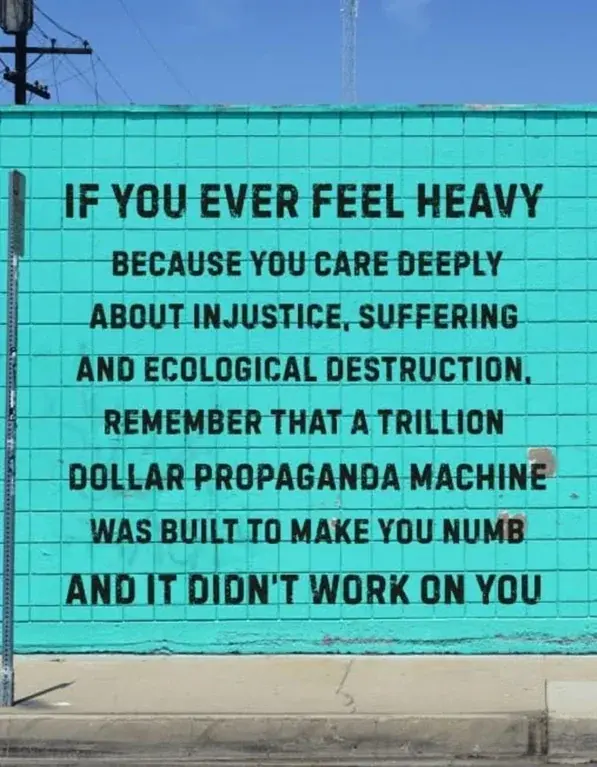
“If you ever feel heavy because you care deeply about injustice, suffering and ecological destruction, remember that a trillion-dollar propaganda machine was built to make you numb, and it didn’t work on you.”
Labor
Thinking Ahead to the Full Military Takeover of Cities by Hamilton Nolan (How Things Work)
“A garbage strike. That would be legitimately useful. If municipal workers refused to work in such a scenario, public outrage would grow very quickly, and it is at least possible that that outrage would reach such a high volume that the White House would conclude that their point had been made, and move on to whatever Trump’s next obsession is. A municipal worker strike is something that requires planning and assistance from all of us. Existing municipal worker unions should begin talking about it now, introducing these ideas to their members. And everyone else in the city should think about what they could do to help such a strike take place, and support the workers if it did. No one should expect low wage municipal workers to sacrifice themselves in order to save the rest of the city. Will you pay their salaries? Will you pay their rent? Will you pay their bail money? Etcetera.”
Economy & Finance
 Excel is the only thing supporting the entire global financial system
Chapter 2 by Hilary Allen (Fintech Dystopia)
“The United States has some of the highest levels of income inequality in the developed world: in 2022, the average so-called “1%” family had 71 times as much wealth as the average middle-class family (in 1963, they only had 36 times as much).”
“According to one 2024 report from Bank of America, nearly half of all surveyed American households self-reported that they were living paycheck-to-paycheck. The report authors also developed their own metric of precarity – “spending 95% or more of their household income on necessary day-to-day expenses” – and found that only one quarter of the households examined by the report authors satisfied that definition.”
“[…] just working your butt off isn’t enough – once more for emphasis, nearly half of full-time workers aren’t making a living wage. And the money coming in is only half of the equation. Shit happens, and the safety nets that used to help Americans cope with job losses, retirement, and health problems are much harder to access than they used to be […]”
“[…] the situation will only get worse now that Republicans in Congress have passed their “Big Beautiful Bill.” That bill is projected to cause nearly 12 million people to lose their health insurance, and Yale’s Budget Lab also projects that the combined impact of the bill and tariff increases will reduce incomes for the bottom 80 percent of U.S. households.”
“Black and Hispanic workers, for example, are nearly twice as likely as white workers not to earn a living wage, and in 2022, the average white family had six times the wealth of the average Black or Hispanic family (if you go back to the 1990s, the multiplier was closer to four times, so racial wealth inequality has been widening).”
“If apps are all we have to solve economic precarity, then we will consider the problem solved if there are more fintech apps that allow more people to access more financial services from more fintech providers.”
The problem of poor people still having money will finally have been solved.
“As we’ll see as we dissect fintech business models, technology is sometimes most useful as a smokescreen to hide the real innovation – which is finding a way around the rules that apply to other financial service providers.”
““the citizens of the United States have accepted their radical precariousness as a way of life. The rise of the gambling industry is just a symptom of our acceptance.” What a depressing – but probably accurate – conclusion. Even for those who wouldn’t otherwise be tempted to gamble much, financial precarity can make risky betting seem like a rational thing to do with any spare money you do have (or, more dangerously, with money you’ve borrowed and need to pay back win or lose). If you are just one medical bill away from financial ruin, then small investments in staid assets that yield moderate returns over a long-term period simply won’t cut it.”
“Let’s use a call option – aka the right to buy a stock – to illustrate. If you buy a call option and then the market price of the stock turns out to be higher than the strike price on the specified date, the option is described as “in the money.” In other words, you win. But if the market price falls below the strike price, then the call option will end up completely worthless. Contrast that with an investor who bought the stock directly – if the market price falls, their stock will be worth less than what they paid for it, but it typically retains some value.”
“Robinhood depends heavily on payment for order flow from its customers’ option trading, though (in 2023, options trading made up almost two-thirds of its transaction-based revenue). Given Silicon Valley’s tendency to view regulatory compliance as optional, you won’t be surprised to hear that Robinhood has let an awful lot of unsophisticated customers trade options.”
“Also according to FINRA, Robinhood made misleading statements to its options trading customers, falsely telling them that they couldn’t lose more than the premium they paid for their option. But many of them lost much more because Robinhood allowed them to select complex options trading strategies that involved margin (i.e. borrowed money) – even if they had expressly elected to disable the use of margin on their app.”
Robinhood should no longer be in business but I bet they’re bigger than ever.
“Fintech entrepreneurs, who want to deploy the standard Silicon Valley move-fast-and-break-things playbook, chafe under that regulation – perhaps because they never bothered to learn about what can go wrong in traditional finance, or perhaps because they don’t care.”
A little of column A; a little of column B. But definitely column B.
“It takes a lot of chutzpah to wrap oneself in the flag and argue that Americans need to gamble themselves out of economic precarity entrenched by structural and political forces beyond their control […]”
“Now, this is neither the time nor the place to go into why the historical practice of pegging currencies to the gold standard was abandoned, but even if this lack of flexibility were desirable (just to be clear, it’s not), bitcoin wouldn’t necessarily cut it because it remains possible to increase the supply of bitcoin. More fundamentally, a hedge is supposed to protect an investor by reducing their risk and providing more certainty – but given bitcoin’s price volatility, and the fact that bitcoin’s price tends to follow similar trajectories to stock prices, it really doesn’t deliver on that front either.”
““imagine if keeping your car idling 24/7 produced solved Sudokus you could trade for heroin”.”
“[…] unless an everlasting supply of new money can be drawn into buying bitcoin, then its price will start to go down whenever the whales cash out, potentially toppling the whole edifice. The price of bitcoin is certainly manipulated to try and stop that from happening (one study found that on average, 70% of the reported trading volume on unregulated crypto exchanges was wash trading, meaning that the same people were trading back and forth with themselves to make it look like lots of people were buying).”
“As I told the Senate Banking Committee in December 2022, “when an entire industry is built on an asset type that can be manufactured at zero cost, has no fundamentals, and trades entirely on sentiment, traditional checks on fraud (like valuation methodologies and financial accounting) will inevitably break down.” But in retrospect, I didn’t fully appreciate the brazen contempt the crypto industry has for its investors.”
“[…] crypto exchanges like Coinbase do integrate these broker and exchange functions, arguing that the laws that apply to securities brokers and exchanges don’t apply to them (Coinbase was, incidentally, the first crypto startup to be funded by Andreessen Horowitz, the venture capital firm that backed Robinhood).”
“[…] the crypto industry has worked hard to convince legislators, courts, and regulators that these longstanding laws should not be applied to it. If these laws were uniformly enforced against the crypto industry, then crypto assets could no longer be made up out of thin air and market manipulation would be illegal and crypto exchanges could no longer perform their conflicted double role of broker and exchange.”
“[…] according to one report, 75% of all payday lending fees come from borrowers who have taken out more than ten payday loans a year. Although fintech lending has often been marketed as a kinder, gentler alternative to payday lending’s predatory inclusion, there is no reason to think that fintech will disrupt this vicious cycle. It may even reintroduce this vicious cycle into places that have banned payday lending.”
“Screening borrowers is a lot of work and most people don’t have the time or the experience to do it properly (or have enough funds to diversify their lending so they’re not overexposed to a single borrower). Unsurprisingly, financial institutions quickly took over the lending function, and borrowers increasingly had to satisfy those lenders’ demands for good credit scores and similar metrics in order to get a loan. What had been referred to as peer-to-peer lending became known as marketplace lending, and then just fintech lending.”
“According to a 2025 survey by LendingTree, roughly half the people surveyed had used BNPL, with some even using it to pay for groceries. Because no interest is charged, BNPL might not seem like a credit product at first blush, but there are many fees buried in the fine print. In particular, consumers who don’t make their installment payments on time are charged late fees that can operate as a type of retroactive interest charge (and some BNPL providers will ding users’ credit reports when this happens).”
“BNPL is disproportionately used by Black and Hispanic customers, and by lower income consumers – so once again we need to ask, is this democratization for these groups, or exploitation?”
“[…] average APR (representing the total cost of using the service) for these tip-based companies was 334%. More specifically pertinent to Earnin, law professor Nakita Cuttino explained that “Earnin has encouraged its users to pay a $9 tip for a one-week loan of $100, which would amount to an APR of 469%… illegal in Washington, D.C. and fifteen of the states where Earnin currently operates.””
“[…] twenty years ago, I recall paying friends online and having the funds become available to them immediately (and just in case you don’t trust my memory, here’s a link to a report that confirms this was a relatively common thing to do at the time). That kind of technology could have been deployed in the United States decades ago, but it wasn’t. There were economic and political forces at work that discouraged its adoption, and those are the kinds of forces we need to focus on if we want to make real inroads on economic precarity in the United States.”
Switzerland has had this forever. You can just pay money to someone’s IBAN number. Swiss banks hook in to Twint, which is a peer-to-peer digital-payment platform developed by the Swiss Post Bank, along with other partners, and which was spun off as a “daughter company”. From what I’ve heard, it’s still not profitable but private usage is still free.
“[…] with more public support, people won’t need to rely so much on credit. Congress will have to get involved to make this happen, and step one is mandating a minimum wage and ensuring social security benefits that people can actually live on. Step two is improving the public safety net.”
There is an Everest of anti-welfare propaganda to counter any plans to make that happen.
MAGA 2.0: Making China Great Again by Dean Baker (CounterPunch)
“There is not much that the U.S. can do about this large and growing disparity. It can and should make sure that we have secure supply-chains for essential items, as the Biden administration tried to do. We also should take steps to promote economic growth here, not just to compete with China, but also to improve living standards for low and middle-income households. But we also need to come to grips with a world where the United States is still a very important actor, but no longer the world’s dominant economic power.”
That’s going to be a giant tantrum that will shake the world and ruin untold lives. We can only hope that there’s anything left once the U.S. is finished throwing itself.
“[…] that would mean finding areas of cooperation with China for mutual benefit. The most obvious one would be sharing technology in health care and clean energy. It benefits both nations and the whole world if pandemics can be prevented or contained, diseases like cancer can be cured, and we manage to limit the damage from global warming.”
“With the world rapidly turning towards cheap and reliable clean energy, Trump has the United States doubling down on fossil fuels. This will have ramifications throughout the economy, most obviously in the power-hungry AI industry. China’s leading developers have the advantage of both being far more energy efficient and also having access to cheap and abundant electricity.”
“On its current course, the United States will both have less economic leverage and virtually zero goodwill by 2030.”
“There is no inherent problem with a country other than the United States having the dominant world economy. After all, the rest of the world dealt with it for the last 100 years, and most countries did just fine. However, the United States would be much better positioned to deal with China as the pre-eminent economic power if we had leaders who lived in the real world. We don’t at present, and it is not clear at what point in the future this could change.”
We haven’t had leaders like that for any time during this transitional period (i.e. during the decline of empire): Obama could not shut up about how exceptional Ameria is, neither can Trump and neither could Biden. The U.S. is not capable of doing this, culturally, philosophically, and socially. It is a machine that has been built to do one thing: plunder. It cannot do this from a non-dominant position. It will not deal with this well, as is apparent from the histrionics and tantrums of the Trump administration.
Chancellor Merz declares Germany “can no longer afford the welfare state” by Peter Schwarz (WSWS)
““The welfare state as we know it today is no longer economically sustainable with what we are producing as a national economy,” declared Chancellor Friedrich Merz on Saturday at a Christian Democratic Union (CDU) state party conference in Osnabrück.
“This is an unmistakable declaration of war on the entire working class. What remains of the hard-won social achievements of the past are to be thrown to the profit-hungry wolves of the stock markets and channelled into rearmament.”
“Merz is thus following an international trend. In the US, the Trump administration has set in motion the process of slashing or abolishing state health insurance for those over 65 (Medicare) and for low earners (Medicaid), in which more than 135 million people are insured. It is establishing an authoritarian police state in order to suppress social resistance.”
“The notion that the ruling elite can be forced to change course by pressure from the streets or moral appeals is entirely illusory. They are systematically preparing for confrontation with the working class. To defend their profits, their wealth and the capitalist system, they are capable of any crime—as their support for the genocide in Gaza demonstrates.
“This is also why the Merz-Klingbeil government has adopted the far-right Alternative for Germany (AfD) anti-migrant policy wholesale. The agitation against refugees, the assault on their democratic rights and their brutal deportation serve to divide the working class, scapegoat the weakest and most defenceless for the social crisis and strengthen the AfD. Here, too, Merz & Co. are emulating Trump. Large sections of the CDU are already flirting with bringing the far-right into government.”
The war against immigrants is depressingly successful. It has so far been a sure-fire, can’t-fail formula for distracting people into fighting on behalf of the elites. They just can’t stop punching down.
Nearly everyone can be convinced
Science & Nature
The Heisig method for learning sinographs by Victor Mair (Language Log)
“I spent over thirteen years in Japan, and my Japanese has only gotten better. My friends and colleagues in this period have been mostly Japanese natives, as is my spouse. I use the language every day at home, I use it to read novels and send emails, to watch South Korean shows with Japanese subtitles, and to file my taxes. I use it more than my own native language, both in spoken and written form. And yet… I cannot handwrite most of those kanji any more. Except for a few hundred simple and/or frequently recurring characters (like those in my home address), I just cannot recall how to draw them out with a pen. I haven’t completely forgotten them, and I’m perfectly capable of reading and understanding them in the blink of an eye—it’s just the act of turning the intended character into ink on paper that is often impossible for me.”
“In other words, what feels like a single, monolithic “literacy” ability is actually two distinct skills, each exercised in different instances and each capable of improving and decaying on its own. We all learn two ways to handle text, not one, although we usually learn them at the same time. Spend years typing on a phone with autocomplete, and your pen-focused neural network weakens.”
Environment & Climate Change
Wasserkraft-Superlative in Tibet – das chinesische Jahrhundert nimmt Fahrt auf und in Deutschland gehen die Lichter aus by Jens Berger (NachDenkSeiten)
“Gebaut wird das Wasserkraftwerk am Oberlauf des Flusses, der in Indien Brahmaputra und in Bangladesch Jamuna genannt wird. Hier im chinesischen Tibet heißt er Yarlung Tsangpo, kurz Tsangpo. Das Einzugsgebiet des Tsangpo ist der nördliche Himalaya. Hier verläuft er auf rund 1.700 Kilometer in West-Ost-Richtung, bevor er auf die Dihangschluchten trifft, die ihrerseits ebenfalls ein Superlativ bilden – rund 500 Kilometer lang und bis zu 6.000 Meter tief, die mit Abstand größte Schlucht der Welt.”
“Das Konzept des Medog-Wasserkraftwerks sind vier jeweils 20 Kilometer lange gigantische Rohre, die in den Berg gebaut werden und über die die 50 Kilometer lange schleifenförmige Passage durch die Schlucht samt ihrer 2.000 Meter Höhenunterschied abgekürzt wird. Entlang der Rohre wollen die Chinesen dann in Kaskaden fünf gigantische Turbinenkraftwerke bauen, die jährlich stolze 300 Terawattstunden Strom generieren können.”
“Wasserkraftprojekte gestartet. Wenn diese Projekte erst einmal alle am Netz sind, sprechen wir über eine Gesamtleistung von über 500 GW, also mehr als 300 Atomkraftwerken. Das erklärt vielleicht auch die strategische Wichtigkeit Tibets für China. Ohne diese gigantischen Kapazitäten wäre es wohl auch unmöglich, China bis zum Jahr 2060 CO2-neutral und unabhängiger von importierten Energieträgern zu machen, wie es die Regierung in Peking geplant hat.”
“Während es hierzulande nahezu unmöglich scheint, den Strom der Windräder aus dem Norden über wenige hundert Kilometer zu den Großabnehmern im Westen und Süden zu transportieren, scheint es in China kein Problem damit zu geben, die zehnfache Menge zu den Großabnehmern in die tausende Kilometer entfernten Industrieregionen im Osten des Landes zu transportieren. Um es klar zu sagen: Wenn wir von der Energiewende sprechen, spielt China in der Champions League und Deutschland bestenfalls in der Kreisklasse.”
“Aktuell plant die Trump-Regierung dafür den Bau von zehn großen Atomkraftwerken und auch die AI-Konzerne selbst investieren derzeit in die Atomkraft. Man munkelt übrigens, dass dies auch einer der Gründe für Donald Trump sei, gute wirtschaftliche Beziehungen zu Russland aufzubauen, hat Russland – zumindest in diesen Kapazitäten – doch derzeit ein Monopol bei der Uranaufbereitung für Atomkraftwerke.”
Continents are drying at an accelerating rate, severely impacting the supply of fresh water by Philip Guelpa (WSWS)
“Terrestrial water storage (TWS) is being depleted at an accelerating rate. A combination of high-latitude water losses (primarily due to increasing glacial melting), droughts especially in Central America and Europe, and groundwater depletion is responsible for 68 percent of the depletion of TWS in non-glaciated continental regions. Especially concerning is the observation that, since 2002, 75 percent of the human population live in 101 countries experiencing fresh water loss.”
“Over the past two decades, the Colorado River basin, which encompasses portions of seven western US states, has lost approximately 10 trillion gallons of water. The authors observe that, “The continued overuse of groundwater, which, in some regions like California, is occurring at an increasing, rather than at sustainable or decreasing rates, undermines regional and global water and food security in ways that are not fully acknowledged around the world.””
“The combined effects of growing extremes of flooding and drought plus rapid sea level rise will severely impact billions of people across the globe, leading [to] mass population displacements, with all of the attendant disruptions. Food supplies will be increasingly threatened, affecting not only the lives of those people forced to migrate due to increasingly difficult living conditions but also those in receiving areas will suffer major impacts. The brutal response to climate refugees is already evident in responses by the US and European imperialist powers.”
“the resource managers and decision-makers are doing less than nothing to address this crisis. As the capitalist crisis deepens, the world’s ruling elite is focused on intensifying exploitation of people and resources by any means necessary, no matter the consequences.
“The inability of the moribund capitalist system to effectively address climate change and all its myriad devastating consequences poses an existential crisis for humanity.”
Artificial Life Is Life, and It’s Killing Us by Indrajit Samarajiva (Indica)
“After killing millions of humans, capitalism sadly won, a pyrrhic victory, leaving a scorched earth for everyone. Maybe if we’d had global communism a century ago we could have done the global changes necessary to avert climate collapse, but it’s too late now. Socialism with Chinese characteristics is too little too late, and America may just irradiate the whole place out of sheer spitefulness. The Rubicon has been crossed, the center cannot hold, things fall apart. We are out of the realm of ideology now, and biology would like a word.”
“Europeans were so poor—so energy (solar) poor—that it constituted a real physical imbalance across the Earth. This also coincidentally made them whiter, because they got so little sun. Like bacteria spilling across a Petri dish, they rushed to where the energy was, capturing solar energy via plantations and riding the wind to do it […]”
Art, Literature, & Cinema
Terence Stamp (1938-2025): A supremely intelligent actor by Paul Bond (WSWS)
“Pier Paolo Pasolini’s Teorema [Theorem] (1968) is one of the most remarkable films of the era. Stamp was the beautiful and enigmatic stranger visiting a bourgeois household and seducing each of its members. It is one of Pasolini’s best films, although its social sharpness is sometimes blunted by mysticism.
“Pasolini indicated he had altered his central character “to the physical and psychological person of the actor. Originally, I intended this visitor to be a fertility god, the typical god of pre-industrial religion, the sun-god, the Biblical god, God the Father. Naturally, when confronted with things as they were, I had to abandon my original idea and so I made Terence Stamp into a generically ultra-terrestrial and metaphysical apparition: he could be the Devil, or a mixture of God and the Devil. The important thing is that he is something authentic and unstoppable.”
“Stamp never felt any rapport with Pasolini but found new dimensions in his performance through Pasolini’s lack of communication. “Because he was filming me secretly,” Stamp said, “he doesn’t want to know what I can do, he wants what I am.””
“He took the part of trans woman Bernadette Bassenger in Stephan Elliott’s Priscilla, Queen of the Desert (1994) because it was “a challenge I couldn’t resist because [otherwise] my life would have been a lie.” Dreading the experience, he found it “one of the great experiences of my whole career… probably the most fun thing I’ve ever done in my life.””
Philosophy, Sociology, & Culture
Authenticate thyself by Marion Fourcade (Aeon Essays)
“Think, for example, of people deciding which restaurant to go to and how to get there. They choose with the assistance of Apple or Google Maps. The map shows their position, and many options for their destination. The locations all have descriptions and ratings attached, together with information on how busy the place is likely to be. Perhaps they will be offered a coupon or some other deal. Once a choice is made, the phone helps find the most effective route, monitoring the position of their car, receiving information about the general flow of traffic, […]”
Consider how woefully manipulable you are in this world. Such a system requires tremendous and ironclad trust. We have nothing approaching that and yet, and yet … we round up with a broad brush, and trust without thinking anyway. It’s easier not to think.about the myriad ways you are manipulated until you not only can no longer determine where your will ends and the algorithm begins, you don’t even understand why that would matter. The capture is complete. The farming is underway. You’re lying back in your capsule in the Matrix, high up on a vertiginous tower of other batteries, all blissfully ignorant, just like you.
“Their phones track them individually while also aggregating information about the global state of things using data from thousands of beacons just like theirs. Some information from the resulting network’s-eye view is fed back to the user. This aids individual drivers, helping them choose the right route. But this information also modulates the overall system by prompting drivers as they make their individual decisions.”
This description blurs so many inaccuracies, approximations, and flat-out mistakes. It imbues the system with a sense of infallibility that it certainly doesn’t have.
“Once the meal is done, the guests might decide to rate the restaurant, leave a review, or share a photograph of their dessert. If they left their car at home and took an Uber instead, they will have rated and been rated by their drivers. On the way home, they may check to see if the selfie they took at dinner has gotten any likes.”
What a shallow existence offered by the algorithm. First it must limit your expectations, reduce possibilities, until you’re satisfied with this paucity.
“This is the real computing revolution. Much of what we do is immediately authenticated as we do it, stored as data, classified or scored on some sort of scale, and deployed in real time to modulate some outcome of interest – usually, the behaviour of a person, or a machine, or an organisation.”
I really hope the author will discuss the validity of this data, and the degree to which we should reasonably trust the conclusions we draw from it. People need to be made more aware that the conclusions drawn from this kind of data doesn’t necessarily have anything to do with reality. It’s a model. It will deliver the results that benefit those who built the model.
I am not too hopeful, though.
“Everywhere, the bureaucratic logic of organisations merges with the calculative logic of machines, feeding on the data emitted by ever-smaller and more powerful devices that ended up first in the homes, then on the laps, and then in the hands of billions of individuals. From this mass of information, ordinateurs spit out scores that create difference, define priorities, organise queues, and provide a tremendously useful and powerful basis for action.”
It’s sounding much more credulous than questioning. I am growing less and less hopeful that the author will be even slightly critical of this system.
“Closing these technical gaps and fusing data from market and state institutions not only makes surveillance much more pervasive, it makes it more powerful. Tools that recognise patterns, predict behaviours and detect anomalies can now work across previously separate domains. Today, staying anonymous requires elaborate countermeasures,”
Nowhere do any of these otherwise astute critics question the accuracy of this data or the relevance or veracity of the conclusions drawn from them. This is pathetic but it is par for the course. For most people, data is considered valid because it was collected; A conclusion is valid because it was made. Information is valid as soon as it is stated. Somehow, collecting, making, and stating imbue information and ideas with validity, somehow they increase the evidentiary basis. This is bollocks but incredibly prevalent and it can probably be traced to some sort of otherwise evolutionarily beneficial facet of human psychology.
“[…] in a world where digital presence is expected, protecting your privacy can make it look like you have something to hide. And perhaps you do. There are all sorts of potential embarrassments or vulnerabilities in the data about you. Proving one’s blamelessness is a near-impossible task.”
Please talk about why this should be up the individual. Gone is the notion of innocent until proven guilty.
“Young people making themselves look tough to sell music on YouTube may learn the hard way that law enforcement officers and judges tend to interpret these signs literally, rather than seeing them as the status games and identity play that they most likely are.”
Please discuss or at least mention how bad this is! You can’t just mention this as if you’re reporting data from a science experiment. This is an essay, dear author. What do you think of people suffering reputational loss or actual freedom without any evidentiary basis? Personally, I think it’s immoral and unjust.
“When the Canadian government in 2023 required internet companies to compensate media outlets for links to news published on their platforms, Meta simply blocked those links on Facebook and Instagram. The resulting information vacuum was quickly filled by unverified and Right-wing content, which helped prop up the local Trumpian candidate.”
What in the hell kind of a crackpot chain of reasoning is that? Is this gospel in the liberal world? These people simply cannot see that, as bad as the right-wing messaging is, the equally neoliberal and neoconservative “balance” on the “other side” is nearly as or just as bad. Just look at the denouement of Russiagate happing right now. Literally no-one who isn’t a Republican has any idea that they, too, are in a cult.
“What may begin as a playful existential quest can easily crystallise into reality-bending beliefs that thrive on and foster new social types and politically potent associations. At its peak, QAnon exemplified the interactions between the searching disposition, digital mediations and for-profit targeting. Its members saw themselves as critical thinkers uniquely equipped to discover hidden truths and interpret byzantine clues. They ferociously denied being part of a cult, since, as one of them put it to the researcher Peter Forberg, ‘no cult tells you to think for yourself.’”
When these essayists offer an example of conspiracy thinking, they will never, ever, ever name Russiagate. They will always, always, always name QAnon. This just shows how deep into their own cult they are.
Influencerism is the highest form of capitalist realism by Yasha Levine (Nefarious Russians)
“[…] these technologies, while they have thrown off the old masters, have acquired a new one. And this new master is harder to see. It’s not a person who tells you what you can and cannot do. The new master doing the talking is a market force — nudging, pushing, rewarding, penalizing… On the surface, these new platforms have shaken up the way the media operates, made it more democratic. But deeper down, in reality, what they have done instead is to bring the media — and the people who produce it — closer in line with market forces. In that sense, they’re just another manifestation of the slow grind of neoliberalism — bringing everything into the market, commodifying every little bit of human life that hasn’t been commodified yet.”
“I was enjoying the lockdown. The suspension of normal life in those days was actually quite pleasant, and it made me even kind of hopeful about the future. There was the fear and the death and control, sure. But there was an optimism, too. The pandemic, at least at first, put the brakes on our consumerist rat race. Many more people had time on their hands to hang out, to cook, to think about the world, and to experience their lives outside the never-ending bullshit jobs cycle. I thought that maybe something positive would emerge, that the status quo would get shaken up.”
“The quick, very topical reaction stuff — writing about what everyone else was writing about, being part of the news cycle — that’s what brought in the eyeballs and the subs. The more scandalous, the more tied to rumors and big personalities, the closer it was to what was on cable news, to what all the other political influencers were talking about it, the more money it made. The longer investigative work that I was doing — the stuff that took time to research and write, well, that could do okay. But it stood outside of the news cycle and so it wasn’t really interesting to people. And so in the end it would barely register. Doing longer historical investigative work was why I had started my Substack in the first place. But I quickly learned that it didn’t really pay and was basically unsustainable. The effort-to-subscription ratio didn’t pan out. It was operating at what was basically a loss. And so I gradually abandoned the longer stuff. Because what readers really wanted — what they craved — was what fed into the news cycle and fed their daily political dopamine habits. People wanted their biases confirmed to them over and over and over again, to have someone hate on the people they hate, to rail against the things they don’t like, and they wanted it in quick bites, and they wanted it at exactly the same time that other political influencers were talking about it.”
“I’d see right away what made money and what didn’t. I found it a little irksome. It was like opening up a portfolio and seeing how much money my trades made. Except in this case, I wasn’t buying and selling stocks or bonds or crypto, I was putting my own ideas — little bits of myself — for sale and seeing how much they fetched. In real time, too.”
“It was the power of the market: an invisible force that was trying to dictate to me what I should write about and how I should write about it. It was a voice whispering in my ear, telling me what should interest me, and by extension, what should interest my readers.”
“That’s the innovation that it foisted on us: famous influencers interviewing other famous people. That’s the main political content we all watch these days. Evgenia has been talking about this for a while now: the celebrity interview as the dominant form of media that the internet has produced. Not films or shows or even any new type of art. Just interviews with famous people. I think it is significant because it ties into the market logic of these direct-to-consumer media platforms: famous people interviewing famous people is what brings in the eyeballs. It’s low effort, high reward. It’s synergistic. Like two brands doing a collab, both bringing in their fans…doubling the audience. People love it. They can’t get enough of it. And they want more. But interviewing famous people is not enough to drive the clicks anymore. Even panel discussions where famous people scream at each other is not enough. Now you need to put famous people in a circular brawl — you need media gang bangs!”
“I helped expose the hidden role that Charles Koch, the head of what was then the richest and most politically powerful family in the United States, played in bankrolling the Tea Party Movement — a pro-austerity astroturf campaign aimed at stopping the Obama administration from providing financial relief to homeowners who got screwed by Wall Street when the housing bubble burst. Back then, America’s entire political class had believed the Tea Party was a natural expression of populist anger — and we stumbled, almost by accident, on a whole network of oligarch-funded groups that were orchestrating, coordinating, and bankrolling a movement aimed at stopping government program that would help regular people facing foreclosure at a when all the Wall Street banks were getting stuffed with government bailouts.”
“[…] Obama, being the Wall Street sellout that he was, caved to the demands of the Tea Party, and the program to help the small guys fucked by the big banks didn’t go through while the bailouts to Wall Street continued to flow. Those with connections got theirs while everyone else got fucked — with help from Obama. We dragged the secretive political network backed by the Koch family out of the shadows and put them on the map and tried to educate people here about how power really worked in America, and how much of a stranglehold the oligarchy has over the culture here. But it didn’t really matter. The American people have short memories and channelled all their resentment into electing Trump, as much of a pro-oligarchy president as the previous guy.”
“The more I learned, the more I realized that underlying it all there was a vast centralization of power in America — a centralization that seemed very similar to the kind of control I had seen in Russia.”
“[…] alongside it was another truth: There’s no editor telling us what to do, but there was something equally powerful: the market. It pushes and nudges, it regiments…It’s all very subtle, too. The control is basically invisible. And lack of success can be explained as your own personal failure, rather than the censorious nature of what the market wants.”
“Am I some kind of insane media Stakhanovite, working overtime, blasting through production goals, working for the collective good…but the collective doesn’t care about me nor does it even care about the collective. What the hell was I doing?”
That is an unfortunate truth: there is no compassion, no empathy, no sympathy, no solidarity. The watchword of the 21st century is atomization. The elites see that balkanizing people into individual islets is incredibly useful. Alone, they are uncertain. They yearn to join a group. The market gives them a group to join. When that purpose is served, they will be atomized again, only to be invited to another, more politically useful group. Hate these immigrants, hate those other people, hate Chinese, hate Latinos, hate the poor, hate the unemployed, hate unions, hate everyone except for billionaires.
What Our World Sounds Like Now by Justin Smith-Ruiu (Hinternet)
“The music I hear inside of me is, in the end, reprocessed human culture — it is the organic filtering, channeling, and recomposition of the sounds of other human beings, mostly American ones, mostly from the 20th century, sounds that were themselves often, in their initial production, enhanced or vehicled by new technologies, but that continued to testify to a clear origin in the human creative drive. AI music is different.”
“[…] do you really not see, yet, that this is what you’ll be hearing when you move through public spaces in the coming years? This is, like it or not, the soundtrack of the near future. Do you think they’re going to let you listen to the Beatles for free? They’re going to keep the Beatles like they keep the Crown Jewels, locked away in a safe, to be hauled out only for the costliest of ceremonies. You haven’t really heard the Beatles, they’ll be telling us in 2040, until you’ve paid to hear the Beatles with an accompanying virtual pilgrimage, via your new state-of-the-art prosthetic memory module, of the 1960s. Meanwhile, in the free spaces, in the spaces unprotected by Mileage+ cards or other such rapidly proliferating privilege packs, you’re going to get what you pay for — you’re going to get AI.”
“I imagine the encore medley must have been at a John Tesh concert at Disneyland on a hot August night in 1991. We see now in fact that Tesh was a great visionary, or auditionary — he was making the sounds of the future, not as the late-20th-century rivetheads imagined it, with a Front 242 CD playing on a Discman plugged into their mom’s Volvo’s cassette-deck via one of those adapters that were such a hot sales item at Radio Shack that same summer of ‘91 (don’t pretend you don’t remember, Aaron), but how it really is — where Disneyland is at the center of a pagan cult, and everything predigital is prehistoric, beyond the limit of the known past.”
While on vacation in the U.S., staying with my in-laws, where WKTV News is on in the morning as we slurp our morning coffee and watch the bluejays swooping in to pick peanuts off of the bannister of the backyard terrace, there is literally a commercial on all the time right now, in 2025, 34 years after that August concert, where Tracy Morgan smashes popcorn into his face while purportedly watching John Tesh smash a few chords of a sport-show’s intro theme on a concert grand piano and says “John Tesh still got it.” Jesus wept.
“Heavy reliance on metronomes and multitrack editing and other techniques enabled Michael Jackson’s human backing band to sound almost perfect in a way that machines were now said to be. In turn, we might now hear the hyperproduced gloss that started to be added to nominally punk music in the 1990s as the first stage of a process of both aesthetically responding to, and at the same time of ushering into the world, the emerging problem of musical waste that has now reached industrial levels.
“We’ve been subjected to bad music in public spaces for a very long time. The difference, I maintain, is that that music was only “garbage” in a metaphorical sense, whereas what we are hearing now is garbage in a literal descriptive sense, like plastic in the oceans. This is the sound that is taking over the world, because this is what the audio in the training data for our AI music generators overwhelmingly sounds like.”
“AI music really does nothing but to riff on its reference tracks, according to its unknowable megrims, based only on what we should probably soon start calling its artificial “taste”: a taste that was forged in the historical vacuum of post-1989 hyperglobalization, and that includes the mass dumping of English-language nonsense slogans on disposable clothing from China as an earlier stage. All of this, too, can be transfigured into objects of aesthetic interest. You can transfigure the bootleg DVDs and the fake Armani belt-buckles and the off-brand USB adapters the poor Malian men stand vending on top of bedsheets, for quick folding should the police arrive, outside the flea market of St. Ouen. And it is roughly in that category of material objects that the sonic objects of AI music generators find their most suitable analogy.”
”Is Hamas Causing The Famine?”, And Other Reader Questions by Caitlin Johnstone (Substack)
“I try to avoid joining up with any ideological factions because humanity is still in a state of extreme delusion at present, so even the best political groups will be full of wildly dysfunctional individuals whose thinking and behavior I’d rather keep at arm’s length to make sure I stay on the right track.”
“I have never used AI to help me write, and I never will. I honestly don’t believe AI will ever be able to do what I do, because so much of it comes from inspiration and insight that machines will never be able to imitate.”
I can concur on this. When the words just flow anyway, when your thoughts cohere into reasonably eloquent sentences, then there’s no need to engage the services of a machine that can do the same thing. The point of writing isn’t to produce more, it’s to cement your thoughts into a tangible souvenir.
By all means, tread on those people by Cory Doctorow (Pluralistic)
“Corporations love the idea of their property rights, but they’re not so keen on your property rights. Think of the practice of locking down digital devices – from phones to cars to tractors – so that they can’t be repaired by third parties, use generic ink or parts, or load third-party apps except via an “app store”:
“A device you own, but can only use in ways that its manufacturer approves of, sure doesn’t sound like “sole and despotic dominion” to me.
“Some corporations (and their weird apologists) like to claim that, by buying their product, you’ve agreed not to use it except in ways that benefit their shareholders, even when that is to your own detriment:
“Apple will say, “We’ve been selling iPhones for nearly 20 years now. It can’t possibly come as a surprise to you that you’re not allowed to install apps that we haven’t approved. If that’s important to you, you shouldn’t have bought an iPhone.”
“But the obvious rejoinder to this is, “People have been given sole and despotic dominion over the things they purchased since time immemorial. If the thought of your customers using their property in ways that displease you causes you to become emotionally disregulated, perhaps you shouldn’t have gotten into the manufacturing business.””
“But that doesn’t mean that there isn’t a connection between the unfair bullshit that monopolies cram down our throat and the rise of fascism. It’s not just that the worst enshittifiers also the biggest Trump donors, it’s that Wilhoit’s Law powers enshittification.
“Wiloitism is shot through the Maga movement. The Flu Klux Klan wants to ban you from wearing a mask for health reasons, but they will defend to the death the right of ICE brownshirts to run around in gaiters[3] and Oakleys as they kidnap our neighbors off the streets.
“Conservative bedwetters will donate six figures to a Givesendgo set up by some crybaby with a viral Rumble video about getting 86'ed from a restaurant for wearing a Maga hat, but they literally want to imprison trans people for wearing clothes that don’t conform to their assigned-at-birth genders.
“They’ll piss and moan about being “canceled” because of hecklers at the speeches they give for the campus chapter of the Hitler Youth, but they experience life-threatening priapism when students who object to the Israeli genocide of Palestinians are expelled, arrested and deported.
“Then there’s their abortion policies, which hold that personhood begins at conception, but ends at birth, and can only be re-established by forming an LLC.
“It’s “in-groups whom the law protects but does not bind, alongside out-groups whom the law binds but does not protect” all the way down.”
[3] I think he meant something like a bandanna here. A “gaiter” is pretty clearly a lower-leg covering.↩
Stop Talking to Technology Executives Like They Have Anything to Say (Still Drinking)
“The following doesn’t apply to everybody in technology, but it applies to enough of them: At some point STEM education was the only thing the Olds cared about because of something something Asia, and now we have a couple of generations that are highly educated on paper and comically unaware of the complexity of the world outside of WordPress plugins.”
“Turns out, figuring out what’s real is not easy and Sam Altman is unqualified to comment on it in a serious way. The question itself is almost always a bad choice even in rhetoric. In an interview, the question gets rolled out to pretend the interview is taking place in a bizarro world where a technology executive might have something interesting to add to the debate. Unsurprisingly, they never do.”
Because Sam Altman is a dipshit who proves what a dipshit he is nearly every time he opens his mouth. The only value his statements have are as further proof on an already prodigious pile of same that the people who succeed in this society are criminal fools and that the system is fundamentally broken if these are the people it rewards.
“It’s not the lack of knowledge alone that makes these conversations so tiresome. It’s not even an unwillingness to admit ignorance: it’s the lack of awareness that there’s already a conversation. Evidence of this erupts constantly from improperly stoppered tech workers’ mouths whenever their work bumps up against social issues, and given the frequency of that bumping one is forced to assume a willful incuriosity. Or, at least, a confidence that nobody else did any reading outside comp sci, so a mumbling attempt at stoner epistemology will sound insightful.”
I have so often had this feeling as well. I’ve noted it several times over the last year, as completely unqualified, untrained, and, moreover, unpracticed people are asked for their opinions.
“A balance of trust and convenience is applied to each situation, exactly like every other single thing in life. To a lot of people, AI is violating the truce of digital representation, and forcing us to become yet even more suspicious of everything we see. This at the same moment the major, clearly-should-have-been-broken-up-monopoly companies are pushing the narrative that if we don’t use AI we’ll get left behind, which is a bald-faced scare tactic to get us to buy into the game so they can paddle upriver long enough to get AI that will let them leave us behind anyway. I don’t think he knows it, but the future Altman sees when he says our sense of reality will “converge” is the one where everybody shrugs and accepts that our access to useful information has yet again fragmented under the weight of the paranoid alienation his ilk keep pumping into the system.”
“[…] one of the more important dregs of joy still allowed us in the modern era is the implicit assumption that when we see a cute or cool thing online, it’s because another human had an experience they wanted to share with us. That is the cornerstone drug of social media that keeps us all hooked despite it being cut with more and more digital PCP every year. That people share things with us purely to get attention erodes that pleasure. People looking for attention for money erodes it further. The bots make it worse. Fake pictures make it worse. Fake videos make it dystopian. Fake videos produced near instantly by AI make it borderline apocalyptic. I don’t think we’ll ever know whether shunting a huge amount of socialization into a digital space was a good or bad idea, because everybody in control of that digital space worked nights for twenty years to ensure that it undercut the foundation of social coherence.”
“It’s the difference between entertainment and documentation: we expect to be misled for the purpose of entertainment, and rightly decry illusion in what is presented to us as documentation. Social media has always muddled this demarcation, to the evident detriment of our faith in any kind of information.”
“I think it’s important to include Sam Altman in this category of asshole. Its members are oblivious to the concept of a world where people want genuine human connection, and to otherwise engage with reality in interesting, even difficult ways.”
“Their wealth insulates them from friction so effectively there’s no incentive or pressure for them to develop an imagination, or diversify their knowledge to the point where an imagination might emerge on its own. I can’t think of a better argument for a humanities requirement than a billionaire being asked “how do we know what is real?” and responding with “cryptographic signatures.”
“I beg of them: Go for a walk. Whittle something. Read a book with a title that doesn’t start with a number.
“Or maybe somebody else consider regulating the insane amount of power allotted people nobody willingly invites to dinner.”
Power concedes nothing without a demand. It never did and it never will.” The winners in this society are selected by its perverse incentives.
Luck Shouldn’t Determine Our Fates by Ben Burgis (Jacobin)
“Some left-wing philosophers are unconcerned with inequality, per se. These thinkers, so-called “sufficientarians” like Harry Frankfurt, argue that as long as everyone has a sufficient minimum, then other people getting more — even a lot more — doesn’t really matter.
“But for most of us, if we’re being honest, there really is something morally troubling about inequality, even when everyone starts from a reasonable minimum. To put it in concrete terms, it is a problem that, under capitalism, even those workers at Amazon who have decent jobs have to carefully plan and save for vacations while their boss was recently in a position to casually send his fiancée on a private space flight. Even if we were able to solve for the fact that capitalism keeps part of the population in a position of abject poverty, sleeping under bridges or on park benches, this egregious gap in privilege and resources would still be a moral violation.”
“Cohen calls his view “luck-egalitarianism.” He thinks inequalities are objectionable when they’re outside of the control of whoever gets the short end of the stick. The ideal society would eliminate inequalities that you can’t do anything to change.
“Interestingly, conservatives seem to agree with this view to some extent, or else they wouldn’t spend so much time justifying capitalism’s inequalities with talk of hard work being rewarded. But what about all the instances in which capitalist property relations generate inequalities that have nothing to do with hard work?
“Under capitalism, a son can inherit his father’s business (or enough of his father’s money to start a new business) like a king inheriting his throne. Someone born into worse circumstances might be able to claw their way up the class structure to become a business owner themselves, but it will be far harder for them than for someone with a large inheritance. It’s true that the second person isn’t as disadvantaged as a serf or a slave who has no possible social mobility. But they and the child of the capitalist certainly don’t have equal access to that advantage.”
“A society where the only way to achieve a middle-class lifestyle was to win a place in a warrior caste through trial by combat would be unfair to people who are physically smaller or weaker through no fault of their own. Similarly, it’s unjust if the few escape routes out of the working class tend to be tied to unevenly distributed academic aptitudes.”
Or, perhaps even more perverse, escape routes that are tied neither to physical nor academic ability but to an ability to screw over other people, to be an asshole, to not only disregard principle but to, if possible, not ever have any in the first place.
We live in a society where, if you don’t already enjoy privilege, your only escape route is to provide some value to the already-wealthy and other elites, usually by providing them means by which they can increase their own personal wealth and power or by massaging their egos with sucking up, or otherwise validating their lifestyles and personal worldview as perfectly entitled masters of the universe.
In this society, you either make do with much less—perhaps much less than you deserve relative to your societal value—or you burrow your nose in some elite ass to climb that ladder until you not only wouldn’t even recognize yourself anymore, you would no longer even be capable of even thinking that any such introspection would be necessary or useful. Instead, the ultimate goal is to become one of them, preening and plundering, encouraging your own entourage of acolytes to burrow their noses in your privileged ass.
“Any time we accept inequalities that the worse-off can do nothing about, we’ve therefore accepted a degree of injustice. That should always leave a bad taste in our mouths, whatever the trade-off with other values. And the towering inequalities built into capitalism are far beyond the realm of painful trade-offs. This is a society where people who work long shifts in meatpacking plants panic when their cars break down because they don’t know how they’ll be able to afford a new one and, meanwhile, Mark Zuckerberg has a 390-foot superyacht named Launchpad that takes $30 million a year to maintain and comes with a separate “support yacht” named Wingman.”
It’s Not Socialism–It’s National Socialism by Liz Anderson (Crooked Timber)
“Trump, too, hates democracy. He is very rapidly building an authoritarian state. Central to this project is crushing all opposition or potential opposition. And central to that is bringing the CEOs and very wealthy to heel. This is what makes his illegal seizure of Nvidia’s revenues so dangerous, even though we should shed no tears over Nvidia itself. And why democrats should oppose Trump’s partial nationalization of Intel, even though in other contexts state-run firms can be a very good idea, and exist even in deep Red states.”
“Billionaires pose grave dangers to democracy, and not just through their excessive influence on the electoral system. Even more because many are attracted to autocracy, and because many more who aren’t will nevertheless flip at the slightest sign of a threat to their wealth and end up bolstering autocrats.”
“When National Socialists speak of “the people,” they never mean, as social democrats do, all the people, but rather the “real” people, the ethno-racial-sexual-religious group that they identify with the nation, to the exclusion of all other citizens and denizens of the state.
“Trump, of course, checks all 3 National Socialist boxes. It’s no secret that his “real” people are white Christian heterosexual patriarchs. And that nobody else matters. That exclusionary message is what bonds his base to him. As Trump once said in a campaign speech, “the only important thing is the unification of the people—because the other people don’t mean anything.” And like all fascists, his promise to them is to restore them to their former supreme position in the nation.”
This is the appeal for so many people: they don’t feel secure enough in their lives—either because of real desperation or because of a desperation imbued by a predatory society farming them for consumption and growth—they accept the embarrassingly simplistic zero-sum framing of society, they have no compunction against plunder—as long it’s at least one degree removed from their actions and, therefore, plausibly deniable—and they have no compunction against othering vast swathes of people that they don’t know, rounding them down to vermin that can be extinguished without causing a single ripple in their moral calm or sense of superiority.
Technology & Engineering
youtube search then vs. now by Man Carrying Thing (YouTube)
These are one-minute documentaries of our era of enshittification, our age of the algorithm.
LLMs & AI
AI Agents Need Data Integrity by Bruce Schneier (Schneier on Security)
“While availability ensures that systems are running and confidentiality prevents unauthorized access, integrity focuses on whether information is accurate, unaltered, and consistent across systems and over time.”
“[…] contextual integrity addresses the appropriate flow of information according to the norms of its larger context. It’s not enough for data to be accurate; it must also be used in ways that respect expectations and boundaries. For example, if a smart speaker listens in on casual family conversations and uses the data to build advertising profiles, that action would violate the expected boundaries of data collection. Preserving contextual integrity requires clear data-governance policies, principles that limit the use of data to its intended purposes, and mechanisms for enforcing information-flow constraints. As AI systems increasingly make critical decisions with reduced human oversight, all these dimensions of integrity become critical.”
This is what annoys me about Schneier: he will state the requirement so well but will then utterly fail to consider that every incentive in government, economy, and culture is working against anything like it coming to fruition. It’s just mental masturbation unless you also identify the systemic changes necessary for us to avoid this worst timeline.
“In our current Web architecture, where control is centralized and removed from individual users, the concern for integrity has diminished. The massive social media platforms have created environments where no one feels responsible for the truthfulness or quality of what circulates.”
No, no, no. Yell at the purveyors of the system! They have built a system that rewards exploitation and profit over integrity and they control everything, having destroyed even the possibility of any alternative by making sure that everything and everyone needs to be viable in the market and then cheating by punting on integrity to gain advantage in that market. That is, they rig the game and force everyone to play.
“The importance of integrity only grows as AI systems are entrusted with more critical applications and operate with less human oversight. While people can sometimes detect integrity lapses, autonomous systems may not only miss warning signs—they may exponentially increase the severity of breaches. Without assurances of integrity, organizations will not trust AI systems for important tasks, and we won’t realize the full potential of AI.”
Talk about begging the question. Yeesh; that was gross.
The Futzing Fraction by Glyph (Deciphering Glyph)
“Generative AI also isn’t free, and so, as responsible consumers, we need to ask: is it worth it? What’s the ROI of genAI, and how can we tell? In this post, I’d like to explore a logical framework for evaluating genAI expenditures, to determine if your organization is getting its money’s worth.”
“[…] the hottest buzzword of the last hype cycle is “agentic”. While I have my own feelings about this particular word, its current practical definition is “a generative AI system which automates the process of re-prompting itself, by having a deterministic program evaluate its outputs for correctness”. A better term for an “agentic” system would be a “self-futzing system”.”
“When the genAI guesses correctly and produces usable output, some of the human’s time will be saved. When the genAI guesses wrong and produces hallucinatory gibberish or even “correct” output that nevertheless fails to account for some unstated but necessary property such as security or scale, some of the human’s time will be wasted evaluating it and re-trying it.”
“If the Futzing Fraction evaluates to a number greater than 1, as previously discussed, you are a bozo; you’re spending more time futzing with Mallory than getting value out of it.”
“If you put a dollar in to a slot machine, and you lose that dollar, this is an unremarkable event. Expected, even. It doesn’t seem interesting. You can repeat this over and over again, a thousand times, and each time it will seem equally unremarkable. If you do it a thousand times, you will probably get gradually more anxious as your sense of your dwindling bank account becomes slowly more salient, but losing one more dollar still seems unremarkable. If you put a dollar in a slot machine and it gives you a thousand dollars, that will probably seem pretty cool. Interesting. Memorable. You might tell a story about this happening, but you definitely wouldn’t really remember any particular time you lost one dollar.”
“If you put ten minutes into writing a prompt, and Mallory gives a completely off-the-rails, useless answer, and you lose ten minutes, well, that’s just what using a computer is like sometimes. Mallory malfunctioned, or hallucinated, but it does that sometimes, everybody knows that. You only wasted ten minutes. It’s fine. Not a big deal. Let’s try it a few more times. Just ten more minutes. It’ll probably work this time. If you put ten minutes into writing a prompt, and it completes a task that would have otherwise taken you 4 hours, that feels amazing. Like the computer is magic! An absolute endorphin rush. Very memorable. When it happens, it feels like P=1. But… did you have a time budget before you started? Did you have a specified N such that “I will give up on Mallory as soon as I have spent N minutes attempting to solve this problem with it”? When the jackpot finally pays out that 4 hours, did you notice that you put 6 hours worth of 10-minute prompt coins into it?”
“If you are attempting to use the same sort of heuristic intuition that probably works pretty well for other business leadership decisions, Mallory’s slot-machine chat-prompt user interface is practically designed to subvert those sensibilities. Most business activities do not have nearly such an emotionally variable, intermittent reward schedule. They’re not going to trick you with this sort of cognitive illusion.”
“If you’ve ever used an heuristic to informally evaluate someone’s credibility by listening for industry-specific shibboleths or ways of describing a particular issue, that skill is now useless. Having ingested every industry’s expert literature, commonly-occurring phrases will always be present in Mallory’s output. Mallory will usually sound like an expert, but then make mistakes at random..”
“Answering questions from more junior folks is one of the best parts of a software development job. It’s an opportunity to be helpful, mostly just by knowing a thing we already knew. And it’s an opportunity to help someone else improve their own agency by giving them knowledge that they can use in the future.”
“[…] our formulation of P must be a somewhat harsher standard than “accuracy”. It’s not merely “was the factual information contained in any generated output accurate”, but, “is the output good enough that some given real knowledge-work task is done and the human does not need to issue another prompt”?”
“With this little test, we can see that at our next iteration we are already at 0.9792, and by 5 tries per prompt, even in this absolute fever-dream of an over-optimistic scenario, with a futzing fraction of 1.2240, Mallory is now a net detriment to our bottom line.”
“An increase could also mean your humans are getting worse at solving problems, because using Mallory has atrophied their skills and sabotaged learning opportunities. It could also go up because your senior, experienced people now hate their jobs.”
“LLMs present opportunities for junior employees to generate an endless stream of chaff that will simultaneously:”
- wreck your performance review process by making them look much more productive than they are,
- increase stress and load on senior employees who need to clean up unforeseen messes created by their LLM output,
- and ruin their own opportunities for career development by skipping over learning opportunities.
“If you’ve already deployed LLM tooling without measuring these things and without updating your performance management processes to account for the strange distortions that these tools make possible, your Futzing Fraction may be much, much greater than 1, creating hidden costs and technical debt that your organization will not notice until a lot of damage has already been done.”
Agentic Browser Security: Indirect Prompt Injection in Perplexity Comet by Simon Willison
“This is the core problem at the heart of prompt injection which we’ve been talking about for nearly three years − to an LLM the trusted instructions and untrusted content are concatenated together into the same stream of tokens, and to date (despite many attempts) nobody has demonstrated a convincing and effective way of distinguishing between the two.
“There’s an element of “those in glass houses shouldn’t throw stones here” − I strongly expect that the entire concept of an agentic browser extension is fatally flawed and cannot be built safely.”
With AI chatbots, Big Tech is moving fast and breaking people by Benj Edwards (Ars Technica)
“Allan Brooks, a 47-year-old corporate recruiter, spent three weeks and 300 hours convinced he’d discovered mathematical formulas that could crack encryption and build levitation machines. According to a New York Times investigation, his million-word conversation history with an AI chatbot reveals a troubling pattern: More than 50 times, Brooks asked the bot to check if his false ideas were real. More than 50 times, it assured him they were.”
This kind of thing was inevitable. The same thing happens with any trending “information” in an algorithm or in any supposedly trusted news or information source. People believe the wildest things without any evidence, then double down again and again, cementing the misinformation as one of their core tenets.
For example, I met people who are convinced that local Amish families are living the high life by not paying taxes and still collecting welfare. A simple search reveals multiple reliable sources that say that this is almost certainly not true. See Amish & The Government (7 Common Questions) for a discussion of taxes and Social Security or this much-older article about food stamps: Amish Refusal to Accept Food Stamps Makes Welfare Workers Look Bad by Ronald Bailey (Reason). This whole area of inquiry is very difficult to investigate because there is so much AI slop. One relatively authoritative-looking article was 16 pages long and had many, many sections that described every last facet of SNAP, Social Security, taxes, the Amish before finally answering the question posed in its title ¾ of the way through the article, then adding a few more sections that basically reiterated what had come before. These are all signs of AI-generated content: the laborious explanaation of every term, the tediously long introduction to get to the point, and then the needless reiteration of points before finally dwindling to a halt.
Still, the Amish pay taxes, do not contribute to Social Security, and are as eligible for welfare/SNAP as any other citizens who exhibit a need for assistance.
“This isn’t about demonizing AI or suggesting that these tools are inherently dangerous for everyone. Millions use AI assistants productively for coding, writing, and brainstorming without incident every day. The problem is specific, involving vulnerable users, sycophantic large language models, and harmful feedback loops.
“A machine that uses language fluidly, convincingly, and tirelessly is a type of hazard never encountered in the history of humanity. Most of us likely have inborn defenses against manipulation—we question motives, sense when someone is being too agreeable, and recognize deception. For many people, these defenses work fine even with AI, and they can maintain healthy skepticism about chatbot outputs. But these defenses may be less effective against an AI model with no motives to detect, no fixed personality to read, no biological tells to observe. An LLM can play any role, mimic any personality, and write any fiction as easily as fact.”
The personhood trap: How AI fakes human personality by Benj Edwards (Ars Technica)
“Recently, a woman slowed down a line at the post office, waving her phone at the clerk. ChatGPT told her there’s a “price match promise” on the USPS website. No such promise exists. But she trusted what the AI “knows” more than the postal worker—as if she’d consulted an oracle rather than a statistical text generator accommodating her wishes.”
This happens all the time, and not just with LLMs, though. People accept pretty much any voice or written word as authoritative, unless they know the speaker and already disagree with them. People have no skeptical capacity; their bullshit meters are broken. They have no information and very little analytical capacity. They don’t know how big things are relative to each other. They don’t know how high 1000 feet is. They don’t know how much a billion dollars is. They have basically been trained to believe anything and everything. It’s no longer cognitive dissonance when they believe two directly contradicting things: they just haven’t noticed that there is a glaring contradiction.
“LLMs are intelligence without agency—what we might call “vox sine persona”: voice without person. Not the voice of someone, not even the collective voice of many someones, but a voice emanating from no one at all.”
“These models encode meaning as mathematical relationships—turning words into numbers that capture how concepts relate to each other. In the models’ internal representations, words and concepts exist as points in a vast mathematical space where “USPS” might be geometrically near “shipping,” while “price matching” sits closer to “retail” and “competition.” A model plots paths through this space, which is why it can so fluently connect USPS with price matching—not because such a policy exists but because the geometric path between these concepts is plausible in the vector landscape shaped by its training data.”
“Unlike today’s LLMs, a human personality maintains continuity over time. When you return to a human friend after a year, you’re interacting with the same human friend, shaped by their experiences over time. This self-continuity is one of the things that underpins actual agency—and with it, the ability to form lasting commitments, maintain consistent values, and be held accountable. Our entire framework of responsibility assumes both persistence and personhood.”
“This isn’t a bug; it’s fundamental to how these systems currently work. Each response emerges from patterns in training data shaped by your current prompt, with no permanent thread connecting one instance to the next beyond an amended prompt, which includes the entire conversation history and any “memories” held by a separate software system, being fed into the next instance. There’s no identity to reform, no true memory to create accountability, no future self that could be deterred by consequences.”
“[…] the “chat” experience with an AI model is a clever hack: Within every AI chatbot interaction, there is an input and an output. The input is the “prompt,” and the output is often called a “prediction” because it attempts to complete the prompt with the best possible continuation. In between, there’s a neural network (or a set of neural networks) with fixed weights doing a processing task. The conversational back and forth isn’t built into the model; it’s a scripting trick that makes next-word-prediction text generation feel like a persistent dialogue.”
This is such an important point. It reminds me of how much fakery goes into producing “realistic” video games. They are simulating reality with mathematical calculations. Video games aren’t showing you reality; they are manipulating quaternions and vectors at hyper-speed, using shortcuts and hacks to make it look like there’s a mirror, or a shadow, or that the cloth is waving in the wind. We seem to understand much more easily that video games aren’t real than that LLM conversations aren’t real. Or do we? Maybe it’s just me, again.
“[…] the system takes the entire conversation history—every message from both you and the bot—and feeds it back to the model as one long prompt, asking it to predict what comes next. The model intelligently reasons about what would logically continue the dialogue, but it doesn’t “remember” your previous messages as an agent with continuous existence would. Instead, it’s re-reading the entire transcript each time and generating a response.”
Again, a very important point to remember. That is what these machines are, at the heart of it. They are brute-force calculators of the next most viable word. This is why they use so much processing power. As you can well imagine, these calculations are not cheap—especially when you consider that the more-common models have hundreds of billions of parameters or nodes or whatever, through which the calculation has to sluice, with tons of data being juggled into the “attention” layers at every single layer. It’s impressive and it is a clever idea, but the execution is not particularly sophisticated. It can’t be, because that’s the only way that it works. DeepSeek’s innovation, for example, wasn’t to change any of this; their biggest innovation was that they discovered that you don’t have to shovel quite as much data to the attention layers as was previously thought. That is, with 10% of the data, you still got over 95% of the accuracy. Then, they ran it twice to boost the reliability. Running things multiple times is another brute-force “hack” that LLMs often use. They call it “reasoning” for marketing purposes—and to convince users that it’s really “thinking”.
“[…] when ChatGPT says, “I remember you mentioned your dog Max,” it’s not accessing memories like you’d imagine a person would, intermingled with its other “knowledge.” It’s not stored in the AI model’s neural network, which remains unchanged between interactions. Every once in a while, an AI company will update a model through a process called fine-tuning, but it’s unrelated to storing user memories.”
“The solution to the confusion between AI and identity is not to abandon conversational interfaces entirely. They make the technology far more accessible to those who would otherwise be excluded. The key is to find a balance: keeping interfaces intuitive while making their true nature clear.”
Here is where, I believe, Benj’s analysis gets a touch shaky: he still seems to believe that it is possible that the system that built these machines will make them less addictive. Their addictive nature is not accidental. It is part of the admittedly shoddy business model.
“And we must be mindful of who is building the interface. When your shower runs cold, you look at the plumbing behind the wall. Similarly, when AI generates harmful content, we shouldn’t blame the chatbot, as if it can answer for itself, but examine both the corporate infrastructure that built it and the user who prompted it.”
He’s getting warmer but we have examined the corporate infrastructure and it is highly unrealistic to expect that anything is going to change for the better simply by pointing out how harmful the results of its actions are for society. They only care if number goes up.
“As a society, we need to broadly recognize LLMs as intellectual engines without drivers, which unlocks their true potential as digital tools. When you stop seeing an LLM as a “person” that does work for you and start viewing it as a tool that enhances your own ideas, you can craft prompts to direct the engine’s processing power, iterate to amplify its ability to make useful connections, and explore multiple perspectives in different chat sessions rather than accepting one fictional narrator’s view as authoritative. You are providing direction to a connection machine—not consulting an oracle with its own agenda.”
We Are Still Unable to Secure LLMs from Malicious Inputs by Bruce Schneier
“This kind of thing should make everybody stop and really think before deploying any AI agents. We simply don’t know to defend against these attacks. We have zero agentic AI systems that are secure against these attacks. Any AI that is working in an adversarial environment—and by this I mean that it may encounter untrusted training data or input—is vulnerable to prompt injection. It’s an existential problem that, near as I can tell, most people developing these technologies are just pretending isn’t there.”
Fun
Trump Aides Unsure Why Spalding Making Such Generous PAC Donations (The Onion)
““Are we doing something with basketballs? Did the president threaten to outlaw basketballs? Do we have to establish a basketball task force now?” said White House aide Jacob Walker, expressing bafflement after the prominent basketball equipment manufacturer sent several multimillion-dollar checks to Trump’s campaign war chest.
“[…]
“Is it possible they did something illegal with basketballs that they’ll need a pardon for? Hard to think what that would even be. Maybe let’s just have the president take a picture holding a Spalding basketball in the Oval Office and call it a day?””
It’s funny because these are actually legitimate questions, ludicrous as they sound.