
Links and Notes for November 7th, 2025
Below are links to articles, highlighted passages[1], and occasional annotations[2] for the week ending on the date in the title, enriching the raw data from Instapaper Likes and Twitter. They are intentionally succinct, else they’d be articles and probably end up in the gigantic backlog of unpublished drafts. YMMV.
[1] Emphases are added, unless otherwise noted.↩
[2] Annotations are only lightly edited and are largely contemporaneous.↩
Table of Contents
- Public Policy & Politics
- Journalism & Media
- Economy & Finance
- Science & Nature
- Medicine & Disease
- Art, Literature, & Cinema
- Philosophy, Sociology, & Culture
- Technology & Engineering
- LLMs & AI
- Programming
- Fun
- Video Games
Public Policy & Politics
Trump’s Greatest Ally is The Democratic Party by Chris Hedges (Substack)
“The oligarchs and corporations, terrified by the mobilization of the left in the 1960s and 1970s — what political scientist Samuel P. Huntington called America’s “excess of democracy” — set out to build counter-institutions to delegitimize and marginalize critics of capitalism and imperialism. They bought the allegiances of the two ruling political parties. They imposed obedience to neoliberalism within academia, government agencies and the press. They neutered the liberal class and crushed popular movements.”
“The differences between the two ruling parties on substantive issues — such as war, tax cuts, trade deals and austerity — became indistinguishable. Politics was reduced to burlesque, popularity contests between manufactured personalities and acrimonious battles over culture wars. Workers lost protections. Wages stagnated. Debt peonage soared. Constitutional rights were revoked by judicial fiat. The Pentagon consumed half of all discretionary spending. The liberal class, rather than stand up against the onslaught, retreated into the boutique activism of political correctness.”
“Clinton’s welfare reform bill, which was signed on Aug. 22, 1996, threw six million people, many of them single mothers, off the welfare rolls within four years. It dumped them onto the streets without child care, rent subsidies and Medicaid coverage. Families were plunged into crisis, struggling to survive on multiple jobs that paid $6 or $7 an hour, or less than $15,000 a year. But they were the lucky ones. In some states, half of those dropped from welfare rolls could not find work. Clinton also slashed Medicare by $115 billion over a five-year period and cut $14 billion in Medicaid funding. The overcrowded prison system handled the influx of the poor, as well as the abandoned mentally ill.”
“The media, owned by corporations and oligarchs, assured the public it was prudent to entrust life savings to a financial system run by speculators and thieves. In the meltdown of 2008, life savings were gutted. And then these media organizations, catering to corporate advertisers and sponsors, rendered invisible those whose misery, poverty, and grievances should be the principal focus of journalism.”
“The Democratic Party throws scraps to the serfs. It congratulates itself for allowing unemployed people the right to keep their unemployed children on for-profit health care policies. It passes a jobs bill that gives tax credits to corporations as a response to an unemployment rate that — if one includes all those who are stuck in part-time or lower skilled jobs but are capable and want to do more — is arguably, closer to 20 percent. It forces taxpayers, one in eight of whom depend on food stamps to eat, to fork over trillions to pay for the crimes of Wall Street and endless war, including the genocide in Gaza.”
“[…] historian Fritz Stern, a refugee from Nazi Germany, wrote that fascism is the bastard child of a bankrupt liberalism.”
“Richard Rorty in his last book in 1999, “Achieving Our Country,” also knew where we were headed. He writes:”“[M]embers of labor unions, and unorganized unskilled workers, will sooner or later realize that their government is not even trying to prevent wages from sinking or to prevent jobs from being exported. Around the same time, they will realize that suburban white-collar workers — themselves desperately afraid of being downsized — are not going to let themselves be taxed to provide social benefits for anyone else.
“At that point, something will crack. The nonsuburban electorate will decide that the system has failed and start looking around for a strongman to vote for — someone willing to assure them that, once he is elected, the smug bureaucrats, tricky lawyers, overpaid bond salesmen, and postmodernist professors will no longer be calling the shots. A scenario like that of Sinclair Lewis’ novel It Can’t Happen Here may then be played out. For once a strongman takes office, nobody can predict what will happen.”
they know how dangerous it is to give people hope by HasanAbi (YouTube)
“Hasan: That’s the reason why so many capital owners are losing their f@&king minds. And as someone who has experienced so much failure of this sort, to basically unlock the class consciousness within the base, to even give people the tools to communicate their f@&king desires, to give people some crumb of hope in spite of the endless hurdles that are thrown in your way, in spite of all of the forces of capital doing everything in its power to try and propagandize the population against the notion that better things are possible. In spite of all of that, good organizing and good politics should be able to win out. That is at the heart of the democratic process. Even in a bourgeois democracy.
“This doesn’t mean that a revolution will come from reforms. I’m not saying that. A lot of you would rather look at any sort of incremental change in the positive direction as a negative thing. And I kind of understand where people are coming from because they’ve seen so much defeat. They’ve only experienced an erosion of hope. I understand where you’re coming from.
“But what do I always say? You cannot succumb to nihilism. You have to maintain revolutionary optimism. And a part of that is taking a disciplined approach and then taking in the victories that you get along the way instead of casting them aside and saying, “This doesn’t matter. This doesn’t mean anything.” If it didn’t mean anything, why do you think all of the forces of capital are using every f@&king social tool they have at their disposal, eroding what remains of their political capital to f@&king go against this dude. They understand the danger of giving the working class a crumb of f@&king hope.”
“Zohran: For too long, my friends, freedom has belonged only to those who can afford to buy it. The oligarchs of New York, they do not want the equation to change. They will do everything they can to prevent their grip from weakening. The truth is as simple as it is non-negotiable. We are all allowed freedom.”
Is China still a socialist country? by Li Jingjing 李菁菁 | Vijay Prashad (YouTube)
“China is in a very important process to build socialism. Socialism is not like a light switch. You have the lights off, it’s capitalism. You put the lights on, it’s socialism. Socialism is always a protracted process, a difficult process. You have to change the hearts and minds of people. You have to build the infrastructure in a very complicated way. And in China certainly because of the role of the communist party of China which actually prevents the creation of a capitalist class. In China you have capitalists but you don’t have a capitalist class. They are not allowed to create their media. They are not allowed to control political parties. They’re not allowed to buy off the election system. They don’t operate as a class. They exist as capitalists because of that political role of the communist party of China. This is certainly a socialist country in a process to build socialism.”
The US Empire Keeps Getting Creepier by Caitlin Johnstone (Substack)
“This is the kind of world we are being offered by the US empire. There is nothing on the menu for us but more war, more genocide, more surveillance, more censorship, more tyranny, and more abuse.
“Things are going to keep getting more and more dystopian for everyone who lives under the thumb of the imperial power structure until enough of us decide that the empire needs to end.”
Interview with East Asia expert David Kang: China does not want to be a world power by NachDenkSeiten (YouTube)
This was a very interesting look at what China is really doing in the world, both now and in the last several decades.
What You Won’t Read About Ukraine in Your Newspaper by Ted Snider (Antiwar.com)
“[…] simultaneous explosions at oil refineries in Hungary and Romania. The fact that both refineries process Russian crude oil and that Ukraine and Europe seem to have shifted their strategy from defeating Russia on the battlefield to cutting off Russia’s oil revenue to drive them to the negotiating table, have led to speculation that Ukraine was behind the two acts of sabotage. […] Ukraine has offered no comment on the explosions, and the silence of the Western media adds to the suspicion. It is alarming that the mainstream media has not a word to say about seemingly coordinated attacks on two European countries that could have enormous consequences in the post Ukraine war world.”
“The Western media seems to be complicit in harmonizing with Kiev’s misleading message in order to keep Western morale up and Western arms flowing. But, though the narrative may be strong enough to mislead a public that trusts its newspapers, it will not be strong enough to alter reality. Ukraine is turning to more desperate measures in an attempt to address a dire situation on the battlefield in which they no longer have the manpower to go on the offensive nor to defend themselves and in which troops are deserting as fast as they are being killed.”
This Is All Our Rulers Are Offering Us by Caitlin Johnstone (Substack)
“This is it. Once they burn through the generative AI scam and sell a few million AI sex robots that cost as much as cars, they’re basically out of ideas. Maybe someone invents an app that helps people sell their kidneys and get them delivered to the purchaser via drone or something, but that’s pretty much it in terms of profit-driven tech innovation. And from there the plan is to just grab up as many resources as possible and hole up in a bunker somewhere while the world burns.”
“These are the sorts of people who are ruling our world. These are the people who are holding the steering wheel of human civilization and determining the future of our species.
“Nothing about this is healthy. Nothing about this is functional. We need drastic revolutionary change and we need it soon, because these freaks are driving us to our doom.”
The Difference Between The US Empire And The British Empire by Caitlin Johnstone (Substack)
“Supporters of the British Empire understood that they were living under an actual empire: a power umbrella comprised of colonies, protectorates, dominions, mandates and territories which spanned the globe. Supporters of the US empire think it is entirely by coincidence that there is a giant cluster of nations which happens to move in near-perfect unison on all foreign policy agendas and continually wages war upon nations which are not part of that cluster.
“The British Empire was entirely open about what it was. It would conquer a place, tell its inhabitants that they are now British subjects, and make them raise the Union Jack on their flag pole. The western empire which is loosely structured around Washington lets its member states keep their own flag and pretend they’re sovereign nations […]”
“It has the most sophisticated propaganda machine that has ever existed, which trains the minds of its subjects to support all its various agendas of capitalism, militarism, imperialism and global domination under the guise of news media, Hollywood productions, and Silicon Valley tech services. Disobedient nations find their information ecosystems awash with National Endowment for Democracy reeducation media informing them why their current government doesn’t serve their interests, and if that doesn’t work there will be a “revolution” which decades later the CIA will admit to having fomented and armed.
“The US empire is a larger, stronger, sneakier, bitchier, less honest, more manipulative version of what the British Empire was. The British Empire told its subjects that they were the property of the King and must do as His Majesty commands. The US empire subjugates people by tricking them into thinking they are free.”
“In another Pro Publica investigation, the reporters reviewed Fox News’ coverage of the ICE protests in Portland. An analysis of more than 700 video clips found that the channel had used footage from five years ago, had mislabeled other dates and suggested that footage from other cities was from Portland.”
This is not accidental. This is not incompetence. This is collusion.
Roaming Charges: Ask the Houseman by Jeffrey St. Clair (CounterPunch)
“Elizabeth Warren: “Under the Big Ugly Bill, Alphabet gets $17.9B in tax breaks. That could pay for SNAP benefits for 7.5 million Americans. Amazon gets $15.7B. That could lower ACA premiums for 2.4 million people. Microsoft gets $12.5B. That could cover Medicaid for 3.8 million children.””
Max Blumenthal : The MAGA Divide: Israel, Epstein, and Kirk Split Trump’s Base by Judge Napolitano (YouTube)
This is an excellent analysis of upcoming domestic politics by Max Blumenthal, talking about how the Democrats are utterly uninterested in building on Zohran Mamdani’s win—and his program—and are instead already working to fence him in, so that by 2028, they’ll be able to force him to endorse Josh Shapiro for president or be called an antisemite. He talks about how the two state governors—women, both Annapolis graduates, one of them having been in the CIA for eight years and thus having no recent history, so she’s proofed against vetting of any kind. Blumenthal says that she had five passports—“more than Jeffrey Epstein”—and was up to who knows what throughout the world. None of this matters. The Democrats are running deep-state operatives—and winning. They will work hand-in-hand with the Republicans to neuter not only Mamdani but any potential allies.
The Empire Only De-Escalates In One Area So It Can Escalate In Another, And Other Notes by Caitlin Johnstone (Substack)
“When you see what a large-scale power broker Jeffrey Epstein was for Israeli intelligence, you understand why it’s entirely reasonable to suspect that extensive state resources would be put toward an elaborate plot to murder him in his prison cell and make it look like a suicide.”
“Generative AI stuff only looks impressive to mediocre people for the same reason a chess novice couldn’t tell you whether they were playing against a Grandmaster or just someone who’s pretty good at chess. We can only appreciate something up to the level of our own adeptness.
“To someone who’s not very bright, an AI’s imitation of reasoning looks sharp. Someone with no aptitude for writing or appreciation for great literature will think its prose reads brilliantly. Its poetry looks good to those who don’t understand poetry. Its “art” looks great to those with no artistic sensibility. It’s music sounds awesome to those with no musical depth. Only those who are emotionally stunted and incapable of meaningful human connection will find them to be stimulating conversationalists and companions.
“Like so much else capitalism produces, it’s a product that’s designed to appeal to the lowest common denominator. For everyone else it looks vapid and gross, just like daytime talk shows, Hollywood blockbusters, and trashy tabloids always have.
“That’s just how it works in a society which only elevates that which can generate profits.”
There Are No Easy Fights In The Struggle Against The Empire by Caitlin Johnstone (Substack)
“The capitalists get everything they want, and succeed in advancing any ecocidal, dystopian agenda of their choosing so long as it generates profits or bolsters the imperial power structure.
“Republicans win and they still act like underdog victims. Democrats win and they act like Republicans. Meanwhile any real political opposition which starts getting its legs underneath it gets stomped into the dirt in its infancy.”
“There are no easy fights. No wins by first-round knockout. At best it’s a grinding slog from bell to bell where you’re spitting out blood between rounds and sucking wind through your gum shield with broken ribs and a busted nose.
“But you fight on anyway.
“Not because you enjoy it. Not because you’re good at it. Not because you feel like you’re going to win. You keep biting down on your mouthguard and throwing hands for no other reason than because that’s all you can do.”
As Chris Hedges has often said,
“I don’t fight fascists because I think I’ll win. I fight them because they’re fascists.”
Journalism & Media
How The Media Normally Report On A Mass Atrocity by Caitlin Johnstone (Substack)
“The reporters talk to the victims, describe the massacres they were told about, explain the various power dynamics at play from a mainstream western perspective, name some US officials who are pushing for a halt to the RSF’s atrocities, and use appropriately strong language to describe the horrors they are documenting — including in the headline. They do all the normal mainstream news reporter things. They cover a depraved mass atrocity the same way they’ve typically covered such things for generations. None of this would stand out on its own, if we hadn’t spent two years watching the mainstream western press do absolutely none of these normal journalistic things in Gaza.”
“There’s a discrepancy in the reporting because there’s a discrepancy in the propaganda needs of the western empire.
“It is good that the western press are doing actual journalism in Sudan and covering that genocide with the normal level of urgency and emphasis. If they had been reporting on Gaza in the same way these last two years, the west’s support for Israel would have completely collapsed by now. Which is exactly why they haven’t been doing it.”
154: The Dingo Ate Your Integrity, with Chris Hedges by BadHasbara | Matt Lieb & Daniel Maté (YouTube)
This is a great 83-minute interview with the incomparable Chris Hedges. If you’ve heard interviews with him before, you’ll know some of the points he covers but I can still recommend this video because his interlocutors are extremely interactive and they really elicit some great re-tellings and great formulations from this eminently well-spoken guest.
He’s so funny when he gets dark. Like, when he’s talking about his fellow reporters in Israel, who would day-trip—morning-trip?—their way into Gaza only very rarely, and then for only a couple of hours to talk to someone completely inconsequential. Hedges lived in Gaza and resented how that kind of reporting eclipsed his on-the-ground reporting, not because of his own reputation but because the really story would be obscured and misrepresented. But when he was talking about them, he said that they wouldn’t visit any of the far-flung parts of Gaza—it’s only 20 miles long—because, due to the traffic and checkpoints, they didn’t want to risk “not being able to get back for dinner at the King David hotel.”
He minces no words in any of his answers. When asked about whether the other reporters really believe that they are doing it right, while he is doing it wrong, he recalls not only the interview that they’re discussing, where he says that the “arrogance” of the interviewer—who’d assumed that he needed to Hedges on how what it means to be a journalist—was exactly the same that he’d encountered from his colleagues when he’d worked at the New York Times. As far as their misreporting on Gaza, he calls it “pure racism”.
The Media Focus On Epstein’s Ties To Trump And Ignore His Ties To Israel by Caitlin Johnstone (Substack)
“[…] the mass media of the western world do not exist to report on the major news stories of our day. They exist to indoctrinate, distract, and manipulate. They are not news services, they are propaganda services.
“Adding a few more details of Trump’s already well-documented Epstein ties to the information ecosystem will drum up a lot of interest and attention and monopolize political discourse for a day or two, but it won’t change anything. The American public developing a universal revulsion toward Israel and its involvement in their own country’s affairs, however, would have far-reaching consequences that could change the face of the world. Which is why the propaganda services of the empire are focusing on the former rather than the latter.”
Economy & Finance
The World Economy’s Centre of Gravity Shifts to Asia by Vijay Prashad (Scheer Post / Tricontinental)
“This was the era of trade liberalisation, when the United States and its G7 partners – flush with the sense that History had ended and that every country would orbit the US for eternity – pushed countries to open their economies to North Atlantic and Japanese corporations. The US hoped that the Maastricht Treaty (1993), which created the European Union, would lead to a transatlantic free trade agreement (though this never happened) and that the North Atlantic Free Trade Agreement (1994) would yoke Canada and Mexico to the US in perpetuity.”
China’s New 5-Year Plan: A High-Stakes Bet on Self-Reliance That Won’t Fix an Unbalanced Economy by Shaoyu Yuan (Scheer Post)
“With China’s 15th five-year plan, Xi Jinping is making a strategic bet on his long-term vision. There is no doubt that the plan is ambitious and comprehensive. And if successful, it could guide China to technological heights and bolster its claim to great-power status. But the plan also reveals Beijing’s reluctance to depart from a formula that has yielded growth at the cost of imbalances that have hurt many households across the vast country. Rather than fundamentally shift course, China is trying to have it all ways: pursuing self-reliance and global integration, professing openness while fortifying itself, and promising prosperity for the people while pouring resources into industry and defense.”
The 100-Year Plan Behind China’s 5-Year-Plan by Indrajit Samarajiva (Indica)
“Reading Chinese policy is about as much fun as reading a lease, because that what this is. The Chinese people actually own their country and have leased it to the Communist Party, to develop it. A Chinese Five-Year Plan is a building contract, not a campaign document. Thus the slogan for 2030 is something really boring, “basically achieve socialist modernization.” I think they’re really underselling it. If they do it—prove that socialism is superior to capitalism—China will make history.”
“[…] the CPC Constitution refers to “a people’s democratic dictatorship.” This Chinese form of democracy is the highest rated in the world by its own citizens, what matters most democratically. The CPC is is still led by workers (engineers) rather than being bled by lawyers as in Western democracies, which are widely hated by their own citizenry, not to mention the people they’re bombing.”
“The CPC’s Constitution (revised in 2017) still sticks to the Four Cardinal Principles, which are,”“The Four Cardinal Principles—to keep to the path of socialism, to uphold the people’s democratic dictatorship, to uphold the leadership of the Communist Party of China, and to uphold Marxism-Leninism and Mao Zedong Thought—form the foundation for building the country. Throughout the whole course of socialist modernization, the Party must adhere to the Four Cardinal Principles and oppose bourgeois liberalization.”
“The vital difference between communism and capitalism is not what but who controls the economy. Under communism, it’s the people (via a dictatorship of the proletariat) and under [capitalism] it’s the rich (via the dickheads of the stock market). That’s the answer to the owl’s question, who? For communism it’s the community and for capitalism, it’s the capitalists. Etymology can be ideology.”
“China has plans written by professionals while America has tweets written by a professional entertainer. These things are not the same. It’s the tortoise vs. the hare, except the tortoise is on a high-speed train.”
Chapter 8: Silicon Valley, Welfare Queen by Hilary Allen (Fintech Dystopia)
“President Eisenhower foreshadowed this possibility back in 1961, warning that”“I think it’s safe to say that a version of Eisenhower’s fears has now been realized and that much of our public policy has, indeed, ended up the captive of the Silicon Valley elite and their techno-solutionist worldview.”“[…] in holding scientific research and discovery in respect, as we should, we must also be alert to the equal and opposite danger that public policy could itself become the captive of a scientific-technological elite.”
“The longer regulators wait to enforce the law, the harder it is for them to eventually crack down – both because their past behavior sent the message that cracking down on innovation is a bad thing, and because their accommodation helped legitimize and encourage the growth of the tech businesses they now want to crack down on. Once those businesses are bigger, more established and more politically connected – and represented by more expensive lawyers – they aren’t going to take the enforcement lying down.”
“[…] when Twitter co-founder Jack Dorsey posts “delete all ip law” and Elon Musk replies “I agree,” how could you not agree to subsidize the AI industry with free training data? The piddling rights of those who created the copyrighted material simply must be trampled upon to feed the models the data they need to bring about the rapture (or the singularity, as I believe the TESCREALists like to call it). The head of the US Copyright Office will just have to be fired for not bending to their whims…”
“While it’s true that laws really do need changing sometimes – they can become outdated or superfluous – let’s think about who currently has the biggest megaphone to broadcast narratives about existing laws being outdated and superfluous. Is it the people protected by those laws, or the people who stand to benefit financially by getting rid of them?”
“The absence of strong legal protections will, of course, make it easier for AI to make money – which, as we saw in Chapter 5, is something that many AI businesses are currently struggling to do. But that underlines a point we’ve made again and again in this book – that legal innovation, rather than technological innovation, is often the driving force behind Silicon Valley businesses.”
“As Nobel Prize winning economists Akerlof and Shiller explain in their book Animal Spirits, “capitalism does not just sell people what they really want; it also sells them what they think they want.” What people think they want is influenced by the stories being told at the time, and this is especially true of Silicon Valley, which trades in ideas as much as products. Sometimes, it’s possible for a crappy technology or business to succeed (at least in the short-term, which is what the VC model focuses on) simply by telling a good story – especially if VCs can tell a good story about why existing laws shouldn’t apply to that business.”
““venture capital looks at valuations and growth, not necessarily at profit or revenue. So you don’t actually have to invest in technology that works, or that even makes a profit, you simply have to have a narrative that is compelling enough to float those valuations.” Particularly during the immediate post-Covid sugar high, the situation “quickly went from not enough capital to not enough ideas for the flood of capital to fund” and VCs invested in many questionable startups – ultrafast delivery companies, crypto, other fintechs – they could at least tell good stories about (AI startups also started to thrive during this easy money period).”
“If you’re a VC who doesn’t know anything about past financial scandals and crises and who is generally pretty contemptuous of government interference, I’m guessing it would be pretty easy to get you jazzed about the prospect of an alternative financial system designed to cut out central banks and regulatory oversight. Given the low costs of including a “loser” in your VC portfolio, ideological hope alone might be enough to get you to fund a blockchain-based startup, even if the underlying blockchain technology – and I cannot emphasize this enough – sucks.”
“[…] crappy blockchains don’t make the crypto industry money; using blockchain hype to justify not complying with the same laws as everyone else makes the crypto industry money. We saw in previous chapters that money laundering and sanctions evasion are big business for the crypto industry. In addition, the costs of an SEC-registered public offering are too high for tokens with no real long-term business model behind them, and private offering exemptions restricted to wealthy and sophisticated investors aren’t all that useful because crypto offerings typically need access to unsophisticated investors (i.e. bagholders). If crypto exchanges were forced to disaggregate all the conflicted functions I just highlighted, and if there were barely any tokens to trade because securities registration requirements were being enforced, then that would be an existential disaster for crypto exchanges like Coinbase (it would also be a huge – if slightly less existential – disaster for VCs like Andreessen Horowitz that have invested heavily in crypto businesses).”
“Here, Coinbase is using “if you make us comply with the law we’ll go out of business” as an argument for why the laws on the books shouldn’t be enforced. But if we reject the techno-solutionist assumption that tech businesses have the right to operate even when doing illegal things, then we might understand this as an admission that Coinbase really shouldn’t exist at all.”
“In short, the crypto industry was built using excitement about new technologies to manufacture legal uncertainty about what counts as a “security,” and lobbying regulators to go along with that perception.”
“Once the CFTC had blessed bitcoin futures, that made it challenging for the SEC – which has jurisdiction over exchange traded products – to say no to exchange traded products based on bitcoin futures. And so the SEC didn’t say no to those, but it did say no to exchange traded products based on bitcoins themselves. The crypto company Grayscale challenged this in court, and in 2023, the SEC was ordered to better explain why it had drawn a distinction between the two kinds of products. Instead of making its case, the SEC rolled over and authorized bitcoin exchange traded products, ensuring that crypto would become more enmeshed with the rest of our financial system.”
“Laws will always need to be interpreted, because as Katharina Pistor describes in The Code of Capital, “a changing world will always leave even the most carefully crafted statutory or case law incomplete.” That’s just how the law works, and what the crypto industry called “regulation by enforcement,” I would simply call enforcing the regulations on the books.”
“I think it’s fair to say that the Silicon Valley elite don’t take kindly to not getting their way. In a 2024 podcast, Horowitz told Andreessen that crypto was “probably the most emotional topic” for him, bemoaning a Biden administration that he alleged “basically subverted the rule of law to attack the crypto industry.””
They have billions, provide little to no value, and can’t stop whining about how everyone is against them. This is their business model: piss and moan like toddlers, throw all their toys out of the pram, and pay off politicians from the hoards that they built on rent, with an adoring public gulled by an equally compromised and craven media.
“Reporting on that podcast, journalist Elizabeth Lopatto observed that when the two VCs talked about SEC Chair Gary Gensler, President Biden, and Senator Elizabeth Warren not meeting with them, “it’s easy to get the impression that they are mostly insulted that they are being treated like ordinary constituents.””
“Because I just gave you one example of state Republicans backing crypto, let me be fair and balanced and give one example of how state-level Democrats also do techno-solutionism. California Governor Gavin Newsom signed an Executive Order in May 2022 that starts by saying that “blockchain technology has laid the foundation for a new generation of innovation” and has “the potential to reconfigure the logic and structure of the World Wide Web and its place in modern society.” It then gives a helping hand to a technology that has struggled to find real use cases by directing California’s Government Operations Agency to “explore opportunities to deploy blockchain technologies to address public-serving and emerging needs.””
Blockchain is a technology in search of a purpose or product, like AI.
“Gallego was elected to fill the Arizona Senate seat vacated by Kyrsten Sinema, who if you recall single-handedly saved VCs from having to pay more taxes, so I guess Arizona’s got form in this regard (Sinema is now a lobbyist who sits on Coinbase’s Global Advisory Council alongside former Republican Senator Pat Toomey). Even though Sinema’s gone, crypto still has a longstanding Democrat Senate champion in New York’s Kirsten Gillibrand, who has co-sponsored several crypto bills with Cynthia Lummis over the years. Gillibrand is also known for campaigning on women’s rights issues, and yet her crypto bills have all studiously ignored the privacy dangers that blockchain-backed payments pose for victims of stalking and intimate partner violence.”
Gillibrand is absolute trash; just an absolute dumpster for bribes. Nearly every N.Y.S. politician has been compromised, in one way or another.
“In 2025, Congress is pushing crypto legislation as if it were America’s number one priority. In July, a stablecoin bill titled the Guiding and Establishing National Innovation for U.S. Stablecoins Act, or GENIUS Act, was signed into law (as I said, I fricking hate these cutesy acronyms; I sometimes suspect that more work goes into the acronym than the actual legislative text). I spent a lot of time in Chapter 3 talking about how dangerous this stablecoin law is, particularly because it is poised to allow the largest tech platforms to effectively become our banks, but also because it applies only light-touch regulation and makes bailouts all but inevitable. Members of Congress were made aware of these and other concerns, and a bipartisan majority voted to pass the GENIUS Act anyway.”
They are venal and stupid.
“The Lever reported on an influential group chat among crypto industry and Democratic party insiders where the industry folks made it clear that “if Dems bail on this [bill], they will get 0 dollars going forward…It would be political suicide for them not to support it.” The same group chat also featured a comment that Democrats “need to win the next election, which means we can not afford to alienate a very vocal and wealthy group of donors.””
Chapter 9: Let’s Get Skeptical by Hilary Allen (Fintech Dystopia)
“[…] there’s just no serious justification for creating a bitcoin reserve other than to juice the price for those who already hold it, and to ensure that environmentally destructive bitcoin mining continues for years to come. Maybe there’s also a hope that the strategic reserve will help legitimize crypto in the eyes of the investing public – as we’ve already seen, that’s been a crypto industry goal for a long time. The deep irony, though, is that the Trump administration’s full-throated embrace of crypto may be undermining the industry’s attempts to look less scammy.”
“The bigger picture takeaway from all of this, though, is that if crypto is what we get from supporting Silicon Valley, then it’s past time for us to reconsider all the handouts we give it. If tax breaks and subsidies and legal accommodations are used to keep bad technologies and business models from dying a natural death, perverting our politics in the process, then we are better off not bestowing those tax breaks and subsidies. A techlash against Silicon Valley is brewing, and maybe – just maybe – we can capitalize on that techlash to fire up our collective skepticism and figure out some non-Silicon Valley ways to solve our problems.”
Juuuuust a couple more bubbles to pop…and then they’ll be ready to listen. HAHAHA I’m just kidding of course. With each popped bubble, people will be increasingly likely to grasp at the next one, out of pure desperation. They will not stop touching that hot stove until they’re really looking at a charred stump.
“Let me pause for a second and acknowledge that, here in the year 2025, the idea that we will see any big, public-minded fixes in America seems laughable. Instead, we’re seeing unprecedented dismantling of legal doctrines and regulatory agencies that were supposed to protect the public from harm – and many of these steps seem designed to benefit the very Silicon Valley elites that I’ve argued need to be marginalized. But if we get out of the present moment alive, we’ll find ourselves with an opportunity to rebuild.”
“Ultimately, turning a blind eye to legal violations or changing the law to accommodate new tech businesses allows the Silicon Valley elites to amass even more political power – which they can then deploy to further undermine regulations designed to protect people with less power, as well as to undermine tax and antitrust laws that might prevent them from amassing even more political power.”
“think through the implications of what Cuban is saying here: his message is that enforcing existing laws against powerful tech industries is a political loser, so policymakers should unilaterally disarm against Silicon Valley so as to not anger the tech elites. That’s the abundance agenda in a nutshell: just let Silicon Valley do what it wants and hope that benefits will trickle down to everyone else.”
It’s just a scam. They want to fleece people unquestioned. If they’re using an illegal business model, don’t you want to know about it and shut it down? Too many people think that they don’t deserve to know. They think that red tape is the devil. They’re absolutely brainwashed, turned into morons. Red tape is largely there to protect your otherwise powerless ass.
“One survey found that 80% of professional VCs are male, and those VCs tend to fund other men. According to Pitchbook, female-founded businesses have never received more than 2.8% of all VC funded capital in any given year. Even where female founders have male co-founders, they are less likely to attract capital: in 2023, the best year so far for gender parity in VC funding, all-male founder teams still received more than 75% of all VC funded capital.”
“There’s also VC groupthink around the idea that crazy charismatic founders are the ones to back – as the website for Peter Thiel’s Founders Fund states, they’re looking for founders who “have a near-messianic attitude and believe their company is essential to making the world a better place.” That, to me, looks like a wanted ad for con men with a god complex – this preference probably helps explain how VCs keep funding problematic founders like FTX’s Sam Bankman-Fried, Theranos’ Elizabeth Holmes, WeWork’s Adam Neumann, and fintech middleman Synapse’s Sankaet Pathak (who isn’t as well-known as the others, but we met him in Chapter 3). After Synapse collapsed, United States Senators demanded to know why venture investors like Andreessen Horowitz hadn’t insisted on adequate controls to protect consumers. I suspect part of the answer is that the VCs had collectively decided that Pathak was a messiah-genius, and didn’t want to upset him.”
“There’s a very narrow universe of businesses that can grow so quickly – and they aren’t the ones building breakthrough new technologies in fields like clean energy and pharmaceuticals. Instead, VCs often favor businesses that focus entirely on software and don’t require any physical prototypes.”
“[…] they aspire to churning out faddish and unprofitable businesses insulated from real competitive pressures by legal dispensations and subsidized funding.”
“We should also resurrect the Inflation Reduction Act’s attempt to close the carried interest loophole, and tax VC funds’ profits as income – or at the very least, raise the capital gains taxation rate. That lower capital gains taxation rate is something else that the VC industry lobbied very hard for back in the 1970s and 80s and without it, VC wouldn’t be what it is today. And with less money behind it, the VC industry’s efforts to lobby for beneficial legislation and sweet-talk regulators would presumably be less effective in procuring the bespoke legal treatment that many mediocre and downright harmful Silicon Vally tech businesses rely upon to survive.”
“But I don’t really think the problem is capitalism per se – we’d frankly be a whole lot closer to the free market ideal than we are now if we were to eliminate Silicon Valley’s subsidies. The problem is capitalism that’s been completely unshackled from legal restraints.”
“[…] precaution can invert the “bullshit asymmetry principle” we talked about in Chapter 1 by creating a presumption of bullshit, then the burden is on Silicon Valley to earn our trust and adequately address the concerns raised by domain experts. The burden will also be on Silicon Valley to explain to the rest of us how the technology actually works – which the hype men may struggle to do (many Silicon Valley techno-optimists are MBAs with no technical training; ditto for a lot of the consultants who hawk these techno-solutions).”
“As Marietje Schaake argues in The Tech Coup, “the highest goal of democratic governments is not, and should not be, innovation. Rather, it is about making sure that various trade-offs, between innovation and safety, digitization and nondiscrimination, are managed in line with the rule of law. The goal is to prevent companies from moving fast and breaking things.” Instead of accommodating new business models with special legal treatment, “the default answer to requests for new exemptions, [or] special regulation…should simply be “no,” as Pistor puts it.”
“I couldn’t help but wonder: if technological progress were really so inevitable, should it really matter how lawmakers and regulators treat it?”
“Marietje Schaake, formerly a Member of the European Parliament, tells a story about a dinner she once attended with top Silicon Valley figures. She describes how she was cornered and asked “did Europeans realize their tendency to overregulate was the reason why no equivalent of Silicon Valley existed there?” But isn’t that ultimately an admission that technological progress can be channeled and even stopped? The Silicon Valley folk treated this as an obvious failing on Europe’s part, but what if, to quote the movie War Games, “the only winning move is not to play”? What if Europe has in fact won by using law to hold some tech businesses back, protecting its citizens and letting other countries be the guinea pigs, ensuring that the worst of Silicon Valley’s pathologies haven’t taken root there? As technology scholars Greta Byrum and Ruha Benjamin have observed, sometimes the best outcomes (in terms of benefit for the broader public) are achieved with non-technological approaches and solutions. Has Europe won by using the law to preserve space for them?”
“[…] the stories Silicon Valley tells about itself make its contributions seem both inexorable and valuable, and deny the label of “innovation” to anything that might come out of the government because – gasp – that might imply that government is sometimes useful and effective, and that Silicon Valley isn’t so special and shouldn’t be able to just do whatever it wants. Their narrative of government incompetence is, however, gaslighting.”
“[…] while many people have had bad experiences at the Department of Motor Vehicles, many people have also had bad experiences with corporate chatbots.”
“All the subsidies we have given to Silicon Valley over the years have been weaponized to build a narrative framing within which it would be very hard for Congress to justify taking away those subsidies.”
This is a money quote.
“Anthony Trollope’s novel Phineas Finn (also published as a serial, as it happens, back in the 1860s). Trollope writes that:”“Many who before regarded legislation on the subject as chimerical, will now fancy that it is only dangerous, or perhaps not more than difficult. And so in time it will come to be looked on as among the things possible, then among the things probable;—and so at last it will be ranged in the list of those few measures which the country requires as being absolutely needed. That is the way in which public opinion is made.”
“Trying to get more independence in academia is challenging for the same reason that trying to get more independence in media is challenging. The problem is money, and the need for public funding is becoming particularly acute at a time when the same techno-libertarians trying to end independent media are also looking to end universities as we know them.”
“I suspect that Silicon Valley hype is effective in part because people want to believe that the world is better than this – that techno-solutionist bullshit couldn’t possibly be perpetuated at such scale in such a cynical way, so there must be some germ of promise in it. Accepting that Silicon Valley can really be this cynical can break your brain, and humor is probably the most palatable way to deliver this kind of brain-breaking message.”
“[…] when the time comes to rebuild, we’ll reject Silicon Valley’s oversimplistic offerings and invest in real, long-term solutions. But as economists often say “it takes a model to beat a model,” and I’ve found over the years that when you explain why Silicon Valley’s techno-solutions are ridiculously unworkable, the techno-solutionists will sometimes retort “have you got a better idea?” It’s far easier to embrace skepticism of Silicon Valley’s version if you have your own vision of what real progress would look like.”
“On clearing paychecks, the technology already exists for faster payments, so this is ultimately not a technology problem – payments processors simply haven’t made faster payment services available to their customers. The Brookings Institution’s Aaron Klein has noted that this problem can be fixed “by simply amending the Expedited Funds Availability Act to require immediate access for the first several thousand dollars of a deposit, instead of permitting the lengthy, costly delays that harm people living paycheck to paycheck.””
This is from somebody at Brookings? Really? Well, whaddya know? Even a blind pig finds a truffle once in a while.
“[…] our present state of affairs – where we subsidize and provide safety nets for what is essentially gambling by wealthy financial institutions – is also pretty outrageous, and we’re only desensitized to it because it has happened incrementally over the space of half a century.”
“[…] as law professor Saule Omarova explains, “financial innovation helped to sever the key functional link between finance and non-financial economic enterprise.” As new types of financial products have been “innovated,” finance has become increasingly detached from its original role as an auxiliary support system for the broader economy and started to look more like straight-up gambling among financial institutions.”
“[…] the traditional banking business is being hollowed out through all kinds of outsourcing, so that banking increasingly resembles a supply chain with only one link in the chain being subject to banking regulation.”
“Banking regulators sometimes struggle to get access to the inner workings of the technological tools that banks are using to perform key functions, because the tech businesses who provide those tools assert trade secrecy protections or argue that banking regulators have no jurisdiction over them. And so we may need to simply tell banks that they cannot rely on technology providers who won’t be open and frank with regulators – and if that requires legal changes to trade secrecy protections, well, so be it. The law giveth those protections, and so the law can taketh them away too.”
Amen, sister.
“For example, Congress could limit bank activities so that no more than a specified percentage of a bank’s loans could be made to businesses that engage in activities that are financial in nature (fortunately, there’s already a pretty broad statutory definition of “activities that are financial in nature”). Instead, banks would be forced to do more of their lending to non-financial businesses, helping to grow the non-financial parts of the economy.”
“But if non-bank financial firms can’t exist without borrowing from banks, then that tells us something about what our subsidies for banks are supporting – and who we’re likely to end up bailing out if we don’t change course.”
“[…] technology doesn’t change people’s motivations, and less-regulated fintechs will have the same incentives as banks to seek privatized gains at the expense of socialized losses. They just won’t have as much regulation reining them in. Fixing finance shouldn’t look like a Silicon Valley fever dream of regulatory arbitrage and abdication of government oversight, but right now, we’re throwing up our hands and letting banking services migrate outside of the regulated perimeter in an unjustified and misguided hope that less regulated fintechs will somehow do it better.”
“[…] regulatory arbitrage shouldn’t be the basis for a business’ competitive edge, and competition on an uneven regulatory playing field is unlikely to be in the public interest.”
“I’m particularly worried that by the time the crash comes, tokenized versions of real financial assets will have been fused with Ponzi-like crypto assets and stablecoins into Frankenstein-style pre-programmed bespoke financial products. It’s hard to predict precisely what will happen when the shit finally hits the fan in ways that these products’ pre-programmed instructions never contemplated, but it’s almost certain that interconnections between different kinds of financial assets will speed up the transmission of panic from one kind of financial asset market to another.”
“It’s also highly likely they’ll be forced to sell off Treasuries from their reserves, which could drive down the price of those Treasuries if there isn’t enough market demand to absorb the sales. That won’t be a good look for what are supposed to be the most stable financial assets in the world, or for the vast global financial markets that depend on the stability of Treasuries for their own stability.”
“What could be more optimistic, really, than speaking truth to power, when the powerful are poised to get everything they want? We skeptics aren’t pessimists – we’re the ultimate optimists because we refuse to accept techno-solutions as inevitable and we persist in trying to challenge Silicon Valley despite the odds. Right now, I feel like I’m watching a slow-motion car crash with Silicon Valley in the driver’s seat and there’s nothing I can do to stop it. But maybe – as skeptics grow in number and noise – we’ll stop it together someday.
“And now if you’ll excuse me, I’ve got to get back in the ring.”
IMF calls for radical reform of the European welfare state by Peter Schwarz (WSWS)
Unsurprisingly, the IMF is calling for the dismantling of the European welfare state. It would have been incredibly surprising if they had advised that Europe should not spend half of its money on a “rearmament” that purports to be in response to a belligerence that exists only in their fevered imaginings. The incredibly expensive military buildup is not a defensive act but a preparation to respond to whichever fictitious cassus belli pleases them and to enter into a war, which they somehow miss having. But the IMF would never tell them that this is a stupid idea, and terrible for the safety, security, and well-being of its people, so it instead tells Europe to dismantle the system that actual was making its people safe, secure, and well. This is the logic of radical oligarchy. This is the logic of a psychotic parasite that kills its host.
Part of the problem is, as usual, the framing. For example, the article cites an editorial that discusses the report,
“Anyone who sees how difficult it is for the SPD to cut even a few million from the welfare state fat, or how irresponsibly France’s left-wing parties prevent any cuts to the luxurious pension system, may doubt that Europe is capable of saving itself from this mess. But there is no alternative; that is the bitter but true message from the IMF.”
You see that word in there? “Luxurious.” That’s right, people: when people like Friedrich Merz go from an incredibly highly paid position at Blackrock to an incredibly powerful and clearly lucrative position as chancellor of Germany—still the largest economy in Europe—it is simply God’s plan and the objectively luxurious life that he leads is simply compensation for the onerous burden he has so selflessly taken upon his thin shoulders. When a couple retires after 35 years of hard work to a life in their home, secure in the knowledge that no-one can take it away from them, secure in the knowledge that they will draw a pension that will pay for food, secure in the knowledge that they will be able to address medical problems, this is termed “luxurious”.
Do you know why they do this? They do this because they consider any plebe being anything but precarious to be “luxurious.” The riffraff should all be worried all of the time about how they’re going to get through the day. This is the true engine of the modern economy: fear. The economy runs on terror. It terrorizes 99% of its participants into generating economic activity that fuels the top 1% objectively luxurious lives. Any crumbs that cling to their fingers as they shovel the world’s riches into the trough of the 1% are called “luxury” because greed knows no bounds.
The scale of existence as the oligarchs—and their dutiful lackeys in the chattering classes—see it has two stages: “destitute” and “luxurious”. There are so many other stages in between, though, like “precarious”, “secure”, and “comfortable”. The degree to which fear works is inversely proportional to the degree of comfort.
The Europeans welfare state decades ago aimed for “comfortable” and kind of got there for a little while before receding now to “secure” and sometimes “precarious”. This is not good, of course, because the increased psychic load of worry and fear means that people aren’t living their best lives. This, in turn, means that they can’t exude a confidence that they don’t have into the economy. No-one cares because they should all be shoveling everything they can into that trough until they drop from exhaustion.
Since they only recognize two stages, they cheerfully round up every stage other than “destitute”—”precarious”, “secure”, and “comfortable”—to “luxurious”. Why would you do that? Why would you want to throw away a welfare state so that you can build weapons instead? Because we are ruled by psychopathic assholes. Because the only dream of the elites in the the media and organizations like the IMF is to become a psychopathic asshole, to achieve orbit, to achieve true luxury, where they have so much money they don’t have to care whether there’s a welfare state or not—they’re dead-wrong about that, but that’s a much-longer discussion—because they will have true “luxury”, i.e., no fear that their lives could ever fall apart. They will cheerfully help sacrifice the lives of the 99% to be consumed by fear and desperation for their own security. They will climb a hill of skulls without a second thought.
“Workers should take this threat seriously. There is indeed no alternative as long as capitalist private property remains untouched and profit interests take precedence over social needs. Anyone who promises—like the Left Party in Germany or Mélenchon’s LFI in France—that all one has to do is vote for them and they will then stop and reverse social cuts without touching capitalist rule is a fraudster.”
“[…] a filthy rich oligarchy has emerged, owning billions, while the majority of the population finds it increasingly difficult to make ends meet. The oligarchy defends its wealth by any means necessary. In the struggle for markets, raw materials and profits, trade wars and military force have replaced “free competition,” while internally, resistance to war and social cuts is suppressed with dictatorial measures.”
From Things Are Shitty Because We Are Ruled By People Who Want Things To Be Shitty by Caitlin Johnstone (Substack),
“Things are shitty because we are ruled by people who want things to be shitty. Once you awaken to this undeniable reality, you will inevitably find yourself growing more and more radicalized.
“Our rulers want nonstop war and genocide. Our rulers want obscene levels of inequality. Our rulers want the public to be poor and struggling. Our rulers want people to be getting dumber, sicker, and more miserable. Our rulers want the unrestricted industry that’s killing earth’s biosphere. Our rulers want us to have vapid, unedifying mainstream culture. This dystopia looks more or less exactly how they want it to look.”
Elon Musk’s $1 trillion payout and the case for expropriation by Andre Damon (WSWS)
“Their intent is clear: A new baseline will be set for the compensation of corporate executives and, more broadly, the financial oligarchy. Musk, once crowned the first trillionaire, will be the first of many, to be followed by the multi-trillionaires.
“In order for Musk to achieve this payout, Tesla must deliver 20 million vehicles, put in place 1 million robotaxies, sell 1 million humanoid robots, and grow its valuation from $1.5 trillion to $8.5 trillion. The only way to achieve these milestones will be through a massive expansion of the exploitation of the working class: both directly in Tesla factories and through the slashing of social spending and the injection of the ensuing savings into the financial markets.”
That may be their plan but it ain’t gonna happen. There ain’t that much blood to squeeze from this stone. The whole market is going to collapse within the next year, taking nearly all of the trillions of market capitalization with it. This is a fantasy, akin to the fevered, childish interpretations of the economy that the Golgafrinchans had.
“Tesla, the source of most of Musk’s wealth, embodies this speculative mania. Last year, Tesla made just $5 billion in profit, and its global sales, revenue and profits are either stagnant or declining. Despite this, its stock share price has doubled since April.”
Yeah, but can it double two more times? That’s what the pay package requires. This is the problem with companies that have grown this large: there’s nowhere to grow anymore.
It’s amusing that $5B in profit is a lot! Like, any other company would love to trade places with Tesla, to have that much profit. But the market valuation of the company is absolutely stupid. It’s not even close to reality-based. But all of these idiots have to keep laughing so that Tinkerbell doesn’t die. It’s a sick joke.
“With a market capitalization of nearly $1.4 trillion, Tesla accounts for 90 percent of the market value of the US auto industry, though it sells just 12 percent of the US auto industry’s vehicles. While it has a market capitalization 20 times greater than General Motors, it sells just one-quarter as many vehicles globally.”
“SpaceX is widely regarded as the largest defense contractor in the world. It operates Starshield, a network of nearly 200 satellites used by the US military and its allies, and which the Trump administration is working to weaponize with missiles and directed energy weapons.
“SpaceX likewise operates Starlink, the world’s largest satellite internet network, which has received millions of dollars in Pentagon contracts, including to provide networking for US/NATO proxy troops in Ukraine.
“Last week, the Wall Street Journal reported that SpaceX is set to receive a $2 billion contract to build missile-tracking satellites under the Trump administration’s “Golden Dome” missile defense project.”
Directed energy weapons? Dude, you’ve got to settle down. Don’t get high on Musk’s supply. Those things don’t exist. Neither can we fire missiles from satellites because of physics.
None of this shit is real. It’s all just boys-with-toys stories that you tell in order to siphon money from a dying government.
“The determination by the financial oligarchy to defend its wealth, privilege and power through the impoverishment of the working class and the assault on democratic rights will inevitably lead to the growth of resistance by the working class.
“But this resistance must be armed with a clear understanding of its tasks. There can be no return to a “normal” capitalism. Any reduction in the rate of exploitation of the working class will lead to a total collapse of the financial bubble and is therefore completely and totally impermissible for the capitalist class. The financial elite, and all its vast apparatus of repression and subversion, will fight tooth and nail to defend its wealth and social privilege.”
“This conflict can be resolved only through the expropriation of the oligarchy. The wealth hoarded by the billionaires must be seized and the major corporations, banks and industries—those that determine the conditions of social life—placed under public ownership and democratic workers’ control. Only in this way can the immense productive capacities of modern society be freed from the parasitic grip of the capitalist class and used to abolish poverty, inequality and war.
“Such a transformation will not come through appeals to the morality of the rich or tinkering around the edges of capitalist society. It requires the conscious, organized intervention of the working class itself—the building of a mass, independent movement of workers in every industry, city and country. The working class must mobilize its collective power on an international scale.”
As China wins AI race, OpenAI begs US gov't for bailout when bubble pops by Ben Norton (YouTube)
“Nvidia CEO Jensen Huang fears China will win the AI race, as OpenAI asks the US government for “federal guarantees” and a “backstop”. The unsustainability of the enormous AI bubble is becoming clear to everyone, and Silicon Valley Big Tech executives want to be guaranteed a bailout.”
I’ve been writing that this is exactly what the plan is these days: inflate yourself as quickly as possible to be “too big to fail.” They obviously think that they can accelerate this by making up a bunch of fake deals with immense amounts of money that either don’t exist at all, or are being double- and triple-promised.
Combine this with an administration that literally has no idea what’s going on—they have no idea what groceries cost or gasoline costs, or who they’re pardoning, etc.—and it’s very likely that, instead of laughing these fools out of the room with their failing businesses, they are going to throw them 10x as much money as they threw at Argentina.
Everyone has completely forgotten about competition-based capitalism by now. Instead, everyone is all-in on the self-elected leaders of the economy—one of which is OpenAI, somehow, even though it didn’t even exist a decade ago—and no longer cares whether their imminent failure is due to their incompetence. Instead of bailing them out, they should be replaced by more competent competitors.
Instead, they all work together to pretend that there’s an economy. Where does the money come from in this diagram?
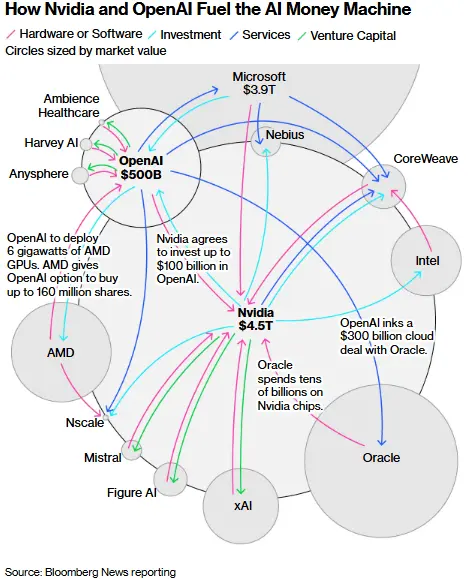 Circular financing without competition
The answer is: the U.S. government. The U.S. taxpayer. The people that the U.S. government plunders.
OpenAI, a company that is hemorrhaging money faster than any other company ever has, a company that has so much money flowing around it, at least on paper, is now demanding that the government start pouring money into it, because it’s so essential to the U.S. economy—so important to the future of western civilization, so important to the war against China—that it should just be subsidized for free, until it manages to do whatever it thinks it needs to do.
It’s not building the AI future, though; it is literally a scam for stealing money from the U.S. taxpayer. It is the next stage in the evolution of predatory capitalism. Instead of using debt to leverage buyouts of other businesses, it’s using its incredibly indebted status to blackmail the largest coffers in the world: the U.S. government.
This is all just a trick to let OpenAI—to let Sam Altman and his pal Peter Thiel—control a good part of what humanity will build with its resources in the next decade. Instead of democratically deciding what to do with $1.4T, the U.S. will simply follow the hair-brained plans of a con artist to funnel as much of that lucre into his own pockets as possible. Nothing will come of this. I’m rounding down. There might be something left over but it won’t come anywhere near having been worth it.
The video contains a lot of detail supporting this but it’s absolutely obvious on its face. These oligarchs are farming a compliant government for unheard-of riches. They are a mafia. None of these data centers and power-generation plants will ever show up. I’m thinking of the half-built off-ramps to nowhere that I remember seeing along the autostrade in northern Italy. The StarGate project is just a 1000x version of that.
This would have been considered shameless and ridiculous a few decades ago but is now envied as a smart business plan.
Just gotta keep those balls in the air long enough to pull the rug.
Once the dust settles, maybe can rationally consider what realistic uses there are for these tools.
Just kidding. We absolutely won’t do that.
We’ll be so far in a depression that we’ll be even more likely to be suckered by the next Ponzi scheme.
We’ll be like a hungry dog that comes closer even though it’s 99.9% sure it’s going to get a kick, not a sandwich.
I am a ray of sunshine.
Layoffs Cannot Prove the Efficacy of AI by Freddie deBoer (Substack)
“[…] while they have some superficially-impressive capabilities, LLMs are fundamentally limited technologies that cannot possibly create the incredible new world repeatedly promised by charlatans like Dario Amodei. We all got way overheated about AI.”
“That layoffs have followed in a higher interest-rate environment where the vast majority of the economy is experiencing sluggish growth and a tiny handful of firms are generating all of the profit − well, that’s not at all surprising.”
“Even if you could, miraculously, trace specific layoffs directly to AI deployments (and you can’t, not with the clean causal clarity people want), that would show only that employers believed that the technology was effective, transformative, and capable of being sensibly deployed, not that it actually is effective, transformative, and going to be sensibly deployed. Companies lie, and they also make mistakes.”
“Blaming AI lets management externalize accountability for those choices. “We had to replace workers with hyperefficient AI to maximize #shareholdervalue” is a better headline than “We misread the post-pandemic economy and overhired, whoops!” − and it allows firms to appear technologically modern while dodging responsibility for poor forecasting or sloppy personnel policy.”
“Corporate statements about AI-driven efficiency are performative acts; they’re aimed at markets, not at rigorous verification. That is a huge part of this, the fact that these corporations are more committed to manipulating their stock prices than anything else. The things they say aren’t reliable because they feel constant intense pressure to maintain a facade for the markets.”
“If your anxious neighbor complains to you about job losses and how “the robots are taking over,” you should ask a follow-up question: did the company replace that position with well-engineered, field-tested automation that demonstrably improved productivity, or did it simply reduce headcount and wave a press release around?”
Growth of private credit a “ticking time bomb” by Nick Beams (WSWS)
“[…] an economy and financial system based on private ownership, private profit and the anarchic market relations arising from it cannot, by their very nature, be subject to conscious control.
“This means that attempts to contain the destructive effects of the private profit market system by closing one door means that sooner or later they will come in through another.
“There has been concern over the growth of private credit for some time. But alarm bells started ringing following the collapse in September of US car parts maker First Brands and the auto lender Tricolor Holdings, both of which had taken considerable loans from non-bank financial institutions.”
“What is set out in this scenario is not mere financial turbulence, but a collapse of the economy and its financial system.
“The report said the agency did not “currently view the risks associated with private credit as systemic.” This was largely because it was still a relatively small part of the overall financial system. But having said that, it warned that in the event of broader economic stress it would be a “meaningful transmission channel given its growth and increasing interconnectedness across various parts of the financial system.”
“Like all those who have probed the risk of private credit and its implications, Fitch called for close monitoring and increased oversight and transparency. But this is under conditions where the very rise of private capital has shown the capacity of finance capital to escape the effects of regulation, and where whatever control mechanisms remain are being systematically scrapped under the Trump regime.”
The Weakening Labor Market: Big Jump in People Looking for Holiday Jobs by Dean Baker (CounterPunch)
“There is also evidence of slowing wage growth in the payroll data released before the shutdown. The average hourly wage increased 3.7 percent year-over-year as of August. This is down from a 4.0 percent rate in 2023 and 2024. It rose at just a 3.5 percent annual rate, taking the average of the last three months (June, July, August) compared with the prior three (March, April, May).
“The slowing has been even sharper for low-paid workers whose wages are most sensitive to labor market conditions. The annual rate of wage growth for low-paid non-supervisory restaurant workers has been just 3.2 percent, comparing the last three months with the prior three. With inflation edging up to 3.0 percent, this implies close to zero real wage growth.
“I may be overly pessimistic here, and I encourage everyone to read Guy Berger’s somewhat more optimistic take, but it seems to me like we are looking at a labor market with near zero labor force growth and near zero real wage growth. The means that real labor income in the economy is essentially flat.
“That fits with the story that Mark Zandi and others are saying where all the consumption growth is coming at the top end of the income distribution. People whose income depends on their wages are not seeing any increase and therefore cannot spend more. It’s only people at the top end who have substantial holdings in stock or other assets who are seeing their income grow.
“That is not a pretty picture from the standpoint of the bulk of the population, and it does not describe a very stable path of economic growth. When the AI bubble bursts, things might get really ugly really fast.”
So Dean Baker is also finally thinking that there is a bubble. He’s been cagy thus far.
Roaming Charges: Ask the Houseman by Jeffrey St. Clair (CounterPunch)
“Monthly mortgage payment on a $500,000 loan”
- 30 years, $3,050 a month
- 50 years, $2950 a month (but 240 more payments)
This is the obvious reason behind this. You pay 3% less per month but pay 60% more than you would have—$1.77M instead of $1.1M for the privilege of having had access to $500K sometime in the deep past. It’s only becoming more obvious what a scam it’s always been. That’s been Trump’s job—making the scam more obvious through the ham-handed, arrogant approach to which his formerly more sophisticated con-man skills have decayed. Or maybe he’s just rightly judged that he and the other elites are really all untouchable now, and it doesn’t matter what you say. Just tell them pretty much the truth—or hide it poorly, like saying 50 years instead of 30 years—and people will still believe you. Why put in more effort to fooling people out of their money than you have to? Why do the work when they’re so eager to do it for you?
I was having a discussion the other day where I posted a short video of someone who was suggesting that we regulate AI. My interlocutor—an American—was horrified because regulation is bad. Look, sometimes it is, so he’s not wrong. It’s also unclear that there is any way of regulating LLM-based tools but I argued that it was a lack of vision and a tsunami of propaganda that convinces us that it’s somehow impossible.
That is, if you’ve given up completely, it sounds stupid to try to regulate AI. In the world of real-life objects, we absolutely do label things with warnings. We’ve just become inured to technology and information not being regulated, because the purveyors of those technologies want to use them for control, so they say that they’re simultaneously absolutely necessary for living your life but also much less dangerous than, e.g., a LAMP.[3]
 Only in America can you have SEVEN warning labels on a lamp. yes SEVEN.
The companies that promulgate technology and information enjoy the privilege of not being monitored or regulated in any way. That’s how the most powerful and richest companies in the world like it. It keeps profit margins sky-high. 👌
I don’t think that we can regulate our way out of this. Regulation would be, at best, a band-aid. Instead, we should improve our culture, understanding, and education so that we no longer fall prey to the grift cooked up by the worst of us, and to no longer promote sociopaths and assholes—those selling us fairytales about how everyone else is trying to pick their pockets—to lead us.
Which means, of course, that we’re doomed.
We are button-pressing monkeys, CRUSHING that little pedal for a dopamine hit every time we see something is even kind-of in the shape of an idea that we already think we might agree with. Those rats that overdosed on cocaine or morphine or whatever have got NOTHING on us.
I’ve been hearing that old saw about “killing competition” my entire life. It took me a while to notice that it always comes from people who are trying to get something for nothing (usually requiring my direct or indirect acquiescence). They’re usually in the Chamber of Commerce or some shit like that.
“Killing competition” usually means “stopping me from making more money than I have any right to expect to make from the value I’m contributing to society.” When they get big enough, they’re all of sudden SUPER-into a lack of competition. At this point, their focus stays the same—their own personal profit—but their methods change: at that point, monopolies will be deemed as “efficient.”
Never trust anyone without principles. Following this precept in our current world yields a lonelier life than one would hope, but that’s the hand we’ve been dealt.
But let’s think some more about who might say something like “killing competition”. Would it be someone who already controls the market? No. Those people don’t want competition. But let’s try it on for size.
“I, as the CEO of a market-dominating company, am asking for less regulation, not to personally benefit from it, but to offer a leg up to potential competitors, whose increased freedom to innovate will, in turn, force me to also innovate more, something that my company cannot bring itself to do on its own—being handcuffed by that dastardly profit motive—but in which we are also very interested, were the government only able to see its way to unshackling our competitors for us. Although my company will be forced to work harder to get its nut—and that nut will necessarily be smaller, given the increased competition—we are delighted to accept this reduction in margins because the commensurate benefit to our consumers, whose satisfaction with our product(s)—and the overall improvement to their lives that they bring—we value above the increase of our own profit.”
Sure, maybe. Hope springs eternal. There are companies like Ben & Jerry’s, LL Bean, Uster, and Patagonia out there. They’re not perfect by any means—and I readily admit that I may have allowed their self-image be my image of them for lack of research effort—but they have at least shown some interest in not being purely rapacious.
However, in our world, the far-more succinct,
“I, as the CEO of a market-dominating company, am asking for less regulation so that I can extract more unearned rent from a captured market, funneling it to myself and my cohort.”
…feels more like where we’re at, unfortunately.
The only reason I’ve seen for larger companies—and we’re talking really big, like Meta/Facebook-big—to ask for more regulation is because larger companies have a neat take on things: they already have a lot of lawyers on staff and they already know how to handle regulators. However, their much-smaller, potential competitors generally don’t. Asking for more regulation ends up being a cynical way of kicking away the ladder.
Science & Nature
Science needs disagreement. What makes some disagreement useless? by Collin Rice (Aeon)
“After all, scientists are not content to merely enumerate a list of facts – they also seek to uncover why and how those facts unfold, operate and interact.”
“They build a model from which they can make predictions. The more accurate the model, the more potentially accurate the predictions. This is a powerful and useful tool.”
“Even in natural philosophy [ie, science], there is always some other explanation possible of the same facts; … and it has to be shown why that other theory cannot be the true one: and until this is shown, and until we know how it is shown, we do not understand the grounds of our opinion.”
“If a scientific community’s power to nurture valuable misunderstandings is a yardstick of its vibrancy, then these science deniers are problematic because they perpetuate misunderstandings that are no longer valuable. This typically occurs when there have been extensive and adequate corrective responses to misunderstandings. In other words, if scientists have already expanded their theoretical, methodological and empirical apparatuses to correct a misunderstanding – and, in the process, have already taken that misunderstanding as a serious possibility – then holding fast to that misunderstanding is pernicious.”
“[…] valuable misunderstandings remind us to avoid fetishising consensus and to recall that effectively responding to dissent and criticism is a longstanding staple of scientific practice. Indeed, communities brimming with valuable misunderstandings but bereft of consensus develop several lines of research that critically engage each other. By contrast, a consensus that abhors valuable misunderstandings can be the result of groupthink, laziness or resistance to alternative viewpoints.”
“Defunding scientific institutions directly undermines science’s mechanisms for transforming dissent and misunderstanding into new understanding, evidence and truth. As long as these and other corrective processes are in place, denials can be handled – if not transformed into valuable misunderstandings.”
“[…] the public needs to know how scientists came to understand by grappling with disagreements and misunderstandings. This signals to those who that their viewpoints have been adequately responded to and that scientific results are not the result of ideology or laziness but of science’s capacity to transform misunderstanding into understanding.”
Medicine & Disease
62-Jährige, die früher mit 35 an Lungenentzündung gestorben wäre, hält nichts von Schulmedizin (Der Postilion)
Translation: 62-year-old woman, who, in earlier times, would have died of pneumonia at 32, thinks modern medicine is worthless.
Many people live in the world where they can say things like “I don’t take vaccines. I won’t let them inject that stuff into me.” They can express an incredibly anti-intellectual anti-science view like believing that the current crop of AIs are already sentient and nothing happens to them. They don’t need to worry that their employers will wonder whether someone that ignorant or gullible might not be the most reliable employee in the capacity for which they’ve been hired. They don’t worry about losing friends. They are mostly supported in their ignorant musings.
It’s nice for them that they live in a society that shields them from the repercussions of their own ignorance of their deliberate ignorance. To the contrary, it coddles them. This society appreciates the ignorant because they won’t bother to inform themselves of anything else that’s going on either. It’s more like their bleats of ignorance are signals they send to the powers-that-be that they have heard and understood the propaganda, and that they will obey.
MAHA's War On Science, Vaccines, And People by Some More News | Cody Johnston (YouTube)
An excellent, well-researched, 1-hour coverage of the history and effects of MAHA on the state of research and government funding in the U.S.
This flu season looks grim as H3N2 emerges with mutations by Beth Mole (Ars Technica)
“Earlier this week, the UK Health Security Agency published a preliminary study finding that, despite the mismatch, this year’s shot still seems to provide important protection. The study found that soon after vaccination, the vaccine provided 70 to 75 percent protection against hospitalization in children aged 2 to 17 years, and 30 to 40 percent protection from hospitalization in adults. These protection levels are within the typical range for flu vaccines, but they’re more often seen at the end of a season […]”
““The bottom line is that it’s looking possible that we may be facing a very bad flu season this year, and the best thing we can all do right now to tackle the problem is to get vaccinated,” Adam Finn, professor of Paediatrics at the University of Bristol, said in a statement.”
Art, Literature, & Cinema
The Aesop for Children by Aesop (U.S. Library of Congress)
Today, I discovered that the U.S. Library of Congress has a whole section of wonderfully formatted Aesop’s fables. There are 147 of them! You can just read them all for free. Is this a public resource for parents and children? Is it possible that this is offered for free, by the U.S. government?
Roaming Charges: Ask the Houseman by Jeffrey St. Clair (CounterPunch)
“I say, let my children have music. I said it earlier. For God’s sake, rid this society of some of the noise so that those who have ears will be able to use them some place listening to good music. When I say good, I don’t mean that today’s music is bad because it is loud. I mean, the structures have paid no attention to the past history of music. Nothing is simple. It’s as if people came to Manhattan and acted like it was still full of trees and grass and Indians instead of concrete and tall buildings. It’s like a tailor cutting clothes without knowing the design. It’s like living in a vacuum and not paying attention to anything that came before you. What’s worse is that critics take a guy who only plays in the key of C and call him a genius, when they should say those guys are a bitch in C-natural.”
What is a Jazz Composer? by Charles Mingus
Friday Poem: Saudade by Robert Rice / Jim Culleny (3QuarksDaily)
“A thousand years ago a song was sung
near a campfire at night
by a singer who was alone, exiled
perhaps, or seeking;“a song whose words were not meant
to be understood, only to be heard,
offered to the silence
and sung in the key of loss.“It confirmed the universe is empty
and dark and knows nothing of us.
Of what we offer, life takes what it wants
and goes.“Exhausted with living
we all listen for a sound
we don’t expect to hear.“A thousand years ago a singer
tended the last coals of a fire and sang
the most beautiful song ever sung,“which no one heard,
and it is the song I need now.”
Philosophy, Sociology, & Culture
Notes on social skills by Iris Meredith (deadSimpleTech)
“[…] it’s questionable whether learning hard skills in any field in depth is actually economically advantageous compared to simply developing the associated traits that make people think you have the skills. Consequently, we have a situation in most modern knowledge work where almost everyone is focused, first and foremost, on cultivating or faking the expression of traits rather than actually learning or getting good at anything. This trait-cultivation then becomes the yardstick by which people gain social status, with the highest positions of power going to the people who can model the appropriate traits most effectively, as opposed to actually developing the skills they need for the role. I think this explains an awful lot about the world we currently live in.”
“[…] for a lot of things, you cannot substitute trait for skill and hope to get a good result, and as a result of us having done this for a considerable length of time, things are breaking on a massive scale. You can’t run a country or a company on the basis of vibes, and yet this has consistently been how we’ve been doing it, and the cracks are really showing.”
“It’s difficult to stress enough how useless a trait-based approach to any of these problems would be: the most offensive example of this in action is punitive actions taken towards unemployed people by governments in a recession economy, as though the negative traits of sloth, laziness or stupidity among the unemployed was solely responsible for unemployment and the systemic lack of jobs has nothing to do with it.”
“The obvious question from here on in is why, if the trait-based structure is causing us such trouble, do so many people tend to persist in it? Here the answer cuts to the core of the problem: fear of agency and the attendant responsibility.”
I don’t agree with this reasoning. I think that the explanation is the same, tired one that explains so much else that is “wrong” with our society: the misalignment of incentives to the goals that we have. People are incentivized to pursue personal goals. This system works fabulously for the people who end up being in charge.
Perhaps a more interesting question is: Why do people who don’t benefit from the system go along? They figure if the system can see its way to promoting a dipshit to prime minister with no obvious effort on his part, then they themselves might have a chance of winning with no effort. The author should consider an approach that doesn’t assume that everyone is as clever as they are; lottos and Ponzis work for a reason; Brainwashing is an important reason but only explains part of it.
C’est la Lune qui nous rend humains by Justin Smith-Ruiu (Hinternet)
“C’est là, en essence, la raison principale pour laquelle, dès le XIVᵉ siècle, les mathématiciens de l’école du Kerala, dans le sud de l’Inde, avaient mis au point des méthodes de calcul de séries décimales infinies — méthodes qui, trois siècles plus tard, devaient être associées au nom de Leibniz et constituer l’une des prétendues innovations du sous-domaine moderne des mathématiques appelé calcul infinitésimal. Sans la défaite du démon Narakasura par le seigneur Krishna, en somme, il n’y aurait ni ponts suspendus, ni satellites GPS, ni semi-conducteurs.”
“Seul un très petit pourcentage de mammifères — peut-être environ 2 % — menstruent, et parmi eux, seule la musaraigne-éléphant, avec son cycle de neuf jours, échappe à la temporalité approximative d’une phase complète de lunaison. Contrairement aux vers et aux palourdes que nous venons d’évoquer, les mammifères menstruants ont évolué des centaines de millions d’années après que leurs ancêtres eurent quitté les mares intertidales, et il n’existe aucun sens littéral dans lequel on pourrait dire que la menstruation des mammifères est causalement liée aux phases de la Lune.”
“De même que le système arithmétique décimal s’est développé à partir du nombre, purement contingent sur le plan évolutif, de doigts de nos mains pour ordonner le monde dans son ensemble, il se peut que l’ordonnancement du temps en unités temporelles régulières procède, lui aussi, du corps féminin humain, ordonnant le monde selon ses rythmes.”
“[…] calendriers rituels des religions mondiales sont généralement ancrés davantage dans les cycles lunaires que dans l’année solaire qui prédomine dans le monde moderne.”
“L’année solaire est fondamentalement cyclique (même les mots qui la désignent dans les langues d’origine latine — annus, an, annuel, etc. — comme dans de nombreuses autres langues du monde, suggèrent quelque chose de circulaire par nature) ; le calendrier lunaire, en revanche, n’est pas, dans son essence, un éternel retour, mais une succession sans fin.”
I just heard someone in a scripted podcast say “everlasting” when they obviously meant “onerous”. I have a colleague who would say, “well you know we can just change the meaning of words. It happens all the time.” Yeah, but who’s allowed to make changes? Any idiot who doesn’t know the language can just mix shit up? I suppose that’s how it is. It’s like the word “cool” didn’t always have it’s second definition of “neat” (which was probably also a relatively recent additional definition). Those are fine. We are used to hearing new words for “noteworthy in a positive way”. The word “geil” in German used to just mean “horny”. Now it also means … “cool”.
I think slang is OK but we have to be careful about distinguishing between changes we accept based upon misinterpretation because a problem with defining your own words or imbuing words with new meanings is that, in nearly every single one of those situations, you’re putting the burden on the person who speaks more of the language to do the work to understand the nimrod who’s birthing a new one.
I don’t understand why we do it this way these days. We used to have masters of something. Those masters would teach the new people what they knew and the new people would be appreciative of the knowledge. They would try to make changes but it was only acceptable to do so once you’d learned at least a little bit about the thing you were trying to change. It wasn’t perfect because it could lead to gatekeeping but it also respected Chesterton’s Fence.
And now we seem to be much more interested in the reverse, where the input of amateurs is revered above that of masters. I think a mix is fine, but I think those who have been around less time should really be slightly more willing to acknowledge when they’re wrong rather than just starting completely useless arguments about stuff that doesn’t matter.
“Everlasting” means forever. It’s right there in the word. It doesn’t mean onerous. It doesn’t mean burdensome. We have words for this. Stop making a different word that you thought meant something mean something else and then doubling down on your belief because you’re either too arrogant to admit that maybe you didn’t know something or you’ve been brought up to be terrified of ever saying anything wrong.
Consider a compiler. If you write “beign” instead of “begin”, the compiler will simply say, “I don’t know what you mean,” and spit out an error message. The compiler has zero interpretive capacity. It is unable to make guesses. A search engine or an LLM will guess what you might have meant. LLMs are extremely good at guessing. It’s kind of their whole thing. Those machines can be used to interpret, but you have to understand that those machines must put in more effort than a compiler. It’s just like more effort is made by a person when they have to interpret something that is inelegantly or incorrectly expressed.
And I don’t think I’m being prescriptive here. I’m not being a gatekeeper. I’m being a sparring partner. I am participating in the evolution of language just as much as the person who’s trying to invent new meanings for words.
Sometimes I do it too! I like to think that more word pairs should have hyphens than most grammar-checkers are comfortable with. I dangle prepositions and split infinitives when it feels right, when I think that a more colloquial approach sounds better. I use “that” more often than the modern style dictates.
Participation doesn’t mean just saying yes to every new word. Some words are stupid. I push back. It’s just like that Internet meme from Mean Girls (Know Your Meme): “Stop trying to make X happen. It’s not going to happen.”
I am participating in the debate. Your inability to take criticism doesn’t make me a prescriptivist.
The greatest trick our rulers ever pulled is to convince us that our work will be rewarded in heaven. Not here, though. They are rewarded here. Not us. Makes sense, right? So we work and work for what are essentially non-existent rewards. We are taught to enjoy the work—love what you do and you’ll never work a day in your life—which they enjoy the fruits of our labor, mysteriously not needing to enjoy any work at all. 🤷🏼♂️ Ours is not question why; our is but to do or die.
Extracts: On Foreigners by E.B. White (Lapham's Quarterly)
“One of the most time-consuming things is to have an enemy.”
“Socialism has a long history in the United States. Some of the most pivotal figures in the history of country were socialists — but that fact has been systematically covered up. Here are 7 well known leaders who were outspoken socialists.”
- Fred Hampton
- Some people say you fight fire best with fire, but we say you put fire out best with water. We’re not gonna fight capitalism with Black capitalism. We’re gonna fight capitalism with socialism. Socialism is the people. If you’re afraid of socialism. you’re afraid of yourself.
- Frida Kahlo
- I am more and more convinced that it is only through communism that we can become human.
- Albert Einstein
The economic anarchy of capitalist society is, in my opinion, the real source of evil. We see before us a huge community of producers, the members of which are unceasingly striving to deprive each other of the fruits of their collective labor − not by force, but on the whole in faithful compliance with legally established rules.
I am convinced there is only one way to eliminate these grave evils, namely through . the establishment of a socialist economy, accompanied by an educational system which would be oriented toward social goals.
- W.E.B. Dubois
- Capitalism cannot reform itself; it is doomed to self- destruction. No universal selfishness can bring social good to all. Communism—the effort to give all men what they need and to ask of each the best they can contribute—it has and will make mistakes, but today marches triumphantly on in education and science, in home and food, with increased freedom of thought and deliverance from dogma. In the end, communism will triumph. I want to help bring that day.
- Assata Shukur
- We’re taught at such an early age to be against the communists, yet mst of us don’t have the faintest idea what communism is. Only a fool let’s somebody else tell him who his enemy is.
- Langston Hughes
- The daily papers picture the Bolsheviks as the greatest devils on earth, but I couldn’t see how they could be so bad if they had done away with race hatred and landlords − two evils that I knew first hand.
- Helen Keller
- I am no worshipper of cloth of any color, but I love the red flag what it symbolizes to me and other socialists. I have a red flag hanging in my study and, if I could, I should gladly march with it past the office of the Times and let all the reporters and photographers make the most of the spectacle.
AI Companies Are Encouraging Users To Believe Chatbots Are People, And It’s Insanely Creepy by Caitlin Johnstone (Substack)
“They’re trying to manipulate us into believing we are much, much less than what we are, just so they can become billionaires and trillionaires. They are attacking the most sacred parts of us for the stupidest reasons imaginable. They are enemies of our species. What they are doing must be rejected with severe revulsion.”
“It’s becoming clear that a huge part of what generative AI offers is just helping people avoid feeling uncomfortable feelings.
“Don’t want to feel the grief of losing a loved one? Here’s an app that will create a chatbot replacement for them so you can pretend they never left.
“Don’t want to push through the cognitive discomfort of writing your own essay? Let AI write it.
“Want a friend who will always validate your ideas and never tell you you’re fulla shit? We’ve got the perfect companion for you.”
This was literally the reason given by one of the interview subjects in the following video:
Is AI Making College Students Dumber? by Ronny Chieng Investigates | The Daily Show (YouTube)
15 Minutes of Ethan Hawke Dropping Gems on a Subway by SubwayTakes with Kareem Rahma (YouTube)
“If you’re not interested in a movie where people are just sitting and talking, you’re telling that your life is not exciting, that your life is—Oh, you’re not involved in any espionage? You haven’t been in a helicopter crash? You’ve never met a blue pod-person who has super magic powers? You don’t know a wizard? You know?
“And it gets to that old thing that the miracle isn’t walking on water; the miracle is walking at all. And what is great about movies that are about real life is you walk out not thinking my life is a bore. I wish I were a wizard. I want to meet a hobbit. You know? You walk out thinking, “Yeah, my life is kind of like…my life is awesome. My life is worthy of a story. Because I’ve fallen in love, because my father has hurt my feelings, because my father and I have recovered from something difficult, my life has value.”
“They’re harder to make, you know, but when you do it, it’s a magic trick because I think people walk out of the theater more interested in themselves than they came in. And that is a gift that you can give people.”
Technology & Engineering
Zed Is Our Office by Joseph Lyons (Zed)
“While collaboration in Zed has given us the ability to run Zed Industries from within Zed, it merely scratches the surface of how we envision working as a team. We’re building toward a future where collaboration is continuous conversation, not discrete commits—where every discussion, edit, and insight remains linked to the code as it evolves, accessible to both teammates and AI agents.
“Getting here hasn’t been a straight line. Over the years, we’ve paused work on collaboration to focus on features users frequently requested—agent-powered tooling, debugging, Windows support, and git support—but our primary goals for Zed have not changed. As we reach parity with other editors on table-stakes features, these detours are becoming less frequent, opening us up to refocus on what we’re most excited about: building the greatest multiplayer software development tool.”
Well, this is only kind-of true. They hope that the detours will become less frequent because they don’t see anything on the horizon.
The Windows version just came out two weeks ago, and they’ve been working nearly exclusively on agent-powered tooling for at least the last year. It’s nice to say that now they’re buckling down on the collaborative vision but, since I’ve been following Zed, they’ve been working on stuff that hasn’t much to do with collaboration. I hope that it’s true this time. This approach looks quite promising.
LLMs & AI
Chinese AI Seems to be Leaping Ahead by Dean Baker (CounterPunch)
“It looks like the latest offerings from China offer comparable speed in computing at a small fraction of the cost. According to this piece on the new MiniMax M2 Model, it can deliver performance that is comparable to the cutting edge U.S. models, at just 8 percent of the cost. This system is also open source. That makes it cheaper to adopt and alter than proprietary models.”
Viral Video Challenge: Can You Spot the AI Fakes? by Behind the News (BTN / Australia) (YouTube)
This is the can’t-trust-video-at-all-anymore singularity. The article Artificial Intelligence Is Making Everything Dumber by Caitlin Johnstone (Substack) writes,
“For decades, video footage was the gold standard for evidence that something had occurred. For a few sweet years there was a period when anything significant that happened in public would usually be recorded on video, because in any group there was bound to be a few people with a smartphone in their pocket, and then those videos could be shared with the world as evidence that the significant thing had occurred. Now whenever there’s footage of a crime, or an act of government tyranny, or just a famous person doing something ridiculous in public, people aren’t going to believe it happened unless it’s corroborated by eyewitness testimony.
“So in that sense we’ve sort of backslid to where we were before the invention of photography, when eyewitness reports were the only thing we had to go by. A video can help illustrate what the eyewitness is talking about, but without a physical witness willing to attest to its veracity, it’s often not going to be worth much in terms of proving that something happened.
“Which of course serves the powerful just fine. Videos of genocidal atrocities, police brutality, and authoritarian abuses have been causing a lot of headaches for our rulers these past few years, so they’ll be happy to see the information ecosystem entering a new era where inconvenient video footage can be dismissed with a scoff.”
The tricks we’ve learned for how to refine a search—e.g., by including details that restrict the potential set of solutions—work against us when we’re formulating a prompt for an AI. Restricting too much encourages the LLM to look in a very specific place in the data, even if our guess is wrong. If it’s wrong, the LLM won’t correct us; it will instead fabricate an entire block of information substantiating our wrong guess.
For example, I search DuckDuckGo AI with the following picture and the prompt “What kind of car is this?”

It told me that it was a Trabant, which is what I suspected. However, the hood logo is an “S,” which I thought kind of odd for a car called “Trabant,” so I wanted to search with a search engine to be sure. The quickest way is, of course, to check Trabant (Wikipedia), which tells us that the manufacture was “VEB Sachsenring,” which is probably where the “S” came from. There is also a picture of a car that looks exactly like the one in my photo, complete with the “S” logo on the hood.
Searching Wikipedia for a specific term is very reliable. Why, though? Because it’s a reference-based encyclopedia that has strict moderation. This is also the kind of information that is highly unlikely to be ideological. It is simply facts about what a particular type of car looks like. It’s unlikely to be politicized or viewed differently by different countries, cultures, or interest groups. It’s not impossible for this to happen and you always have to be careful, but it’s unlikely enough that you don’t have to invest a tremendous amount of time vetting information like this.
Searching a general web index like DuckDuckGo is not as reliable but still quite reliable. Why? Because the underlying technology is deterministic. There are potential outside influences, like advertisers or ideology, but the likelihood that you’re going to get completely made-up results without explanation is very, very low. As above, searching for “s-symbol logo car trabant” is probably not going to run afoul of anyone’s guardrails, guidelines, or ideology. Adding “Trabant” to the search terms is a good thing in an index-based search engine because it restricts the possibilities. Restricting the possibilities in such an index increases the likelihood that you’ll get a precise and accurate answer.
Prompting an LLM with the same text—”s-symbol logo car trabant”—is counterproductive because it will put far too much weight on the odd word “trabant,” which will lead the non-deterministic LLM to invent information. You increase the likelihood of getting a precise but not accurate response. The better prompt leaves off the word “Trabant,” leaving the LLM to determine how “likely” it is that the word Trabant is associated with the rest of the prompt. If it determines that the response should be “Trabant,” then this will support your supposition that it’s a Trabant. If you’d led with that in the prompt, then you couldn’t realistically gain any confidence in your guess because you know that the LLM is very likely to sycophantically parrot your guess back at you.
LLM’s are perfect for people who want to appear well-informed—or want to be paid for being well-informed—but, for whatever reason—perhaps they consider it to be too much work or out of their grasp—they aren’t well-informed. .
LLM‘s allow people to LARP as well-informed people. This works perfectly for people who don’t know anything (or think they don’t). However, if you know how to search the web, if you know how to control which information you get out of search engines, if you know how to quickly read pages and judge which content is useful in them, you will also quickly get to exactly the information you were looking for without the intermediary of an LLM.
And your confidence in the result can be higher.
If you already know what you’re doing, then the LLM serves only to obfuscate, to dull, to blur the information. It serves to reduce, not to enhance the accuracy and precision of what you’re reading. It is perhaps the people who are better at doing those things that LLM purports to help us all do, who see less utility in LLMs.
Having a machine that does what they themselves can already do, but slightly worse, and only occasionally slightly faster, the speed coming at the cost of accuracy (which happens a lot), is not a very attractive proposition. If you don’t know how to do anything like the things that LLMs offer, then an LLM seems like a panacea.
People who are consultants, who are already capable of doing things that LLMs do, and who are consulted for those capabilities, have much less need of an LLM as a shortcut for a lot of what they do.
AI’s 70% Problem by Addy Osmani (Zed)
“If you’re using AI to generate the code, using AI to test the code, I think that at some point you’re probably gonna try throwing AI into the code review loop as well. And at that point, AI is just doing the entire thing. You don’t really know what’s happening at all.”
“[…] trust is surprisingly low and it’s declining. Favorable views about AI coding kind of dropped from 70 to 60% within two years, and about 30% of people are reporting little to no trust in AI generated code at all. Which is kind of wild given how much we’re relying on this now.”
“Often on Twitter, when we see people citing these very high percentage numbers about their productivity gains, if you zoom in, often those are companies that are doing greenfield development on something completely fresh. They don’t have technical debt, they don’t have all of the baggage that usually comes with traditional software engineering on something that is real and has existed for a while.”
dead framework theory by Paul Kinlan (AI Focus)
“if you’re building a new framework, library or browser feature today, you need to understand that you’re not just competing with React—you’re competing against a self-reinforcing feedback loop between LLM training data, system prompts, and developer output that makes displacing React functionally impossible.”
This has been my experience: when you prompt for an HTML/CSS/JS website, you get a React website. The LLMs generally ignore your wishes. You have to be really explicit. I have seen a colleague recently have some success getting Claude in Copilot to help add features to a Svelte web site. In that case, he’d generated the default site with a command-line tool first, so there was plenty of context to keep the LLM from falling into the pit of React.
“The models and the tools are preferring the tools that developers are already using, and it’s driving a self-reinforcing cycle of adoption. If you are launching a new API or tool today, you need to consider how it will be adopted by the ecosystem and how to get it into the training corpus of the LLMs.”
“You’re not competing with React’s technical merits—you’re competing with React’s statistical dominance in every LLM training corpus and every tools providers preference for their customer.”
“This is the new reality: If it’s not in the LLM training data, it doesn’t exist. Not for 12-18 months, at least not until the next model training cycle and not until enough examples exist in the wild to statistically matter.”
But this also applies to React itself! The author writes about React as if it were a monolith but React is also trapped by this. They are trapped in a world where they have to continue to support old, shitty features that amateur or at-best mediocre programmers are generating into their sites by the millions. React is innovating as well. The latest version has a compiler, for God’s sake. It’s more like Svelte than the React with which the LLMs are familiar. This boxes React in to an innovation-free space as well. This is bad for everyone. It’s stagnation. There is no reward for innovation.
“As an industry we should absolutely innovate and build new frameworks, libraries and platform features. We need innovation to push the web forward and create competition. But we need to be aware of the dynamics at play and have clear strategies to get our work into LLM training corpus, system prompts, and developer minds.”
Here’s where we cross our fingers and hope that this utterly stupid approach doesn’t end up dominating human ingenuity but my hopes are slim. Very slim. I can only hope that the “real” internet remains, where I can subscribe to blogs via RSS and learn about interesting research, libraries, and frameworks without having to wait 12–18 months for the LLMs to pick them up. This is actually an opportunity for real programmers, for clever programmers, to get a jump on all of the fools who are only willing—or only able—to generate code with LLMs.
AI (Belongs) In Ads by Indrajit Samarajiva (Indica)
“For a world-changing technology, AI hasn’t changed the world much. The only place I really see AI is in advertising. The local Sri Lankan bookies uses AI girls to replace stock photography. The mobile ads on pirate South African TV use full AI videography. Advertising is really the only sensible use for AI art. Nobody wants to see ads, so it’s fitting that nobody makes them.
“Advertising is great for AI because the company doesn’t really care, the creatives cares even less, and the audience cares least of all. AI is good when you need something that looks real, but which nobody really looks at, which is basically a definition of advertising. By definition people aren’t looking at ads closely, and they were always fake to being with. Making ads that are completely fake is thus just a logical progression.”
Exclusive: Here’s How Much OpenAI Spends On Inference and Its Revenue Share With Microsoft by Ed Zitron (Where's Your Ed At?)
“OpenAI’s inference spend with Microsoft Azure between CY2024 and Q3 CY2025 was $12.43 billion. That is an astonishing figure, one that dramatically dwarfs any and all reporting, which, based on my analysis, suggested that OpenAI spent $2 billion on inference in 2024 and $2.5 billion through H1 CY2025. In other words, inference costs are nearly triple that reported elsewhere.”
“If it costs this much to run inference for OpenAI, I believe it costs this much for any generative AI firm to run on OpenAI’s models. If it does not, OpenAI’s costs are dramatically higher than the prices it is charging its customers, which makes me wonder whether price increases could be necessary to begin making more money, or at the very least losing less.
“Similarly, if OpenAI’s costs are this high, it makes me wonder about the margins of any frontier model developer.”
Premium: The Hater’s Guide To The AI Bubble Vol. 2 by Ed Zitron (Where's Your Ed At?)
“somebody posted a clip of Microsoft CEO Satya Nadella saying, who had this to say when asked about recent revenue projections from AI labs: ”“What do you expect an independent lab that is trying to raise money to do? They have to put some numbers out there such that they can actually go raise money so that they can pay their bills for compute.”“I don’t know Satya, not fucking make shit up? Not embellishing? Is it too much to ask that these companies make projections that adhere to reality, rather than whatever an investor would want to hear? Or, indeed, projections that perpetuate a myth of inevitability, but fly in the face of reality?
“I get that in any investment scenario you want to sell a story, but the idea that the CEO of a company with a $3.8 trillion market cap is sitting around saying “what do you expect them to do, tell the truth? They need money for compute!” is fucking disgraceful.”
“[…] the gulf between “38%” and “negative 109%” gross margins is pretty fucking large, and suggests that whatever Anthropic is sharing with investors (I assume) is either so rapidly changing that giving a number is foolish, or made up on the spot as a means of pretending you have a functional business.”
Programming
You can’t cURL a Border by Vadim Drobinin
“Take this routing: depart Dublin morning of November the 17th, brief Newark layover, a longer one in Mexico City, 23-hour Heathrow stop, then Tenerife. Ask five immigration systems “how many tax residency days?” and you get five answers: Ireland: zero (under 30 days/year threshold). US: zero (foreign-to-foreign transit under 24 hours). Mexico: two (you cross midnight twice). UK: zero (even though you cross midnight once), unless you went landside for non-travel reasons, then one. Schengen: one (entry day counts, exit day will count too, even if both are only for 15 minutes). Each stop has same or similar conditions, but different state machines are asking different questions. I pin the timezone database version that produced each result, and when rules or clocks shift, I recompute so I could show both answers if needed. Yesterday should stay reproducible even when tomorrow disagrees.”
“Can I book Christmas in the Alps with three summer weekends planned in Europe? Does it matter if I leave UK before the tax year ends? What passport should I travel on? Does anything expire between booking and boarding? Every question has the same shape: simulate forward, find what breaks, decide if you care.”
Why Engineers Can’t Be Rational About Programming Languages by Steve Francia (spf13)
“[…] what struck me was how broken their reasoning was. If they were making a logical argument, surely they would have considered Go and in doing so with their presented criteria they would have realized Go was a better option and, at the very least, refined their criteria. I pulled the VP aside after the meeting. “Walk me through how you evaluated other language candidates,” I said. His face went blank. “We… didn’t really look at any others,” he admitted. “Everyone’s talking about Rust.” There it was: a 50 million dollar decision made on hype, about to be green lit. For me this was the moment of epiphany, finally an answer to the question for the beginning of my career. The presentation didn’t share an analysis, they hadn’t done one; it was a justification for a choice already made. This was a decision based purely on hype, emotion, and identity.”
This is utterly unsurprising. No evaluation. Gut feeling. Justify that when things go tits-up. Or maybe—and stick with me here—it wouldn’t have gone tits-up if you’d done an evaluation.
“The researchers’ conclusion was stark: “To consider an alternative view, you have to imagine an alternative version of yourself.” Your brain can’t objectively evaluate challenges to identity based beliefs because doing so requires temporarily dismantling the neural architecture that defines who you are. It’s not a matter of being more rational or trying harder. The mechanism that would allow you to see the bias clearly is the same mechanism the bias has compromised.”
“Every time an engineer evaluates a language that isn’t “theirs,” their brain is literally working against them. They’re not just analyzing technical trade offs, they’re contemplating a version of themselves that doesn’t exist yet, that feels threatening to the version that does. The Python developer reads case studies about Go’s performance and their amygdala quietly marks each one as a threat to be neutralized. The Rust advocate looks at identical problems and their Default Mode Network constructs narratives about why “only” Rust can solve them.”
“The moment you hire a Rust developer to evaluate languages, you’ve already chosen Rust. You’ve just added a $2 million feasibility study to make the predetermined decision feel rational.”
“Industry research suggests that technology stack decisions account for 40-60% of total development costs over a product’s lifecycle. Research by Stripe found that developers spend 42% of their time on technical debt.”
“Instead of asking “which language is best?” we need to ask “what is this language going to cost us?” Not just in salaries, but in velocity, in technical debt, in hiring difficulty, in operational complexity, in every dimension that actually determines whether you survive.”
“Choosing a programming language is the single most expensive economic decision your company will make. It will define your culture, constrain your budget, determine your hiring pipeline, set your operational costs, and ultimately dictate whether you can move fast enough to win your market.”
This goes for frameworks and technologies as well.
HTML Slides with notes … in 22 lines of JavaScript
The following chunk of code implements an HTML slide show:
- Define slides with
<div class=“slide”></div> - Press j to increment, k to decrement, and n to toggle notes.
- Notes and slides can be in separate windows.
Today I learned about BroadcastChannel (MDN), which allows windows of the same origin to communicate with each other. It
“[…] represents a named channel that any browsing context of a given origin can subscribe to. It allows communication between different documents (in different windows, tabs, frames or iframes) of the same origin. Messages are broadcasted via a message event fired at all BroadcastChannel objects listening to the channel, except the object that sent the message.”
let slides = […document.getElementsByClassName("slide")]
  .map((slide, i) => [
      slide,
      (i = slide.nextElementSibling)?.className === "slidenote" ? i : slide
  ]),
  current = 0
  viewSlides = 0,
  jump = () => slides[current][viewSlides].scrollIntoView(),
  bc = new BroadcastChannel("slide_switching"),
  l = slides.length-1;
bc.onmessage = ({data}) => {
  viewSlides = 1 ^ data.viewSlides;
  current = data.current;
  jump();
};
document.addEventListener("keypress",  ({key}) => {
  current += (key == "j") − (key == "k");
  current = current < 0 ? 0 : current > l : l : current;
  viewSlides ^= (key == "n");
  bc.postMessage({current, viewSlides});
  jump();
});
So it all started with a this line of code,
locator.GetInstance<IAuthenticationService>().LogInBasedOnGeneralSettings();being replaced with this
#if DEBUG
    locator.GetInstance<IAuthenticationService>().LogInBasedOnGeneralSettings();
#else
    locator.GetInstance<LoginViewModel>().Show();
#endif
This code is in the Startup.cs of a WPF application.
Going by the single-responsibility principle, the startup should be responsible for starting the app but not making decisions.
The following is just an idea. You can also just move it to a method in the startup.
I just like to reduce calls to locator.GetInstance() as much as possible, so prefer the following solution:
A LoginService that consumes the IAuthenticationService and the LoginViewModel, so that you have something like this:
class LoginService
{
    private readonly IAuthenticationService _authenticationService;
    private readonly LoginViewModel _loginViewModel;

    public LoginService(IAuthenticationService authenticationService, LoginViewModel loginViewModel)
    {
        this._authenticationService = authenticationService ?? throw new ArgumentNullException(nameof(authenticationService));
        this._loginViewModel = loginViewModel ?? throw new ArgumentNullException(nameof(loginViewModel));
    }

    public void EnsureLoggedIn()
    {
#if DEBUG
        this._authenticationService.LogInBasedOnGeneralSettings();
#else
        this._loginViewModel.Show();
#endif
    }
}
Then you can call locator.GetInstance<LoginService>().EnsureLoggedIn(), which is all you really need to know from the startup. We don’t need to pollute the startup with the nuance of which mode you’re in.
A colleague responded that,
“But then you have to […] inject a ViewModel into a Service?”
I’m not trying to be pedantic; it just comes naturally. 😃
- I was going to write that injecting a
ViewModelinto a service isn’t bad because it’s just a view model. But then I noticed that it seems to be communicating with the view in order to show something to the user. 😃 - We’re trying to abstract away complexity and to make our logic testable.
- We need to call
Show()during startup; that’s a fact. If we introduce a service, it actually makes that part mockable. - If we wanted to test that the
LogInBasedOnGeneratedSettings()is called when expected, we couldn’t do that right now, could we? - If we make it a service, then we could think about verifying the logic with a test.
- Of course, once we want to build the test, we’d then be confronted with the need to abstract away the compiler-define. Otherwise, we wouldn’t be able to test both branches without recompiling. That’s a code smell, too.
- Which is why I usually end up with some standard settings objects like:
public interface ICompilerSettings
{
    public bool IsDebug { get; }
}

public class CompilerSettings : ICompilerSettings
{
    public bool IsDebug
    {
        get
        {
#if DEBUG
        return true;
#else
        return false;
#endif
        }
    }
}

public interface ILoginServiceSettings
{
    public bool ForceLogin { get; }
}

public class LoginServiceSettings : ILoginServiceSettings
{
    private readonly ICompilerSettings _compilerSettings;

    public LoginServiceSettings(ICompilerSettings compilerSettings)
    {
        this._compilerSettings = compilerSettings ?? throw new ArgumentNullException(nameof(compilerSettings));
    }

    public bool ForceLogin => !_compilerSettings.IsDebug;
}
I think this nicely separates the concerns while leaving all possible tests open.
Then I could inject those settings into the LoginService and easily verify the behavior with test and some mocked classes.
It might look like a lot of ceremony but, without it, how else can you say with confidence that the login is required in some cases but not others? We can even verify that it’s not required in DEBUG mode by mocking ICompilerSettings.
Then the only thing we have to verify without automated tests is that the CompilerSettings are implemented as expected, which is very little code to manually check. We don’t need to look at the rest. 👍
My colleague very politely responded,
“Injecting ViewModels into Services is generally considered bad practice. The rest seems to depend on what you wish to test and don’t overengineer it…”
At this point, we took the conversation to meatspace, i.e., I ran over to his desk to tell him that “I always want to test everything.” I am willing to concede on time constraints, priority, and planning, but my goal is “test all the code paths”. I’m patient, though, so will accept unwritten tests as technical debt.
We shouldn’t just punt on tests because “it looks difficult” or “it’s not much logic”.
In the first case, the fact that it looks difficult may indicate you’re not writing your code in a testable way or may reveal architectural problems. In the second case, those are famous last words. If it’s just a little logic, then why wouldn’t you just test it instead of investing the time arguing that you don’t need a test?
If you have a code base that’s difficult to test because of some unfortunate architectural decisions, then the thing to do is not to ignore it but to slowly chip away at it.
How else would we get a higher percentage of our code covered by tests? Hint: it’s not by continuing to write more code without tests.
He’d also argued about mixing levels—injecting a ViewModel into a service—but I convinced him that this is already what was happening whether you wrap a service around it or not. The startup is already instantiating and using a view model. Is that somehow better?
I don’t think it’s a bad thing, as it’s just a way of asking the user for input in order to continue starting the application. It’s a step in the application startup. If you wrap it in a service, then you can at least test that the code does what you want. This is exactly the kind of thing that everyone is going to forget to test manually.
APIs vs. MCP by Steve Krouse (Twitter)
“Normal APIs are promises to developers, because developer commit code that relies on those APIs, and then walk away. If you break the API, you break the promise, and you break that code. This means a developer gets woken up at 2am to fix the code
“But MCP servers are called by LLMs which dynamically read the spec every time, which allow us to constantly change the MCP server. It doesn’t matter! We haven’t made any promises. The LLM can figure it out afresh every time”
I’m not sure where to begin. Please don’t build the world like this. People are going to get hurt. Do we no longer yearn for precision, accuracy, reliability, performance, and efficiency? No, no, we don’t. Have we forgotten that these are non-deterministic roulette wheels? Of course we have. Because it is in man’s nature—especially that of a silly person—to round up to flawless, especially when there’s work to be avoided and money to be made.
Text Editing Hates You Too on October, 2019 (Lord.io)
“[…] on the web, text input and keypresses are separate events. Terminals conflate these two, causing problems.
“This is just one example of the many, many different ways that people input text. (Don’t forget about non-keyboard methods like voice and handwriting input!) Fortunately for text field implementors, the operating system provides all these input methods for you. Unfortunately for text field implementors, you have to get your text field to speak the common text input protocol used by all these input methods. For Windows, that’s those 128 interfaces listed at the beginning of this article. Other operating systems have simpler interfaces, but usually they’re still tricky to implement.
“You also may have noticed that the input method is a separate process from our text field, and since both the input method and application can make modifications to the state of the text field, this protocol is a concurrent editing protocol. Windows solves this with its eight (8!) types of locks. Although holding a lock across process boundaries may sound questionable to you, most other platforms try to use imperfect heuristics to fix concurrency issues. Or they just hope race conditions don’t happen. In my experience, prayers are not a very effective concurrency primitive.”
That’s a great line.
“Ken Thompson’s editor was much, much simpler than what we expect from our text editors today. Unicode supports almost every one of the ~7000 living languages used around the world, and plenty more dead languages too. These use a variety of scripts, directions, and input methods that each impose tricky (and in some cases, unsolved) problems on any editor we’d like to make. Our editor also needs to be usable by vision-impaired folks who use screen readers.
“The necessary complexity here is immense, and this post only scratches the very surface of it. If anything, it’s a miracle of the simplicity of modern programming that we’re able to just slap down a
<textarea>on a web page and instantly provide a text input for every internet user around the globe.”
The Inner Workings of JavaScript Source Maps by Manoj Vivek (Polar Signals)
“Notice how the decoded values give relative positions, each value represents the difference from the previous position, not absolute coordinates. This is crucial: instead of encoding large column numbers like 27698 in minified files, source maps only store small deltas like +7 or +15, making the encoded strings much more compact.”
“VLQ (Variable Length Quantity) encoding is an efficient way to represent numbers using as few bytes as possible. It’s perfect for source maps because most position differences are small numbers.”
The Web Animation Performance Tier List by Matt Perry (Motion+)
“Here’s the interesting crinkle in hardware accelerated animations: To support them, browsers essentially have to maintain two separate animation engines, one for the CPU-bound main thread and one for the GPU compositor thread.
“Here’s the thing not many people know: The compositor animation engine doesn’t have to be spec-complete. Because, if the user requests a feature that the compositor thread doesn’t support, the browser can simply run it on the main thread, silently losing its hardware acceleration.
“Safari is the biggest offender here. It doesn’t (yet) have a dedicated compositor engine, instead re-using macOS’s Core Animation framework. So if your animation calls for a feature that Core Animation doesn’t support, like a playbackRate other than 1, then the animation is no longer hardware accelerated.
“Likewise, some values might not be supported by the compositor engine. For example, Chrome only added support for %-based translate values long after adding accelerated animations.”
“Another (quite literally) big performance caveat with S-Tier animations is that they always require the creation of a layer.
“A layer is an element, or group of elements, painted together. Essentially, an image that the compositor can move, transform and fade independently, before grouping (or compositing) them all into one final image.
“These images can become huge without you realising it. Desktop GPUs usually handle this well, but on mobile devices it’s easy to blow out the GPU memory and crash a website.”
“A shader is a small WebGL/WebGPU program that decides which colour to paint a pixel. Because they run massively in parallel, they can produce complex effects with incredible performance.
“However, shader updates are still scheduled via
requestAnimationFrame, which means timing is controlled by the main thread. That’s why shaders aren’t S-Tier: they can render incredibly fast, but they can still miss frames if the main thread is blocked.”
“I recently found a site updating a global CSS variable every frame. It forced style recalculations on 1300+ elements, costing a whopping 8 ms per frame. This is the entire budget for a 120fps animation, just to decide which elements needed rendering.
“Replacing this CSS variable with targeted JavaScript style updates reduced this cost to almost nothing. From 8ms to nanoseconds.”
“The browser is already quite intelligent about scoping layout recalculations. For instance, changes to the size and position of a position: absolute or position: fixed element aren’t going to trigger the recalculation of surrounding elements, as their layouts are isolated.
“You can also manually tell the browser that a layout is contained by using the
containCSS rule. This tells the browser that changes to layout within an element aren’t going to affect the layouts of surrounding elements.”
“There’s [sic] no hard rules. Every choice − memory, layers, hardware acceleration etc − has intersecting tradeoffs. Although in my experience 90% of performance issues are just a bigfilter: blur, hopefully you’re now better equipped to deal with the remaining 10%.”
Fun
Oval Office Press Conference Cold Open by SNL (YouTube)
“[…] a medical professional almost DYING in my oval office at the mere thought of charging less for drugs […]”
“How about RFK, huh? Booked it out of here. like someone was trying to give him a vaccine. Brainworm, take the wheel! That thing kind of Ratatouille’d him right out of the room.”
“And people are saying, “But, sir, how will I afford my Thanksgiving turkey for my family?”
“Well, good news is your family’s not coming because all the planes are gone. We call that problem solving problem. Killing two birds with another bird.”
“How’s it going back there? Is he dead?
“Oh, they’re doing the – They got the legs up.
“That means dead in cartoon.
“Actually, don’t tell me if he’s dead. I want to be surprised.”
Not Sure How They Deal With Criminals In Your Town, But ’Round Here We Use A Restorative Justice Process by Wyatt Ramsey (The Onion)
“Well, well, well. What have we got here? Another city slicker who thinks he can waltz into my town and start causin’ all sorts of trouble. I’d be careful if I was you, fella. Because however they do things where you’re from, ’round here we have our own way of dealin’ with criminals, and that’s through a rehabilitation-centered restorative justice process.”
I just read this out loud to Kath from start to end in the most southern-fried accent I could muster. She was oddly and surprisingly entertained.
Enter The Sandstorm by DJ Cummerbund (YouTube)
The master of mashups is back with a mashup of Metallica’s Enter Sandman and Darude’s Sandstorm.
Video Games
Game design is simple, actually by Raph Koster
This is a rich resource of thoughts about how games work, with a wealth of links to supporting materials and a ton of examples.
- Fun
- Fun is basically about making progress on prediction.
- Problems and Toys
- We play with systems that have constraints and movement, and we stick goals on them to test ourselves.
- Prediction and Uncertainty
- The more uncertainty, indeterminacy, ambiguity in your game, the more depth it will have.
- Loops
- Players need to understand how to use the machine, and the point is to gradually infer how it works by testing it against varied situations.
- Feedback
- Show what you can do, that you did it, what difference it made, and whether it helped.
- Variation and escalation
- Escalate the situations so that theories can be tested, refined, and abandoned.
- Pacing and balance
- Vary intensity and pressure, give players a chance to practice and moments to be tested.
- Games are made of games
- Build small problems into larger webs, and map them so you understand how they connect.
- Actual systems design
Not every mechanic has been invented, but a ton have. Build your catalog and workbench.
“These break down into a ton of sub-problems, but there are less than you think, and you can actually find lists of them. The hard part is that often they each seem so small and trivial that we don’t think of them as actually being worth looking at!
“They are also often in disguise: the problem behind where a tossed ball will land, and the problem of how much fuel you have left in your car if you keep driving at this speed, and the problem of when your hit points will run out given you have a poison status effect on you are the same thing.”
- Dressing and experience
- Game development is a compound art form. You can go learn those individual arts and the part unique to games.
- Motivations
- No game is for everyone, so you will make better games if you know who you are posing problems for.
- It’s simple, but not
- Each of these topics is deep, but you want a smattering of all of them.
“But I also guarantee that if you get better at the above twelve things, you will get better at making games. This is a pragmatic list. And it will be helpful for making narrative games, puzzle games, boardgames, action games, RPGs, whatever. I breezed through it, but there are very specific tools you can pick up underneath each of these twelve things. It really is that simple, but also that hard, because that’s a frickin’ long list if you want to actually dive into each of the twelve.”
[3]
Picture taken from Only in America can you have SEVEN warning labels on a lamp, yes SEVEN. which requires a login.
↩