
Links and Notes for November 14th, 2025
Below are links to articles, highlighted passages[1], and occasional annotations[2] for the week ending on the date in the title, enriching the raw data from Instapaper Likes and Twitter. They are intentionally succinct, else they’d be articles and probably end up in the gigantic backlog of unpublished drafts. YMMV.
[1] Emphases are added, unless otherwise noted.↩
[2] Annotations are only lightly edited and are largely contemporaneous.↩
Table of Contents
- Public Policy & Politics
- Journalism & Media
- Labor
- Economy & Finance
- Science & Nature
- Environment & Climate Change
- Art, Literature, Music, & Cinema
- Philosophy, Sociology, & Culture
- Technology & Engineering
- LLMs & AI
- Programming
- Sports
- Fun
Public Policy & Politics
”You Have a Mother” by Chris Hedges (Substack)
“They were quarantined in Camp C after being shaved, sprayed with DDT and tattooed. She remembers seeing a group of dwarfs in the camp. “They were so beautiful,” she said. “I wanted to play with them. They were like dolls. On the second or third night they all disappeared.”
“She and her mother spent about eight months working in Birkenau. At one point they were stripped and forced into a gas chamber with a large group of women before the execution was abruptly canceled. Lola had begged her mother before entering the gas chamber for their last piece of bread. “I said, ‘I don’t want to die hungry,’ ” she remembered. “My mother, said, ‘When we come out you will tell me you are hungry.’ I said, ‘I don’t care.’ And she gave me the bread. When we got out of the gas chamber my mother said, ‘I told you so.’ ”The women were later put to work twisting strips of oilcloth into braids to be used, she believed, to make plane doors airtight.”
“We walked through the night. We passed our town, Katowice. We saw the lights. The next day my mother wasn’t feeling good. She was dizzy. She asked me for a little sugar. We were not allowed to bend down for snow. If you bent down they would shoot you. There were bodies on the sides of the road. But my mother asked me for some snow. I bent down quickly to get her some snow. The women around us helped my mother for a little while. They walked with her. Then my mother couldn’t walk. There was a tree. She lay down. She told me, ‘Run quickly and maybe you will save myself.’ Then a German materialized. I fought with him. I told him, ‘You have a mother. You know what it means to have a mother. Let her rest a minute and she will be able to get up.’ He smiled. I will always remember that strange smile. Something amused him. By that time his pistol was drawn. The soldiers began to hit me and push me away. He shot her.”
“There is, somewhere in the vastness of the universe, amid galaxies and stars that light emanating from our planet takes decades to reach, the airy image of a girl playing with a doll in the Polish town of Katowice, the image of a girl terrified and clutched by her mother near a bombed bridge, the image of a girl hiding with her brother under a pile of sawdust and accepting a small piece of bread, the image of a girl shaking the hand of the Nazi governor of Poland and the image of a girl in her mother’s arms in a basement listening to men and women about to die singing Shema Yisrael. There is, too, the image of a girl telling a German soldier with a drawn pistol, “You have a mother.””
How the US Intervened to Sabotage Angola’s Independence by Elizabeth Schmidt (Jacobin)
“The Angolan war was on pause, but it had not ended. After a brief hiatus, UNITA resumed the fight. In 1985, the Reagan administration convinced Congress to repeal the Clark Amendment, and in 1986, Congress restored US military aid to UNITA, supplying the rebel force with some of the most sophisticated American weapons on the market, including heat-seeking Stinger antiaircraft missiles. The war against Angola continued until 2002, when UNITA leader Jonas Savimbi was killed in combat. Angola has not yet recovered from the devastating destabilization of wars that lasted more than a quarter of a century — wars that destroyed the country’s infrastructure, claimed the lives of one million people, and drove four million people from their homes. With the country in tatters, corrupt, authoritarian leaders moved into the void, turning Angola into another African petrostate that takes from the many and gives to the few.”
America is a Banana Republic by Chris Hedges (Substack)
“El Presidente — in every dictatorship — follows the same playbook. It is a grotesque opera buffa. No encomium is too outrageous. No bribe too small. No violation of civil liberties too extreme. No stupidity too absurd. All dissent, no matter how tepid, is treason.”
“It is not only violence and intimidation that keep El Presidente in power. It is the stupefying inversion of reality, the daily denial of what we perceive and its replacement by disorienting fictions that keep us off balance. This, combined with state-induced fear, turns countries into open-air prisons. Human consciousness is bombarded until it is broken and becomes a well-oiled cog in the vast carceral machine.”
“Dictators wallow in kitsch. Kitsch requires zero intellectual investment. It glorifies the state and the cult leader. It celebrates a fantasy world of virtuous rulers, a happy, adoring population and idealized portraits of the citizens. In the case of Trump, this means white citizens. It glitters and sparkles, like the garish gold trophies and vases lined up on the mantelpiece in the Oval Office that have been matched by equally tasteless gold coasters with Trump’s name on them. It snuffs out culture. The National Symphony Orchestra at the Kennedy Center now opens all its performances with the national anthem. Trump, who appointed himself the new chairman of the center, posted, “NO MORE DRAG SHOWS, OR OTHER ANTI-AMERICAN PROPAGANDA.””
““The worst thing that can happen to a Dominican is to be intelligent or competent,” he had once heard Agustín Cabral say (“A very intelligent and competent Dominican,” he told himself) and the words had been etched in his mind: “Because sooner or later Trujillo will call upon him to serve the regime, or his person, and when he calls, one is not permitted to say no.””
“78 years of betrayals.” by Guy Mettan (The Floutist)
“Palesintians [sic] were not consulted or given any part in the drafting process. Hamas, a legitimate liberation movement fighting an occupying power as international law gives it the right to do, is to disarm and have no future role in Gaza. There is but a brief, flimsy reference to Palestinian independence and sovereignty—when “conditions may finally be in place for a credible pathway to Palestinian self-determination and statehood.” Israeli aggression in the West Bank goes unmentioned.
“Eva Bartlett put it as well as anyone in her In Gaza newsletter the other day, when she called this plan “the usual Israeli ultimatum: surrender or be murdered.” Indeed, the genocide in Gaza and the Zionist regime’s increasing aggression in the West Bank are fairly read as the grotesquely logical result of the cynical abuse of the peace process on the part of Israel and its Western supporters over many decades.”
Interview With Boris Kagarlitsky From Behind Bars by Boris Kagarlitsky, Andrey Rudoy (ZNetwork)
“Another instructive observation concerns the motivation of those who sign up. Among them I have not met a single person motivated by ideology; on the contrary, I have repeatedly met people who are convinced opponents of the SMO. So why do they sign contracts? For the sake of release and for money for their families. The recruiters also pressed exactly these points, without placing much emphasis on patriotism. It is a pragmatic decision, dictated not by convictions but by life circumstances.
“Meanwhile, we do have a certain number of ardent, ideologically minded patriots who repeat propaganda talking points, but there has never once been a case of any of them enlisting to fight. Not once.”
“In general, it seems to me very important to avoid simplified, black-and-white judgments. As in: if someone fought, then he is for the war. Or the reverse: if someone does not want to fight, then he is against it. Unfortunately, everything is much more complicated.”
“When people tell me that from abroad I could have spoken more sharply and used harsher language, I remind them that is not my style at all. I have always tried, and still try, to speak correctly and politely, even when I am talking about people who, in my view, do not deserve respect. Restraint only makes speech more convincing.”
“I have no intention of condemning people who went abroad, especially if they are able to sustain or create projects that are useful to the common cause. One can and should work under different circumstances. We complement one another and help one another. Some are in emigration, some inside the country, and some in prison. The main thing is that we all preserve our solidarity and our faith in what we are doing.”
“[…] we do not get distracted by trivialities. I often notice that people on the outside are in a kind of depression, a pessimistic mood. And so it turns out, amusingly enough, that I have to cheer them up from prison. Here in the colony, it is easier to distinguish the essential from the secondary.”
“Another way some responded to this contradiction was apoliticism: “We are not interested in politics; it is all awful — nothing but opportunism, bourgeois institutions and so on. We are immersing ourselves in pure theory, in the world of ideas, or in historical reconstruction.” The trouble is that the theory that consciously turns its back on the present is a worthless theory.”
“In real life everything is much more complicated, more tangled. Abstract criticism of capitalism and liberalism made it possible not only for different people to meet on the same platform, but also for very different, often even opposing ideas to coexist within a single head. And there were, and still are, very many such heads. We have to work with them.”
“Historically, Stalinist ideology went through several stages and changed substantially. One thing is the ideology of the 1930s, where there is still a lot of revolutionary rhetoric, references to class interests, and so on. Another thing is the ideology of 1948–1953, which in essence prepares today’s “red imperialism.” There’s nothing progressive left in it. To use familiar terms, there was a shift from Soviet Thermidorianism to Soviet Bonapartism.”
“[…] today’s political system did not arise out of thin air; it rests on certain relations of economic power and property, on a social structure that not only presupposes egregious social and material inequality, but also alienates the overwhelming majority of citizens, including even the middle class, from participation in decision-making.”
“I often encounter the same person saying something quite sensible when the discussion concerns, say, their professional field, and then spouting conspiratorial nonsense when it comes to politics or political history. But real politics is always concrete and demands systemic logic. In other words, politicisation orders and structures consciousness.”
“Undoubtedly, the achievement of the revolution was the social state, which, incidentally, only fully took shape by the 1960s, though it was declared as a goal from the very beginning; mass enlightenment, not only through schools and universities, but through the spread of high culture; and, of course, the immense work of transforming an agrarian country into an industrial one, the development of science, and so on.
“But the point is that the Soviet Union was an extremely contradictory society. And the aspects of Soviet history I am talking about did not simply coexist in parallel with repression, the suppression of the individual, campaigns against genetics or “rootless cosmopolitans,” savage bureaucratism, and the like — all of this was tightly intertwined.
“And here we see the crucial problem. Those who now so zealously defend the Soviet Union are in fact defending not the Soviet Union, but precisely the dark, reactionary or conservative sides of Soviet history — the very traits of the Soviet system that ultimately doomed it to historical defeat. For us as leftists it is of fundamental importance to draw critical conclusions from that experience so as to not repeat it and not repeat its defeat. We are not planning to wallow in nostalgia; we intend to win.”
“Why do I say the question of democracy is a class question? Because the mass self-organisation of working people is possible only under conditions of freedom and openness, when many rank-and-file members of the working class, and not just individual heroes and activists, can join left organisations, can voice their views without fear of repression, and can, finally, influence politics — including the politics of left parties.
“I understand perfectly well that some leftists do not need any working masses; they dream of becoming bosses and imposing their transformations on the people from above. But those are bad leftists. And above all, they will not succeed.”
“I find it strange to suppose that in order to be a decent person one must necessarily be afraid of God. Can you not behave decently simply as such? For example, not feel a compulsive desire to foul your neighbour. And we have no shortage of people who constantly declare their faith while acting as if at the devil’s prompting.
“Now, of course, if one of us needs God, I have nothing against it. But from a sociological point of view, society simply needs morality, certain ethical benchmarks without which the reproduction of social and economic relations would be impossible. These general moral rules can be codified in religious form — through the Ten Commandments — or in the form of the Moral Code of the Builder of Communism.”
“By law alone and the threat of repression it is impossible to sustain, on an everyday level, the reproduction of society; something self-evident is needed, grounded not in fear of punishment, but in the need for constructive interaction and mutual understanding with other people.”
“What is more interesting is this: our circle members often do not just have a poor grasp of non-Marxist literature, they do not always read Marx himself carefully. Who in fact studied volumes two and three of Capital in these circles? Or the Economic and Philosophic Manuscripts of 1844? Or the articles on British rule in India? If those texts had been read attentively, many absurd disputes and complaints about other leftists would never have arisen, especially at moments when those leftists were simply repeating an idea first articulated by Marx. Or by Rosa Luxemburg, for that matter.”
“Otto Šik’s Plan and Market under Socialism should finally be coming out soon. The series is interesting because it presents different authors and currents of socialist thought, from Austro-Marxists to Mao [Zedong]. Let readers draw their own conclusions. The main thing is to overcome ignorance. And from the non-Marxist sociological and economic classics, Max Weber, Émile Durkheim, Keynes, and Joseph Schumpeter are must-reads.”
“The end of the war means the end of the current political configuration. It does not even matter how the hostilities end. Peace is a challenge for which the actors are not ready; they are terrified of it. But it is inevitable anyway. I used to think there would be a peace agreement and then, as a result, a transfer of power. Now I think it will be the other way around: first the transfer, then peace. In any case, it seems to me Trump only delayed and muddled the matter.”
“It is like a ship drifting by inertia while an endless argument rages on the bridge over where to sail. How long can this go on? We have been sailing this way for at least a year. And we can drift on until an iceberg appears. What could play the role of an iceberg? A serious military setback or an acute manifestation of economic and financial crisis. So far nothing of that sort is visible, but an iceberg, as is known, emerges from the fog unexpectedly.
“And here it does not matter whether a collision occurs. What matters is that those arguing on the bridge notice it and finally decide to turn the wheel. Everything will happen suddenly and very quickly. In short, the title of Alexei Yurchak’s classic comes to mind: Everything Was Forever, Until It Was No More.”
“This is an important lesson for left activists: do not lock yourselves in your own milieu. We need to make it interesting for the ordinary, depoliticised layperson to be with us, and to make it possible for them to identify with us. Then it will be easy to advance a political agenda. That is hegemony. Not in theory, but in practice.”
You Don’t Have to Be a Commie to Stand with Venezuela by Nicky Reid (Exile in Happy Valley)
“Hugo Chavez turned out to be human being after all.
“That fantastic human missile crisis died very suddenly and somewhat suspiciously of cancer in 2013 and his successor, then-Vice President Nicholas Maduro, seemed to waste very little time betraying his revolution. He very quickly turned the Bolivarian Republic into a giant bludgeon for him to maintain the power he had practically stumbled into over Hugo’s corpse, starting by dismantling the various workers councils, misiones, comunas and collectives that had created the architecture of direct democracy that had served as the backbone of Hugo’s revolution and then concentrating their power back into a bureaucratic elite while repressing anyone who stood in this pink oligarchy’s way beneath a banner of Dengist-style state socialism.
“By 2015, Maduro was ruling the nation largely by decree, by 2017, he was castrating the National Assembly and rewriting the Constitution that Hugo Chavez and millions of other Venezuelans had risked their lives to preserve, and by 2018, the Bolivarian Revolution was dead and I was heartbroken. However, in my disillusioned grief, I was also forced to take a second look at the Revolution altogether, and I was haunted by what I found. While Hugo certainly did appear to do all that he could for the Venezuelan poor, he had also steadfastly relied on many pre-existing state powers to do so and in the process consistently undermined his own revolution’s grass roots civilian infrastructure.”
“This humongous corporate behemoth continues to represent 90% of Venezuela’s economy and was largely dependent on Chevron to function before Donald Trump’s escalated embargo pushed Maduro to replace them with Chinese capitalist roadsters [sic?] who now essentially own the nation’s economy thanks to $62.5 billion dollars in predatory loans.”
I’m not quite sure I can take that at face value. Are these really predatory loans? A loan can also be seen as an investment, if the terms and interest aren’t usurious or extortionate. The Chinese have, at least in other places, been much more lenient than the west with loan conditions, or even loan-forgiveness. It’s possible that Venezuela is suffering from more than just the U.S. economic attack, and is also subject to the predations of Chinese capitalists operating away from the aegis of their state—which, as noted, generally doesn’t carry a big stick for short-term wealth-extraction—but I would want to corroborate this claim.
“At best, this arrangement swapped one raft of oligarchs for another, turning “revolutionary” civil servants into the new bourgeoisie, but mostly it just left a system designed for oppression largely intact and only one strongman away from being turned back into another meat grinder.”
“The problem was and has always been the state itself. As long as there is a system in place that offers one class of people a monopoly on the use of force, the government will always be a den for despotism regardless of whether the scam is dressed up in the trappings of socialism, capitalism, democracy or nationalism. Just so long as the sanctity of the state is left intact, the results will always ultimately be the same.”
“In 2014, Venezuela’s [per-capita] GDP (Statista) stood shoulder to shoulder with Brazil’s at $14,000. By 2024, it was closer to Bangladesh at $3,870. As a result of this medieval style siege accelerated by every single American president from Obama to Trump, 7.7 million Venezuelans have fled for their lives, constituting the single largest displacement in modern history with 25% of the nation’s population now living abroad as refugees. Some might argue such mass sadism constitutes a form of genocide; however, this Latin American Nakba is also primed for some serious blowback.”
“Now, there are dozens of Colectivos operating in 16 of Venezuela’s 23 states with numbers as high as 8,000. If Donald Trump is stupid enough to play Iraq with Venezuela, he won’t be fighting fat thugs like Maduro; that pig will roll quicker than Saddam; he will be fighting a guerrilla war against the true bastard fathers of Hugo’s revolution. The Colectivos will become the Sadrists of the Western Hemisphere, and I will support their fight for the same reason that Murray Rothbard supported the Vietcong. Because sovereignty is sacred and solidarity is bigger than any one ideology.”
Japan’s new far-right PM threatens war with China over Taiwan by Ben McGrath (WSWS)
“On November 7, while speaking to the National Diet’s lower house budget committee, Takaichi discussed a situation in which Japan’s military, formally known as the Self-Defense Forces (SDF), could be dispatched against China. If Beijing were to impose a military blockade around Taiwan, she said, “No matter how you think about it, it could constitute a survival-threatening situation [for Japan].”
“She stated, “Simply lining up civilian ships to make passage difficult would not be a survival-threatening situation. If it is a wartime blockade, with drones flying and various other developments, then the situation could be seen differently.” She also added that an attack on US warships attempting to break a blockade could also justify dispatching the SDF.
“The carefully-chosen phrase, “survival-threatening situation,” is a legal term bound up with Japan’s remilitarization. Japan is barred from waging war overseas by Article 9 of its constitution, informally known as the pacifist clause. In 2015, the government of then-Prime Minister Shinzo Abe, from whom Takaichi draws her political inspiration, rammed military legislation through parliament despite mass anti-war protests. It allows Japan to go to war so long as these deployments can be justified as “collective self-defense” in a so-called “survival-threatening situation.”
“According to its latest Defense Ministry White Paper, Tokyo defines a “survival-threatening situation” as one “where an armed attack against a foreign country that is in a close relationship with Japan occurs, which as a result, threatens Japan’s survival and poses a clear danger of fundamentally overturning Japanese people’s right to life, liberty and pursuit of happiness.”
“This deliberately vague definition could be used to justify any number of military actions and there is nothing defensive about Tokyo’s position. Takaichi is the first sitting Japanese prime minister to explicitly state that Japan would go to war with China over Taiwan.”
“China has made clear that the status of Taiwan is its most significant redline and has stated that any declaration of independence by Taiwan would result in war.
“Beijing fears that if Taiwan declared independence, it would set a precedent for a further carve-up of Chinese territory, recalling the division and subjugation of China by the imperialist powers in the 19th and early 20th centuries. Taiwan would also quickly become a US military base posing a threat to mainland China along with existing bases in Japan and South Korea, which are home to approximately 80,000 US troops in total.”
“A war over Taiwan would not take place in a vacuum. The US is already conducting a war against Russia in Ukraine while also backing Israel’s barbaric genocide of the Palestinian people, and using it to justify bombing Iran in June. Trump is now on the verge of launching another illegal war against Venezuela, having amassed an armada off the South American coast. Amid all of this, Trump is seeking to undermine China by carrying out an economic war against it. The outbreak of hostilities in the Indo-Pacific would mean a major new front in what is rapidly evolving into a world war.”
Taiwan is part of China. Japan acknowledges that. Japan is now openly supporting the west’s desire to separate Taiwan from China. It’s as if someone who went to your wedding is publicly posting on social media how your wife needs to leave you. Then they wonder why you’re getting so mad.
Iran: Three Things The New York Times Gets Wrong by Ted Snider (Antiwar.com)
“The Saudi-Pakistani defense agreement is more reasonably seen as a growing realization in the region that their interests are better served by relying on each other – including Iran – than by relying on the United States. The bilateral security agreement joins calls by Turkey, Egypt and Pakistan for a pan-Islamic security alliance. Most recently, Oman’s Foreign Minister, Badr al-Busaidi, called for an regional Gulf security architecture that includes Iran.”
“If war in Iran is to be avoided, the truth needs to be told, starting with truthful reporting. Iran is not being isolated by the regional powers but integrated. Iran is not seen by the countries of the region as the primary threat or source of instability. And Iran is not building a nuclear bomb.”
With UN blessing, the US and Israel impose the master’s plan by Aaron Maté (Substack)
“To get Russia and China to stand down, the US also pressed its case with open threats. Ahead of the vote, the US mission to the UN warned that alternative proposals like Russia’s amounted to “attempts to sow discord,” and would have “grave, tangible and entirely avoidable consequences for Palestinians in Gaza.” Any “departure” from the US position, “be it by those who wish to play political games or to relitigate the past,” US Ambassador Mike Waltz wrote, “will come with a real human cost.””
The Empire: Do what we say and we’ll kill everyone in sight.
The Rest: Or, right?
The Empire: We said what we said.
“Waltz’s threat is backed by a long past that carries into the present. The US and Israel have come to their dominant position precisely because of their willingness to impose massive human cost throughout the region, not just in Palestine but also Iraq, Libya, Yemen, Syria, and Lebanon. That aggression continues in Gaza, where Israel has killed at least 280 people since the so-called “ceasefire” took effect last month. Israel also continues to block the delivery of basic supplies, subjecting displaced Palestinians to new depths of suffering at the outset of winter. This includes devastating flooding after heavy rains and uncontrolled sewage water soaked families sheltering in dilapidated tents.
“Israel can continue to kill Palestinians and ignore its humanitarian obligations as a result of what the Wall Street Journal recently described as a “new position of power after a series of wars that have left it with no significant regional rivals.” Or as Amos Hochstein, a top official for the Middle East under Joe Biden, put it: “The fundamental change that has to be recognized in addressing the future of the Middle East is that Israel is now the strongest power in the Middle East. They are the absolute, overwhelming, dominant military hegemon of the Middle East.”
“The dominant military hegemon makes no effort to hide its contempt for the region’s weakest party. “Israel’s policy is clear: There will be no Palestinian state,” Defense Minister Israel Katz said ahead of the UNSC vote. “The only real solution for Gaza,” Katz added, “is encouraging voluntary emigration.”
“All a part of the master’s plan.”
All The Ways Trump Is Using The Presidency To Enrich Himself by Some More News | Cody Johnston (YouTube)
At about 05:30,
“Sharper Image was a semifancy gadget store that was basically Spencer’s gifts for the upper middle class. Also, for our younger viewers, Spencer’s Gifts is a shop at the mall that sells silly tchotchkes and blacklight posters. Like a proto Hot Topic that had lava lamps and mugs shaped like a boob. Also, a mall was like a physical version of Amazon that you could eat soft pretzels in. Oh, and the middle class was this third class between dirt poor and having all the money ever.”
At about 8:30,
“He essentially made himself the shorthand for a rich guy. […] Instead of actually being super rich and successful, he became a mascot for being rich and successful. A monopoly guy. Scrooge McDuck. Richie Rich, the Ronald McDonald of luxury. Donald McDonald, a walking Sharper Image for upper-middle-class people to admire and actual rich people to ignore. And he slapped that name on everything like the affforementioned stakes, but also vodka and dietary supplements.”
At about 12:30,
“Trump’s name is mostly used as a label for other companies to license, including foreign governments and investors that are developing large-scale hotels and luxury properties. The Trump Organization has at least five real estate deals with Saudi real estate company DarGlobal. One of which, Trump International Oman, is partnered with Oman state-owned tourism group, promising investors both hands-off investment expertly managed by Trump to generate income on top of lifetime residency visas. This is along with developments in Dubai, Qatar, and Saudi Arabia.
“The New Yorker estimates that these licensing and management deals being made in the Gulf are bringing in a minimum of $15 million. Vietnam also struck a deal with Trump to build $1.5 billion luxury golf courses and hotels.
“And while that’s all well and good for Trump, the scammy business mascot, I probably don’t have to stress that this is a president now. It is the United States president—now the mascot of the Republican party—being used as an international brand while he’s the president. I know it seems normal now. I guess since Trump is a TV real-estate guy and has been president once before and nobody seems to be willing or able to stop him from doing all of these things that are obviously weird for a president to do. But it’s very weird. It’s abnormal actually for a president to be developing all of these opulent resorts overseas in order to curry favor with others or to allow others to curry favor with him or to generally enrich himself.”
At about 15:30,
“The president who has spent a third of his presidency at his own properties using taxpayer dollars to promote his business when he’s supposed to be doing president stuff. He’s just flying around in a jet we pay for doing his side hustle. We pay for that. It’s the company car and he’s using it for personal stuff. He’s hosting official government events at his hotels, making foreign governments and the Secret Service pay millions at his properties using our tax dollars.”
At about 32:30, he does a segment on cryptocurrencies:
“ It’s a very fickle, highly volatile investment that has limited regulations that are currently in flux around the world, has no safety net, gets lost frequently, and is the go-to method to shadow-fund criminals and hate groups and online gamblers.
“Again, it’s cool in theory. It’s like anarchist bucks, but instead of being used to get into some cool bondage club to learn about the matrix, it’s mostly being used by Wall Street types and the literal president of the United States to get around laws.
“This is why cryptocurrency is frequently used as a pump and dump scheme, which is when people talk up their cryptocurrency to maximize its value, sell it off for real money, and then watch its worth fall down to nothing. It’s money but worse.”
At about 38:00,
“I will reiterate that a handful of people purchased [Melaniacoin] before it was announced, meaning that they must have preemptively known, perhaps because they knew Melania or the company hosting it. It could, in theory, not be people in Trump’s circle.
“But I also need to remind you that there are still transaction fees and the entity in charge of the Melaniacoin, a company called Meteora, also made at least $64 million in real money through those transaction fees. So you have a small group of anonymous traders making $100 million, seemingly tipped off in advance, on top of the extra money going to the company hosting this. The first lady presumably gets a cut because it’s her coin that she launched. But thanks to the third party, she is also legally insulated from any corruption.
“That means the most innocent scenario is that the president and first lady are licensing their names to the futuristic version of a shady gambling app and are unaware that it’s a scam. Again, the most innocent scenario is that the president is ignorant and gullible.
“And of course, the exact same situation is happening with Trump coins. He announced the launch on Truth Social, and wouldn’t you know it, the value way the heck up to $6 billion within days of launch. The Trump Organization and its affiliates own 80% of the coin supply and have collected millions of dollars in just those trading fees alone.
“Just the United States president taking a rake.
“Again, it’s perfect for Trump. He has distilled everything he’s done in the past down to this digital frontier, selling his name and name alone with no product or actual value. Like, even if he wasn’t [sic] the president, he would absolutely be doing this. But of course, he is the president.
“Trump the crypto scammer. As I said, it is perfect for him. And better yet, it’s through a market that he as the president also gets to regulate on a federal level. It’s win-win if you don’t factor in the rest of the country.”
At about 53:00,
“Jimmy Carter gave up his peanut farm. That wasn’t for nothing. That was to avoid Jimmy Carter forcing American consumers and companies to become obsessed with peanuts and make him money via peanuts.
“Of course, in this case, Trump’s preferred industry is just scams. He’s helping himself and the scam industry. He’s also uniquely able to get away with this stuff. He’s done it his entire life and he has ported that ability to his time at the White House.
“Literally, when the House Oversight Committee Chair, James Comey, was asked about the Trump family’s crypto scams, he said it’s okay because, quote, “They’re admitting they’re doing this.” See, they’re holding a big sign that reads, “Doing crimes,” which makes it all above board, right? He’s donating his paycheck to renovate the White House. See, he gives back. He doesn’t need the money on account of the hundreds of millions of dollars he’s you know scammed from so many people.”
At about 54:00,
“You might notice that in all of what I just said, all the ways Trump made money involve him never producing a single worthwhile product or giving anything in return. It’s just a series of financial scams and social cheat codes where he used an inflated personal brand to run sweaty scams that compounded into enough money and power to shield him from consequences.
“There are so many Trumps out there, but only one is like the mascot for unearned wealth and power, and only one that is using the office of the president for the first time ever while he’s the president to amass massive personal wealth. We kind of need to nip this one in the bud.”
Capitalism Is The Best It’s Ever Been! by Caitlin Johnstone (Substack)
“No no everything’s fine. It’s perfectly normal for people to have 80 hour work weeks while billionaires transform into trillionaires and tech plutocrats feed all our drinking water to AI servers as the planet dies. This is the only system that could possibly work.
“No no it’s great. If you can’t afford a house it’s because you’re lazy and entitled. Stop eating fancy fruits and vegetables and sleep in your cubicle. One time I saw a homeless person with a phone. Sell your phone and use the money buy a house, you idiot.
“What do you mean you want taxes to go toward infrastructure and basic social safety nets? That money is for the arms industry, and for Israel. If you want a high-speed rail system, build it yourself.
“If you’re sad about being poor, ask your parents to loan you a few million dollars so you can invest it and become wealthy. There’s a veritable smorgasbord of exciting new opportunities on the horizon.”
“Create a line of children’s toys with functions you can activate through a small monthly fee with flexible tiered payment options.
“See if you can design a highly addictive social media platform that feeds people’s information directly to CIA headquarters.
“Invent an AI system that automatically freezes people’s digital money if they try to start a union.
“Make a new gig economy app that helps poor people sell and deliver their organs to rich people.”
“Speaking of advertisements, how has nobody thought of drones with megaphones blaring commercials at pedestrians yet? That’s a multibillion-dollar industry right there. They should fill the air in every major city on earth.”
Journalism & Media
Announcements Vs. Actions by Indrajit Samarajiva (Indica)
“So when you hear about Australia buying submarines (to protect its trade routes with China from China), understand that that isn’t happening. Just don’t buy it. And when you hear about OpenAI buying data centers just look at the most basic data, their bottomless pit of a bottom line. And when America pledges to reindustrialize, when Europe promises not to deindustrialize, when vassal states pledge to revassalize, just use what I call Fuck ‘Ems Razor. Fuck ‘em and assume they’re always lying.”
Zionists Are Freaking Out About Losing Control Of The Narrative by Caitlin Johnstone (Substack)
“You can’t stand in front of a pile of child corpses justifying their murder and then whine when people ignore your spinmeistering and keep staring at the tiny bodies. That’s like murdering an entire family and then telling the cops, “But you’re not listening to my reasons for killing them!” They’re doing the normal thing while you are being obscene.”
“I don’t know about you, but if my siblings were murdering civilians I would immediately become their enemy. I wouldn’t defend my brother if he was going around shooting children in the head like IDF snipers have been doing in Gaza, in fact I would feel a special responsibility to stop him exactly because he is my brother. Genocide doesn’t magically become acceptable if the perpetrators are your “siblings”, unless you are a sociopath.”
Labor
You misunderstand what it means to be poor by Dom Corriveau
“The problem isn’t skills, its money. When you are broke, spending $300 instead of $1,000 sounds like a win because you can’t afford the $1,000. When you’re poor $300 might as well be $1,000 or $10,000, you will never afford it. This is not a matter of time, either. I can’t put aside money each month and then get it. There is never money to put aside. I can’t put it on the credit card as I know I will never be able to pay it. I’ll just have this $300 debt looming over me, increasing with interest every month, mocking how much of a loser I am.”
“How do I have the time to work multiple jobs when I’m doing all this extra work? How do I have the time when in my extra time I’m fixing cars, appliances, the roof, and cooking every meal from scratch? Should I work a second job and never see my wife? My kids? Should I never have any personal time? Should my entire life revolve around money? Should I kill myself for capitalism?”
“Being poor is not missing $1,000 or $10,000 in the short term. It’s missing $40,000 a year, every year, forever.”
“Being poor is you already did all those things. You cancelled all your streaming services years ago. You make all your food from scratch all the time. You never go to fucking Starbucks. You fix everything yourself. You already stretch everything to the limit. That is how you have to live every day of your life, for eternity, with no relief in sight.”
“How are they to get another job or put in extra hours if they have to stand in line for 3 hours to get food? Should they go without food until they get that job and the paycheck?”
Interview with Brian Goldstone, author of There Is No Place for Us: Working and Homeless in America: “In America right now, a low-wage job … is homelessness waiting to happen” by James McDonald (WSWS)
“Gentrification isn’t simply about changing tastes, new coffee shops or shifting demographics—it’s about how land and housing are transformed into vehicles of wealth extraction. Before an area gentrifies, it first has to become gentrifiable, and that happens at the level of city planning—or more precisely, through the collusion of urban planning and real estate capital.”
“It’s wrong to say that people are “falling” into homelessness. They’re being pushed. They’re casualties of their city’s “success”—victims not of a failing economy but of one that, by most conventional measures, is thriving, just not for them. And when people are pushed out of gentrifying neighborhoods, they often end up in areas that have been hollowed out by what geographer Ruth Wilson Gilmore calls “organized abandonment.” These places—where housing is substandard, services are stripped away, and the infrastructure has collapsed—don’t just coexist alongside newly redeveloped neighborhoods. They’re produced by them.”
“The danger for most Americans isn’t that they’ll lose their jobs, but that their jobs will never pay enough, never provide enough hours, never offer enough stability to keep them housed. We see a similar pattern in some of the richest, most rapidly developing cities: unemployment is low, corporate profits are soaring, and yet the people who make those economies run—teachers, grocery clerks, home health aides, warehouse workers—are being priced not only out of their communities, but out of housing altogether.”
“[…] at every turn in these families’ journeys, there were entire business models designed to profit from their hardship. We talk a lot about the “housing crisis,” but what we’re really living through is the financialization of housing: the transformation of homes into financial instruments and people’s instability into a source of profit.”
“We know this works. Finland has virtually ended homelessness by building tens of thousands of social housing units on publicly owned land. In Vienna, two-thirds of residents live in high-quality public housing and spend about a fifth of their income on rent and utilities.”
Stocks Aren’t Salvation by Hamilton Nolan (How Things Work)
“[…] people who own stocks feel better about the economy than their stockless peers. “Sentiment among people who don’t own stocks is at the lowest level on a three-month moving average since the university began tracking it in 1998,” the Wall Street Journal reports today—but that is not true of large stockholders, who are basking in a collective gain of tens of trillions of dollars in wealth since the beginning of the pandemic. The paper notes that 87% of stocks are owned by the top 20% of earners, but even that understates the concentration of stock ownership: fully half of all stocks are owned by the top 1% wealthiest people in America.”
“Boom times for corporations would, in theory, raise wages if there were strong competition in the market—but corporations do everything in their power to eliminate that competition. They trend always towards monopoly. And the rising value of corporations would, in theory, tend to enrich workers if they had strong unions to ensure that they shared in the gains—but corporations do everything in their power to crush unions and labor power in general at every turn. The natural incentive for a corporation, the goal that wins the game of capitalism, is a 100% market share and labor costs of zero. Companies don’t get there, but that is where they aim.”
“The way that American investor capitalism works is that the managers are paid enough to manage the company in a way that funnels the maximum possible share of the money to the investors and the lowest possible share to the workers, and then the larger political project of companies is to minimize the [corporate] tax share.”
“Crucially, these incentives do not change when companies make a lot of money. There is no level of profit that causes a company or its investors to suddenly become altruistic.”
“There are, however, some serious political consequences that would result from adopting this as our preferred method of reform. The more stock you own, the more your own economic incentives become tied to rising stock prices. This implies that your incentives also are for: lower workers wages at the companies, less government regulation of the companies, lower corporate taxes, and other corporate-friendly policies. As the amount of stock you own rises in importance relative to your own wage income, you may find yourself in the odd place of being incentivized for both higher wages for yourself, and lower wages for all of your fellow workers of the world.”
That’s not odd; that’s the norm. People lose absolutely no sleep over this moral inconsistency. Why would they? They don’t even notice they have it. if you were to point it out to them, they would explain to you—as if you were a child—that it’s the most natural thing in the world to look out only for oneself, that it’s human nature.
“[…] that doesn’t mean it is smart to organize our entire society around corporate profits. Corporations are good at doing the one thing they do but if you don’t watch out we all end up serving them and not vice versa.”
Economy & Finance
The Monkey’s Paw: Markets And Misaligned Proxies by Jochen Szangolies (3QuarksDaily)
“It was while watching the unveiling video of 1X Technologies’ home robot assistant Neo that I was hit with a revelation of a fundamental truth of our current moment in time: the world is a lot as if my ten year old sci-fi nerd self had had many of his wishes fulfilled, but by a cursed monkey’s paw. You want robots? You got it, but they’re creepy, kind of useless, probably spying on you and nevertheless will displace human workers from their jobs. You want AI? You got it, but it frequently makes stuff up, traps people in parasocial relationships while isolating them from the real world, floods the social sphere with misinformation and bad art, threatens the environment and funnels power to the people least fit to wield it.”
Instead of watching the official unveiling video, which is ten minutes long and starts off with the nearly painfully socially incompetent CEO of the company introducing his robot buddy, watch the following video with the incomparable Ronny Chieng instead.
Ronny Chieng Meets Neo, the World’s Stupidest Robot Maid by Ronny Chieng | Daily Show (YouTube)
“I thus propose the Monkey’s Paw effect: whenever neoliberal capitalism grants you a wish, it does so in the way you’d least like to see it granted. That way, defenders of the current economic order can point to all the wishes that have indeed been fulfilled—health, wealth, education, instant access to cat pictures across the globe—and be perfectly justified in doing so; all the while the rest of us watches the world being pushed ever further into overlapping crises.”
“The dominant imperative of the capitalist mode of production is growth, and as with trees in the forest, whatever fails to grow fast enough risks being cut off from vital sunlight. This generates a motive to maximize profits, or else, be outcompeted. In turn, there is an incentive to do the bare minimum, deliver the minimal viable product, put minimal effort into compliance with regulations, show minimal care for anything else. This makes the Monkey’s Paw effect a statistical likelihood: since there are many more ways a wish can go wrong than there are for it to have no negative consequences, but there is no incentive to care about such ‘externalities’, each new miracle arrives with a high probability of breaking something else down the line.”
“The profit motive is not well aligned with the goal of delivering the best possible product. There are many more ways of reducing costs and improving margins while delivering slightly subpar goods. The gradient of maximizing profit thus typically points away from an improved product—at least, once a need has been met. Moreover, once we customers have found a new need fulfilled, we are very reluctant to renege on this and give it up again: we tend to get locked in to the new offering. This is part of the danger of Pinkerish narratives: the idea that we should be satisfied with the way our needs are met yields an easy excuse for not looking for better alternatives. What could we, after all, improve in this best of all possible worlds shaped by the invisible hand of the market?”
“In characterizing an increase in housing, electrification, stable incomes etc. as a ‘reverse apocalypse’, we’re implicitly endorsing a certain value system. That’s not in and of itself a bad thing: I happen to think those are, by and large, good values. But still we should be weary of hasty universalization: these values are themselves appropriate to a culture which is already steeped in their widespread adoption.
“Its implicit assumption is that life without the amenities of modern civilization is of necessity ‘nasty, brutish, and short’, in Hobbes’ phrasing. But modern anthropology has long painted a more nuanced picture of lifestyles associated with ‘pre-modern’ humanity”
“We have become proficient at optimizing narrow measures for wealth, health, and well-being. But such measures are not universal goods: indeed, they may diverge widely from more nebulous judgments of a life well lived. This is what I like to call the proxy fallacy: finding a measure usually correlated with something more difficult to quantify, and then try and increase it. But, per Goodhart’s law, any measure that becomes a target ceased to be a good measure. Good research is often highly cited; but trying to increase citation counts does not necessarily produce better research.”
“[…] when we pay to see their performance, what we get is a window onto their private opinions, that we’re seeing something with substance and depth, presented in a cutting and entertaining manner. But in reality, it is all entertainment, all surface (the ‘flatness’ of a postmodern aesthetic): the critique offered is itself the product, and its purveyors do what one does with one’s products—sell it to the highest bidder. The form of their critique is just that of the particular market niche they find themselves occupying, and it is this form that is selected for, rather than any substantial, deep-rooted conviction. Critique of the market is itself a marketable product.”
That’s a long and elegant way of describing “selling out.” You’re not speaking out against poverty out of conviction; you’re doing it because it makes you money.
“Recall the popular gloss of its celebrated three laws: you can’t win, you can’t break even, and you can’t get out of the game. But the important part here is that the laws of neoliberal capitalism aren’t natural laws: we have decided on a particular way the world works; we can decide on a different one. However, doing so will require, first and foremost, a clear-eyed look at the current systems features—and its faults.”
In Capitalism They Tell You To Become The Hammer If You Don’t Like Being The Nail by Caitlin Johnstone (Substack)
“[…] what’s really crazy is that in this horror movie, the villain is entirely within reach. He’s standing there taunting everyone at the top of the room from a platform where he controls the water levels, and his legs are right there within grabbing distance. But instead of grabbing those legs and pulling him down so they can drain the room and save everyone, they’re fighting each other for air and saying anyone who drowns is to blame for their own drowning.
“Craziest thing you can imagine, really. I wouldn’t even pay to watch that movie, because it’s too unbelievable.
“And yet here we are.”
Buoyancy by Trudy & Doug (Oglaf)
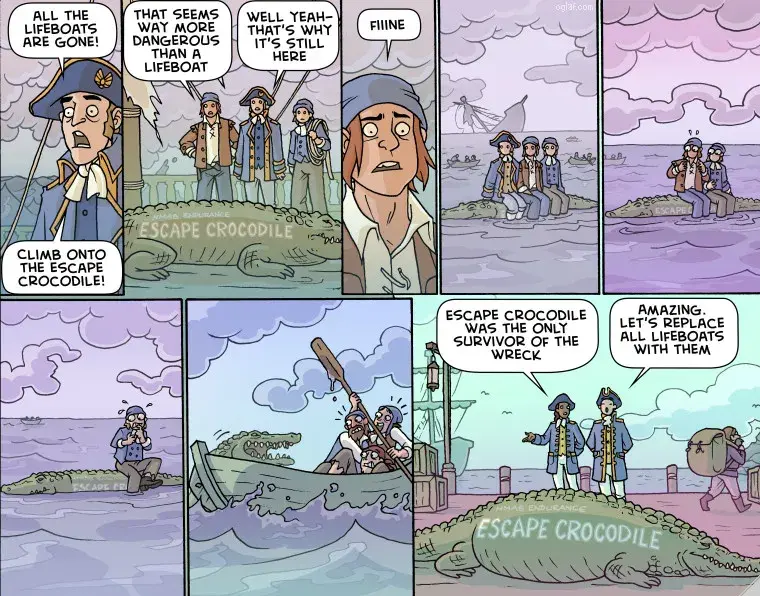
I can’t help but think that this is a clever metaphor for how everything in this stupid economy works.
Is it Happening All Over Again? by Eric Salzman (Racket News)
“In another recent debacle, BlackRock’s private credit fund TCP Capital Corp valued the debt it extended to Renovo Home Partners to be worth 100 cents on the dollar as late as this past September and by November, Renovo declared Chapter 7 bankruptcy and the loan was valued as zero. From Bloomberg:”“The two biggest Hail Marys in the credit business — debt for equity swaps and deferred interest payments (payment in kind) — were being thrown at this pig, and still BlackRock and MidCap valued the loans to Renovo at 100 cents on the dollar and then valued them at zero in the span of a few weeks. Some — perhaps investors — might call that fraud, too.”“It was no mystery Renovo was in a tough spot. In April, lenders had agreed to take losses and convert some of their loans into equity as part of a recapitalization that was supposed to give the company a chance to turn its business around, the people said. In the third quarter, they also allowed for deferred cash interest payments on its restructured debt, an arrangement known as payment-in-kind, regulatory filings show. Yet at the end of September, funds managed by BlackRock and MidCap Financial were still marking the new Renovo debt at par, which typically indicates investors expect to be paid back in full.”
“[…] the Financial Times noted that Edgan-Janes’ ability to issue more than 3,600 rates last year (and another 3,400 so far in 2025) with only about 20 analysts makes it “the most prolific grader of loans to individual businesses.”
“Those analysts must be pretty busy.”
They’re just waving everything through again, for kickbacks. Hold on to your hats.
“What the Fed does not seem to be addressing is that while banks have cut back their direct lending to middle markets, they have ramped up their lending to private credit who in turn lend to middle markets.”
Is it really this easy to evade regulation now? Does this work? Or is it illegal and everyone will get yelled at later, when the entire economy has gone tits-up again? Are there no adults around?
Bessent Torched Over Bonkers Explanation for Rising Beef Costs (Facebook)
It’s amazing that what Bessent says makes me angrier than Facebook’s video-player UI.
He’s an idiot but he fits in perfectly. He has no idea what he’s talking about and yet here we are, listening to him because he is the fucking treasury secretary. None of them have any idea what they’re doing, so they do the worst thing possible every time. Marco Rubio is the worst. No, wait. Vance is the worst. No, Trump is the worst. No, wait, they’re all the worst.
On the subject of that video player: by the time I figure out where the “sound on” button is, seconds have passed. I can’t scrub back though because there’s no scrubber to go back to the beginning of the video. For the same reason, you can’t tell how much longer it is, nor can you really tell when it’s just looped back (because you missed the start and you can’t see the video progress). I WEEP for how people are forced to use the Internet.
As a dear, brilliant friend once told me: “We could have such nice things.”
How China is Turning Climate Action Into Economic Strategy by Imran Khalid (CounterPunch)
“For developing nations already facing floods, heatwaves, and food insecurity, COP30 is more than another climate summit, it is a test of credibility. With Washington stepping back, Beijing’s consistency assumes outsized importance. Its zero-tariff access for green technologies, combined with massive investments in solar, wind, and electric vehicles, has already helped push global costs down. These are tangible contributions, not diplomatic talking points. For much of the Global South, China’s approach offers not just technology, but dignity. It is a model of partnership rather than prescription.
“Still, China’s transition remains a balancing act. Coal continues to play a role in its energy mix, and regional disparities persist between industrial output and environmental goals. Yet the trajectory is unmistakable. China is investing in green innovation, scaling up renewables, and embedding sustainability across its broader development strategy. Its upcoming fifteenth Five-Year Plan is expected to deepen this integration further, linking emission goals with industrial upgrading, digitalization, and infrastructure planning.
“What makes Beijing’s approach distinctive is its systemic logic. Climate policy is not treated as a standalone concern but as part of an economic transformation. The Belt and Road Initiative’s Green Silk Road, for example, now emphasizes sustainable projects, from solar parks in Kenya to hydropower modernization in Central Asia. These aren’t merely reputational exercises; they illustrate how climate action can align with development and diplomacy simultaneously.”
“China’s willingness to share technology through trade and investment makes it a collaborator rather than a gatekeeper in the energy transition.”
Stranded Assets and the AI-Driven Gas Turbine Renaissance by Paul Kedrosky (Substack)
“AI has flipped the global gas-turbine market from slack to locked-in:”“The key point: this is forward-committed demand—capacity pre-sold years ahead based on today’s AI-energy nexus narrative.”
- Lead times: Now 5–7 years for large turbines.
- Order books: OEMs (Mitsubishi, GE, Siemens) say they are fully committed to ~2030–2032.
- Prices: Turbine costs are up 2x in some categories.
- Driver: AI/data centers projected to take ~12% of U.S. power demand by 2028 vs ~4% in 2023.
- Customer mix: Hyperscalers are crowding out utilities and emerging-market buyers for the same hardware.
Debt now moving to centre of AI boom by Nick Beams (WSWS)
“Morgan Stanley estimates that between this year and 2028 the capital spending on AI infrastructure will be $2.9 trillion, of which $1.5 trillion will be financed externally, including $800 billion from private credit sources.
“Apart from the money involved, the scale of AI data centres is indicated by their power consumption. The International Energy Agency has estimated that electricity demand from AI data centres worldwide will more than double by 2030 and reach a level higher than the electricity consumption of Japan, the world’s fourth-largest economy.
“Last month, OpenAI announced plans for a major data centre in Michigan which, according to a report in the Financial Times, will consume as much electricity as 44.2 million households. Other operations are on the same scale.”
“[…] the enormous gulf between the spending on infrastructure and the revenue being generated. OpenAI has signed deals amounting to $1.5 trillion, but its revenue for this year is expected to be just $20 billion. If it is going to go anywhere near meeting its commitments to acquire chips, then that will have to be raised to the hundreds of billions of dollars.”
“Another issue is the short life cycle of chips, which can be as little as three years. This means that the value of the asset backing of the massive loans used to finance the data centre will be rapidly depreciated as they become redundant, requiring new expenditures to remain competitive.”
“According to calculations by former International Monetary Fund leading economist Gita Gopinath, a collapse in the AI market equivalent to the bursting of the dot-com bubble would cause US investors to lose $20 trillion, an amount equivalent to 70 percent of American GDP, and deliver a $15 trillion hit to the rest of the world, equivalent to 20 percent of its GDP.”
GP Vs. GPUs: How OpenAI Loses Money by Indrajit Samarajiva (Indica)
“It’s disgusting how much OpenAI ignores Gross Profit. GP was the bedrock of Economics as I was taught it, but Technomics hits the crack rock of ignoring it. On the street, if coke costs 9 and cutting it costs 1, you need to sell crack for 10 or else you’re done. If you lose money on each rock, you’re not a dealer, you’re a crackhead, or a narc. On Wall Street, however, if compute costs $5 billion and you sell it for $4.3, that’s somehow a galaxy brain idea. Those are actualish OpenAI numbers, check the FT, and they’re actually retarded.
“OpenAI is just a money laundry for Microsoft and NVIDIA and other evil there. The business never even beings to break even, according to their own projections, and yet they’re writing promissory notes worth trillions for decades into the future, as if they’re building pyramids. They’re pyramid scheming. As the FT says in their reporting, this is not a serious chart and these are not, as Logan Roy said, serious people.”
“Every instance of ChatGPT has to reincarnate fully, which is really expensive folly. It’s comically and karmically expensive. It’s like rubbing a genie bottle to do the dishes. At some point, just you run out of wishes. And I, for one, am here for it. The crash of OpenAI will be delicious, and if we’re lucky, it takes the whole US economy with it.”
“OpenAI loses money on a GP level, and companies that do this are not supposed to exist. They’re supposed to go out of business, because selling quarters for a dime is not a business. But now they’re betting the whole US economy on this. It’s not the USA anymore, it’s USAI. As Economist Jason Furman said when you remove data centers and AI from the US of AI, growth is only 0.1%. GPUs are the tulips for this turnt empire, grown in copious bullshit, and ultimately useless.”
“Profit is, again roughly, (GP − everything else). If you’re losing money here, you need not (necessarily) fear. The machine makes money, just not enough to cover rent and stuff. Negative profit is a problem that can be solved by more volume, but more volume just makes negative gross profit worse. This is the vital difference between the vital statistics.”
“Inference—meaning every dumb prompter’s cost to be the boss—costs a lot. This isn’t Google, serving a cached webpage and printing cash by making it worse. Each query on OpenAI has to spin up expensive, environment-incinerating GPUs to think all over again, over and over again. These servers run hot, and they burn money on every query.
“DeepSeek showed you could do this more efficiently, but the US of AI collectively responded by saying, “Bro, we’re doing fraud here, STFU about efficiency.” The name of the game is buying more GPUs, not increasing GP, you rubes. This is real late-stage capitalist shit, fakes, frauds, and counterfeits, and they’re all in on it.”
“The last thing we should be doing is wasting energy during a climate collapse, but that’s what the US of AI is doing. OpenAI’s business model is not just a violation of Gross Profit. It’s downright disgusting.”
The Rich People Who Own the Media Want Generations to Fight, Not Classes by Dean Baker (CounterPunch)
“The problem is not greedy boomers, but rather ridiculously rich people like Elon Musk, Jeff Bezos, and Mark Zuckerberg hoarding the country’s wealth for their own use and the use of their heirs. People are less likely to see that story because these super-rich people are the ones who own the major media outlets and social media platforms, but that is reality.”
“Since average income has risen consistently over the last seventy years and is universally projected to continue to rise (barring a climate disaster), the only reason why most workers won’t earn more than their parents would be a further rise in inequality. In other words, more money going to people like Washington Post owner Jeff Bezos and less money going to ordinary workers.
“If there is not a further increase in inequality, then most workers in ten or twenty years will be earning considerably more than do workers today. That is irrefutable logic, which apparently has no place in the Washington Post.”
The Dutch Confronted China. It Didn’t Go Well. by Ben Wray (Jacobin)
“[…] in a stunning U-turn this Wednesday, Karremans suspended the takeover. So what had changed?
“In the seven weeks between the seizure and the U-turn, Europe came face-to-face with the reality of its own economic and geopolitical weakness. China flexed its muscles in response, revealing its capacity to cut supply chains that are a lifeline for European industry.
“The Nexperia humiliation is a case study in the depth of Europe’s dependency on critical technologies, and the loss of political sovereignty that economic dependency ultimately results in. But it also tells us something about the geopolitical trap that the continent has fallen into. The truth of the Nexperia tale is that the Dutch would not have even considered the risk of taking on China if the company was not in the crosshairs of American imperialism.”
“The Dutch government claimed the timing of the seizure and the US blacklist announcement were “purely coincidental.” Yet it is absolutely clear from a court case relating to the Nexperia dispute that this is not true. The court documents describe a meeting this June 12 between Dutch and US officials, during which the American side stressed their unhappiness “that no externally visible measures have been taken.””
“[…] the Netherlands was forced by the United States to choose between Chinese divestment from Nexperia or Nexperia being treated as toxic waste by the US government and American big business. The Dutch, as they always do, chose to tow [sic] Washington’s line”
“[…] Wingtech responded to the Dutch government seizing control of Nexperia by cutting the subsidiary off from its production facilities in Guangdong, China — crippling 70 percent of Nexperia’s output — trouble was brewing for European manufacturers. The problem accelerated when the Chinese government then banned Wingtech from selling its chips anywhere except China.”
Science & Nature
What Is a Manifold? by Paulina Rowińska (Quanta Magazine)
“Manifolds have also come to occupy a central role in fields such as geometry, dynamical systems, data analysis and physics. Today, they give mathematicians a common vocabulary for solving all sorts of problems. They’re as fundamental to mathematics as the alphabet is to language. “If I know Cyrillic, do I know Russian?” said Fabrizio Bianchi, a mathematician at the University of Pisa in Italy. “No. But try to learn Russian without learning Cyrillic.””
“By considering the string in three dimensions, you can pass it over and under itself before you connect the ends, creating all sorts of knots beyond the simple loop. They all represent the same one-dimensional manifold — the looped string — but they have different properties when considered in two versus three dimensions.”
“All that had been achieved by the Nexperia spectacle was to demonstrate just how deferential Europe is to the United States, and how dependent it is on China.”
Why should we care, you might ask? Because often these results map onto other domains of more practical use. We have tended to profit from proven facts—especially simple ones that are orthogonal to each other—from which we build complex systems, often ones that are recursive or fractal and whose power and design would be otherwise inscrutable.
“Because it’s possible to think about any small patch of the manifold in terms of Euclidean space, mathematicians can use traditional calculus techniques to, say, compute its area or volume, or describe movement on it.”
“Even in cases where manifolds don’t seem to be present, mathematicians and physicists try to rewrite their problems in the language of manifolds to make use of their helpful properties. “So much of physics comes down to understanding geometry,” said Jonathan Sorce (opens a new tab), a theoretical physicist at Princeton University. “And often in surprising ways.””
“Each point on this torus represents one possible state of the pendulum; paths on the torus represent the trajectories the pendulum might follow through space. This allows researchers to translate their physical questions about the pendulum into geometric ones, making them more intuitive and easier to solve. This is also how they study the movements of fluids, robots, quantum particles and more.”
Why don’t jet engines melt? by Veritasium (YouTube)
This video should make you incredibly respectful of industrial engineering, materials science, and manufacturing but may also make you wonder how a jet engine works at all. It works because of regulation. This is a highly regulated industry. There is no room for moving fast and breaking things. You need to produce materials that survive hellish conditions for dozens of thousands of hours, approaching failure in a very predictable way.
At about 16:00, the host starts talking about replacing an incredibly skilled woman with a robot while standing right behind her. Rude.
From the comments:
“I sometimes think about what would happen if by some crisis we’d lose all our civilizational knowledge. This insane level of material science of just a tiny bit of a plane reminds me how impossible it would be to just build this knowledge back”
“comp sci and such would be comparatively easy − they’re purely logic based professions. Logic doesn’t change and the search space, while infinite, has a lot more hints about how to navigate it (and fewer barriers to entry) compared to something like physics or material science. There are metallurgic advancements we have not managed to figure out from our own history already. Not that we can’t do better now, but that we don’t know how it was done with the materials, machines, and knowledge on hand.
“Heck, it took us forever to figure out Roman concrete despite having the recipe, and it inadvertently uses a ton of the same tricks as many of our most advanced formulas, allowing it a modicum of self-repair under certain circumstances.”
“My father was a wax mould maker and it was fascinating to see him work on the math to think of the final metal cast part while making the mould for the wax, taking the wax retraction and metal retraction into account. He wasn’t a great dad but he was one amazing engineer.”
Even the testing facility at the end, where they throw dust into the engine to measure its ability to continue running as expected under conditions in the upper atmosphere…that whole facility has incredibly sophisticated machines, each composed of sophisticated parts, each of which were built and tested to expected conditions in their own testing facilities, all the way down to the smallest screw.
It is an absolute miracle, really, that this all keeps going. The first half of the video shows in painstaking detail how metallurgists spent years testing different materials to find something that would be able to withstand the extreme heat of a jet engine—2500ºC—but also the incredible centripetal force exerted on each blade—20 tons—until they ended up growing each blade from a single crystal of a ceramic compound and set up all of the production to create these things with the level of quality, reliability, and reproducibility that means that they last for 25,000 hours of service before they fail and, when they do fail, they do so along predictable curves so that you never send something up in the sky that might suddenly break. The entire process is an absolute work of art.
It’s a pity that those in charge have little idea of how fragile this is, and how appreciative we should be of it. They’re just interested in extraction, slicing away the leeway and margins out of this incredibly sophisticated processes, surfing the edge of safety to generate profit for themselves. If they fall off their surfboard, no big deal for them. This video is a great reminder of what it means when you hear “manufacturing is gone” or “we’ve lost a generation of manufacturing”.
Environment & Climate Change
I wish we could ignore Bill Gates on the climate crisis. But he’s a billionaire, so we can’t by George Monbiot (The Guardian)
“[Gates] writes as if there were no such thing as political power, and no such thing as billionaires. His main contention is that funds are very limited, so the delegates at this month’s climate summit in Brazil should direct money away from “near-term emissions goals” towards climate “adaptation” and spending on poverty and disease.”
“Yes, the funds available for any good cause are scarce, but that’s not because of some natural law, some implacable truth about human society. It’s because oligarchic power has waged war on benign state spending, leading to the destruction of USAID and drastic cuts to the aid budgets of other countries, including the UK. Austerity is a political choice. The decision to impose it is driven by governments bowing to the wishes of the ultra-rich.”
“There are truckloads of money available. Just after Gates published his new missive, Oxfam revealed that the net worth of the 10 richest US billionaires grew by $698bn in the past year. That money alone, the increment in the wealth of 10 people, is almost 10 times the annual amount required to end extreme poverty worldwide.”
It’s not real but ok point taken, it still conveys power. It will disappear soon, but so will everyone else’s money.
Art, Literature, Music, & Cinema
Of a Dreamy Sabbath Afternoon by D.H. (Lapham's Quarterly)
“In the nautical sense, the phrase in irons, refers to a sailing vessel that is, according to the OED, “stalled head to wind and unable to come about or tack either way”—a definition well-seasoned with still more nautical language: head to wind, come about. In its nautical sense, the term in irons dates only to 1832 and seems to have derived from an older meaning of irons, synonym for manacles or handcuffs. A boat in irons has been taken prisoner by the wind.”
“In the lines, hempen and invisible, that tether Isolatoes to one another, federating them along one keel, Melville finds a metaphor that complicates Emersonian notions of self-reliance, a metaphor of mutual risk and mutual dependence that suggests to Sachs and to other readers the need for solidarity, about which Hannah Arendt also wrote, as Roger Berkowitz reminds us in today’s installment of Amor Mundi:”“Solidarity, Arendt insists, “is not sentimental.” It is not grounded in pity, which isolates and condescends. Pity narrows compassion to the miserable; solidarity, by contrast, partakes of judgment and reason. It binds the strong and the weak, the rich and the poor, into what she calls “a community of interest.” Its foundation is not guilt or empathy alone, but what Arendt names “the honor of the human race.“”
“We learned this week, from a kindly curator at the Plattsburgh State Art Museum, that Rockwell Kent’s illustrations for the 1930 edition of Moby-Dick have just this year entered the public domain. Kent’s illustration for Chapter 110 appears atop this dispatch. He did not choose to depict Queequeg, or Queequeg’s coffin. He chose instead to illustrate this passage describing the imaginary funerary rites of Rokovoko, a fictional island that is not down in any map because “true places never are.” There is the dead warrior in his canoe. There, beyond the visible horizon, is a starry archipelago. And the canoe’s white wake is a Milky Way.”
Why Movies Just Don't Feel 'Real' Anymore by Like Stories of Old (YouTube)
This video is chock-full of great comparisons of movies that don’t convince juxtaposed with those that do. It’s about authenticity. And this isn’t a problem that AI can really make significantly worse because it’s already gotten so bad over the last couple of years.
While he does discuss the wholly unnecessary foreground-blur engendered by faking focal length in digital processing, he doesn’t talk about how shaky-cam is a 21st-century cinematic pandemic.
Sunday Poem: Hope and Love by Jane Hirshfield | Jim Culleny (3QuarksDaily)
“All winter
the blue heron
slept among the horses.
I do not know
the custom of herons,
do not know
if the solitary habit
is their way,
or if he listened for
some missing one –
not knowing even
that was what he did –
in the blowing
sounds in the dark.
I know that
hope is the hardest
love we carry.
He slept
with his long neck
folded, like a letter
put away.”
Treasure by Caitlin Johnstone (Substack)
“[…]
“The cobalt is mined by children
and the music is made by robots“and the grownups are wondering
where the fireflies went.“[…]
“And the boy’s vision changes
and he no longer sees the treasure in things.“He runs to join his dad
and they walk together down the shore“through a dying world
of fading wonder
full of worthless beach trash.““He is wrong,” you whisper
as the blood leaves your body.““There is treasure everywhere.””
The Problem with Guillermo Del Toro's Frankenstein by Professor Asma's Guide To Unusual Knowledge (YouTube)
“In this episode, we explore Guillermo del Toro’s new Frankenstein and the major theme it quietly abandons. We start with Mary Shelley’s original message and what gets lost when the creature is turned into a figure who only wants understanding. Shelley’s monster is not a misunderstood victim. He is a rational and cruel being who chooses slaughter with clear intention.
“From there, we look at the modern trend of monster stories turning fearsome figures into sympathetic victims who lash out only because the world has wounded them. This shift is everywhere in contemporary storytelling, and Del Toro’s film fits right into that pattern.
“Finally, we examine the idea of righteous slaughter and the uncomfortable truth that stories can present rational violence without moral softness. Shelley’s creature stands as the strongest example of this kind of brutal clarity. Understanding this sharpens the tragedy and the horror behind the original novel.”
In the video, he contrasts the film The Joker with the novel Frankenstein, saying that they are completely different because the film exonerates its monster. I don’t agree. I thought that the film’s monster—Arthur—followed more or less the same story arc: they were mostly nice and willing to go along to get along until unspeakable cruelty elicited a cruel response. The creature in Frankenstein may have contained cruelness—and we all do—but it only began to express that cruelness—to let it out, to enjoy it—when Frankenstein was cruel to it, when Frankenstein made it clear that the creature would never be able to enjoy the benefits of the wonderful world limned in the books it had read or in the world he glimpsed in his creator’s own life.
Contrary to Asma, I argue that Arthur in the Joker is the same. I don’t see any extra nobility or clarity of rationality in the creature. Although the cruelness is immanent in both of them, the rational expression of it in the creature—as opposed to what Asma perceives as the haphazard and therefore irrational expression of it by Arthur—doesn’t make that cruelty different. I don’t think that the film portrays Arthur as a sympathetic figure after the first act. He is increasingly terrifying.
He was literally not bothering anyone, suffering along, trying to bring joy as a clown for children, when he was finally shit upon enough by society to cause what some would perhaps nowadays term a “psychotic break” but which was really just as rational a response to a cruel world as the creature’s in Frankenstein.
And, like the creature, he enjoyed it. They are both monsters. They have a similar origin story. I think Asma was distracted by how the people he’s arguing against interpreted the Joker rather than how the film actually was. Many people misunderstood that film and held Arthur up as an edgy, dark hero. That is completely wrong. He began a movement that descended Gotham City into chaos, destroying and robbing the lives of many others who were just as innocent as Arthur just months before.
There is no justification for this kind of violence, even if you round up your behavior to “sticking it to the man,” even if you somehow explain that the current owners of the city are also cruel and don’t deserve to rule it. There is no justification for upending the lives of innocents, of everyday people in that way. Especially when you enjoy the cruelty of it, especially when you find yourself allied with the worst of humanity, with people who are no better than—and possibly worse—than those you claim to be fighting.
“One of the most valuable functions of monster stories is their capacity to help us confront the shadow sides of ourselves. Basically, the parts we disavow. And I think the monstrous figures, they externalize our internal contradictions. They they carry our fears and our fantasies. But in order to do that work, they must be allowed to remain threatening. They must sort of retain their capacity for harm.
“The problem with making monsters purely sympathetic is that we end up telling stories of injustice without agency. The monster becomes a proxy for marginalized identities and all this violence is sort of rendered passive, reactive or or somehow even redemptive. We like it that they’re destroying everything because they were hurt themselves. But cruelty isn’t always passive like this and malice unfortunately is not as rare as we’d like to believe. So when we erase those aspects of the monster like Del Toro does, then we kind of dull the moral and psychological edge of these stories.”
Tape Bowing Ensemble by Open Reel Ensemble (YouTube)
This sounds nice. It’s wild and weird. It’s a single fixed camera. No jumps. No cuts. Just three musicians. No sales pitch. The only hint that it doesn’t come from the deep past of the Internet is that it’s in HD.
The same group also gets considerably more experimental.
Magnetik Phunk (Who's Playing What) by Open Reel Ensemble (YouTube)
Sci-Fi Short Film 'Metropius: Beneath the Surface' by DUST (YouTube)
This ended up being better than I’d expected. It’s very much a video-game vibe but it has good world-building, a good story, good direction, and good shot-selection. The world is completely rendered in what looks like a video-game engine. The people aren’t very realistic, which is probably good, as it avoids the uncanny valley, for the most part. Only the very first character was offputting. Otherwise, the animation, gesturing, etc. were relatively convincing.
I wonder, though, to what degree mass-consumption of this kind of content paved way for AI-generated content and videos. I think that AI-generated content still has very far to go—largely because it lacks nearly all of the subtle cues that make something watchable or readable. It’s just not good. People either don’t notice that it’s not good because their taste has been fundamentally broken by decades of non-AI slop—let’s not pretend that slop began with AIs—or because they just don’t know enough to care, i.e., they seek distraction.
While this video ended up being better than I expected it to be, I was reminded of a short story I’d read earlier in Linux admin hated downtime so much he schlepped a live UPS during office move by Simon Sharwood (The Register), which was intriguing but failed to entertain because the storytelling style was so wooden. There was no rhythm to it, no beat that you could pick up on. It was just bad writing. I was forced to wonder whether the author was just bad at writing or whether he’d had the story written by an LLM. Even the title, in hindsight, is trash, although it was click-bait-y enough to make me click on it. I actually clicked it because I have a good friend who likes these kind of stories. But it’s so poorly written that I wouldn’t bother him with it.
If the author wrote this himself—if the author even exists!—then it would be a waste of time paying him for stories like this. If the Register can fill its site with “content” for pennies by having an LLM write this kind of trash, then they probably “win” by gaining page impressions that they can monetize.
Crutches by Amy X. Wang (The Baffler)
“At the animal shelter I said, Give me the worst dog available, which turned out to be an oafish, fecal-brown Vizsla missing a back leg. But of course B doted on him. She found endless excuses to come over. She took a hundred pictures of Tokyo expelling sludge in the yard, balanced on his three legs, prism-like.”
This very short story was surprisingly good. There is no good way to cite it to give you a flavor of it. It is unique. It is kind of about love. There are dogs in it. There are misunderstood and psychotic friends. There is devotion. It’s weird but good.
Philosophy, Sociology, & Culture
Welcome To The Machine by Indrajit Samarajiva (Indica)
“You can really feel it in the liminal spaces, where you feed yourself to the machine. Where they scan you, pat you, and ask you for ID; evidence that you’ve been scanned, patted, and ID’d already, by some other part of the machine. It’s a very big machine and the right hand doesn’t know what the left is doing.”
“[…] you can feel the state’s mastication, running you across their teeth to see if they should bite you or let you be. You can feel palpitation of nations—each office an orifice—whispering what is thissss? Fingering IDs, IDing fingerprints, so that the blind state may see. We are always subliminally inside the machine, but in these liminal spaces, you can really feel it.”
“This is why I say that we have been ruled by AI for centuries. When you’re in the belly of the beast, who cares if it’s based on silicon or carbon copies? It’s like debating whether it’s a crocodile or alligator while the thing is eating you.”
Exactly! AI is incremental, not substantial. It is another step down the wrong road, so we’re even farther from where most of us would like to be.
“They write my name in red, the facts of the case in blue. Every time they write my name, my address, and religion, because the state AI has a very small context window. Then the cop writes a page-long essay on my missing parking ticket—what it contains I can’t ascertain—and then I sign the thing because I’m just trying to leave. Why should a fish debate with the crocodile’s teeth? I’ve long since given up and try to let them shit me out in peace. And I’m almost there, I can feel it.”
What Socialism Got Right by Jeffrey Pomerantz & Jason Griffey (MIT Press)
“Through a close examination of the shattered careers and broken families of ordinary men and women forced to live through the cataclysmic decade of the 1990s, I asked readers to empathize with the sheer scale of the upheavals of banking collapses, hyperinflation, unemployment, violence, suicide, and the mass emigration of youth. Capitalism promised prosperity and freedom, but for many it delivered little more than poverty and despair. The dislocations of the transition period, as I’ve documented in my subsequent books, still reverberate today. One can easily draw a straight line from the trauma of the 1990s to the rise of right-wing parties and authoritarian leaders in the region.”
“[…] she maintained that this was only because they had been brainwashed by the socialist system. My Bulgarian informants in the late 1990s were apparently incapable of understanding that capitalism would bring higher salaries with which one could purchase supposedly better-quality housing, education, healthcare, and childcare, and that this would be far preferable to having lower wages but receiving these things for free.”
“This is not to deny that there were some appalling things about the communist regimes, including its lack of genuinely representative government, its attacks on political speech the government didn’t like, and its use of repressive and secretive police outside the rule of law. One should condemn such infringements of basic human rights, both as they occurred under communism and as they are happening now in the United States.”
“Those with the most to gain from capitalism want us to forget the good things that happened under socialism, lest we try to do anything to change a system in which wealth flows up into the hands of the rich and powerful.”
“The experiences of socialist countries in Eastern Europe remind us that societies can achieve a great deal when they treat people’s basic needs as a shared responsibility. Education, healthcare, childcare, housing, and a reasonable, minimal standard of living were seen not as privileges, but as something we should collectively guarantee for all.”
“My subjects did complain about having to wake up early for neighborhood work on a “Lenin Saturday,” but also noted that socialism promoted a belief in the power of community and the dignity of every person’s contribution. Women entered schools and workplaces in greater numbers, finding new confidence and independence. Cultural life — music, theater, literature — was made accessible to everyone, helping people feel connected to something larger than themselves.”
“[…] success isn’t only about material wealth or technology, but about how we choose to care for one another. When an economy is guided by social purpose instead of profit, it can serve the common good and lay a foundation for long-term progress, a lesson that we should all remember as we face the existential threat of the climate crisis.”
Idle Things by Robert Rubsam (The Baffler)
“The Nazi architect Albert Speer certainly thought ahead. His plans for the Nuremberg parade grounds and the Berlin Volkshalle took into account how each structure would look once it had fallen into disrepair—to become ruins on the level of Greece and Rome, long after the thousand-year Reich had run its course. Ruins, for Speer, were fundamentally aesthetic objects, works of picturesque destruction which acquire through their wear and tear a unique form of “ruin value.” The grandeur of the Nazi regime would only come into view once cracked and scoured by wind and rain, ravaged by the passage of time.”
““Only later did I understand,” Erpenbeck reflects, “that what seemed so familiar to my childhood eyes was actually another era, a destroyed era that sticks in the throat of the new one until it can finally be spit out.””
“The structure, built over the demolished ruins of the old Berlin City Palace, had now become politically redundant and spiritually toxic, and, like all other reminders of the DDR, it had to go. Like the state it had been erected to celebrate, the Palace was razed and replaced. In this case, by a brand-new Berlin Palace, reconstructed in the grand old style. The past has returned in the garb of the future and consigned what was once the given present to a distant and inaccessible time. Reading Erpenbeck, you see how we must live through history to see the ruin anew. Or rather: by living through history, we see that every ruin has a ruiner.”
“When a world dies, much dies alongside it. Ways of thinking, ways of building, ways of living so mundane no one noticed their presence or their passing. “Whenever a thing disappears from everyday life,” Erpenbeck writes, “much more has disappeared than the thing itself.” The evaporation of the DDR shifted border lines, political formations, rights of free trade and free passage. It allowed former East Germans to replace damaged tights, to fill their apartments with brand-new furniture, to bring back espresso machines from their trips to Italy, just as it allowed them to get rid of their darning thread, to junk old wooden furnishings, to get rid of those coffee pots that Erpenbeck remembers on the table of her family reunions, always pear-shaped and full of weak coffee and always with a foam rubber roll around the lid to catch stray droplets.”
“The shared spaces between apartment buildings are dissected and fenced off, until they become unusable/impassable. Erpenbeck’s son’s nursery school in historic Mitte is sold off and demolished, more valuable for its property than whatever educational purpose it might have served. Even the Splitterbrötchen pastries she grew up eating are now scarce. It is her own world which has become the relic, the curio, the tumbledown ruin. Or perhaps a skeleton, “individual bones with a great deal of soil in between.””
“Rather than the active, mutable space of the vacant lot, the derelict building, the ruin, you have the strictly policed sites of “memory culture,” which run a border wall between what can be respectably mourned and what must be forgotten.”
“No more than a memorial arch or a pair of legs ruined in the desert, these words cause us to pause and to reflect. That things have once been otherwise and might be otherwise again. That structures raised today will fall tomorrow. That in the end, as Schalansky writes, “all that remains is simply whatever is left.””
On The Rapidly Spreading Delusion That AI Chatbots Are Conscious by Caitlin Johnstone (Substack)
“The fact that so many people are unable to understand the difference between a person and a computer program that talks like a person says such dark things about our society. There are whole sections of the population that have never examined what it is to be conscious, who have never examined the nature of their own minds and their own experience. If they had, it would never even occur to them that an AI chatbot is in any way similar to a human organism in terms of thinking, feeling, and subjective experience.”
At first, this made me think that most of these people don’t actually believe that chatbots are real; they’re just grifting. That’s also terrible, though. If the only viable explanations for what we’re looking at is either that the participants are so shallow that they don’t understand the first thing about being human, or that they’re grifting, or some combination of the two, then what we’re looking at is objectively bad.
It is stupid and unhelpful to round these chatbots up to humans. Anyone who believes that they are human doesn’t understand the first thing about being human themselves—they’ve not put in the effort to learn empathy or exercise any introspection and have effectively rounded themselves down to chatbots themselves.
But, sure, go ahead and make this play. Who’s going to stop you? You’ll probably all end up millionaires for being shockingly infantile or immorally greedy or both. That’s what our society seems to reward the most.
Strange Visitors Discover the Secrets of a Long-Dead Space Station by DUST | Sam Bradley (YouTube)
It’s unclear why DUST chooses to retitle these things. The original name is Space Between Stars (IMDb). It’s absolutely wonderfully animated. There is no dialogue. A good comment on YouTube sums up the plot (spoilers),
“An eldritch scourge that looks cute. That explains why when the first two larger ones were killed, the other’s didn’t actually react, just simply continued to run away for themselves together. Then the last larger one sacrificed the two lesser ones to survive for itself long enough to get to the source, grow and propagate.
“The red droid simply already knew what they were, which is why it tried to take them out. The blue things were allegedly the very thing the ship’s race was running from, defending from. This is why the red one was scared when it failed, actually showed emotion; showed fear.
“We watch from the scourge’s side even though it would have been the red droid and it’s people’s side we would have sided with morally based on our own morals and beliefs. But the winners win, and the losers lose. And the winners get to choose how history is written, eh?”
Fear is the Heart of All Bad Things by Freddie deBoer (Substack)
“I live right up the street from a public elementary school. This was part of the reason we bought this house, if a minor one; I mean, who knows if we’ll even still be living here in five years when Junho is ready for kindergarten. But it’s a lovely little school by the woods that’s a ten-minute walk from our home, and thinking about walking him to school in the mornings fills me with what the kids use to call “the feels.” Crunching through leaves on a New England fall morning, delivering my little guy to school as he bops along beside me…. I drive by and see the sweet little multiracial student body doing silly kid stuff on the playground and I try to imagine him that age. Can’t do it! But I look forward all the same.”
“I cannot stress enough how fundamentally irrational it is to chauffer your children to school every day, out of safety concerns; that reasoning requires just a wild misreading of the underlying danger. The child fatality rate for school buses is 0.2 fatalities per 100 million vehicle miles traveled (VMT), while the rate for passenger cars is 1.5 fatalities per 100 million VMT. This means students are nearly eight times more likely to die in a passenger car than in a school bus per mile driven.”
“If your family is middle class or above, the risk of your child being snatched off the street are far lower than the risk of them being killed by bees or by a dog. And if you’re inclined to say that children today are safe because of fearful overparenting, I’m afraid the evidence just doesn’t support your position. Random child abduction has always been remarkably rare. It’s just not a realistic fear.”
“[…] every successive generation seems to fall deeper and deeper into the clutches of irrational fear. I mean, if you think Gen Z is unhealthily addicted to safety and habituated to fear when it comes to their own lives, can you imagine how they’re going to parent?”
“That we exempt the most dangerous machines in the lives of most people, their cars, is just another reminder that irrationality and fear go hand in glove. Whatever the reasoning, car-addicted parents believe they’re mitigating risk when in fact they’re escalating it.
“Safetyism thrives on a false sense of control. Driving your kid isn’t safer but feels safer because you are behind the wheel, you are monitoring the environment, you are acting. Sending a child off unsupervised, whether onto a bus or onto a sidewalk, feels like relinquishing agency. But of course the factors that govern risk don’t care about feelings.”
“This bone-deep cultural addiction to irrationality isn’t an annoying quirk but a societal crisis with societal consequences. The more parents who overparent and treat their children as incredibly delicate creatures who have to be hidden away from the world, the more that becomes a social expectation that everyone else has to labor under. The more that fearful parenting becomes the norm, the more that legal structures bend to punish parents who push for a heathy sense of risk and freedom for their own children.”
“At the heart of all this is an American identity forged around the idea that danger is omnipresent and must be fought with constant vigilance and personal sacrifice. Safety becomes less about actual outcomes and more about performing the role of the good, ever-concerned parent. But when emotion and optics take precedence over evidence, we create exactly the harms we claim to be preventing. Luxuriating in fear that way feels responsible; the reality is anything but.”
This addiction to fear expresses itself much more nastily in the American public’s propensity for approving lustily of any violence exacted on other countries in the name of their security. The “bone-deep cultural addiction to irrationality” is just one facet of a virulent anti-intellectualism that the U.S. seeks to impose on other countries—the worst kind of cultural infection.
It was cold and starting to rain this morning as I was in home office. I was on the terrace for a couple of minutes, getting some fresh air and stretching. The walking path that goes past my building leads directly to an elementary school. Four times a day, hordes of kids stream back and forth. Today, there were two stragglers, sharing an umbrella, in the kind of scene that most people who drive their kids to school every day would immediately “like” in a Facebook or Instagram post, or would love to see included in a calendar.
I was thinking the same thing as deBoer this morning: that those who drive their kids to and from school every day are robbing their children of these experiences, of the socializing on the way to school, of the feeling of autonomy, of sharing a secret with a friend, etc. etc.
Was the United States Once a Global Leader in Educational Metrics? Have We Fallen From Those Lofty Heights? No and No by Freddie deBoer (Substack)
“[…] the collection of quantitative data was paltry compared to the 21st century. If you take an average 17-year-old from the United States in, say, 1975, you’re talking about a student who likely never received any educational assessment or benchmarking besides the grades on their report card, which they likely received twice or four times a year. Those grades might not even have been averaged together into a GPA. We just don’t have data to compare to. Personally, I find it powerfully unlikely that if you could pull aside the average American in 1975 or 1950 or 1925 or 1900 or 1875 and give them an academic exam, they would produce results that suggest a past golden age of academic preparedness.”
“Free compulsory K-12 education is the best thing this country ever did, but of course it had the consequence of average student performance looking far worse than it did when only the brightest children of the richest families were ever educated to begin with.”
“In 2011, the Brookings Institution released a report explicitly aimed at debunking this “myth of glory days.” The report highlighted results from the First International Mathematics Study (FIMS) conducted in 1964. In that assessment, the United States ranked 11th out of 12 participating countries, beating only Sweden. Far from leading the pack, the U.S. was already trailing nations like Japan and the UK well before the cultural upheavals of the late 1960s or the educational reforms of subsequent decades. As the Brookings report noted, “The United States never led the world… it was never number one and has never been close to number one on international math tests.””
“Poor math performance by average students made no difference to our scientific and technological advantages; the performance of the most academically gifted and inclined are what matter in the world of high-stakes science and technology. Which is fine.”
“In 1989, a dozen countries and Canadian provinces participated in a mathematics assessment conducted by the Educational Testing Service. Korea, French Quebec, and British Columbia were the top three. The United States ranked last.
“An international study in the 1990s tested 13 year olds in mathematics in 15 countries. The United States placed next to last, above Jordan.
“Here are the results of science assessments of high school students: In 1973, the U.S. rank was 14 out of 14 countries. In the mid-1980s, the U.S. rank in biology was 13 out of 13 countries; the U.S. rank in chemistry was 11 out of 13 countries; the U.S. rank in physics was 9 out of 13 countries. In 1991, the U.S. rank in science was 13 out of 15.”
So the average is terrible but there are pockets of excellence, as noted below,
“[…] the U.S. produces a peerless cohort of elite students. For starters, we simply have more top students than most developed nations. The OECD’s PISA country notes for the U.S. highlight that a larger percentage of American students were “top performers” (achieving Level 5 or 6) in Reading and Science than the OECD average. In Science, 11% of U.S. students were top performers compared to the OECD average of 7%. In Reading, 14% of U.S. students reached the top levels versus an OECD average of 7%.
“More than just the number of really smart kids, though, there’s just how well our very brightest students perform. American students are currently enjoying a run of dominance in the world’s most prestigious academic competitions that would be the envy of any nation.”
“It’s perfectly fair to say that higher expectations don’t mean much if they aren’t being met. But you do have to factor that into any narrative of decline; attempting harder material over time is a fundamental part of the advance of education. To say students are “doing worse” ignores that they are attempting much harder material much earlier.”
“The narrative that American schools “broke” while the rest of the world flourished is factually incorrect. Learning loss is a global phenomenon, exacerbated by a catastrophic event, not a structural flaw unique to the American education system. And the fact that this decline is so widespread makes efforts to blame American policy and pedagogy specifically very, very weird. Surely, an international decline in academic performance that’s strikingly uniform is not a reason to blame specific American policies!”
Technology & Engineering
.jpeg) Apple Store still loves the same three apps (and also Gemini)
Apple Store still loves the same three apps (and also Gemini)
A few months later and the Apple Store is still just as boring as ever. They literally have no better ideas than to push AI apps on their users. The logos all look the same. None of them look like anything. AI continues to suck all of the air out of the room as every giant company in the world continues to try to shove money under itself in order to keep itself above water and OpenAI is openly ordering the U.S. government to backstop it. This is a great timeline.
The Death of the Landline Will Kill You by Ted Rall
“The scale of this stupidity is breathtaking. Without a second of thought, the United States has decided to destroy its own ability to communicate in the event of a natural disaster, civil conflict, or war. Under POTS, the only single point of failure—the vulnerable link in a system—was the telecoms’ switching hubs. Fiber-optic networks require backups all over the place, including the modem of every single Internet user in the nation.
“We are one hacker or technological maintenance error away from the digital phone system being taken out over a vast swath of the country. Citizens won’t be able to contact emergency responders. Government officials won’t be able to talk to one another. You won’t be able to contact your family or friends. Businesspeople will be silenced when they need to conduct financial transactions.
“We haven’t met the enemy yet. But his best friend is us.”
LLMs & AI
Only three kinds of AI products actually work by sean goedecke
“You can only give your chatbots tools that the user could do themselves − in which case, your chatbot is competing with the usability of your actual product, and will likely lose.
“Why will your chatbot lose? Because chat is not a good user interface. Users simply do not want to type out “hey, can you increase the font size for me” when they could simply hit “ctrl-plus” or click a single button3.”
This might be true for simple products. More complex products might benefit from a search-like UI built directly into the tool itself. You can either dig your way through hundreds of settings or you can write “Make the debugger always stop when it encounters any exception.” That kind of thing has been difficult in the past and I think that there’s an opportunity to be had by wrapping a tool, its help files, and an internet search in an LLM response.
The author is making the same mistake that I’ve seen so many other tech-savvy writers make: they don’t interact with real users. They have no idea that almost no-one uses hotkeys—even savvier ones—, that almost no-one uses most of a tool’s features, that almost no-one knows anything about settings. For these people, the LLM prompt and response is a much more fun—if possibly also unsuccessful—endeavor than actually learning the tool, which they have never, to this day, bothered to do. This is, of course, assuming that they are even capable of learning the ins and outs of the tool.
The LLM interface can be useful where the abstraction offered by the tool is leaky. When a user needs to know what a proxy server is, in order to tweak a proxy setting so that their VPN software continues to work, the abstraction has not only leaked, it’s broken.
“LLM-generated completions allow users to access the power of AI models without having to change any part of their current workflow: they simply see the kind of autocomplete suggestions their editor was already giving them, but far more powerful.”
“[…] scrolling feeds has become the primary way users interact with technology in general, so the potential here is massive. It does not seem unlikely to me at all that in five years time most internet users will spend a big part of their day scrolling an AI-generated feed.”
How do you not shudder with horror at reading or writing that?
Oh, he’s not done. He seems oblivious to the eldritch horror he describes.
“Users can experience the benefits of an LLM-generated feed (if any) without having to change their consumption habits at all.”
The only caveat he’s willing to offer is that little “(if any)”. It seems inadequate to me.
“I think AI image generation is still more of a toy than a product, but it’s certainly seeing a ton of use.”
Here, I must disagree, as well. I don’t think it’s going to be used for important things but it is seeing heavy use to spice things up for internal documents or documentation. It is now possible to generate graphics that you’d have had to either search, steal, or create in the past. You can even iterate more quickly and reliably than two years ago. I think the use cases are toy-like in that you wouldn’t put the results into a professional product but it is certainly creating some value at companies internally.
The article Uncommented citation of Ethan Mollick glazing Gemini by Simon Willison selected the following quote from Three Years from GPT-3 to Gemini 3 by Ethan Mollick (Substack)
“Three years ago, we were impressed that a machine could write a poem about otters. Less than 1,000 days later, I am debating statistical methodology with an agent that built its own research environment. The era of the chatbot is turning into the era of the digital coworker. To be very clear, Gemini 3 isn’t perfect, and it still needs a manager who can guide and check it. But it suggests that “human in the loop” is evolving from “human who fixes AI mistakes” to “human who directs AI work.” And that may be the biggest change since the release of ChatGPT.”
That’s a carefully crafted statement that sounds a lot like the same shit that people have been saying all along. Each new version is the next great thing. Maybe this one is it. Maybe they really have stopped making mistakes. Maybe they really have gotten better at numbers. Or maybe people have gotten brain-damaged enough to meet LLMs where they are.
“[…] it built me a tiny game where I had to use the power of candy to escape otters, featuring small poems and an ongoing set of amusing updates.”
Yeah, it sounds like Mollick’s brain is gone. It’s nice that he’s amused by shiny objects, though. It must be pleasant. Maybe I’m just too cynical. That’s probably it.
I wonder why this article is coming out now? Oh, right. Google just released Gemini 3.0 and their IDE AntiGravity or whatever. So this is almost certainly an undeclared paid post.
Oh, yeah, so it’s definitely that Mollick’s piece is basically a press release, akin to the 9.8 / 10 reviews you’d see in video-game magazines in the 90s and 2000s.
Let’s see what else we have in our feed. What about Google unveils Gemini 3 AI model and AI-first IDE called Antigravity by Ryan Whitwam (Ars Technica). which is oddly written by a columnist I’ve never seen before. Usually Benj Edwards cover the AI beat but he’s probably a wee bit too skeptical for a press-release puff-piece so they told him to go have fun at the beach.
How does Whitwam treat Gemini?
“Factuality has been a problem for all gen AI models, but Google says Gemini 3 is a big step in the right direction, and there are myriad benchmarks to tell the story. In the 1,000-question SimpleQA Verified test, Gemini 3 scored a record 72.1 percent. Yes, that means the state-of-the-art LLM still screws up almost 30 percent of general knowledge questions, but Google says this still shows substantial progress. On the much more difficult Humanity’s Last Exam, which tests PhD-level knowledge and reasoning, Gemini set another record, scoring 37.5 percent without tool use.”
You know what? That’s not bad, actually. He’s trying hard to be compliant but is unable to deliver a ringing endorsement. Reading through this, and the models aren’t even available for general-use yet. They just seem to be enjoyer a “presser” because…why? Why are they talking up Google’s models right now?
Let’s check the feeds again. Ah, here’s another one: Google CEO: If an AI bubble pops, no one is getting out clean by Benj Edwards (Ars Technica). I guess Benj was working on this piece instead.
“On Tuesday, Alphabet CEO Sundar Pichai warned of “irrationality” in the AI market, telling the BBC in an interview, “I think no company is going to be immune, including us.””
Neato.
“Pichai also told the BBC that people should not “blindly trust” everything AI tools output. The company currently faces repeated accuracy concerns about some of its AI models. Pichai said that while AI tools are helpful “if you want to creatively write something,” people “have to learn to use these tools for what they’re good at and not blindly trust everything they say.””
I’m getting mixed signals. This sounds like someone who’s shored up all of his personal financial positions and is ready for inevitable collapse.
“[…] the Google boss also addressed the “immense” energy needs of AI, acknowledging that the intensive energy requirements of expanding AI ventures have caused slippage on Alphabet’s climate targets. However, Pichai insisted that the company still wants to achieve net zero by 2030 through investments in new energy technologies. “The rate at which we were hoping to make progress will be impacted,” Pichai said, warning that constraining an economy based on energy “will have consequences.””
Dude can just say anything. You can just make up all sorts of numbers and dreams and goals and visions because no-one who matters is checking your work. They’re not going to hit their climate goals. There is literally no pressure for them to do so.
And, once the AI/Finance/Crypto/PC (Private Credit) bubble craters, no-one’s going to be asking stupid questions about climate goals. They’re going to be taking turns getting on the bike that runs the generator that keeps the lights on in the tent.
Back to Mollick’s puff piece.
There’s a section titled “PhD Level Intelligence?”, which must have come directly from Google’s marketing department.
What fascinates me is that people are so willing to take these tools at their face value, never, ever questioning the mechanisms, never asking how they work. We were told they were black boxes years ago and most people accepted that and moved on. Now they never ask questions about how one tool might be better than another. Two years ago, it was all about attention and transformers and RLHF and now it’s just … crickets. Nothing. No-one writing about these tools seems to care how they seem to have gotten better. Is it the LLM? It is massive amounts of compute? Is it layer and layers of other stuff around it? What about guardrails? Are you only asking things that it’s been programmed to answer? No-one cares. Look at the shiny.
Oh, look, there’s a footnote.
“Obligatory warning: Giving an AI agent access to your computer can be risky if you don’t know what you are doing. They can move or delete files without asking you and can potentially present a security risk as well by exposing your documents to others. I suspect many of these problems will be addressed as these tools are adapted to non-coders, but, for now, be very careful.”
You see how nice and shiny the world is from inside an unthinking womb of fuzzy thought? You only run risks running tools like agents when “you don’t know what you are doing.” When you know what you’re doing—like Ethan does—giving a black box that you don’t understand control of your machine is safe. Also, when you don’t know how things work—and you also don’t wonder how they work—you can believe that all security problems will be addressed because they have to be. Wishing makes it real. If you don’t know how it works, you don’t have to consider that the security risks might be so inherent as to invalidate the approach. But that can’t be, because it has to work. It’s the logic employed by a lusty teen on a Saturday night: the lady just told you she has an STD but you won’t catch it because she’s super-hot.
Programming
Text Buffer Reimplementation by Peng Lyu (Visual Studio Code)
“We now have to decide what metadata we should use as the key to compare tree nodes. As said, using the node’s offset in the document or the absolute line number will bring the time complexity of editing operations to O(N). If we want a time complexity of O(log n), we need something that’s only related to a tree node’s subtree. Thus, when a user edits text, we recompute the metadata for the modified nodes, and then bubble the metadata change along the parent nodes all the way to the root.”
“[…] the buffers in a piece table are either readonly (original buffers) or append-only (changed buffers), so the line breaks within a buffer don’t move. Node can simply hold two references to the line break offsets on its corresponding buffer. The less we do, the better the performance is.”
“Having thousands of edits is relatively rare. You might get there after replacing a commonly occurring sequence of characters in a large file. Also, we are talking about microseconds for eachgetLineContentcall so it is not something we are concerned about at this time. Most ofgetLineContentcalls are from view rendering and tokenization, and the post processes of line contents are much more time consuming. DOM construction and rendering or tokenization of a view port usually takes tens of milliseconds, in whichgetLineContentonly accounts for less than 1%. Nevertheless, we are considering eventually implementing a normalization step, where we would recreate buffers and nodes if certain conditions such as a high number of nodes are met.”
Visual Studio Code’s rendering budget is quite a bit higher than Zed’s, which, at 120FPS, has only 8ms per rendering frame.
“Dealing with CRLF or mixed line breaks sequences is a programmer’s nightmare. For every modification, we need to check if it splits a Carriage Return/Line Feed (CRLF) sequence, or if it creates a new CRLF sequence. Dealing with all the possible cases, in the context of a tree, took several attempts until I had a solution that was correct and fast.”
Why in God’s name do you retain the two characters in the buffers? Just keep \n and then convert on save, no? Or do you need to support binary content? I’m sure there’s a reason but my first instinct would be to normalize away the line-endings in memory.
Text Rendering Hates You by Aria Desires (Faultlore)
“Most fonts don’t actually provide every glyph in existence. There’s too many glyphs, so fonts are usually designed to only implement a particular script. End users usually don’t know or care about this, and so a robust system must cascade into other fonts when characters aren’t available. For instance, even though the markup of the following text doesn’t suggest the presence of multiple fonts, drawing it correctly on all systems absolutely requires it: hello 😺 मनीष بسم 好. This is dangerously close to Step 1 (Styling) depending on the results of Step 3 (Shaping)!”
“For every character (EGC) in our text, keep asking each font in our cascade if it knows about all the scalars that make up that character, and use it if it does. If we get to the end of the cascade with no providers, then we yield tofu ( , a missing glyph indicator).”
“Things like paragraph breaks give you a nice hard break on lines, but the only way to do wrapping is to iteratively do shaping! You have to assume that your text fits on a single line and shape it until you run out of space. At that point you can perform layout operations and figure out where to break the text and start the next line. Repeat until everything is shaped and laid out.”
While you only have to do shaping once, imagine this algorithm with optional hyphenation as well as balancing the text to reduce ragged edges and repeated hyphenated line-endings.
“[…] some languages are basically entirely ligatures. For instance “ड्ड بسم” has individual characters of “ड् ड ب س م”. If you’re viewing this in a competent text-rendering system (any of the major browsers), those two strings should look very different.”
“[…] this isn’t about the difference between unicode scalars and extended grapheme clusters. If you ask a unicode-robust system (such as Swift) for the extended grapheme clusters of that string, it will spit out those 5 characters! The shape of a character depends on its neighbours: you cannot correctly draw text character-by-character. Which is to say, you must use a shaping library. The industry standard for this is HarfBuzz, and it’s extremely hard to implement your own. Use HarfBuzz. (GibHub)”
“A “correct” implementation will draw the text to a temporary surface without transparency and then composite that surface into the scene with transparency. Firefox and Chrome don’t do this because it’s expensive and usually unnecessary for the major western languages. Interestingly, they do understand the issue, because they actually bend over backwards to specially handle this for emoji”
“[…] different platforms approach this in different ways. Some provide emoji as a straight-up image (Apple), others provide emoji as a series of single-color layers (Microsoft). The latter approach is kinda nice because it integrates well with existing text rendering pipelines by “just” desugarring a glyph into a series of single-color glyphs, which everyone is used to working with. However that means that your style can change repeatedly while drawing a “single” glyph. It also means that a “single” glyph can overlap itself, leading to the transparency issues discussed in an earlier section. And yet, as shown above, browsers do properly composite the transparency for emoji!”
Also, Microsoft Windows emojis are more limited and uglier than the Apple iOS and MacOS ones.
“[…] if you take a screenshot of subpixel-AA text you will absolutely be able to see the colors if you resize the image, or even look at it on a monitor with a different subpixel layout.. This is why screenshots of text often look really weird and bad. (As a total aside, the fact that this works also means that the color of an icon can accidentally change its perceived size and position, which is really annoying.) So subpixel-AA is a really neat hack that can significantly improve text legibility, great! But, sadly, it’s also a huge pain in the neck! Note that regardless of the AA system you use, you can also have subpixel glyph offsets. Although you always want your rasterized glyphs to be snapped to full pixels, the rasterization itself is for a specific subpixel offset (a value between 0 and 1).”
“Quality and performance must be balanced here, and that can be done by snapping your subpixel offsets. For english text, a reasonable balance is to have no vertical subpixel precision while snapping the horizontal subpixel offset to a quarter-integer. This leaves you with only 4 subpixel-positions, which is still a big improvement in quality while allowing for a reasonable amount of caching.”
“The entire idea behind subpixel-AA is that you are abusing how the pixels are laid out in a display. If the pixels of the display don’t line up with the pixels of your texture, the red and blue edges will be clearly visible! One might think that the “fix” for this is to just rerasterize the glyphs in their new location. And indeed, if the transform is static, this can work. But if the transform is an animation this will actually look even worse. This is actually a really common browser bug: if we ever fail to detect that an animation is happening to some text, the characters will jiggle as each glyph bounces around between different subpixel snappings and hints on each frame.”
“Mercifully, subpixel-AA has become less relevant over the years: Retina displays really don’t need it The subpixel layout on phones prevents the trick from working (without major work) On newer versions of macos, subpixel-aa of text is disabled at the OS level by default Chrome seems to be disabling subpixel-aa more aggressively (not sure what the exact policy is) Firefox’s new graphics backend (webrender) has abandoned Component Alpha for the sake of simplicity”
“[…] you should use the system’s native text libraries to match that system’s aesthetic (Core Text, DirectWrite, and FreeType on their respective platforms).”
The magic of auto-fit and auto-fill (and the difference between them) by Kevin Powell (YouTube)
This is a nice grid-column template that fits as many columns as possible within the parent container, passing a declaration to the constraint-solver where each column is to be constrained within a minimum defined by a variable as the upper bound for the minimum and 100% of the parent container’s size as the lower bound for the minimum, and a maximum of an equal part of the total container width divided by the number of columns that the solver is testing.
Whew. That’s a … lot.
The CSS is:
.grid {
  –min-col-size: 300px;

  display: grid;
  gap: 1rem;

  grid-template-columns:
    repeat (auto-fit, minmax (min(var(–min-col-size), 100%), 1fr));
}
The end of the video nicely illustrates the difference between auto-fit and auto-fill. The former results in columns that are a bit “squishier” (as Powell puts it), so the widths will change more as you resize the content, whereas the latter will “fill” in extra columns to keep the layout more stable.
The article Auto-Sizing Columns in CSS Grid: `auto-fill` vs `auto-fit` by Sara Soueidan (CSS Tricks) provides more details, with short video snippets and side-by-side image comparisons.
“The difference between
auto-fillandauto-fitfor sizing columns is only noticeable when the row is wide enough to fit more columns in it.“If you’re using
auto-fit, the content will stretch to fill the entire row width. Whereas withauto-fill, the browser will allow empty columns to occupy space in the row like their non-empty neighbors — they will be allocated a fraction of the space even if they have no grid items in them, thus affecting the size/width of the latter.”
Grid: how grid-template-areas offer a visual solution for your code by Saron Yitbarek (WebKit Blog)
.pricing-options {
  display: grid;
  grid-template-columns: repeat(3, minmax(0, 1fr));
  gap: 2em;
  grid-template-areas:
    "product-1 product-2 add-ons"
    "testimonial testimonial add-ons";
}

“The beauty of grid-template-areas is that all of the decisions about where to place what element happen in a single property. You still have to do the upfront work of naming your elements, but once you’ve done that, you can visually see where everything is in relation to each other in a single place. Changing it is simpler too — just move the element name to a different “cell” and you’re done.”
Empirical software prototyping by Mark Seemann (Ploeh Blog)
“Even when a teacher understands that there are exceptions, he or she starts with a general rule, like ‘you should always do TDD’.”
I like to say that you should always try to do TDD, even in prototypes, if it makes your life easier. Even in those very early stages, your skills benefit by thinking about how you would test even your prototyping code, if you had to or wanted to. You’ll tend to write more architecturally sound code if you write testable code.
If you’re really just hacking around, just go for it and be absolutely sloppy, as long as it runs. But be aware of what you’ve done.. Don’t kid yourself that you’ve written anything but prototyping code.
You should definitely be using it for production code, as it will definitely save you time. If you don’t think it does, then you’re not using it correctly or your architecture doesn’t support testing well enough.
“The very nature of a prototype is that it’s an experiment designed to explore an idea. The safest way to engage with a prototype is to create an isolated code base for that particular purpose. A prototype is not an MVP or an early version of the product. It is a deliberately unstructured exploration of what’s possible. The entire purpose of a prototype is to learn. Often the exploration process is time-boxed.
“If the prototype turns out to be successful, you may proceed to implement the idea in your production code base. Even if you didn’t use TDD for the prototype, you should now have learned enough that you can apply TDD for the production implementation.”
- 🆗 Nullable Reference Types: It’s Actually About Non-Nullable Reference Types by dotnet | Shawn Wildermuth (YouTube)
- This is a decent, thorough—though somewhat slow—introduction to non-nullable reference types in .NET/C# (which have been available since .NET 3.x / C# 8). If you already know about them, then there’s nothing new here.
- 🆗 Going Passwordless − A Practical Guide to Passkeys in ASP.NET Core by dotnet | Maarten Balliauw (YouTube)
- This is a decent and thorough introduction to authentication mechanisms, from passwords to MFA to passkeys, illustrating both the differences between passkeys and other methods as well as the .NET support for working with passkeys in your own applications (mostly in the last third of the video).
- 🆗 What’s New in Containers for .NET 10 by dotnet | Rich Lander & Chet Husk (YouTube)
- The two presenters first discuss the history of containers in .NET, including operating systems, support periods, etc. The second half demonstrates using
dotnet publishusing AOT and multiple OS targets and then deploying them into various containers. This targets are all variations of Linux and for command-line or server apps. - ✅ Performance Improvements in .NET 10 by dotnet | Stephen Toub (YouTube)
An in-depth examination of performance improvements in .NET 10. He explains how the various compilers (AOT, JIT, etc.) have been optimized to eliminate allocations and just generally optimized for performance. A reduction in allocations is a multi-win: the performance is better because the allocator isn’t working, the memory usage has dropped, and the garbage collector also works less.
He compares .NET Framework 4.8 vs. .NET 9 vs. .NET 10. The most impressive improvements are from 4.8 to 9.0, of course, but he highlights some interesting places where .NET 10 eclipses .NET 9, where .NET 9 had already eclipsed .NET Framework 4.8.
The last example shows how regular expressions have been continually optimized so that an operation that took 24ms in .NET Framework 4.8 was improved by about 12x to 2.5ms in .NET 9 but has been further improved by about 62,500x to about 40ns in .NET 10.
For more coverage, see Toub’s 232-page tour-de-force on performance in .NET 10.
- ⛔What’s New in Windows Forms by dotnet | Mary McGalla & Klaus Loeffelmann (YouTube)
The two presenters use a giant prompt with Copilot to build a .NET 10 Winforms app to show slides like PowerPoint. As usual, they feed this prompt in to the “planner” to get a more agent-friendly plan that they’ll send to the agent. They had to jabber quite a bit because the tool takes a long time to run.
The tool generates a list of steps in Markdown with checkboxes and a progress bar that it regenerates as it works. OK? I guess? Is Markdown a UI target now? WTF? Like, how shitty are your WPF or HTML skills when you’re hacking a new UI library on top of a Markdown renderer? Who thought that this was a good idea? I guess the last state of the UI is preserved and can be fed back in to the planner or agent?
It seems to have worked, though, … except that you can’t go to the next slide. Oh, no, wait, cursor keys are supported.
As usual, they didn’t show any of the content in the gigantic prompt that they wrote.
These two fools seem to have no idea how the tool that they spent 25 minutes using works.
Also, they barely talk about Winforms. The few things that they mentioned are better covered in the What’s new in Windows Forms for .NET 10 release notes.
This video sucked unless you enjoy watching people watch Visual Studio build code for them.
- ⛔ Modern Windows Development with .NET by dotnet | Roy & Michael Hawker (YouTube)
The two presenters discuss how much the community has done for WinUI3 development, with a huge style guide and much-better integration with the common MVVM toolkit also used in WPF and Maui. The WinUI3 styles can also be used with WPF, so that’s neat, I guess. They didn’t mention Maui. They talked about open-sourcing WinUI for quite a while.
They also pretty much watched Copilot do stuff like generating UI chunks from text examples, converting to JSON then to a view (I think). This was all running locally, on the NPU (Neural Processing Unit) rather than using a model in the cloud, which is kind of nice. However, it’s amazing how happy they are to demonstrate brute-forcing regeneration of a tool that generates a JSON then view from text, again and again and again.
No-one asks at all anymore whether the generated code is the same, whether it works, whether there are tests to verify it, whether it makes sense to generate umpteen copies, whether the time couldn’t be better spent on just doing it yourself, etc. etc. Of course, they never, ever show what was generated or give any indication that they have reviewed the code or consider it necessary to do so. Just run it once, look at it for a second, commit, push, and make a pull request.
Hey everyone! We’ve all been wasting our time all of these years with structured development practices. With this tool that’s right 70% of the time, you can skip all of that. Look at that UI go! Watch it flicker as it generates a whole bunch of stuff you’re never even going to bother looking at until you get a call at 03:00 in the morning because everything blew up. Just kidding. No-one’s going to call you. They’re going to call other people who were stupid enough to take jobs on an on-call team.
- ✅ TUIs Are Back (Although They Never Left): Creating Modern CLI Apps in .NET. by dotnet | Andres Pineda (YouTube)
He goes through the history of UIs for the first third of the video, which is kind of interesting and provides decent context for why we might want a TUI. In the second third, he presents the
Spectre.Consoleframework for building TUIs. The initial version uses an in-memory database, then an SQLite database, and then an external database. It uses dependency injection and the by-now standard application startup.He also discusses
Terminal.Gui, which runs on all supported platforms and has Miguel de Icaza as a contributor. This one creates apps that kind of look the old Borland DOS-mode applications. You build them with MVVM (supportsCommunityToolkit.Mvvm) and generated views (not XAML) that you build with a text-console-based visual designer. You kind of have to see it to believe it. It’s really pretty cool.If you want to use XAML, though, you can use
RazorConsolewithSpectre.Consoleto build UIs with that instead.- ⛔ .NET Scores “A Perfect 10” by dotnet | Shaun Walker (YouTube)
- He describes a successful migration of a large Blazor application to .NET 10 (the open-source Oqtane (GitHub)), presumably from .NET 8. This is OK, but he just describes what he did without showing it. Once he gets to the product, he actually ends up demoing the Oqtane software—and Blazor’s capabilities—more than he showed any details about what migrating to .NET 10 entailed, apart from a few sentences in the slides. Instead, he spent a bunch of time discussing features introduced by .NET 10 that Oqtane ended up using. That is, instead of covering the migration itself, he discussed the extensions to the product that were enabled by a move to .NET 10.
My Foreword to “Frictionless” by Martin Fowler
“We can only find out whether we are on the right path by getting rapid feedback. The longer the delay between that blue dot moving on my phone-map, the longer I walk in the wrong direction before realizing my mistake. If our feedback is rapid, we can remain in the second element, a flow state, where we can smoothly and rapidly get things done, improving our products and our motivation. Flow also depends on our ability to understand what we need to do, which means we must be wary of being overwhelmed by cognitive load, whether it comes in the form of poorly structured code, flaky tests, or interruptions that break our flow.”
Companies complaining .NET moves too fast should just pay for post-EOL support by Andrew Lock (.NET Escapades)
“We easily replaced a vulnerable version of .NET 6 with HeroDevs’ NES for .NET version and our app was no longer vulnerable. No costly or risky major version updates required, just support for what you’re already using!
“One aspect I didn’t strictly demonstrate was that we didn’t even recompile the app—we simply swapped out the runtime image, not the build step. Even if you can’t rebuild your app (perhaps you lost the source code, for example), the HeroDevs solution still works, while updating to a new major version clearly wouldn’t be an option!
“I demonstrated an ASP.NET Core app in this example, but HeroDevs support many different components: the .NET SDK, the runtime, the ASP.NET Core runtime, WPF, and more! Just reach out to the team at HeroDevs and see how they can help you keep your applications protected.”
How quake.exe got its TCP/IP stack by Fabien Sanglard
“It may not be apparent how much of a tour-de-force it was for djgpp to make their DPMI client work with another DPMI server but knowing a little about how it works, it blows me away. Raymond Chen, Microsoft kernel engineer at the time, had the best description of how to perceive this situation.”“The client application was written with the assumption that it is using the MS-DOS extender that is included with the application, but in reality it is talking to the DPMI host that comes with Windows.
“The fact that programs seem to run mostly okay in spite of running under a foreign extender is either completely astonishing or totally obvious, depending on your point of view.
“It’s completely astonishing because, well, you’re taking a program written to be run in one environment, and running it in a different environment. Or it’s totally obvious because they are using the same DPMI interface, and as long as the interface has the same behavior, then naturally the program will continue to work, because that’s why we have interfaces!”
It’s true that it rarely works out that way because of Hyrun’s Law:
“With a sufficient number of users of an API,
it does not matter what you promise in the contract:
all observable behaviors of your system
will be depended on by somebody.”
“Quake came with PDIPX.EXE which loaded an IPX DOS TSR. That TSR communicated with a packet driver which in turn hit the network card. Quake was able to probe for that DOS TSR and upon detection allowed players to select IPX.
“Using TCP/IP was nearly impossible. DOS did not come with a TCP/IP stack and it was something complex enough that only a single vendor provided a TSR for it on DOS.”
I remember cheerily choosing “IPX” without a care in the world for how impossible it was that a small gaming company was writing low-level network drivers without automated tetss and it worked every time, without fail and without degradation.
Sports
Private Equity’s New Venture: Youth Sports by Luke Goldstein (Jacobin)
“In some instances, parents have been threatened that if they choose to defy the rules and record the game, they may end up on a blacklist that punishes their kids’ teams. Those threats were even reportedly made to a sitting US senator.”
“The professionalization of youth sports has further driven up costs. Some parents now pay for personal trainers and even sports psychologists to give their kids a competitive edge in the hopes of them reaching the collegiate or professional level.”
“Starting this year, Black Bear is introducing another fee: a separate registration and insurance charge for adult leagues to access its ice rinks.”
It’s a bit of a longer read but it’s interesting because the first reaction is “HAHA you fuckers thought you were rich, and now you’re getting bossed around by people way richer than you. Welcome to the club.” but the problem of private equity hoovering up everything is a general problem that makes life shittier for everyone.
The class war has already seen to it that most kids can’t afford to play in these leagues anyway. The private equity twist is that they’re taking the class war to people who thought that their money made them untouchable. They are now realizing that an ultra-rich segment will pillage everything.
That segment doesn’t distinguish between plebes who make one million times less than they do and those who merely make 50,000 times less. Do you make a distinction between a tiny gnat and an ant one-hundred times its size? Of course not. You probably ruthlessly squash them both and go about your day.
Everyone else is just a rounding error to the ultra-rich, as they twist the knobs and turn the dials on their little finance machines, high above, where all of this human activity is just froth that appears as minor perturbations in the numbers on a spreadsheet.
The parents rage against those enforcing the rules but those people are part of the machine too, removed by untold layers from those who impose the rules for their own financial gain—a gain that is nearly purely theoretical because they already have so much. They seek to gain because it’s the only thing that they know how to do and they have no morals and no souls. They are corporations made flesh.
They are vampires, parasites. They see any expenditure of energy, any generation of any form of value, as theirs, as something from which they personally should benefit, exclusively wherever possible.
Are people enjoying themselves at their kids’ sports events?
They think: Well, how much would they pay to keep doing that? What if I bought the sports venue? Then I would be able to convert their tears of joy and frustration into money for me.
No-one is to be left alone.
Do you like writing poetry? Ah, shit. There’s no money in that.
But wait! What if we made a machine that wrote shitty poetry. We could cannibalize the non-existent poetry market by convincing people to buy tokens for an LLM that generates poems for them.
Yes! We’ve converted poetry into a revenue stream.
High fives all around.
Fun
Women Never Apologize! by Brian Simpson (YouTube)
I like this guy’s style. He kept getting better and better.