
Links and Notes for February 20th, 2026
Below are links to articles, highlighted passages[1], and occasional annotations[2] for the week ending on the date in the title, enriching the raw data from Instapaper Likes and Twitter. They are intentionally succinct, else they’d be articles and probably end up in the gigantic backlog of unpublished drafts. YMMV.
[1] Emphases are added, unless otherwise noted.↩
[2] Annotations are only lightly edited and are largely contemporaneous.↩
Table of Contents
- Public Policy & Politics
- Labor
- Economy & Finance
- Science & Nature
- Environment & Climate Change
- Medicine & Disease
- Art, Literature, Music, & Cinema
- Philosophy, Sociology, & Culture
- Technology & Engineering
- LLMs & AI
- Programming
- Design
- Sports
- Fun
Public Policy & Politics
Is Washington Serious About Iran? Marandi on Sanctions, Epstein Power & the Asia Shift by India & Global Left (YouTube)
On what happened in Iran,
“According to the US Secretary of Treasury, he said this on multiple occasions gloatingly that the United States brought down the Iranian currency, attacking the Iranian currency to bring people to the streets. And, when people did come to the streets, not in large numbers, and carried out peaceful protests, there were no arrests, no harassment, no issue. And the government said their protests are legitimate. These business people have concerns about the fall of the currency that went down 30 to 40%.
“But then, on day three, we saw this sudden influx of very well-trained rioters and terrorists who started creating destruction. And then, on the 8th and 9th of January, they became very violent. On the 8th, they killed a large number of police officers. The officers on that day did not have the weapons necessary to defend themselves. And on the 9th, there were effectively street battles in different cities and in different parts of big cities. 3,111 people died. Well over 300 police officers and security officials were killed, which, if that had happened in the United States or anywhere in Europe, they would have declared a state of emergency or curfews. But we didn’t have that here. That didn’t happen.
“So, many innocent bystanders were killed mostly at the hands of these terrorists and the very violent rioters because they wanted the casualty numbers to go up. They wanted chaos. That’s why they burned down hundreds of ambulances, many fire engines, many public vehicles, and hundreds of banks, hundreds of schools, hundreds of mosques, and they burnt many people alive. They cut people’s throats and they smashed people’s heads. And the video evidence is there, but also the Israelis and the Americans basically took responsibility for it.
“We know what the Treasury Secretary said, but Pompeo, who was the former head of the CIA, in a tweet said Mossad’s on the ground. More recently, Pompeo on channel 13, I think it was, said that the American CIA people were on the ground. This is Pompeo. And then the Mossad itself put out a statement in Persian and channel 14 of the Israeli regime said that they brought into the country weapons that killed hundreds of police officers and security officials. So they’re bragging about it, gloating it about it. The footage is all there, but western media—or Epstein class-owned media—they are completely silent. They go with the narrative that these were just peaceful protesters and it’s as if the government was just gunning down ordinary people, which is, of course, the narrative that they want, in order to justify aggression.
“So, this whole conspiracy was to create an environment for the United States to attack. Fortunately, the riots failed. On the 9th, they ended. And on the 12th, we had mass demonstrations across the country. Now, this is important. We had millions of people on the streets of Tehran and tens of millions across the country protesting against these rioters. Western media ignored it. They even tried to pretend that this was AI, including Musk and his people.
“So, on February the 11th, on the anniversary of the revolution, people were called to come to the streets again. And the numbers this time around were even larger. Four million came to the Tehran and there were lots of foreign journalists there from across the world. So that this time around Musk or the Guardian or the New York Times or Fox News, none of them could lie about the numbers.
“So, it’s very clear where public opinion stands and they are completely opposed to the terrorists. They’re completely opposed to aggression. They’re completely opposed to any US-led war or the Israeli regime carrying out a war against the Iranian people. But again, this just shows that Western media is completely discredited—and we saw that during the entire Gaza genocide.
“But one thing that was interesting, and that is that western media, while we didn’t have internet in Iran, they kept increasing the numbers of casualties—10,000, 20,000, 50,000, 80,000, and even higher probably—and then, when the Iranians put out the numbers—the 3,117 with their ID numbers, their full names, all their data, of the police officers, the innocent people killed by the rioters, the terrorists themselves, the rioters—they couldn’t sustain the numbers, so they had to bring them down to sort of like 6,000. They couldn’t accept the Iranian the real numbers, so they still gave these fabricated numbers.”
On the nature of sanctions,
“I did a half-an-hour show on what sanctions are. Sanctions are basically to kill people. That’s the objective, is to destroy societies. So, for example, right now the Trump regime or the Epstein regime, they are strangling Cuba and Western media is not complaining about it. They are not screaming and yelling about the children of Cuba because they don’t care about the children of Cuba because they don’t care about human life. What they say about Iran is just fake. It’s just basically because they want to pull public opinion into supporting another war.
“But what the objective is in Cuba, or in Syria before that, is to destroy a society. It’s to crush a society. It’s to make people lose jobs. It’s to make people suffer. It’s to make people not have the money to purchase adequate food. Not to be able to continue living in a house, not to be able to purchase medicine if someone is very sick. That is the objective. It is to break up society. It is to bring people to their knees. Whether it’s a Cuba or Venezuela or Syria or Iran or Yemen or anywhere else, that is the objective.
“It is a silent war to kill kids. One American official who was behind the sanctions regime on Iran called wrote a book—called it The Art of Sanctions, which I think is a very monstrous title for a book. It’s the art of killing kids. It’s the art of—I think the title of that program on al-mayadin was The Art of Silently Killing Kids. That’s basically it. You destroy societies. to crush people without the bombs, without the media showing being forced to show any interest.”
The rest of the interview is just as good. Marandi is extremely well-informed, extremely well-spoken, passionate, and moral.
The Suicidal Folly of a War with Iran by Chris Hedges (Substack)
“Iran is the seventeenth largest country in the world, with a land mass equivalent to the size of Western Europe. It has a population of almost 90 million — 10 times greater than Israel — and its military resources, as well as alliances with China and Russia, make it a formidable opponent.”
“[…] [Iran] can inflict a lot of damage. It will do this as swiftly as possible. Hundreds of American troops will likely be killed. Iran will certainly shut down the Strait of Hormuz, the world’s most important oil chokepoint that facilitates the passage of 20 percent of the world’s oil supply. This will double or triple the price of oil and devastate the global economy. It will target oil installations along with U.S. ships and military bases in the region. Mounting losses and a huge spike in oil prices will provide the fodder for Trump, and his vile counterpart in Israel, to ignite a sustained regional war. This is the cost of being governed by imbeciles. God help us.”
Journalists Jailed by ICE Are Revealing the Horrors of Incarceration by Jeremy Busby (Scheer Post)
“Hamdi described being treated like a subhuman during his detention by ICE officials. In addition to being held in painfully tight shackles for days, with his pleas to loosen them ignored, Hamdi said he and others were denied access to legal representation and medical treatment — people had to feign life-or-death emergencies to have a chance at seeing a medical professional.”
“Hamdi also told Truthout how he was forced to sleep in filthy, overcrowded cells, and to consume rotten food that made him violently ill. Others told him that experience was common for new detainees whose stomachs had not adjusted to their new diets. Since Hamdi’s time in ICE custody, many others, including 5-year old Liam Conejo Ramos and other young children, have reportedly suffered similar reactions to the contaminated food served in ICE facilities.”
“The accounts of people being detained by ICE show how being held for months or even years before being afforded an opportunity to challenge one’s detention before a judge comes with serious personal, financial, and social costs. But their experience is not new. A significant number of U.S. citizens endure this daily all across the country.
“Civil liberties organizations like the American Civil Liberties Union have condemned the practice of holding people in prolonged detention before trial. The “guilty until proven innocent” approach violates core principles of the U.S. Constitution.”
Yeah. No shit. The Constitution is effectively dead. It has been for a while. It’s just starting to affect non-poor people so more people are noticing.
“Hamdi described how an elderly man from Uzbekistan who had been broken by 13 months of ICE detention confided in him that he was ready to volunteer for deportation back to his impoverished country, despite knowing he would be able to win his case in court.
““You can have this country,” Hamdi said the Uzbek man confessed.”
““They know that it is wrong,” Hamdi told Freedom of the Press Foundation during an online event in November. “They know that if the American public finds out the realities of what’s happening, ICE will be dismantled in an instant.”
“Hamdi may have overestimated us. The conditions at Dilley have been widely reported lately, but so far there has been no dismantling. Instead, the administration plans to expand ICE’s capacity to warehouse people. Hopefully the talented writers who now know firsthand of the horrors that expansion will bring can help persuade the public to finally recognize the injustices currently exemplified by ICE jails but equally prevalent across all carceral institutions.”
Yeah, most people have had any principles they might have ever had wrung out of them. If it’s not happening to them or to someone they know and/or love, then they can not only be quickly and easily convinced not to give a shit but to actively cheer the inhumane treatment. Most people will believe the last thing they’ve heard, and they constantly hear that it’s absolutely OK to torture people who they’ve been instructed to believe deserve it. They don’t care about due process, they don’t care about appropriate sentencing, they don’t care about going too far. There is no too far for them. They’ve been watching and reading about this stuff for a quarter of a century and they just don’t care. I doubt they ever will, right up until they themselves are tipped into the maw of the depraved state that they so enthusiastically supported.
US planes flood UK bases in preparation for attack on Iran by Robert Stevens (WSWS)
““Strategic American aircraft, capable of transporting heavy weaponry and troops, were tracked using US airbases at Prestwick, Scotland—a key transatlantic fuelling station for deployments towards the Middle East.”
“What The i describes as a “staggering volume of military aircraft” being deployed takes place despite, as reported by the Times last week, the Starmer government’s refusal to grant the US permission to use the military base on Diego Garcia or the Royal Air Force Base in Fairford, England—to carry out its planned assault on Iran.”
“The decision was made six years after the International Court of Justice (ICJ) issued an advisory opinion in 2019, noting that “the process of decolonization of Mauritius was not lawfully completed” and that the UK had violated United Nations resolutions prohibiting the breaking up of colonies before granting independence.
“As the WSWS noted, “With its customary imperial arrogance, the British government ignored this and similar rulings. But there was another much more important [2021] opinion by the United Nations International Tribunal for the Law of the Sea (ITLOS) that the British government could not ignore, despite its protestations at the time. ITLOS had ruled that the UK had no sovereignty over the Chagos Islands and thus it considered all the seas and therefore airspace around the Chagos islands as belonging to Mauritius.”
“The problem facing the UK—and by extension the US—was that this opinion could be made binding in law, meaning that “Mauritius could take legal action against Washington and London or any company supplying their operations for invading its air or sea space if they had done so without permission from Mauritius. Furthermore, Mauritius would be entitled to open up the Islands to Chinese or Russian bases. This was a risk the US and UK governments were not prepared to take.””
If You Think The US Wants To Bring Democracy To Iran, Watch What They’re Currently Doing To Iraq by Caitlin Johnstone (Substack)
“Ditz explains that Trump is able to sway Iraqi politics with credible threats due to the US control that was imposed on the nation’s economy following the Iraq invasion:”“Underpinning this whole thing is that after the 2003 US invasion and occupation of Iraq, the country was restructured such that all of Iraq’s oil revenue was paid in US dollars through the New York Federal Reserve Bank. Since that revenue is almost the entirety of Iraq’s government budget, that means the US can virtually seize Iraq’s treasury at any time and bankrupt the country on a moment’s notice.”“This is what US-imposed “democracy” looks like in practice: giving a nation the freedom to do what Washington tells them to do and elect the leaders that Washington allows them to elect.
“You may recall that the narrative to justify the US coalition’s overthrow of Saddam Hussein in 2003 was the urgent need to bring freedom and democracy to the Iraqi people. The US literally titled the invasion “Operation Iraqi Freedom”. They then killed a million people, plunged the region into chaos and instability for years, and ensured that the Iraqi people would forever remain under the boot of the US empire.”
“The US does not seek democracy, it seeks planetary domination. That’s all these moves are ever about, and the empire doesn’t care how many people it needs to hurt along the way in order to get there.”
Resistance101: Forging a New Movement for Palestine in Italy DOCUMENTARY by The Chris Hedges YouTube Channel (YouTube)
“With little hope of the genocide in Gaza subsiding, dock workers in major Italian port cities have organized strikes and large demonstrations to halt arms shipments to Israel. These actions are a direct response to the refusal of international institutions and governments around the world to confront the carnage. Though the genocide continues, the dockworkers’ industrial disruption offer us a model of resistance. Will the Italian way spread to the imperial core — and can it end the genocide?”
I didn’t watch, listen to, or read a transcript of the 2026 State of the Union. I have covered them sporadically in the past but couldn’t get up the gumption to tackle this one. I used to read the transcripts but the wheels are so far off of that clown car what’s the point.
It doesn’t matter. Nothing matters. Nothing that he says matters. It’s all bullshit. Spare yourself the two hours. Take ‘em for yourself. Go outside. Touch grass.
A friend sent me this summary, writing “I went heavy on the nutmeg so this is exactly how I remember it”. I believe him.
 SOTU summary
“Trump points to Erika Kirk who is seated in the balcony. She stands up and takes out a mic. She begins to sing a song no one understands. Trump is swaying to the beat. “She’s top notch” he exclaims. “We bombed Iran 5 minutes ago” he says and shrugs. Erika is now singing louder and the words don’t make any sense. Trump reprimands her “Easy does it, you gotta build to the chorus.” Jeffrey Epstein and Ghislaine Maxwell stand up. A mix of cheers and boos. “You two have caused me a lot of trouble,” Trump says grinning. They both laugh. AOC rolls her eyes. A dominatrix walks shirtless Lindsay Graham in on a leash. Graham yells “Death is the one true God” Erika is now scream singing to the point where everyone is uncomfortable. Trump is shaking his head “She’s blowing it big time.” Trump brings in the little kid from the last state of the union “He’s in ICE now.” Everyone cheers.”
If Iran Kills US Troops, The Blame Rests Solely On The US And Israel by Caitlin Johnstone (Substack)
“[…] the plan is to let Israel initiate the war, draw out an aggressive Iranian response against Israel and US military assets in the area, and then let the media saturate American airwaves with photographs of slain US soldiers so that Americans will support a new war in the middle east.
“As a plan to drum up domestic support for war, it would probably work. Israel would certainly be all too happy to initiate another war. The US media would certainly be all too happy to drum up support for American retaliation. And many Americans, God bless them, would be dumb enough to swallow it.
“We all saw how easily the American public can be persuaded to sign off on any US military operation after 9/11. We know the drill: Americans get killed, the imperial propaganda machine kicks into hyperdrive, and all of a sudden you’ve got every war plan and domestic surveillance agenda ever dreamed up by Washington’s nastiest swamp monsters being advanced at breakneck pace.”
Kat Abughazaleh is incredible by HasanAbi (YouTube)
“We have a justice system that can function without ICE and that functioned without ICE before. ICE has shown that is completely untrustworthy, that it lies, that it kills, that it kidnaps, that it abuses. ICE should not be seen as any legitimate law enforcement agency. And I don’t trust a single thing they say.”
Trump confirms in video message that military campaign in Iran has begun (CNN)
Shocking.
Aren't you Lucky? by WKUK: Whitest Kids U’ Know (YouTube)
“Aren’t you lucky to be born into the only place that always gets it right?
“Aren’t you lucky to be born into the place where everyone is smart and
nice?“Well, aren’t you lucky to be born to the only one whose God is even really
real?“Being born over there must really suck. Can you imagine how they feel?”
War Against Iran Has Begun (Some Sources To Follow) by Indrajit Samarajiva (Indica)
“Confirmed targets in Tehran:”
- Iran’s Ministry of Intelligence
- Iran’s Ministry of Defense
- Supreme Leader’s office
- Iranian Atomic Energy Agency
- Parchin
“Iran has said that they will treat any attack as existential and attack preset US and ‘Israeli’ targets throughout the entire occupied region (it’s all one White Empire). These targets are set at a decentralized level, so the command structure cannot be decapitated in that sense, the commands are already given.”
What Pakistan’s ‘open war’ on Taliban in Afghanistan really means by Adam Weinstein (Responsible Statecraft)
“Pakistan’s airstrikes on Kabul and Kandahar over the last 24 hours are nothing new. Islamabad has carried out strikes inside Afghanistan several times since the Taliban’s return to power. Pakistan claimed that the Afghan Taliban used drones to conduct strikes in Pakistan.
“What distinguishes this latest episode is the rhetorical escalation, with Pakistani officials openly referring to the action as “open war.” While the language grabbed international headlines, it is best understood as part of a managed escalation designed to signal resolve without crossing red lines that would make de-escalation impossible.
“An all-out war with Afghanistan would severely drain Pakistan’s military resources without achieving its core security objective of stopping attacks by Tehrik-e-Taliban Pakistan (TTP), sometimes referred to as the Pakistani Taliban. This is because the TTP is already operating inside Pakistan and its attacks against Pakistani military and police forces have reached casualty levels comparable to, or worse than, those sustained by the United States at the height of its surge in Afghanistan. Pakistan hopes that by inflicting material costs that embarrass the Afghan Taliban, it might pressure them to reconsider their relationship with the TTP, and to demonstrate strength and resolve to Pakistan’s domestic audience.”
“The most likely outcome is a prolonged cycle of intensifying clashes punctuated by mediation. Short bursts of violence and rhetorical escalation will likely be followed by diplomatic efforts to prevent further escalation. Neither side appears eager for sustained war, but both face domestic and ideological pressures that make meaningful compromise elusive.”
Labor
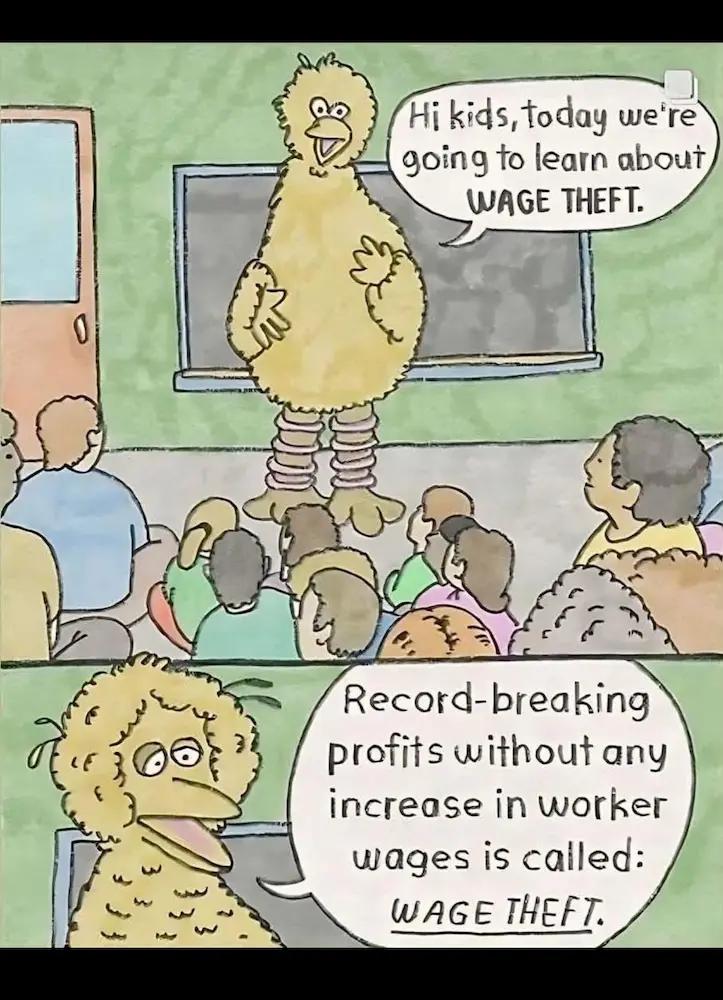 Record-breaking profits without an increase in wages is called WAGE THEFT
“Hi kids, today we’re going to learn about WAGE THEFT.
“Record-breaking profits without any increase in worker wages is called: WAGE THEFT.”
Economy & Finance
Rough Notes, Feb 22, 2026: Agents, Clawdbot Collapse, Microsoft as Exxon, etc. by Paul Kedrosky
This chart is from the “etc.” part of the free section of this paid newsletter.
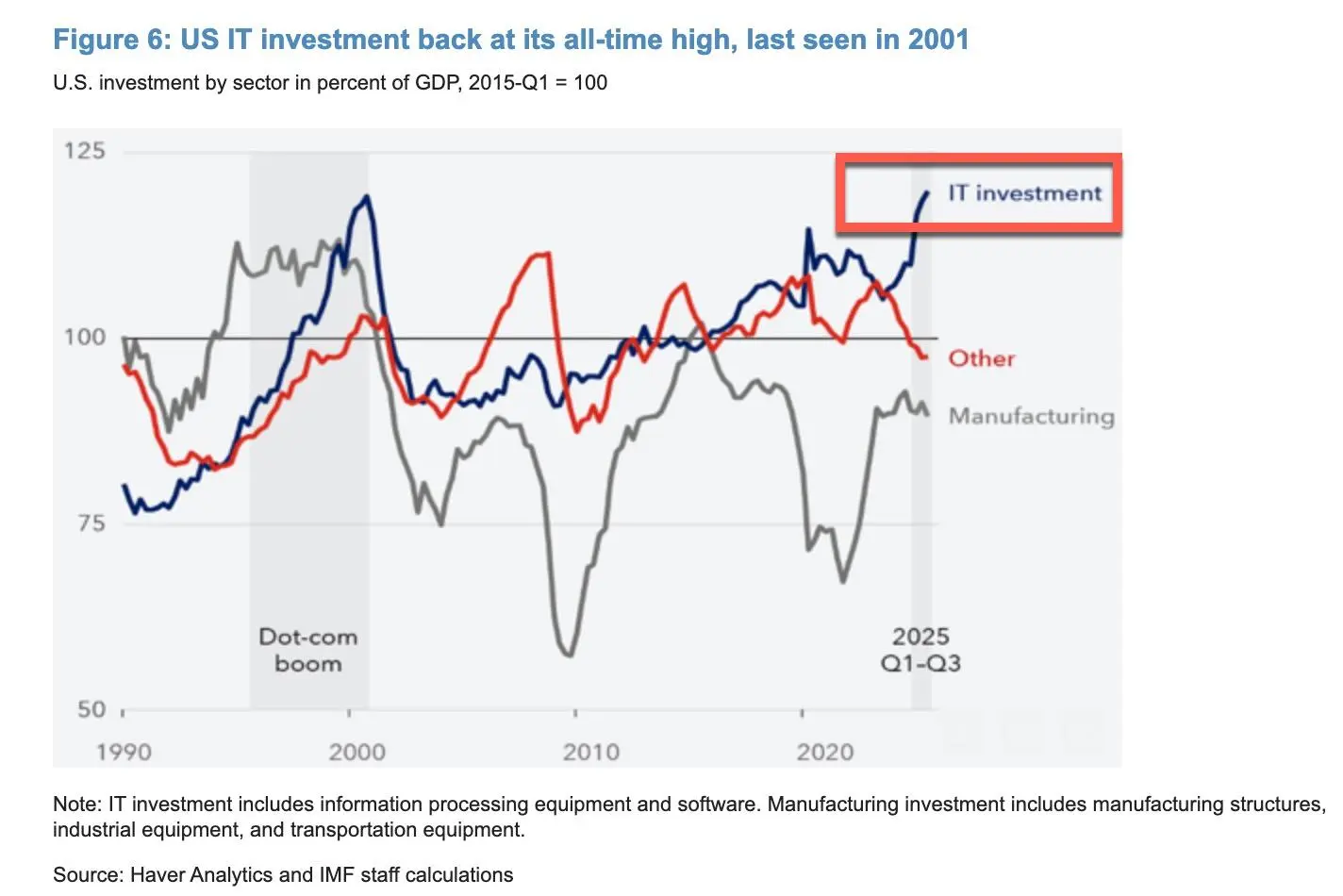 US IT Investment back at its all-time high, last seen in 2001
I tell people all the time that AI/tech investment is sucking all of the air out of the room for the rest of the economy. This chart illustrates that quite well. The little blue line going steeply up tech investment. The one plummeting almost as quickly is “Other” investment. Manufacturing is largely unchanged.
Elon Musk Brings 4th Quarter GDP Growth to a Crawl by Dean Baker (CounterPunch)
“Consumption grew at a healthy 2.4% annual rate in the quarter, but 44.8% of that growth was due to increased spending on healthcare services. Healthcare spending continues to be a main factor driving growth. Nominal spending on healthcare services rose even more rapidly, growing at an 8.9% annual rate. From the standpoint of affordability, nominal spending on healthcare is arguably the major concern, and it is hugely outpacing income growth.
“Most other categories of consumption were weak in the quarter. Consumption of housing grew at just a 1.1% annual rate. Consumption of durable goods fell at a 0.9% annual rate, driven by a sharp fall in car buying, and non-durable consumption grew at a 0.4% annual rate.”
“The notion of stretched consumers is consistent with the index of spending at fast-food restaurants. After rising rapidly in 2022 and into 2023, real spending in fast-food restaurants has been essentially flat since the fall of 2023.
“I have argued that this can be a useful gauge of the consumption of non-wealthy households. While increased consumption in most areas may be driven by higher income people spending based on stock gains, it is unlikely that stock gains would significantly impact their spending at fast-food restaurants. High-income people do eat at McDonalds or KFC, but it is unlikely that they would increase their consumption at these restaurants because the value of their stocks has risen. Insofar as that story is accurate, it doesn’t look like most people are doing very well.”
The Grand Illusion: The US – Europe Growth Gap by Dean Baker (CounterPunch)
“There are periodic efforts by the University of Groningen’s Growth and Development Center(GDC) to systematically measure each country’s GDP using a common set of prices, where each television set, smartphone, haircut, and knee surgery is counted at the same price regardless of which country it is produced in. The GDC is recognized as being at the cutting edge in these sorts of apples-to-apples measures of GDP.
“These measures tell a different story. According to these measures, there has been little change in the ratio of Europe’s productivity to productivity in the US GDP over the last three decades. This suggests that most, if not all, of the reported gap in growth between the United States and Europe is due to measurement issues, not a more rapid growth rate.
“In short, it seems the secret to the superiority of the US economic performance isn’t the entrepreneurial genius of Elon Musk or Mark Zuckerberg, but the bureaucrats making quality adjustments at the Bureau of Labor Statistics. Maybe they should get a raise.
“People should read Seth’s paper to get the more complete picture.”
On NVIDIA and Analyslop by Ed Zitron (Where's Your Ed At?)
“NVIDIA’s entire future is built on the idea that hyperscalers will buy GPUs at increasingly-higher prices and at increasingly-higher rates every single year. It is completely reliant on maybe four or five companies being willing to shove tens of billions of dollars a quarter directly into Jensen Huang’s wallet. If anything changes here — such as difficulty acquiring debt or investor pressure cutting capex — NVIDIA is in real trouble, as it’s made over $95 billion in commitments to build out for the AI bubble.”
“There is no rational basis for anything about this sell-off other than that our financial media and markets do not appear to understand the very basic things about the stuff they invest in. Software may seem complex, but (especially in these cases) it’s really quite simple: investors are conflating “an AI model can spit out code” with “an AI model can create the entire experience of what we know as ‘software,’ or is close enough that we have to start freaking out.”
“This is thanks to the intentionally-deceptive marketing pedalled by Anthropic and validated by the media. In a piece from September 2025, Bloomberg reported that Claude Sonnet 4.5 could “code on its own for up to 30 hours straight,” a statement directly from Anthropic repeated by other outlets that added that it did so “on complex, multi-step tasks,” none of which were explained. The Verge, however, added that apparently Anthropic “coded a chat app akin to Slack or Teams,” and no, you can’t see it, or know anything about how much it costs or its functionality. Does it run? Is it useful? Does it work in any way? What does it look like? We have absolutely no proof this happened other than Anthropic saying it, but because the media repeated it it’s now a fact.”
“[…] even if we believe the idea that Spotify’s best engineers are not writing any code, I have to ask: to what end? Is Spotify shipping more software? Is the software better? Are there more features? Are there less bugs? What are the engineers doing with the time they’re saving?”
“I also think we need to really think deeply about how, for the second time in a month, the markets and the media have had a miniature shitfit based on blogs that tell lies using fan fiction. As I covered in my annotations of Matt Shumer’s “Something Big Is Happening,” the people that are meant to tell the general public what’s happening in the world appear to be falling for ghost stories that confirm their biases or investment strategies, even if said stories are full of half-truths and outright lies.
“I am despairing a little. When I see Matt Shumer on CNN or hear from the head of a PE firm about Citrini Research, I begin to wonder whether everybody got where they were not through any actual work but by making the right noises.
“This is the grifter economy, and the people that should be stopping them are asleep at the wheel.”
Cookie Clicker Capitalism (Reddit)
 Cookie clicker is a depiction of capitalism; the critique emerges naturally
Cookie Clicker (Urban Dictionary)
“A game that consists of a cookie that must be clicked repeatedly to make more cookies. It gives you the illusion that you are making cookies, but you are really not. Tumblr seems to be obsessed with it (around August 2013)”
This time is different by Terence Eden
“3D TV, AMP, Augmented Reality, Beanie Babies, Blockchain, Cartoon Avatars, Curved TVs, Frogans, Hoverboards, iBeacons, Jetpacks, Metaverse, NFTs, Physical Web, Quantum Computing, Quibi, Small and Safe Nuclear Reactors, Smart Glasses, Stadia, WiMAX.
“The problem is, the same dudes (and it was nearly always dudes) who were pumped for all of that bollocks now won’t stop wanging on about Artificial Fucking Intelligence.”
“No enemies had ever taken Ankh-Morpork. Well technically they had, quite often; the city welcomed free-spending barbarian invaders, but somehow the puzzled raiders found, after a few days, that they didn’t own their horses any more, and within a couple of months they were just another minority group with its own graffiti and food shops.”
—Terry Pratchett (Eric)
Science & Nature
Is Time Real? The Physics Behind the Illusion of Time by Quanta Magazine (YouTube)
“The hypotheses put primary importance on the comprehensible input (CI) that language learners are exposed to. Understanding spoken and written language input is seen as the only mechanism that results in the increase of underlying linguistic competence, and language output is not seen as having any effect on learners’ ability. Furthermore, Krashen claimed that linguistic competence is only advanced when language is subconsciously acquired, and that conscious learning cannot be used as a source of spontaneous language production. Finally, learning is seen to be heavily dependent on the mood of the learner, with learning being impaired if the learner is under stress or does not want to learn the language.”
Environment & Climate Change
Study shows how rocket launches pollute the atmosphere by Bob Berwyn (Ars Technica)
“New research published Thursday bolsters growing concerns that a handful of companies and countries are using the global atmospheric commons as a dumping ground for potentially toxic and climate-altering industrial waste byproducts from loosely regulated commercial space flights.”
“The study shows that instruments can detect rocket pollution “in the ‘Ignorosphere’ (upper atmosphere near space),” he wrote. “There is hope that we can get ahead of the problem and that we don’t run blind into a new era of emissions from space.””
Yes, we are very good at doing that thing. It is lucky that we are not deeply ensconced in a system that values the personal profit of a handful over the needs of the many, else we might suffer the detrimental environmental effects of the unrestricted exploitation of space for short-term profit by those who already have most of the wealth.
“SpaceX did not immediately respond to questions or requests for comment from Inside Climate News.”
Yeah, I’m not surprised. They’re not paid to care about shit like this. Nor would they ever be fined for it. SpaceX and it’s trillionaire idiot owner will just get to trash that commons until it’s too late to save it with a few minor regulations.
“International agreements covering rocket pollution include the Outer Space Treaty and Liability Convention. They require countries to avoid harmful contamination and to accept responsibility for damage caused by their space objects. Those principles are reflected by several International Court of Justice rulings and opinions on preventing cross-border environmental harm. Debris and atmospheric pollution from space launches disperses globally, affecting many nations that do not launch rockets at all.”
I’m sure the fines are prodigious.
What did you say? Compliance is voluntary and there is no regulation or fine structure? I’m shocked.
“Some projections suggest as many as 60,000 satellites could be in orbit by 2040, with reentries every one to two days, injecting up to 10,000 metric tons of aluminum oxide particles into the upper atmosphere each year.
“The study found that those aerosols could warm parts of the upper atmosphere by about 1.5 degrees Celsius within one or two years of reaching that number of satellites. That could alter winds and ozone chemistry, and persist for years, indicating a rapidly growing human-made source of pollution at the highest levels of the atmosphere.”
There is no mechanism in any part of human society that will stop this from happening. Only the Chinese seem to be able to put any brakes on anything. It’s unclear whether they would prioritize this. I think India has also occasionally found a truffle.
“The expanding commercial use of what appears to be a free resource is actually shifting its real costs onto others, the article noted.”
No shit. That would be the first sentence in the extractive capitalism charter. It’s like the first capitalist commandment.
“There may not be time to wait for more scientific certainty, Schulz said: “In 10 years, it might be too late to do anything about it.””
Hey, look! The second capitalist commandment.
Medicine & Disease
From wellness grifter to surgeon general: Trump nominates anti-science quack Casey Means by Evan Blake (WSWS)
“The pattern of evasion was relentless. Asked whether she would encourage parents to vaccinate their children against measles amid an active outbreak with children dying, Means would say only: “I do believe that each patient, mother, parent needs to have a conversation with their pediatrician.” The formulation transparently expresses general “support” for vaccines while refusing to recommend any specific vaccine to any specific person.”
“Born in 1987 to a politically connected Washington family, Means graduated from Stanford Medical School and began a surgical residency at Oregon Health and Science University before quitting. She has since built a career as a wellness influencer, with 845,000 Instagram followers, co-founding a health app called Levels and holding equity in Truemed, a company owned by her brother Calley Means, a senior adviser at HHS on food and nutrition policy.
“According to a Public Citizen report filed with the Federal Trade Commission (FTC) on February 4, Casey Means failed to disclose financial relationships in 79 out of 140 instances (56 percent) of promoting affiliated products on social media, an obvious conflict of interest violation.”
Art, Literature, Music, & Cinema
Ingmar Bergman − The Master of Cinematic Emotion (YouTube)
“ I will try to to do as much as I can. I try to be as as good as
possible and I will try to to put my limits aside, and I will try to be a
human being on the dirty earth under an empty heaven.”
“Time and space do not exist, only a flimsy framework of reality. The imagination spins, weaving new patterns. ”
When you hear a song you don’t immediately like, you might feel exasperated, like you’re wasting time with something when you could be listening to something that you already know makes you feel good. This is even worse when the song is longer, or has an unfamiliar structure.
As you get older, this feeling tends to increase, I think, as you already know thousands of songs that you like, and you really start to wonder why you’re not spending your precious listening time listening to one of those.
Technology has more than met us halfway here, as you can control your intake precisely, if you so choose. A lot of people are listening to Spotify streams, peppered with ads, for some damned reason, but others are just listening to the same few albums.
As we were growing up, we listened to the radio a lot, where you had no control over anything. It was like Spotify, but not even customized for you. It was a communal sound. Everyone heard the same thing.
You could buy records but you couldn’t record anything of your own.
As we grew, we gained the ability to record with cassettes. We made mix tapes. We could listen to what we wanted when we wanted, to a certain degree.
Then came CDs and, for a while, we were back in the world of records. We couldn’t record to CDs, but we could record from CD onto tape, though the quality suffered a bit. It was its own sound, though, one that I still sometimes prefer.
With time, we gained the ability to “rip CDs” and were able to, once again, curate our own listening experiences.
How do you find new, good music without listening to stuff that has the potential to annoy you? The feeds like Spotify won’t challenge you. Neither will your own CD collection.
You’ve got to branch out, get into some curated feeds from people you trust. Listen to radio stations with taste.
Yesterday Luke asked me to have lunch with him, which I almost never eat upstairs because I prefer the lake but the weather was not great and I haven’t chatted with him in a while and kind of missed him so we had lunch and were joined by Jack and this new embedded SW engineer Karoły so, once they sat down and Karl’s German not being so solid yet and his Swiss German being nonexistent and with Jack smiling to himself as he eavesdropped on our conversation, we switched to English and I’m just tearing through conversational topics that I consider to be 100% normal, like what do we really know about the whole Epstein boondoggle versus what do we think we know or what have we just assumed from sources whose provenance is not only questionable but is outright invalidated by pretty much everything else they’ve reported on but hey, we’re here to cherry-pick and perform our virtue about being against pedophiles I guess but why do we have to care about people being pedophiles when those same people are in charge of mass murder around the world and are running several starvation campaigns, like, right now, so it’s a bit weird that we’re obsessed about also proving that they might have slept with some underaged girls two decades ago (or whatever) when we have them not only dead to rights about crimes of global proportion but they’re kinda bragging about it all the time, and like starting a war in Iran right now (or pretty soon anyway) and we were walking back downstairs and Carl asks “are lunch conversations always this intense?” and Jack and Luke both said “only when Marco’s around” and I had to smile because I find smalltalk to be a waste of time.
Philosophy, Sociology, & Culture
Cozy Girl Lifestyle is a Rational Response to a Winner-Take-All Culture by Freddie deBoer (Substack)
“[…] we live in an era in which the range of lives publicly regarded as worthy of living has contracted almost to nothing. Our culture confers esteem on a vanishingly small number of roles, and those roles are largely defined by being visible − that is to say, by attracting public attention, of which there is a necessarily finite supply. Success, as it is marketed to young people, means being a pop star on the order of a Sabrina Carpenter, a director with the cultural cachet of a Greta Gerwig, or at minimum a micro-celebrity “creator” whose daily routines are packaged for the algorithm. A contented life requires building a brand, cultivating a following, being legible to the feed. Everything else − teacher! paralegal! office manager! dental hygienist! retail supervisor! random white collar office email job that’s basically fine! − is flattened into an undifferentiated gray. These are necessary roles, some of them pay well, but they certainly aren’t glamorous ones, and young Americans seem increasingly convinced that a life that doesn’t inspire envy among others − when broadcast online, naturally − isn’t one worth living.”
“For Gen Z, this has all combined with a frankly pathological embrace of high-risk, high-variance speculation into something I find very scary; it’s a generation that seems to view all ordinary jobs as sucker deals for “NPCs,” pushing them towards more and more risky efforts to make money and escape the life of drudgery they mostly haven’t lived but have been taught to disdain. “Gen Z” is the empty, meaningless signifier that we’ve chosen for them, but it would be more apt to call them Generation Roulette Wheel. They never stop looking for a get-rich-quick hustle. Cryptocurrency manias rise and fall with the chaos of a fever dream; meme stocks explode and crater in a matter of days; sports gambling apps turn every game into a financial instrument, every friendship into a wagering pool. When your ambient culture tells you that the only meaningful victories are stratospheric and rare, it makes a certain perverse sense to chase stratospheric and rare outcomes. If stability isn’t honored, what’s left other than volatility?”
And the already-rich and well-positioned lick their lips at volatility. They know that they are best-positioned to ride its risky waves.
“The genius of the cozy aesthetic is that it identifies sources of pleasure that are widely accessible and modest and treats them as inherently worthy of serious cultivation: a soft sweater, a well-made cup of tea, a public library card, a crockpot recipe that reliably produces something warm and nourishing, a Saturday morning with nowhere to be. You may find any one or all of these more or less attractive based on your own preferences, but whatever they are, they’re not signifiers of elite achievement, they’re all available in low-cost forms, and they’re all reliable and attainable. They’re not blue-check credentials, they don’t require venture capital or viral reach, and you don’t need to chew your fingernails waiting for the wheel to spin to see if you’ve won them. These simple pleasures are, instead, elements of an ordinary life lived with intention.”
“What she does, instead, is lower the bar for a life that feels good to live, and in so doing, she makes happiness less hostage to the approval of strangers. In a digital world defined by our constant communicative proximity to each other, the sense of performing for others has become reflexive, constant. A lot of younger adults seem genuinely not to understand what it means to do something just to do it, rather than to be seen doing it. The fact that a cozy girl’s pleasures are not subject to the external review of her peers thus matters more than her critics are willing to admit.”
“You can imagine the terminology: white, sanitized, protofascist. I would simply say that this is an example of theory slop that has no point and no potential for victory; no one is going to stop liking looseleaf tea and a cat curled up on their lap because some take-slinging thinkpiece wrangler says they should.”
“if we have to live in a world where most people are going to spend an inordinate amount of time looking at things they want on Instagram, I think it’s much healthier to look at cats, sweaters, and used books than at unobtainably attractive women, unfeasibly expensive cars, totally impractical vacations, or entirely unachievable lives.”
“Capitalism has an uncanny ability to commodify even our attempts to opt out. But this is not a unique indictment of coziness; it’s a feature of the system in which we are all entangled. And unlike expensive car culture or celebrity culture or extravagant travel culture, there are inexpensive versions of almost everything that cozy girl life has to offer, as well as a lot of cozy girl influencers who specialize in bringing an affordable version to the masses. You could do a lot worse.”
“In a culture that demands constant performance and a society that honors only the extraordinary, choosing to be cozy isn’t giving up. The cozy girl opts out of a rigged hierarchy and builds, quietly or not, a life that does not require applause to be worth living.”
Why do trans women struggle so much in the hiring process? by Iris Meredith (deadSimpleTech)
“[…] the unconscious or semi-conscious bias that a hiring manager holds against trans women is more akin to the kind that a person with a criminal conviction on their record faces than it is to capability-model bigotry: we’re seen, not as incapable, but as being dangerous, deceptive or a liability, simply by the fact of who we are.”
“[…] it’s a monumental waste of potential: some of the finest minds of this generation are stuck writing open-source Rust tools because nobody’s willing to employ them, and while the tools are very useful, I think we’d all benefit from having them work on larger and more ambitious projects in some of the many fields that we badly need to work on. One way or another, we need to fix this shit.”
What we think is a decline in literacy is a design problem by Carlo Iacono (Aeon)
“Amy Orben, a psychologist studying technology panics, identifies the ‘Sisyphean cycle’: each generation fears new media will corrupt youth; politicians exploit these fears while deflecting from systemic issues like inequality and educational underfunding; research begins too late; and by the time evidence accumulates showing mixed effects dependent on context, a new technology emerges and the cycle restarts.”
“What demonstrates that these panics were exaggerated? The predicted disasters never arrive. Adolescent aggression continued after comic book restrictions – because comics weren’t the cause. Novels didn’t trigger mass elopements. Radio didn’t destroy children’s capacity for thought. Each panic uses identical rhetoric: addiction metaphors, moral corruption, passive victimhood, apocalyptic predictions. Each time, the research eventually shows complex effects mediated by content, context and individual differences. And, each time, when the disaster fails to materialise, attention simply shifts to the next technology.”
“Others are drowning, attempting sustained thought in environments engineered to prevent it. They sit with laptops open, seven tabs competing for attention, notifications sliding in from three different apps, phones vibrating every few minutes. They’re trying to read serious material while fighting a losing battle against behavioural psychology weaponised at scale. They believe their inability to focus is a personal failure rather than a design problem. They don’t realise they’re trying to think in a space optimised to prevent thinking.”
“Consider those who flourish with audiobooks but struggle with printed text. For years, educators told them they had learning disabilities, by which they meant: disabilities that prevented learning through the one true method we recognise. But they don’t have learning disabilities. The instruction has a disability – it can’t accommodate different neurological architectures. Give them the same text as audio, and suddenly the ‘disability’ vanishes. The ideas that were opaque on the page become transparent in sound. Not because audio is superior to text, but because particular neurologies process spoken language more fluently than written symbols.”
“Recording studios where oral traditions find new life, where explaining ideas aloud to an imagined audience requires different cognitive work than writing an essay, often producing more sophisticated analysis.”
I would leave away the last clause. The analysis may be more sophisticated than what those same people would have been able to produce in text form, but it’s probably not more sophisticated than what someone who’s good at the text form could produce. The audio format tends to remain unedited and thus mixes several draft versions together. This can be illuminating—some essayists leave in multiple formulations of the same idea to the same effect, as, for example, this very essay has done, nearly to the point of redundancy—but it can also be distracting and long-winded.
“These aren’t concessions to declining attention spans. They’re recognitions that human understanding has always been richer than any single medium could contain. We’re not abandoning literacy. We’re discovering what literacy meant all along: not just the ability to decode symbols on a page, but the capacity to move fluently between all the ways humans encode meaning.”
“They struggle with philosophy textbooks but thrive when they can listen to lectures while taking visual notes, discuss ideas in study groups, and write while pacing. This isn’t deficit. It’s difference. And our responsibility is to build environments where that difference becomes an asset rather than an obstacle.”
We have to be so careful to determine that they are equivalent. And certain modes are more vulnerable to commercialization. Regressing to the mean (if that’s the right phrase). But I’m all for experimenting honestly, against meaningful measures.
“We built a world that profits from distraction and then pathologise the distracted.”
We didn’t build that world. We exchanged that world to a bunch of sociopaths for a few baubles.
“Immanuel Kant didn’t need bound paper specifically to write the Critique of Pure Reason (1781); he needed a medium that allowed him to externalise thought, revise it, and develop it over time. Digital documents do this as effectively as paper. The problem is that most digital engagement isn’t writing-based. It’s consumption of algorithmically curated feeds optimised by sophisticated behavioural engineering to maximise time-on-platform.”
“Reading worked so well for so long not because text is magic, but because books came with built-in boundaries. They end. Pages stay still. Libraries provide quiet. These weren’t features of literacy itself but of the habitats where literacy lived. We need to rebuild those habitats for a world where meaning travels through many channels at once.
“[…] The library of the future isn’t a warehouse for books. It’s a gymnasium for attention. It’s where communities go to practise different modes of understanding.”
Reading worked well because it’s relatively compact, it’s static. In the digital age, it can be easily searched and analyzed. It can be cited. It’s easier to scan than other media, even those that purport to replace or enhance it.
“A well-crafted video essay can carry philosophical weight. A podcast can enable the kind of long-form thinking we associate with written essays. An interactive visualisation can reveal patterns that pages of description struggle to achieve.”
“We can drift into a world where sustained thought becomes a luxury good, where only the privileged have access to the conditions that enable deep thinking. Or we can build something unprecedented: a culture that preserves the best of print’s cognitive gifts while embracing the possibilities of a world where ideas travel through light, sound and interaction.
“The choice isn’t between books and screens. The choice is between intentional design and profitable chaos. Between habitats that cultivate human potential and platforms that extract human attention.”
British Museum caves in to Zionist lobby group, removes “Palestine” from Ancient Middle East displays (WSWS)
“The historian, author, and podcaster William Dalrymple called the British Museum’s decision to change its labelling “ridiculous”, arguing that the first reference to Palestine could be traced to 1186 BCE on the Egyptian monument of Medinet Habu. This was well before the biblical Saul established the Kingdom of Israel in 1047 BCE, which split into two—Israel and Judah—after Solomon’s death in 930 BCE. These small biblical kingdoms were but two of several short-lived polities in the region that was dominated by the Assyrian and Egyptian empires at that time.”
men holding fish 🐟: a case study of hyperreality by Meditations for the anxious mind (YouTube)
“When all futures have faded away, all that’s left for us is compulsive pleasure-seeking in the absence of social transformation. So, we hit the dopamine button until it drowns us, until the only difference between you and the animal is you’re gutted as you’re the one who can’t breathe when the water rises. You’re now tuned into the spectacle, where there’s nothing left to believe in, but still plenty more to post.”
Technology & Engineering
Please, please, please stop using passkeys for encrypting user data by Tim Cappalli
Always use a password that you can store yourself to encrypt backups. If you use a passkey, you have encrypted your data using a file that you absolutely must keep. There are good reasons why you might lose it. Don’t use passkeys for anything but authentication.
Google quantum-proofs HTTPS by squeezing 2.5kB of data into 64-byte space by Dan Goodin (Ars Technica)
“To bypass the bottleneck, companies are turning to Merkle Trees, a data structure that uses cryptographic hashes and other math to verify the contents of large amounts of information using a small fraction of material used in more traditional verification processes in public key infrastructure.
“Merkle Tree Certificates, “replace the heavy, serialized chain of signatures found in traditional PKI with compact Merkle Tree proofs,” members of Google’s Chrome Secure Web and Networking Team wrote Friday. “In this model, a Certification Authority (CA) signs a single ‘Tree Head’ representing potentially millions of certificates, and the ‘certificate’ sent to the browser is merely a lightweight proof of inclusion in that tree.””
“The MTCs use Merkle Trees to provide quantum-resistant assurances that a certificate has been published without having to add most of the lengthy keys and hashes. Using other techniques to reduce the data sizes, the MTCs will be roughly the same 64-byte length they are now, Westerbaan said.”
LLMs & AI
#chatgpt thinks you should throw away all your upside down cups by FatherPhi (YouTube)
This is wonderful. Given that this is real: The technology is amazing but it’s not going to be doing any engineering for us. God help us if they start using it for emergency services.
These things always remind me of playing video games. It’s a sophisticated video game.
Someone named “WhereIsRichardParker” replied, ostensibly from Telerik. The other commentators quickly came to the conclusion that it was an AI-generated response, and possibly a bot. I thought it was a nicely formatted response but did wonder “why would Telerik be so forthcoming with an outdated technology?”

It turns out, though, that the “bot” could convince the commentators that there was a real person behind it.


“a watched nut never busts. or something. i dont fucking know what you people find funny anymore. 9/11.
“why is this the one”
Underneath this post, there was also bot-accusations:
 AI suspicion is everywhere now
I’m listening to a presentation for a tool that is supposed to generate requirements for features in a project-management system. It of course uses LLMs to generate the text. You provide the context. Part of the context will be your own documents but part of it will also be some boilerplate instructions for how to produce the output. What strikes me is how hopeful these instructions are.
That is, you write in plain text what you would like to see, like “be concise but don’t lose any information; use short bullet points” and we just hope that it will be respected, no matter how unlikely it is that the context will be respected. You can gauge whether there are long bullet points and shorten them if it messes up, but how do you figure out whether it has lost information? How do you measure “concise”?
We just kind of all assume that it works as it looks like it will, and then round up. That is, we tend to completely forget when it doesn’t stick to the ground rules we’ve elucidated and completely forget to question whether the other instructions are being followed.
Azure Boards integration with GitHub Copilot − Azure DevOps Blog
tl;dr: Why is it not available? Because it only works with repositories in GitHub.
“The goal was simple: allow teams to take a work item from Azure Boards and send it directly to GitHub Copilot so the coding agent could begin working on it, track progress, and generate a pull request.
We are happy to announce that this integration is now being rolled out as generally available 🎉.”
It looks like we’re going to have to continue doing our own work, I guess.
“We are also working on two enhancements that will be delivered after the initial general availability rollout. First, while the integration currently uses the default coding agent and model, organizations with custom agents will soon be able to select which agent is used when creating a draft pull request with Copilot. You will also be able to choose the model.”
According to the release notes from February 11, the feature to be able to select custom agents has now been implemented.
This is, as noted, theoretical for us at Uster, because our repositories are stored in ADOS not GitHub. It is unclear whether Microsoft plans to roll out support for repositories stored in ADOS.
It’s also unclear whether we’re ready to try something like this because it’s basically vibe-coding, with a review at the end, after all of the work has been done. That is absolutely not the level of granularity that anyone sane is recommending for anything other than the most trivial work.
If you have a boilerplate features to implement (new action in a controller, new controller that looks a dozen others, etc.) then it’s possible that this might be useful.
However, in order for this to be at-all useful, you need:
- Precise, accurate, clear, and extensively documented requirements.
- At work, we are currently evaluating a tool called Copilot4DevOps, which looks like it might be useful for generating the kind of requirements that would not only be useful for human developers but might have the level of detail required to constrain an LLM coding agent into delivering something useful.
- Test coverage.
I know that people will be thinking: doesn’t it generate the tests for you? To which I roll my eyes so hard that I injure myself. Most sane observers of this LLM-coding-agent era that we are forced to live through are saying that it is only with tests that you can harness LLM agents in any reasonable way. If you think about it, how does an agent know when it’s done? When all the tests pass. Where do the tests come from? They should be based on the requirements.
At the very least, the tests should be verified by a human developer before proceeding to the solution. At best, a human developer writes the tests—perhaps assisted by an LLM coding agent—in a tighter feedback loop. Again, we need people to verify the code, and people are better at verifying snippets of code rather than 50 tests in 1000 lines.
The danger, as always, is complacency and laziness. These tools offer a panacea and they offer superficially correct solutions. This is what the literature has shown again and again and again. Those who claim that everything is perfect and that you could just click a button in a work item to go from specification to implementation in 30 minutes are selling you something. Be sure of what you’re getting. So far, I have seen no evidence that it works exactly as advertised.
We can extract value from these tools, hopefully improve efficiency, allowing us to focus on more interesting work, but you need a proper process laid over it but that involves thought and discipline.
- It is faster than your feet depending on the terrain
- It is way slower and less reliable than a train but can go more places
- You cannot simply tell it to go to the store for you
- You have to tell it where to turn even if it might guess right sometimes
- You have to keep it on the road even if it usually stays on the road
- You can only lead it to water, you cannot make it drink
OpenAI raises $110B on $730B pre-money valuation (Hacker News)
“IMO this looks largely like another circular investment. Amazon’s investment is tied to OpenAI using AWS for their Frontier product and I assume Nvidia’s conditions are that OpenAI continue buying hardware from them. Then there’s SoftBank though given that those are the same guys that invested heavily in WeWork, I assume this is just very brash bullishness on their part.
From my perspective, I hope that OpenAI survives and can pull of their IPO but I just have that nagging feeling in my gut that their IPO will be rejected in much the same way that the WeWork IPO was rejected.“On the one hand you can look at these companies investing and take it as a signal that there is something there (in OpenAI) that’s worth investing in. On the other hand all these companies that are investing are basically getting that investment back through spending commitments and such and are just using OpenAI as a proxy for what is essentially buying more revenue for themselves.
“When their IPO hits later this year I hope that it’s the former case and there’s actually some good underlying fundamentals to invest in. But based on everything I’ve read, my gut is telling me they will eventually implode under the weight of their business model and spending commitments.”
Another user linked the article How will OpenAI compete? by Benedict Evans, which lays out a much more detailed case for “there’s no there there” in the case of OpenAI.
“OpenAI does still at least arguably set the agenda for new models, and it has a lot of great technology and a lot of clever and ambitious people. But unlike Google in the 2000s or Apple in the 2010s, those people don’t have a thing that really really works already that no-one else can do. I think that one way you could see OpenAI’s activity in the last 12 months is that Sam Altman is deeply aware of this, and is trying above all to trade his paper for more durable strategic positions before the music stops.”
“This engagement is a clearly a ‘glass half full or half empty?’ question, but this is supposed to be a transformation in how you use computers. If people are only using this a couple of times a week at most, and can’t think of anything to do with it on the average day, it hasn’t changed their life. OpenAI itself admits the problem, talking about a ‘capability gap’ between what the models can do and what people do with them, which seems to me like a way to avoid saying that you don’t have clear product-market fit.”
“[…] it’s not self-evident that if someone can’t think of anything to do with ChatGPT today or this week, that will change if you give them a better model. It might, but it’s at least equally likely that they’re stuck on the blank screen problem, or that the chatbot itself just isn’t the right product and experience for their use-cases no matter how good the model is.”
“[…] if you invent a brilliant new app or product or service using generative AI, or add it as a feature to an existing product, you use the APIs to call a foundation model running in the cloud and the users don’t know or care what model you used. No-one using Snap cares if it runs on AWS or GCP. When you buy an enterprise SaaS product you don’t care if it uses AWS or Azure. And if I do a Google Search and the first match is a product that’s running on Google Cloud, I would never know.
“That doesn’t mean these APIs are interchangeable − there are good reasons why AWS, GCP and Azure have very different market shares, and why developers choose each. But the customer doesn’t know or care. Running a cloud doesn’t give you leverage over third part products and services that are further up the stack.”
“Foundation models are certainly multipliers: massive amounts of new stuff will be built with them. But do you have a reason why everyone has to use your thing, even though your competitors have built the same thing? And are there reasons why your thing will always be better than the competition no matter how much money and effort they throw at it? That’s how the entire consumer tech industry has worked for all of our lives. If not, then the only thing you have is execution, every single day. Executing better than everyone else is certainly an aspiration, and some companies have managed it over extended periods and even persuaded themselves that they’ve institutionalised this, but it’s not a strategy. ”
“[M]assive amounts of new stuff will be built with them.” This makes me so sad because it simply and stupidly feeds into the growth-at-all-costs axiom on which the world runs. It doesn’t matter what you make, just make stuff. Our stores are jam-packed with the stuff. It doesn’t matter whether it works, just get it out there. Use energy, use resources, it doesn’t matter. If you wet the right beaks, you will be heavily subsidized to keep the flywheel running with taxpayer money.
Speaking of taxpayer money, OpenAI published a statement that they will be doing what the U.S. government tells it to do as long as the contracts keep coming. (Twitter)
“[…] the DoW [Department of War] displayed a deep respect for safety and a desire to partner to achieve the best possible outcome.”
Department of War: Trump confirms in video message that military campaign in Iran has begun (CNN)
Trump blacklists Anthropic, orders all federal agencies to cease use of AI firm’s technology by Evan Blake (WSWS)
“Amodei wrote, “We have never raised objections to particular military operations nor attempted to limit use of our technology in an ad hoc manner.” Here Amodei confirmed that Anthropic raised no objection to the Pentagon’s military assault on Caracas in early January, an operation that killed between 83 and 100 people and led to the illegal seizure of Venezuelan president Nicolas Maduro, and which ostensibly triggered this crisis. Not only that, he has never objected to any other US military operation!
“The man being hailed as a champion of ethical AI effectively told the Pentagon: we support everything you have done; we merely request two technical carve-outs going forward.”
“Anthropic is a $380 billion AI company backed by $8 billion from Amazon—whose AWS built and operates the CIA’s primary cloud infrastructure—$3 billion from Google, and $15 billion from Microsoft and Nvidia combined. It celebrated its $200 million Pentagon contract in July 2025, and partnered with Palantir—whose entire business model is built on serving the US military and intelligence apparatus, from drone targeting to immigrant tracking for ICE—to deploy Claude on classified networks.”
“But both letters remain within the framework of appeals to corporate management and the state. Neither demands public ownership of AI, democratic control by workers, or the termination of military contracts as such. The critical question is whether these workers will develop an independent political perspective—opposing the capitalist state and its military apparatus as a whole—or remain a pressure group for one faction of capital against another.”
“The growing dangers of the use of AI by the military were underscored this week by a scientific study which placed Claude, ChatGPT, and Gemini in armed conflict simulations. AI models chose to deploy nuclear weapons in 95 percent of scenarios, while Claude recommended nuclear strikes in 64 percent of games.”
The Hater’s Guide to Private Equity by Ed Zitron (Where's Your Ed At?)
“[…] those dumping software stocks believe that AI will replace these businesses because people will be able to code their own software solutions. This is an intellectually bankrupt position, one that shows an alarming (and common) misunderstanding of very basic concepts. It is not just a matter of “enough prompts until it does this” — good (or even functional!) software engineering is technical, infrastructural, and philosophical, and the thing you are “automating” is not just the code that makes a thing run.”
“Software is a tremendous pain in the ass. You write code, then you have to make sure the code actually runs, and that code needs to run in some cases on specific hardware, and that hardware needs to be set up right, and some things are written in different languages, and those languages sometimes use more memory or less memory and if you give them the wrong amounts or forget to close the door in your code on something everything breaks, sometimes costing you money or introducing security vulnerabilities.
“In any case, even for experienced, well-versed software engineers, maintaining software that involves any kind of customer data requires significant investments in compliance, including things like SOC-2 audits if the customer itself ever has to interact with the system, as well as massive investments in security.
“And yet, the myth that LLMs are an existential threat to existing software companies has taken root in the market, sending the share prices of the legacy incumbents tumbling. A great example would be SAP, down 10% in the last month. ”
“Most software is like this. I’d say all software that people rely on is like this. I am begging with you, pleading with you to think about how much you trust the software that’s on every single thing you use, and what you do when a piece of software stops working, and how you feel about the company that does that. If your money or personal information touches it, they’ve had to go through all sorts of shit that doesn’t involve the code to bring you the software.”
“Any company of a reasonable size would likely be committing hundreds of thousands if not millions of dollars of legal and accounting fees to make sure it worked, engineers would have to be hired to maintain it, and you, as the sole customer of this massive ERP system, would have to build every single new feature and integration you want. Then you’d have to keep it running, this massive thing that involves, in many cases, tons of personally identifiable information.”
“And then we get to the fact that building stuff with Claude Code is not that straightforward. Every example you’ve read about somebody being amazed by it has built a toy app or website that’s very similar to many open source projects or website templates that Anthropic trained its training data on.
“[…] Claude Code does not actually build unique software. You can say “create me a CRM,” but whatever CRM it pops out will not magically jump onto Amazon Web Services, nor will it magically be efficient, or functional, or compliant, or secure, nor will it be differentiated at all from, I assume, the open source or publicly-available SaaS it was trained on. You really still need engineers, if not more of them than you had before.”
“Is your argument that you’d still have a team of engineers (so they know what the outputs mean), but they’d be working on replacing your SaaS subscription? You’re basically becoming a startup with none of the benefits.”
Nothing has changed about the approach, no matter how much the world yells that everything has changed since November 2025. That is, LLMs are
“[…] a great way to solve certain, tedious problems more quickly, and the responsible ones understand you have to read most of the output, which takes an appreciable fraction of the time it would take to write the code in many cases. Claude doesn’t write terrible code all the time, it’s actually good for many cases because many cases are boring. You just have to read all of it if you aren’t a fucking moron because it periodically makes company-ending decisions.”
—Nikhil Suresh
The people with all the money don’t understand the first thing about how the world actually works. They are privileged to be able to continue to benefit from a system that works despite their idiocy. That doesn’t mean we should actually listen to what they’re saying. They don’t have to care whether things continue working because, not knowing how anything works, they have no idea when something they’re doing threatens to break everything. We are a Golgafrinchan world and have been for decades. The world rolls on despite them—but there is no reason to believe that it will continue to do so forever.
Programming
Addressing Common Misconceptions about .NET in the InfoSec World by Washi
“What you should do is get familiar with CIL, the underlying bytecode the decompiled code was based on, and use the IL editor instead. Not only is it 100% reliable and prevents incorrect decompiler artifacts from sneaking in, you will also lay a good foundation for making tools that solely operate on this level of abstraction, which will be required for more complicated cases (e.g., deobfuscation). Also, stop being lazy; CIL is really not a hard language to learn. It’s a very basic stack machine; you don’t need to know about registers, calling conventions, stack memory, etc.”
I also learned about deobfuscation and decomplication tools like de4dot (GitHub) and obfuscation tools like ConfuserEx (GitHub).
“I have seen a lot of people in infosec that fall into this trap, particularly people that only know Python. For better or worse, the reverse engineering world primarily runs on Python, and as such, there are a good number of Python libraries that implement some form of .NET binary parsing (e.g., dnfile, dncil, dotnetfile…).
“With all due respect to the original authors, these Python libraries all are vastly inferior to what is actually available and used in .NET binary processing, and I put a lot of the blame on them for this misconception.”
“Tooling for .NET RE has matured so much that all major libraries that do have a more sane higher-level API (e.g., Mono.Cecil, dnlib or AsmResolver, shameless self-plug I know, sue me) have implemented this all for you correctly, and abstracted it away into a DOM-like representation, similar to how you’d see it in a decompiler.
“You want to find the method called
StringDecryptor.Decrypt(string)in a File.exe and iterate through its instructions? Don’t go to the metadata tables and 50 pages deep into specification documents. Just walk the DOM tree:”
- Open the assembly file.
- Find the
StringDecryptortype.- Find the
Decryptmethod with a single parameter of typeSystem.String.- Loop over all the method’s instructions.
“I have also come to notice AI has made people lazy.
“People don’t want to do research themselves anymore and settle for mediocre. Maybe it is me getting old, but it blows my mind that people’s first instinct for looking up something on the internet is having an AI chatbot hallucinate a summary on the keywords, rather than going to a search engine and considering the facts yourself. It gets worse, when the AI is inevitably wrong one day, people are completely clueless on what to do. I no joke have been asked multiple times:”
“To me, it shows a clear lack of understanding of the problem you are trying to solve, and frankly, if you are asking me this genuinely, you should maybe consider doing something else in life.”“Hey I have this binary and I cannot make sense of it. I tried [insert LLM name] but it didn’t work. Do you have recommendations for other LLMs that do work?”
Design
The Hidden Trick of Style Queries and if() by Temani Afif (CSS Tip)
“[…]here is what you need to remember:
“The use of
style(–variable: value)will perform an exact match of both computed values. This one is suitable for string-like matching (ex:style(–stock: low)).“
style(–variable = value)will perform a numerical comparison between two values that should have the same type (from the types I listed previously). This one is suitable for math stuff (ex:style(–n = 5))”
Sports
The Slovakian men’s hockey team lost 6–2 to the U.S.A. yesterday. I wrote the following to a friend from Slovakia.
The Empire is yet too strong. Still, a good effort to get two goals. That shows steel. When I stopped watching, at the end of the second period, it was 5-0 and I thought the bleeding had but begun.
It is an honorable thing to be able to fight for bronze. You have already defeated the Finns once. You can do it again.
Twould be the first medal for your modest land. My land is greedy and has 17 medals already. Our women will fight for the curling gold medal on Sunday.
“During a game between the visiting St. Louis Blues and Malarchuk’s Buffalo Sabres on March 22, 1989, Steve Tuttle of the Blues and Uwe Krupp of the Sabres crashed hard into the goal crease during play. As they collided, Tuttle’s skate blade hit the right front side of Malarchuk’s neck, severing his carotid artery and partially cutting his jugular vein.
“With blood gushing out of Malarchuk’s neck onto the ice, he was able to leave the ice on his own feet with the assistance of his team’s athletic trainer, Jim Pizzutelli. Many spectators were physically sickened by the sight. It was reported that the excessive amount of blood that Malarchuk lost caused eleven fans to faint, two more to have heart attacks, and three players to vomit on the ice. Local television cameras covering the game cut away from the sight of Malarchuk bleeding after noticing what had happened, and Sabres announcers Ted Darling and Mike Robitaille were audibly shaken. At the production room of the national cable sports highlight show, a producer scrolled his tape back to show the event to two other producers, who were both horrified by the sight.[8]
“Malarchuk, meanwhile, believed that he was going to die. “All I wanted to do was get off the ice”, said Malarchuk. “My mother was watching the game on TV, and I didn’t want her to see me die.” Aware that his mother had been watching the game on TV, he had an equipment manager call and tell her he loved her. Then he asked for a priest.
“Malarchuk’s life was saved due to quick action by the Sabres’ athletic trainer, Jim Pizzutelli, a former US Army combat medic who had served in the Vietnam War. He gripped Malarchuk’s neck and pinched off the blood vessels, not letting go until doctors arrived to begin stabilizing the wound. He led Malarchuk off the ice then applied extreme pressure by kneeling on his collarbone—a procedure designed to produce a low breathing rate and low metabolic state, which is preferable to exsanguination. Malarchuk was conscious and talking on the way to the hospital, and jokingly asked paramedics if they could bring him back in time for the third period. The game resumed when league personnel received word that Malarchuk was in stable condition.”
The 2026 Winter Olympics: Remarkable athleticism poisoned by nationalist chauvinism by Andy Thompson (WSWS)
“[…] the realization of a genuine Olympic spirit is at direct odds with a global political order characterized by capitalist economic competition teetering on the edge of world war. For this reason, the games are used to promote the most filthy forms of nationalism, pitting nations against one another as bitter rivals rather than competing as equals in sport. The degeneration of the games has reached the point where the International Olympic Committee is little more than a direct tool of imperialism.
“The most obvious example, and a recurring blight on the Olympics, is the continuing ban on Russian and Belarusian participation from international competitions. Despite being home to athletes capable of competing in nearly every event, men and women from these countries are barred entirely or forced to compete under “neutral” status. This anti-Russian campaign began with the politicized doping allegations following the 2014 Sochi Games and have expanded to ban Russia from essentially all international competitions since the invasion of Ukraine in 2022.
“Even to compete as a neutral athlete, Russian competitors have to state their political opposition to the Russian government, which can lead to major personal consequences. The IOC’s requirements specifically state that “Athletes who actively support the war [in Ukraine] cannot compete.”
“The position of the Olympic Committee is immensely hypocritical. While Russian athletes are treated as pariahs, Israel is permitted to compete with full national honors and state sponsorship, even as it continues its ethnic cleansing operations in Gaza. The difference is only that the reactionary Russian invasion is an obstacle to imperialist interests, while the genocide in Gaza advances them.”
A friend sent me a meme about the gold-medal Olympic men’s hockey match between the U.S.A. and Canada. I wrote back,
That hockey game went like so many hockey games go: the U.S. won against the overwhelming run of play. Canada put on a clinic and anyone watching would have been humbled by the awesome and relentless power of the hockey clinic that they put on for long, long minutes at a time, non-stop. I had to keep checking the corner of the screen to be sure that they didn’t have a power play. The U.S. got so lucky so many times. They played well enough, especially in the first ten minutes but, after that, it was Canada’s game to lose. And they lost on the scoreboard, but it wasn’t a victory for the U.S. to be bragging about. It was obvious who’s actually better at hockey.
He wrote back,
“I started saying in the 2nd period that either Canada’s constant zone time was going to wear down the US or the US was going to hold tough and win on a freak breakout”
I was in awe at Canada. Flat-out. That pressure was unreal. It was like watching the Devils with Brodeur playing against the relentless Redwings back in the 90s.
“Anyone playing Buffalo with Hasek in net”
Fun
You look at a color for five seconds, then you have to recreate the color you saw using the color-picker tools. It’s made more difficult in that the color picker is usually configured far, far away from the color you want. You also have to have some intuitive facility with where to find colors and how to adjust saturation, hue, and luminence.
 Color Game − 44.34
LOOP − Mejor Cortometraje de animación en los 37 Premios Goya by UniKo | Pablo Polledri (YouTube)
“En esta sociedad cada ser humano repite una misma acción una y otra vez, en esta sociedad cada ser humano repite una misma acción una y otra vez, en esta sociedad cada ser humano repite una misma acción una y otra vez, en esta sociedad cada ser humano repite una misma acción una y otra vez.”
HiPPO IN THE CITY by Whitest Kids U' Know (YouTube)
Confusing Japanese Glory Hole Has Too Many Bells And Whistles (The Onion)
““Okay, so the screen is telling me to select my ‘pleasure style,’ and the options are a picture of a tulip, a volcano, and a trumpet…is there not just a normal blow-job button?” a baffled and sexually frustrated Willis said before he hesitantly chose the tulip, which prompted a nozzle to spray his groin with a spermicidal mist as a uniformed digital attendant appeared on a screen and politely instructed him to “Please reveal genitals and commence stimulation.””